REVIEW 3 major objections 2 minor 42 references
A deep neural network learns to set optimal movable-antenna positions from partial power measurements alone.
Reviewed by Pith at T0; open to challenge. T0 means a machine referee read the full paper against a public rubric. the ladder, T0–T4 →
DNN-based optimization of movable antenna positions from partial CSI achieves near-optimal performance in single-user and outperforms conventional methods in multi-user scenarios.
T0 review reviewed 2026-06-26 challenge →
load-bearing objection The paper shows a DNN can optimize movable antenna positions using only partial channel power gains from a few locations, trained with supervised learning for one user and unsupervised sum-rate maximization for multiple users. the 3 major comments →
Deep Learning-Empowered Movable-Antenna Position Optimization with Partial CSI
The pith
A machine-rendered reading of the paper's core claim, the machinery that carries it, and where it could break.
The reading
Core claim
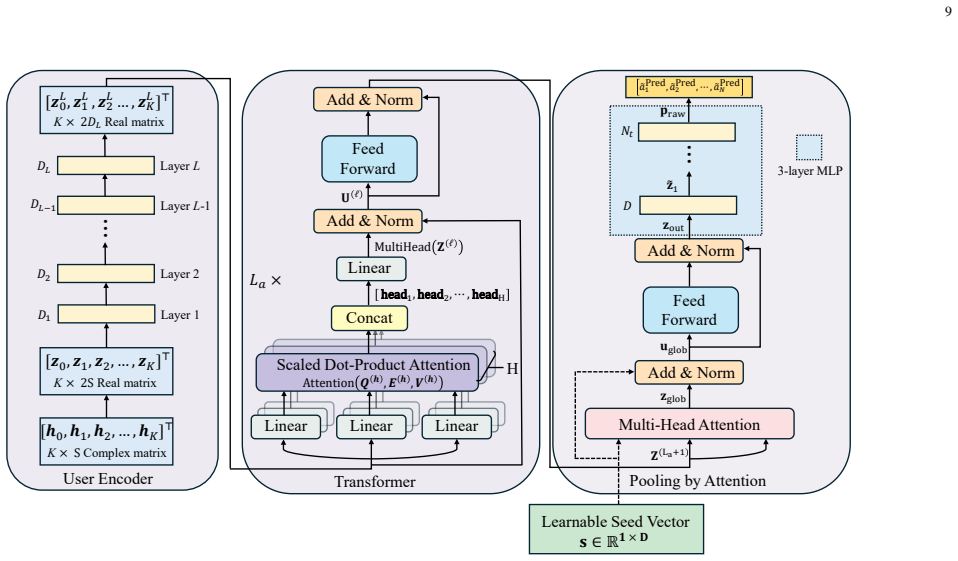
A DNN trained on partial channel power gains predicts the positions of multiple transmit movable antennas that maximize sum-rate; in single-user settings the network is trained by supervised learning to match known optima, while in multi-user settings an unsupervised attention architecture directly optimizes the rate expression without requiring globally optimal position labels.
What carries the argument
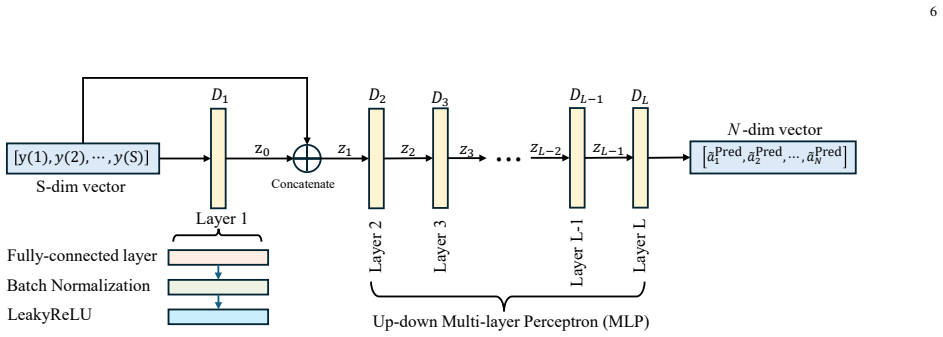
Attention-based deep neural network that maps a vector of partial power measurements to a set of movable-antenna coordinates.
Load-bearing premise
The relationship between optimal antenna positions and power gains at a small subset of locations can be learned by a neural network trained only on simulated data.
What would settle it
Compare the sum-rate achieved by the DNN positions against the sum-rate of positions found by exhaustive search over the full movement region with complete CSI; a large persistent gap falsifies the claim.
If this is right
- Single-user systems reach performance within a small gap of the full-CSI optimum.
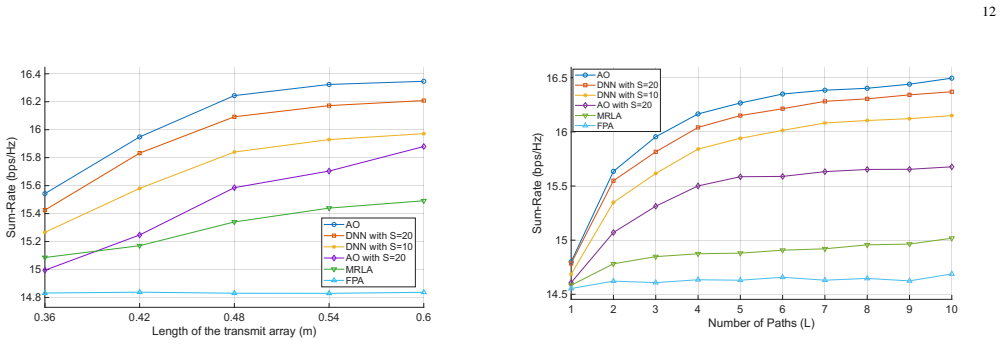
- Multi-user systems exceed the rates of conventional alternating-optimization methods that rely on full CSI.
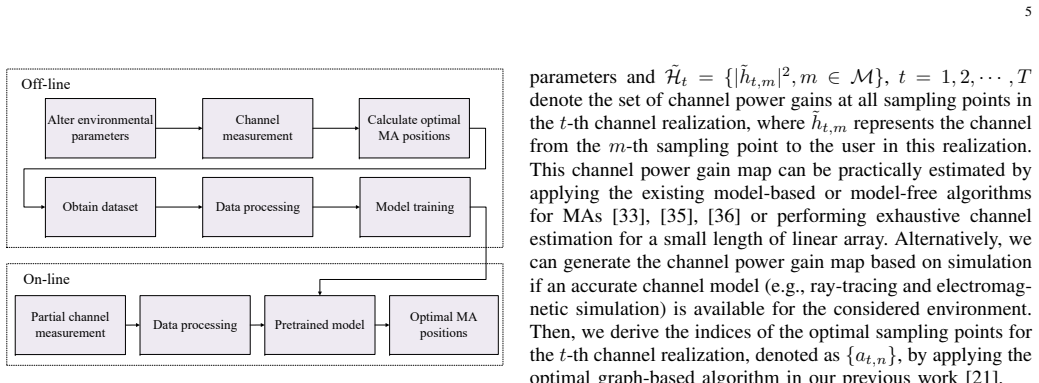
- Position decisions are obtained from a small number of power measurements without estimating channels everywhere.
- The same network can be deployed in real time once trained offline.
Where Pith is reading between the lines
- The overhead of channel estimation in movable-antenna systems drops from scaling with the number of candidate positions to scaling only with the number of measurement points.
- Similar partial-observation learning could apply to other high-dimensional antenna reconfiguration problems where exhaustive search is infeasible.
- Transfer from simulation to real channels remains untested and would be the next concrete experiment.
- If the learned mapping proves robust, it suggests many wireless resource-allocation tasks with prohibitive measurement costs can be solved by neural networks trained on subsets of observations.
Editorial analysis
A structured set of objections, weighed in public.
Referee Report
Summary. The manuscript proposes a DNN framework to optimize positions of multiple transmit movable antennas (MAs) in a multi-user MISO system using only partial channel power gain measurements from a subset of locations, thereby avoiding full CSI acquisition. In the single-user case, a supervised DNN is trained to learn the nonlinear mapping from these partial gains to near-optimal MA positions. In the multi-user case, an unsupervised attention-based DNN is trained by directly maximizing the sum-rate objective. Simulation results are reported to show near-optimal single-user performance and outperformance versus conventional full-CSI alternating optimization in the multi-user setting.
Significance. If the empirical mappings generalize beyond the simulated training distributions, the work would meaningfully reduce the prohibitive channel estimation overhead that currently limits practical deployment of movable-antenna systems. The unsupervised multi-user formulation is a notable technical contribution because it sidesteps the need for globally optimal position labels.
major comments (3)
- [single-user analysis and multi-user training sections] The central claim that a DNN can reliably capture the mapping from partial power gains to optimal MA positions rests entirely on empirical performance for the specific channel models used in training; no analytical identifiability result, approximation bound, or robustness analysis against model mismatch is supplied (single-user analysis and multi-user training sections).
- [simulation results section] The multi-user claim that the attention-based unsupervised network surpasses CSI-based alternating optimization is load-bearing for the paper's contribution, yet the manuscript provides no details on Monte-Carlo trial count, error bars, or statistical testing of the reported sum-rate gains (simulation results section).
- [multi-user framework] The unsupervised loss directly maximizes the instantaneous sum-rate expression, but the paper does not address how the attention mechanism implicitly resolves inter-user interference when only partial measurements are available, nor does it compare against stronger baselines that also operate on partial CSI.
minor comments (2)
- [system model] Notation for the partial measurement set and the attention-module input dimension should be introduced earlier and used consistently.
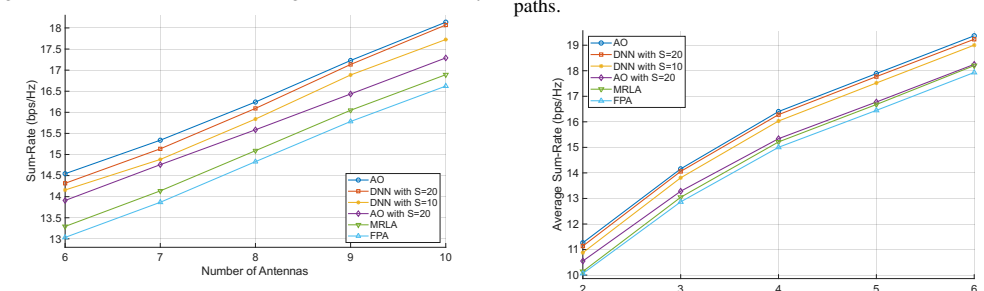
- [simulation results] Figure captions for the simulation plots should explicitly state the number of independent channel realizations and the exact channel model parameters.
Simulated Author's Rebuttal
We thank the referee for the constructive feedback. We address each major comment below and indicate planned revisions to strengthen the manuscript.
read point-by-point responses
-
Referee: [single-user analysis and multi-user training sections] The central claim that a DNN can reliably capture the mapping from partial power gains to optimal MA positions rests entirely on empirical performance for the specific channel models used in training; no analytical identifiability result, approximation bound, or robustness analysis against model mismatch is supplied (single-user analysis and multi-user training sections).
Authors: We acknowledge that the proposed DNN approach is fundamentally empirical, as deriving closed-form identifiability results or approximation bounds for general channel models is intractable due to the highly nonlinear mapping involved. In the revision, we will add a dedicated limitations subsection discussing this aspect and include new simulation results evaluating robustness under channel model mismatch (e.g., different path-loss exponents and Rician factors). revision: partial
-
Referee: [simulation results section] The multi-user claim that the attention-based unsupervised network surpasses CSI-based alternating optimization is load-bearing for the paper's contribution, yet the manuscript provides no details on Monte-Carlo trial count, error bars, or statistical testing of the reported sum-rate gains (simulation results section).
Authors: We agree that additional statistical details are needed. The revised manuscript will explicitly state that results are averaged over 1000 independent Monte-Carlo trials, include error bars showing one standard deviation, and note that the observed sum-rate improvements are consistent across trials. revision: yes
-
Referee: [multi-user framework] The unsupervised loss directly maximizes the instantaneous sum-rate expression, but the paper does not address how the attention mechanism implicitly resolves inter-user interference when only partial measurements are available, nor does it compare against stronger baselines that also operate on partial CSI.
Authors: The attention layers are intended to learn cross-user feature correlations from the partial power gains that implicitly account for interference; we will expand the multi-user framework section with a qualitative explanation of this mechanism supported by attention weight visualizations. We will also add comparisons against partial-CSI baselines such as position selection via greedy search on measured gains and a simple DNN regressor trained on partial data. revision: partial
Circularity Check
No circularity in derivation; empirical learning from simulation is self-contained.
full rationale
The paper explicitly states that the mapping from partial power gains to optimal MA positions cannot be mathematically characterized for practical channels and therefore trains a DNN (supervised for single-user, unsupervised sum-rate maximization for multi-user). No derivation chain reduces by construction to its inputs, no fitted parameter is renamed as a prediction, and no load-bearing self-citation or uniqueness theorem is invoked. The unsupervised loss directly optimizes the stated objective without presupposing labels that embed the result. This is a standard empirical ML approach with independent content from the training data and objective.
Axiom & Free-Parameter Ledger
Cite this review
Pith. "Pith review of Deep Learning-Empowered Movable-Antenna Position Optimization with Partial CSI." pith.science (2026). https://pith.science/paper/533OZHUV
@misc{pith2026260617543,
  author       = {Pith},
  title        = {Pith review of: Deep Learning-Empowered Movable-Antenna Position Optimization with Partial CSI},
  year         = {2026},
  howpublished = {\url{https://pith.science/paper/533OZHUV}},
  note         = {Machine review of arXiv:2606.17543}
}
read the original abstract
Movable antennas (MAs) are a promising technology to improve wireless data rates by dynamically adjusting their positions to avoid deep fading. However, finding the optimal MA positions requires full channel state information (CSI) for all possible locations within the movement region, creating massive channel estimation overhead. This paper proposes a deep neural network (DNN)-based learning framework to predict the optimal positions of multiple transmit MAs in a multi-user multiple-input single-output (MISO) system, entirely bypassing explicit channel estimation.First, we analyze a single-user MISO case, revealing a complex, highly nonlinear mapping between the optimal MA positions and the channel power gains from a specific subset of locations in the transmit region to the user. Because this mapping cannot be mathematically characterized for practical channel models, we train a DNN via supervised learning to capture it. The pre-trained DNN can then determine optimized MA positions in real-time relying only on partial power measurements from the transmit region.Extending this to multi-user scenarios is challenging due to complex rate expressions and the lack of globally optimal position solutions to use as training labels. To overcome this, we develop an unsupervised training framework that directly maximizes the multi-user sum-rate. This framework utilizes an attention-based architecture to extract latent features from the partial channel measurements and effectively manage inter-user interference. Simulation results show that our proposed approach achieves near-optimal performance in single-user systems and surpasses conventional CSI-based alternating optimization algorithms in multi-user environments.
Figures


Reference graph
Works this paper leans on
-
[1]
Learning- based movable-antenna position optimization with implicit CSI,
L. Lu, W. Mei, X. Wei, H. Hua, Z. Chen, and B. Ning, “Learning- based movable-antenna position optimization with implicit CSI,” in Proc. IEEE Int. Symp. Personal, Indoor and Mobile Radio Commun. (PIMRC), Istanbul, Turkiye, Sep. 2025, pp. 1–6
2025
-
[2]
A tutorial on movable antennas for wireless networks,
L. Zhu et al., “A tutorial on movable antennas for wireless networks,” IEEE Commun. Surveys Tuts., vol. 28, pp. 3002–3054, 2026
2026
-
[3]
Movable antennas for wireless communication: Opportunities and challenges,
L. Zhu, W. Ma, and R. Zhang, “Movable antennas for wireless communication: Opportunities and challenges,”IEEE Commun. Mag., vol. 62, no. 6, pp. 114–120, 2024
2024
-
[4]
Movable antenna-enhanced wireless communications: General architectures and implementation methods,
B. Ning et al., “Movable antenna-enhanced wireless communications: General architectures and implementation methods,”IEEE Wireless Commun., vol. 32, no. 5, pp. 108–116, 2025
2025
-
[5]
Movable antenna enhanced wireless sensing via antenna position optimization,
W. Ma, L. Zhu, and R. Zhang, “Movable antenna enhanced wireless sensing via antenna position optimization,”IEEE Trans. Wireless Commun., vol. 23, no. 11, pp. 16 575–16 589, Nov. 2024
2024
-
[6]
Antenna position optimization for movable antenna- empowered near-field sensing,
Y . Wang et al., “Antenna position optimization for movable antenna- empowered near-field sensing,” inProc. IEEE Int. Conf. Commun. Workshops, Montreal, QC, Canada, Jun. 2025, pp. 324–329
2025
-
[7]
Multi-beam forming with movable-antenna array,
W. Ma et al., “Multi-beam forming with movable-antenna array,” IEEE Commun. Lett., vol. 28, no. 3, pp. 697–701, Jan. 2024
2024
-
[8]
Movable-antenna array enhanced beamforming: Achieving full array gain with null steering,
L. Zhu, W. Ma, and R. Zhang, “Movable-antenna array enhanced beamforming: Achieving full array gain with null steering,”IEEE Commun. Lett., vol. 27, no. 12, pp. 3340–3344, Oct. 2023
2023
-
[9]
Movable antenna enhanced wide-beam coverage: Joint antenna position and beamforming optimization,
D. Wang, W. Mei, B. Ning, Z. Chen, and R. Zhang, “Movable antenna enhanced wide-beam coverage: Joint antenna position and beamforming optimization,”IEEE Trans. Wireless Commun., vol. 25, pp. 3541–3558, 2026
2026
-
[10]
Movable antenna enhanced multi-region beam coverage: A multi-notch-filter-inspired design,
D. Wang, W. Mei, Z. Chen, and B. Ning, “Movable antenna enhanced multi-region beam coverage: A multi-notch-filter-inspired design,” IEEE Wireless Commun. Lett., vol. 15, pp. 1320–1324, 2026
2026
-
[11]
A tutorial on fluid antenna system for 6G net- works: Encompassing communication theory, optimization methods and hardware designs,
W. K. New et al., “A tutorial on fluid antenna system for 6G net- works: Encompassing communication theory, optimization methods and hardware designs,”IEEE Commun. Surveys Tuts., vol. 27, no. 4, pp. 2325–2377, Aug. 2025
2025
-
[12]
G. Yan, L. Zhu, and R. Zhang, “Movable antenna aided multiuser communications: Antenna position optimization based on statistical channel information,”arXiv preprint, 2025, arXiv:2502.20856. [On- line]. Available: https://arxiv.org/abs/2502.20856
-
[13]
Pre-optimized irregular arrays versus movable antennas in multi-user MIMO systems,
A. Irshad et al., “Pre-optimized irregular arrays versus movable antennas in multi-user MIMO systems,”IEEE Wireless Commun. Lett., vol. 14, no. 8, pp. 2656–2660, Aug. 2025
2025
-
[14]
MIMO capacity characterization for movable antenna systems,
W. Ma, L. Zhu, and R. Zhang, “MIMO capacity characterization for movable antenna systems,”IEEE Trans. Wireless Commun., vol. 23, no. 4, pp. 3392–3407, Sep. 2024
2024
-
[15]
Secure wireless communication via movable-antenna array,
G. Hu, Q. Wu, K. Xu, J. Si, and N. Al-Dhahir, “Secure wireless communication via movable-antenna array,”IEEE Signal Process. Lett., vol. 31, pp. 516–520, 2024
2024
-
[16]
Movable antenna enabled interfer- ence network: Joint antenna position and beamforming design,
H. Wang, Q. Wu, and W. Chen, “Movable antenna enabled interfer- ence network: Joint antenna position and beamforming design,”IEEE Wireless Commun. Lett., vol. 13, no. 9, pp. 2517–2521, Sep. 2024
2024
-
[17]
Movable-antenna enhanced multiuser communication via antenna position optimization,
L. Zhu, W. Ma, B. Ning, and R. Zhang, “Movable-antenna enhanced multiuser communication via antenna position optimization,”IEEE Trans. Wireless Commun., vol. 23, no. 7, pp. 7214–7229, 2024
2024
-
[18]
Movable antenna enhanced DF and AF relaying sys- tems: Performance analysis and optimization,
N. Li et al., “Movable antenna enhanced DF and AF relaying sys- tems: Performance analysis and optimization,”IEEE Trans. Commun., vol. 73, no. 12, pp. 13 239–13 255, Dec. 2025
2025
-
[19]
Firefly algorithm for movable antenna arrays,
M. K. Hoang et al., “Firefly algorithm for movable antenna arrays,” IEEE Wireless Commun. Lett., vol. 13, no. 11, pp. 3157–3161, Nov. 2024
2024
-
[20]
Multiuser communications with movable-antenna base station: Joint antenna positioning, receive combining, and power control,
Z. Xiao et al., “Multiuser communications with movable-antenna base station: Joint antenna positioning, receive combining, and power control,”IEEE Trans. Wireless Commun., vol. 23, no. 12, pp. 19 744– 19 759, Dec. 2024
2024
-
[21]
Movable-antenna position optimization: A graph-based approach,
W. Mei, X. Wei, B. Ning, Z. Chen, and R. Zhang, “Movable-antenna position optimization: A graph-based approach,”IEEE Wireless Com- mun. Lett., vol. 13, no. 7, pp. 1853–1857, Jul. 2024
2024
-
[22]
Movable antenna-enhanced multiuser communication: Jointly optimal discrete antenna positioning and beamforming,
Y . Wu, D. Xu, D. W. K. Ng, W. Gerstacker, and R. Schober, “Movable antenna-enhanced multiuser communication: Jointly optimal discrete antenna positioning and beamforming,” inProc. IEEE Global Com- mun. Conf., Kuala Lumpur, Malaysia, 2023, pp. 7508–7513
2023
-
[23]
Movable-antenna position optimization for physical- layer security via discrete sampling,
W. Mei et al., “Movable-antenna position optimization for physical- layer security via discrete sampling,” inProc. IEEE Global Commun. Conf., Cape Town, South Africa, Dec. 2024, pp. 4739–4744
2024
-
[24]
Movable-antenna-enhanced physical-layer service integration: Performance analysis and optimization,
X. Shen et al., “Movable-antenna-enhanced physical-layer service integration: Performance analysis and optimization,”IEEE Wireless Commun. Lett., vol. 14, no. 9, pp. 2952–2956, Sep. 2025
2025
-
[25]
Joint beamforming and antenna position optimiza- tion for movable antenna-assisted spectrum sharing,
X. Wei et al., “Joint beamforming and antenna position optimiza- tion for movable antenna-assisted spectrum sharing,”IEEE Wireless Commun. Lett., vol. 13, no. 9, pp. 2502–2506, Sep. 2024
2024
-
[26]
Movable antennas meet intelligent reflecting surface: Friends or foes?
X. Wei et al., “Movable antennas meet intelligent reflecting surface: Friends or foes?”IEEE Trans. Commun., vol. 73, no. 11, pp. 12 756– 12 770, Nov. 2025
2025
-
[27]
Robust movable- antenna position optimization with imperfect CSI for MISO systems,
H. Ma, W. Mei, X. Wei, B. Ning, and Z. Chen, “Robust movable- antenna position optimization with imperfect CSI for MISO systems,” IEEE Commun. Lett., vol. 29, no. 7, pp. 1594–1598, Jul. 2025
2025
-
[28]
Trajectory optimization for minimizing movement delay in movable antenna systems,
Q. Li, W. Mei, R. Zhang, and B. Ning, “Trajectory optimization for minimizing movement delay in movable antenna systems,”IEEE Trans. Wireless Commun., vol. 25, pp. 6986–6999, 2026
2026
-
[29]
Performance optimization for movable antenna enhanced MISO-OFDM systems,
R. Feng et al., “Performance optimization for movable antenna enhanced MISO-OFDM systems,”arXiv preprint, 2025. [Online]. Available: https://arxiv.org/abs/2510.01789
-
[30]
A general optimiza- tion framework for movable antenna systems via discrete sampling,
C. Liu, W. Mei, Z. Chen, J. Fang, and B. Ning, “A general optimiza- tion framework for movable antenna systems via discrete sampling,” IEEE Wireless Commun. Lett., vol. 15, pp. 475–479, 2026
2026
-
[31]
Compressed sensing based channel estimation for movable antenna communications,
W. Ma, L. Zhu, and R. Zhang, “Compressed sensing based channel estimation for movable antenna communications,”IEEE Commun. Lett., vol. 27, no. 10, pp. 2747–2751, Oct. 2023
2023
-
[32]
Channel estimation for movable antenna communi- cation systems: A framework based on compressed sensing,
Z. Xiao et al., “Channel estimation for movable antenna communi- cation systems: A framework based on compressed sensing,”IEEE Trans. Wireless Commun., vol. 23, no. 9, pp. 11 814–11 830, Sep. 2024
2024
-
[33]
Channel estimation for movable-antenna MIMO systems via tensor decomposition,
R. Zhang et al., “Channel estimation for movable-antenna MIMO systems via tensor decomposition,”IEEE Wireless Commun. Lett., vol. 13, no. 11, pp. 3089–3093, Nov. 2024
2024
-
[34]
Successive Bayesian reconstructor for channel estimation in fluid antenna systems,
Z. Zhang, J. Zhu, L. Dai, and R. W. Heath, “Successive Bayesian reconstructor for channel estimation in fluid antenna systems,”IEEE Trans. Wireless Commun., vol. 24, no. 3, pp. 1992–2006, Mar. 2025
1992
-
[35]
Fluid antenna with linear MMSE channel estimation for large-scale cellular networks,
C. Skouroumounis and I. Krikidis, “Fluid antenna with linear MMSE channel estimation for large-scale cellular networks,”IEEE Trans. Commun., vol. 71, no. 2, pp. 1112–1125, 2023
2023
-
[36]
Correlation-based machine learning techniques for channel estimation with fluid antennas,
S. Ji, C. Psomas, and J. Thompson, “Correlation-based machine learning techniques for channel estimation with fluid antennas,” in Proc. IEEE ICASSP, Seoul, Korea, 2024, pp. 8891–8895
2024
-
[37]
CNN-based channel map estimation for movable antenna systems,
Y . Huang, W. Mei, X. Wei, Z. Chen, and B. Ning, “CNN-based channel map estimation for movable antenna systems,” inProc. IEEE SPAWC, Surrey, United Kingdom, Jul. 2025, pp. 1–5
2025
-
[38]
An iteratively weighted MMSE approach to distributed sum-utility maximization for a MIMO interfering broadcast channel,
Q. Shi, M. Razaviyayn, Z.-Q. Luo, and C. He, “An iteratively weighted MMSE approach to distributed sum-utility maximization for a MIMO interfering broadcast channel,”IEEE Trans. Signal Process., vol. 59, no. 9, pp. 4331–4340, Sep. 2011
2011
-
[39]
Minimum-redundancy linear arrays,
A. Moffet, “Minimum-redundancy linear arrays,”IEEE Trans. Anten- nas Propag., vol. 16, no. 2, pp. 172–175, 1968
1968
-
[40]
6D movable antenna based on user distribution: Modeling and optimization,
X. Shao, Q. Jiang, and R. Zhang, “6D movable antenna based on user distribution: Modeling and optimization,”IEEE Trans. Wireless Commun., vol. 24, no. 1, pp. 355–370, 2025
2025
-
[41]
Hierarchically tunable 6DMA for wireless communi- cation and sensing: Modeling and performance optimization,
H. Hua et al., “Hierarchically tunable 6DMA for wireless communi- cation and sensing: Modeling and performance optimization,”IEEE Trans. Wireless Commun., vol. 25, pp. 4721–4736, 2026
2026
-
[42]
A tutorial on six-dimensional movable antenna for 6G networks: Synergizing positionable and rotatable antennas,
X. Shao et al., “A tutorial on six-dimensional movable antenna for 6G networks: Synergizing positionable and rotatable antennas,”IEEE Commun. Surveys Tuts., vol. 28, pp. 3666–3709, 2026
2026
This paper was first reviewed by grok-4.3 on June 26, 2026.
discussion (0)
Sign in with ORCID, Apple, or X to comment. Anyone can read and Pith papers without signing in.