Detectability of deuterium in spectra of early-type stars
Pith reviewed 2026-06-26 23:00 UTC · model grok-4.3
The pith
Deuterium may be detectable in spectra of early-type stars in heavily accretion-contaminated cases.
A machine-rendered reading of the paper's core claim, the machinery that carries it, and where it could break.
Core claim
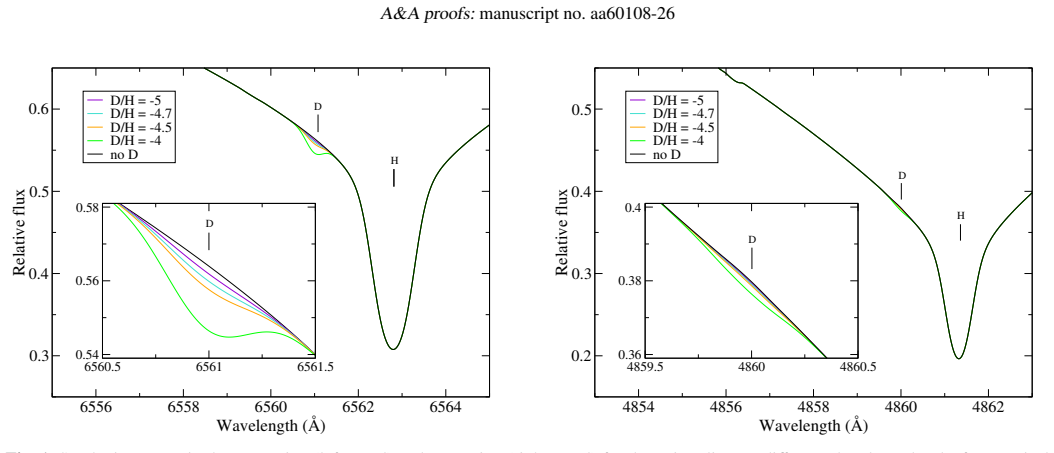
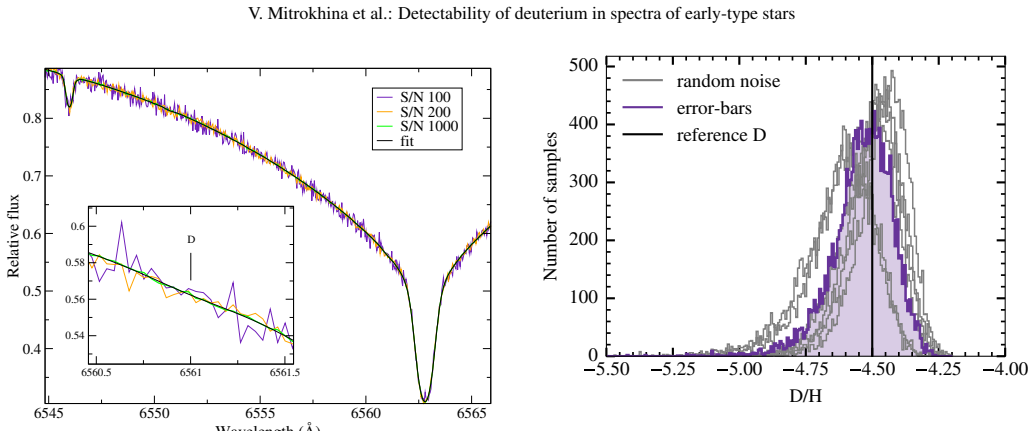
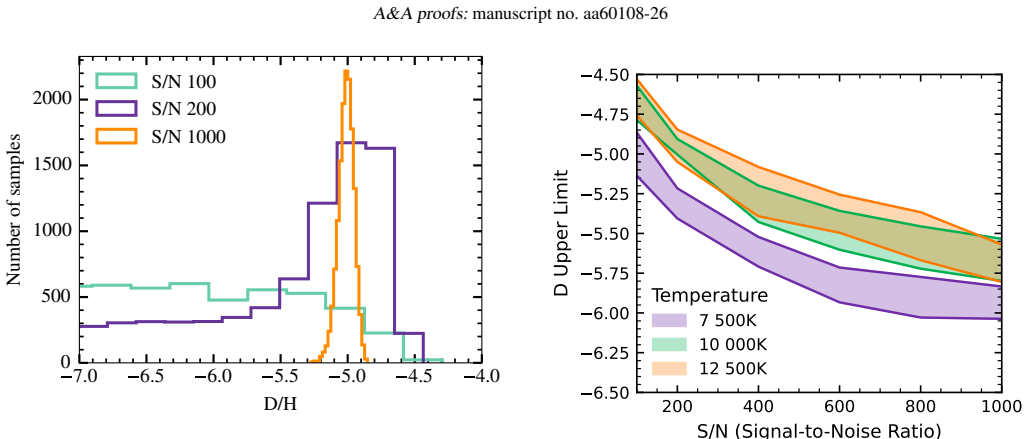
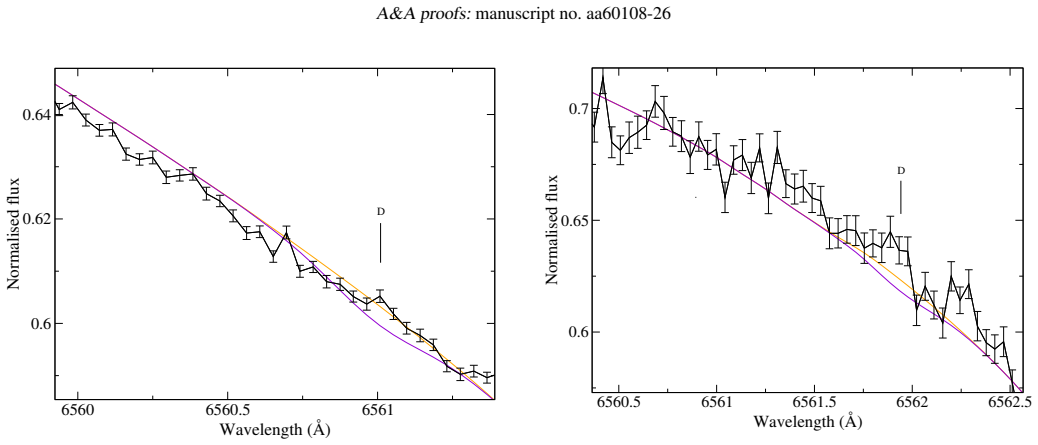
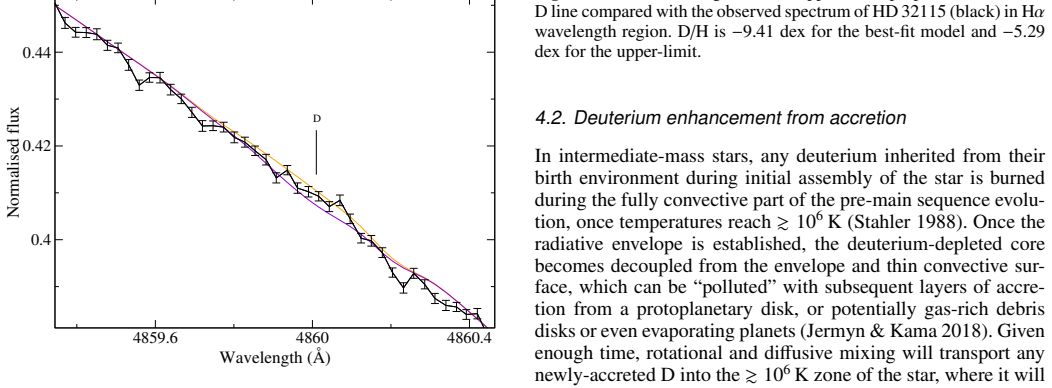
Detection of deuterium on early-type stars may be possible in some heavily accretion-contaminated cases. For a 10000 K star the detection limit improves from D/H = -4.6 dex at SNR 100 to D/H = -5.5 dex at SNR 1000. Observed spectra yield upper limits of D/H < -5.5 dex for the A9 star HD 32115 and D/H < -4.9 dex for the B9.5 star 21 Peg, showing that the signal is currently below detection thresholds except under extreme accretion conditions.
What carries the argument
Synthetic spectra of Balmer line regions analyzed via Markov Chain Monte Carlo fitting to isolate the minimum detectable deuterium abundance.
If this is right
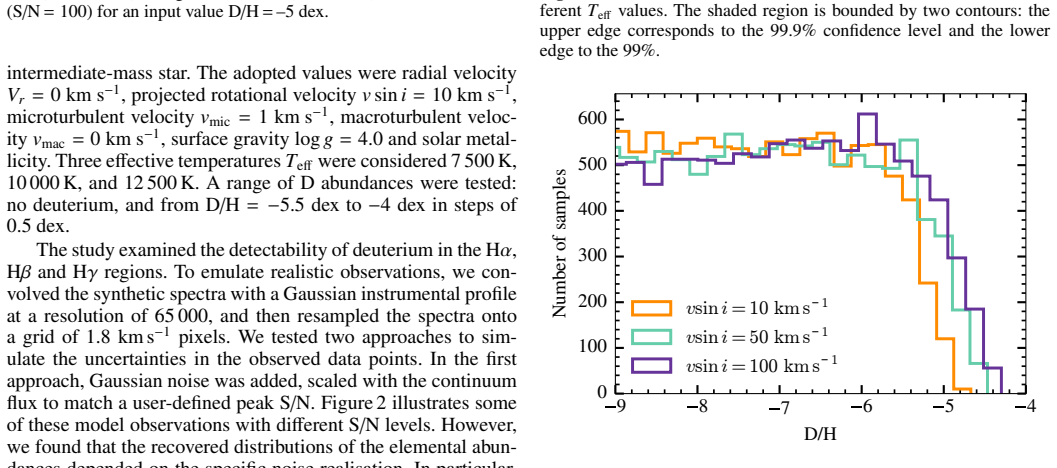
- Detection limits improve steadily with higher signal-to-noise ratio and lower projected rotational velocity.
- Stars in the 7500-12500 K range with radiative envelopes are the most promising targets.
- Upper limits can already be placed on deuterium content for specific observed stars.
- The technique supplies a new observational diagnostic for material recently accreted onto the star.
Where Pith is reading between the lines
- Confirmed detections would directly constrain the mass and timing of accretion from protoplanetary disks.
- The same modeling framework could be tested on other destroyed light isotopes once higher-resolution data become available.
- Application to larger samples of young early-type stars might reveal statistical trends linked to planet formation.
Load-bearing premise
The synthetic spectra correctly isolate the deuterium contribution to Balmer lines without unmodeled blending, velocity fields, or other elemental lines that could mimic or mask the signal.
What would settle it
A spectrum of a 10000 K star at SNR 1000 that shows no deuterium feature at D/H = -5.5 dex, after the model has accounted for all other parameters, would falsify the claimed detection limit.
Figures
read the original abstract
Context: Deuterium is easily destroyed in stellar interiors through nuclear fusion. It is therefore usually not expected to be present in stellar photospheres. Early-type stars, with radiative envelopes that mix slowly, may provide a favourable environment for the survival of recently accreted deuterium. Aims: In this study, we explore the detectability of deuterium in B-, A-, and F-type stars, which possess radiative envelopes that can delay the mixing and destruction of recently accreted material. Methods: We used synthetic spectra to generate model observations including deuterium, focusing on Balmer line regions, for stars with effective temperatures between 7 500 K and 12 500 K and a surface gravity of log g = 4.0. To assess the detectability of deuterium, we employed a Markov Chain Monte Carlo framework over a range of signal-to-noise ratios between 100 and 1000. We then applied this method to observed spectra of the A9 star HD 32115 and the B9.5 star 21 Peg. Results: We show how detection limits of deuterium abundance depend on signal-to-noise ratio, effective temperature, and projected rotational velocity. For example, for a 10 000 K star, the detection limit decreases from D/H = -4.6 dex to -5.5 dex, as the signal-to-noise ratio increases from 100 to 1000. For HD 32115, we find an upper limit of D/H < -5.5 dex, and for 21 Peg < -4.9 dex. We conclude that the detection of deuterium on early-type stars may be possible in some heavily accretion-contaminated cases, providing a new diagnostic tool for the study of proto- or exo-planetary material.
Editorial analysis
A structured set of objections, weighed in public.
Referee Report
Summary. The manuscript investigates the detectability of deuterium in early-type stars with radiative envelopes by modeling synthetic spectra of Balmer lines with added deuterium for stars with Teff between 7500 and 12500 K and log g = 4.0. Using an MCMC framework, it determines detection limits as a function of SNR (100-1000), Teff, and v sin i. The method is applied to observed spectra of HD 32115 and 21 Peg, yielding upper limits of D/H < -5.5 dex and < -4.9 dex, respectively. The authors conclude that deuterium detection may be possible in heavily accretion-contaminated cases, offering a new diagnostic for proto- or exo-planetary material.
Significance. If the modeling assumptions hold, this provides a potentially useful new observational diagnostic for accreted material in stars with slow-mixing radiative envelopes. The quantitative dependence of limits on SNR, temperature, and rotation is a practical strength.
major comments (1)
- [Methods (synthetic spectra generation and MCMC framework)] The central claim that detection is possible in heavily accretion-contaminated cases rests on the MCMC-derived limits (e.g., D/H improving from -4.6 to -5.5 dex for a 10 000 K star as SNR rises from 100 to 1000) being driven solely by the added deuterium feature in the synthetic Balmer profiles. The manuscript does not describe explicit validation or sensitivity tests for unmodeled metal-line blends, differential rotation, microturbulence, or other velocity fields that could alter wings/cores and either mask or mimic the D signal; this isolation assumption is load-bearing for the reported upper limits on HD 32115 and 21 Peg and for the extrapolated detectability statement.
minor comments (3)
- [Abstract] The abstract refers to 'heavily accretion-contaminated cases' without quantifying what abundance threshold or accretion rate this corresponds to.
- [Results] A summary table of detection limits across the full Teff and v sin i grid at the three SNR values would improve readability and allow direct comparison with the two observed stars.
- [Application to observed spectra] The application section would benefit from a brief description of continuum normalization and any preprocessing steps applied to the observed spectra of HD 32115 and 21 Peg before the MCMC fitting.
Simulated Author's Rebuttal
We thank the referee for their constructive review and recommendation of major revision. We address the single major comment below, clarifying our modeling choices while agreeing to expand the discussion of assumptions in the revised manuscript.
read point-by-point responses
-
Referee: [Methods (synthetic spectra generation and MCMC framework)] The central claim that detection is possible in heavily accretion-contaminated cases rests on the MCMC-derived limits (e.g., D/H improving from -4.6 to -5.5 dex for a 10 000 K star as SNR rises from 100 to 1000) being driven solely by the added deuterium feature in the synthetic Balmer profiles. The manuscript does not describe explicit validation or sensitivity tests for unmodeled metal-line blends, differential rotation, microturbulence, or other velocity fields that could alter wings/cores and either mask or mimic the D signal; this isolation assumption is load-bearing for the reported upper limits on HD 32115 and 21 Peg and for the extrapolated detectability statement.
Authors: We appreciate the referee's emphasis on the importance of validating the isolation of the deuterium signal. Our synthetic spectra were generated from standard LTE model atmospheres with fixed Teff, log g = 4.0, and v sin i, adding deuterium only to the Balmer line profiles while holding all other parameters constant; the MCMC then recovers the D/H ratio from these controlled synthetic observations to map detectability limits versus SNR, Teff, and rotation. This design deliberately isolates the deuterium contribution to provide baseline quantitative limits, rather than attempting a full end-to-end simulation of every possible blend or velocity field. We acknowledge that the original manuscript does not present explicit sensitivity tests for metal-line blends, microturbulence variations, or differential rotation, which could in principle affect the line wings or cores. For the two program stars, the observed spectra were selected for their relatively clean Balmer regions and well-determined parameters, but we agree that real-world applications would require simultaneous modeling of all lines. In the revised manuscript we will add a dedicated paragraph in the Methods section discussing these assumptions, note that the reported limits are optimistic (i.e., assuming the D feature is the dominant perturbation), and include a brief sensitivity test varying microturbulence by ±0.5 km s^{-1} to illustrate robustness. We believe these additions will strengthen the paper without altering the core conclusions. revision: partial
Circularity Check
No circularity: forward modeling of detection limits from synthetic spectra is independent of inputs
full rationale
The paper constructs synthetic spectra with added deuterium in Balmer regions for Teff 7500-12500 K, runs MCMC to extract detection limits versus SNR and v sin i, then applies the same forward model to two observed spectra to report upper limits (D/H < -5.5 dex and < -4.9 dex). No equation or result is defined in terms of itself, no fitted parameter is relabeled as a prediction, and no load-bearing premise rests on self-citation. The chain is a standard forward simulation followed by application to data, remaining self-contained against external benchmarks.
Axiom & Free-Parameter Ledger
axioms (1)
- domain assumption Synthetic spectra accurately represent deuterium line profiles in the Balmer region for the stated temperature and gravity range
Reference graph
Works this paper leans on
-
[1]
Big Bang Nucleosynthesis: 2015
Big bang nucleosynthesis: Present status. Reviews of Modern Physics , keywords =. doi:10.1103/RevModPhys.88.015004 , archivePrefix =. 1505.01076 , primaryClass =
work page internal anchor Pith review Pith/arXiv arXiv doi:10.1103/revmodphys.88.015004
-
[2]
Deuterium and the Stellar Birthline. , keywords =. doi:10.1086/166694 , adsurl =
-
[3]
The origin of deuterium. , keywords =. doi:10.1038/263198a0 , adsurl =
-
[4]
The deuterium abundance in the local interstellar medium. , keywords =. doi:10.1111/j.1365-2966.2010.16734.x , archivePrefix =. 0910.4961 , primaryClass =
-
[5]
JOYS: The [D/H] abundance derived from protostellar outflows across the Galactic disk measured with JWST. , keywords =. doi:10.1051/0004-6361/202451629 , archivePrefix =. 2501.02085 , primaryClass =
-
[6]
A D/H ratio consistent with Earth's water in Halley-type comet 12P from ALMA HDO mapping. Nature Astronomy , keywords =. doi:10.1038/s41550-025-02614-7 , archivePrefix =. 2508.05925 , primaryClass =
-
[7]
Deuterium/Hydrogen Ratio (in Encyclopedia of Astrobiology)
Pinti, Daniele L. Deuterium/Hydrogen Ratio (in Encyclopedia of Astrobiology). Encyclopedia of Astrobiology. 2020. doi:10.1007/978-3-642-27833-4_418-4
-
[8]
doi:10.1007/978-3-540-76949-1 , adsurl =
Physics, Formation and Evolution of Rotating Stars. doi:10.1007/978-3-540-76949-1 , adsurl =
-
[9]
Observations of convection in A-type stars
Observations of convection in A-type stars. The A-Star Puzzle , year = 2004, editor =. doi:10.1017/S1743921304004478 , archivePrefix =. astro-ph/0408222 , primaryClass =
work page internal anchor Pith review Pith/arXiv arXiv doi:10.1017/s1743921304004478 2004
-
[10]
Astronomische Nachrichten , keywords =
Probing the Przybylski star for deuterium. Astronomische Nachrichten , keywords =. doi:10.1002/asna.20220133 , archivePrefix =. 2302.02487 , primaryClass =
-
[11]
A Search for Deuterium in Stellar Spectra. I. Magnetic Stars. , year = 1965, month = feb, volume =. doi:10.1086/148146 , adsurl =
-
[12]
A Search for Deuterium in Stellar Spectra. II. Normal Stars of Types b, a, and F. , year = 1965, month = oct, volume =. doi:10.1086/148371 , adsurl =
-
[13]
, keywords =
Stellar deuterium abundance : a new upper limit in Canopus. , keywords =
-
[14]
, keywords =
An upper limit for the deuterium abundance in Canopus. , keywords =
-
[15]
The case of alpha Pavonis
Deuterium in early-type stars. The case of alpha Pavonis. , keywords =
-
[16]
A spectroscopic survey of Herbig Ae/Be stars with X-shooter - I. Stellar parameters and accretion rates. , keywords =. doi:10.1093/mnras/stv1576 , archivePrefix =. 1507.05967 , primaryClass =
work page internal anchor Pith review Pith/arXiv arXiv doi:10.1093/mnras/stv1576
-
[17]
Predictions for the secondary CO, C and O gas content of debris discs from the destruction of volatile-rich planetesimals. , keywords =. doi:10.1093/mnras/stx730 , archivePrefix =. 1703.10693 , primaryClass =
work page internal anchor Pith review Pith/arXiv arXiv doi:10.1093/mnras/stx730
-
[18]
Imaging [CI] around HD 131835: reinterpreting young debris discs with protoplanetary disc levels of CO gas as shielded secondary discs. , keywords =. doi:10.1093/mnras/sty2923 , archivePrefix =. 1811.08439 , primaryClass =
-
[19]
Stellar Photospheric Abundances as a Probe of Disks and Planets
Stellar photospheric abundances as a probe of discs and planets. , keywords =. doi:10.1093/mnras/sty429 , archivePrefix =. 1804.06414 , primaryClass =
work page internal anchor Pith review Pith/arXiv arXiv doi:10.1093/mnras/sty429
-
[20]
emcee: The MCMC Hammer. , keywords =. doi:10.1086/670067 , archivePrefix =. 1202.3665 , primaryClass =
work page internal anchor Pith review Pith/arXiv arXiv doi:10.1086/670067
-
[21]
corner.py: Scatterplot matrices in Python. The Journal of Open Source Software , year = 2016, month = jun, volume =. doi:10.21105/joss.00024 , adsurl =
-
[22]
2016 , note =
corner.py: Scatterplot matrices in Python. 2016 , note =
2016
-
[23]
Solar Polarization , year = 2003, editor =
ESPaDOnS: An Echelle SpectroPolarimetric Device for the Observation of Stars at CFHT. Solar Polarization , year = 2003, editor =
2003
-
[24]
title An XMM-Newton spectral survey of 12 m selected galaxies - I
The accuracy of stellar atmospheric parameter determinations: a case study with HD 32115 and HD 37594. , keywords =. doi:10.1111/j.1365-2966.2011.19289.x , archivePrefix =. 1106.4406 , primaryClass =
-
[25]
The chemical abundance analysis of normal early A- and late B-type stars
The chemical abundance analysis of normal early A- and late B-type stars. , keywords =. doi:10.1051/0004-6361/200811561 , archivePrefix =. 0906.5269 , primaryClass =
work page internal anchor Pith review Pith/arXiv arXiv doi:10.1051/0004-6361/200811561
-
[26]
, keywords =
VALD: The Vienna Atomic Line Data Base. , keywords =
-
[27]
The Vienna Atomic Line Database : Present State and Future Development. Baltic Astronomy , keywords =. doi:10.1515/astro-1997-0216 , adsurl =
-
[28]
VALD-2: Progress of the Vienna Atomic Line Data Base. , keywords =. doi:10.1051/aas:1999267 , adsurl =
-
[29]
VALD-2 -- The New Vienna Atomic Line Database. Baltic Astronomy , keywords =. doi:10.1515/astro-2000-0420 , adsurl =
-
[30]
, year = 2015, month = may, volume =
A major upgrade of the VALD database. , year = 2015, month = may, volume =. doi:10.1088/0031-8949/90/5/054005 , adsurl =
-
[31]
Hyperfine Splitting in the VALD Database of Spectral-line Parameters. Astronomy Reports , keywords =. doi:10.1134/S1063772919120047 , archivePrefix =. 1911.03189 , primaryClass =
-
[32]
Summary of the content and survey properties
Gaia Data Release 3. Summary of the content and survey properties. , keywords =. doi:10.1051/0004-6361/202243940 , archivePrefix =. 2208.00211 , primaryClass =
-
[33]
2024 , howpublished =
2024
-
[34]
PolarBase: a data base of high resolution spectropolarimetric stellar observations
PolarBase: A Database of High-Resolution Spectropolarimetric Stellar Observations. , keywords =. doi:10.1086/676976 , archivePrefix =. 1401.1082 , primaryClass =
work page internal anchor Pith review Pith/arXiv arXiv doi:10.1086/676976
-
[35]
1993 , howpublished =
ATLAS9 Stellar Atmosphere Programs and 2 km/s grid. 1993 , howpublished =
1993
-
[36]
2004 , eprint=
New Grids of ATLAS9 Model Atmospheres , author=. 2004 , eprint=
2004
-
[37]
The interagreement of three independent polarised radiative transfer codes
LTE spectrum synthesis in magnetic stellar atmospheres. The interagreement of three independent polarised radiative transfer codes. , keywords =. doi:10.1051/0004-6361:20010735 , adsurl =
-
[38]
The Magnetic Field and Abundance Distribution Geometry of the Peculiar A Star 53 Camelopardalis. , keywords =. doi:10.1086/166155 , adsurl =
-
[39]
Monthly Notices of the Royal Astronomical Society , volume =
Chemical abundances of magnetic and non-magnetic Herbig Ae/Be stars. , keywords =. doi:10.1111/j.1365-2966.2012.20718.x , archivePrefix =. 1202.1845 , primaryClass =
-
[40]
A rare phosphorus-rich star in an eclipsing binary from TESS. , keywords =. doi:10.1051/0004-6361/202142124 , archivePrefix =. 2111.07526 , primaryClass =
-
[41]
A study of deuterated water in the low-mass protostar IRAS16293-2422
A study of deuterated water in the low-mass protostar IRAS 16293-2422. , keywords =. doi:10.1051/0004-6361/201117627 , archivePrefix =. 1201.1785 , primaryClass =
work page internal anchor Pith review Pith/arXiv arXiv doi:10.1051/0004-6361/201117627
-
[42]
, year = 2023, month = mar, volume =
Deuterium-enriched water ties planet-forming disks to comets and protostars. , year = 2023, month = mar, volume =. doi:10.1038/s41586-022-05676-z , adsurl =
-
[43]
Pristine ices in a planet-forming disk revealed by heavy water. Nature Astronomy , keywords =. doi:10.1038/s41550-025-02663-y , archivePrefix =. 2510.19919 , primaryClass =
-
[44]
HDO Ice Detected toward an Isolated Low-mass Protostar with JWST. , keywords =. doi:10.3847/2041-8213/addb45 , archivePrefix =. 2505.14686 , primaryClass =
-
[45]
Observable Metal Pollution in Main-sequence Stars: Simulations of Rocky Planets Engulfed by Stars in the 0.5 to 1.4 M _ Range. , keywords =. doi:10.3847/1538-4357/ae5b9a , archivePrefix =. 2601.00949 , primaryClass =
-
[46]
The deuterium abundance in Jupiter and Saturn from ISO-SWS observations. , keywords =. doi:10.1051/0004-6361:20010259 , adsurl =
-
[47]
D/H Ratios on Saturn and Jupiter from Cassini CIRS. , keywords =. doi:10.3847/1538-3881/aa899d , adsurl =
-
[48]
, keywords =
Detection of HD in the atmospheres of Uranus and Neptune: a new determination of the D/H ratio. , keywords =
-
[49]
The Observation and Analysis of Stellar Photospheres
-
[50]
Introduction to quantum mechanics
-
[51]
Polynomial partition function approximations of 344 atomic and molecular species. , keywords =. doi:10.1086/190730 , adsurl =
-
[52]
Extended VCS Stark broadening tables for hydrogen -- Lyman to Brackett series. , keywords =. doi:10.1051/aas:1997134 , adsurl =
-
[53]
, year = 1973, month = jan, volume =
Hydrogen Stark-Broadening Tables. , year = 1973, month = jan, volume =. doi:10.1086/190264 , adsurl =
-
[54]
Physical Review , year = 1965, month = nov, volume =
Theory of Resonance Broadening of Spectral Lines by Atom-Atom Impacts. Physical Review , year = 1965, month = nov, volume =. doi:10.1103/PhysRev.140.A1044 , adsurl =
-
[55]
Physical Review , year = 1966, month = apr, volume =
Theory of Resonance Broadening of Spectral Lines by Atom-Atom Impacts. Physical Review , year = 1966, month = apr, volume =. doi:10.1103/PhysRev.144.366 , adsurl =
-
[56]
Accretion-related properties of Herbig Ae/Be stars. Comparison with T Tauris
Accretion-related properties of Herbig Ae/Be stars. Comparison with T Tauris. , keywords =. doi:10.1051/0004-6361/201219110 , archivePrefix =. 1205.4734 , primaryClass =
work page internal anchor Pith review Pith/arXiv arXiv doi:10.1051/0004-6361/201219110
-
[57]
Fingerprints of giant planets in the photospheres of Herbig stars
Fingerprints of giant planets in the photospheres of Herbig stars. , keywords =. doi:10.1051/0004-6361/201527094 , archivePrefix =. 1509.02741 , primaryClass =
work page internal anchor Pith review Pith/arXiv arXiv doi:10.1051/0004-6361/201527094
-
[58]
Volatile carbon locking and release in protoplanetary disks. A study of TW Hya and HD 100546
Volatile-carbon locking and release in protoplanetary disks. A study of TW Hya and HD 100546. , keywords =. doi:10.1051/0004-6361/201526991 , archivePrefix =. 1605.05093 , primaryClass =
work page internal anchor Pith review Pith/arXiv arXiv doi:10.1051/0004-6361/201526991
-
[59]
Abundance analysis of stars hosting gas-rich debris discs. , keywords =. doi:10.1051/0004-6361/202452840 , archivePrefix =. 2503.03614 , primaryClass =
-
[60]
A potential link with planet formation
Relation between metallicities and spectral energy distributions of Herbig Ae/Be stars. A potential link with planet formation. , keywords =. doi:10.1051/0004-6361/202245427 , archivePrefix =. 2212.14022 , primaryClass =
-
[61]
A precise asteroseismic age and metallicity for HD 139614: a pre-main-sequence star with a protoplanetary disc in Upper Centaurus-Lupus. , keywords =. doi:10.1093/mnras/stab144 , archivePrefix =. 2011.11821 , primaryClass =
-
[62]
A critical assessment of the applicability of the energy-limited approximation for estimating exoplanetary mass-loss rates. , keywords =. doi:10.1051/0004-6361/202140437 , archivePrefix =. 2105.05858 , primaryClass =
-
[63]
Atmospheric Escape and the Evolution of Close-in Exoplanets
Atmospheric Escape and the Evolution of Close-In Exoplanets. Annual Review of Earth and Planetary Sciences , keywords =. doi:10.1146/annurev-earth-053018-060246 , archivePrefix =. 1807.07609 , primaryClass =
work page internal anchor Pith review Pith/arXiv arXiv doi:10.1146/annurev-earth-053018-060246
-
[64]
Mass-loss rate and local thermodynamic state of the KELT-9 b thermosphere from the hydrogen Balmer series. , keywords =. doi:10.1051/0004-6361/201937316 , archivePrefix =. 2004.13733 , primaryClass =
-
[65]
Solar Bayesian Analysis Toolkit A New Markov Chain Monte Carlo IDL Code for Bayesian Parameter Inference. , keywords =. doi:10.3847/1538-4365/abc5c1 , archivePrefix =. 2005.05365 , primaryClass =
-
[66]
Data analysis recipes: Fitting a model to data
Data analysis recipes: Fitting a model to data. arXiv e-prints , keywords =. doi:10.48550/arXiv.1008.4686 , archivePrefix =. 1008.4686 , primaryClass =
work page internal anchor Pith review Pith/arXiv arXiv doi:10.48550/arxiv.1008.4686
-
[67]
Odessa Astronomical Publications , keywords =
An Enigma of the Przybylski Star. Odessa Astronomical Publications , keywords =. doi:10.18524/1810-4215.2022.35.268673 , adsurl =
discussion (0)
Sign in with ORCID, Apple, or X to comment. Anyone can read and Pith papers without signing in.