KANLib -- A Modular, Extensible and Fast Kolmogorov-Arnold Network Implementation
Pith reviewed 2026-06-27 01:09 UTC · model grok-4.3
The pith
KANLib is a modular framework that unifies existing Kolmogorov-Arnold Network approaches to match their predictive results while delivering competitive speed and support for custom designs.
A machine-rendered reading of the paper's core claim, the machinery that carries it, and where it could break.
Core claim
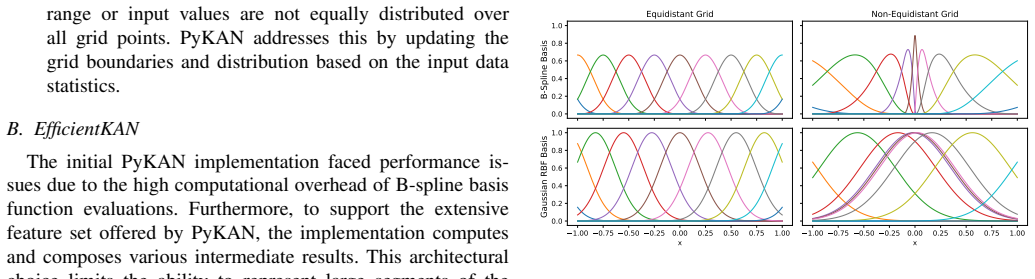
The framework unifies core concepts from existing implementations within a consistent software architecture that emphasizes flexibility, feature parity, and high performance. It supports two basis function types, adaptive grid rescaling, grid extension, and fine-grained architectural customization while maintaining compatibility with standard deep learning workflows. Experimental evaluation on a standard benchmark demonstrates that it reproduces the predictive behavior of established reference implementations while achieving competitive computational efficiency. The framework also enables the exploration of architectural variations beyond standard formulations with only minor impacts on pred
What carries the argument
KANLib, the modular software framework that provides a unified architecture for Kolmogorov-Arnold Networks with support for multiple basis functions and adaptive grids.
If this is right
- The framework reproduces predictive results from earlier Kolmogorov-Arnold Network tools.
- Computational efficiency stays competitive with those tools.
- Architectural changes can be explored with only small effects on how well the network predicts.
- It serves as a base for developing more scalable Kolmogorov-Arnold Network versions.
Where Pith is reading between the lines
- Wider use of this library could lead to more consistent comparisons across different Kolmogorov-Arnold Network studies.
- Efficiency improvements might allow these networks to be applied to problems with larger input sizes or more data points.
- The modular structure opens the door to adding support for additional types of basis functions in future updates.
Load-bearing premise
The results from one regression benchmark and comparisons to a few reference implementations are sufficient to establish that the framework generally reproduces behavior and runs efficiently.
What would settle it
Running the same models on a different dataset or task and finding that prediction accuracy or computation time differs substantially from the reference implementations.
Figures
read the original abstract
Kolmogorov-Arnold Networks (KANs) have recently emerged as a promising alternative to traditional multilayer perceptrons by replacing linear weights with learnable univariate functions. Despite their theoretical advantages in interpretability and expressiveness, practical research of KANs remains difficult due to high computational costs and inconsistent feature support across existing frameworks. This paper introduces KANLib, a modular, extensible, and computationally efficient framework for developing and evaluating KAN architectures. KANLib unifies core concepts from existing implementations, including PyKAN, EfficientKAN, and FastKAN, within a consistent software architecture that emphasizes flexibility, feature parity, and high performance. The framework supports two basis function types, adaptive grid rescaling, grid extension, and fine-grained architectural customization while maintaining compatibility with standard PyTorch workflows. Experimental evaluation on the California Housing benchmark demonstrates that KANLib reproduces the predictive behavior of established reference KAN implementations while achieving competitive computational efficiency. Furthermore, the framework enables the exploration of architectural variations beyond standard KAN formulations with only minor impacts on predictive performance. Overall, KANLib provides a robust foundation for future research on scalable and extensible KAN architectures.
Editorial analysis
A structured set of objections, weighed in public.
Referee Report
Summary. The paper introduces KANLib, a modular, extensible, and computationally efficient PyTorch-compatible framework for Kolmogorov-Arnold Networks that unifies concepts from PyKAN, EfficientKAN, and FastKAN. It supports two basis function types, adaptive grid rescaling, grid extension, and fine-grained architectural customization. The central claim is that experimental evaluation on the California Housing benchmark shows KANLib reproduces the predictive behavior of reference implementations while achieving competitive computational efficiency, and that the framework enables exploration of architectural variations beyond standard KAN formulations with only minor impacts on predictive performance.
Significance. If the reproduction and efficiency claims hold, KANLib would provide a useful practical contribution to the field by offering a unified high-performance platform that lowers barriers to KAN research and enables consistent experimentation. The modular design, feature parity with existing implementations, support for grid operations, and PyTorch compatibility are explicit strengths that could accelerate work on interpretable and scalable neural architectures.
major comments (1)
- [Experimental evaluation] Experimental evaluation section: reproduction of predictive behavior and competitive efficiency are asserted solely on the California Housing regression task. No quantitative metrics, error bars, multiple runs, or statistical comparisons are supplied, and no results appear for classification tasks, additional datasets, or scaling experiments that vary grid size, input dimension, or loss landscape. This single-benchmark design is load-bearing for the central claim and leaves generalizability unsupported.
minor comments (1)
- [Abstract] Abstract: the statements that KANLib 'reproduces the predictive behavior' and achieves 'competitive computational efficiency' are not accompanied by any numerical values or direct comparisons, reducing immediate readability of the results.
Simulated Author's Rebuttal
We thank the referee for the constructive comments on the experimental evaluation. We address the concern below and will revise the manuscript accordingly.
read point-by-point responses
-
Referee: [Experimental evaluation] Experimental evaluation section: reproduction of predictive behavior and competitive efficiency are asserted solely on the California Housing regression task. No quantitative metrics, error bars, multiple runs, or statistical comparisons are supplied, and no results appear for classification tasks, additional datasets, or scaling experiments that vary grid size, input dimension, or loss landscape. This single-benchmark design is load-bearing for the central claim and leaves generalizability unsupported.
Authors: We agree that the current experimental section relies on a single regression benchmark without statistical analysis or broader evaluation. The manuscript's central claims focus on reproduction of reference behavior and framework extensibility on this task (a standard benchmark in prior KAN work), but we acknowledge the limitation for generalizability. In revision, we will expand the section to report mean and standard deviation over multiple random seeds, include at least one classification dataset, and add scaling experiments on grid size and input dimension. revision: yes
Circularity Check
No circularity; implementation and benchmark claims rest on external references.
full rationale
The manuscript introduces a software library (KANLib) that unifies features from PyKAN, EfficientKAN and FastKAN and reports reproduction of predictive behavior plus competitive runtime on the California Housing regression task. No equations, fitted parameters, uniqueness theorems, or ansatzes appear; the central claims are direct empirical comparisons against independently published reference implementations on a public dataset. No self-citation chain or self-definitional reduction exists, so the result is self-contained against external benchmarks.
Axiom & Free-Parameter Ledger
Reference graph
Works this paper leans on
-
[1]
Multilayer feedforward networks are universal approximators,
K. Hornik, M. Stinchcombe, and H. White, “Multilayer feedforward networks are universal approximators,”Neural Networks, vol. 2, no. 5, pp. 359–366, Jan. 1989. [Online]. Available: https://www.sciencedirect. com/science/article/pii/0893608089900208
-
[2]
KAN: Kolmogorov-Arnold Networks
Z. Liu, Y . Wang, S. Vaidya, F. Ruehle, J. Halverson, M. Solja ˇci´c, T. Y . Hou, and M. Tegmark, “KAN: Kolmogorov-Arnold Networks,” Feb. 2025, arXiv:2404.19756 [cs]. [Online]. Available: http://arxiv.org/abs/ 2404.19756
work page internal anchor Pith review Pith/arXiv arXiv 2025
-
[3]
julianhoever/KANLib,
J. Hoever, “julianhoever/KANLib,” Jan. 2026, original-date: 2025- 07-24T06:53:54Z. [Online]. Available: https://github.com/julianhoever/ KANLib
2026
-
[4]
On the Representation of Continuous Functions of Several Variables by Superposition of Continuous Functions of One Variable and Addition,
A. N. Kolmogorov, “On the Representation of Continuous Functions of Several Variables by Superposition of Continuous Functions of One Variable and Addition,”Doklady Akademii Nauk SSSR, vol. 114, pp. 369–373, 1957
1957
-
[5]
Representation Properties of Networks: Kolmogorov’s Theorem Is Irrelevant,
F. Girosi and T. Poggio, “Representation Properties of Networks: Kolmogorov’s Theorem Is Irrelevant,”Neural Computation, vol. 1, no. 4, pp. 465–469, Dec. 1989. [Online]. Available: https://doi.org/10. 1162/neco.1989.1.4.465
1989
-
[6]
Kolmogorov-Arnold Networks are Radial Basis Function Networks,
Z. Li, “Kolmogorov-Arnold Networks are Radial Basis Function Networks,” May 2024, arXiv:2405.06721 [cs]. [Online]. Available: http://arxiv.org/abs/2405.06721
-
[7]
Blealtan/efficient-kan,
Blealtan, “Blealtan/efficient-kan,” Oct. 2025, original-date: 2024- 05-02T14:19:28Z. [Online]. Available: https://github.com/Blealtan/ efficient-kan
2025
-
[8]
Enhancing Graph Collaborative Filtering with FourierKAN Feature Transformation,
J. Xu, Z. Chen, J. Li, S. Yang, W. Wang, X. Hu, and E. Ngai, “Enhancing Graph Collaborative Filtering with FourierKAN Feature Transformation,” Aug. 2025, arXiv:2406.01034 [cs] version: 3. [Online]. Available: http://arxiv.org/abs/2406.01034
-
[9]
fKAN: Fractional Kolmogorov–Arnold Networks with trainable Jacobi basis functions,
A. Afzal Aghaei, “fKAN: Fractional Kolmogorov–Arnold Networks with trainable Jacobi basis functions,”Neurocomputing, vol. 623, p. 129414, Mar. 2025. [Online]. Available: https://www.sciencedirect.com/ science/article/pii/S0925231225000864
2025
-
[10]
KindXiaoming/pykan,
Z. Liu, “KindXiaoming/pykan,” Oct. 2025, original-date: 2024-04- 27T21:25:35Z. [Online]. Available: https://github.com/KindXiaoming/ pykan
2025
-
[11]
ZiyaoLi/fast-kan,
Z. Li, “ZiyaoLi/fast-kan,” Oct. 2025, original-date: 2024-05- 09T10:34:01Z. [Online]. Available: https://github.com/ZiyaoLi/fast-kan
2025
-
[12]
mintisan/awesome-kan,
Jinhui.Lin, “mintisan/awesome-kan,” Jan. 2026, original-date: 2024- 05-08T03:24:36Z. [Online]. Available: https://github.com/mintisan/ awesome-kan
2026
-
[13]
KAN 2.0: Kolmogorov-Arnold Networks Meet Science,
Z. Liu, P. Ma, Y . Wang, W. Matusik, and M. Tegmark, “KAN 2.0: Kolmogorov-Arnold Networks Meet Science,” Aug. 2024, arXiv:2408.10205 [cs]. [Online]. Available: http://arxiv.org/abs/2408. 10205
-
[14]
J. L. Ba, J. R. Kiros, and G. E. Hinton, “Layer Normalization,” Jul. 2016, arXiv:1607.06450 [stat]. [Online]. Available: http://arxiv.org/abs/ 1607.06450
work page internal anchor Pith review Pith/arXiv arXiv 2016
-
[15]
The California housing dataset — Scikit-learn course
“The California housing dataset — Scikit-learn course.” [Online]. Available: https://inria.github.io/scikit-learn-mooc/python scripts/datasets california housing.html#
discussion (0)
Sign in with ORCID, Apple, or X to comment. Anyone can read and Pith papers without signing in.