Quantum statistical enhancement of collective behaviour in a bosonic active Ising model
Pith reviewed 2026-06-27 00:08 UTC · model grok-4.3
The pith
Bosonic quantum statistics markedly enhance flocking and aster formation in a one-dimensional active Ising model.
A machine-rendered reading of the paper's core claim, the machinery that carries it, and where it could break.
Core claim
In a one-dimensional quantum active Ising model realized with ideal bosons on a lattice, the bosonic quantum statistics produce a clear enhancement of the classical collective behaviors of flocking and aster formation; this stabilization competes with the phase-suppressing effect of quantum fluctuations induced by a transverse external magnetic field.
What carries the argument
Ideal bosonic quantum statistics on a one-dimensional lattice with alignment and self-propulsion rules taken from the classical active Ising model.
If this is right
- The quantum statistical effect stabilizes the collective phases against suppression by a transverse magnetic field.
- The competition between statistical enhancement and fluctuation-induced suppression can be tuned by the field strength.
- The model provides a controlled setting to compare quantum and classical active-matter dynamics on the same lattice geometry.
Where Pith is reading between the lines
- Analogous statistical enhancements could appear in other active systems once quantum indistinguishability is included.
- Cold-atom platforms with multiple internal states might serve as experimental tests of the predicted stabilization.
Load-bearing premise
The particles are ideal non-interacting bosons whose only quantum feature is their statistics, and the alignment and propulsion rules are copied directly from the classical model.
What would settle it
A numerical simulation or experiment in which the same lattice rules are run with distinguishable particles or with fermions instead of bosons, and the enhancement of flocking and aster formation disappears.
Figures
read the original abstract
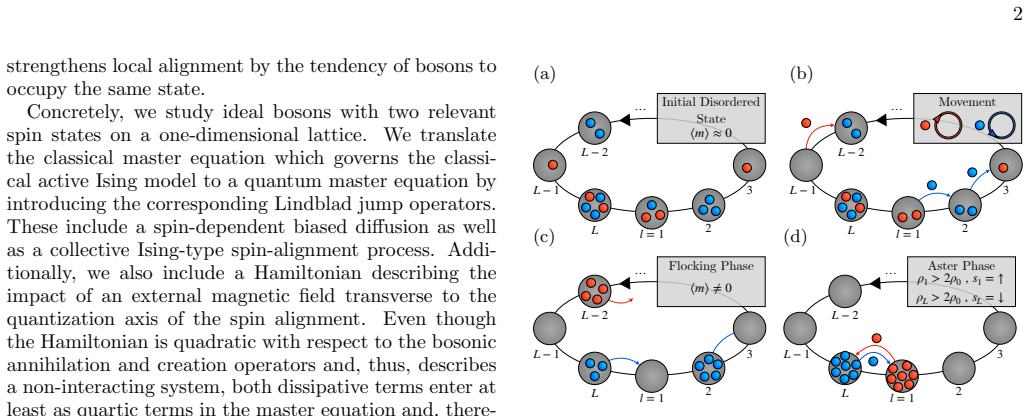
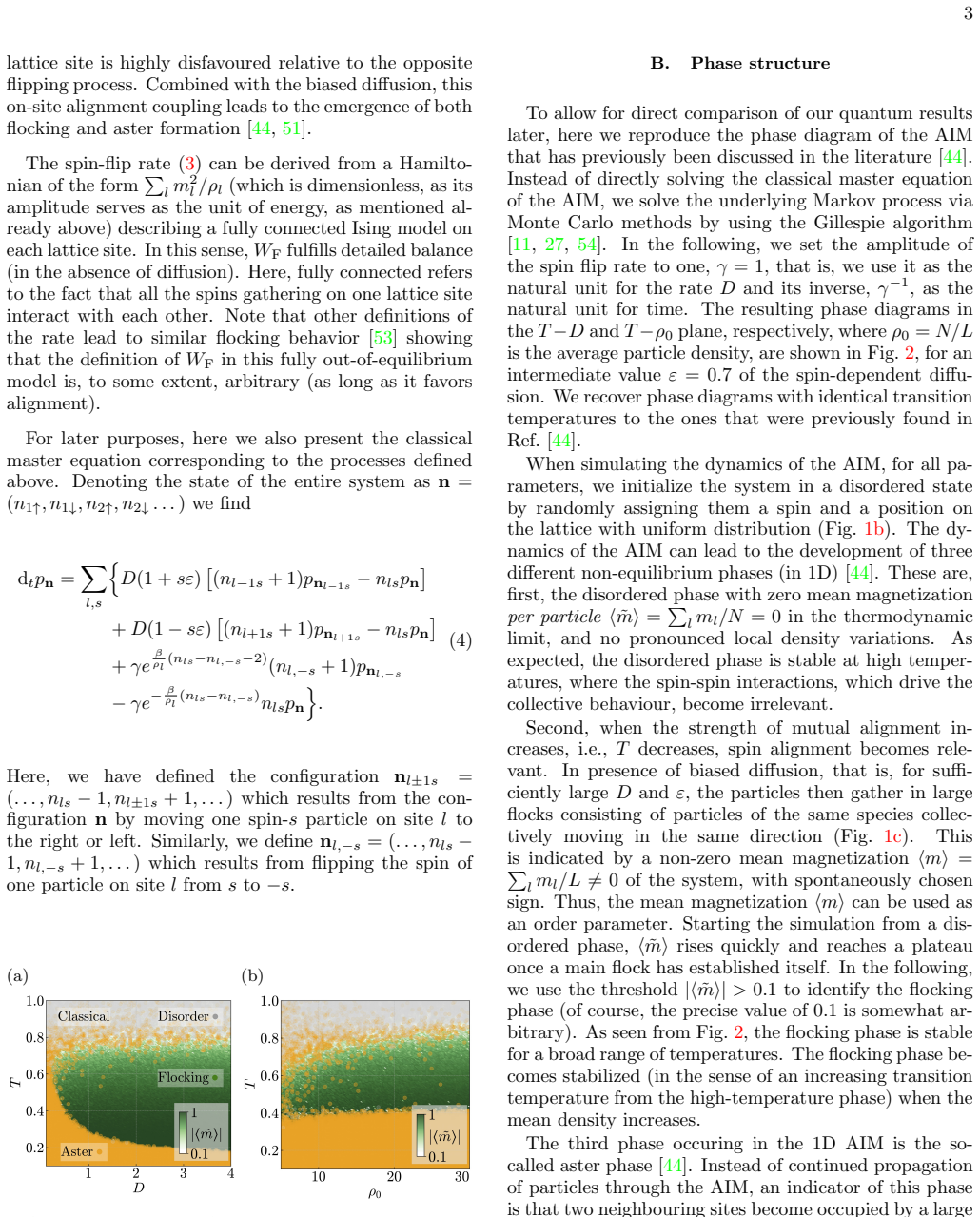
Collective behaviour such as flocking (the collective motion of a spontaneously formed group along a common direction) or aster formation (the binding of opposing flocks, inhibiting each others motion) are intriguing emergent phenomena in active systems with local alignment rules. Until recently, their occurrence was mainly studied for classical systems, a prime example being the active Ising model (AIM), which translates the main ingredients of flocking and aster formation (i.e., alignment and self-propulsion) to a lattice framework. Here we introduce and study a one-dimensional (1D) quantum lattice variant of the AIM, based on ideal bosons with a spin degree of freedom. We find that both the collective behaviours of the 1D classical model, flocking and aster formation, are markedly enhanced by the bosonic quantum statistics. This contrasts with a recent quantum generalization of the AIM based onto hard-core bosons [Khasseh et al., Phys. Rev. Lett. 135, 248302 (2025)], where flocking, but neither its quantum-statistical stabilization nor aster states were observed as a consequence of interactions. Moreover, we investigate the competition of this quantum statistical stabilization of collective phases with their suppression by the quantum fluctuations induced by a transverse external magnetic field.
Editorial analysis
A structured set of objections, weighed in public.
Referee Report
Summary. The manuscript introduces a one-dimensional quantum lattice version of the active Ising model constructed from ideal (non-interacting) bosons carrying a spin degree of freedom. It reports that bosonic quantum statistics produce a marked enhancement of both flocking and aster formation relative to the classical AIM, contrasts this with the hard-core boson variant of Khasseh et al., and examines the competition between this stabilization and suppression by a transverse magnetic field.
Significance. If the reported enhancement survives controls that isolate statistics from occupancy, the result would establish a concrete mechanism by which Bose statistics can stabilize collective phases in active matter, providing a clear point of comparison with both classical and hard-core quantum models.
major comments (2)
- [Model construction (§2)] Model construction (likely §2 or §3): the Hamiltonian and update rules are defined for ideal bosons, which permit arbitrary occupation numbers per site. The classical AIM comparison retains the standard single-occupancy exclusion. No auxiliary classical simulation or analytic limit with unlimited occupancy (while preserving all other alignment and propulsion rules) is presented; without it the attribution of the enhancement specifically to quantum statistics rather than the occupancy constraint remains untested.
- [Results (§4)] Results on flocking and aster states (likely §4): the quantitative measures of enhancement (order parameters, correlation lengths, or phase boundaries) are reported only for the ideal-boson case versus the classical single-occupancy case. A direct comparison to a classical unlimited-occupancy variant is required to establish that the observed difference is load-bearing for the central claim.
minor comments (2)
- [Introduction] The abstract states that the model is 'based on ideal bosons'; a single sentence in the introduction clarifying how the spin-1/2 degree of freedom is attached to the bosonic operators would remove any ambiguity for readers unfamiliar with the construction.
- [Figure captions] Figure captions for the phase diagrams should explicitly state whether the plotted quantities are obtained from exact diagonalization, quantum Monte Carlo, or mean-field theory.
Simulated Author's Rebuttal
We thank the referee for their careful reading and constructive comments. We address each major comment below.
read point-by-point responses
-
Referee: [Model construction (§2)] Model construction (likely §2 or §3): the Hamiltonian and update rules are defined for ideal bosons, which permit arbitrary occupation numbers per site. The classical AIM comparison retains the standard single-occupancy exclusion. No auxiliary classical simulation or analytic limit with unlimited occupancy (while preserving all other alignment and propulsion rules) is presented; without it the attribution of the enhancement specifically to quantum statistics rather than the occupancy constraint remains untested.
Authors: We thank the referee for this observation. The classical AIM is conventionally formulated with single-occupancy exclusion. Our quantum model is defined for ideal bosons, where multiple occupancy follows directly from the bosonic commutation relations and is thus inseparable from the quantum statistics under study. Constructing an auxiliary classical model with unlimited occupancy would require additional, non-standard rules for alignment and self-propulsion among multiple particles on one site, taking the comparison outside the established AIM framework. The contrast with the hard-core boson model (single occupancy enforced quantum-mechanically, no enhancement) supports that the observed stabilization is tied to Bose statistics. We will add a clarifying paragraph in §2 of the revised manuscript. revision: partial
-
Referee: [Results (§4)] Results on flocking and aster states (likely §4): the quantitative measures of enhancement (order parameters, correlation lengths, or phase boundaries) are reported only for the ideal-boson case versus the classical single-occupancy case. A direct comparison to a classical unlimited-occupancy variant is required to establish that the observed difference is load-bearing for the central claim.
Authors: The quantitative comparisons are presented between the ideal-boson case and the standard single-occupancy classical AIM. As explained in our response to the model-construction comment, multiple occupancy is an intrinsic consequence of the bosonic statistics rather than an independent parameter. The absence of comparable stabilization in the hard-core boson variant further indicates that the statistics, not merely occupancy, drive the effect. We therefore maintain that the existing comparisons are sufficient and load-bearing for the central claim. We will expand the discussion in §4 to make this reasoning explicit. revision: partial
Circularity Check
No significant circularity; new model construction is self-contained
full rationale
The paper introduces a novel 1D quantum AIM variant using ideal bosons and reports enhanced flocking/aster formation relative to the classical AIM and a separate hard-core boson model. No equations, fits, or derivations are shown that reduce a claimed prediction to an input parameter by construction, nor any load-bearing self-citations or ansatzes imported from prior author work. The central claim rests on direct comparison of the constructed model, which is independent of the result itself.
Axiom & Free-Parameter Ledger
Reference graph
Works this paper leans on
-
[1]
D X l (1 +ε)D h a† l−1↓al↓ i ρ #! =D (1 +ε) 2 D a† k↑a† k+1↓ak+1↓ak↓ −a † k↑a† k−1↓ak−1↓ak↓ −a † k↑ak↓ E (C9) dt⟨a† k↑ak↓⟩5 =tr a† k↑ak↓
is an interesting question to explore in future work. ACKNOWLEDGMENTS We acknowledge discussions with Hendrik Weimer, Markus Heyl and Michael te Vr¨ ugt. AE and AS acknowl- edge support by the Deutsche Forschungsgemeinschaft (DFG, German Research Foundation) via the Research Unit FOR 5688 (Project No. 521530974). Appendix A: Higher moments in kinetic equa...
-
[2]
Bloch, J
I. Bloch, J. Dalibard, and S. Nascimb` ene, Quantum sim- ulations with ultracold quantum gases, Nature Physics 8, 267 (2012)
2012
-
[3]
Carusotto and C
I. Carusotto and C. Ciuti, Quantum fluids of light, Re- views of Modern Physics85, 299 (2013)
2013
-
[4]
A. Eckardt, Colloquium: Atomic quantum gases in pe- riodically driven optical lattices, Reviews of Modern Physics89, 10.1103/revmodphys.89.011004 (2017)
-
[5]
A. J. Daley, I. Bloch, C. Kokail, S. Flannigan, N. Pearson, M. Troyer, and P. Zoller, Practical quantum advantage in quantum simulation, Nature607, 667 (2022)
2022
-
[6]
Oka and S
T. Oka and S. Kitamura, Floquet engineering of quantum materials, Annual Review of Condensed Matter Physics 10, 387–408 (2019)
2019
-
[7]
J. L. Bohn, A. M. Rey, and J. Ye, Cold molecules: Progress in quantum engineering of chemistry and quan- tum matter, Science357, 1002–1010 (2017)
2017
-
[8]
C. J. Eckhardt, G. Passetti, M. Othman, C. Karrasch, F. Cavaliere, M. A. Sentef, and D. M. Kennes, Quan- tum floquet engineering with an exactly solvable tight- binding chain in a cavity, Communications Physics5, 10.1038/s42005-022-00880-9 (2022)
-
[9]
L. M. Sieberer, M. Buchhold, and S. Diehl, Keldysh field theory for driven open quantum systems, Reports on Progress in Physics79, 096001 (2016)
2016
-
[10]
Bloch, I
J. Bloch, I. Carusotto, and M. Wouters, Non-equilibrium Bose–Einstein condensation in photonic systems, Nature Reviews Physics4, 470 (2022), iSBN: 2522-5820
2022
-
[11]
L. M. Sieberer, M. Buchhold, J. Marino, and S. Diehl, Universality in driven open quantum matter, Reviews of Modern Physics97, 025004 (2025)
2025
-
[12]
Vorberg, W
D. Vorberg, W. Wustmann, H. Schomerus, R. Ketzmer- ick, and A. Eckardt, Nonequilibrium steady states of ideal bosonic and fermionic quantum gases, Phys. Rev. E92, 062119 (2015), publisher: American Physical Society
2015
-
[13]
Leymann, D
H. Leymann, D. Vorberg, T. Lettau, C. Hopfmann, C. Schneider, M. Kamp, S. H¨ ofling, R. Ketzmerick, J. Wiersig, S. Reitzenstein, and A. Eckardt, Pump- Power-Driven Mode Switching in a Microcavity Device and Its Relation to Bose-Einstein Condensation, Physi- 18 cal Review X7, 021045 (2017)
2017
-
[14]
D. A. Lidar, Lecture notes on the theory of open quantum systems (2020), arXiv:1902.00967 [quant-ph]
arXiv 2020
-
[15]
R. P. Rundle, T. Tilma, J. H. Samson, V. M. Dwyer, R. F. Bishop, and M. J. Everitt, General approach to quantum mechanics as a statistical theory, Physical Re- view A99, 10.1103/physreva.99.012115 (2019)
-
[16]
F. Minganti and A. Biella, Open quantum systems – a brief introduction (2024), arXiv:2407.16855 [quant-ph]
arXiv 2024
-
[17]
R. Fazio, J. Keeling, L. Mazza, and M. Schir` o, Many- body open quantum systems, SciPost Physics Lecture Notes 10.21468/scipostphyslectnotes.99 (2025)
-
[18]
P. Sza´ nkowski, Introduction to the theory of open quantum systems, SciPost Physics Lecture Notes 10.21468/scipostphyslectnotes.68 (2023)
-
[19]
Fontaine, D
Q. Fontaine, D. Squizzato, F. Baboux, I. Amelio, A. Lemaˆ ıtre, M. Morassi, I. Sagnes, L. Le Gratiet, A. Harouri, M. Wouters, I. Carusotto, A. Amo, M. Richard, A. Minguzzi, L. Canet, S. Ravets, and J. Bloch, Kardar–Parisi–Zhang universality in a one- dimensional polariton condensate, Nature608, 687 (2022)
2022
-
[20]
Klaers, J
J. Klaers, J. Schmitt, F. Vewinger, and M. Weitz, Bose–Einstein condensation of photons in an optical mi- crocavity, Nature468, 545 (2010)
2010
-
[21]
Vretenar, C
M. Vretenar, C. Toebes, and J. Klaers, Modified Bose- Einstein condensation in an optical quantum gas, Nature Communications12, 5749 (2021)
2021
-
[22]
Krantz, M
P. Krantz, M. Kjaergaard, F. Yan, T. P. Orlando, S. Gus- tavsson, and W. D. Oliver, A quantum engineer’s guide to superconducting qubits, Applied Physics Reviews6, 021318 (2019)
2019
-
[23]
Blais, A
A. Blais, A. L. Grimsmo, S. Girvin, and A. Wallraff, Circuit quantum electrodynamics, Reviews of Modern Physics93, 025005 (2021)
2021
-
[24]
R. Ma, B. Saxberg, C. Owens, N. Leung, Y. Lu, J. Si- mon, and D. I. Schuster, A dissipatively stabilized Mott insulator of photons, Nature566, 51 (2019)
2019
-
[25]
I. T. Rosen, S. Muschinske, C. N. Barrett, A. Chatter- jee, M. Hays, M. A. DeMarco, A. H. Karamlou, D. A. Rower, R. Das, D. K. Kim, B. M. Niedzielski, M. Schuldt, K. Serniak, M. E. Schwartz, J. L. Yoder, J. A. Grover, and W. D. Oliver, A synthetic magnetic vector potential in a 2D superconducting qubit array, Nature Physics20, 1881 (2024)
2024
-
[26]
L. W. Clark, N. Schine, C. Baum, N. Jia, and J. Si- mon, Observation of Laughlin states made of light, Na- ture582, 41 (2020)
2020
-
[27]
Wang, F.-M
C. Wang, F.-M. Liu, M.-C. Chen, H. Chen, X.-H. Zhao, C. Ying, Z.-X. Shang, J.-W. Wang, Y.-H. Huo, C.-Z. Peng, X. Zhu, C.-Y. Lu, and J.-W. Pan, Realization of fractional quantum Hall state with interacting photons, Science384, 579 (2024)
2024
-
[28]
Vorberg, W
D. Vorberg, W. Wustmann, R. Ketzmerick, and A. Eckardt, Generalized bose-einstein condensation into multiple states in driven-dissipative systems, Phys. Rev. Lett.111, 240405 (2013)
2013
-
[29]
Schnell, D
A. Schnell, D. Vorberg, R. Ketzmerick, and A. Eckardt, High-Temperature Nonequilibrium Bose Condensation Induced by a Hot Needle, Phys. Rev. Lett.119, 140602 (2017)
2017
-
[30]
Schnell, R
A. Schnell, R. Ketzmerick, and A. Eckardt, On the num- ber of Bose-selected modes in driven-dissipative ideal Bose gases, Phys. Rev. E97, 032136 (2018), publisher: American Physical Society
2018
-
[31]
Altman, L
E. Altman, L. M. Sieberer, L. Chen, S. Diehl, and J. Toner, Two-Dimensional Superfluidity of Exciton Po- laritons Requires Strong Anisotropy, Physical Review X 5, 011017 (2015)
2015
-
[32]
C. P. Zelle, R. Daviet, A. Rosch, and S. Diehl, Uni- versal Phenomenology at Critical Exceptional Points of Nonequilibrium$\mathrm{O}(N)$Models, Physical Re- view X14, 021052 (2024)
2024
-
[33]
Iadecola, T
T. Iadecola, T. Neupert, and C. Chamon, Occupation of topological Floquet bands in open systems, Phys. Rev. B 91, 235133 (2015)
2015
-
[34]
Shirai, T
T. Shirai, T. Mori, and S. Miyashita, Condition for emer- gence of the Floquet-Gibbs state in periodically driven open systems, Phys. Rev. E91, 030101 (2015)
2015
-
[35]
Shirai, J
T. Shirai, J. Thingna, T. Mori, S. Denisov, P. H¨ anggi, and S. Miyashita, Effective Floquet-Gibbs states for dis- sipativbe quantum systems, New J.\Phys.18, 053008 (2016)
2016
-
[36]
Schnell, C
A. Schnell, C. Weitenberg, and A. Eckardt, Dissipative preparation of a Floquet topological insulator in an opti- cal lattice via bath engineering, SciPost Physics17, 052 (2024)
2024
-
[37]
Petiziol and A
F. Petiziol and A. Eckardt, Cavity-Based Reservoir En- gineering for Floquet-Engineered Superconducting Cir- cuits, Physical Review Letters129, 233601 (2022)
2022
-
[38]
Schnell, L.-N
A. Schnell, L.-N. Wu, A. Widera, and A. Eckardt, Floquet-heating-induced Bose condensation in a scarlike mode of an open driven optical-lattice system, Physical Review A107, L021301 (2023)
2023
-
[39]
V. N. Gladilin and M. Wouters, Vortex-pair annihilation in arrays of photon cavities, Phys. Rev. A105, 013527 (2022)
2022
-
[40]
M. C. Marchetti, J. F. Joanny, S. Ramaswamy, T. B. Liverpool, J. Prost, M. Rao, and R. A. Simha, Hydrody- namics of soft active matter, Reviews of Modern Physics 85, 1143 (2013)
2013
-
[41]
Bechinger, R
C. Bechinger, R. Di Leonardo, H. L¨ owen, C. Reichhardt, G. Volpe, and G. Volpe, Active particles in complex and crowded environments, Reviews of Modern Physics88, 045006 (2016)
2016
-
[42]
Vicsek, A
T. Vicsek, A. Czirok, E. Ben-Jacob, I. Cohen, and O. Shochet, Novel type of phase transition in a system of self-driven particles, Phys. Rev. Lett.75(1995)
1995
-
[43]
A. P. Solon, H. Chat´ e, and J. Tailleur, From Phase to Microphase Separation in Flocking Models: The Essen- tial Role of Nonequilibrium Fluctuations, Physical Re- view Letters114, 068101 (2015)
2015
-
[44]
Chat´ e, Dry Aligning Dilute Active Matter, Annual Review of Condensed Matter Physics11, 189 (2020)
H. Chat´ e, Dry Aligning Dilute Active Matter, Annual Review of Condensed Matter Physics11, 189 (2020)
2020
-
[45]
Benvegnen, H
B. Benvegnen, H. Chat´ e, P. L. Krapivsky, J. Tailleur, and A. Solon, Flocking in one dimension: Asters and reversals, Phys. Rev. E106, 054608 (2022)
2022
-
[46]
M. E. Cates and J. Tailleur, Motility-Induced Phase Sep- aration, Annual Review of Condensed Matter Physics6, 219 (2015)
2015
-
[47]
Bialk´ e, H
J. Bialk´ e, H. L¨ owen, and T. Speck, Microscopic theory for the phase separation of self-propelled repulsive disks, Europhysics Letters103, 30008 (2013)
2013
-
[48]
H. H. Wensink, J. Dunkel, S. Heidenreich, K. Drescher, R. E. Goldstein, H. L¨ owen, , and J. M. Yeomans, Meso- scale turbulence in living fluids, Proc. Natl. Acad. Sci. (USA)109(2012). 19
2012
-
[49]
H. Reinken, S. Heidenreich, M. B¨ ar, and S. H. Klapp, Ising-like critical behavior of vortex lattices in an ac- tive fluid, Physical Review Letters128, 10.1103/phys- revlett.128.048004 (2022)
-
[50]
R. Khasseh, S. Wald, R. Moessner, C. A. Weber, and M. Heyl, Active quantum flocks (2024), arXiv:2308.01603 [quant-ph]
arXiv 2024
-
[51]
A. P. Antonov, Y. Zheng, B. Liebchen, and H. L¨ owen, Engineering active motion in quantum matter, Physical Review Research7, 10.1103/z3gm-32jn (2025)
-
[52]
A. P. Solon and J. Tailleur, Revisiting the Flocking Tran- sition Using Active Spins, Physical Review Letters111, 078101 (2013)
2013
-
[53]
A. P. Solon and J. Tailleur, Flocking with discrete sym- metry: The two-dimensional active ising model, Physical Review E92, 10.1103/physreve.92.042119 (2015)
-
[54]
Scandolo, J
M. Scandolo, J. Pausch, and M. E. Cates, Active Ising Models of flocking: a field-theoretic approach, The Eu- ropean Physical Journal E46, 103 (2023)
2023
-
[55]
Wolff, Collective monte carlo updating for spin sys- tems, Phys
U. Wolff, Collective monte carlo updating for spin sys- tems, Phys. Rev. Lett.62, 361 (1989)
1989
-
[56]
Breuer and F
H.-P. Breuer and F. Petruccione,The Theory of Open Quantum Systems(Oxford University Press, Oxford & New York, 2002)
2002
-
[57]
Weiss,Quantum Dissipative Systems, 4th ed
U. Weiss,Quantum Dissipative Systems, 4th ed. (WORLD SCIENTIFIC, 2012) eprint: https://www.worldscientific.com/doi/pdf/10.1142/8334
-
[58]
S. Bandyopadhyay, S. Chatterjee, A. K. Dutta, M. Kar- makar, H. Rieger, and R. Paul, Ordering kinetics in the active ising model, Physical Review E109, 10.1103/physreve.109.064143 (2024)
-
[59]
Lange, Z
F. Lange, Z. Lenarˇ ciˇ c, and A. Rosch, Pumping approx- imately integrable systems, Nature Communications8, 15767 (2017), publisher: Nature Publishing Group
2017
-
[60]
Fruchart, R
M. Fruchart, R. Hanai, P. B. Littlewood, and V. Vitelli, Non-reciprocal phase transitions, Nature592, 363 (2021)
2021
-
[61]
K. L. Kreienkamp and S. H. L. Klapp, Synchronization and exceptional points in nonreciprocal active polar mix- tures, Communications Physics8, 307 (2025)
2025
discussion (0)
Sign in with ORCID, Apple, or X to comment. Anyone can read and Pith papers without signing in.