Observation of a dominant boldsymbol{0f_(7/2)} neutron configuration in the boldsymbol{³²}Si boldsymbol{J^(π)=5^-} isomeric state
Pith reviewed 2026-06-26 21:36 UTC · model grok-4.3
The pith
The 5^- isomer in 32Si shows a dominant single-neutron 0f7/2 configuration.
A machine-rendered reading of the paper's core claim, the machinery that carries it, and where it could break.
Core claim
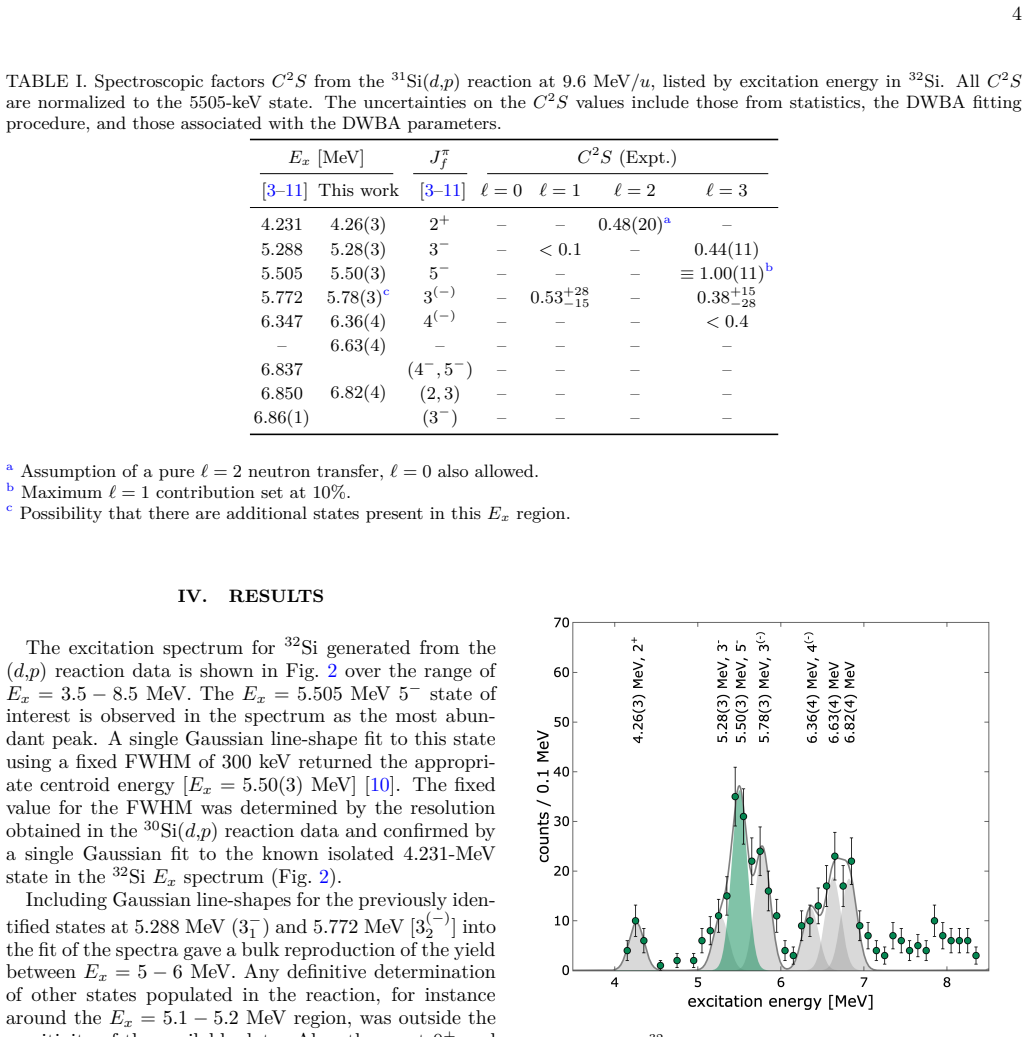
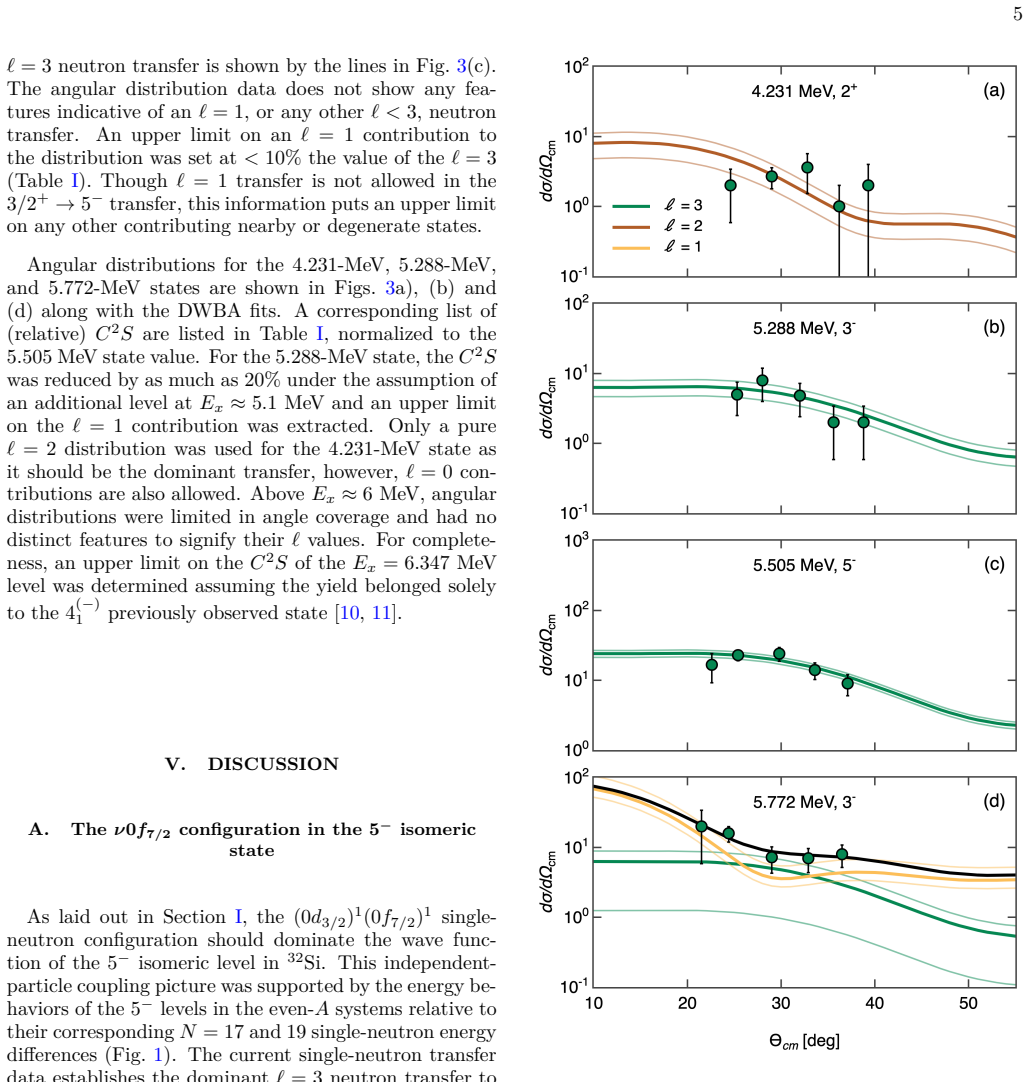
The yrast 5- state in 32Si appears as a dominant ℓ=3 transfer with a relatively large spectroscopic factor in the 31Si(d,p)32Si reaction, confirming its single-particle ν0f7/2 character. The yrast 3- level shows a reduced ℓ=3 spectroscopic factor of approximately 0.44 compared with the 5-1 level. The hindrance of the 5-1 to 3-1 E3 transition is therefore not primarily due to differing neutron-structure overlaps; instead the lack of participation by both protons and neutrons is proposed as the mechanism that reduces the transition strength.
What carries the argument
Spectroscopic factors for ℓ=3 neutron transfer extracted via DWBA analysis of the 31Si(d,p)32Si reaction at 9.6 MeV/u.
If this is right
- The E3 hindrance in 32Si is explained by minimal proton and neutron participation in the transition.
- The neutron-structure difference between the 5- and 3- states is not the main cause of the reduced transition strength.
- The same spectroscopic-factor pattern appears in 34S, yet that nucleus shows a much stronger 5- to 3- E2 transition.
Where Pith is reading between the lines
- Shell-model calculations that include explicit proton excitations may be needed to reproduce the observed transition rates.
- Similar transfer-reaction studies on neighboring even-even nuclei could test whether proton inactivity is a general cause of hindered E3 decays in this mass region.
- The single-particle assignment for the 5- isomer supplies a benchmark for testing effective interactions near the N=20 shell closure.
Load-bearing premise
The spectroscopic factors obtained from the DWBA analysis accurately reflect the single-particle neutron strengths without large multi-step reaction contributions or configuration mixing.
What would settle it
A measurement or shell-model result showing that the 5- to 3- E3 matrix element is dominated by neutron overlap differences rather than by simultaneous proton and neutron inactivity.
Figures
read the original abstract
An yrast, $J^{\pi}=5^-$, spin-trap isomer has been previously identified in $^{32}$Si. The isomeric state decays predominantly via a hindered $E3$ transition [B($E3$) = 0.0841(10)~W.u.], bypassing a nearby $E2$ decay path to the first excited $3^-$ level. The single-neutron aspects of these negative parity levels were investigated via the $^{31}$Si$(d$,$p)^{32}$Si reaction at 9.6~MeV/$u$ using HELIOS and the ATLAS in-flight facility. The $5^-$ state appears as a dominant $\ell=3$ transfer with a relatively large spectroscopic factor, confirming its single-particle $\nu0f_{7/2}$ character. The yrast $3^-$ level had a reduced $\ell=3$ spectroscopic factor of $\approx$ 0.44 compared to that of the $5^-_1$ level. This is similar to the situation observed in nearby $^{34}$S which by contrast has a measured B($E2, 5^-\rightarrow 3^-$) transition strength closer to 1~W.u.. It has been concluded that the hinderance of the $5^-_1\rightarrow 3^-_1$ transition in $^{32}$Si is not primarily due to the differing overlaps in the neutron structure. Instead, the lack of participation by both the protons and the neutrons in the transition is proposed as the transition-strength reduction mechanism.
Editorial analysis
A structured set of objections, weighed in public.
Referee Report
Summary. The manuscript reports results from the 31Si(d,p)32Si reaction at 9.6 MeV/u using HELIOS, finding that the 5- isomeric state in 32Si is populated via dominant ℓ=3 transfer with a relatively large spectroscopic factor, confirming its ν0f7/2 neutron character. The yrast 3- state shows a reduced ℓ=3 spectroscopic factor of ≈0.44 relative to the 5- state. By comparison to 34S (where the analogous E3 transition is stronger), the authors conclude that the observed E3 hindrance [B(E3)=0.0841(10) W.u.] in 32Si is not due to neutron overlap differences but instead arises from lack of participation by both protons and neutrons in the transition.
Significance. If the spectroscopic factors hold, the work provides useful experimental constraints on the single-particle structure of negative-parity states in 32Si and identifies proton configuration effects as the likely origin of E3 hindrance, which can benchmark shell-model predictions in the sd-fp region. The inverse-kinematics approach with a radioactive beam is a positive aspect of the experimental design.
major comments (1)
- The central claim—that the 5- state has dominant ν0f7/2 character and that neutron overlaps are not the primary cause of the E3 hindrance—depends on the relative spectroscopic factors extracted from DWBA analysis of the (d,p) data. The reaction energy of 9.6 MeV/u lies at the lower end of the regime where single-step DWBA is typically reliable; multi-step or compound contributions are not discussed and could distort the angular distributions and the apparent ℓ=3 strengths. This is load-bearing for the interpretation and the comparison to 34S.
Simulated Author's Rebuttal
We thank the referee for their review and for recognizing the value of the inverse-kinematics transfer data. We address the single major comment below.
read point-by-point responses
-
Referee: The central claim—that the 5- state has dominant ν0f7/2 character and that neutron overlaps are not the primary cause of the E3 hindrance—depends on the relative spectroscopic factors extracted from DWBA analysis of the (d,p) data. The reaction energy of 9.6 MeV/u lies at the lower end of the regime where single-step DWBA is typically reliable; multi-step or compound contributions are not discussed and could distort the angular distributions and the apparent ℓ=3 strengths. This is load-bearing for the interpretation and the comparison to 34S.
Authors: We acknowledge that 9.6 MeV/u is toward the lower end of energies commonly used for (d,p) DWBA analyses and that the manuscript does not explicitly discuss possible multi-step or compound-nucleus contributions. The observed angular distributions for the 5− state are nevertheless well described by standard single-step DWBA calculations for ℓ=3 transfer using global optical potentials, with no obvious signatures of significant multi-step feeding. The same DWBA framework was applied to both 32Si and the comparison nucleus 34S, so the relative spectroscopic factors remain the basis for the structural interpretation. In the revised manuscript we will add a dedicated paragraph in the analysis section that (i) justifies the applicability of DWBA at this energy by reference to prior (d,p) work in the sd–fp region at comparable beam energies, (ii) notes the quality of the ℓ=3 fits, and (iii) briefly addresses the absence of evidence for compound or multi-step processes in the present data set. This addition will strengthen the manuscript without altering the central conclusions. revision: partial
Circularity Check
No circularity: spectroscopic factors extracted from independent reaction data
full rationale
The paper's central claims rest on new experimental cross-section measurements from the 31Si(d,p)32Si reaction at 9.6 MeV/u, followed by standard DWBA analysis to obtain ℓ=3 spectroscopic factors for the 5^- and 3^- states. These values are then compared to the known B(E3) hindrance in 32Si and the contrasting B(E2) strength in 34S. No equation or step defines a quantity in terms of the target conclusion, renames a fit as a prediction, or reduces the interpretation to a self-citation chain. The analysis is self-contained against external benchmarks (measured angular distributions and prior transition rates) with no load-bearing self-referential steps.
Axiom & Free-Parameter Ledger
axioms (1)
- domain assumption Distorted-wave Born approximation reliably extracts spectroscopic factors for this (d,p) reaction on a light target at 9.6 MeV/u.
Reference graph
Works this paper leans on
-
[1]
(b) The 0f 7/2−0d3/2 single-neutron energy centroid differences in the odd-N,N= 17 andN= 19 isotones [18–22]
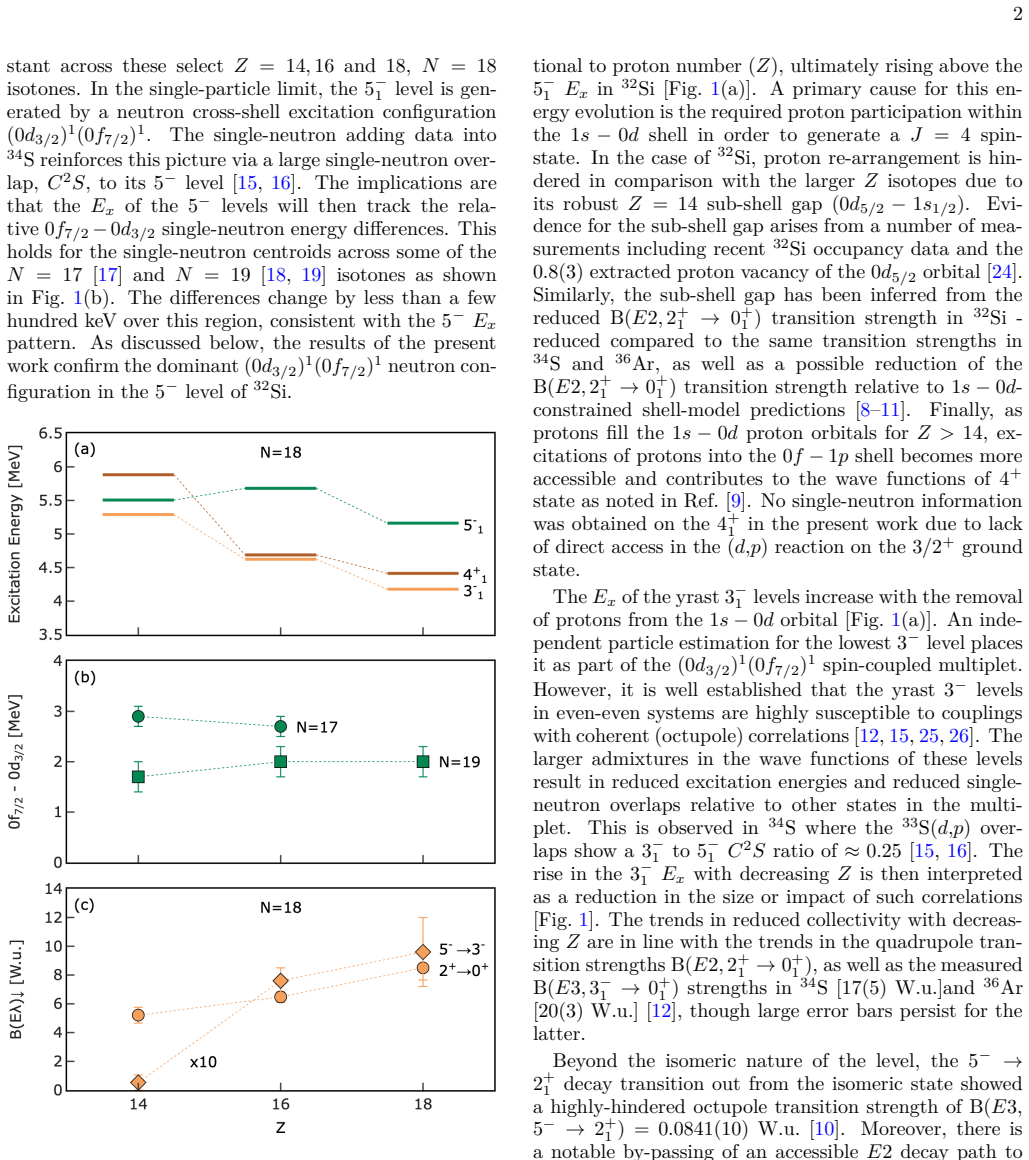
and 36Ar (Z= 18). (b) The 0f 7/2−0d3/2 single-neutron energy centroid differences in the odd-N,N= 17 andN= 19 isotones [18–22]. (c) The 2 + 1 to ground state [B(E2,2 + 1 → 0+ 1 )] and 5 − 1 to 3− 1 [B(E2,5− 1 →3− 1 )] quadrupole transition strengths in theN= 18 even-even systems in Weisskopf units (W.u.) [13, 23]. Note that the B(E2,5 −→3−) include a fact...
-
[2]
Lindner, New Nuclides Produced in Chlorine Spalla- tion, Phys
M. Lindner, New Nuclides Produced in Chlorine Spalla- tion, Phys. Rev.91, 642 (1953)
1953
-
[3]
Thoennessen, Discovery of the Isotopes with 11≤ Z≤19, Atomic Data and Nuclear Data Tables98, 933 (2012)
M. Thoennessen, Discovery of the Isotopes with 11≤ Z≤19, Atomic Data and Nuclear Data Tables98, 933 (2012)
2012
-
[4]
H. T. Fortune, L. Bland, D. L. Watson, and M. A. Abouzeid, 32Si from 30Si(t,p), Phys. Rev. C25, 5 (1982)
1982
-
[5]
Fornal, R
B. Fornal, R. Broda, W. Kr´ olas, T. Paw/suppress lat, J. Wrzesi´ nski, D. Bazzacco, D. Fabris, S. Lunardi, C. Rossi Alvarez, G. Viesti, G. de Angelis, M. Cinausero, D. R. Napoli, and Z. W. Grabowski,γ-ray studies of neutron-rich N = 18,19 nuclei produced in deep-inelastic collisions, Phys. Rev. C55, 762 (1997)
1997
-
[6]
J. G. Pronko and R. E. McDonald, Study of 32Si using the 30Si(t,pγ) reaction, Phys. Rev. C6, 2065 (1972)
2065
-
[7]
Guillaume, B
G. Guillaume, B. Rastegar, P. Fintz, and A. Gallmann, Transitions ´ electromagn´ etiques dans le noyau32Si atteint par la r´ eaction 30Si(t,pγ)32Si, Nucl. Phys. A227, 284 (1974)
1974
-
[8]
A. Paul, S. R¨ ottger, A. Zimbal, and U. Keyser, Prompt (n,γ) mass measurements for the avogadro project, Hy- perfine Interactions132, 189 (2001)
2001
-
[9]
Heery, J
J. Heery, J. Henderson, C. R. Hoffman, A. M. Hill, T. Beck, C. Cousins, P. Farris, A. Gade, S. A. Gillespie, J. D. Holt, B. Hu, H. Iwasaki, S. Kisyov, A. N. Kuchera, B. Longfellow, C. M¨ uller-Gatermann, A. Poves, E. Ru- bino, R. Russell, R. Salinas, A. Sanchez, D. Weisshaar, C. Y. Wu, and J. Wu, Suppressed electric quadrupole collectivity in 32Si, Phys. ...
2024
-
[10]
Williams, G
J. Williams, G. Hackman, K. Starosta, R. S. Lubna, P. Choudhary, P. C. Srivastava, C. Andreoiu, D. An- nen, H. Asch, M. D. H. K. G. Badanage, G. C. Ball, M. Beuschlein, H. Bidaman, V. Bildstein, R. Coleman, A. B. Garnsworthy, B. Greaves, G. Leckenby, V. Karay- onchev, M. S. Martin, C. Natzke, C. M. Petrache, A. Radich, E. Raleigh-Smith, D. Rhodes, R. Russ...
2023
-
[11]
Williams, G
J. Williams, G. Hackman, K. Starosta, R. S. Lubna, P. Choudhary, S. Sahoo, P. C. Srivastava, C. Andreoiu, D. Annen, H. Asch, M. D. H. K. G. Badanage, G. C. Ball, M. Beuschlein, H. Bidaman, V. Bildstein, R. Cole- man, A. B. Garnsworthy, B. Greaves, G. Leckenby, V. Karayonchev, M. S. Martin, C. Natzke, C. M. Petra- che, A. Radich, E. Raleigh-Smith, D. Rhode...
2025
-
[12]
Williams, G
J. Williams, G. Hackman, K. Starosta, R. S. Lubna, P. Choudhary, S. Sahoo, P. C. Srivastava, C. Andreoiu, D. Annen, H. Asch, M. D. H. K. G. Badanage, G. C. Ball, M. Beuschlein, H. Bidaman, V. Bildstein, R. J. Coleman, A. B. Garnsworthy, B. Greaves, G. Leckenby, V. Karayonchev, M. S. Martin, C. Natzke, C. M. Petra- che, A. Radich, E. Raleigh-Smith, D. Rhod...
2025
-
[13]
Kib´ edi and R
T. Kib´ edi and R. H. Spear, Electric octupole (E3) tran- sition probabilities in nuclei, Atomic Data and Nuclear Data Tables80, 35 (2002)
2002
-
[14]
M. W. Greene, J. A. Kuehner, G. C. Ball, C. Broude, and J. S. Forster, Lifetime of the 5.69 Mev 5 −level in 34S, Nucl. Phys. A188, 83 (1972)
1972
-
[15]
Piskoˇ r, J
ˇS. Piskoˇ r, J. Nov´ ak, E.ˇSimeˇ ckov´ a, J. Cejpek, V. Kroha, J. Dobeˇ s, and P. Navr´ atil, A study of the 30Si(d,p)31Si reaction, Nucl. Phys. A662, 112 (2000)
2000
-
[16]
D. J. Crozier, Energy levels of 34S from the 33S(d,p)34S reaction, Nucl. Phys. A198, 209 (1972)
1972
-
[17]
J. G. Van Der Baan and B. R. Sikora, Investigation of the 33S(d,p)34S reaction, Nuclear Physics A173, 456 (1971)
1971
-
[18]
P. T. MacGregor, D. K. Sharp, S. J. Freeman, C. R. Hoff- man, B. P. Kay, T. L. Tang, L. P. Gaffney, E. F. Baader, M. J. G. Borge, P. A. Butler, W. N. Catford, B. D. Crop- per, G. de Angelis, J. Konki, T. Kr¨ oll, M. Labiche, I. H. Lazarus, R. S. Lubna, I. Martel, D. G. McNeel, R. D. Page, O. Poleshchuk, R. Raabe, F. Recchia, and J. Yang, Evolution of sing...
2021
-
[19]
J. Chen, B. P. Kay, C. R. Hoffman, T. L. Tang, I. A. Tolstukhin, D. Bazin, R. S. Lubna, Y. Ayyad, S. Beceiro- Novo, B. J. Coombes, S. J. Freeman, L. P. Gaffney, R. Garg, H. Jayatissa, A. N. Kuchera, P. MacGregor, A. J. Mitchell, W. Mittig, B. Monteagudo, A. Munoz- Ramos, C. M¨ uller-Gatermann, F. Recchia, N. Rijal, C. Santamaria, M. Z. Serikow, D. K. Shar...
2024
-
[20]
A. N. Kuchera, C. R. Hoffman, G. Ryan, I. B. D’Amato, O. M. Guarinello, P. S. Kielb, R. Aggarwal, S. Ajayi, A. L. Conley, I. Conroy, P. D. Cottle, J. C. Esparza, S. Genty, K. Hanselman, M. Heinze, D. Houlihan, B. Kelly, M. I. Khawaja, E. Lopez-Saavedra, G. W. McCann, A. B. Morelock, L. A. Riley, A. Sandrik, V. Sitaraman, M. Spieker, E. Temanson, C. Wibiso...
2024
-
[21]
Burgunder, O
G. Burgunder, O. Sorlin, F. Nowacki, S. Giron, F. Ham- mache, M. Moukaddam, N. de S´ er´ eville, D. Beaumel, L. C` aceres, E. Cl´ ement, G. Duchˆ ene, J. P. Ebran, B. Fernandez-Dominguez, F. Flavigny, S. Franchoo, J. Gibelin, A. Gillibert, S. Gr´ evy, J. Guillot, A. Le- pailleur, I. Matea, A. Matta, L. Nalpas, A. Obertelli, T. Otsuka, J. Pancin, A. Poves,...
2014
-
[22]
Eckle, H
G. Eckle, H. Kader, H. Clement, F. J. Eckle, F. Merz, R. Hertenberger, H. J. Maier, P. Schiemenz, and G. Graw, A 36S(d,p) study with high energy resolution, Nucl. Phys. A491, 205 (1989)
1989
-
[23]
M. C. Mermaz, C. A. Whitten, J. W. Champlin, A. J. Howard, and D. A. Bromley, Study of the (d,p) reaction on 28Si, 32S, and 36Ar atE d = 18.00 MeV, Phys. Rev. C 4, 1778 (1971)
1971
-
[24]
Raman, C
S. Raman, C. Nestor Jr., and P. Tikkanen, Transition probability from the ground to the first-excited 2 + state of even–even nuclides, At. Data Nucl. Data Tables78, 1 (2001)
2001
-
[25]
Watwood, C
N. Watwood, C. R. Hoffman, B. P. Kay, I. A. Tolstukhin, J. Chen, T. L. Tang, D. Bazin, Y. Ayyad, S. Beceiro- Novo, S. J. Freeman, L. P. Gaffney, R. Garg, H. Jay- atissa, A. N. Kuchera, P. T. MacGregor, A. J. Mitchell, A. Mu˜ noz Ramos, C. M¨ uller-Gatermann, F. Recchia, C. Santamaria, M. Z. Serikow, D. K. Sharp, G. L. Wil- son, A. H. Wuosmaa, and J. C. Za...
2025
-
[26]
Bohr and B
A. Bohr and B. R. Mottelson,Nuclear Structure: Nuclear Deformations, Vol. 2 (Benjamin, Reading, MA, 1975)
1975
-
[27]
R. H. Spear, Reduced electric-octupole transition proba- bilities,B(E3; 0 +→3− 1 ), for even-even nuclides through- out the periodic table, Atomic Data and Nuclear Data Tables42, 55 (1989)
1989
-
[28]
R. S. Lubna, K. Kravvaris, S. L. Tabor, V. Tripathi, E. Rubino, and A. Volya, Evolution of the N = 20 and 28 shell gaps and two-particle-two-hole states in the FSU interaction, Phys. Rev. Research2, 043342 (2020)
2020
-
[29]
R. S. Lubna, A. B. Garnsworthy, V. Tripathi, G. C. Ball, C. R. Natzke, M. Rocchini, C. Andreoiu, S. S. Bhattacharjee, I. Dillmann, F. H. Garcia, S. A. Gille- spie, G. Hackman, C. J. Griffin, G. Leckenby, T. Miyagi, B. Olaizola, C. Porzio, M. M. Rajabali, Y. Saito, P. Spag- noletti, S. L. Tabor, R. Umashankar, V. Vedia, A. Volya, J. Williams, and D. Yates,...
2024
-
[30]
Hoffman, T
C. Hoffman, T. Tang, M. A vila, Y. Ayyad, K. Brown, J. Chen, K. Chipps, H. Jayatissa, B. Kay, C. M¨ uller- Gatermann, H. Ong, J. Song, and G. Wilson, In-flight production of an isomeric beam of 16N, Nucl. Instrum. Meth. A1032, 166612 (2022)
2022
-
[31]
K. Rehm, J. Greene, B. Harss, D. Henderson, C. Jiang, R. Pardo, B. Zabransky, and M. Paul, Gas cell targets for experiments with radioactive beams, Nucl. Instrum. Meth. A647, 3 (2011)
2011
-
[32]
A. H. Wuosmaa, J. P. Schiffer, B. B. Back, C. J. Lister, and K. E. Rehm, A solenoidal spectrometer for reactions in inverse kinematics, Nucl. Instrum. Meth. A580, 1290 (2007)
2007
-
[33]
J. C. Lighthall, B. B. Back, S. I. Baker, S. J. Freeman, H. Y. Lee, B. P. Kay, S. T. Marley, K. E. Rehm, J. E. Rohrer, J. P. Schiffer, D. V. Shetty, A. W. Vann, J. R. Winkelbauer, and A. H. Wuosmaa, Commissioning of the HELIOS spectrometer, Nucl. Instrum. Meth. A622, 97 (2010)
2010
-
[34]
C. R. Hoffman, B. B. Back, B. P. Kay, J. P. Schiffer, M. Alcorta, S. I. Baker, S. Bedoor, P. F. Bertone, J. A. Clark, C. M. Deibel, B. DiGiovine, S. J. Freeman, J. P. Greene, J. C. Lighthall, S. T. Marley, R. C. Pardo, K. E. Rehm, A. Rojas, D. Santiago-Gonzalez, D. K. Sharp, 9 D. V. Shetty, J. S. Thomas, I. Wiedenh¨ over, and A. H. Wuosmaa, Experimental s...
2012
-
[35]
M. H. Macfarlane and S. C. Pieper, Ptolemy: A pro- gram for heavy-ion direct-reaction calculations (1978), Argonne National Laboratory Report ANL-76-11, Rev. 1
1978
-
[36]
An and C
H. An and C. Cai, Global deuteron optical model poten- tial for the energy range up to 183 MeV, Phys. Rev. C 73, 054605 (2006)
2006
-
[37]
A. J. Koning and J. P. Delaroche, Local and global nu- cleon optical models from 1 keV to 200 MeV, Nucl. Phys. A713, 231 (2003)
2003
-
[38]
C. M. Perey and F. G. Perey, Deuteron optical-model analysis in the range of 11 to 27 MeV, Phys. Rev.132, 755 (1963)
1963
-
[39]
F. G. Perey, Optical-model analysis of proton elastic scat- tering in the range of 9 to 22 MeV, Phys. Rev.131, 745 (1963)
1963
-
[40]
R. B. Wiringa, V. G. J. Stoks, and R. Schiavilla, Accu- rate nucleon-nucleon potential with charge-independence breaking, Phys. Rev. C51, 38 (1995)
1995
-
[41]
R. W. Ibbotson, T. Glasmacher, B. A. Brown, L. Chen, M. J. DeCola, D. E. Groh, M. Honma, C. Jewell, K. W. Kemper, P. F. Mantica, D. Miller, W. F. Mueller, T. Ot- suka, L. A. Riley, and M. Weber, Quadrupole collectivity in 32Mg, Phys. Rev. Lett.80, 2081 (1998)
2081
-
[42]
P. W. M. Glaudemans, P. M. Endt, and A. E. L. Dieperink, Many-particle shell model calculation of elec- tromagnetic transition rates and multipole moments in A= 30–34 nuclei, Ann. Phys. (N.Y.)63, 134 (1971)
1971
-
[43]
Mackh, H
H. Mackh, H. Oeschler, G. J. Wagner, D. Dehnhard, and H. Ohnuma, Energy levels in 30Si from the 29Si(d, p) 30Si reaction, Nucl. Phys. A202, 497 (1973)
1973
-
[44]
A. M. Baxter, J. A. Kuehner, D. T. Petty, and J. M. O’Donnell, Gamma-ray spectroscopy in 30Si, Phys. Rev. C2, 320 (1970)
1970
-
[45]
A. M. Bernstein, V. R. Brown, and V. A. Madsen, Isospin decomposition of nuclear multipole matrix elements from γdecay rates of mirror transitions: Test of values ob- tained with hadronic probes, Phys. Rev. Lett.42, 425 (1979)
1979
-
[46]
Mutschler, A
A. Mutschler, A. Lemasson, O. Sorlin, D. Bazin, C. Borcea, R. Borcea, Z. Dombr´ adi, J. P. Ebran, A. Gade, H. Iwasaki, E. Khan, A. Lepailleur, F. Recchia, T. Roger, F. Rotaru, D. Sohler, M. Stanoiu, S. R. Stroberg, J. A. Tostevin, M. Vandebrouck, D. Weisshaar, and K. Wim- mer, A proton density bubble in the doubly magic 34Si nucleus, Nature Physics13, 152 (2017)
2017
-
[47]
Baumann, A
P. Baumann, A. Huck, G. Klotz, A. Knipper, G. Walter, G. Marguier, H. L. Ravn, C. Richard-Serre, A. Poves, and J. Retamosa, 34Si: A new doubly magic nucleus?, Phys. Lett. B228, 458 (1989)
1989
-
[48]
Nummela, P
S. Nummela, P. Baumann, E. Caurier, P. Dessagne, A. Jokinen, A. Knipper, G. Le Scornet, C. Mieh´ e, F. Nowacki, M. Oinonen, Z. Radivojevic, M. Ramdhane, G. Walter, and J. ¨Ayst¨ o, Spectroscopy of34,35Si byβde- cay:sd−fpshell gap and single-particle states, Phys. Rev. C63, 044316 (2001)
2001
-
[49]
Paschalis, P
S. Paschalis, P. Fallon, A. O. Macchiavelli, R. M. Clark, H. L. Crawford, C. J. Lister, R. Vondrasek, D. Bazin, J. S. Berryman, C. A. Bertulani, B. A. Brown, C. M. Campbell, M. P. Carpenter, R. Chapman, P. Chowdhury, A. Gade, T. Glasmacher, J. P. Greene, A. A. Hecht, C. R. Hoffman, R. V. F. Janssens, B. P. Kay, T. Lauritsen, C. Nair, H. J. Ong, W. Reviol,...
2011
-
[50]
Rotaru, F
F. Rotaru, F. Negoita, S. Gr´ evy, J. Mrazek, S. Lukyanov, F. Nowacki, A. Poves, O. Sorlin, C. Borcea, R. Borcea, A. Buta, L. C´ aceres, S. Calinescu, R. Chevrier, Z. Dombr´ adi, J. M. Daugas, D. Lebhertz, Y. Penionzhke- vich, C. Petrone, D. Sohler, M. Stanoiu, and J. C. Thomas, Unveiling the intruder deformed 0 + 2 state in 34Si, Phys. Rev. Lett.109, 092...
2012
-
[51]
Lic˘ a, F
R. Lic˘ a, F. Rotaru, M. J. G. Borge, S. Gr´ evy, F. Negoit ¸˘ a, A. Poves, O. Sorlin, A. N. Andreyev, R. Borcea, C. Costache, H. De Witte, L. M. Fraile, P. T. Greenlees, M. Huyse, A. Ionescu, S. Kisyov, J. Konki, I. Lazarus, M. Madurga, N. M˘ arginean, R. M˘ arginean, C. Mi- hai, R. E. Mihai, A. Negret, F. Nowacki, R. D. Page, J. Pakarinen, V. Pucknell, ...
2019
-
[52]
Grocutt, R
L. Grocutt, R. Chapman, M. Bouhelal, F. Haas, A. Goas- duff, J. F. Smith, R. S. Lubna, S. Courtin, D. Bazza- cco, T. Braunroth, L. Capponi, L. Corradi, X. Derkx, P. Desesquelles, M. Doncel, E. Fioretto, A. Gottardo, V. Liberati, B. Melon, D. Mengoni, C. Michelagnoli, T. Mijatovi´ c, V. Modamio, G. Montagnoli, D. Montanari, K. F. Mulholland, D. R. Napoli, ...
2022
-
[53]
Rudolph, C
D. Rudolph, C. Baktash, J. Dobaczewski, W. Nazarewicz, W. Satula, M. Devlin, D. R. Hart- ley, D. R. LaFosse, F. Lerma, D. G. Sarantites, A. V. Afanasjev, M. P. Carpenter, T. Lauritsen, A. O. Mac- chiavelli, C. E. Svensson, C. Andreoiu, M. Axiotis, E. Farnea, A. Gadea, D. R. Napoli, and G. de Angelis, Spherical and deformed high-spin states in 38Ar, Phys. ...
2002
-
[54]
G. A. P. Engelbertink, K. W. Jones, J. W. Olness, and E. K. Warburton, Lifetime of the 5−, 4585 keV 38Ar level, Phys. Lett. B33B, 353 (1970)
1970
-
[55]
J. J. Kolata, Investigation of high-spin states in 38Ar, Phys. Rev. C13, 1944 (1976)
1944
discussion (0)
Sign in with ORCID, Apple, or X to comment. Anyone can read and Pith papers without signing in.