Revisiting the Exo-Mercury Candidate GJ 367 b with ESPRESSO and a Self-Consistent Tidal Distortion Model
Pith reviewed 2026-06-26 22:21 UTC · model grok-4.3
The pith
Revised mass and radius measurements show GJ 367 b has a 50-70 percent iron fraction, matching Mercury rather than nearly pure iron.
A machine-rendered reading of the paper's core claim, the machinery that carries it, and where it could break.
Core claim
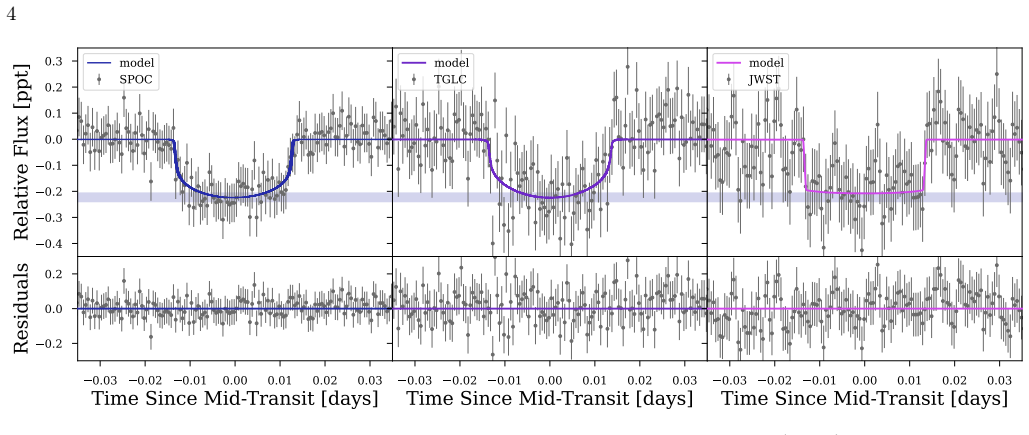
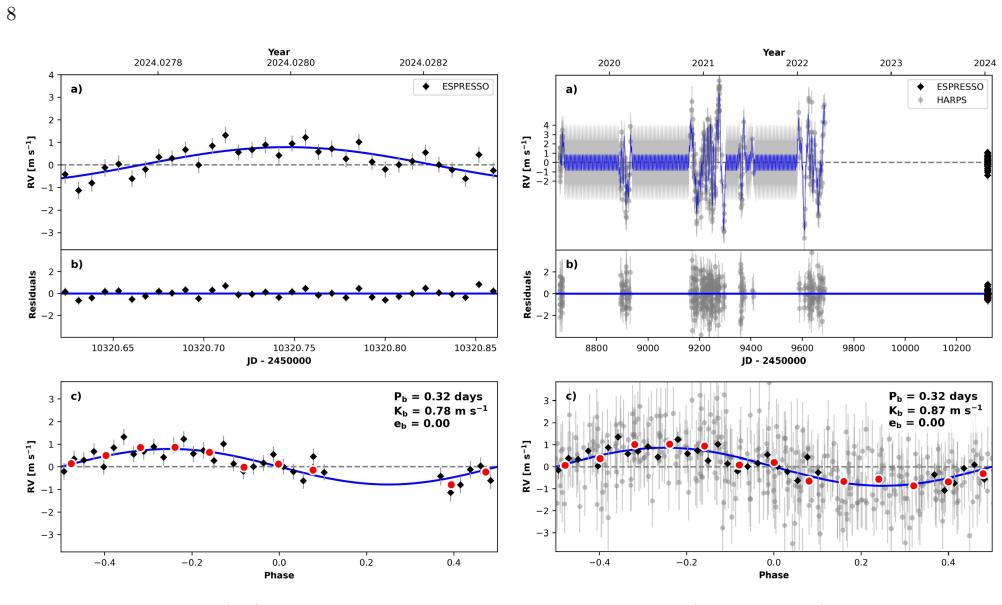
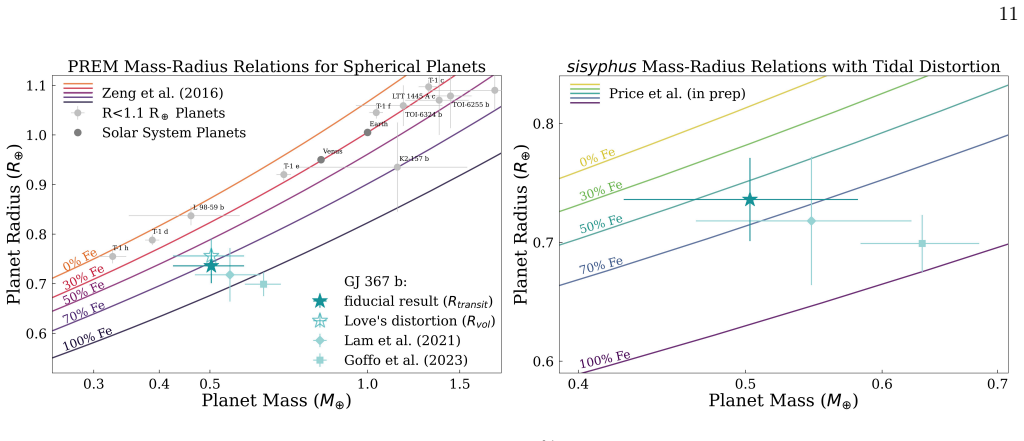
We report a radius of 0.736 +/- 0.035 Earth radii from TESS photometry and a mass of 0.503 +/- 0.078 Earth masses from ESPRESSO radial velocities, giving a density of 6.9 +1.6/-1.4 g cm^{-3}. Using a new self-consistent tidal distortion and interior composition framework, and considering multiple interior assumptions and radial aspect ratios, the iron fraction is found to be approximately 50-70 percent, broadly consistent with Mercury and lower than prior estimates that approached solid iron.
What carries the argument
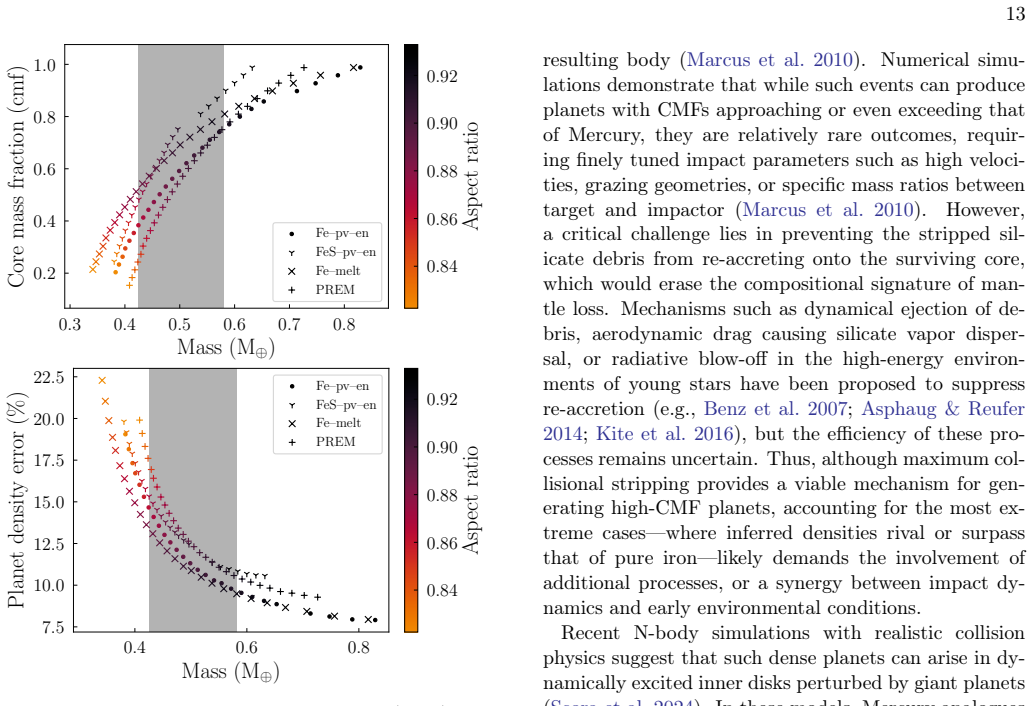
A self-consistent tidal distortion and interior composition modeling framework that evaluates iron mass fraction from assumed compositions and radial aspect ratios while incorporating the planet's distorted shape.
If this is right
- GJ 367 b's bulk density is lower than earlier reports that placed it near solid iron.
- Standard planet formation scenarios face reduced tension from this object's composition.
- The iron fraction of 50-70 percent matches Mercury across varied interior assumptions.
- Accounting for tidal distortion is necessary to avoid overestimating iron content in ultra-short-period planets.
Where Pith is reading between the lines
- Similar tidal modeling could revise density estimates for other ultra-short-period planets around M dwarfs.
- If the framework holds, Mercury-like iron fractions may be common rather than exceptional among the closest-in planets.
- Future multi-planet system studies could test whether this composition pattern correlates with orbital architecture.
Load-bearing premise
The tidal distortion and interior composition model accurately determines the planet's shape and density without leftover effects from photometric dilution, stellar activity, or unmodeled radial velocity signals.
What would settle it
An independent measurement yielding a bulk density above 9 g cm^{-3} or an iron fraction above 80 percent under the same modeling assumptions would contradict the revised composition range.
Figures
read the original abstract
We report revised mass and radius measurements for GJ 367 b, an ultra-short-period (7.7 hr) sub-Earth in a multi-planet system orbiting a nearby (~9 pc) M dwarf host. Previous mass and radius measurements have suggested GJ 367 b has an anomalously high bulk density, close to that of solid iron. The existence of such an iron-rich planet is in tension with established planet formation scenarios. We utilized newly available TESS short-cadence photometry to constrain the radius of GJ 367 b to 0.736 +/- 0.035 R_Earth. We consider observational and modeling effects such as photometric dilution, stellar activity, and tidal distortion to account for possible inaccuracies in the star and planet radius measurements. From our radial velocity (RV) analysis using VLT/ESPRESSO data covering nearly the full orbit in a single night, we find a mass of 0.503 +/- 0.078 M_Earth, corresponding to a bulk density of 6.9 +1.6/-1.4 g cm-1. We present a new tidal distortion and interior composition modeling framework to assess the iron mass fraction of GJ 367 b. Considering several different interior composition assumptions and radial aspect ratios, we find an iron fraction of ~50-70%, which is broadly consistent with that of Mercury and not as iron rich as previously suggested.
Editorial analysis
A structured set of objections, weighed in public.
Referee Report
Summary. The manuscript reports revised mass (0.503 ± 0.078 M⊕) and radius (0.736 ± 0.035 R⊕) for the ultra-short-period planet GJ 367 b from new ESPRESSO RV observations and TESS short-cadence photometry. Accounting for photometric dilution, stellar activity, and tidal distortion yields a bulk density of 6.9 +1.6/-1.4 g cm^{-3}. A new self-consistent tidal distortion and interior composition framework is presented, from which an iron mass fraction of ~50-70% is inferred across multiple assumptions and aspect ratios, indicating consistency with Mercury rather than an anomalously high iron content.
Significance. If the new tidal-interior framework is shown to be accurate, the work alleviates tension between the planet's properties and standard formation models. The self-consistent treatment of tidal distortion is a methodological advance over prior analyses, but its reliability is central to the revised iron-fraction conclusion.
major comments (1)
- [tidal distortion and interior composition modeling framework (abstract and associated methods section)] The headline result (iron fraction ~50-70%) rests on the new tidal distortion and interior composition framework (abstract, final paragraph) mapping the measured density to composition. No validation of this framework against known planets, synthetic injected signals, or a standard non-tidal interior code is described; without such tests, systematic shifts of even 5-10% in effective volume or density could move the inferred range outside the Mercury-like window.
minor comments (2)
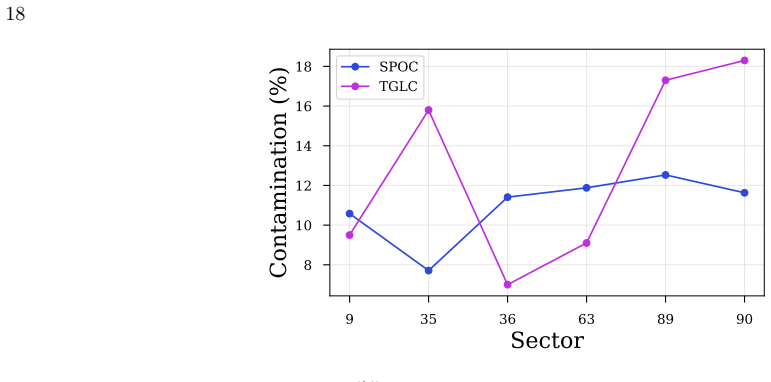
- [Abstract] The abstract states that observational effects (photometric dilution, stellar activity, tidal distortion) were considered but supplies no quantitative details on how these were propagated into the final mass, radius, and density uncertainties.
- [Abstract] No statement is made regarding code or data availability for the new tidal-interior model, which would aid reproducibility of the 50-70% iron-fraction range.
Simulated Author's Rebuttal
We thank the referee for their constructive review. We address the major comment on validation of the tidal distortion and interior composition framework below.
read point-by-point responses
-
Referee: [tidal distortion and interior composition modeling framework (abstract and associated methods section)] The headline result (iron fraction ~50-70%) rests on the new tidal distortion and interior composition framework (abstract, final paragraph) mapping the measured density to composition. No validation of this framework against known planets, synthetic injected signals, or a standard non-tidal interior code is described; without such tests, systematic shifts of even 5-10% in effective volume or density could move the inferred range outside the Mercury-like window.
Authors: We agree that explicit validation tests would strengthen the manuscript. The framework is constructed to be self-consistent by solving the interior structure equations with tidal distortion included from the outset, and we demonstrate robustness across multiple composition assumptions and aspect ratios. However, the submitted version did not include direct comparisons to standard non-tidal codes or synthetic data injections. In revision we will add a new methods subsection with two validation exercises: (1) recovery of known iron fractions for Earth and Mercury when the framework is applied to their measured densities and radii, and (2) injection-recovery tests using synthetic photometry and RV data. These tests will quantify any systematic offsets in effective volume or density and confirm that the inferred 50-70% iron range is preserved. We view this as a straightforward and necessary addition that does not change the scientific conclusions. revision: yes
Circularity Check
Mass/radius from independent RV+photometry; iron fraction from new model with varied priors
full rationale
The paper derives mass (0.503 ± 0.078 M⊕) from ESPRESSO RV data and radius (0.736 ± 0.035 R⊕) from TESS photometry, computes density, then applies a new tidal-distortion + interior model across multiple composition assumptions and aspect ratios to obtain the 50-70% iron range. No equation or step reduces the iron fraction to a quantity defined by the same fitted parameters, no self-citation is load-bearing for the central claim, and the model is presented as an independent framework rather than a fit to this planet's data. The derivation chain remains self-contained against external benchmarks.
Axiom & Free-Parameter Ledger
Reference graph
Works this paper leans on
-
[2]
doi:10.1051/0004-6361/201731483 , keywords =
, volume = 609, pages =. doi:10.1051/0004-6361/201731483 , keywords =
-
[3]
Transiting Exoplanet Survey Satellite (TESS). Journal of Astronomical Telescopes, Instruments, and Systems , year = 2015, month = jan, volume =. doi:10.1117/1.JATIS.1.1.014003 , adsurl =
work page internal anchor Pith review doi:10.1117/1.jatis.1.1.014003 2015
-
[4]
A Search for Signatures of Volcanism and Geodynamics on the Hot Rocky Exoplanet LHS 3844b
-
[5]
Determining the Atmospheric Composition of the Super-Earth 55 Cancri e
-
[6]
A nearby transiting rocky exoplanet that is suitable for atmospheric investigation. Science , keywords =. doi:10.1126/science.abd7645 , archivePrefix =. 2103.04950 , primaryClass =
-
[8]
The Detection of Earth-mass Planets around Active Stars: The Mass of Kepler-78b
The detection of Earth-mass planets around active stars. The mass of Kepler-78b. , keywords =. doi:10.1051/0004-6361/201424025 , archivePrefix =. 1407.0853 , primaryClass =
work page internal anchor Pith review Pith/arXiv arXiv doi:10.1051/0004-6361/201424025
-
[9]
Ultra-short-period Planets in K2. III. Neighbors are Common with 13 New Multiplanet Systems and 10 Newly Validated Planets in Campaigns 0-8 and 10. , keywords =. doi:10.3847/PSJ/ac0ea0 , archivePrefix =. 2011.11698 , primaryClass =
-
[10]
275 Candidates and 149 Validated Planets Orbiting Bright Stars in K2 Campaigns 0-10
275 Candidates and 149 Validated Planets Orbiting Bright Stars in K2 Campaigns 0-10. , keywords =. doi:10.3847/1538-3881/aaadff , archivePrefix =. 1802.05277 , primaryClass =
work page internal anchor Pith review Pith/arXiv arXiv doi:10.3847/1538-3881/aaadff
-
[11]
The Astrophysical Journal , author =
A. The Astrophysical Journal , author =. 2014 , note =. doi:10.1088/0004-637X/787/1/47 , abstract =
-
[12]
Nature Communications , author =
Hot super-. Nature Communications , author =. 2016 , note =. doi:10.1038/ncomms11201 , abstract =
-
[13]
Monthly Notices of the Royal Astronomical Society , author =
Born dry in the photoevaporation desert:. Monthly Notices of the Royal Astronomical Society , author =. 2017 , pages =. doi:10.1093/mnras/stx1558 , abstract =
-
[14]
A map of the large day–night temperature gradient of a super-. Nature , author =. 2016 , note =. doi:10.1038/nature17169 , abstract =
-
[15]
Absence of a thick atmosphere on the terrestrial exoplanet. Nature , author =. 2019 , note =. doi:10.1038/s41586-019-1497-4 , abstract =
-
[16]
The Astrophysical Journal Letters , author =. 2024 , note =. doi:10.3847/2041-8213/ad1a07 , abstract =
-
[17]
New Astronomy Reviews , author =
Kepler-78 and the. New Astronomy Reviews , author =. 2018 , keywords =. doi:10.1016/j.newar.2019.03.006 , abstract =
-
[18]
The Astronomical Journal , author =
The. The Astronomical Journal , author =. 2021 , note =. doi:10.3847/1538-3881/abd409 , abstract =
-
[19]
The Astronomical Journal , author =
The. The Astronomical Journal , author =. 2024 , note =. doi:10.3847/1538-3881/ad28bb , abstract =
-
[20]
The Astrophysical Journal Letters , author =
Company for the. The Astrophysical Journal Letters , author =. 2023 , note =. doi:10.3847/2041-8213/ace0c7 , abstract =
-
[21]
The Astronomical Journal , author =. 2023 , note =. doi:10.3847/1538-3881/acad83 , abstract =
-
[22]
The Astronomical Journal , author =. 2023 , note =. doi:10.3847/1538-3881/ac9834 , abstract =
-
[23]
The Astronomical Journal , author =. 2021 , note =. doi:10.3847/1538-3881/ac02bd , abstract =
-
[25]
The Astrophysical Journal Letters , author =. 2013 , note =. doi:10.1088/2041-8205/773/1/L15 , abstract =
-
[26]
Winn, J. N. , month = dec, year =. Exoplanet. doi:10.48550/arXiv.1001.2010 , note =
work page internal anchor Pith review Pith/arXiv arXiv doi:10.48550/arxiv.1001.2010 2010
-
[27]
The Astronomical Journal , author =. 2021 , note =. doi:10.3847/1538-3881/ac26bd , abstract =
-
[28]
Journal of Open Source Software , author =
`exoplanet`:. Journal of Open Source Software , author =. 2021 , pages =. doi:10.21105/joss.03285 , abstract =
-
[29]
Monthly Notices of the Royal Astronomical Society , author =
High-contrast, high-angular resolution view of the. Monthly Notices of the Royal Astronomical Society , author =. 2022 , pages =. doi:10.1093/mnras/stac961 , abstract =
-
[30]
Publications of the Astronomical Society of the Pacific , author =. 2018 , note =. doi:10.1088/1538-3873/aaaaa8 , abstract =
-
[31]
The Astronomical Journal , author =
Wōtan:. The Astronomical Journal , author =. 2019 , note =. doi:10.3847/1538-3881/ab3984 , abstract =
-
[32]
The Astronomical Journal , author =. 2023 , pages =. doi:10.3847/1538-3881/acaaa7 , abstract =
-
[33]
Physics of the Earth and Planetary Interiors , year = 1981, month = jun, volume =
Preliminary reference Earth model. Physics of the Earth and Planetary Interiors , year = 1981, month = jun, volume =. doi:10.1016/0031-9201(81)90046-7 , adsurl =
-
[34]
Deformation and tidal evolution of close-in planets and satellites using a Maxwell viscoelastic rheology. , keywords =. doi:10.1051/0004-6361/201424211 , archivePrefix =. 1411.1860 , primaryClass =
work page internal anchor Pith review Pith/arXiv arXiv doi:10.1051/0004-6361/201424211
-
[35]
emcee: The MCMC Hammer. , keywords =. doi:10.1086/670067 , archivePrefix =. 1202.3665 , primaryClass =
work page internal anchor Pith review Pith/arXiv arXiv doi:10.1086/670067
-
[36]
The TESS science processing operations center. Software and Cyberinfrastructure for Astronomy IV , year = 2016, editor =. doi:10.1117/12.2233418 , adsurl =
-
[37]
ascl:1812.013 , adsurl =
Lightkurve: Kepler and TESS time series analysis in Python. ascl:1812.013 , adsurl =
-
[38]
The Detectability of Rocky Planet Surface and Atmosphere Composition with the JWST: The Case of LHS 3844b. , keywords =. doi:10.3847/1538-3881/ac9ab3 , archivePrefix =. 2207.08889 , primaryClass =
-
[39]
Detection of an atmosphere around the super-Earth 55 Cancri e
Detection of an Atmosphere Around the Super-Earth 55 Cancri e. , keywords =. doi:10.3847/0004-637X/820/2/99 , archivePrefix =. 1511.08901 , primaryClass =
work page internal anchor Pith review Pith/arXiv arXiv doi:10.3847/0004-637x/820/2/99
-
[40]
and Seager, Sara , title =
Elkins-Tanton, Linda T. and Seager, Sara , title =. The Astrophysical Journal , year =
-
[41]
Publications of the Astronomical Society of the Pacific , year =
Nutzman, Philip and Charbonneau, David , title =. Publications of the Astronomical Society of the Pacific , year =
-
[42]
and Irwin, Jonathan and Burke, Christopher J
Charbonneau, David and Berta, Zachory K. and Irwin, Jonathan and Burke, Christopher J. and Nutzman, Philip and Buchhave, Lars A. and Lovis, Christophe and Bonfils, Xavier and Latham, David W. and Udry, Stephane and Murray-Clay, Ruth A. and Holman, Matthew J. and Falco, Emilio E. and Winn, Joshua N. and Queloz, Didier and Pepe, Francesco and Mayor, Michel ...
-
[43]
and Gillon, Michaël and Lewis, Nikole K
de Wit, Julien and Wakeford, Hannah R. and Gillon, Michaël and Lewis, Nikole K. and Valenti, Jeff A. and Demory, Brice-Olivier and Bolmont, Emeline and Bourrier, Vincent and Burdanov, Artem and Delrez, Laetitia and Ehrenreich, David and Jehin, Emmanu. A combined transmission spectrum of the Earth-sized exoplanets TRAPPIST-1 b and c , journal =. 2016 , volume =
2016
-
[44]
and Charbonneau, David , title =
Dressing, Courtney D. and Charbonneau, David , title =. The Astrophysical Journal , year =
-
[45]
and Lincowski, Andrew P
Lustig-Yaeger, Jacob and Meadows, Victoria S. and Lincowski, Andrew P. , title =. The Astronomical Journal , year =
-
[46]
and Kraus, Adam L
Gaidos, Eric and Mann, Andrew W. and Kraus, Adam L. and Ireland, Michael , title =. Monthly Notices of the Royal Astronomical Society , year =
-
[47]
The Kepler Giant Planet Search. I. A Decade of Kepler Planet-host Radial Velocities from W. M. Keck Observatory. , keywords =. doi:10.3847/1538-4365/ad0cab , archivePrefix =. 2304.00071 , primaryClass =
-
[48]
and Otegi, Jon F
Reinhardt, Christian and Meier, Thomas and Stadel, Joachim G. and Otegi, Jon F. and Helled, Ravit , title =. Monthly Notices of the Royal Astronomical Society , year =
-
[49]
Dorn, Caroline and Harrison, Jacob H. D. and Bonsor, Amy and Hands, T. O. , title =. Monthly Notices of the Royal Astronomical Society , year =
-
[50]
The Astrophysical Journal , year =
Ito, Yuta and Ikoma, Masahiro and Kawahara, Hajime , title =. The Astrophysical Journal , year =
-
[51]
GJ 1252b: A Hot Terrestrial Super-Earth with No Atmosphere. , keywords =. doi:10.3847/2041-8213/ac886b , archivePrefix =. 2208.09479 , primaryClass =
-
[52]
Resonant and Ultra-short-period Planet Systems Are at Opposite Ends of the Exoplanet Age Distribution. , keywords =. doi:10.3847/1538-3881/ad5d76 , archivePrefix =. 2407.04765 , primaryClass =
-
[53]
and Kitzmann, D
Zięba, S. and Kitzmann, D. and Demory, B.-O. and Fossati, L. and Lendl, M. and Morris, B. M. and Oza, A. V. and Stamenković, V. and Witzke, V. and Heng, K. , title =. Nature Astronomy , year =
-
[54]
and Louden, Tom and Mortier, Annelies and Rice, Ken and Buchhave, Lars A
Malavolta, Luca and Mayo, Andrew W. and Louden, Tom and Mortier, Annelies and Rice, Ken and Buchhave, Lars A. and Poretti, Ennio and Piotto, Giampaolo and Bonomo, Aldo S. and Cameron, Andrew C. and Dumusque, Xavier and Figueira, Pedro and Lopez-Morales, Mercedes and Sozzetti, Alessandro and Vanderburg, Andrew and Watson, Chris and Buchschacher, Nicolas an...
-
[55]
A Catalog of Cool Dwarf Targets for the Transiting Exoplanet Survey Satellite
A Catalog of Cool Dwarf Targets for the Transiting Exoplanet Survey Satellite. , keywords =. doi:10.3847/1538-3881/aab710 , archivePrefix =. 1710.00193 , primaryClass =
work page internal anchor Pith review Pith/arXiv arXiv doi:10.3847/1538-3881/aab710
-
[56]
Calibration of the MEarth Photometric System: Optical Magnitudes and Photometric Metallicity Estimates for 1802 Nearby M-Dwarfs. , keywords =. doi:10.3847/0004-637X/818/2/153 , archivePrefix =. 1510.06711 , primaryClass =
work page internal anchor Pith review Pith/arXiv arXiv doi:10.3847/0004-637x/818/2/153
-
[57]
The Astrophysical Journal , year =
Morales, Juan Carlos and Gallardo, Jaime and Ribas, Ignasi and Jordi, Carme and Baraffe, Isabelle and Chabrier, Gilles , title =. The Astrophysical Journal , year =
-
[58]
An Earth-Sized Planet in a 5.4h Orbit Around a Nearby K dwarf. arXiv e-prints , keywords =. doi:10.48550/arXiv.2507.08464 , archivePrefix =. 2507.08464 , primaryClass =
-
[59]
Self-consistent Magnetic Stellar Evolution Models of the Detached, Solar-type Eclipsing Binary EF Aquarii. , keywords =. doi:10.1088/0004-637X/761/1/30 , archivePrefix =. 1210.6177 , primaryClass =
work page internal anchor Pith review Pith/arXiv arXiv doi:10.1088/0004-637x/761/1/30
-
[60]
Updating the Dartmouth Stellar Evolution Model Grid: Pre-Main-Sequence Models & Magnetic Fields
Updating the Dartmouth Stellar Evolution Model Grid: Pre-main-sequence Models & Magnetic Fields. 18th Cambridge Workshop on Cool Stars, Stellar Systems, and the Sun , year = 2015, editor =. doi:10.48550/arXiv.1408.1791 , archivePrefix =. 1408.1791 , primaryClass =
work page internal anchor Pith review Pith/arXiv arXiv doi:10.48550/arxiv.1408.1791 2015
-
[61]
Magnetic inhibition of convection and the fundamental properties of low-mass stars. III. A consistent 10 Myr age for the Upper Scorpius OB association. , keywords =. doi:10.1051/0004-6361/201527613 , archivePrefix =. 1604.08036 , primaryClass =
work page internal anchor Pith review Pith/arXiv arXiv doi:10.1051/0004-6361/201527613
-
[62]
Minimum Radii of Super-Earths: Constraints from Giant Impacts
Minimum Radii of Super-Earths: Constraints from Giant Impacts. , keywords =. doi:10.1088/2041-8205/712/1/L73 , archivePrefix =. 1003.0451 , primaryClass =
work page internal anchor Pith review Pith/arXiv arXiv doi:10.1088/2041-8205/712/1/l73 2041
-
[63]
The Mass-Radius(-Rotation?) Relation for Low-Mass Stars
The Mass-Radius(-Rotation?) Relation for Low-mass Stars. , keywords =. doi:10.1088/0004-637X/728/1/48 , archivePrefix =. 1011.2757 , primaryClass =
work page internal anchor Pith review Pith/arXiv arXiv doi:10.1088/0004-637x/728/1/48
-
[64]
The magnetic and spin-down properties of slowly rotating fully convective M dwarfs. , keywords =. doi:10.1093/mnras/staf1197 , archivePrefix =. 2507.16986 , primaryClass =
-
[65]
TESS Light Curves - All Sectors , year = 2021, doi =
2021
-
[66]
Exoplanet Follow-up Observing Program - TESS, IPAC , year = 2019, doi =
2019
-
[67]
, year = 1966, month = jan, volume =
Q in the Solar System. , year = 1966, month = jan, volume =. doi:10.1016/0019-1035(66)90051-0 , adsurl =
-
[68]
K2-141 b: A 5-M$_\oplus$ super-Earth transiting a K7 V star every 6.7 hours
K2-141 b. A 5-M _ super-Earth transiting a K7 V star every 6.7 h. , keywords =. doi:10.1051/0004-6361/201732217 , archivePrefix =. 1711.02097 , primaryClass =
work page internal anchor Pith review Pith/arXiv arXiv doi:10.1051/0004-6361/201732217
-
[69]
Melting of Io by Tidal Dissipation. Science , keywords =. doi:10.1126/science.203.4383.892 , adsurl =
-
[70]
Stellar Diameters and Temperatures. II. Main-sequence K- and M-stars. , keywords =. doi:10.1088/0004-637X/757/2/112 , archivePrefix =. 1208.2431 , primaryClass =
work page internal anchor Pith review Pith/arXiv arXiv doi:10.1088/0004-637x/757/2/112
-
[71]
and Winn, Joshua N
Bouma, Luke G. and Winn, Joshua N. and Howard, Andrew W. and Masuda, Kento and Petigura, Erik A. , title =. The Astronomical Journal , year =
-
[72]
Transit Detection in the MEarth Survey of Nearby M Dwarfs: Bridging the Clean-first, Search-later Divide. , keywords =. doi:10.1088/0004-6256/144/5/145 , archivePrefix =. 1206.4715 , primaryClass =
work page internal anchor Pith review Pith/arXiv arXiv doi:10.1088/0004-6256/144/5/145
-
[73]
The MEarth-North and MEarth-South Transit Surveys: Searching for Habitable Super-Earth Exoplanets Around Nearby M-dwarfs. 18th Cambridge Workshop on Cool Stars, Stellar Systems, and the Sun , year = 2015, editor =. doi:10.48550/arXiv.1409.0891 , archivePrefix =. 1409.0891 , primaryClass =
work page internal anchor Pith review Pith/arXiv arXiv doi:10.48550/arxiv.1409.0891 2015
-
[74]
The rotation and Galactic kinematics of mid M dwarfs in the Solar Neighborhood
The Rotation and Galactic Kinematics of Mid M Dwarfs in the Solar Neighborhood. , keywords =. doi:10.3847/0004-637X/821/2/93 , archivePrefix =. 1511.00957 , primaryClass =
work page internal anchor Pith review Pith/arXiv arXiv doi:10.3847/0004-637x/821/2/93
-
[75]
The TESS Input Catalog and Candidate Target List
The TESS Input Catalog and Candidate Target List. , keywords =. doi:10.3847/1538-3881/aad050 , archivePrefix =. 1706.00495 , primaryClass =
work page internal anchor Pith review Pith/arXiv arXiv doi:10.3847/1538-3881/aad050
-
[76]
APF - The Lick Observatory Automated Planet Finder
APF The Lick Observatory Automated Planet Finder. , keywords =. doi:10.1086/676120 , archivePrefix =. 1402.6684 , primaryClass =
work page internal anchor Pith review Pith/arXiv arXiv doi:10.1086/676120
-
[77]
Precision Stellar Characterization of FGKM Stars using an Empirical Spectral Library
Precision Stellar Characterization of FGKM Stars using an Empirical Spectral Library. , keywords =. doi:10.3847/1538-4357/836/1/77 , archivePrefix =. 1701.00922 , primaryClass =
work page internal anchor Pith review Pith/arXiv arXiv doi:10.3847/1538-4357/836/1/77
-
[78]
Asteroseismology and Gaia: Testing Scaling Relations Using 2200 Kepler Stars with TGAS Parallaxes
Asteroseismology and Gaia: Testing Scaling Relations Using 2200 Kepler Stars with TGAS Parallaxes. , keywords =. doi:10.3847/1538-4357/aa75ca , archivePrefix =. 1705.04697 , primaryClass =
work page internal anchor Pith review Pith/arXiv arXiv doi:10.3847/1538-4357/aa75ca
-
[79]
Research Notes of the American Astronomical Society , keywords =
Photometry of 10 Million Stars from the First Two Years of TESS Full Frame Images: Part I. Research Notes of the American Astronomical Society , keywords =. doi:10.3847/2515-5172/abca2e , archivePrefix =. 2011.06459 , primaryClass =
-
[80]
Least-Squares Frequency Analysis of Unequally Spaced Data. , keywords =. doi:10.1007/BF00648343 , adsurl =
-
[81]
Studies in astronomical time series analysis. II. Statistical aspects of spectral analysis of unevenly spaced data. , keywords =. doi:10.1086/160554 , adsurl =
-
[83]
arXiv e-prints , year = 2021, month = may, eid =
exoplanet: Gradient-based probabilistic inference for exoplanet data & other astronomical time series. arXiv e-prints , year = 2021, month = may, eid =
2021
-
[84]
Brandt and Tom Barclay , title =
Daniel Foreman-Mackey and Arjun Savel and Rodrigo Luger and Eric Agol and Ian Czekala and Adrian Price-Whelan and Christina Hedges and Emily Gilbert and Luke Bouma and Timothy D. Brandt and Tom Barclay , title =. doi:10.5281/zenodo.1998447 , url =
discussion (0)
Sign in with ORCID, Apple, or X to comment. Anyone can read and Pith papers without signing in.