akaitools: A Python package for parsing and analyzing AkaiKKR electronic structure calculations
Pith reviewed 2026-06-26 23:22 UTC · model grok-4.3
The pith
akaitools converts AkaiKKR text outputs into type-annotated Python dataclasses for SCF results, component DOS, and Bloch spectral functions.
A machine-rendered reading of the paper's core claim, the machinery that carries it, and where it could break.
Core claim
akaitools supplies a parser that maps AkaiKKR's plain-text SCF, DOS, and spectral-function files onto structured dataclasses, enabling unit-consistent access, export, and visualization without manual extraction. The resulting objects cover convergence behavior, atom-resolved properties, CPA-component DOS curves, and k-resolved spectral functions while also providing an input generator so that entire calculation workflows can stay inside Python.
What carries the argument
Parser that extracts SCF, spin- and orbital-resolved CPA DOS, and Bloch spectral function data from AkaiKKR text files into immutable dataclasses with NumPy arrays and unit conversion.
If this is right
- High-throughput studies of substitutionally disordered alloys become practical because data no longer require manual parsing.
- Magnetic and electronic properties per CPA component can be extracted and compared systematically across many compositions.
- Calculation pipelines can be written entirely in Python from input generation through analysis and plotting.
- Results are immediately usable in Pandas-based workflows or saved as JSON for archiving.
Where Pith is reading between the lines
- The package could reduce setup errors in alloy calculations by letting users script both input creation and output checking in one language.
- Parsed spectral functions open the door to direct comparison against experimental photoemission or transport data without intermediate file handling.
- If other KKR codes produce similar text layouts, the same parsing approach might be reused with modest adaptation.
Load-bearing premise
AkaiKKR output files keep a stable, sufficiently documented format so the parser can extract every intended field without loss or misinterpretation.
What would settle it
Feeding the parser a new AkaiKKR version's output file and observing missing fields, incorrect numerical values, or unparsed sections would show the extraction is incomplete.
Figures
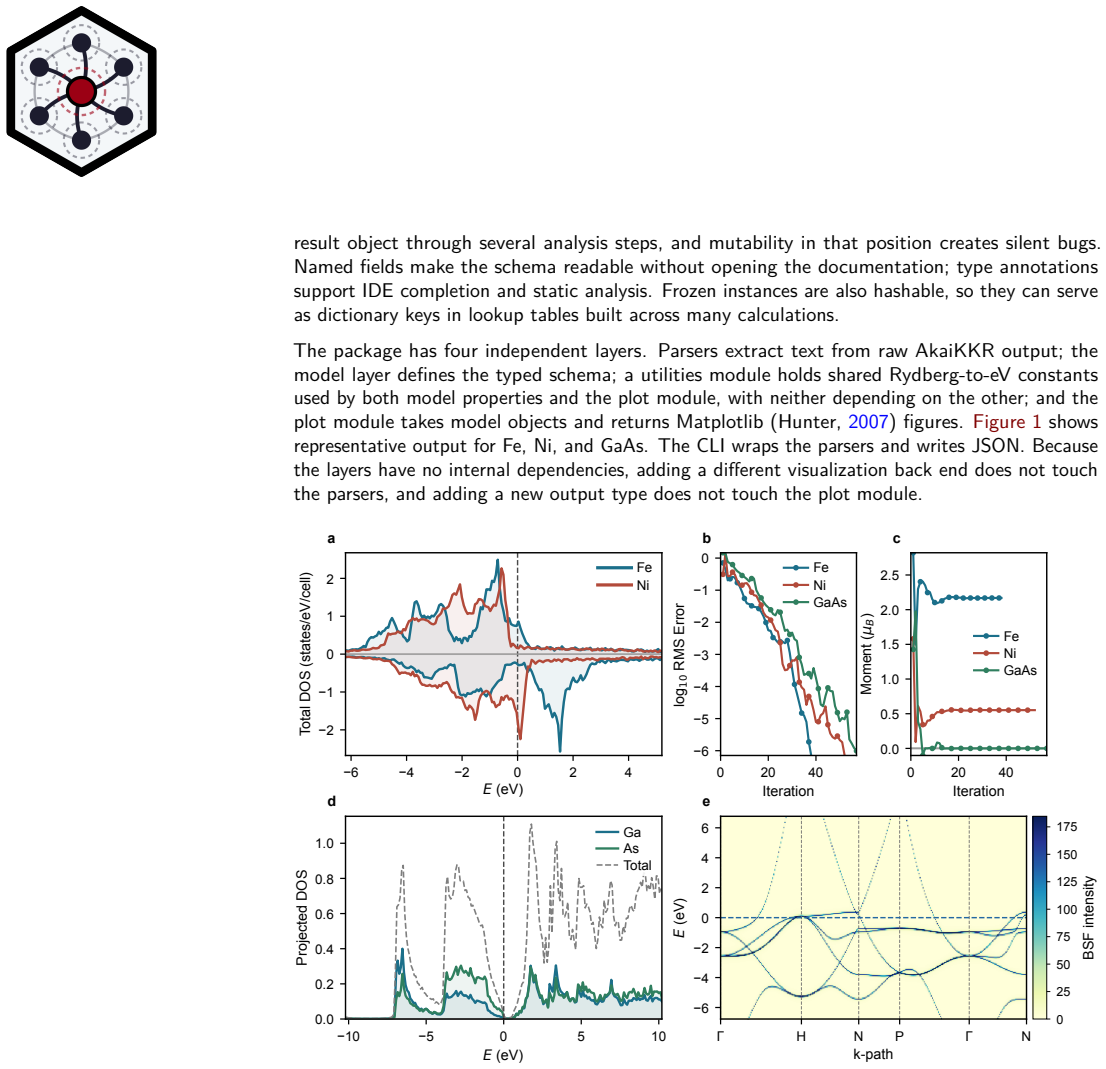
read the original abstract
The Korringa-Kohn-Rostoker (KKR) Green's function method is a first-principles electronic structure approach well suited to substitutionally disordered alloys through the Coherent Potential Approximation (CPA). AkaiKKR is a widely used implementation, known for efficient treatment of metallic systems and their magnetic properties. Its output, however, is unstructured plain text with no programmatic interface, leaving data extraction entirely to the user and making systematic or high-throughput studies impractical. akaitools is a Python package that parses AkaiKKR output files into structured, type-annotated Python objects. The package covers three output types: self-consistent field (SCF) results, which capture convergence history and per-atom electronic and magnetic properties; spin-resolved, orbital projected density of states for each CPA component; and Bloch spectral functions on a user-defined k-point path. Results come back as immutable dataclasses backed by NumPy arrays. Energy quantities are available in both Rydbergs and electronvolts, and results can be exported to Pandas DataFrames. A built-in plotting module produces Matplotlib figures for DOS curves and SCF convergence. A command-line interface provides file summaries and JSON export without any Python scripting. The package also includes a programmatic input file generator, so full calculation pipelines from input preparation to output analysis can be run in Python.
Editorial analysis
A structured set of objections, weighed in public.
Referee Report
Summary. The manuscript introduces akaitools, a Python package that parses unstructured plain-text outputs from AkaiKKR KKR-CPA calculations into structured, immutable, type-annotated dataclasses backed by NumPy arrays. It covers three output classes—SCF convergence and per-atom electronic/magnetic properties, spin-resolved orbital-projected DOS for each CPA component, and Bloch spectral functions—while providing Rydberg-to-eV unit conversion, Pandas DataFrame export, Matplotlib plotting routines, a CLI for summaries and JSON export, and a programmatic input-file generator.
Significance. If the described parsing and analysis tools function as stated, the package would remove a practical bottleneck for users of AkaiKKR by enabling scripted, reproducible extraction and post-processing of results for disordered alloys. This could support higher-throughput studies of magnetic and electronic properties in metallic systems where the KKR-CPA method is already established.
major comments (1)
- [Abstract and package description] The central claim that akaitools reliably extracts all listed fields (SCF history, per-atom properties, spin- and orbital-projected DOS per CPA component, Bloch spectral functions) into typed objects rests on the unstated assumption that the AkaiKKR plain-text format is stable and that every target datum appears in a fixed, unambiguous location; the manuscript provides no validation against reference outputs, no test-suite description, and no discussion of version-to-version format changes, which is load-bearing for the utility of the tool.
minor comments (2)
- The manuscript would benefit from one or two short code snippets showing typical usage (e.g., parsing an SCF file and exporting DOS to Pandas) to make the API concrete for readers.
- Consider adding a brief “Limitations” paragraph noting any known AkaiKKR output variants or fields that are currently ignored by the parser.
Simulated Author's Rebuttal
We thank the referee for the positive assessment and the constructive major comment. We agree that the manuscript would be strengthened by explicit discussion of validation, testing, and format assumptions, and we will revise accordingly.
read point-by-point responses
-
Referee: [Abstract and package description] The central claim that akaitools reliably extracts all listed fields (SCF history, per-atom properties, spin- and orbital-projected DOS per CPA component, Bloch spectral functions) into typed objects rests on the unstated assumption that the AkaiKKR plain-text format is stable and that every target datum appears in a fixed, unambiguous location; the manuscript provides no validation against reference outputs, no test-suite description, and no discussion of version-to-version format changes, which is load-bearing for the utility of the tool.
Authors: We agree with the referee that the manuscript does not describe validation procedures, a test suite, or address AkaiKKR output format stability. This omission weakens the central claim. In the revised manuscript we will add a new subsection (likely under 'Implementation') that (1) describes the existing test suite, which includes unit tests exercising each parser on reference SCF, DOS, and Bloch spectral function outputs; (2) states that these reference files were generated with AkaiKKR versions 2.XX and 3.XX and that all listed fields are verified by direct comparison with manually extracted values; and (3) notes the assumption of a stable plain-text layout together with a commitment to update the parsers for future AkaiKKR releases. These additions make the reliability assumptions explicit and transparent. revision: yes
Circularity Check
No circularity: software description with no derivations or self-referential claims
full rationale
The paper is a description of a Python parsing package for AkaiKKR outputs. It contains no equations, no fitted parameters, no predictions, no uniqueness theorems, and no derivation chain of any kind. The central claim is simply that the package implements parsers for three classes of plain-text outputs and provides export/plotting utilities. No step reduces to a self-definition, a fitted input renamed as prediction, or a self-citation load-bearing premise. The format-stability assumption noted by the skeptic is an external engineering risk, not a circularity in any claimed derivation.
Axiom & Free-Parameter Ledger
Reference graph
Works this paper leans on
-
[1]
Journal of Physics: Condensed Matter , volume =
Akai, Hisazumi , title =. Journal of Physics: Condensed Matter , volume =. 1989 , doi =
1989
-
[2]
Physica , volume =
Korringa, Jan , title =. Physica , volume =. 1947 , doi =
1947
-
[3]
Physical Review , volume =
Kohn, Walter and Rostoker, Norman , title =. Physical Review , volume =. 1954 , doi =
1954
-
[4]
Physical Review , volume =
Soven, Paul , title =. Physical Review , volume =. 1967 , doi =
1967
-
[5]
and Millman, K
Harris, Charles R. and Millman, K. Jarrod and van der Walt, St\'. Array programming with. Nature , volume =. 2020 , doi =
2020
-
[6]
, title =
Hunter, John D. , title =. Computing in Science & Engineering , volume =. 2007 , doi =
2007
-
[7]
and Persson, Kristin A
Ong, Shyue Ping and Richards, William Davidson and Jain, Anubhav and Hautier, Geoffroy and Kocher, Michael and Cholia, Shreyas and Gunter, Dan and Chevrier, Vincent L. and Persson, Kristin A. and Ceder, Gerbrand , title =. Computational Materials Science , volume =. 2013 , doi =
2013
-
[8]
2021 , howpublished =
2021
-
[9]
Calculating condensed matter properties using the
Ebert, Hubert and K\". Calculating condensed matter properties using the. Reports on Progress in Physics , volume =. 2011 , doi =
2011
-
[10]
R\". The. npj Computational Materials , volume =. 2021 , doi =
2021
-
[11]
The atomic simulation environment --- a
Larsen, Ask Hjorth and Mortensen, Jens J. The atomic simulation environment --- a. Journal of Physics: Condensed Matter , volume =. 2017 , doi =
2017
-
[12]
and Zoupanos, Spyros and Uhrin, Martin and Talirz, Leopold and Kahle, Leonid and H\"
Huber, Sebastiaan P. and Zoupanos, Spyros and Uhrin, Martin and Talirz, Leopold and Kahle, Leonid and H\". Scientific Data , volume =. 2020 , doi =
2020
discussion (0)
Sign in with ORCID, Apple, or X to comment. Anyone can read and Pith papers without signing in.