Magnetotransport Measurements on Isolated Polycrystalline Grains of Type-II Silicon Clathrate
Pith reviewed 2026-06-26 23:19 UTC · model grok-4.3
The pith
Isolated grains of type-II silicon clathrate show n-type conduction with a transition to hopping transport at cryogenic temperatures.
A machine-rendered reading of the paper's core claim, the machinery that carries it, and where it could break.
Core claim
Microfabricated isolation of single polycrystalline Na_x Si_136 grains, verified by Raman spectroscopy to be largely free of amorphous silicon, permits four-probe resistivity, Hall, and gate-dependent measurements that reveal n-type conduction, carrier freeze-out, and a crossover to hopping conduction at low temperature.
What carries the argument
Microfabrication isolation of individual grains combined with Raman verification of crystal structure, enabling direct four-probe transport and Hall measurements on single grains.
If this is right
- The grains exhibit distinct conduction mechanisms that can be tracked through activation energies extracted from resistivity and corroborated by Hall data.
- n-type behavior with measurable mobility persists down to 3.5 K, establishing baseline parameters for device modeling.
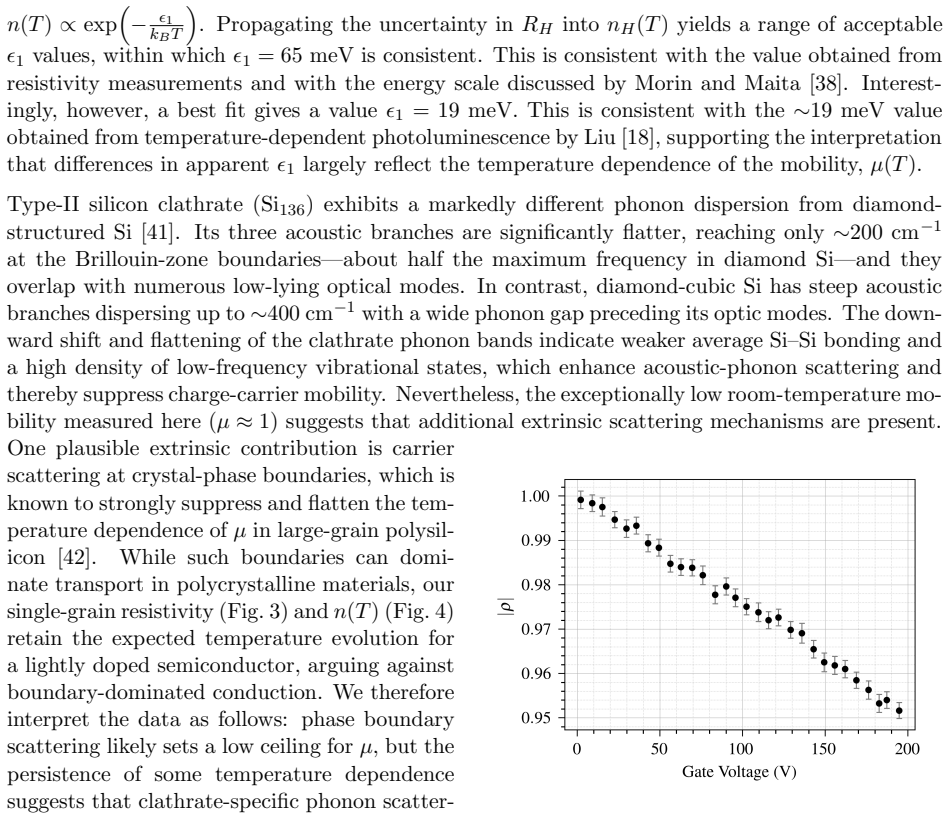
- Room-temperature gate control of conductivity demonstrates that electrostatic doping is feasible without altering the grain structure.
- The combination of isolation technique and transport data opens a route to study quantum or optoelectronic behavior in this clathrate on a grain-by-grain basis.
Where Pith is reading between the lines
- If the observed hopping conduction persists in larger single-crystal samples, it could set a practical lower temperature limit for conventional semiconductor operation in clathrate-based devices.
- The reported gate tunability at 290 K suggests that similar structures might function as field-effect sensors or switches if scaled to thin films or nanowires.
- Because the grains are polycrystalline, grain-boundary scattering may dominate the mobility values; measurements on truly single-crystal grains would separate that contribution from intrinsic band transport.
Load-bearing premise
The microfabrication steps used to isolate the grains do not change their electronic properties and Raman spectra alone are enough to confirm that amorphous silicon is absent and does not influence the measured transport.
What would settle it
Transport measurements on grains isolated by a different, non-microfabrication method that yield resistivity or carrier densities differing by more than the reported sample-to-sample variation would falsify the claim that the reported parameters belong to unaltered grains.
Figures
read the original abstract
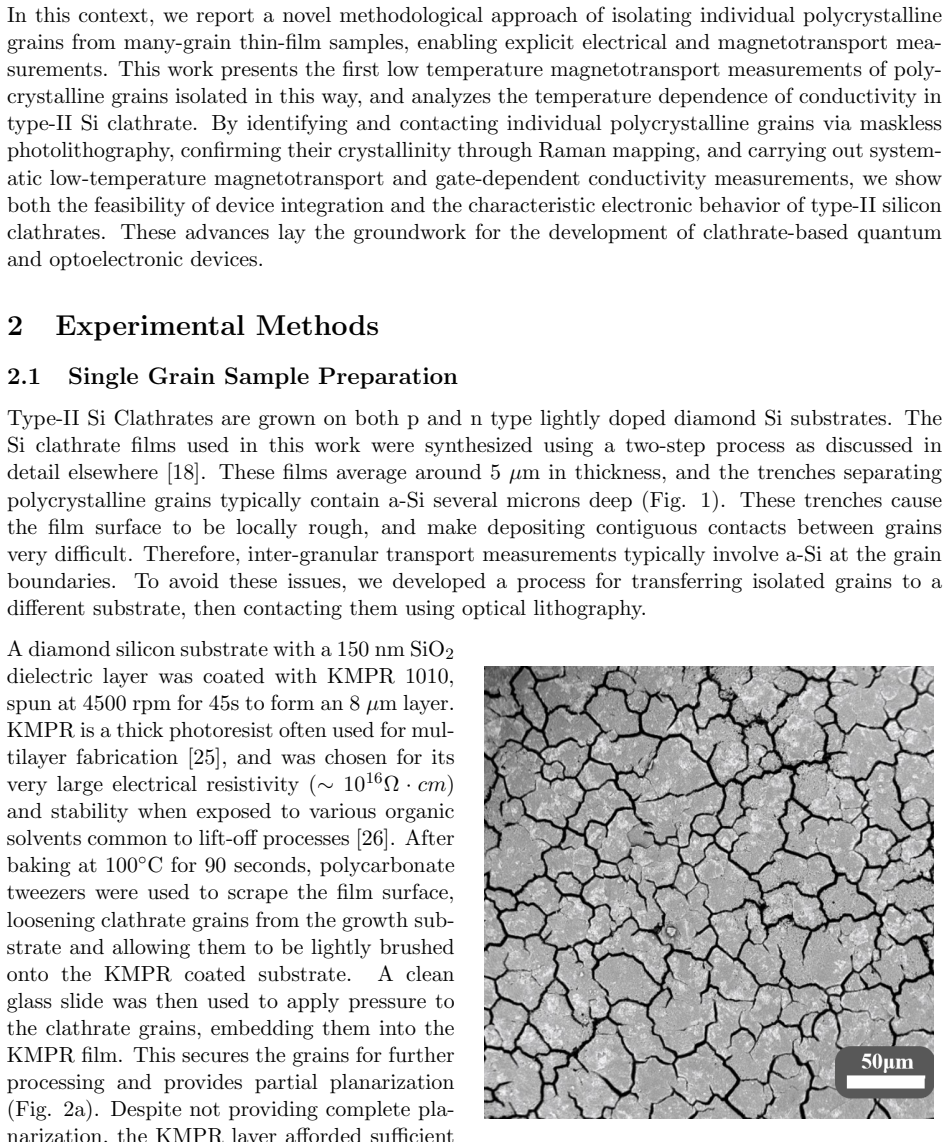
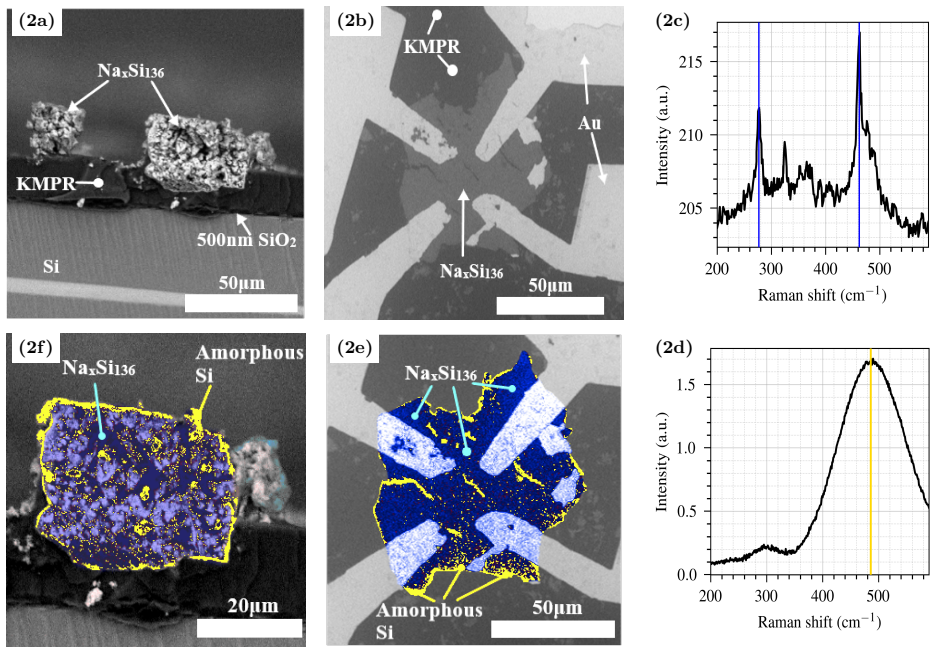
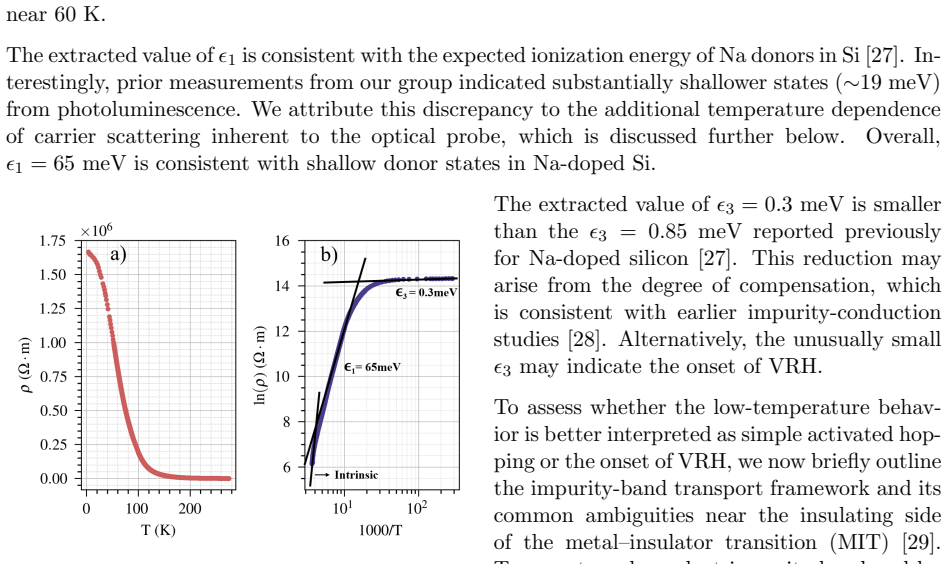
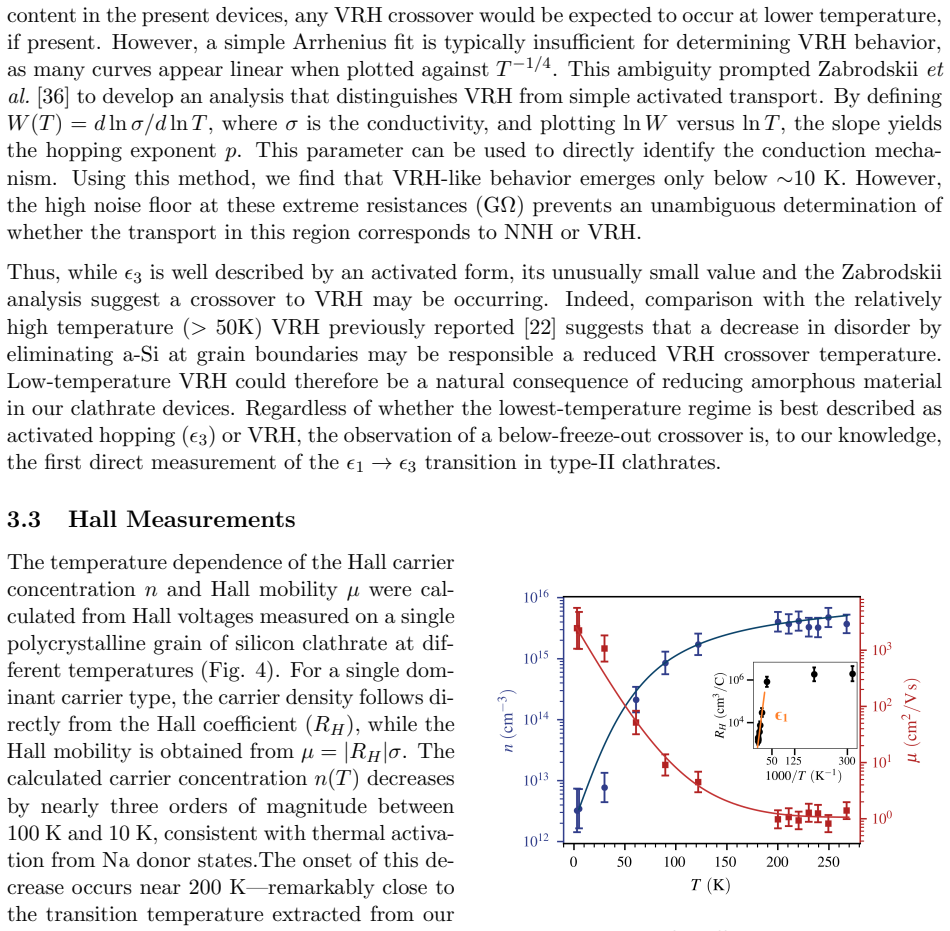
The first low-temperature electronic transport characterization of individual polycrystalline grains of type-II silicon clathrate (Na$_x$Si$_{136}$, $x \ll 1$), isolated using microfabrication techniques, is reported. Structural characterization via Raman spectroscopy confirms that the isolated grains are largely devoid of amorphous silicon (a-Si). Temperature-dependent resistivity reveals multiple conduction regimes, including thermally activated freeze-out behavior and a transition to low-activation-energy transport at cryogenic temperatures, consistent with hopping conduction mechanisms. Hall measurements from 290 K to 3.5 K yield carrier concentration and mobility trends that correlate with the extracted activation energies, verifying $n$-type conduction. Additionally, gate-dependent conductivity measurements demonstrate electrostatic tunability at room temperature. Collectively, these results establish the magnetotransport parameters of single, isolated grains of type-II silicon clathrate and demonstrate the potential of this material for future quantum and optoelectronic devices.
Editorial analysis
A structured set of objections, weighed in public.
Referee Report
Summary. The manuscript reports the first low-temperature electronic transport characterization of individual polycrystalline grains of type-II silicon clathrate (Na_x Si_136, x ≪ 1) isolated via microfabrication. Raman spectroscopy is used to confirm the grains are largely devoid of amorphous silicon. Temperature-dependent resistivity measurements reveal multiple conduction regimes, including thermally activated freeze-out and a transition to low-activation-energy hopping at cryogenic temperatures. Hall measurements from 290 K to 3.5 K yield carrier concentration and mobility trends consistent with n-type conduction, while gate-dependent conductivity demonstrates electrostatic tunability at room temperature. The work claims to establish the magnetotransport parameters of single isolated grains and their potential for quantum and optoelectronic devices.
Significance. If the measured low-T resistivity, Hall, and gate data reflect intrinsic grain properties, the results would supply the first such dataset on isolated type-II clathrate grains, enabling comparison with bulk or thin-film studies and supporting device applications. The correlation between activation energies and Hall parameters is a positive feature. However, the significance is reduced by the absence of controls demonstrating that microfabrication steps leave the electronic properties unaltered.
major comments (2)
- [Methods and Results (isolation and transport sections)] The central claim that the reported cryogenic transport parameters (resistivity regimes, activation energies, Hall carrier density) represent intrinsic grain behavior rests on the assumption that the microfabrication isolation process (lithography, etching, contact deposition) introduces no surface damage, strain, or dopants that dominate hopping or freeze-out. No before/after transport comparisons, control samples, or surface characterization (e.g., TEM cross-sections) are described to bound these effects.
- [Structural characterization via Raman spectroscopy] Raman spectroscopy is stated to confirm grains are 'largely devoid' of a-Si, yet no quantitative calibration, detection limits, or complementary measurements (TEM, XRD) are provided. Trace a-Si fractions below typical Raman sensitivity can still open parallel conduction paths or alter low-T activation energies in hopping regimes; this directly undermines the interpretation of the observed conduction mechanisms.
minor comments (1)
- Notation for the clathrate composition (Na_x Si_136) should be defined consistently with the value of x reported from the synthesis or measurement.
Simulated Author's Rebuttal
We thank the referee for their thorough review and valuable suggestions. We have addressed the major comments by expanding discussions on potential fabrication effects and improving the Raman analysis description. Point-by-point responses are provided below.
read point-by-point responses
-
Referee: [Methods and Results (isolation and transport sections)] The central claim that the reported cryogenic transport parameters (resistivity regimes, activation energies, Hall carrier density) represent intrinsic grain behavior rests on the assumption that the microfabrication isolation process (lithography, etching, contact deposition) introduces no surface damage, strain, or dopants that dominate hopping or freeze-out. No before/after transport comparisons, control samples, or surface characterization (e.g., TEM cross-sections) are described to bound these effects.
Authors: We acknowledge this as a valid concern. The microfabrication process was optimized to minimize damage, using low-power etching and standard metal contacts. In the revised manuscript, we have added a dedicated paragraph in the Methods section discussing possible fabrication-induced effects and why they are unlikely to dominate based on the observed n-type behavior and correlation with Hall data. We also reference similar studies on other Si nanostructures where intrinsic properties were preserved. However, we do not have before/after comparisons available, as the grains were isolated specifically for this study. revision: partial
-
Referee: [Structural characterization via Raman spectroscopy] Raman spectroscopy is stated to confirm grains are 'largely devoid' of a-Si, yet no quantitative calibration, detection limits, or complementary measurements (TEM, XRD) are provided. Trace a-Si fractions below typical Raman sensitivity can still open parallel conduction paths or alter low-T activation energies in hopping regimes; this directly undermines the interpretation of the observed conduction mechanisms.
Authors: We have revised the structural characterization section to include quantitative analysis of the Raman spectra. Using calibration samples with known a-Si content, we estimate the detection limit to be approximately 5% a-Si by volume. No a-Si signal was observed above this threshold. While we agree that complementary TEM would be beneficial, the absence of a-Si Raman peaks, combined with the transport data showing clear freeze-out and hopping regimes consistent with crystalline clathrate, supports our interpretation. We have added this discussion and note the limitation. revision: yes
- Lack of TEM or XRD complementary measurements and before/after transport data, which were not included in the original experiments.
Circularity Check
No circularity: purely experimental report with no derivations or fitted predictions
full rationale
The paper reports experimental measurements (Raman, resistivity vs T, Hall effect, gate-dependent conductivity) on isolated grains. No derivation chain, first-principles results, parameter fits presented as predictions, or self-citations invoked to justify uniqueness or ansatzes appear in the abstract or described content. All claims are direct observations or standard interpretations of data; no step reduces by construction to its own inputs. This matches the default case of a self-contained experimental study.
Axiom & Free-Parameter Ledger
axioms (1)
- domain assumption Raman spectroscopy reliably confirms absence of amorphous silicon affecting transport
Reference graph
Works this paper leans on
-
[1]
Inorganic Clathrate-II Materials: Synthesis, Structure, and Thermoelectric Properties
M. Beekman and G. S. Nolas. “Inorganic Clathrate-II Materials: Synthesis, Structure, and Thermoelectric Properties”. In:J. Mater. Chem. C3.18 (2015), pp. 4692–4708.doi:10 . 1557/PROC-1044-U05-05
2015
-
[2]
Clathrate Structure of Silicon Na8Si46 and NaxSi136 (x <11)
J. S. Kasper et al. “Clathrate Structure of Silicon Na8Si46 and NaxSi136 (x <11)”. In: Science150 (1965), pp. 1713–1714.doi:10.1126/science.150.3704.1713
-
[3]
Semiconducting clathrates: synthesis, structure and prop- erties
K. A. Kovnir and A. V. Shevelkov. “Semiconducting clathrates: synthesis, structure and prop- erties”. In:Russian Chemical Reviews73.9 (2004), p. 923.doi:10.1070/RC2004v073n09ABEH000916
-
[4]
Advancements in low-density crystalline silicon allotropes
Y. Liu et al. “Advancements in low-density crystalline silicon allotropes”. In:Appl. Phys. Lett.126.9 (2025), p. 090501.doi:10.1063/5.0252405
-
[5]
Low-density framework form of crystalline silicon with a wide optical band gap
J. Gryko et al. “Low-density framework form of crystalline silicon with a wide optical band gap”. In:Phys. Rev. B62 (2000), R7707–R7710.doi:10.1103/PhysRevB.62.R7707
-
[6]
G. S. Nolas, ed.The Physics and Chemistry of Inorganic Clathrates. Vol. 199. Springer Series in Materials Science. Springer, 2014.doi:10.1007/978-94-017-9127-4
-
[7]
Wide-band-gap si in open fourfold-coordinated clathrate structures
G. B. Adams et al. “Wide-band-gap si in open fourfold-coordinated clathrate structures”. In: Phys. Rev. B49 (1994), p. 8048.doi:10.1103/PhysRevB.49.8048
-
[8]
Silicon Clathrate Films for Photovoltaic Applications
T. Fix et al. “Silicon Clathrate Films for Photovoltaic Applications”. In:J. Phys. Chem. C 124 (2020), pp. 14972–14977.doi:10.1021/acs.jpcc.0c02712
-
[9]
Electron paramagnetic resonance study of type-II silicon clathrate with low sodium guest concentration
W. K. Schenken et al. “Electron paramagnetic resonance study of type-II silicon clathrate with low sodium guest concentration”. In:Phys. Rev. B101 (2020), p. 245204.doi:10.1103/ PhysRevB.101.245204
2020
-
[10]
Spin relaxation and coherence times for electrons at the Si/SiO2 interface
S. Shankar et al. “Spin relaxation and coherence times for electrons at the Si/SiO2 interface”. In:Phys. Rev. B82 (2010), p. 195323.doi:doi.org/10.1103/PhysRevB.82.195323
-
[11]
Electronic structures of Na 8Si46 and Ba8Si46
K. Moriguchi et al. “Electronic structures of Na 8Si46 and Ba8Si46”. In:Phys. Rev. B61 (15 2000), pp. 9859–9862.doi:10.1103/PhysRevB.61.9859
-
[12]
Electronic structure of Si 46 and Na 2Ba6Si46
S. Saito and A. Oshiyama. “Electronic structure of Si 46 and Na 2Ba6Si46”. In:Phys. Rev. B 51 (4 1995), pp. 2628–2631.doi:10.1103/PhysRevB.51.2628
-
[13]
Low temperature transport properties and heat capacity of single-crystal Na8Si46
S. Stefanoski, J. B. Martin, and G. S. Nolas. “Low temperature transport properties and heat capacity of single-crystal Na8Si46”. In:J. Phys.: Condens. Matter22.48 (2010), p. 485404. doi:10.1088/0953-8984/22/48/485404
-
[14]
Simple approach for selective crystal growth of intermetallic clathrates
S. Stefanoski et al. “Simple approach for selective crystal growth of intermetallic clathrates”. In:Chem. Mater.23 (2011), pp. 1491–1495.doi:10.1021/cm103135k
-
[15]
S. Stefanoski et al. “Synthesis and Structural Characterization of NaxSi136 (0< x≤24) Single Crystals and Low-Temperature Transport of Polycrystalline Specimens”. In:Inorg. Chem.51 (2012), pp. 8686–8692.doi:10.1021/ic202199t. 12
-
[16]
Synthesis of Group IV Clathrates for Photovoltaics
A. D. Martinez et al. “Synthesis of Group IV Clathrates for Photovoltaics”. In:IEEE J. Photovoltaics3 (2013), pp. 1305–1310.doi:10.1109/JPHOTOV.2013.2276478
-
[17]
Dynamic free energy surfaces for sodium diffusion in type II sili- con clathrates
J. G. Slingsby et al. “Dynamic free energy surfaces for sodium diffusion in type II sili- con clathrates”. In:Phys. Chem. Chem. Phys.18 (2016), pp. 5121–5128.doi:10 . 1039 / C5CP06066D
2016
-
[18]
Synthesis and characterization of type II silicon clathrate films with low Na concentration
Y. Liu et al. “Synthesis and characterization of type II silicon clathrate films with low Na concentration”. In:Appl. Phys. Rev.8 (2021), p. 041408.doi:10.1063/5.0062723
-
[19]
Characterization of low sodium type II silicon clathrate film spin dynam- ics
J. P. Briggs et al. “Characterization of low sodium type II silicon clathrate film spin dynam- ics”. In:Appl. Phys. Lett.125.20 (2024), p. 202402.doi:10.1063/5.0230407
-
[20]
Synthesis, Crystal Structure, and Transport Properties of Na22Si136
M. Beekman et al. “Synthesis, Crystal Structure, and Transport Properties of Na22Si136”. In:J. Electron. Mater.38 (2009), pp. 1136–1141.doi:10.1007/s11664-008-0641-y
-
[21]
Thin film of guest-free type-II silicon clathrate on Si(111) wafer
T. Kume et al. “Thin film of guest-free type-II silicon clathrate on Si(111) wafer”. In:Thin Solid Films609 (2016), pp. 30–34.doi:10.1016/j.tsf.2016.03.056
-
[22]
Properties of compounds of type Na xSi136 and Na8Si46
N. F. Mott and E. A. Davis. “Properties of compounds of type Na xSi136 and Na8Si46”. In:J. Solid State Chem.6.3 (1973), pp. 348–351.doi:10.1016/0022-4596(73)90221-1
-
[23]
Hopping Conductivity in Disordered Systems
V. Ambegaokar, B. I. Halperin, and J. S. Langer. “Hopping Conductivity in Disordered Systems”. In:Phys. Rev. B4.8 (1971), pp. 2612–2620.doi:10.1103/PhysRevB.4.2612
-
[24]
T. G. Castner and W. N. Shafarman. “Deconvolution of activated and variable-range-hopping conduction for barely insulating arsenic-doped silicon”. In:Phys. Rev. B60.20 (1999), pp. 14182– 14185.doi:10.1103/PhysRevB.60.14182
-
[25]
D. Han et al. “Multilayer Fabrication of Micromolding and Electroforming with the Planariza- tion of Grinding for High-Aspect-Ratio Microelectrodes in Electro-conjugate Fluid (ECF) Mi- cropumps”. In:Int. J. Precis. Eng. Manuf.21 (2020).doi:10.1007/s12541-019-00299-3
-
[26]
Variation of thermal and mechanical properties of KMPR due to pro- cessing parameters
M. Reynolds et al. “Variation of thermal and mechanical properties of KMPR due to pro- cessing parameters”. In:J. Micromech. Microeng.22 (2012), p. 125023.doi:10.1088/0960- 1317/22/12/125023
-
[27]
The Electrical Properties of Silicon with Sodium Donors
P. Doubrava. “The Electrical Properties of Silicon with Sodium Donors”. In:Phys. Status Solidi B40.2 (1970), pp. 483–492.doi:10.1002/pssb.19700400205
-
[28]
Impurity Conduction in Silicon
R. K. Ray and H. Y. Fan. “Impurity Conduction in Silicon”. In:Phys. Rev.121.3 (1961), pp. 768–776.doi:10.1103/PhysRev.121.768
-
[29]
Low-temperature conductivity and the metal– insulator transition in compensated n-type germanium
A. G. Zabrodskii and K. N. Zinovyeva. “Low-temperature conductivity and the metal– insulator transition in compensated n-type germanium”. In:Soviet Physics JETP59.2 (1984), pp. 425–432
1984
-
[30]
Low Temperature Conductivity in n -Type Noncompensated Silicon below Insulator-Metal Transition
A. Danilyuk et al. “Low Temperature Conductivity in n -Type Noncompensated Silicon below Insulator-Metal Transition”. In:Advances in Condensed Matter Physics2017 (2017), pp. 1– 12.doi:10.1155/2017/5038462
-
[31]
B. I. Shklovskii and A. L. Efros.Electronic Properties of Doped Semiconductors. Springer Series in Solid-State Sciences. Springer, 1984
1984
-
[32]
A. Miller and E. Abrahams. In:Phys. Rev.120.3 (1960), pp. 745–755.doi:10.1103/PhysRev. 120.745
-
[33]
N. A. Poklonski et al. “Activation Energy of DC Hopping Conductivity of Lightly Doped Weakly Compensated Crystalline Semiconductors”. In:Phys. Status Solidi B262.1 (2025), p. 2400132.doi:10.1002/pssb.202400132
-
[34]
N. F. Mott and E. A. Davis.Electronic Processes in Non-Crystalline Materials. 2nd. Oxford: Clarendon Press, 1979.doi:10.1088/0031-9112/24/5/033
-
[35]
Hopping Conduction and Chemical Structure : a study on Silicon Subox- ides
J. J. van Hapert. “Hopping Conduction and Chemical Structure : a study on Silicon Subox- ides”. PhD thesis. University of Utrecht, Netherlands, 2002. 13
2002
-
[36]
Determination of the conductivity mechanism from the temperature dependence of conductivity
A. G. Zabrodskii and K. N. Zinov’eva. “Determination of the conductivity mechanism from the temperature dependence of conductivity”. In:Soviet Journal of Low Temperature Physics 7 (1981), pp. 331–334
1981
-
[37]
C. Cros, M. Pouchard, and P. Hagenmuller. “Preparation and Characterization of the Silicon Clathrate NaxSi 136 (x≤3): Electrical Transport in the Dilute Sodium Limit”. In:J. Solid State Chem.2 (1970), pp. 570–581.doi:10.1016/0022-4596(70)90053-8
-
[38]
Electrical Properties of Silicon Containing Arsenic and Boron
F. J. Morin and J. P. Maita. “Electrical Properties of Silicon Containing Arsenic and Boron”. In:Phys. Rev.96.1 (1954), pp. 28–35.doi:10.1103/PhysRev.96.28
-
[39]
The Hall effect in the variable-range-hopping regime
L. Friedman and M. Pollak. “The Hall effect in the variable-range-hopping regime”. In:Philos. Mag. B44.4 (1981), pp. 487–507.doi:10.1080/01418638108222584
-
[40]
A. Avdonin, P. Skupi´ nski, and K. Grasza. “Hall effect in hopping regime”. In:Physica B483 (2016), pp. 13–18.doi:10.1016/j.physb.2015.12.024
-
[41]
J. Dong, O. F. Sankey, and G. Kern. “Theoretical study of the vibrational modes and their pressure dependence in the pure clathrate-II silicon framework”. In:Phys. Rev. B60.2 (1999), pp. 950–958.doi:10.1103/PhysRevB.60.950
-
[42]
Grain Boundary Effects on the Carrier Mobility of Polysili- con
M. R. Murti and K. V. Reddy. “Grain Boundary Effects on the Carrier Mobility of Polysili- con”. In:Phys. Status Solidi A119.1 (1990), pp. 237–240.doi:10.1002/pssa.2211190128
-
[43]
Thermal conductivity of elemental crystalline silicon clathrate Si 136
G. S. Nolas et al. “Thermal conductivity of elemental crystalline silicon clathrate Si 136”. In: Appl. Phys. Lett.82.6 (2003), pp. 910–912.doi:10.1063/1.1544640
-
[44]
Structural Dynamics, Phonon Spectra and Ther- mal Transport in the Silicon Clathrates
B. Wei, J. M. Flitcroft, and J. M. Skelton. “Structural Dynamics, Phonon Spectra and Ther- mal Transport in the Silicon Clathrates”. In:Molecules27.19 (2022), p. 6431.doi:10.3390/ molecules27196431
2022
-
[45]
Glasslike Heat Conduction in High-Mobility Crystalline Semiconductors
J. L. Cohn et al. “Glasslike Heat Conduction in High-Mobility Crystalline Semiconductors”. In:Phys. Rev. Lett.82.4 (1999), pp. 779–782.doi:10.1103/PhysRevLett.82.779
-
[46]
Phonon engineering through crystal chem- istry
E. S. Toberer, A. Zevalkink, and G. J. Snyder. “Phonon engineering through crystal chem- istry”. In:J. Mater. Chem.21.40 (2011), pp. 15843–15852.doi:10.1039/C1JM11754H. 14
discussion (0)
Sign in with ORCID, Apple, or X to comment. Anyone can read and Pith papers without signing in.