Time-resolved synchronization analysis of stacked intrinsic Josephson junctions of a cuprate superconductor with frequency-modulated terahertz radiation spectra
Pith reviewed 2026-06-26 19:20 UTC · model grok-4.3
The pith
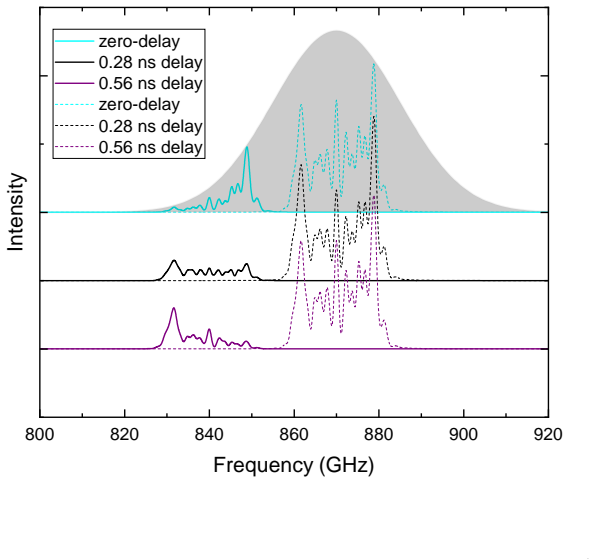
Frequency-modulated terahertz spectra from cuprate Josephson junctions yield a 0.28 ns synchronized relaxation time that explains changes at 1 GHz modulation.
A machine-rendered reading of the paper's core claim, the machinery that carries it, and where it could break.
Core claim
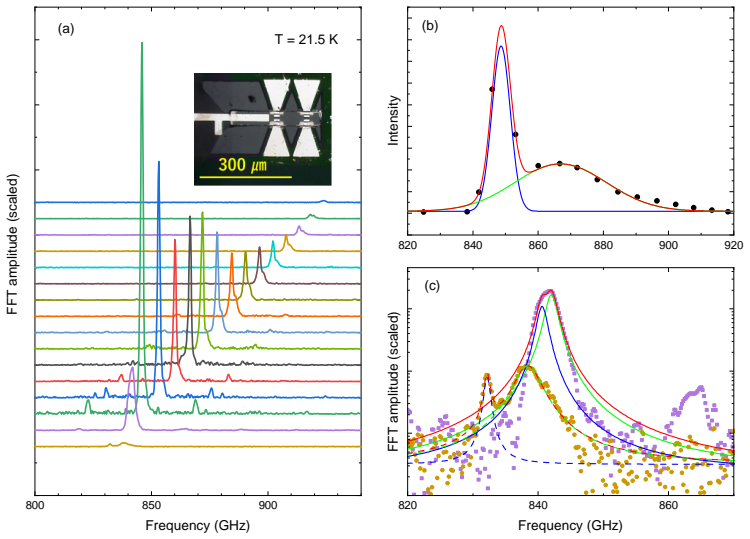
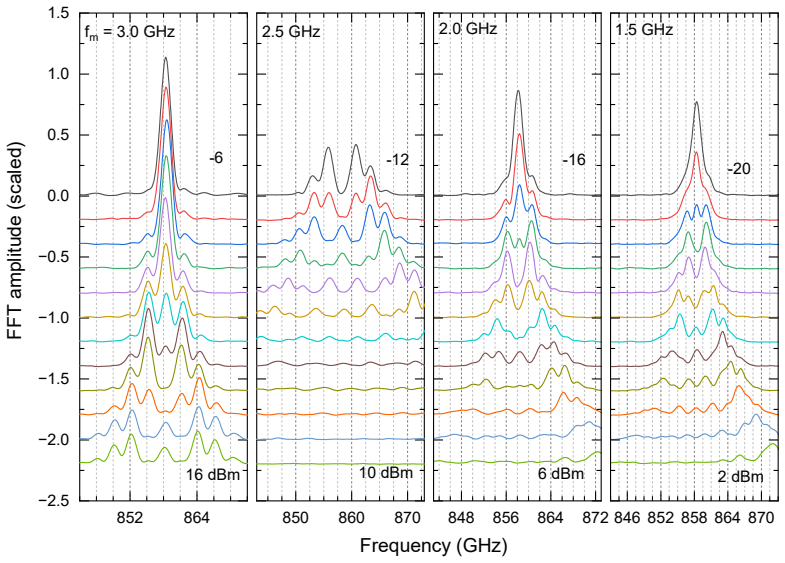
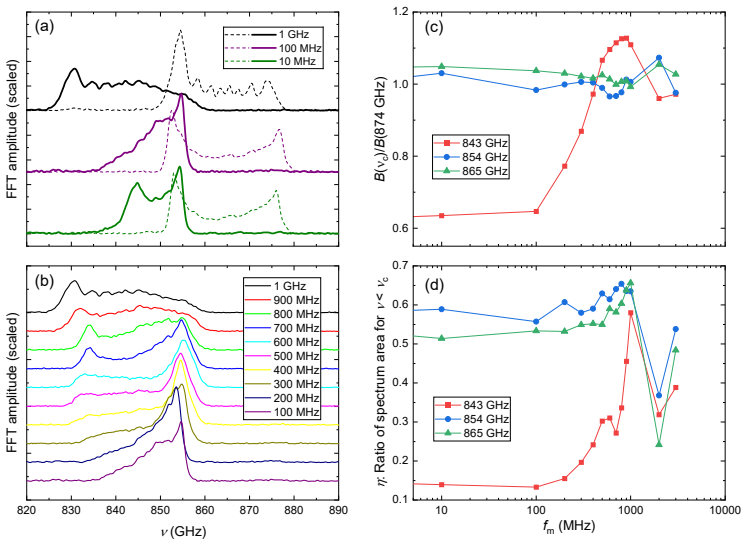
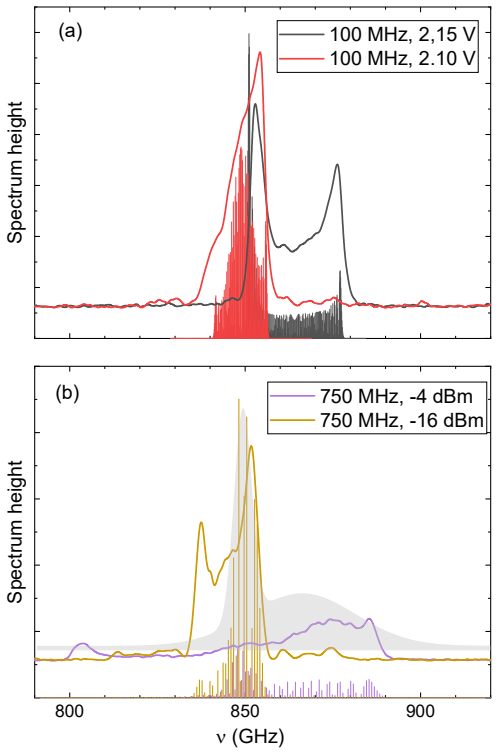
In the unmodulated intensity distribution as a function of radiation frequency I_UM(ω), a double Gaussian peak structure is observed. Double-peak spectra obtained at a constant bias voltage imply either a rapid temporal distribution of resonances or their simultaneous excitation, driven by the mutual electromagnetic coupling between the IJJ mesa and the antennas. At low modulation frequencies f_m, the spectra are well reproduced by the products of I_UM(ω) and frequency combs, yielding a synchronized relaxation time τ_s ≃ 0.28 ns. Incorporating τ_s quantitatively reproduces a drastic spectral transformation observed around f_m ∼ 1 GHz, unveiling the sub-nanosecond non-equilibrium dynamics of
What carries the argument
The synchronized relaxation time τ_s obtained from matching low-frequency modulated spectra to the product of the unmodulated double-Gaussian intensity I_UM(ω) and frequency combs.
If this is right
- Double-peak spectra at constant bias voltage indicate either rapid temporal distribution of resonances or simultaneous excitation via electromagnetic coupling between the mesa and antennas.
- The value of τ_s directly governs the drastic spectral transformation at modulation frequencies near 1 GHz.
- The method extracts sub-nanosecond non-equilibrium dynamics of the coupled Josephson plasma without requiring direct time-domain measurements.
- The double-Gaussian unmodulated profile sets the base intensity that gets reshaped by the frequency combs at low f_m.
Where Pith is reading between the lines
- The extracted τ_s sets an upper bound on how rapidly such junctions can be modulated while remaining synchronized for practical THz sources.
- The same comb-product analysis could be applied to other stacked Josephson systems or coupled oscillators to extract their intrinsic relaxation times.
- The two Gaussian peaks may correspond to distinct plasma modes whose mutual coupling through the antennas determines the observed synchronization behavior.
Load-bearing premise
The modulated spectra at low f_m are exactly the product of the unmodulated double-Gaussian intensity and frequency combs, directly yielding a single relaxation time τ_s that governs the high-frequency spectral change.
What would settle it
A measurement showing that the spectra at low modulation frequencies deviate from the product of I_UM(ω) and frequency combs, or that incorporating τ_s = 0.28 ns fails to reproduce the observed spectral transformation around f_m ∼ 1 GHz.
Figures
read the original abstract
Terahertz radiation from $\text{Bi}_2\text{Sr}_2\text{CaCu}_2\text{O}_{8+\delta}$ intrinsic Josephson junctions (IJJs) provides an ideal platform to study the synchronization of a macroscopic quantum system. Here, we present a spectral analysis of a frequency-modulated Josephson plasma emitter coupled with patch antennas. In the unmodulated intensity distribution as a function of radiation frequency $I_{\mathrm{UM}}(\omega)$, we observe a double Gaussian peak structure. Crucially, double-peak spectra obtained at a constant bias voltage imply either a rapid temporal distribution of resonances or their simultaneous excitation, driven by the mutual electromagnetic coupling between the IJJ mesa and the antennas. At low modulation frequencies $f_m$, the spectra are well reproduced by the products of $I_{\mathrm{UM}}(\omega)$ and frequency combs, yielding a synchronized relaxation time $\tau_s \simeq 0.28\text{ ns}$. Incorporating $\tau_s$ quantitatively reproduces a drastic spectral transformation observed around $f_m \sim 1\text{ GHz}$, unveiling the sub-nanosecond non-equilibrium dynamics of coupled Josephson plasma.
Editorial analysis
A structured set of objections, weighed in public.
Referee Report
Summary. The manuscript analyzes frequency-modulated terahertz spectra from Bi2Sr2CaCu2O8+δ intrinsic Josephson junctions coupled to patch antennas. It reports a double-Gaussian structure in the unmodulated intensity I_UM(ω). At low modulation frequencies f_m the observed spectra are reproduced by the product of I_UM(ω) and frequency combs, from which a single synchronized relaxation time τ_s ≃ 0.28 ns is extracted. Insertion of this τ_s into a relaxation-dynamics description is claimed to quantitatively reproduce the drastic spectral transformation seen near f_m ∼ 1 GHz, thereby revealing sub-nanosecond non-equilibrium dynamics of the coupled Josephson plasma.
Significance. If the quantitative reproduction holds, the work supplies a concrete experimental route to sub-nanosecond synchronization timescales in a macroscopic quantum system and demonstrates predictive use of a single extracted time constant across modulation regimes. Such a result would be of interest for THz-source engineering and for studies of non-equilibrium Josephson plasma dynamics.
major comments (2)
- [Abstract] Abstract and main text: the central claim that τ_s extracted from the low-f_m product model 'quantitatively reproduces' the high-f_m spectral change rests on the assumption that the low-f_m spectra are exactly the product of the measured double-Gaussian I_UM(ω) and frequency combs. No explicit statement of fit residuals, χ² values, or how deviations from the product form are handled is supplied, leaving the robustness of the single-τ_s extraction unclear.
- The sequential procedure (fit τ_s at low f_m, then insert unchanged into the high-f_m regime) is presented as predictive, yet the manuscript provides neither error bars on the extracted τ_s nor a direct overlay of the predicted versus measured high-f_m spectra with quantitative metrics. This information is required to evaluate whether the reproduction is within experimental uncertainty.
minor comments (1)
- [Abstract] The double-Gaussian decomposition of I_UM(ω) is used without discussion of possible physical origins (e.g., antenna coupling or mesa inhomogeneity); a brief remark on whether the two Gaussians are treated as independent or coupled would improve clarity.
Simulated Author's Rebuttal
We thank the referee for the careful reading and the constructive comments on the quantitative aspects of our analysis. We address each major comment below and will incorporate the requested details into a revised manuscript.
read point-by-point responses
-
Referee: [Abstract] Abstract and main text: the central claim that τ_s extracted from the low-f_m product model 'quantitatively reproduces' the high-f_m spectral change rests on the assumption that the low-f_m spectra are exactly the product of the measured double-Gaussian I_UM(ω) and frequency combs. No explicit statement of fit residuals, χ² values, or how deviations from the product form are handled is supplied, leaving the robustness of the single-τ_s extraction unclear.
Authors: We agree that explicit quantitative measures of fit quality are needed to substantiate the claim. In the revised manuscript we will add χ² values for the low-f_m product-model fits, display representative residual plots, and discuss the magnitude and handling of any systematic deviations from the exact product form. These additions will allow an independent assessment of the robustness of the extracted τ_s ≃ 0.28 ns. revision: yes
-
Referee: [—] The sequential procedure (fit τ_s at low f_m, then insert unchanged into the high-f_m regime) is presented as predictive, yet the manuscript provides neither error bars on the extracted τ_s nor a direct overlay of the predicted versus measured high-f_m spectra with quantitative metrics. This information is required to evaluate whether the reproduction is within experimental uncertainty.
Authors: We concur that error bars and direct quantitative comparisons are required. The revised manuscript will report uncertainties on τ_s obtained from the low-f_m fits and will include side-by-side overlays of the predicted and measured high-f_m spectra together with a quantitative metric (e.g., root-mean-square deviation) to demonstrate the level of agreement. revision: yes
Circularity Check
τ_s extracted via low-f_m product-model fit then inserted to account for high-f_m spectral change
specific steps
-
fitted input called prediction
[Abstract]
"At low modulation frequencies f_m, the spectra are well reproduced by the products of I_UM(ω) and frequency combs, yielding a synchronized relaxation time τ_s ≃ 0.28 ns. Incorporating τ_s quantitatively reproduces a drastic spectral transformation observed around f_m ∼ 1 GHz"
τ_s is obtained by fitting the product model to the low-f_m subset; the identical model with that fitted τ_s is then invoked to account for the high-f_m data, so the quantitative agreement is statistically dependent on the initial extraction rather than an independent test.
full rationale
The paper's central quantitative claim rests on a single fitted parameter τ_s obtained by matching the product of measured I_UM(ω) and frequency combs to low-f_m spectra; this same τ_s is then used inside the identical functional form to reproduce the observed transformation near 1 GHz. This matches the 'fitted input called prediction' pattern but remains a standard sequential fit rather than a definitional identity or self-citation chain. No other load-bearing steps reduce to their inputs by construction. The derivation is otherwise self-contained with external data (measured spectra) providing the anchor.
Axiom & Free-Parameter Ledger
free parameters (1)
- τ_s =
0.28 ns
axioms (2)
- domain assumption Modulated spectra at low f_m equal the product of the unmodulated double-Gaussian intensity I_UM(ω) and frequency combs.
- domain assumption The double-peak structure at constant bias arises from rapid temporal distribution or simultaneous excitation due to electromagnetic coupling.
Reference graph
Works this paper leans on
-
[1]
Considering B(874GHz) = 2ν d, with increasingf mτs,B(843GHz)/B(874GHz) varies from 0.5+δto 1 and saturates atf m = 0.9 GHz
It is noted thatB(843GHz) does not depend onf m whenf mτs < δ/2π. Considering B(874GHz) = 2ν d, with increasingf mτs,B(843GHz)/B(874GHz) varies from 0.5+δto 1 and saturates atf m = 0.9 GHz. Thus, based on this simplified model, a synchronized lifetimeτ s ≃0.28 nsec is estimated for this device. We expect thatτ s is determined by the strength of the inter-...
-
[2]
Kleiner, F
R. Kleiner, F. Steinmeyer, G. Kunkel, and P. M¨ uller, Phys. Rev. Lett.68, 2394 (1992)
1992
-
[3]
A. A. Yurgens, Supercond. Sci. Technol.13, R85 (2000)
2000
-
[4]
Kleiner and H
R. Kleiner and H. Wang (Springer Verlag, 2019) pp. 367–454
2019
-
[5]
A. Jain, K. Likharev, J. Lukens, and J. Sauvageau, Phys. Rep.109, 309 (1984)
1984
-
[6]
Wiesenfeld, P
K. Wiesenfeld, P. Colet, and S. Strogatz, Phys. Rev. E57, 1563 (1998)
1998
-
[7]
B. C. Daniels, S. T. M. Dissanayake, and B. R. Trees, Phys. Rev. E67, 026216 (2003)
2003
-
[8]
Sakai, P
S. Sakai, P. Bodin, and N. F. Pedersen, J. Appl. Phys.73, 2411 (1993)
1993
-
[9]
Kleiner, Phys
R. Kleiner, Phys. Rev. B50, 6919 (1994)
1994
-
[10]
Koyama and M
T. Koyama and M. Tachiki, Phys. Rev. B54, 16183 (1996)
1996
-
[11]
Machida, T
M. Machida, T. Koyama, and M. Tachiki, Phys. Rev. Lett.83, 4618 (1999)
1999
-
[12]
Machida and S
M. Machida and S. Sakai, Phys. Rev. B70, 144520 (2004)
2004
-
[13]
Tachiki, T
M. Tachiki, T. Koyama, and S. Takahashi, Phys. Rev. B50, 7065 (1994)
1994
-
[14]
Kakeya, K
I. Kakeya, K. Kindo, K. Kadowaki, S. Takahashi, and T. Mochiku, Phys. Rev. B57, 3108 (1998)
1998
-
[15]
Ozyuzer, A
L. Ozyuzer, A. E. Koshelev, C. Kurter, N. Gopalsami, Q. Li, M. Tachiki, K. Kadowaki, T. Yamamoto, H. Minami, H. Yamaguchi, T. Tachiki, K. E. Gray, W.-K. Kwok, and U. Welp, Science318, 1291 (2007)
2007
-
[16]
Kadowaki, H
K. Kadowaki, H. Yamaguchi, K. Kawamata, T. Yamamoto, H. Minami, I. Kakeya, U. Welp, L. Ozyuzer, A. Koshelev, C. Kurter, K. Gray, and W.-K. Kwok, Phys. C Supercond. its Appl. 468, 634 (2008)
2008
-
[17]
H. B. Wang, S. Gu´ enon, B. Gross, J. Yuan, Z. G. Jiang, Y. Y. Zhong, M. Gr¨ unzweig, A. Iishi, P. H. Wu, T. Hatano, D. Koelle, and R. Kleiner, Phys. Rev. Lett.105, 057002 (2010), arXiv:1005.0081
Pith/arXiv arXiv 2010
-
[18]
X. Hu and S.-Z. Lin, Supercond. Sci. Technol.23, 053001 (2010), arXiv:0911.5371
Pith/arXiv arXiv 2010
-
[19]
U. Welp, K. Kadowaki, and R. Kleiner, Nat. Photonics7, 702 (2013)
2013
-
[20]
Kakeya and H
I. Kakeya and H. Wang, Supercond. Sci. Technol.29, 073001 (2016). 20
2016
-
[21]
Delfanazari, R
K. Delfanazari, R. A. Klemm, H. J. Joyce, D. A. Ritchie, and K. Kadowaki, Proc. IEEE108, 721 (2020)
2020
-
[22]
T. M. Benseman, A. E. Koshelev, K. E. Gray, W.-K. Kwok, U. Welp, K. Kadowaki, M. Tachiki, and T. Yamamoto, Phys. Rev. B84, 064523 (2011)
2011
-
[23]
Tsujimoto, T
M. Tsujimoto, T. Yamamoto, K. Delfanazari, R. Nakayama, T. Kitamura, M. Sawamura, T. Kashiwagi, H. Minami, M. Tachiki, K. Kadowaki, and R. A. Klemm, Phys. Rev. Lett.108, 107006 (2012)
2012
-
[24]
Kashiwagi, K
T. Kashiwagi, K. Nakade, B. Markovi´ c, Y. Saiwai, H. Minami, T. Kitamura, C. Watanabe, K. Ishida, S. Sekimoto, K. Asanuma, T. Yasui, Y. Shibano, M. Tsujimoto, T. Yamamoto, J. Mirkovi´ c, and K. Kadowaki, Appl. Phys. Lett.104, 022601 (2014)
2014
-
[25]
E. A. Borodianskyi and V. M. Krasnov, Nat. Commun.8, 1742 (2017)
2017
-
[26]
H. Sun, S. Chen, Y.-L. Wang, G. Sun, J. Chen, T. Hatano, V. P. Koshelets, D. Koelle, R. Kleiner, H. Wang, and P. Wu, Appl. Sci.13, 3469 (2023)
2023
-
[27]
Tsujimoto, H
M. Tsujimoto, H. Minami, K. Delfanazari, M. Sawamura, R. Nakayama, T. Kitamura, T. Ya- mamoto, T. Kashiwagi, T. Hattori, and K. Kadowaki, J. Appl. Phys.111, 123111 (2012)
2012
-
[28]
L. Y. Hao, M. Ji, J. Yuan, D. Y. An, M. Y. Li, X. J. Zhou, Y. Huang, H. C. Sun, Q. Zhu, F. Rudau, R. Wieland, N. Kinev, J. Li, W. W. Xu, B. B. Jin, J. Chen, T. Hatano, V. P. Koshelets, D. Koelle, R. Kleiner, H. B. Wang, and P. H. Wu, Phys. Rev. Appl.3, 024006 (2015)
2015
-
[29]
H. Sun, Z. Yang, N. V. Kinev, O. S. Kiselev, Y. Lv, Y. Huang, L. Hao, X. Zhou, M. Ji, X. Tu, C. Zhang, J. Li, F. Rudau, R. Wieland, J. S. Hampp, O. Kizilaslan, D. Koelle, B. Jin, J. Chen, L. Kang, W. Xu, R. Kleiner, V. P. Koshelets, H. Wang, and P. Wu, Phys. Rev. Appl. 8, 054005 (2017)
2017
-
[30]
Nakade, T
K. Nakade, T. Kashiwagi, Y. Saiwai, H. Minami, T. Yamamoto, R. A. Klemm, and K. Kad- owaki, Sci. Rep.6, 23178 (2016)
2016
-
[31]
Asai and S
H. Asai and S. Kawabata, Appl. Phys. Lett.110, 132601 (2017)
2017
-
[32]
Elarabi, Y
A. Elarabi, Y. Yoshioka, M. Tsujimoto, and I. Kakeya, Phys. Rev. Appl.8, 064034 (2017)
2017
-
[33]
Saito, I
Y. Saito, I. Kakeya, and Y. Takano, Appl. Phys. Lett.121, 212601 (2022)
2022
-
[34]
A. Elarabi, Y. Saito, H. Asai, R. Kobayashi, K. Hayama, K. Maeda, S. Fujita, Y. Yoshioka, Y. Takano, M. Tsujimoto, and I. Kakeya, Jpn. J. Appl. Phys.63, 10.35848/1347-4065/ad0cdd (2024). 21
-
[35]
S. Lin and X. Hu, Phys. Rev. Lett.100, 247006 (2008), arXiv:0803.4244
Pith/arXiv arXiv 2008
-
[36]
Kakeya, Y
I. Kakeya, Y. Omukai, T. Yamamoto, K. Kadowaki, and M. Suzuki, Appl. Phys. Lett.100, 242603 (2012)
2012
-
[37]
M. Tsujimoto, H. Kambara, Y. Maeda, Y. Yoshioka, Y. Nakagawa, and I. Kakeya, Phys. Rev. Appl.2, 10.1103/PhysRevApplied.2.044016 (2014)
-
[38]
T. M. Benseman, A. E. Koshelev, V. Vlasko-Vlasov, Y. Hao, U. Welp, W.-K. Kwok, B. Gross, M. Lange, D. Koelle, R. Kleiner, H. Minami, M. Tsujimoto, and K. Kadowaki, Phys. Rev. B 100, 144503 (2019)
2019
-
[39]
Tsujimoto, S
M. Tsujimoto, S. Fujita, G. Kuwano, K. Maeda, A. Elarabi, J. Hawecker, J. Tignon, J. Man- geney, S. Dhillon, and I. Kakeya, Phys. Rev. Appl.13, 051001 (2020)
2020
-
[40]
Kobayashi, K
R. Kobayashi, K. Hayama, S. Fujita, M. Tsujimoto, and I. Kakeya, Phys. Rev. Appl.17, 054043 (2022)
2022
-
[41]
R. Kleiner, X. Zhou, E. Dorsch, X. Zhang, D. Koelle, and D. Jin, Nat. Commun.12, 6038 (2021), arXiv:2012.01387
arXiv 2021
-
[42]
R. Cattaneo, A. E. Efimov, K. I. Shiianov, O. Kieler, and V. M. Krasnov, Nat. Commun.16, 7927 (2025), arXiv:2409.16050
arXiv 2025
-
[43]
Miyamoto, R
M. Miyamoto, R. Kobayashi, G. Kuwano, M. Tsujimoto, and I. Kakeya, Nat. Photonics18, 267 (2024)
2024
-
[44]
Tsujimoto, Y
M. Tsujimoto, Y. Kaneko, G. Kuwano, K. Nagayama, T. Imai, Y. Ono, S. Kusunose, T. Kashi- wagi, H. Minami, K. Kadowaki, Y. Simsek, U. Welp, and W.-K. Kwok, Opt. Express29, 16980 (2021)
2021
-
[45]
Kakeya, N
I. Kakeya, N. Hirayama, T. Nakagawa, Y. Omukai, and M. Suzuki, Phys. C Supercond. its Appl.491, 11 (2013)
2013
-
[46]
Tachiki, K
M. Tachiki, K. Ivanovic, K. Kadowaki, and T. Koyama, Phys. Rev. B83, 014508 (2011)
2011
-
[47]
Kobayashi and I
R. Kobayashi and I. Kakeya, Supercond. Sci. Technol.38, 02LT01 (2025)
2025
-
[48]
Kashiwagi, K
T. Kashiwagi, K. Yamaki, M. Tsujimoto, K. Deguchi, N. Orita, T. Koike, R. Nakayama, H. Minami, T. Yamamoto, R. a. Klemm, M. Tachiki, and K. Kadowaki, J. Phys. Soc. Japan 80, 094709 (2011)
2011
-
[49]
Zhang, R
H. Zhang, R. Wieland, W. Chen, O. Kizilaslan, S. Ishida, C. Han, W. Tian, Z. Xu, Z. Qi, T. Qing, Y. Lv, X. Zhou, N. Kinev, A. B. Ermakov, E. Dorsch, M. Ziegele, D. Koelle, H. Eisaki, Y. Yoshida, V. P. Koshelets, R. Kleiner, H. Wang, and P. Wu, Phys. Rev. Appl.11, 044004 22 (2019)
2019
-
[50]
M. B. Gaifullin, Y. Matsuda, N. Chikumoto, J. Shimoyama, K. Kishio, and R. Yoshizaki, Phys. Rev. Lett.83, 3928 (1999)
1999
-
[51]
Kakeya, T
I. Kakeya, T. Wada, R. Nakamura, and K. Kadowaki, Phys. Rev. B72, 14540 (2005)
2005
-
[52]
P. Abajyan, B. Chomet, D. A. Diaz-Thomas, M. Saemian, M. Miˇ cica, J. Mangeney, J. Tignon, A. N. Baranov, K. Pantzas, I. Sagnes, C. Sirtori, L. Cerutti, and S. Dhillon, Appl. Phys. Lett. 126, 10.1063/5.0245050 (2025). 23
discussion (0)
Sign in with ORCID, Apple, or X to comment. Anyone can read and Pith papers without signing in.