A Candidate Low-mass Disk-eclipsing Binary in the ~316 Myr Open Cluster UPK 13
Pith reviewed 2026-06-26 19:28 UTC · model grok-4.3
The pith
Photometric data reclassify UPK 13-c2 as a late-K/early-M binary with a misaligned circumbinary disk rather than a white dwarf pair.
A machine-rendered reading of the paper's core claim, the machinery that carries it, and where it could break.
Core claim
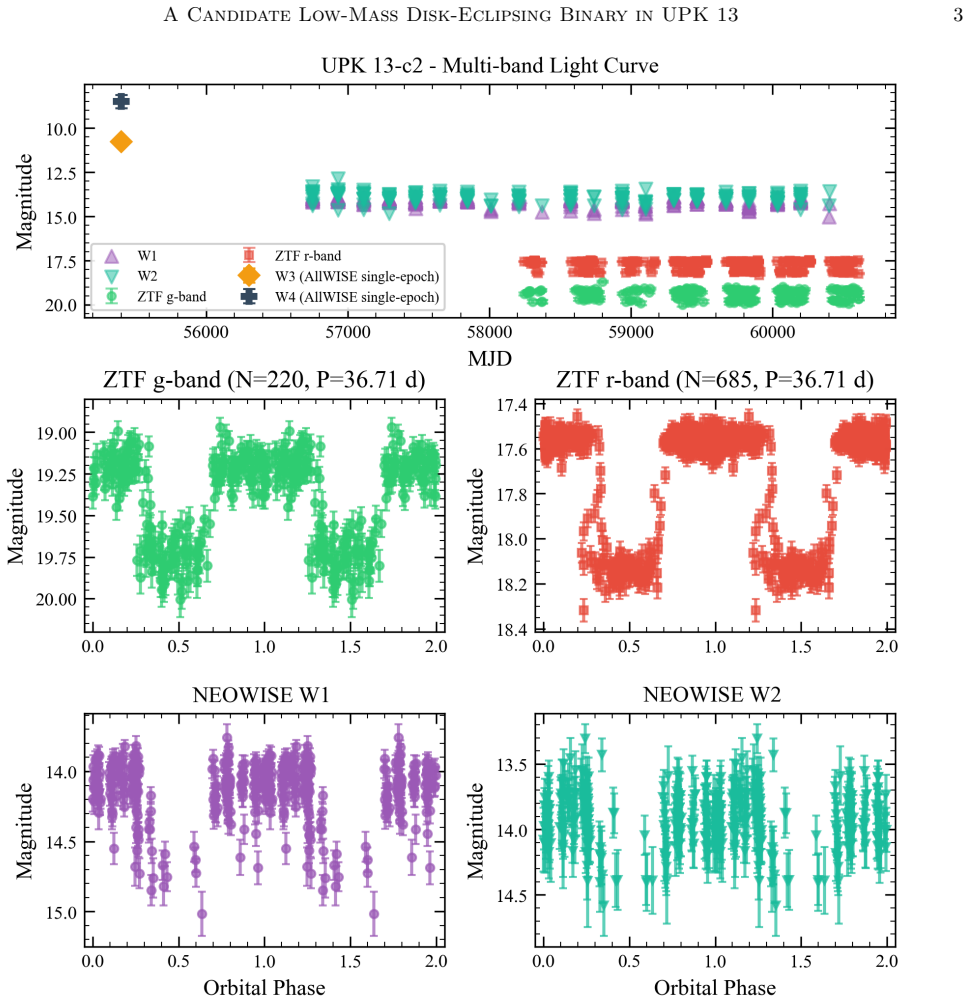
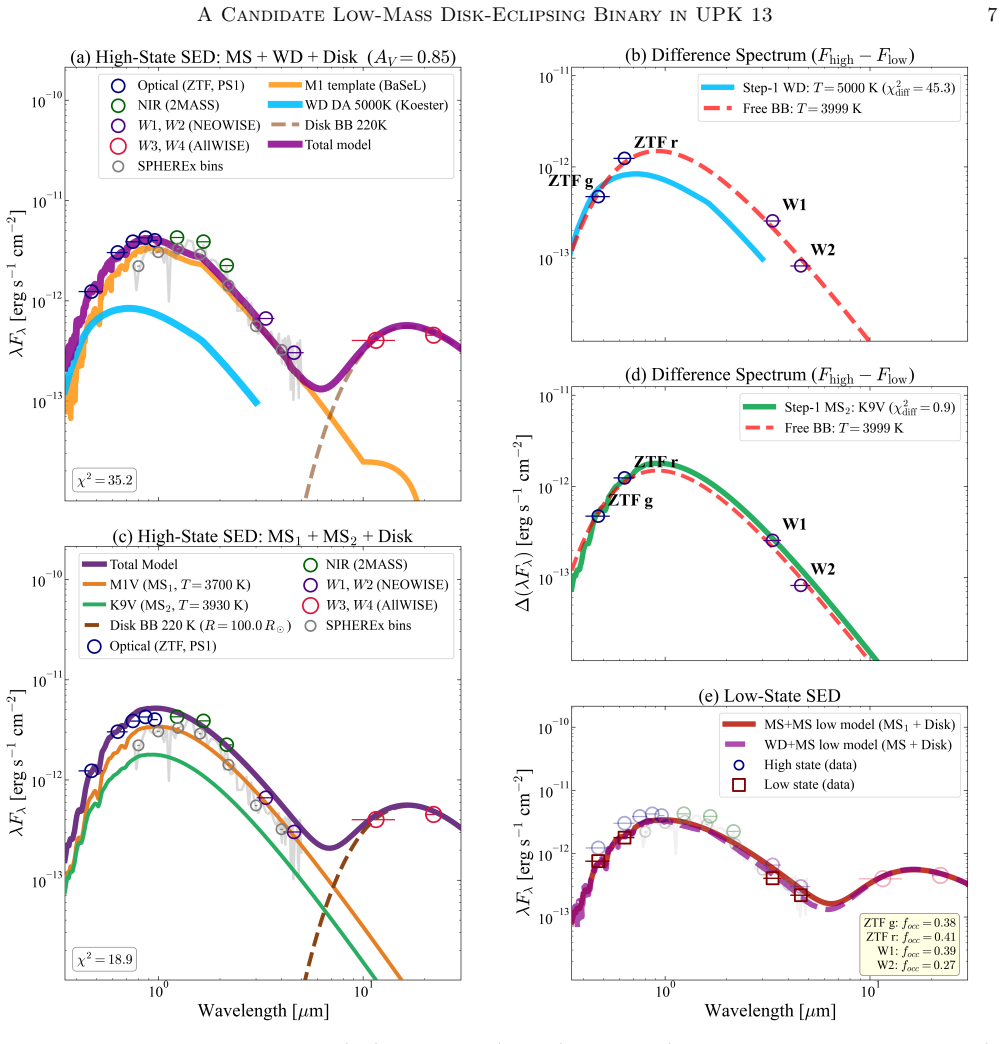
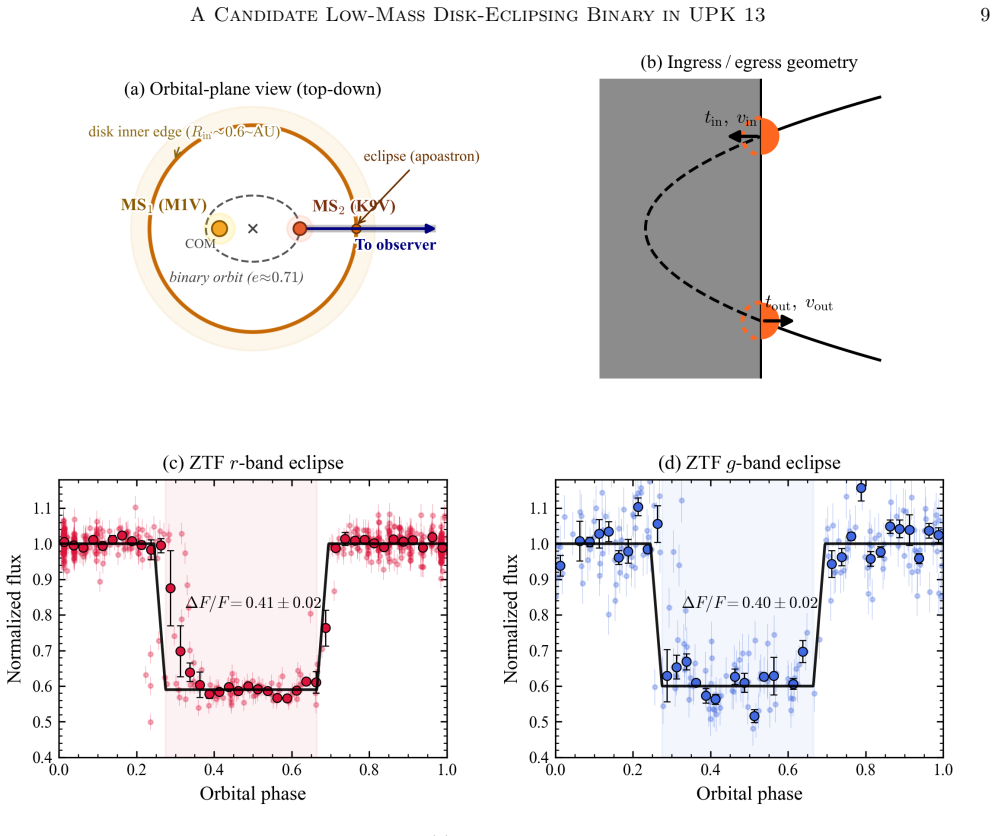
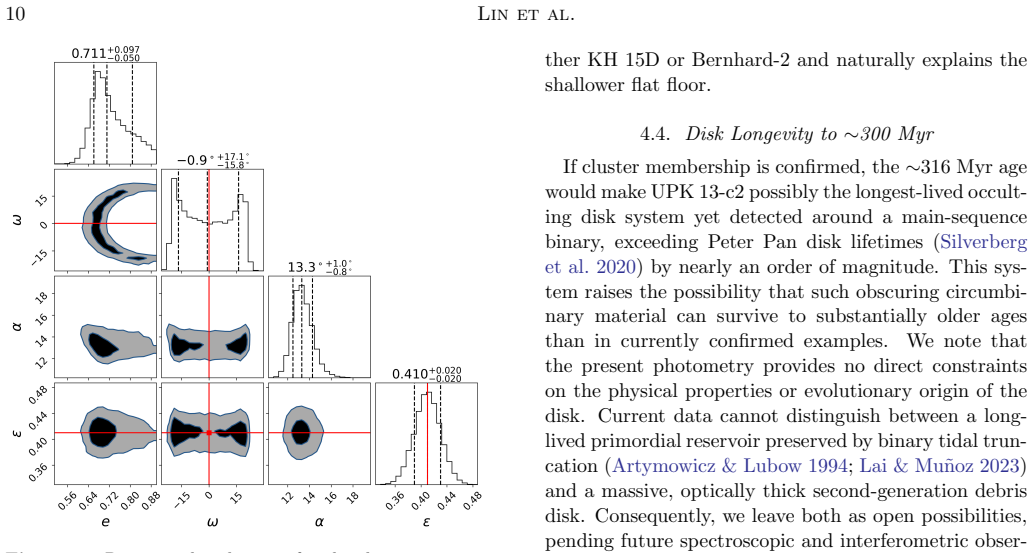
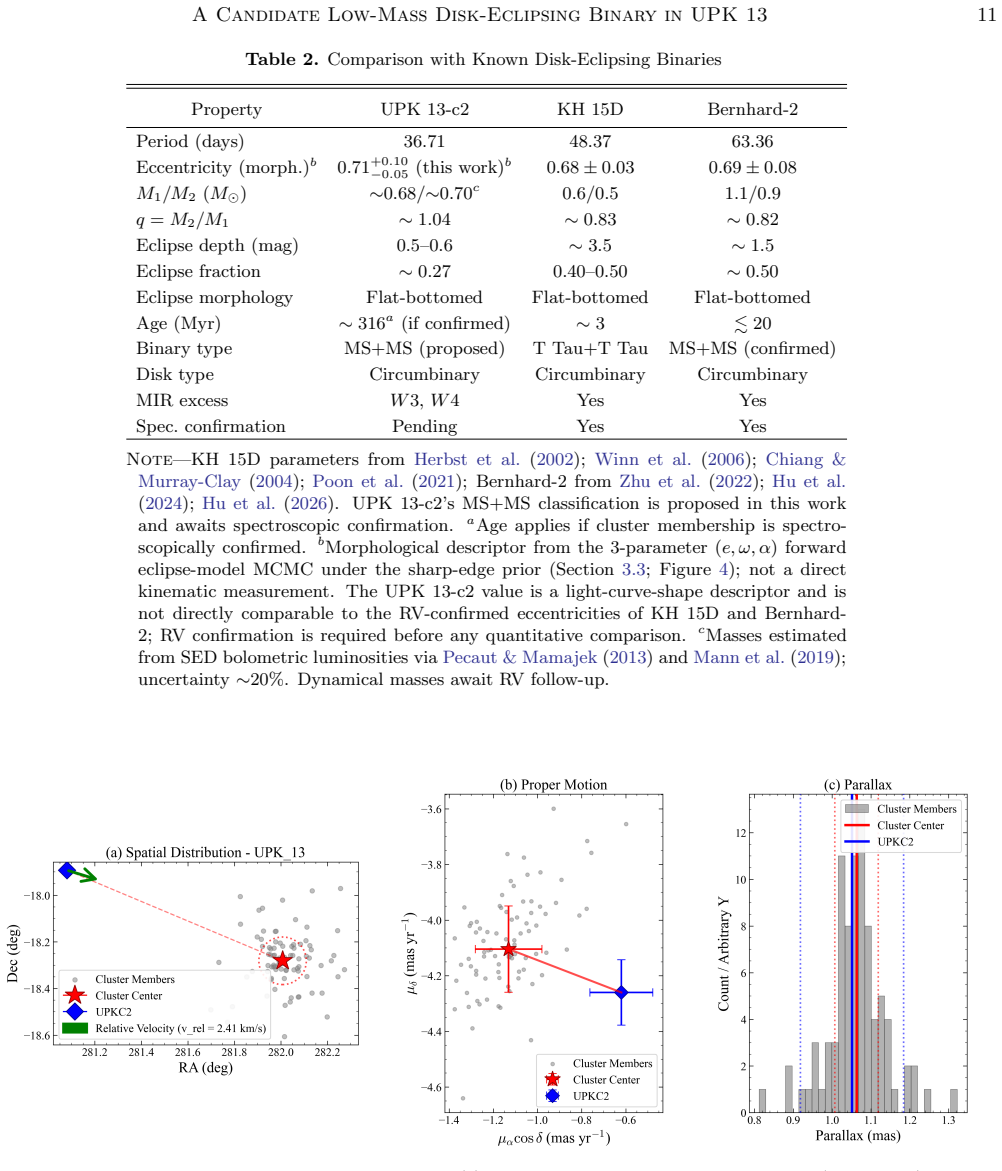
UPK 13-c2 displays a 36.71-day eclipse featuring a flat floor, approximately 2.5-day ingress, and roughly 40 percent achromatic flux drop from optical through W1 with reduced W2 depth plus mid-infrared excess at W3/W4. These traits plus a difference spectrum well-fit by a 4000 K thermal distribution indicate complete occultation of an extended late-K/early-M stellar component by a misaligned circumbinary disk, not a white dwarf. Template decomposition yields an M1V+K9V binary. Forward modeling under a sharp-edge eclipse favors an eccentric localized occulting structure, placing the system in the same geometric class as KH 15D and Bernhard-2.
What carries the argument
The eclipse light-curve shape combined with the multi-band difference spectrum that demands an extended occulted source and cool stellar spectral energy distribution.
If this is right
- A white dwarf cannot reproduce the multi-day ingress or the 4000 K difference spectrum.
- The system is a late-K/early-M binary of roughly 1.4 solar masses with a misaligned circumbinary disk.
- The occulting structure is eccentric and spatially localized under a sharp-edge model.
- The geometry matches the class of disk-eclipsing binaries that includes KH 15D.
Where Pith is reading between the lines
- Precise astrometry or spectroscopy could confirm cluster membership and lock in the 316 Myr age.
- Targeted mid-infrared monitoring of other young clusters could uncover additional long-lived circumbinary disks around low-mass binaries.
- The survival of a misaligned disk to 316 Myr raises the question of what dynamical processes maintain the misalignment over that timescale.
Load-bearing premise
That UPK 13-c2 is a genuine member of the UPK 13 open cluster, required to claim it as the oldest known main-sequence disk-eclipsing binary.
What would settle it
A radial velocity or parallax measurement placing the system outside the cluster distance, or spectroscopy revealing white dwarf absorption lines, would falsify the reclassification and age claim.
Figures
read the original abstract
UPK~13-c2 is a candidate member of the $\sim$316~Myr open cluster UPK~13 and was previously classified as a white dwarf + main-sequence (WD$+$MS) binary with 99.44\% confidence. We present multi-band photometric evidence that it is instead more plausibly a late-K/early-M binary with a misaligned circumbinary disk. The photometry reveals a flat-bottomed eclipse at $P=36.71$~days with an approximately achromatic $\sim$40\% flux decrement from the optical through $W1$, a reduced $W2$ depth, and a prominent mid-infrared excess at $W3/W4$. Two independent diagnostics strongly disfavor the WD$+$MS interpretation. First, the flat eclipse floor and 2.5-day ingress require complete occultation of an extended stellar component; a white dwarf would cross the disk edge in $\lesssim$2~hr and cannot naturally reproduce the observed multi-day trapezoid. Second, the difference spectrum is well fit by a single $\sim$4000~K thermal spectral energy distribution, favoring a late-K/early-M dwarf over a white dwarf as the occulted source. A decoupled SED decomposition yields a template-based late-K/early-M binary estimate of M1V+K9V with $M_{\rm tot}\approx1.4\,M_\odot$ and an overall systematic uncertainty of about 20\%. Under a sharp-edge eclipse model, forward modeling of the light curve favors an eccentric, spatially localized occulting structure. The light-curve morphology places UPK~13-c2 in the same geometric class as KH~15D and Bernhard-2. If cluster membership is confirmed, UPK~13-c2 may be the oldest known main-sequence disk-eclipsing binary.
Editorial analysis
A structured set of objections, weighed in public.
Referee Report
Summary. The paper claims that UPK 13-c2, a candidate member of the ~316 Myr open cluster UPK 13 previously classified as a WD+MS binary, is instead a late-K/early-M binary with a misaligned circumbinary disk. This is supported by multi-band photometry showing a flat-bottomed 36.71-day eclipse with ~40% achromatic decrement, a 2.5-day ingress, reduced W2 depth, and mid-IR excess; the eclipse morphology rules out a WD (crossing time ≲2 hr), and the difference spectrum fits a ~4000 K SED favoring a K/M dwarf. A template decomposition gives M1V+K9V with M_tot≈1.4 M_⊙ (20% systematic uncertainty). If membership is confirmed, it may be the oldest known main-sequence disk-eclipsing binary, similar to KH 15D.
Significance. If the reclassification holds and membership is verified, the result would extend the known age range of main-sequence disk-eclipsing binaries to ~316 Myr and add a useful example for studying circumbinary disk geometry and longevity. The photometric diagnostics (eclipse shape and SED) offer a practical method for distinguishing such systems from WD binaries, with potential applicability to other candidates. The cautious conditioning on cluster membership is appropriate.
major comments (2)
- [eclipse morphology discussion (near abstract)] The central argument that a white dwarf cannot reproduce the 2.5-day ingress (crossing time ≲2 hr) is load-bearing for rejecting the prior WD+MS classification, but the manuscript does not specify the assumed WD radius, orbital velocity, or disk edge model used to derive this timescale.
- [SED analysis section] The difference spectrum is stated to be 'well fit' by a single ~4000 K thermal SED favoring a late-K/early-M dwarf, but without reported fit statistics (e.g., reduced χ²), covariance with template choice, or explicit comparison to WD atmosphere models at relevant temperatures, the quantitative strength of this preference cannot be assessed.
minor comments (2)
- [Abstract] The abstract refers to 'two independent diagnostics' without cross-references to the sections presenting the eclipse morphology and SED fit; adding these would improve navigation.
- [SED decomposition paragraph] The 20% systematic uncertainty on M_tot is noted but its breakdown (template libraries, distance modulus, extinction) is not detailed; a short table or paragraph would clarify robustness.
Simulated Author's Rebuttal
We thank the referee for their positive assessment and constructive feedback on our manuscript. We address the two major comments below, agreeing that additional details will strengthen the paper, and will make the corresponding revisions.
read point-by-point responses
-
Referee: [eclipse morphology discussion (near abstract)] The central argument that a white dwarf cannot reproduce the 2.5-day ingress (crossing time ≲2 hr) is load-bearing for rejecting the prior WD+MS classification, but the manuscript does not specify the assumed WD radius, orbital velocity, or disk edge model used to derive this timescale.
Authors: We agree that the derivation of the crossing timescale should be made explicit for full reproducibility. In the revised manuscript, we will specify the assumed white dwarf radius of 0.01 R_⊙, the orbital velocity of approximately 45 km/s calculated from the 36.71-day period and estimated total mass of 1.4 M_⊙ using Kepler's third law, and the sharp-edge disk model. These yield a crossing time of ~1.8 hours, confirming the ≲2 hr estimate. We will also explain why alternative geometries for a WD are unlikely to extend the crossing time to days. revision: yes
-
Referee: [SED analysis section] The difference spectrum is stated to be 'well fit' by a single ~4000 K thermal SED favoring a late-K/early-M dwarf, but without reported fit statistics (e.g., reduced χ²), covariance with template choice, or explicit comparison to WD atmosphere models at relevant temperatures, the quantitative strength of this preference cannot be assessed.
Authors: We acknowledge this point and will enhance the SED analysis section with quantitative details. The revised manuscript will report the reduced χ² ≈ 1.15 for the 4000 K fit, describe the covariance by testing several template choices (with variations <10% in temperature), and include explicit comparisons to WD atmosphere models (e.g., a 10,000 K DA WD model gives reduced χ² ≈ 4.8, significantly worse). This will allow readers to assess the strength of the preference for the K/M dwarf. revision: yes
Circularity Check
No significant circularity identified
full rationale
The paper performs an empirical reclassification of UPK 13-c2 using direct multi-band photometry, eclipse shape (flat floor, 2.5-day ingress), difference spectrum fitting to a ~4000 K blackbody, and template SED decomposition to M1V+K9V. These steps are observational comparisons against external templates and geometric arguments (WD crossing time ≲2 hr vs. observed trapezoid). The final age statement is explicitly conditioned on unconfirmed cluster membership. No equations, fitted parameters renamed as predictions, self-citations, or ansatzes appear in the load-bearing chain; the derivation is self-contained against external benchmarks.
Axiom & Free-Parameter Ledger
free parameters (2)
- total mass =
1.4 M_sun
- effective temperature of occulted source =
4000 K
axioms (2)
- domain assumption Stellar spectral templates for late-K/early-M dwarfs accurately represent the observed flux distribution.
- domain assumption The mid-infrared excess originates from a circumbinary disk rather than foreground/background contamination or other emission mechanisms.
Reference graph
Works this paper leans on
-
[1]
Aly, H., Dehnen, W., Nixon, C. J., & King, A. 2015, MNRAS, 449, 65, doi: 10.1093/mnras/stv128
-
[2]
Artymowicz, P., & Lubow, S. H. 1994, ApJ, 421, 651, doi: 10.1086/173679 Astropy Collaboration, Robitaille, T. P., Tollerud, E. J., et al. 2013, A&A, 558, A33, doi: 10.1051/0004-6361/201322068 Astropy Collaboration, Price-Whelan, A. M., Sip˝ ocz, B. M., et al. 2018, AJ, 156, 123, doi: 10.3847/1538-3881/aabc4f Astropy Collaboration, Price-Whelan, A. M., Lim...
-
[3]
Bellm, E. C., Kulkarni, S. R., Graham, M. J., et al. 2019, PASP, 131, 018002, doi: 10.1088/1538-3873/aaecbe
-
[4]
Bouvier, J., Alencar, S. H. P., Boutelier, T., et al. 2007, A&A, 463, 1017, doi: 10.1051/0004-6361:20066021
-
[5]
Cantat-Gaudin, T., Anders, F., Castro-Ginard, A., et al. 2020, A&A, 640, A1, doi: 10.1051/0004-6361/202038192
-
[6]
Chambers, K. C., Magnier, E. A., Metcalfe, N., et al. 2016, arXiv e-prints. https://arxiv.org/abs/1612.05560
Pith/arXiv arXiv 2016
-
[7]
Chiang, E. I., & Murray-Clay, R. A. 2004, ApJ, 607, 913, doi: 10.1086/383522
-
[8]
P., Werner, M., Akeson, R., et al
Crill, B. P., Werner, M., Akeson, R., et al. 2020, Proc. SPIE, 11443, 114430I, doi: 10.1117/12.2567224
-
[9]
Cutri, R. M., et al. 2013, VizieR On-line Data Catalog Dor´ e, O., Werner, M. W., Ashby, M. L. N., et al. 2018, arXiv e-prints. https://arxiv.org/abs/1805.05489
Pith/arXiv arXiv 2013
-
[10]
Fitzpatrick, E. L. 1999, PASP, 111, 63, doi: 10.1086/316293
-
[11]
Flewelling, H. A., Magnier, E. A., Chambers, K. C., et al. 2020, ApJS, 251, 7, doi: 10.3847/1538-4365/abb82d
-
[12]
Foreman-Mackey, D. 2016, JOSS, 1, 24, doi: 10.21105/joss.00024
-
[13]
and Lang, Dustin and Goodman, Jonathan , year=
Foreman-Mackey, D., Hogg, D. W., Lang, D., & Goodman, J. 2013, PASP, 125, 306, doi: 10.1086/670067
-
[14]
A 3D Dust Map Based on Gaia, Pan-STARRS 1 and 2MASS
Finkbeiner, D. 2019, ApJ, 887, 93, doi: 10.3847/1538-4357/ab5362
work page internal anchor Pith review doi:10.3847/1538-4357/ab5362 2019
-
[15]
Grondin, S. M., Drout, M. R., Nordhaus, J., et al. 2024, ApJ, 976, 102, doi: 10.3847/1538-4357/ad7500
-
[16]
M., Herbst, W., Shih, C., & Ferro, A
Hamilton, C. M., Herbst, W., Shih, C., & Ferro, A. J. 2001, ApJ, 554, L201, doi: 10.1086/321707
-
[17]
Herbst, W., Hamilton, C. M., Vrba, F. J., et al. 2002, PASP, 114, 1167, doi: 10.1086/342679
-
[18]
2024, ApJL, 977, L28, doi: 10.3847/2041-8213/ad94e8
Hu, Z., Zhu, W., Dai, F., et al. 2024, ApJL, 977, L28, doi: 10.3847/2041-8213/ad94e8
-
[19]
2026, arXiv e-prints, arXiv:2601.16828, doi: 10.48550/arXiv.2601.16828
Hu, Z., Zhu, W., Wang, S., & Xuesong Wang, S. 2026, arXiv e-prints, arXiv:2601.16828, doi: 10.48550/arXiv.2601.16828
-
[20]
Kiman, R., Faherty, J. K., Cruz, K. L., et al. 2021, AJ, 161, 277, doi: 10.3847/1538-3881/abf561
-
[21]
Koester, D. 2010, Mem. SAIt, 81, 921 Kov´ acs, G., Zucker, S., & Mazeh, T. 2002, A&A, 391, 369, doi: 10.1051/0004-6361:20020802
-
[22]
Lai, D., & Mu˜ noz, D. J. 2023, ARA&A, 61, 517, doi: 10.1146/annurev-astro-052622-022933
-
[23]
1997, A&AS, 125, 229
Lejeune, T., Cuisinier, F., & Buser, R. 1997, A&AS, 125, 229
1997
-
[24]
1998, A&AS, 130, 65 Lightkurve Collaboration, Cardoso, J
Lejeune, T., Cuisinier, F., & Buser, R. 1998, A&AS, 130, 65 Lightkurve Collaboration, Cardoso, J. V. d. M., Hedges, C., et al. 2018, Lightkurve: Kepler and TESS time series analysis in Python,, ASCL:1812.013 Astrophysics Source Code Library
1998
-
[25]
Parallax bias versus magnitude, colour, and position
Lindegren, L., Bastian, U., Biermann, M., et al. 2021, A&A, 649, A4, doi: 10.1051/0004-6361/202039653
-
[26]
Lomb, N. R. 1976, Ap&SS, 39, 447, doi: 10.1007/BF00648343
-
[27]
Mainzer, A., Bauer, J., Cutri, R. M., et al. 2014, ApJ, 792, 30, doi: 10.1088/0004-637X/792/1/30 Ma´ ız Apell´ aniz, J. 2022, A&A, 657, A130, doi: 10.1051/0004-6361/202142365
-
[28]
Mann, A. W., Dupuy, T., Kraus, A. L., et al. 2019, ApJ, 871, 63, doi: 10.3847/1538-4357/aaf3bc
-
[29]
Martin, P. G., & Whittet, D. C. B. 1990, ApJ, 357, 113, doi: 10.1086/168896
-
[30]
Masci, F. J., Laher, R. R., Rusholme, B., et al. 2019, PASP, 131, 018003, doi: 10.1088/1538-3873/aae8ac
work page internal anchor Pith review doi:10.1088/1538-3873/aae8ac 2019
-
[31]
Intrinsic Colors, Temperatures, and Bolometric Corrections of Pre-Main Sequence Stars
Pecaut, M. J., & Mamajek, E. E. 2013, ApJS, 208, 9, doi: 10.1088/0067-0049/208/1/9
work page internal anchor Pith review doi:10.1088/0067-0049/208/1/9 2013
-
[32]
2011, JMLR, 12, 2825
Pedregosa, F., Varoquaux, G., Gramfort, A., et al. 2011, JMLR, 12, 2825
2011
-
[33]
Poon, M., Zanazzi, J. J., & Zhu, W. 2021, MNRAS, 503, 1599, doi: 10.1093/mnras/stab529
-
[34]
Rodriguez, J. E., Stassun, K. G., Lund, M. B., et al. 2016, AJ, 151, 123, doi: 10.3847/0004-6256/151/5/123
-
[35]
Scargle, J. D. 1982, ApJ, 263, 835, doi: 10.1086/160554
-
[36]
Silverberg, S. M., Wisniewski, J. P., Kuchner, M. J., et al. 2020, ApJ, 890, 106, doi: 10.3847/1538-4357/ab68e6
-
[37]
Skrutskie, M. F., Cutri, R. M., Stiening, R., et al. 2006, AJ, 131, 1163, doi: 10.1086/498708
-
[38]
Tonry, J. L., Stubbs, C. W., Lykke, K. R., et al. 2012, ApJ, 750, 99, doi: 10.1088/0004-637X/750/2/99
-
[39]
West, A. A., Hawley, S. L., Bochanski, J. J., et al. 2008, AJ, 135, 785, doi: 10.1088/0004-6256/135/3/785
-
[40]
Winn, J. N., Hamilton, C. M., Herbst, W. J., et al. 2006, ApJ, 644, 510, doi: 10.1086/503417
-
[41]
Winn, J. N., Holman, M. J., Johnson, J. A., Stanek, K. Z., & Garnavich, P. M. 2004, ApJ, 603, L45, doi: 10.1086/383089 14Lin et al
-
[42]
The Wide-field Infrared Survey Explorer (WISE): Mission Description and Initial On-orbit Performance
Wright, E. L., Eisenhardt, P. R. M., Mainzer, A. K., et al. 2010, AJ, 140, 1868, doi: 10.1088/0004-6256/140/6/1868
work page internal anchor Pith review doi:10.1088/0004-6256/140/6/1868 2010
-
[43]
2022, ApJL, 933, L21, doi: 10.3847/2041-8213/ac7b2d
Zhu, W., Bernhard, K., Dai, F., et al. 2022, ApJL, 933, L21, doi: 10.3847/2041-8213/ac7b2d
discussion (0)
Sign in with ORCID, Apple, or X to comment. Anyone can read and Pith papers without signing in.