Contextuality as a Diagnostic of Translation-Symmetry Breaking in Translation-Invariant 1D Hamiltonians
Pith reviewed 2026-06-26 20:57 UTC · model grok-4.3
The pith
In translation-invariant 1D chains, maximal contextuality violation coincides with spontaneous breaking of one-site translation symmetry to yield p-periodic ground states.
A machine-rendered reading of the paper's core claim, the machinery that carries it, and where it could break.
Core claim
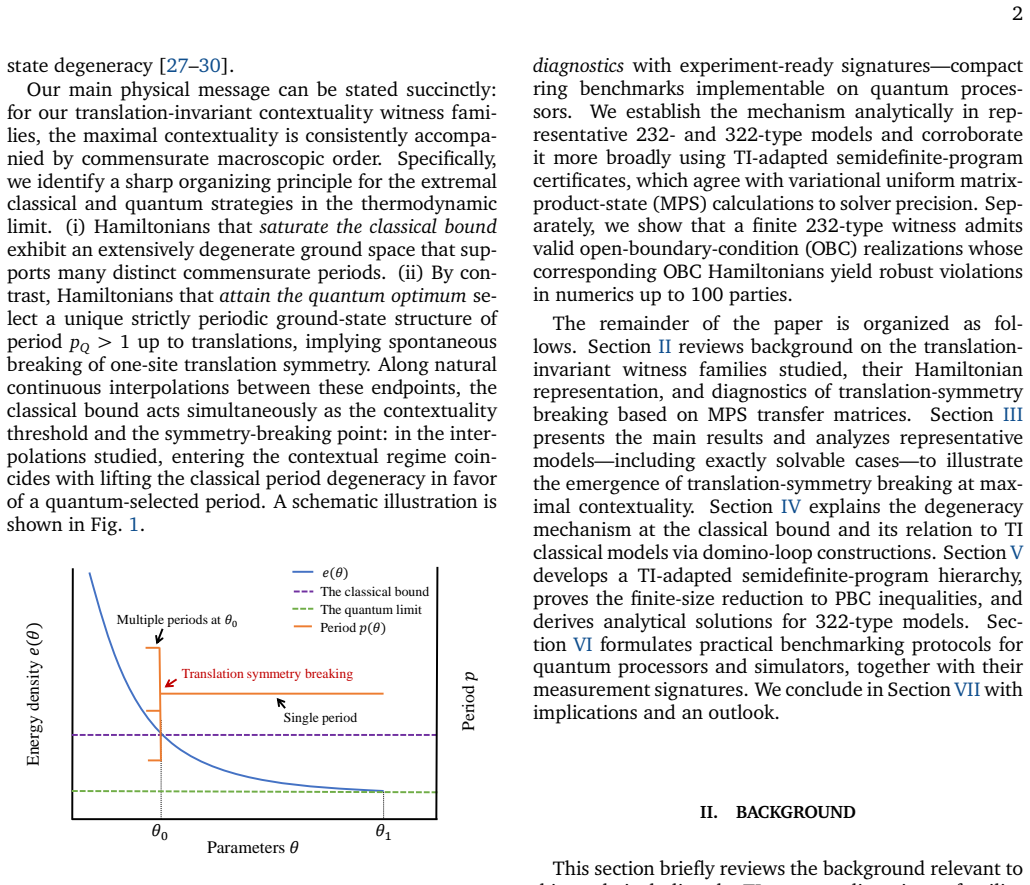
Within the witness families studied, the maximal quantum violation coincides with spontaneous breaking of one-site translation symmetry, producing strictly p-periodic ground states with p>1. Along natural continuous interpolations between classical-bound and quantum-optimal Hamiltonians, the classical bound marks a symmetry-breaking point where competing classical periodicities are lifted in favor of a unique quantum-selected period. At the quantum optimum, the studied families admit exact finite-size reductions: a translation-invariant contextuality witness induces a p-site periodic-boundary-condition inequality with identical classical and quantum bounds.
What carries the argument
A translation-invariant contextuality witness that reduces the infinite-chain problem to a p-site periodic-boundary-condition inequality while preserving identical classical and quantum bounds.
If this is right
- The classical bound of the witness marks the location of the symmetry-breaking transition along the interpolation path.
- The reduction produces compact finite-ring inequalities that can be tested with local energy measurements and are tight in several cases.
- Contextuality acquires a thermodynamic interpretation as a diagnostic of which periodicity is selected in the ground state.
- The mechanism is established analytically for representative two- and three-body models and supported numerically for broader families.
Where Pith is reading between the lines
- The same diagnostic relation might be testable in other symmetry-breaking scenarios such as discrete time-translation or spatial reflection.
- If the reduction technique extends, contextuality witnesses could become practical probes for periodicity in experimental many-body platforms without requiring full tomography.
- Competing periodicities at the classical bound suggest that contextuality strength could quantify the selection pressure exerted by quantum fluctuations.
Load-bearing premise
The coincidence between maximal violation and symmetry breaking holds only for the specific families of contextuality witnesses considered along the continuous interpolations examined.
What would settle it
Finding, within one of the studied witness families, a translation-invariant Hamiltonian whose ground state breaks one-site translation symmetry yet fails to achieve the maximal quantum violation, or achieves the maximal violation without symmetry breaking.
Figures


read the original abstract
Bell- and contextuality-type inequalities have become practical probes of many-body quantum correlations, often involving only few-body correlators and quantities with a direct Hamiltonian interpretation such as an energy density. Here we show that, in infinite one-dimensional translation-invariant chains, contextuality can acquire a genuinely thermodynamic meaning: within the witness families studied, the maximal quantum violation coincides with spontaneous breaking of one-site translation symmetry, producing strictly $p$-periodic ground states with $p>1$. Along natural continuous interpolations between classical-bound and quantum-optimal Hamiltonians, the classical bound marks a symmetry-breaking point where competing classical periodicities are lifted in favor of a unique quantum-selected period. At the quantum optimum, the studied families admit exact finite-size reductions: a translation-invariant contextuality witness induces a $p$-site periodic-boundary-condition inequality with identical classical and quantum bounds (hence no loss under reduction), and in several cases the resulting finite inequalities are tight. This reduction turns an infinite-chain contextuality certification into a compact, hardware-testable benchmark on a small ring, requiring only local energy measurements. We establish the mechanism analytically in representative two- and three-body witness models and corroborate it more broadly using a translation-invariant adaptation of semidefinite-program hierarchies together with variational matrix-product-state algorithms.
Editorial analysis
A structured set of objections, weighed in public.
Referee Report
Summary. The paper claims that, within specific families of contextuality witnesses for infinite translation-invariant 1D chains, the maximal quantum violation coincides with spontaneous breaking of one-site translation symmetry, yielding strictly p-periodic ground states (p>1). Along continuous interpolations between classical-bound and quantum-optimal Hamiltonians, the classical bound marks a symmetry-breaking transition; the witnesses admit exact finite-size reductions to p-site periodic-boundary inequalities that preserve both classical and quantum bounds exactly (hence no loss), with several cases being tight. The mechanism is established analytically for representative two- and three-body models and corroborated via translation-invariant SDP hierarchies and MPS variational methods, turning the certification into a compact, locally measurable benchmark on small rings.
Significance. If the central claim holds, the work supplies a thermodynamic interpretation of contextuality in many-body systems by linking maximal violation directly to symmetry breaking, with the exact finite-size reductions providing a concrete, hardware-testable diagnostic. Analytic proofs for representative models, exact bound preservation under reduction, and the combination of SDP hierarchies with MPS constitute clear strengths that make the result falsifiable and practically relevant within the stated scope of witness families and continuous interpolations.
minor comments (2)
- [Abstract] The abstract and introduction would benefit from an explicit statement (perhaps as a numbered remark) that the coincidence is scoped to the witness families studied and does not extend to arbitrary contextuality witnesses; this is already implicit but would prevent misreading.
- Notation for the p-periodic reductions (e.g., the mapping from infinite-chain witnesses to finite-ring inequalities) could be introduced with a small diagram or table summarizing the preserved bounds for the two- and three-body cases.
Simulated Author's Rebuttal
We thank the referee for their positive evaluation of the manuscript and for recommending acceptance. We are pleased that the central claims, analytic proofs, exact finite-size reductions, and practical diagnostic aspects were viewed as strengths.
Circularity Check
No significant circularity; derivation uses independent external methods
full rationale
The central claim—that maximal quantum violation of the studied contextuality witnesses coincides with spontaneous one-site translation symmetry breaking—is established via analytic proofs on representative two- and three-body models together with corroboration from translation-invariant SDP hierarchies and MPS variational algorithms. These are external, independently verifiable computational tools whose outputs are not defined in terms of the symmetry-breaking point itself. The result is explicitly scoped to the witness families and continuous interpolations considered, with finite-size reductions shown to preserve bounds exactly without introducing self-referential fits or load-bearing self-citations. No step reduces the prediction to a fitted input or prior author result by construction.
Axiom & Free-Parameter Ledger
axioms (2)
- domain assumption Standard quantum mechanics and the validity of contextuality inequalities as probes of many-body correlations
- domain assumption The Hamiltonians are translation-invariant and the ground states can be analyzed via symmetry breaking
Reference graph
Works this paper leans on
-
[1]
,an,0,a n,1,a n,2) =1,(19) where(a 2k+1,0,a 2k+1,1,a 2k+1,2) = (0, 0, 0), and (a2k,0,a 2k,1,a 2k,2) = (0, 1, 0), fork=0,
Then-partite in- equality with open boundary conditions (OBC) given by 1 n−1 n−1X i=1 〈σ(i) 1 σ(i+1) 0 +σ (i) 1 σ(i+1) 1 σ(i) 2 σ(i+1) 0 +σ (i) 2 σ(i+1) 1 〉 ≥ −2 (18) is also a valid inequality for anyn>2, since the classi- cal bound can always be saturated by a LHV model (see details in Section IVA) given by Q(a1,0,a 1,1,a 1,2, . . . ,an,0,a n,1,a n,2) =...
-
[2]
ForQ(010101) =1, the ground state is|222〉⊗∞
-
[3]
ForQ(110101) =Q(010111) =Q(011101) =1/3, the ground state is|122〉⊗∞
-
[4]
ForQ(001101) =Q(110101) =Q(010100) = Q(010011) =1/4, the ground state is|0122〉⊗∞
-
[5]
ForQ(001101) =Q(110101) =Q(010111) = Q(011100) =Q(110011) =1/5, the ground state is|01221〉 ⊗∞
-
[6]
In fact, the TI ground sector ofHcan be characterized using the domino-loop construction
ForQ(000011) =Q(001101) =Q(110101) = Q(010111) =Q(011100) =Q(110000) =1/6, the ground state is|001221〉⊗∞. In fact, the TI ground sector ofHcan be characterized using the domino-loop construction. By the TI ground sector, we mean the set of energy-density-minimizing states within the class of TI orp-periodic states; sym- metrizingap-periodicstateproducesaT...
-
[7]
energy fingerprint
Therefore,L p ≤L TI, and henceLp =L TI. By the domino-loop construction, we find that there is a vertex solution with periodpfor each model in Ta- ble I, and the results are listed in Table II. Consequently, the finite PBC inequalities all share the same classical bound with the TI inequalities. The classical bound of the 232-type inequality can be attain...
-
[8]
J. S. Bell, On the Einstein Podolsky Rosen paradox, Phys. Phys. Fiz.1, 195 (1964)
1964
-
[9]
Brunner, D
N. Brunner, D. Cavalcanti, S. Pironio, V. Scarani, and S.Wehner,Bellnonlocality,ReviewsofModernPhysics86, 419 (2014)
2014
-
[10]
Kochen and E
S. Kochen and E. P. Specker, The problem of hidden variables in quantum mechanics, inErnst Specker Selecta (Birkhäuser Basel, 1990) pp. 235–263
1990
-
[11]
Budroni, A
C. Budroni, A. Cabello, O. Gühne, M. Kleinmann, and J.-Å. Larsson, Kochen-Specker contextuality, Reviews of Mod- ern Physics94, 045007 (2022)
2022
-
[12]
A. Cabello, Bell non-locality and Kochen–Specker contex- tuality: How are they connected?, Foundations of Physics 51, 61 (2021), arXiv:1904.05306 [quant-ph]
-
[13]
Howard, J
M. Howard, J. Wallman, V. Veitch, and J. Emerson, Con- textuality supplies the ‘magic’ for quantum computation, Nature510, 351 (2014)
2014
-
[14]
Contextuality as a resource for models of quantum computation on qubits
J. Bermejo-Vega, N. Delfosse, D. E. Browne, C. Okay, and R. Raussendorf, Contextuality as a resource for models of quantum computation with qubits, Physical Review Let- ters119, 120505 (2017), arXiv:1610.08529 [quant-ph]
work page internal anchor Pith review Pith/arXiv arXiv 2017
-
[15]
Bravyi, D
S. Bravyi, D. Gosset, and R. König, Quantum advantage with shallow circuits, Science362, 308 (2018)
2018
-
[16]
Bravyi, D
S. Bravyi, D. Gosset, R. König, and M. Tomamichel, Quan- tum advantage with noisy shallow circuits, Nature Physics 16, 1040 (2020)
2020
- [17]
- [18]
-
[19]
Acín, Detecting nonlocality in many-body quantum states, Science344, 1256 (2014)
J.Tura,R.Augusiak,A.B.Sainz,T.Vértesi,M.Lewenstein, and A. Acín, Detecting nonlocality in many-body quantum states, Science344, 1256 (2014)
2014
-
[20]
J. Tura, A. B Sainz, T. Vértesi, A. Acín, M. Lewenstein, and R. Augusiak, Translationally invariant multipartite Bell in- equalities involving only two-body correlators, Journal of Physics A: Mathematical and Theoretical47, 424024 (2014)
2014
-
[21]
M. Hu, E. Vallée, T. Seynnaeve, P. Emonts, F. Moham- madi, and J. Tura, Characterizing translation-invariant Bell inequalities using tropical algebra and graph poly- topes, Phys. Rev. A113, 032421 (2026)
2026
-
[22]
M.HuandJ.Tura,Tropicalcontractionoftensornetworks as a Bell inequality optimization toolset, Phys. Rev. Lett. 136, 100202 (2026)
2026
-
[23]
J. Tura, G. De las Cuevas, R. Augusiak, M. Lewenstein, A. Acín, and J. I. Cirac, Energy as a detector of nonlocality of many-body spin systems, Physical Review X7, 021005 (2017)
2017
-
[24]
Z. Wang, S. Singh, and M. Navascués, Entanglement and nonlocality in infinite 1D systems, Physical Review Letters 118, 230401 (2017)
2017
-
[25]
Fine, Hidden variables, joint probability, and the Bell inequalities, Physical Review Letters48, 291 (1982)
A. Fine, Hidden variables, joint probability, and the Bell inequalities, Physical Review Letters48, 291 (1982)
1982
-
[26]
K. Yang, X. Zeng, Y. Luo, G. Yang, L. Shu, M. Navascués, and Z. Wang, Contextuality in infinite one-dimensional translation-invariant local Hamiltonians, npj Quantum In- formation8, 89 (2022)
2022
-
[27]
C. K. Majumdar and D. K. Ghosh, On next-nearest- neighbor interaction in linear chain. I, Journal of Math- ematical Physics10, 1388 (1969)
1969
-
[28]
C. K. Majumdar and D. K. Ghosh, On next-nearest- neighbor interaction in linear chain. II, Journal of Mathe- matical Physics10, 1399 (1969)
1969
-
[29]
F. D. M. Haldane, Spontaneous dimerization in theS=1 2 Heisenbergantiferromagneticchainwithcompetinginter- actions, Physical Review B25, 4925 (1982)
1982
-
[30]
Okamoto and K
K. Okamoto and K. Nomura, Fluid-dimer critical point in S = 1/2 antiferromagnetic Heisenberg chain with next nearest neighbor interactions, Physics Letters A169, 433 (1992)
1992
-
[31]
M. E. Fisher and W. Selke, Infinitely many commensurate phasesinasimpleIsingmodel,PhysicalReviewLetters44, 1502 (1980)
1980
-
[32]
Bak, Commensurate phases, incommensurate phases and the devil’s staircase, Reports on Progress in Physics 45, 587 (1982)
P. Bak, Commensurate phases, incommensurate phases and the devil’s staircase, Reports on Progress in Physics 45, 587 (1982)
1982
-
[33]
W.Selke,TheANNNImodel—theoreticalanalysisandex- perimental application, Physics Reports170, 213 (1988)
1988
-
[34]
E. Lieb, T. Schultz, and D. Mattis, Two soluble models of an antiferromagnetic chain, Annals of Physics16, 407 (1961)
1961
-
[35]
Haldanegap
M. Oshikawa, M. Yamanaka, and I. Affleck, Magnetiza- tionplateausinspinchains: “Haldanegap”forhalf-integer 17 spins, Physical Review Letters78, 1984 (1997)
1984
-
[36]
Oshikawa, Commensurability, excitation gap, and topology in quantum many-particle systems on a periodic lattice, Physical Review Letters84, 1535 (2000)
M. Oshikawa, Commensurability, excitation gap, and topology in quantum many-particle systems on a periodic lattice, Physical Review Letters84, 1535 (2000)
2000
-
[37]
M. B. Hastings, Lieb-Schultz-Mattis in higher dimensions, Physical Review B69, 104431 (2004)
2004
-
[38]
Zauner-Stauber, L
V. Zauner-Stauber, L. Vanderstraeten, M. T. Fishman, F. Verstraete, and J. Haegeman, Variational optimization algorithms for uniform matrix product states, Physical Re- view B97, 045145 (2018)
2018
-
[39]
Haegeman, J
J. Haegeman, J. I. Cirac, T. J. Osborne, I. Pižorn, H. Ver- schelde, and F. Verstraete, Time-dependent variational principle for quantum lattices, Physical Review Letters 107, 070601 (2011)
2011
-
[40]
D.Perez-Garcia,F.Verstraete,M.Wolf,andJ.Cirac,Matrix product state representations, Quantum Information and Computation7, 401 (2007)
2007
-
[41]
Navascués, S
M. Navascués, S. Pironio, and A. Acín, Bounding the set of quantumcorrelations,PhysicalReviewLetters98,010401 (2007)
2007
-
[42]
Navascués, S
M. Navascués, S. Pironio, and A. Acín, A convergent hier- archy of semidefinite programs characterizing the set of quantum correlations, New Journal of Physics10, 073013 (2008)
2008
-
[43]
D. Collins and N. Gisin, A relevant two qubit Bell in- equality inequivalent to the CHSH inequality, Journal of Physics A: Mathematical and General37, 1775 (2004), arXiv:quant-ph/0306129
-
[44]
Scarani,Bell Nonlocality(Oxford University Press, 2019)
V. Scarani,Bell Nonlocality(Oxford University Press, 2019)
2019
-
[45]
Blakaj and M
V. Blakaj and M. M. Wolf, On the set of reduced states of translation invariant, infinite quantum systems, Letters in Mathematical Physics114, 28 (2024)
2024
-
[46]
K.Yang, Y.Zhu, X.Zeng, Z.Zou, M.-H.Yung,andZ.Wang, Cost of locally approximating high-dimensional ground states of contextual quantum models, Communications Physics8, 204 (2025)
2025
-
[47]
Ringbauer, M
M. Ringbauer, M. Meth, L. Postler, R. Stricker, R. Blatt, P. Schindler, and T. Monz, A universal qudit quantum pro- cessor with trapped ions, Nature Physics18, 1053 (2022)
2022
-
[48]
Blatt, P
P.Hrmo, B.Wilhelm, L.Gerster, M.W.vanMourik, M.Hu- ber, R. Blatt, P. Schindler, T. Monz, and M. Ringbauer, Na- tive qudit entanglement in a trapped ion quantum proces- sor, Nature Communications14, 2242 (2023)
2023
-
[49]
Henriet, L
L. Henriet, L. Beguin, A. Signoles, T. Lahaye, A. Browaeys, G.-O.Reymond,andC.Jurczak,Quantumcomputingwith neutral atoms, Quantum4, 327 (2020)
2020
-
[50]
Y. Wang, Z. Hu, B. C. Sanders, and S. Kais, Qudits and high-dimensional quantum computing, Frontiers in Physics8, 589504 (2020)
2020
-
[51]
Peruzzo, J
A. Peruzzo, J. McClean, P. Shadbolt, M.-H. Yung, X.-Q. Zhou, P. J. Love, A. Aspuru-Guzik, and J. L. O’Brien, A variational eigenvalue solver on a photonic quantum pro- cessor, Nature Communications5, 4213 (2014)
2014
-
[52]
Cerezo, A
M. Cerezo, A. Arrasmith, R. Babbush, S. C. Benjamin, S.Endo, K.Fujii, J.R.McClean, K.Mitarai, X.Yuan, L.Cin- cio, and P. J. Coles, Variational quantum algorithms, Na- ture Reviews Physics3, 625 (2021)
2021
- [53]
- [54]
- [55]
-
[56]
Wang and M
Z. Wang and M. Navascués, Two-dimensional translation- invariant probability distributions: approximations, char- acterizations and no-go theorems, Proceedings of the Royal Society A: Mathematical, Physical and Engineering Sciences474, 20170822 (2018)
2018
-
[57]
Lagae, J
A. Lagae, J. Kari, and P. Dutré, Aperiodic sets of square tiles with colored corners, Report CW460(2006)
2006
-
[58]
Gottesman and S
D. Gottesman and S. Irani, The quantum and classical complexity of translationally invariant tiling and Hamil- tonian problems, in2009 50th Annual IEEE Symposium on Foundations of Computer Science(IEEE, 2009) pp. 95–104
2009
-
[59]
T. S. Cubitt, D. Perez-Garcia, and M. M. Wolf, Undecidabil- ity of the spectral gap, Nature528, 207 (2015)
2015
-
[60]
M. Ioannou and D. Rosset, Noncommutative polynomial optimization under symmetry (2021), arXiv:2112.10803 [quant-ph]
-
[61]
thesis, Université de Genéve (2015)
Rosset, Denis,Characterization of correlations in quantum networks, Ph.D. thesis, Université de Genéve (2015). 18 Appendix A: The analytical solution of the 232-type contextuality witness
2015
-
[62]
(A1) Using MPS-based optimization and NPA, we found that the maximum quantum violation can be saturated when d=5,D=4
The optimal observables and state The 232-type contextuality witness is in the form of 〈E〉TI =〈σ (1) 1 σ(2) 0 +σ (1) 1 σ(2) 1 −σ (1) 2 σ(2) 0 +σ (1) 2 σ(2) 1 〉TI ≥ −2. (A1) Using MPS-based optimization and NPA, we found that the maximum quantum violation can be saturated when d=5,D=4. ThesimplestoptimalobservableswefoundforEq.(A1) are σ0 = 1 0 0 0 ...
-
[63]
Incorporating LTI and symmetries in the NPA hierarchy The goal in this subsection is to derive the tight lower bound of Eq. (A1). To compute the tight lower bound, we use NPA, which is a convergent hierarchy of SDPs charac- terizing the set of quantum correlations. The tricky part of Eq. (A1) is that the operators{σ(1) x σ(2) y }are evaluated on the two-b...
discussion (0)
Sign in with ORCID, Apple, or X to comment. Anyone can read and Pith papers without signing in.