Constraints on Cosmic Strings from the Curl-Mode CMB Lensing Power Spectrum measured by ACT DR6
Pith reviewed 2026-06-26 19:38 UTC · model grok-4.3
The pith
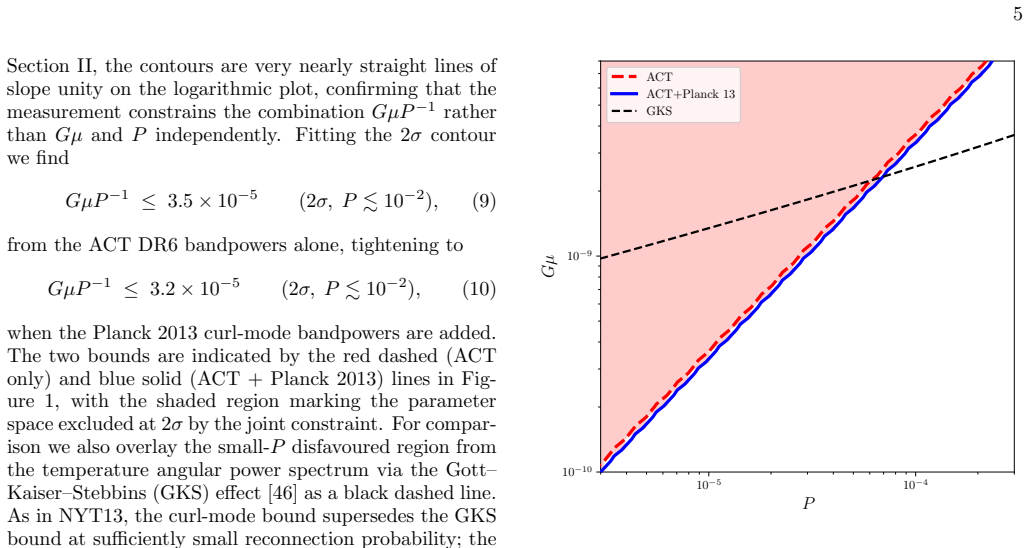
ACT DR6 curl-mode lensing data bounds cosmic string tension Gμ at 5.0×10^{-5} (2σ) for Nambu-Goto strings.
A machine-rendered reading of the paper's core claim, the machinery that carries it, and where it could break.
Core claim
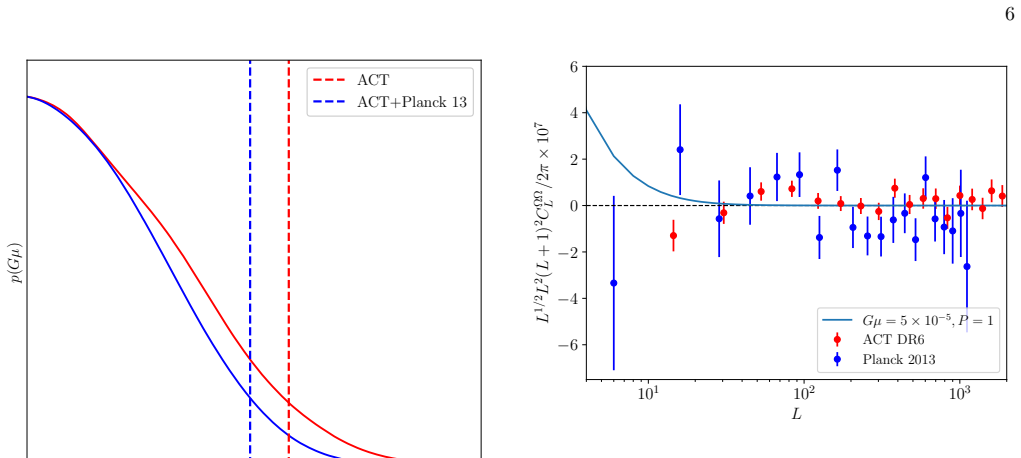
Modelling the string-induced curl power spectrum within the velocity-dependent one-scale framework, the authors obtain a 2σ upper bound on the combination Gμ P^{-1} ≤ 3.5×10^{-5} in the small-P regime, and Gμ ≤ 5.0×10^{-5} at 2σ assuming the canonical Nambu-Goto value P=1. Combining the ACT DR6 curl bandpowers with the Planck 2013 curl-mode reconstruction tightens these bounds to Gμ P^{-1} ≤ 3.2×10^{-5} and Gμ ≤ 4.3×10^{-5} (2σ).
What carries the argument
The velocity-dependent one-scale (VOS) framework that predicts the amplitude and shape of the curl-mode power spectrum generated by a cosmic string network from the tension Gμ and reconnection probability P.
If this is right
- The ACT DR6 bound on Gμ P^{-1} is nearly an order of magnitude tighter than the 2008 ACT result.
- Adding Planck 2013 data that reaches lower multipoles further tightens both the Gμ P^{-1} and Gμ limits.
- These are the strongest constraints derived from curl-mode CMB lensing to date.
- The small-P regime bound applies when intercommutation probability is low, a regime relevant to some string-theory constructions.
Where Pith is reading between the lines
- If the VOS model holds, future CMB experiments with lower noise on large angular scales could push the Gμ limit below 10^{-6}.
- The curl-only approach avoids contamination from scalar lensing, so it remains complementary to temperature and B-mode searches for strings.
- A detection of curl power at the current upper limit would require either a higher string density or a breakdown of the VOS assumptions.
Load-bearing premise
The velocity-dependent one-scale model correctly predicts both the amplitude and the shape of the curl-mode power spectrum produced by cosmic strings.
What would settle it
A future measurement of the curl-mode lensing power spectrum that lies significantly above the VOS-model prediction for Gμ = 5×10^{-5} would falsify the bound.
Figures
read the original abstract
A network of cosmic strings is one of the few well-motivated cosmological sources of vector and tensor metric perturbations on the largest observable scales. Such perturbations imprint a characteristic curl component in the deflection angle of cosmic microwave background (CMB) photons that, unlike the scalar lensing potential, vanishes for adiabatic density fluctuations at linear order. We exploit the curl-mode lensing reconstruction released as part of the Atacama Cosmology Telescope (ACT) Data Release~6 (DR6), based on five seasons of temperature and polarization data covering $9400~\mathrm{deg}^2$ of sky, to set new constraints on the dimensionless string tension $G\mu$ and the inter-commutation (reconnection) probability $P$. Modelling the string-induced curl power spectrum within the velocity-dependent one-scale framework, we obtain a $2\sigma$ upper bound on the combination $G\mu P^{-1}\le 3.5\times 10^{-5}$ in the small-$P$ regime, and $G\mu \le 5.0\times 10^{-5}$ at $2\sigma$ assuming the canonical Nambu-Goto value $P=1$. Combining the ACT DR6 curl bandpowers with the Planck 2013 curl-mode reconstruction, which extends down to $L_{\rm min}=2$, tightens these bounds to $G\mu P^{-1}\le 3.2\times 10^{-5}$ and $G\mu\le 4.3\times 10^{-5}$ ($2\sigma$). These represent the tightest constraints on cosmic strings derived from the curl-mode CMB lensing power spectrum to date. Using the ACT data alone, compared to the ACT 2008-season analysis, the ACT DR6 constraint on $G\mu P^{-1}$ is nearly an order of magnitude tighter.
Editorial analysis
A structured set of objections, weighed in public.
Referee Report
Summary. The manuscript derives 2σ upper bounds on cosmic string parameters from the curl-mode CMB lensing power spectrum measured in ACT DR6 (and combined with Planck 2013). Modeling the string network within the velocity-dependent one-scale (VOS) framework yields Gμ P^{-1} ≤ 3.5×10^{-5} in the small-P regime and Gμ ≤ 5.0×10^{-5} for P=1; the ACT-only bound on Gμ P^{-1} is nearly an order of magnitude tighter than the 2008 analysis.
Significance. If the VOS predictions for the curl spectrum hold, the work supplies the tightest limits to date from this observable and demonstrates the constraining power of the new ACT DR6 reconstruction over a large sky area. The analysis performs a direct forward-model comparison to bandpowers rather than a derived fitted quantity, which is a methodological strength.
major comments (2)
- [VOS modeling description] VOS modeling description (referenced in abstract and § on string network modeling): the framework supplies both the overall normalization (via P^{-1} scaling and vector/tensor amplitudes) and the multipole shape of C_L^{curl}; no uncertainty budget, parameter variation study, or direct comparison to Nambu-Goto/Abelian-Higgs simulations is provided for the curl channel, which is load-bearing for the quoted numerical limits.
- [Results and data combination section] Results and data combination section: the covariance between ACT DR6 and Planck 2013 curl bandpowers is not specified, nor is the impact of any shared systematics on the tightened bounds Gμ P^{-1} ≤ 3.2×10^{-5} and Gμ ≤ 4.3×10^{-5}.
minor comments (2)
- [Figures] Figure captions for the curl power spectrum plots should explicitly state the L-range used in the likelihood and whether the model curves include the full VOS parameter set.
- [Abstract] The abstract states the bounds at 2σ but does not indicate whether these are one-sided or two-sided limits; a brief clarification would aid readers.
Simulated Author's Rebuttal
We thank the referee for their positive evaluation of the work's significance and for the detailed comments. We address each major point below and outline planned revisions.
read point-by-point responses
-
Referee: VOS modeling description (referenced in abstract and § on string network modeling): the framework supplies both the overall normalization (via P^{-1} scaling and vector/tensor amplitudes) and the multipole shape of C_L^{curl}; no uncertainty budget, parameter variation study, or direct comparison to Nambu-Goto/Abelian-Higgs simulations is provided for the curl channel, which is load-bearing for the quoted numerical limits.
Authors: The VOS framework is the standard model employed in the literature for cosmic-string constraints on CMB vector and tensor modes, with its parameters (including the P^{-1} scaling) calibrated to Nambu-Goto simulations in prior works. We agree that an explicit uncertainty budget and robustness checks for the curl channel would strengthen the presentation. We will revise the string-network-modeling section to include a short parameter-variation study for the key VOS inputs and to acknowledge the current scarcity of direct curl-channel comparisons with full simulations. revision: yes
-
Referee: Results and data combination section: the covariance between ACT DR6 and Planck 2013 curl bandpowers is not specified, nor is the impact of any shared systematics on the tightened bounds Gμ P^{-1} ≤ 3.2×10^{-5} and Gμ ≤ 4.3×10^{-5}.
Authors: ACT DR6 and Planck 2013 cover largely disjoint sky patches and employ independent reconstruction methods, so we treated the bandpowers as uncorrelated. We will add an explicit statement of this assumption in the results section, together with a brief discussion of possible shared systematics (e.g., common foreground residuals) and why their effect on the combined limits is expected to be negligible. revision: yes
Circularity Check
No significant circularity detected
full rationale
The paper's central result consists of 2σ upper bounds on Gμ P^{-1} and Gμ obtained by forward-modeling the string-induced curl lensing spectrum inside the external velocity-dependent one-scale (VOS) framework and comparing the resulting template directly to ACT DR6 (and Planck) bandpowers. No step in the provided abstract or modeling description reduces the reported limits to a quantity defined inside the paper by construction, nor does any load-bearing premise rest on a self-citation chain whose validity is presupposed by the present work. The VOS framework is invoked as a pre-existing modeling tool rather than derived or fitted within this manuscript, rendering the derivation self-contained against external data.
Axiom & Free-Parameter Ledger
axioms (2)
- domain assumption The velocity-dependent one-scale framework accurately models the evolution and curl power spectrum of a cosmic string network.
- standard math Curl-mode lensing vanishes for adiabatic scalar fluctuations at linear order.
Reference graph
Works this paper leans on
-
[1]
K. M. Smith, O. Zahn, and O. Dor´ e, Phys. Rev. D76, 043510 (2007), arXiv:0705.3980
Pith/arXiv arXiv 2007
-
[2]
C. M. Hirata, S. Ho, N. Padmanabhan, U. Seljak, and N. A. Bahcall, Phys. Rev. D78, 043520 (2008), arXiv:0801.0644
Pith/arXiv arXiv 2008
-
[3]
S. Das, B. D. Sherwin,et al., Phys. Rev. Lett.107, 021301 (2011), arXiv:1103.2124
Pith/arXiv arXiv 2011
-
[4]
A. van Engelen, R. Keisler, O. Zahn, K. Aird, B. Benson, et al., Astrophys. J.756, 142 (2012), arXiv:1202.0546
Pith/arXiv arXiv 2012
-
[5]
L. Bleem, A. van Engelen, G. Holder,et al., Astrophys. J. Lett.753, L9 (2012), arXiv:1203.4808
Pith/arXiv arXiv 2012
-
[6]
B. D. Sherwin, S. Das, A. Hajian,et al., Phys. Rev. D 86, 083006 (2012), arXiv:1207.4543
Pith/arXiv arXiv 2012
-
[7]
S. Das, T. Louis, M. R. Nolta,et al., JCAP04, 014, arXiv:1301.1037
-
[8]
P. Adeet al., Physical Review Letters113, 10.1103/phys- revlett.113.021301 (2014)
-
[9]
F. J. Qu, B. D. Sherwin, M. S. Madhavacheril, D. Han, K. T. Crowley,et al., Astrophys. J.962, 112 (2024), arXiv:2304.05202
Pith/arXiv arXiv 2024
-
[10]
M. Kamionkowski, A. Kosowsky, and A. Stebbins, Phys. Rev. Lett.78, 2058 (1997), arXiv:astro-ph/9609132
Pith/arXiv arXiv 2058
-
[11]
C. M. Hirata and U. Seljak, Phys. Rev. D68, 083002 (2003), arXiv:astro-ph/0306354
Pith/arXiv arXiv 2003
-
[12]
A. Cooray, M. Kamionkowski, and R. R. Caldwell, Phys. Rev. D71, 123527 (2005), arXiv:astro-ph/0503002
Pith/arXiv arXiv 2005
- [13]
-
[14]
A. Cooray and W. Hu, Astrophys. J.574, 19 (2002), arXiv:astro-ph/0202411
Pith/arXiv arXiv 2002
-
[15]
S. Saga, D. Yamauchi, and K. Ichiki, Phys. Rev. D92, 063533 (2015), arXiv:1505.02774 [astro-ph.CO]
Pith/arXiv arXiv 2015
- [16]
-
[17]
M. Robertson, G. Fabbian, J. Carron, and A. Lewis, JCAP02, 034, arXiv:2406.19998 [astro-ph.CO]
-
[18]
E. J. Copeland, R. C. Myers, and J. Polchinski, JHEP 06, 013, arXiv:hep-th/0312067
-
[19]
M. G. Jackson, N. T. Jones, and J. Polchinski, JHEP10, 013, arXiv:hep-th/0405229
-
[20]
T. Namikawa, D. Yamauchi, and A. Taruya, Phys. Rev. D88, 083525 (2013), arXiv:1308.6068
Pith/arXiv arXiv 2013
- [21]
- [22]
-
[23]
C. J. A. P. Martins and E. P. S. Shellard, Phys. Rev. D 54, 2535 (1996), arXiv:hep-ph/9602271
Pith/arXiv arXiv 1996
-
[24]
C. J. A. P. Martins and E. P. S. Shellard, Phys. Rev. D 65, 043514 (2002), arXiv:hep-ph/0003298
Pith/arXiv arXiv 2002
-
[25]
A. Avgoustidis and E. P. S. Shellard, Phys. Rev. D73, 041301 (2006), arXiv:astro-ph/0512582
Pith/arXiv arXiv 2006
-
[26]
M. S. Madhavacheril, F. J. Qu, B. D. Sherwin,et al., Astrophys. J.962, 113 (2024), arXiv:2304.05203
Pith/arXiv arXiv 2024
-
[27]
N. MacCrann, B. D. Sherwin, F. J. Qu,et al., Astrophys. J.966, 138 (2024), arXiv:2304.05196
arXiv 2024
- [28]
-
[29]
Adeet al., Journal of Cosmology and Astroparticle Physics2019(02), 056
P. Adeet al., Journal of Cosmology and Astroparticle Physics2019(02), 056
-
[30]
Abitbolet al., Journal of Cosmology and Astroparti- cle Physics2025(08), 034
M. Abitbolet al., Journal of Cosmology and Astroparti- cle Physics2025(08), 034
-
[31]
Lonappanet al., Journal of Cosmology and Astropar- ticle Physics2024(06), 009
A. Lonappanet al., Journal of Cosmology and Astropar- ticle Physics2024(06), 009
-
[32]
Ruiz-Grandaet al., Journal of Cosmology and As- troparticle Physics2025(11), 073
M. Ruiz-Grandaet al., Journal of Cosmology and As- troparticle Physics2025(11), 073
-
[33]
N. Sehgalet al.(CMB-HD),Bulletin of the American As- tronomical Society, Bulletin of the American Astronomi- cal Society51, 6 (2019), arXiv:2203.05728 [astro-ph.CO]
arXiv 2019
-
[34]
S. Dodelson, E. Rozo, and A. Stebbins, Phys. Rev. Lett. 91, 021301 (2003), arXiv:astro-ph/0301177
Pith/arXiv arXiv 2003
-
[35]
C. Li and A. Cooray, Phys. Rev. D74, 023521 (2006), arXiv:astro-ph/0604179
Pith/arXiv arXiv 2006
-
[36]
S. Saga, K. Horiguchi, and K. Ichiki, Phys. Rev. D95, 123524 (2017), arXiv:1612.04006 [astro-ph.CO]
Pith/arXiv arXiv 2017
-
[37]
M. Jain, A. J. Long, and M. A. Amin, Journal of Cos- mology and Astroparticle Physics2021(05), 055
-
[38]
T. Okamoto and W. Hu, Phys. Rev. D67, 083002 (2003), arXiv:astro-ph/0301031
Pith/arXiv arXiv 2003
-
[39]
T. Namikawa, D. Hanson, and R. Takahashi, Mon. Not. Roy. Astron. Soc.431, 609 (2013), arXiv:1209.0091
Pith/arXiv arXiv 2013
- [40]
-
[41]
M. S. Madhavacheril, K. M. Smith, B. D. Sherwin, and S. Naess, Journal of Cosmology and Astroparticle Physics 2021(05), 028
2021
-
[42]
M. H. Kesden, A. Cooray, and M. Kamionkowski, Phys. Rev. D67, 123507 (2003), arXiv:astro-ph/0302536
Pith/arXiv arXiv 2003
-
[43]
D. Hanson, A. Challinor, G. Efstathiou, and P. Bielewicz, Phys. Rev. D83, 043005 (2011), arXiv:1008.4403
Pith/arXiv arXiv 2011
-
[44]
Astrophys.641, A8 (2020), arXiv:1807.06210
Planck Collaboration, Astron. Astrophys.641, A8 (2020), arXiv:1807.06210
arXiv 2020
-
[45]
Astrophys.571, A17 (2014), arXiv:1303.5077
Planck Collaboration, Astron. Astrophys.571, A17 (2014), arXiv:1303.5077
Pith/arXiv arXiv 2014
-
[46]
D. Yamauchi, K. Takahashi, Y. Sendouda, C.-M. Yoo, and M. Sasaki, Phys. Rev. D82, 063518 (2010), arXiv:1006.0687
Pith/arXiv arXiv 2010
-
[47]
A. Lewis, A. Challinor, and A. Lasenby, Astrophys. J. 538, 473 (2000), arXiv:astro-ph/9911177
Pith/arXiv arXiv 2000
-
[48]
C. R. Harris, K. J. Millman, S. J. van der Walt,et al., Nature585, 357 (2020), arXiv:2006.10256 [cs.MS]
Pith/arXiv arXiv 2020
-
[49]
P. Virtanen, R. Gommers, T. E. Oliphant,et al., Nature Methods17, 261 (2020), arXiv:1907.10121 [cs.MS]
Pith/arXiv arXiv 2020
-
[50]
D. Foreman-Mackey, D. W. Hogg, D. Lang, and J. Good- man, Publications of the Astronomical Society of the Pa- cific125, 306 (2013), arXiv:1202.3665 [astro-ph.IM]
Pith/arXiv arXiv 2013
-
[51]
Lewis, Journal of Cosmology and Astroparticle Physics2025(08), 025, arXiv:1910.13970 [astro-ph.IM]
A. Lewis, Journal of Cosmology and Astroparticle Physics2025(08), 025, arXiv:1910.13970 [astro-ph.IM]
Pith/arXiv arXiv 1910
-
[52]
J. D. Hunter, Computing in Science & Engineering9, 90 (2007). [53]https://lambda.gsfc.nasa.gov/
2007
discussion (0)
Sign in with ORCID, Apple, or X to comment. Anyone can read and Pith papers without signing in.