A Hybrid GNN-FEM Framework for Phase-Field Fracture Simulation. Physics-Preserving Hybridization for Generalizable Surrogate Modeling
Pith reviewed 2026-06-27 04:44 UTC · model grok-4.3
The pith
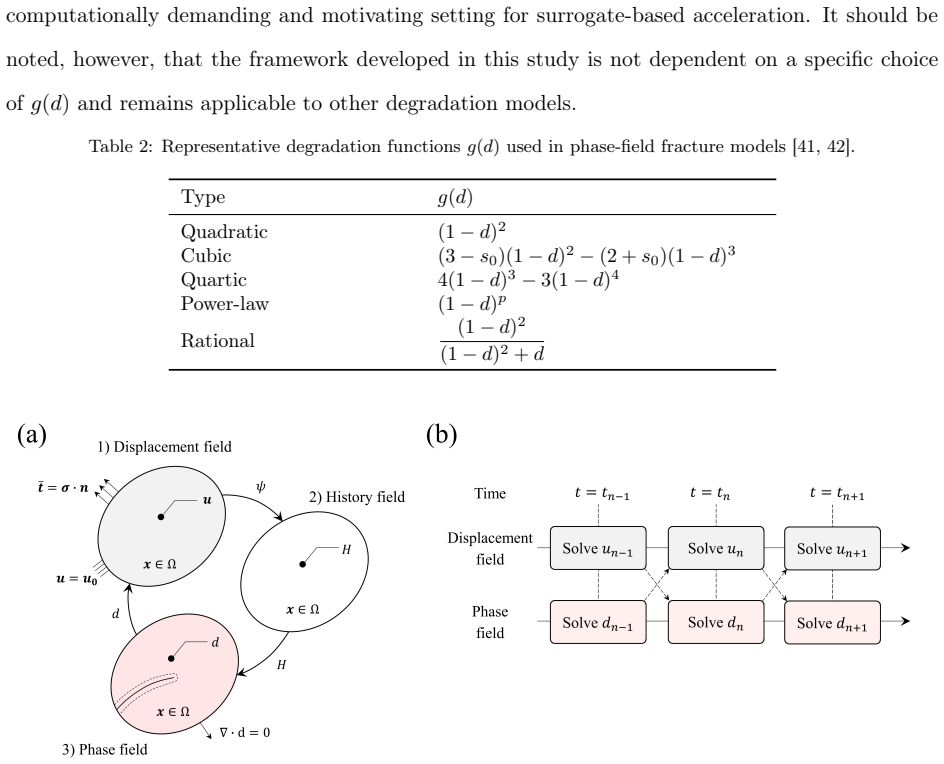
A graph neural network can replace only the phase-field update inside a standard staggered FEM scheme for fracture while the displacement solve stays with FEM to preserve equilibrium and history dependence.
A machine-rendered reading of the paper's core claim, the machinery that carries it, and where it could break.
Core claim
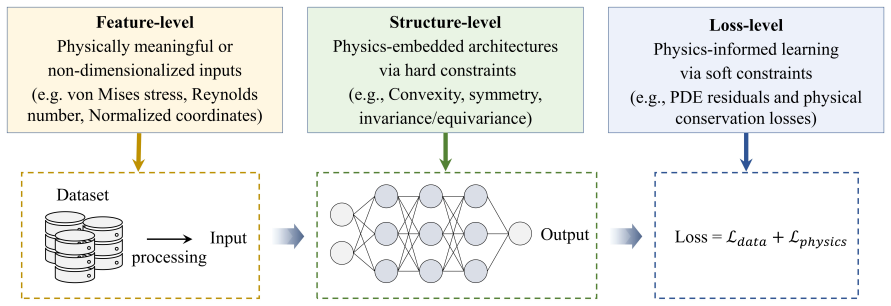
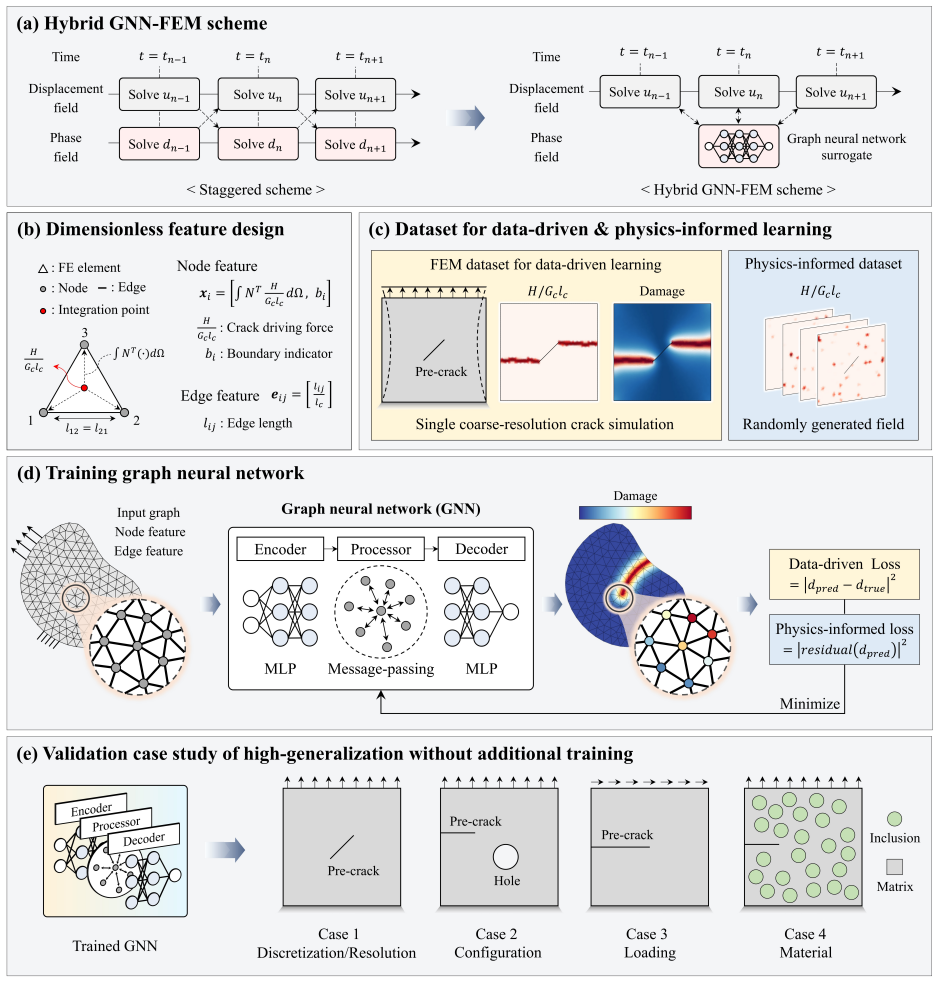
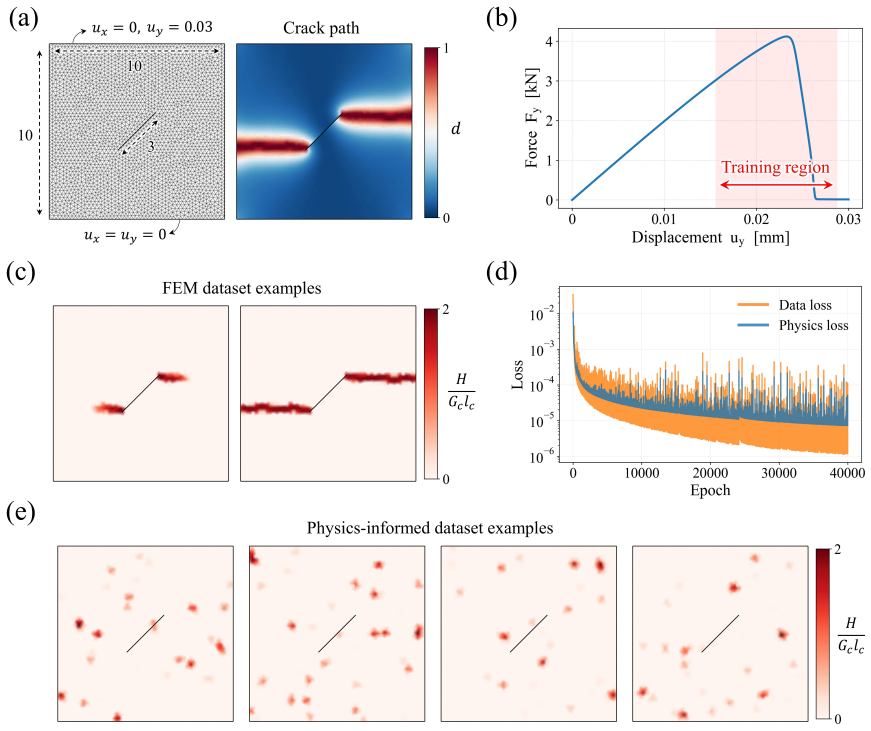
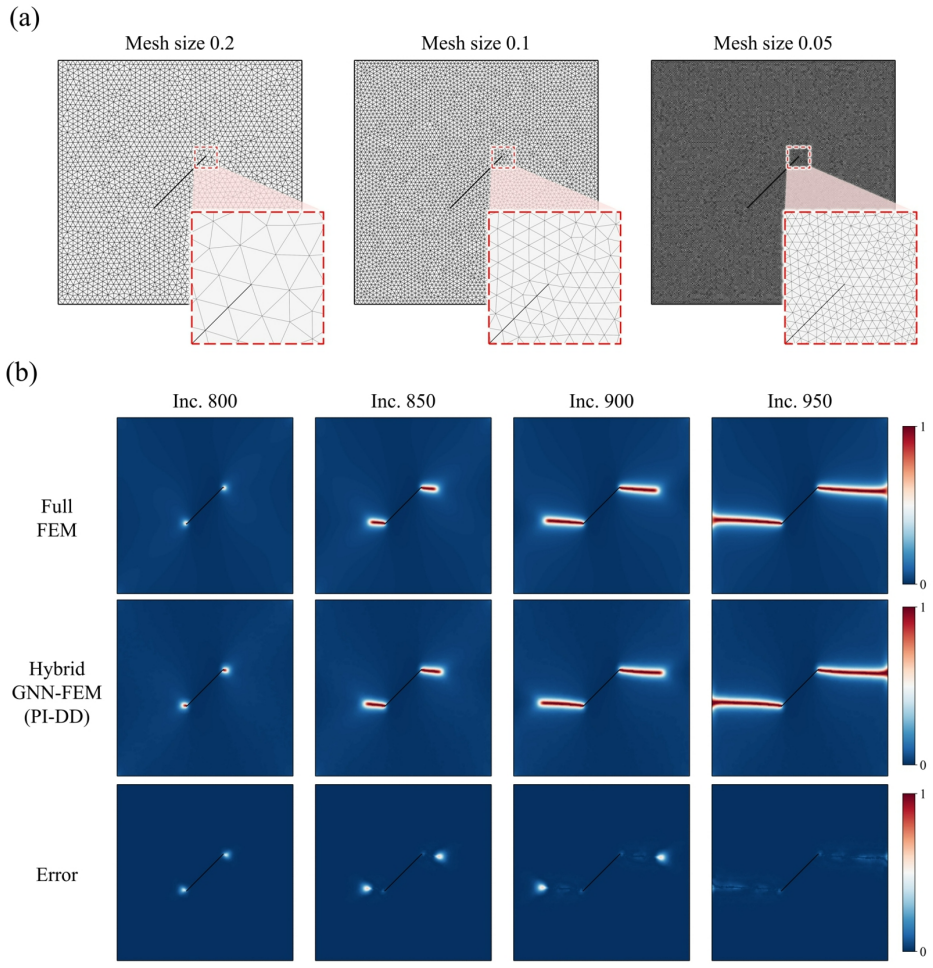
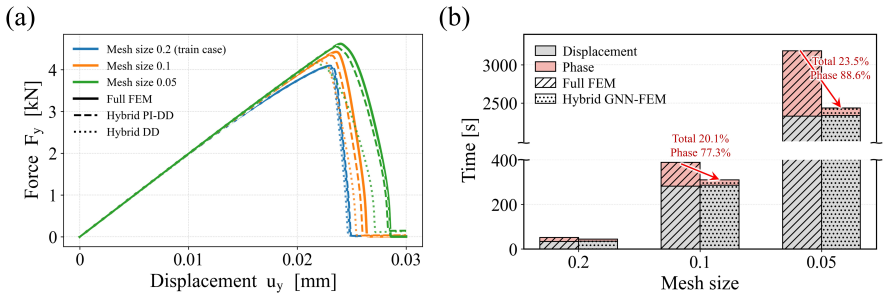
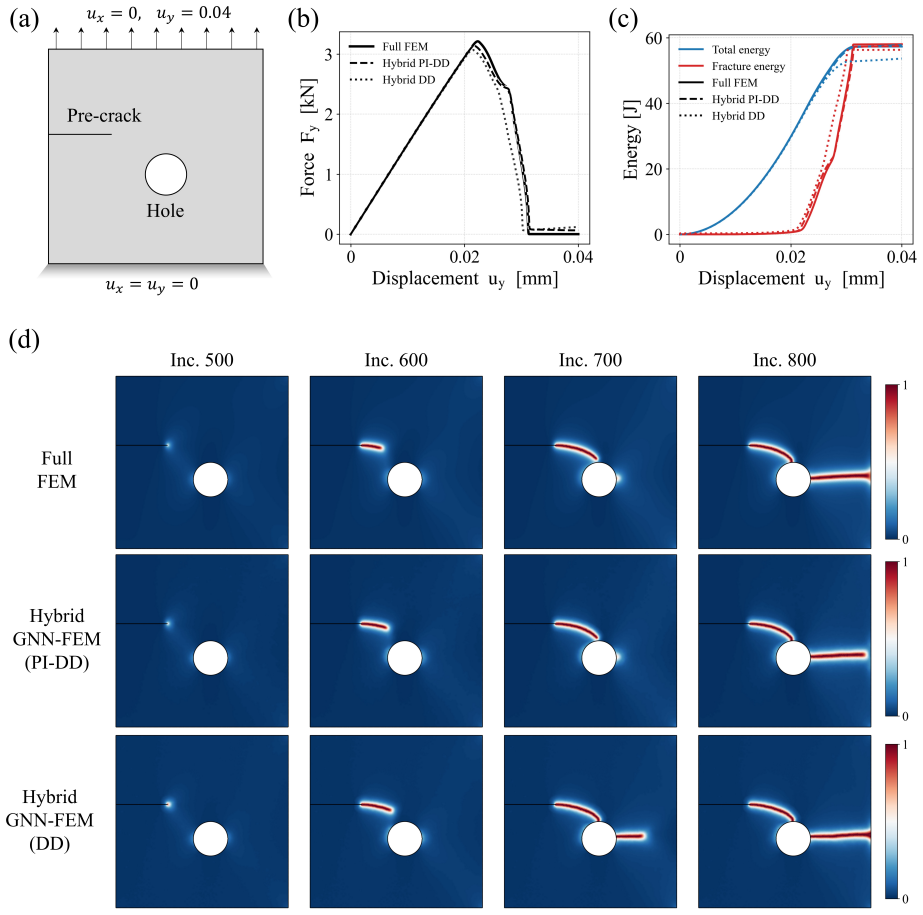
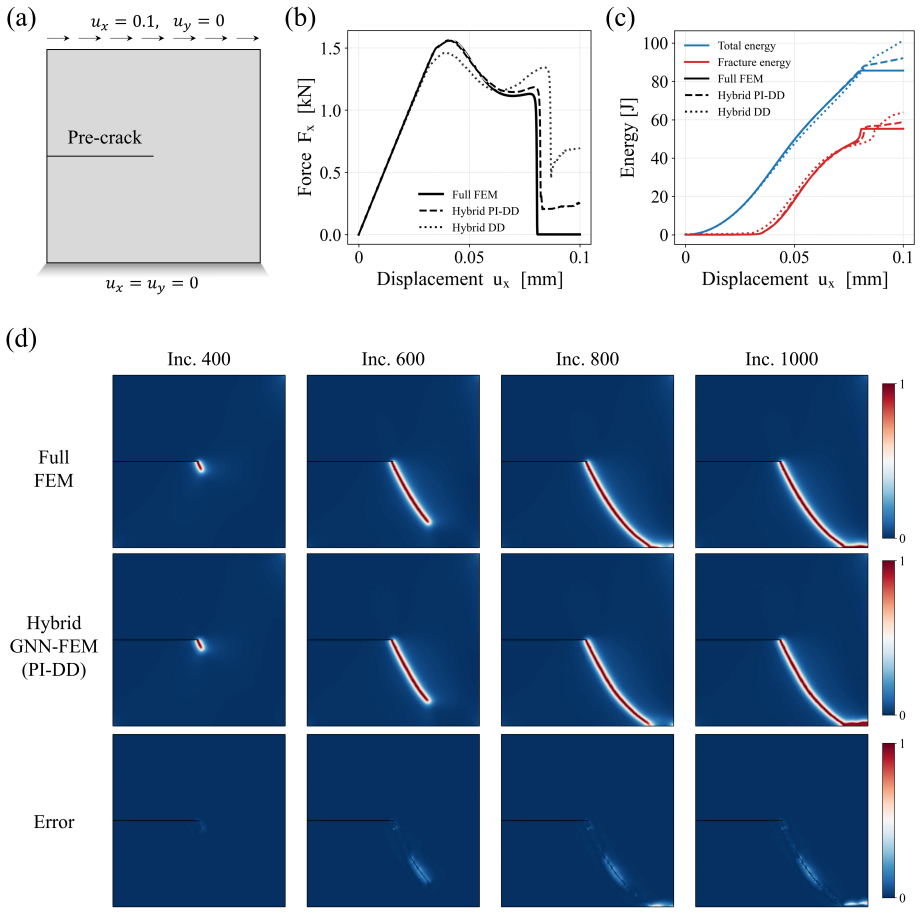
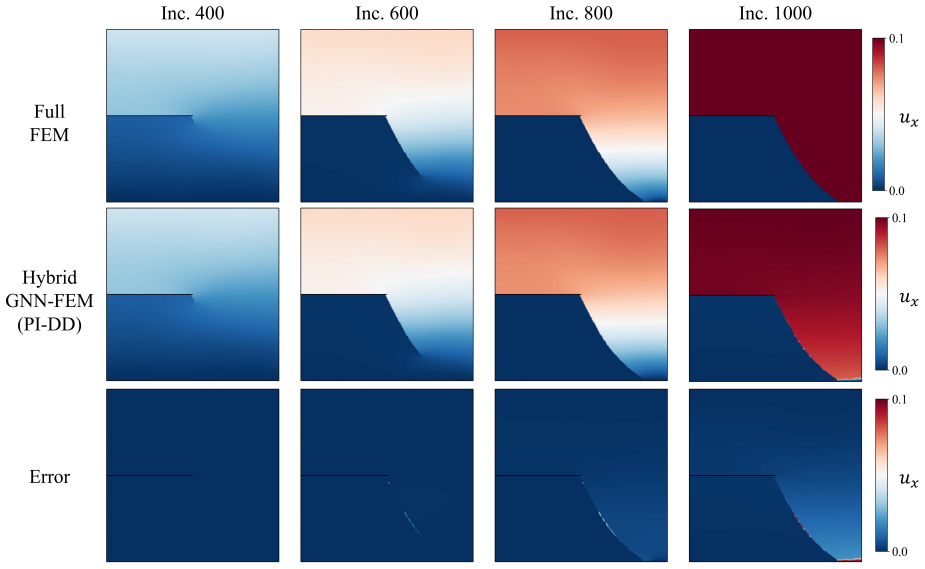
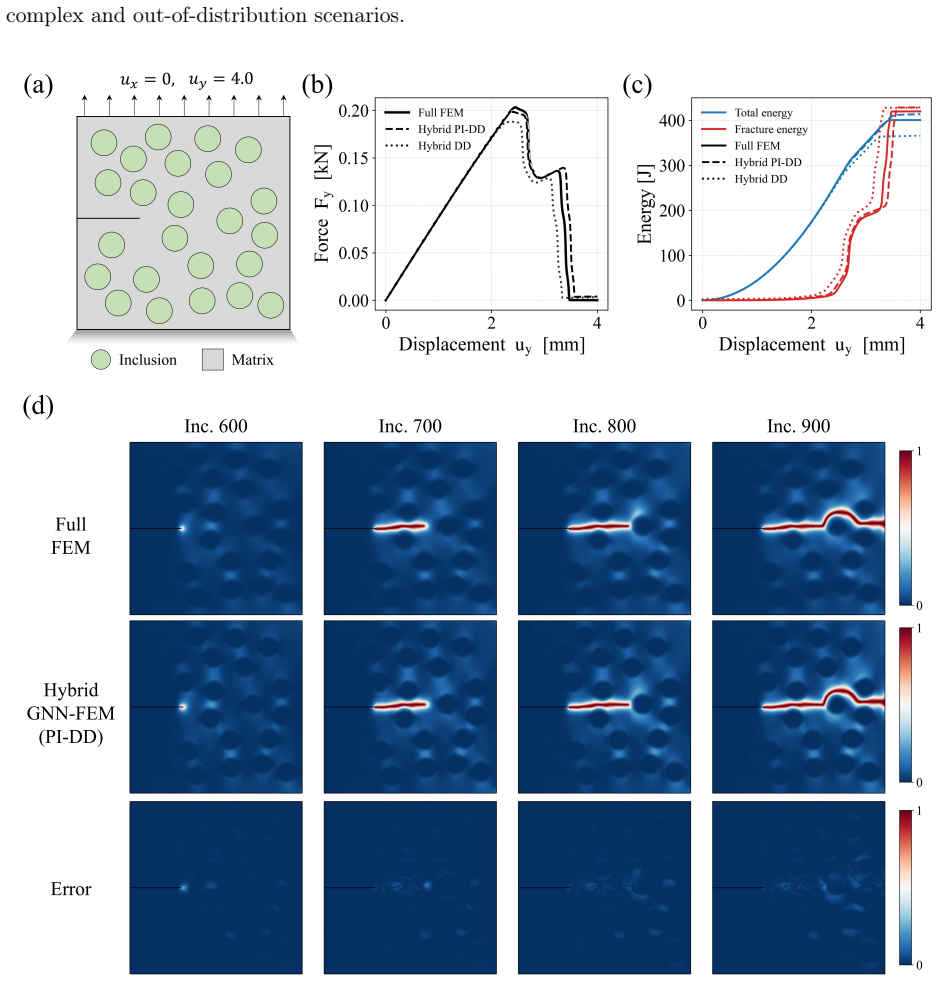
By training a graph neural network to perform only the phase-field update within the existing staggered incremental scheme and retaining the FEM solver for displacements, the hybrid framework keeps consistency with history-dependent evolution. The method achieves generalization across varying geometries, loading conditions, material properties, and discretizations through dimensionless feature design, graph formulation on mesh domains, and a physics-informed loss derived from the governing phase-field equation, while lowering overall computational cost relative to conventional FEM.
What carries the argument
Selective GNN surrogate inserted only into the phase-field update step of the staggered incremental FEM scheme, with FEM retained for displacement solution and equilibrium enforcement.
If this is right
- Computational expense drops because the expensive nonlinear phase-field solve is replaced by a fast network inference at each step.
- Accuracy and physical consistency are maintained because the incremental staggered structure is unchanged and FEM continues to enforce equilibrium.
- The same trained network produces usable results on new geometries, boundary conditions, material constants, and mesh resolutions without retraining.
- History dependence is respected without the network needing to approximate the full solution trajectory over all prior steps.
Where Pith is reading between the lines
- The selective-surrogate idea could be tested on other staggered multiphysics problems such as thermo-mechanical coupling where only one field is expensive to resolve at each step.
- Long-time stability tests on crack branching or coalescence scenarios not represented in training would expose whether error drift appears after hundreds of increments.
- The design choice of matching the learning target exactly to one step of an established numerical algorithm rather than end-to-end prediction may be reusable in other nonlinear mechanics settings.
Load-bearing premise
A network trained solely on individual phase-field updates will stay stable and avoid accumulating errors when applied repeatedly across many load increments in evolving fracture problems.
What would settle it
Execute the hybrid model on a new geometry through a long sequence of load increments and compare the predicted crack path and total dissipated energy against a reference full-FEM run; large deviation in final crack configuration would show the incremental surrogate has failed.
Figures
read the original abstract
Scientific machine learning (SciML) has emerged as a promising approach for accelerating simulations of complex physical systems, yet achieving physically consistent and generalizable predictions for nonlinear, history-dependent problems remains a central challenge. In this study, we propose a hybrid GNN--FEM framework for efficient and generalizable phase-field fracture modeling. While phase-field approaches provide a robust variational framework for simulating complex crack evolution, their high computational cost limits practical applications because they require solving coupled, nonlinear, and history-dependent systems within an incremental finite element procedure. To address this challenge, a graph neural network surrogate is integrated into the conventional staggered scheme, replacing the phase-field update at each load increment while retaining the FEM-based displacement solver to enforce mechanical equilibrium and boundary conditions. By preserving the incremental solution structure, the framework remains consistent with history-dependent fracture evolution without requiring the surrogate to approximate the full solution trajectory. This selective surrogate strategy emphasizes the identification of a physically meaningful and incrementally structured learning target, rather than relying on brute-force data generation to learn the full fracture process. The proposed framework achieves strong generalization across varying geometries, loading conditions, material properties, and discretizations through dimensionless feature design, a graph-based formulation on mesh-based domains, and a physics-informed loss derived from the governing phase-field equation. Numerical experiments demonstrate that the hybrid approach reduces computational cost while maintaining accuracy compared with conventional FEM, and exhibits robust predictive performance across diverse problem settings.
Editorial analysis
A structured set of objections, weighed in public.
Referee Report
Summary. The manuscript proposes a hybrid GNN-FEM framework for phase-field fracture modeling. A graph neural network surrogate replaces only the phase-field subproblem update inside the standard staggered incremental scheme, while the FEM displacement solver is retained to enforce mechanical equilibrium and boundary conditions. The approach relies on dimensionless feature design, a mesh-based graph formulation, and a physics-informed loss derived from the phase-field governing equation to achieve generalization across geometries, loading conditions, material properties, and discretizations, while claiming reduced computational cost relative to conventional FEM without requiring the surrogate to learn the full coupled trajectory.
Significance. If the central stability and generalization claims hold, the selective hybridization strategy offers a principled route to accelerating history-dependent nonlinear fracture simulations by preserving the incremental variational structure rather than learning entire trajectories. This could be valuable for engineering applications where repeated solves under varying conditions are needed. The explicit retention of the staggered scheme and use of physics-informed loss are positive design choices that align with existing phase-field literature.
major comments (2)
- [Numerical experiments] Numerical experiments section: the central claim that the per-increment GNN surrogate produces variationally consistent trajectories over many load steps rests on the untested assumption that local residuals do not accumulate into drift in the history variable or coupled displacement field. No a priori error bounds, Lyapunov-style arguments, or explicit long-horizon ablation studies (e.g., crack-path accuracy after 50–200 increments) are provided to substantiate this.
- [Abstract / Numerical experiments] Abstract and results: the claims of 'strong generalization' and 'maintaining accuracy' are stated without reference to quantitative metrics such as L2 errors on phase-field or displacement fields, relative cost reduction factors, or comparisons against full FEM baselines across the reported parameter sweeps; this leaves the generalization performance unquantified.
minor comments (2)
- [Method] The description of the graph construction on mesh-based domains would benefit from an explicit statement of how nodal features are normalized to remain dimensionless under mesh refinement.
- [Method] Clarify whether the physics-informed loss is enforced only on the phase-field residual or also includes consistency with the history variable update.
Simulated Author's Rebuttal
We thank the referee for the detailed and constructive report. The two major comments identify key areas where additional evidence and quantification would strengthen the claims regarding long-term stability and generalization performance. We address each comment below and indicate the revisions planned for the next version of the manuscript.
read point-by-point responses
-
Referee: [Numerical experiments] Numerical experiments section: the central claim that the per-increment GNN surrogate produces variationally consistent trajectories over many load steps rests on the untested assumption that local residuals do not accumulate into drift in the history variable or coupled displacement field. No a priori error bounds, Lyapunov-style arguments, or explicit long-horizon ablation studies (e.g., crack-path accuracy after 50–200 increments) are provided to substantiate this.
Authors: We agree that explicit verification of long-horizon behavior is necessary to support the claim of variationally consistent trajectories. The staggered scheme is constructed to enforce the incremental variational structure at each step, which in principle limits drift, but we acknowledge that this has not been demonstrated through dedicated ablation studies in the current manuscript. In the revised version we will add long-horizon experiments that track crack-path fidelity and accumulated error in the history variable over 100–200 load increments on representative test cases. Regarding a priori error bounds or Lyapunov-style arguments, these lie outside the empirical focus of the present work; we will instead include a brief discussion of potential accumulation mechanisms and their mitigation by the hybrid formulation. revision: partial
-
Referee: [Abstract / Numerical experiments] Abstract and results: the claims of 'strong generalization' and 'maintaining accuracy' are stated without reference to quantitative metrics such as L2 errors on phase-field or displacement fields, relative cost reduction factors, or comparisons against full FEM baselines across the reported parameter sweeps; this leaves the generalization performance unquantified.
Authors: We accept that the abstract and result summaries would benefit from explicit quantitative metrics. While the numerical experiments section reports comparisons against full FEM, these figures were not distilled into summary statistics in the abstract or across all parameter sweeps. In the revision we will update the abstract to report concrete values (average relative L2 errors on the phase-field and displacement fields, observed wall-clock speed-up factors, and direct baseline comparisons) and will add a consolidated table summarizing performance across the geometry, load, material, and discretization sweeps. revision: yes
Circularity Check
No circularity: framework builds on standard staggered scheme with independent physics-informed components
full rationale
The paper presents a hybrid GNN-FEM surrogate that replaces only the phase-field subproblem inside the existing incremental staggered FEM scheme while retaining the displacement solver. Generalization is attributed to dimensionless features, graph formulation on meshes, and a physics-informed loss derived from the governing equation; none of these reduce by construction to fitted parameters or self-citations. No equations are shown that equate a claimed prediction to an input fit, and the incremental structure is explicitly preserved rather than learned end-to-end. The derivation chain therefore remains self-contained against external benchmarks and does not trigger any of the enumerated circularity patterns.
Axiom & Free-Parameter Ledger
Reference graph
Works this paper leans on
-
[1]
S. L. Brunton, J. N. Kutz, Promising directions of machine learning for partial differential equations, Nature Computational Science 4 (7) (2024) 483–494
2024
-
[2]
Azizzadenesheli, N
K. Azizzadenesheli, N. Kovachki, Z. Li, M. Liu-Schiaffini, J. Kossaifi, A. Anandkumar, Neural operatorsforacceleratingscientificsimulationsanddesign, NatureReviewsPhysics6(5)(2024) 320–328
2024
-
[3]
Z. Li, N. Kovachki, K. Azizzadenesheli, B. Liu, K. Bhattacharya, A. Stuart, A. Anand- kumar, Fourier neural operator for parametric partial differential equations, arXiv preprint arXiv:2010.08895 (2020)
Pith/arXiv arXiv 2010
-
[4]
L. Lu, P. Jin, G. Pang, Z. Zhang, G. E. Karniadakis, Learning nonlinear operators via deeponet based on the universal approximation theorem of operators, Nature machine intelligence 3 (3) (2021) 218–229
2021
-
[5]
G. E. Karniadakis, I. G. Kevrekidis, L. Lu, P. Perdikaris, S. Wang, L. Yang, Physics-informed machine learning, Nature Reviews Physics 3 (6) (2021) 422–440
2021
-
[6]
Z. Hao, S. Liu, Y. Zhang, C. Ying, Y. Feng, H. Su, J. Zhu, Physics-informed machine learning: A survey on problems, methods and applications, arXiv preprint arXiv:2211.08064 (2022)
arXiv 2022
-
[7]
C. Meng, S. Griesemer, D. Cao, S. Seo, Y. Liu, When physics meets machine learning: A survey of physics-informed machine learning, Machine Learning for Computational Science and Engineering 1 (1) (2025) 20
2025
-
[8]
L. Yuan, H. S. Park, E. Lejeune, Towards out of distribution generalization for problems in mechanics, Computer Methods in Applied Mechanics and Engineering 400 (2022) 115569
2022
-
[9]
Hamdi, E
E. Hamdi, E. Lejeune, Towards robust surrogate models: Benchmarking machine learning approaches to expediting phase field simulations of brittle fracture, Computer Methods in Applied Mechanics and Engineering 449 (2026) 118526
2026
-
[10]
Lourenço, A
R. Lourenço, A. Tariq, P. Georgieva, A. Andrade-Campos, B. Deliktaş, On the use of physics- based constraints and validation kpi for data-driven elastoplastic constitutive modelling, Com- puter Methods in Applied Mechanics and Engineering 437 (2025) 117743
2025
-
[11]
J. N. Fuhg, C. M. Hamel, K. Johnson, R. Jones, N. Bouklas, Modular machine learning-based elastoplasticity: Generalization in the context of limited data, Computer Methods in Applied Mechanics and Engineering 407 (2023) 115930
2023
-
[12]
H. Moon, J. Lee, J. Yu, S. Ryu, Physics-informed machine learning for material characteri- zation: A perspective on data-efficient discovery through physics-informed neural networks, International Journal of AI for Materials and Design 2 (4) (2025) 1
2025
-
[13]
S. Liu, B. B. Kappes, B. Amin-ahmadi, O. Benafan, X. Zhang, A. P. Stebner, Physics-informed machine learning for composition–process–property design: Shape memory alloy demonstra- tion, Applied Materials Today 22 (2021) 100898
2021
-
[14]
Faegh, S
M. Faegh, S. Ghungrad, J. P. Oliveira, P. Rao, A. Haghighi, A review on physics-informed machine learning for process-structure-property modeling in additive manufacturing, Journal of Manufacturing Processes 133 (2025) 524–555
2025
-
[15]
J. Leng, K. Zuo, C. Xu, X. Zhou, S. Zheng, J. Kang, Q. Liu, X. Chen, W. Shen, L. Wang, et al., Physics-informed machine learning in intelligent manufacturing: a review, Journal of Intelligent Manufacturing (2025) 1–43
2025
-
[16]
Cuomo, V
S. Cuomo, V. S. Di Cola, F. Giampaolo, G. Rozza, M. Raissi, F. Piccialli, Scientific machine learning through physics–informed neural networks: Where we are and what’s next, Journal of Scientific Computing 92 (3) (2022) 88
2022
-
[17]
K. Luo, J. Zhao, Y. Wang, J. Li, J. Wen, J. Liang, H. Soekmadji, S. Liao, Physics-informed neural networks for pde problems: A comprehensive review, Artificial Intelligence Review 58 (10) (2025) 323
2025
-
[18]
Y. Wang, J. Sun, J. Bai, C. Anitescu, M. S. Eshaghi, X. Zhuang, T. Rabczuk, Y. Liu, Kolmogorov–arnold-informed neural network: A physics-informed deep learning framework 44 for solving forward and inverse problems based on kolmogorov–arnold networks, Computer Methods in Applied Mechanics and Engineering 433 (2025) 117518
2025
-
[19]
Thakolkaran, Y
P. Thakolkaran, Y. Guo, S. Saini, M. Peirlinck, B. Alheit, S. Kumar, Can kan cans? input- convex kolmogorov-arnold networks (kans) as hyperelastic constitutive artificial neural net- works (cans), Computer Methods in Applied Mechanics and Engineering 443 (2025) 118089
2025
-
[20]
T.-W. Hsu, Z. Fang, A. Bansil, Q. Yan, Accurate prediction of tensorial spectra using equiv- ariant graph neural network, Nature Communications (2026)
2026
-
[21]
K. A. Kalina, J. Brummund, M. Kästner, A physics-augmented neural network framework for finite strain incompressible viscoelasticity, arXiv preprint arXiv:2511.02959 (2025)
arXiv 2025
-
[22]
S. K. Mitusch, S. W. Funke, M. Kuchta, Hybrid fem-nn models: Combining artificial neural networks with the finite element method, Journal of Computational Physics 446 (2021) 110651
2021
-
[23]
S. Wang, S. He, Y. Li, R. Zhang, G. Wu, Shear-nn: neural network-based shear constitutive modeling of beam-column joints in finite element analysis, in: Structures, Vol. 81, Elsevier, 2025, p. 110274
2025
-
[24]
S. Baral, Y. Lee, S. Khanal, J. Jeon, Xrepit: A deep learning–computational fluid dynamics hybridframeworkimplementedinopenfoamforfast, robust, andscalableunsteadysimulations, Computers & Fluids 314 (2026) 107075.doi:https://doi.org/10.1016/j.compfluid.2026. 107075
-
[25]
Pantidis, L
P. Pantidis, L. Svolos, D. Abueidda, M. E. Mobasher, Integrated finite element neural network (ifenn) for phase-field fracture with minimal input and generalized geometry-load handling, Computer Methods in Applied Mechanics and Engineering 448 (2026) 118485
2026
-
[26]
X.Wang, Z.-Y.Yin, W.Wu, H.-H.Zhu, Neuralnetwork-augmenteddifferentiablefiniteelement method for boundary value problems, International Journal of Mechanical Sciences 285 (2025) 109783.doi:https://doi.org/10.1016/j.ijmecsci.2024.109783
-
[27]
J. Jung, K. Yoon, P.-S. Lee, Deep learned finite elements, Computer Methods in Applied Mechanics and Engineering 372 (2020) 113401
2020
-
[28]
Miehe, M
C. Miehe, M. Hofacker, F. Welschinger, A phase field model for rate-independent crack prop- agation: Robust algorithmic implementation based on operator splits, Computer Methods in Applied Mechanics and Engineering 199 (45-48) (2010) 2765–2778
2010
-
[29]
C. Kuhn, R. Müller, A continuum phase field model for fracture, Engineering fracture mechan- ics 77 (18) (2010) 3625–3634
2010
-
[30]
Ambati, T
M. Ambati, T. Gerasimov, L. De Lorenzis, A review on phase-field models of brittle fracture and a new fast hybrid formulation, Computational Mechanics 55 (2) (2015) 383–405
2015
-
[31]
Jeong, S
H. Jeong, S. Signetti, T.-S. Han, S. Ryu, Phase field modeling of crack propagation under combined shear and tensile loading with hybrid formulation, Computational Materials Science 155 (2018) 483–492
2018
-
[32]
Goswami, M
S. Goswami, M. Yin, Y. Yu, G. E. Karniadakis, A physics-informed variational deeponet for predicting crack path in quasi-brittle materials, Computer Methods in Applied Mechanics and Engineering 391 (2022) 114587
2022
-
[33]
Perera, V
R. Perera, V. Agrawal, Dynamic and adaptive mesh-based graph neural network framework for simulating displacement and crack fields in phase field models, Mechanics of Materials 186 (2023) 104789
2023
-
[34]
Kiyani, M
E. Kiyani, M. Manav, N. Kadivar, L. De Lorenzis, G. E. Karniadakis, Predicting crack nu- cleation and propagation in brittle materials using deep operator networks with diverse trunk architectures, Computer Methods in Applied Mechanics and Engineering 441 (2025) 117984
2025
-
[35]
K. Feng, X.-P. Zhou, A novel graph networks based learnable physics engines for crack propa- gation and coalescence in solid mechanics, Engineering Fracture Mechanics 315 (2025) 110800. doi:https://doi.org/10.1016/j.engfracmech.2025.110800
-
[36]
Manav, R
M. Manav, R. Molinaro, S. Mishra, L. De Lorenzis, Phase-field modeling of fracture with physics-informed deep learning, Computer Methods in Applied Mechanics and Engineering 45 429 (2024) 117104
2024
-
[37]
B. Feng, X.-P. Zhou, The novel physics-enhanced graph neural network for phase-field fracture modelling, Computer Methods in Applied Mechanics and Engineering 446 (2025) 118284.doi: https://doi.org/10.1016/j.cma.2025.118284
-
[38]
L. Ning, Z. Cai, H. Dong, Y. Liu, W. Wang, Physics-informed neural network frameworks for crack simulation based on minimized peridynamic potential energy, Computer Methods in Applied Mechanics and Engineering 417 (2023) 116430.doi:https://doi.org/10.1016/j. cma.2023.116430
work page doi:10.1016/j 2023
-
[39]
D. Park, J. Lee, H. Lee, G. X. Gu, S. Ryu, Deep generative spatiotemporal learning for inte- grating fracture mechanics in composite materials: inverse design, discovery, and optimization, Materials Horizons 11 (13) (2024) 3048–3065
2024
-
[40]
Miehe, M
C. Miehe, M. Hofacker, F. Welschinger, A phase field model for rate-independent crack prop- agation: Robust algorithmic implementation based on operator splits, Computer Methods in Applied Mechanics and Engineering 199 (45) (2010) 2765–2778.doi:https://doi.org/10. 1016/j.cma.2010.04.011. URLhttps://www.sciencedirect.com/science/article/pii/S0045782510001283
2010
-
[41]
J. M. Sargado, E. Keilegavlen, I. Berre, J. M. Nordbotten, High-accuracy phase-field models for brittle fracture based on a new family of degradation functions, Journal of the Mechanics and Physics of Solids 111 (2018) 458–489
2018
-
[42]
Livingston, S
E. Livingston, S. Srivastava, J. Holber, H. M. Mourad, K. Garikipati, Inference of phase field fracture models, Journal of the Mechanics and Physics of Solids (2025) 106495
2025
-
[43]
S. Teichtmeister, D. Kienle, F. Aldakheel, M.-A. Keip, Phase field modeling of fracture in anisotropic brittle solids, International Journal of Non-Linear Mechanics 97 (2017) 1–21.doi: 10.1016/j.ijnonlinmec.2017.06.018
-
[44]
J. Bleyer, R. Alessi, Phase-field modeling of anisotropic brittle fracture including several dam- age mechanisms, Computer Methods in Applied Mechanics and Engineering 336 (2018) 213– 236.doi:10.1016/j.cma.2018.03.012
-
[45]
V. G. Satorras, E. Hoogeboom, M. Welling, E(n) equivariant graph neural networks, in: Pro- ceedings of the 38th International Conference on Machine Learning, PMLR, 2021, pp. 9323– 9332. 46
2021
discussion (0)
Sign in with ORCID, Apple, or X to comment. Anyone can read and Pith papers without signing in.