Phase Transitions and Gravitational Wave Production at the End of Thermal Inflation
Pith reviewed 2026-06-26 16:35 UTC · model grok-4.3
The pith
The phase transition ending thermal inflation generates a stochastic gravitational wave background within the sensitivity of future detectors like BBO and DECIGO.
A machine-rendered reading of the paper's core claim, the machinery that carries it, and where it could break.
Core claim
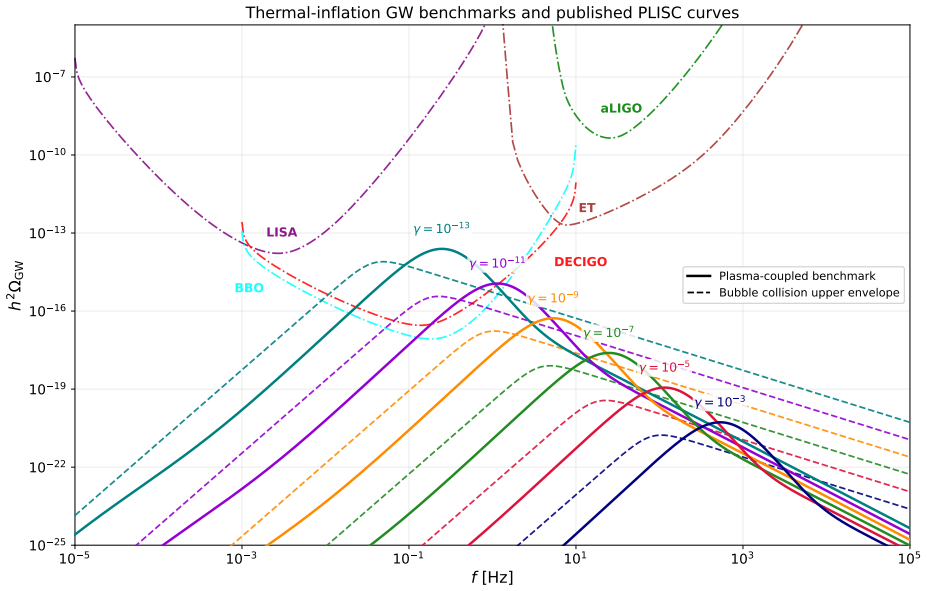
The termination of thermal inflation proceeds via a first-order phase transition with bubble nucleation and growth, as confirmed by bounce action calculations and three-dimensional Langevin lattice simulations incorporating Hubble expansion. The resulting stochastic gravitational wave spectrum from bubble collisions and acoustic motions in the plasma lies within the projected sensitivity of future observatories including BBO and DECIGO.
What carries the argument
The first-order phase transition terminating thermal inflation, characterized by bounce action computation and three-dimensional lattice simulation of bubble nucleation and growth with expansion.
If this is right
- Bubble nucleation and growth dominate over phase-mixing instability during the transition.
- Both bubble collisions and acoustic motions in the plasma contribute to the gravitational wave production.
- The transition parameters from lattice simulations align with semi-analytic bounce action estimates.
- The generated stochastic background reaches the sensitivity of BBO and DECIGO detectors.
Where Pith is reading between the lines
- Detection of this background could help distinguish thermal inflation from other early-universe scenarios by matching the predicted frequency and amplitude.
- The lattice simulation method with expansion could be adapted to study phase transitions in other cosmological models.
- Non-detection in the targeted bands would require adjustments to the assumptions about the inflaton potential or the transition order.
Load-bearing premise
The end of thermal inflation is a first-order phase transition whose parameters can be extracted reliably from the bounce action and whose dynamics are accurately represented by the three-dimensional lattice simulation.
What would settle it
Gravitational wave observations from BBO or DECIGO that show either no signal or a spectrum with amplitude and peak frequency outside the range predicted from the simulated transition parameters.
Figures
read the original abstract
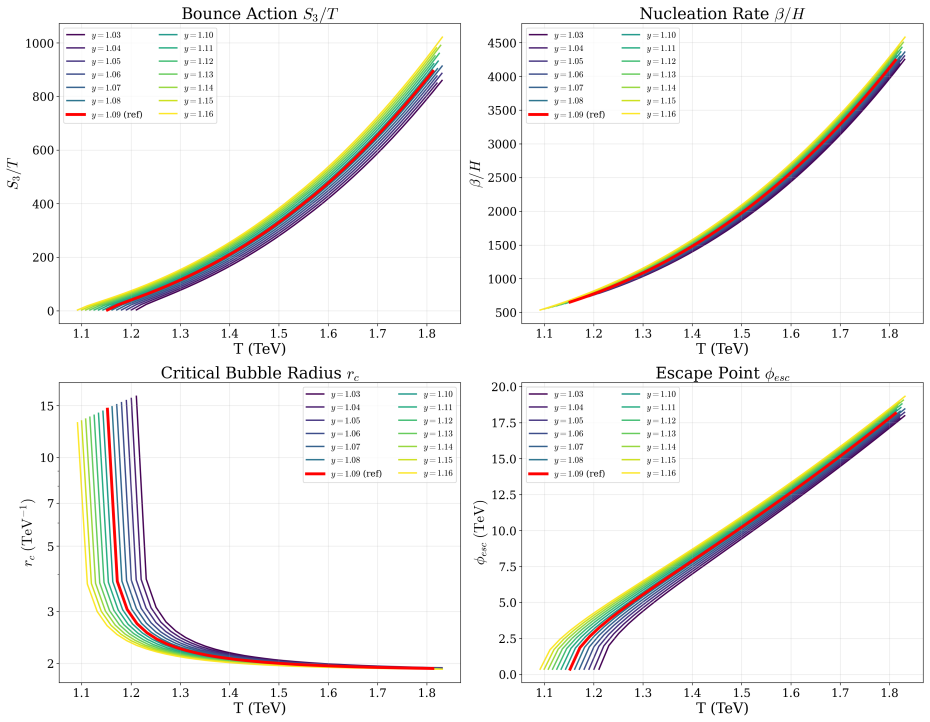
We investigate the first-order phase transition that terminates thermal inflation and evaluate the associated stochastic gravitational-wave signals. The transition is first characterized through semi-analytic calculations of the bounce action, which are compared with numerical results obtained using CosmoTransitions. We then study its real-time evolution in a three-dimensional Langevin lattice simulation that incorporates Hubble expansion and the corresponding temperature evolution throughout the transition. The lattice dynamics are consistent with the bounce-action estimates: the transition proceeds through localized bubble nucleation and subsequent bubble growth, rather than through a phase-mixing instability. Using the resulting transition parameters, we estimate the gravitational-wave spectra generated by bubble collisions and acoustic motions in the plasma. The predicted stochastic background lies within the projected sensitivity ranges of future gravitational-wave observatories, including BBO and DECIGO.
Editorial analysis
A structured set of objections, weighed in public.
Referee Report
Summary. The paper investigates the first-order phase transition terminating thermal inflation. It computes the bounce action semi-analytically and compares results to CosmoTransitions, then evolves the transition in real time via three-dimensional Langevin lattice simulations that include Hubble expansion and temperature evolution. The simulations confirm bubble nucleation and growth rather than phase mixing. Transition parameters extracted from the lattice are used to compute the stochastic gravitational-wave spectrum from bubble collisions and acoustic motions in the plasma, with the conclusion that the predicted background falls within the sensitivity reach of future detectors including BBO and DECIGO.
Significance. If the extracted transition parameters (nucleation rate, wall velocity, energy release) are shown to be robust, the work would identify a concrete, potentially observable GW source tied to thermal inflation, a scenario already motivated by the need to solve the moduli problem. The inclusion of Hubble expansion in the 3D lattice dynamics is a methodological strength relative to purely static or 2D treatments.
major comments (1)
- [Lattice simulation and GW estimation sections] The central detectability claim rests on transition parameters (β/H, α, v_w) extracted from the 3D Langevin simulation. The manuscript asserts consistency with bounce-action estimates but supplies no convergence tests with respect to lattice spacing, volume, or time step, no error bars on the measured nucleation rate or bubble statistics, and no quantitative comparison of the simulated bubble number density or size distribution against the semi-analytic nucleation rate. Because the GW peak frequency scales as β/H and the amplitude as (β/H)^{-2} or stronger, O(1) shifts in these quantities can move the signal in or out of the BBO/DECIGO bands; this quantification is therefore load-bearing for the main result.
minor comments (2)
- Notation for the Hubble parameter during the transition (H vs. H*) should be defined once and used consistently when reporting β/H and β/H*.
- The temperature evolution equation implemented in the lattice should be stated explicitly, including any assumptions about the equation of state or entropy conservation.
Simulated Author's Rebuttal
We thank the referee for the careful reading and for noting the methodological strengths of our work. We address the single major comment below.
read point-by-point responses
-
Referee: The central detectability claim rests on transition parameters (β/H, α, v_w) extracted from the 3D Langevin simulation. The manuscript asserts consistency with bounce-action estimates but supplies no convergence tests with respect to lattice spacing, volume, or time step, no error bars on the measured nucleation rate or bubble statistics, and no quantitative comparison of the simulated bubble number density or size distribution against the semi-analytic nucleation rate. Because the GW peak frequency scales as β/H and the amplitude as (β/H)^{-2} or stronger, O(1) shifts in these quantities can move the signal in or out of the BBO/DECIGO bands; this quantification is therefore load-bearing for the main result.
Authors: We agree that the absence of explicit convergence tests, error bars, and quantitative bubble-statistic comparisons represents a genuine limitation for the robustness of the extracted parameters, especially given the sensitivity of the GW spectrum. The manuscript demonstrates only qualitative consistency between the lattice evolution and the semi-analytic bounce-action results. In the revised version we will add a dedicated subsection presenting convergence tests under variations of lattice spacing, volume, and time step; we will report statistical error bars on the measured nucleation rate and bubble statistics; and we will include a direct quantitative comparison of the simulated bubble number density and size distribution against the semi-analytic expectation. These additions will allow a clearer assessment of uncertainties in β/H, α, and v_w. revision: yes
Circularity Check
No significant circularity; derivation chain is self-contained
full rationale
The paper computes the bounce action semi-analytically and via CosmoTransitions (external code), runs independent 3D Langevin lattice simulations incorporating Hubble expansion to extract transition parameters, and then feeds those parameters into standard GW spectrum formulas for bubble collisions and acoustic motions. No equation or step equates a claimed prediction to a fitted quantity defined from the same data, no self-citation is load-bearing for the central result, and no ansatz or uniqueness theorem is smuggled in. The detectability statement is a direct consequence of the computed parameters rather than a renaming or self-referential construction.
Axiom & Free-Parameter Ledger
Reference graph
Works this paper leans on
-
[1]
Thermal inflation was originally proposed as a solution to the cosmological moduli prob- lem [23, 24]
and the proposed Big Bang Observer (BBO) [19, 20], and nanohertz pulsar timing arrays such as NANOGrav [21] and the International Pulsar Timing Array (IPTA) [22]. Thermal inflation was originally proposed as a solution to the cosmological moduli prob- lem [23, 24]. Many extensions of the SM based on supersymmetric and string theory predict the existence o...
-
[2]
Requiring the vacuum energy to vanish at the true minimum then fixesV 0 =m 2ϕ2 0/4
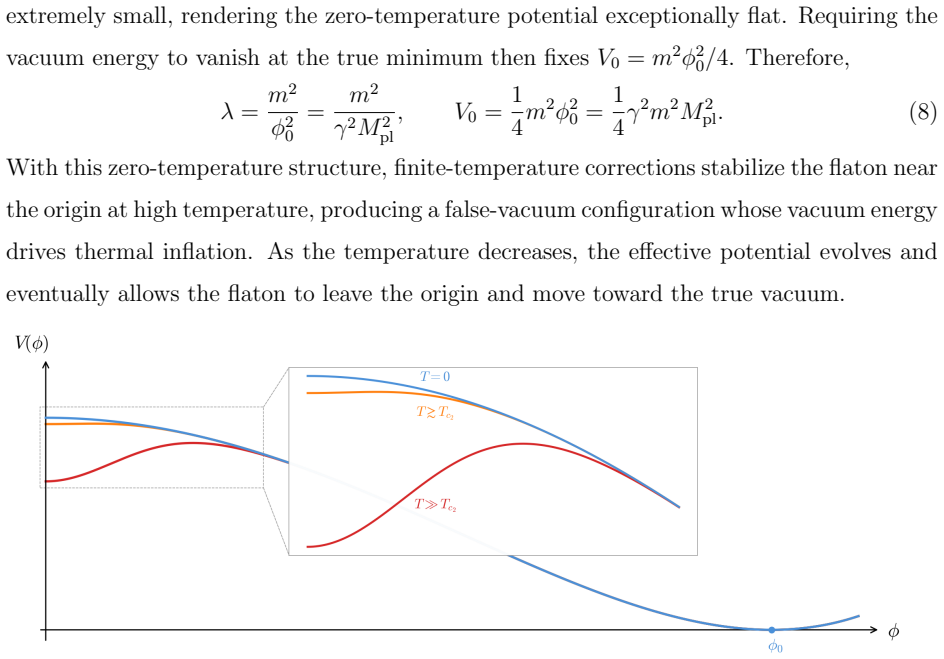
Since the typical vacuum expectation value for thermal inflation lies in the intermediate scale rangeϕ 0 ∼10 7–109 TeV, the corresponding quartic couplingλis 5 extremely small, rendering the zero-temperature potential exceptionally flat. Requiring the vacuum energy to vanish at the true minimum then fixesV 0 =m 2ϕ2 0/4. Therefore, λ= m2 ϕ2 0 = m2 γ2M 2 pl...
-
[3]
Since ˜x=mxand ˜t=mt, the rescaled lattice spacings are dimensionless
Numerical setup and initial conditions We impose periodic boundary conditions and perform the reference simulations on a cubic lattice with linear grid sizeN= 256, corresponding toN 3 = 2563 lattice sites. Since ˜x=mxand ˜t=mt, the rescaled lattice spacings are dimensionless. We choose ∆˜x= 1,∆ ˜t= 0.1.(68) Form= 1 TeV, these values correspond to ∆x= 1 Te...
-
[4]
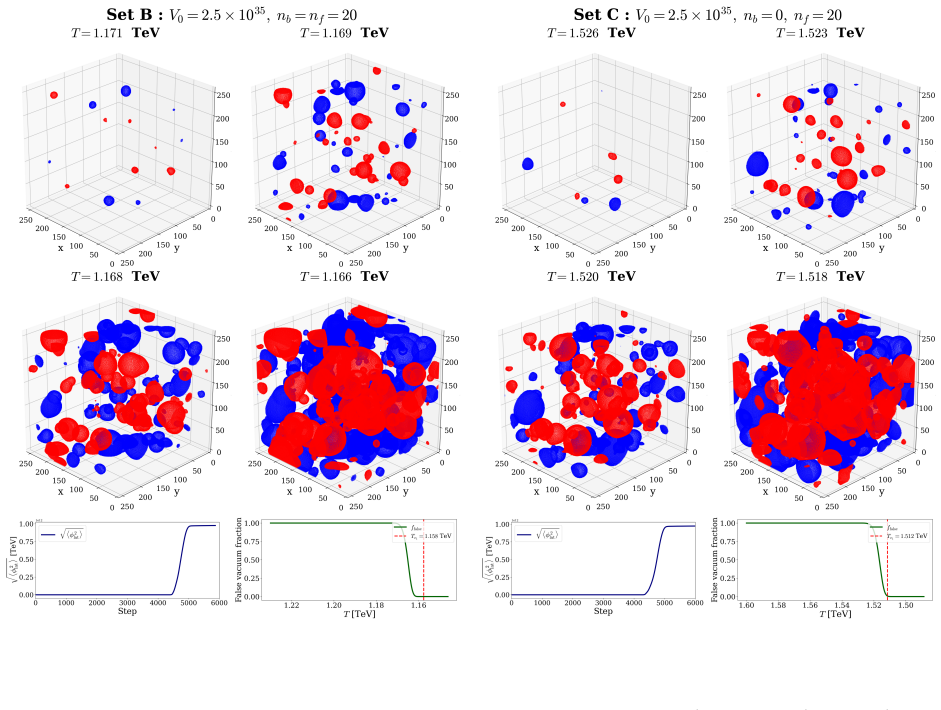
False-vacuum fraction and transition completion To quantify the progress of the transition, we classify each lattice site according to its local field value. We define a site as remaining in the false-vacuum region if ϕi(˜t) < ϕcut.(80) The threshold is chosen with reference to the tunneling escape-point scale obtained from the bounce calculation. Near th...
-
[5]
(67) is regulated by the lattice spacing
Convergence and robustness tests The white-noise source in Eq. (67) is regulated by the lattice spacing. Accordingly, the simulations should be interpreted as an effective stochastic description with a finite 23 FIG. 6. Evolution of the lattice field configurations for benchmark sets B (left column) and C (right column), withy=y b =y f = 1.09. The top and...
-
[6]
These control runs are intended to identify the numerical ingredient responsible for the difference; they should not be interpreted as independent cosmological models
Role of the evolving cosmological background To isolate the origin of the difference from the phase-mixing picture reported in [32], we perform diagnostic control simulations in which the background treatment is varied while the microphysical parameters are held fixed. These control runs are intended to identify the numerical ingredient responsible for th...
-
[7]
S. R. Coleman, Phys. Rev. D15, 2929 (1977), [Erratum: Phys.Rev.D 16, 1248 (1977)]. 36
1977
-
[8]
Callan, Curtis G
J. Callan, Curtis G. and S. R. Coleman, Phys. Rev. D16, 1762 (1977)
1977
-
[9]
A. D. Linde, Phys. Lett. B100, 37 (1981)
1981
-
[10]
A. D. Linde, Nucl. Phys. B216, 421 (1983), [Erratum: Nucl.Phys.B 223, 544 (1983)]
1983
-
[11]
A. H. Guth and E. J. Weinberg, Phys. Rev. D23, 876 (1981)
1981
-
[12]
E. W. Kolb and M. S. Turner,The Early Universe, Frontiers in Physics, Vol. 69 (Addison- Wesley, 1990)
1990
-
[13]
M. S. Turner, E. J. Weinberg, and L. M. Widrow, Phys. Rev. D46, 2384 (1992)
1992
-
[14]
A. Megevand and S. Ramirez, Nucl. Phys. B919, 74 (2017), arXiv:1611.05853 [astro-ph.CO]
Pith/arXiv arXiv 2017
- [15]
-
[16]
M. Gleiser, Phys. Rev. Lett.73, 3495 (1994), arXiv:hep-ph/9403310
Pith/arXiv arXiv 1994
-
[17]
T. Hiramatsu, M. Kawasaki, K. Saikawa, and T. Sekiguchi, JCAP01, 001, arXiv:1207.3166 [hep-ph]
-
[18]
M. Hindmarsh, S. J. Huber, K. Rummukainen, and D. J. Weir, Phys. Rev. D92, 123009 (2015), arXiv:1504.03291 [astro-ph.CO]
Pith/arXiv arXiv 2015
-
[19]
D. Cutting, M. Hindmarsh, and D. J. Weir, Phys. Rev. Lett.125, 021302 (2020), arXiv:1906.00480 [hep-ph]
arXiv 2020
-
[20]
Kosowsky, M
A. Kosowsky, M. S. Turner, and R. Watkins, Phys. Rev. Lett.69, 2026 (1992)
2026
-
[21]
C. Caprini, R. Durrer, and G. Servant, JCAP12, 024, arXiv:0909.0622 [astro-ph.CO]
-
[22]
Capriniet al., JCAP04, 001, arXiv:1512.06239 [astro-ph.CO]
C. Capriniet al., JCAP04, 001, arXiv:1512.06239 [astro-ph.CO]
-
[23]
Aasiet al.(LIGO Scientific), Class
J. Aasiet al.(LIGO Scientific), Class. Quant. Grav.32, 074001 (2015), arXiv:1411.4547 [gr- qc]
Pith/arXiv arXiv 2015
-
[24]
Amaro-Seoaneet al.(LISA), Laser Interferometer Space Antenna (2017), arXiv:1702.00786 [astro-ph.IM]
P. Amaro-Seoaneet al.(LISA), Laser Interferometer Space Antenna (2017), arXiv:1702.00786 [astro-ph.IM]
Pith/arXiv arXiv 2017
-
[25]
G. M. Harry, P. Fritschel, D. A. Shaddock, W. Folkner, and E. S. Phinney, Class. Quant. Grav.23, 4887 (2006), [Erratum: Class.Quant.Grav. 23, 7361 (2006)]
2006
-
[26]
V. Corbin and N. J. Cornish, Class. Quant. Grav.23, 2435 (2006), arXiv:gr-qc/0512039
Pith/arXiv arXiv 2006
-
[27]
Agazieet al.(NANOGrav), Astrophys
G. Agazieet al.(NANOGrav), Astrophys. J. Lett.951, L8 (2023), arXiv:2306.16213 [astro- ph.HE]
Pith/arXiv arXiv 2023
-
[28]
J. Antoniadiset al., Mon. Not. Roy. Astron. Soc.510, 4873 (2022), arXiv:2201.03980 [astro- ph.HE]
arXiv 2022
-
[29]
D. H. Lyth and E. D. Stewart, Phys. Rev. Lett.75, 201 (1995), arXiv:hep-ph/9502417. 37
Pith/arXiv arXiv 1995
-
[30]
D. H. Lyth and E. D. Stewart, Phys. Rev. D53, 1784 (1996), arXiv:hep-ph/9510204
Pith/arXiv arXiv 1996
-
[31]
S. E. Hong, H.-J. Lee, Y. J. Lee, E. D. Stewart, and H. Zoe, JCAP06, 002, arXiv:1503.08938 [astro-ph.CO]
-
[32]
K. Cho, S. E. Hong, E. D. Stewart, and H. Zoe, JCAP08, 002, arXiv:1705.02741 [astro- ph.CO]
-
[33]
S. E. Hong, H. Zoe, and K. Ahn, Phys. Rev. D96, 103515 (2017), arXiv:1706.08049 [astro- ph.CO]
Pith/arXiv arXiv 2017
-
[34]
J.-M. Bae, S. E. Hong, and H. Zoe, Class. Quant. Grav.41, 015024 (2024), arXiv:2204.08657 [astro-ph.CO]
arXiv 2024
-
[35]
G. N. Felder, H. Kim, W.-I. Park, and E. D. Stewart, JCAP06, 005, arXiv:hep-ph/0703275
-
[36]
S. Kim, W.-I. Park, and E. D. Stewart, JHEP01, 015, arXiv:0807.3607 [hep-ph]
-
[37]
R. Easther, J. T. Giblin, Jr., E. A. Lim, W.-I. Park, and E. D. Stewart, JCAP05, 013, arXiv:0801.4197 [astro-ph]
-
[38]
T. Hiramatsu, Y. Miyamoto, and J. Yokoyama, JCAP03, 024, arXiv:1412.7814 [hep-ph]
-
[39]
T. P. Dutka, T. H. Jung, and C. S. Shin, JHEP05, 182, arXiv:2412.15864 [hep-ph]
-
[40]
Dolan and R
L. Dolan and R. Jackiw, Phys. Rev. D9, 3320 (1974)
1974
-
[41]
D. G. Figueroa, A. Florio, F. Torrenti, and W. Valkenburg, Comput. Phys. Commun.283, 108586 (2023), arXiv:2102.01031 [astro-ph.CO]
arXiv 2023
-
[42]
G. S. Rodrigues and R. O. Ramos, JCAP09, 014, arXiv:2504.17760 [astro-ph.CO]
-
[43]
A. Fowlie, Comput. Phys. Commun.228, 264 (2018), arXiv:1802.02720 [hep-ph]
Pith/arXiv arXiv 2018
-
[44]
C. L. Wainwright, Comput. Phys. Commun.183, 2006 (2012), arXiv:1109.4189 [hep-ph]
Pith/arXiv arXiv 2006
-
[45]
X. Wang, F. P. Huang, and X. Zhang, JCAP05, 045, arXiv:2003.08892 [hep-ph]
arXiv 2003
-
[46]
Courant, K
R. Courant, K. Friedrichs, and H. Lewy, IBM Journal of Research and Development11, 215 (1967)
1967
- [47]
- [48]
-
[49]
D. J. Weir, Phys. Rev. D93, 124037 (2016), arXiv:1604.08429 [astro-ph.CO]
Pith/arXiv arXiv 2016
-
[50]
M. Hindmarsh, S. J. Huber, K. Rummukainen, and D. J. Weir, Phys. Rev. D96, 103520 (2017), [Erratum: Phys.Rev.D 101, 089902 (2020)], arXiv:1704.05871 [astro-ph.CO]
arXiv 2017
- [51]
-
[52]
Schmitz, JHEP01, 097, arXiv:2002.04615 [hep-ph]
K. Schmitz, JHEP01, 097, arXiv:2002.04615 [hep-ph]. 38
Pith/arXiv arXiv 2002
- [53]
-
[54]
K. S. Jeong and W.-i. Park, JCAP11, 016, arXiv:2305.11143 [hep-ph]
-
[55]
G. H. Golub and J. H. Welsch, Mathematics of Computation23, 221 (1969). 39
1969
discussion (0)
Sign in with ORCID, Apple, or X to comment. Anyone can read and Pith papers without signing in.