Controllable Quantum Spin Hall Phases in Bi₂Te₃-Family van der Waals Heterobilayers
Pith reviewed 2026-06-26 16:00 UTC · model grok-4.3
The pith
Stacking two trivial quintuple layers from the Bi₂Te₃ family creates controllable quantum spin Hall phases.
A machine-rendered reading of the paper's core claim, the machinery that carries it, and where it could break.
Core claim
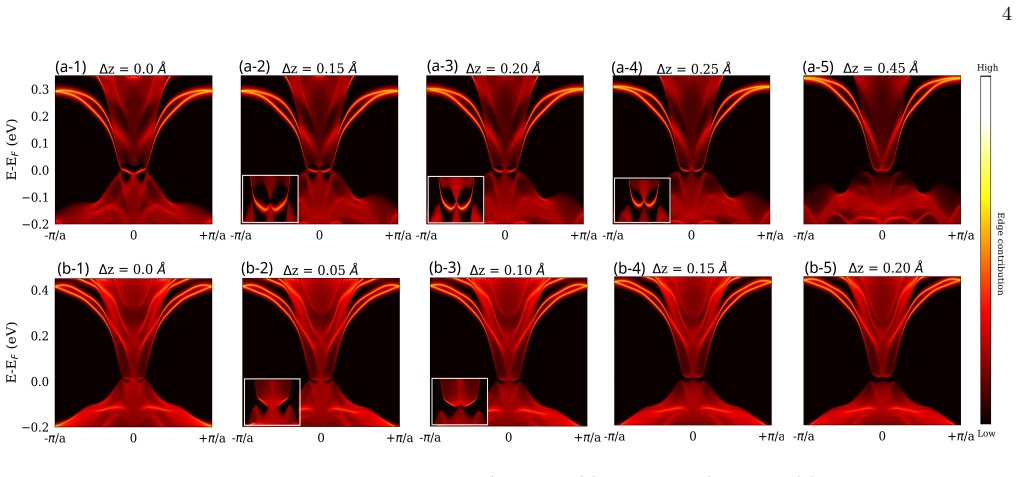
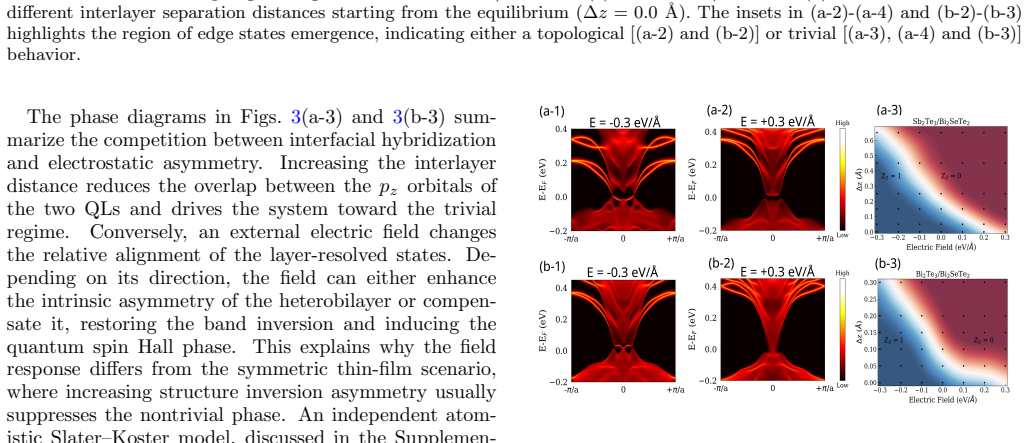
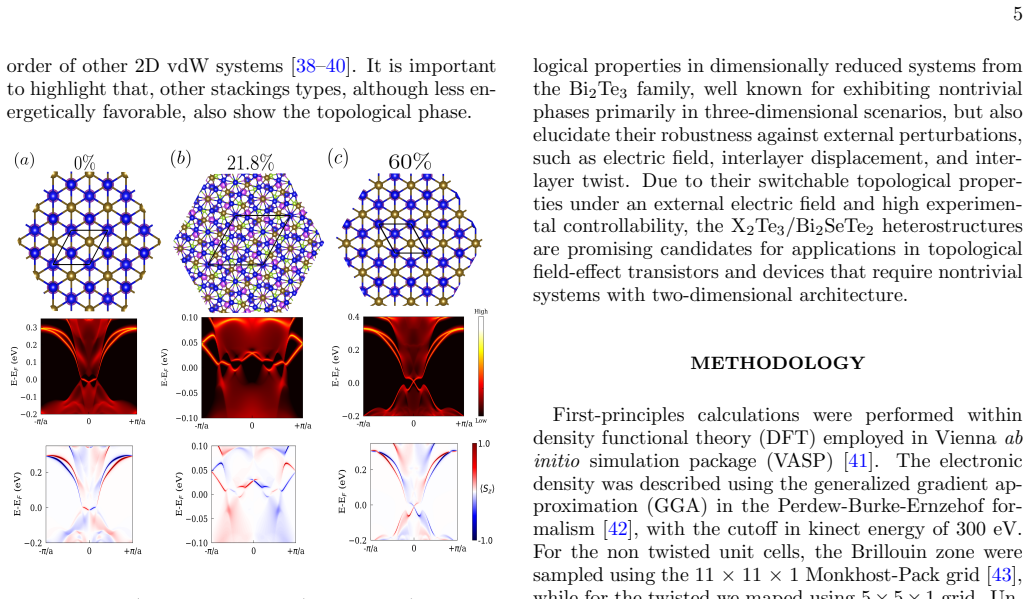
By combining first-principles calculations and Wannier-based tight-binding methods, stacking two trivial quintuple layers from the Bi₂Te₃ family induces quantum spin Hall phases in the resulting van der Waals heterostructures. The edge states are tunable under interlayer strain and external electric field effects, allowing switching of topological edge states by external control, and remain robust against interlayer twist.
What carries the argument
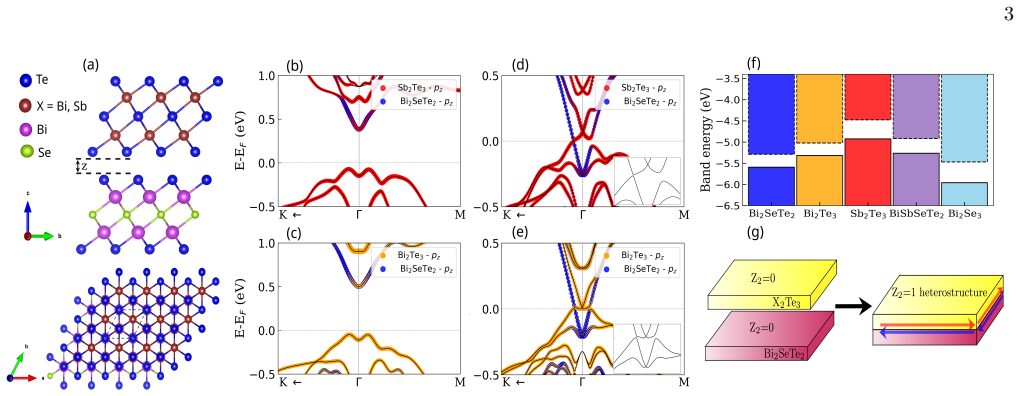
The van der Waals heterobilayer of two trivial quintuple layers, whose topological character emerges from the stacking and is modulated by interlayer distance and perpendicular electric field.
If this is right
- Topological edge states can be switched on and off by external strain or electric field.
- The phases remain stable against interlayer twist, indicating resilience to fabrication variations.
- This approach enables creation of two-dimensional topological phases in Bi₂Te₃-based systems for device applications.
- Such heterostructures could serve as platforms for topological field effect transistors.
Where Pith is reading between the lines
- The tunability suggests potential for low-power spintronic devices where edge state conductance is controlled electrically.
- Robustness to twist may allow use in flexible or misaligned 2D material stacks without loss of topological protection.
- Similar stacking strategies could be explored in other trivial layered materials to induce topology.
Load-bearing premise
The first-principles calculations and Wannier tight-binding model accurately capture the topological invariants and their changes under strain and electric field without artifacts from the approximations used.
What would settle it
Experimental fabrication of a Bi₂Te₃-family heterobilayer followed by transport measurements showing the presence or absence of protected edge states under controlled strain and electric field.
Figures
read the original abstract
The tunability and control of topological edge/surface states are crucial for the development of new device applications. In this work, by combining first-principles calculations and Wannier-based tight-binding methods, we show the emergence of quantum spin Hall phases in van der Waals heterostructures formed by stacking two trivial quintuple layers from the Bi$_2$Te$_3$ family. We demonstrate the tunability of the edge states under interlayer strain and external electric field effects, suggesting the possibility of switching topological edge states on/off by external control. Additionally, the quantum spin Hall edge channels remain robust against interlayer twist, highlighting their stability against external perturbations. Our results provide a new way to create and manipulate two-dimensional topological phases in systems based on Bi$_2$Te$_3$ family, which can be valuable for practical applications, such as topological field effect transistors and spintronic devices.
Editorial analysis
A structured set of objections, weighed in public.
Referee Report
Summary. The manuscript uses first-principles DFT calculations combined with Wannier tight-binding models to claim that stacking two individually trivial quintuple layers from the Bi₂Te₃ family in van der Waals heterobilayers induces a quantum spin Hall (QSH) phase with Z₂=1. It further asserts that the resulting edge states can be tuned (switched on/off) by interlayer strain and external electric field while remaining robust to interlayer twist, offering a route to controllable 2D topological phases for applications such as topological FETs.
Significance. If the reported QSH phase and its external tunability are confirmed to be free of DFT artifacts, the work would provide a concrete materials platform for engineering switchable topological edge channels in a well-studied family, with direct relevance to spintronic and topological-device proposals. The robustness claim against twist is a potentially useful practical result.
major comments (3)
- [Computational Methods] Computational Methods (DFT setup paragraph): the manuscript employs a single exchange-correlation functional plus vdW correction without any comparison to hybrid functionals or GW calculations. Given the well-documented sensitivity of Bi₂Te₃-family band inversions and parity eigenvalues to the precise position of Te-p and Bi-p states and to interlayer spacing, this choice is load-bearing for the central claim that stacking two trivial layers produces Z₂=1.
- [Results] Results section on topological characterization: while band structures and edge-state dispersions are presented, the explicit computation of the topological invariant (parity eigenvalues at TRIM points or Wilson-loop/Berry-phase integration on the Wannier model) is not detailed with convergence data or comparison to a reference method. This leaves the assignment of the QSH phase dependent on the unbenchmarked DFT gap and inversion.
- [Results (strain/E-field subsections)] Strain and electric-field response figures: the reported closing/reopening of the gap and switching of edge states under strain/E-field are shown only for the chosen functional; no test is provided of whether a functional that opens a larger gap (e.g., hybrid) would preserve the same tunability window or the same Z₂ response.
minor comments (2)
- Notation for the heterobilayer stacking registry and twist angle should be defined once in a dedicated figure or table rather than repeated in text.
- [Abstract] The abstract states the layers are 'trivial' individually; a brief citation or one-sentence reminder of the bulk Z₂=0 for the isolated quintuple layer would help readers.
Simulated Author's Rebuttal
We thank the referee for the thorough review and valuable comments, which help clarify the computational robustness of our claims. We address each major point below and will revise the manuscript accordingly where appropriate.
read point-by-point responses
-
Referee: [Computational Methods] Computational Methods (DFT setup paragraph): the manuscript employs a single exchange-correlation functional plus vdW correction without any comparison to hybrid functionals or GW calculations. Given the well-documented sensitivity of Bi₂Te₃-family band inversions and parity eigenvalues to the precise position of Te-p and Bi-p states and to interlayer spacing, this choice is load-bearing for the central claim that stacking two trivial layers produces Z₂=1.
Authors: We acknowledge the known sensitivity of Bi₂Te₃-family band structures to the choice of exchange-correlation functional. Our calculations employ the PBE functional with vdW corrections, which is standard in the literature for this materials family and yields lattice constants in good agreement with experiment. To strengthen the central claim, we will add benchmark calculations using the HSE06 hybrid functional on representative bilayer configurations, confirming that the band inversion and Z₂=1 assignment persist. These results will be included in a revised Methods section and a new supplementary figure. revision: yes
-
Referee: [Results] Results section on topological characterization: while band structures and edge-state dispersions are presented, the explicit computation of the topological invariant (parity eigenvalues at TRIM points or Wilson-loop/Berry-phase integration on the Wannier model) is not detailed with convergence data or comparison to a reference method. This leaves the assignment of the QSH phase dependent on the unbenchmarked DFT gap and inversion.
Authors: The Z₂ invariant was obtained from parity eigenvalues at the four time-reversal invariant momenta evaluated on the Wannier tight-binding model, supplemented by Wilson-loop calculations. We agree that the presentation should be more explicit. In the revised manuscript we will add a dedicated subsection (or expanded supplementary material) that tabulates the parity eigenvalues, shows the Wilson-loop spectra, and reports convergence with respect to k-mesh density and Wannier-function spread. This will make the topological assignment fully transparent and reproducible. revision: yes
-
Referee: [Results (strain/E-field subsections)] Strain and electric-field response figures: the reported closing/reopening of the gap and switching of edge states under strain/E-field are shown only for the chosen functional; no test is provided of whether a functional that opens a larger gap (e.g., hybrid) would preserve the same tunability window or the same Z₂ response.
Authors: The gap-closing/reopening behavior is driven by the orbital character and symmetry of the states near the Fermi level, which are expected to be qualitatively robust. Nevertheless, we will perform additional hybrid-functional calculations at selected strain and electric-field values to verify that the topological switching window remains intact. These checks will be reported in the revised strain and electric-field subsections (or supplementary information) to address the concern about functional dependence. revision: partial
Circularity Check
No significant circularity; claims rest on external first-principles computations
full rationale
The paper derives its central claims about emergent QSH phases, edge-state tunability under strain/E-field, and robustness to twist directly from first-principles DFT calculations plus Wannier tight-binding interpolation performed on the heterobilayer structures. These steps constitute independent numerical evidence rather than algebraic reductions, self-definitions, or fitted parameters renamed as predictions. No load-bearing step in the provided abstract or described workflow reduces by construction to the paper's own inputs or to a self-citation chain; the topological invariants and response functions are outputs of the external computations, not tautological re-expressions of them. This is the normal case of a computation-driven materials paper whose derivation chain remains self-contained against external benchmarks.
Axiom & Free-Parameter Ledger
axioms (1)
- domain assumption DFT with chosen functional and van der Waals corrections suffices to determine topological character and response to strain/field in these heterobilayers.
Reference graph
Works this paper leans on
-
[1]
L. Locatelli, A. Kumar, P. Tsipas, A. Dimoulas, E. Longo, and R. Mantovan, Magnetotransport and ARPES studies of the topological insulators Sb2Te3 and Bi2Te3 grown by MOCVD on large-area Si sub- 6 strates, Scientific Reports12, 10.1038/s41598-022-07496- 7 (2022)
-
[2]
and Wu, Yue and Chen, Yong P., Topolog- ical insulator bi2te3 films synthesized by metal organic chemical vapor deposition, Applied Physics Letters101, 162104 (2012)
Cao, Helin and Venkatasubramanian, Rama and Liu, Chang and Pierce, Jonathan and Yang, Haoran and Za- hid Hasan, M. and Wu, Yue and Chen, Yong P., Topolog- ical insulator bi2te3 films synthesized by metal organic chemical vapor deposition, Applied Physics Letters101, 162104 (2012)
2012
-
[3]
Z. Zeng, T. A. Morgan, D. Fan, C. Li, Y. Hirono, X. Hu, Y. Zhao, J. S. Lee, J. Wang, Z. M. Wang, S. Yu, M. E. Hawkridge, M. Benamara, and G. J. Salamo, Molecular beam epitaxial growth of Bi2Te3 and Sb2Te3 topological insulators on GaAs (111) substrates: a potential route to fabricate topological insulator p-n junction, AIP Ad- vances3, 10.1063/1.4815972 (2013)
-
[4]
G. Zhang, H. Qin, J. Teng, J. Guo, Q. Guo, X. Dai, Z. Fang, and K. Wu, Quintuple-layer epitaxy of thin films of topological insulator Bi2Se3, Applied Physics Letters 95, 10.1063/1.3200237 (2009)
-
[5]
Wang and S
Z. Wang and S. Law, Optimization of the Growth of the Van der Waals Materials Bi 2Se3 and (Bi 0.5In0.5)2Se3 by Molecular Beam Epitaxy, Crystal Growth & Design21, 6752–6765 (2021)
2021
-
[6]
Rodrigues-Junior, A
G. Rodrigues-Junior, A. S. Vieira, A. L. Ara´ ujo, F. Crasto de Lima, R. R. Barreto, L. G. Moura, R. O. Cunha, R. Magalh˜ aes Paniago, A. Fazzio, and J. B. S. Mendes, Probing Dirac states in sputtered Bi 2Se3 topo- logical insulator thin films, Phys. Rev. Mater.9, 094203 (2025)
2025
-
[7]
Deng, H.-m
Y. Deng, H.-m. Liang, Y. Wang, Z.-w. Zhang, M. Tan, and J.-l. Cui, Growth and transport properties of ori- ented bismuth telluride films, Journal of Alloys and Com- pounds509, 5683–5687 (2011)
2011
-
[8]
S. K. Chong, L. Liu, K. Watanabe, T. Taniguchi, T. D. Sparks, F. Liu, and V. V. Deshpande, Emergent helical edge states in a hybridized three-dimensional topological insulator, Nature Communications13, 10.1038/s41467- 022-33643-9 (2022)
-
[9]
P. H. R. Goncalves, L. Calil, I. Antoniazzi, T. Chagas, u. Malachias, E. A. Soares, V. E. de Carvalho, D. R. Miq- uita, R. Magalh˜ aes-Paniago, and W. S. Silva, Experimen- tal Realization of a Quaternary Bi-Chalcogenide Topo- logical Insulator with Smaller Effective Mass, The Jour- nal of Physical Chemistry C123, 14398–14403 (2019)
2019
-
[10]
Z. Ren, A. A. Taskin, S. Sasaki, K. Segawa, and Y. Ando, OptimizingBi 2−xSbxT e3−ySey solid solutions to ap- proach the intrinsic topological insulator regime, Phys. Rev. B84, 165311 (2011)
2011
-
[11]
M. Eschbach, E. M ly´ nczak, J. Kellner, J. Kampmeier, M. Lanius, E. Neumann, C. Weyrich, M. Gehlmann, P. Gospodariˇ c, S. D¨ oring, G. Mussler, N. Demarina, M. Luysberg, G. Bihlmayer, T. Sch¨ apers, L. Plucin- ski, S. Bl¨ ugel, M. Morgenstern, C. M. Schneider, and D. Gr¨ utzmacher, Realization of a vertical topological p–n junction in epitaxial Sb2Te3/Bi...
-
[12]
Y. Zhao, C.-Z. Chang, Y. Jiang, A. DaSilva, Y. Sun, H. Wang, Y. Xing, Y. Wang, K. He, X. Ma, Q.-K. Xue, and J. Wang, Demonstration of surface transport in a hybrid Bi2Se3/Bi2Te3 heterostructure, Scientific Reports 3, 10.1038/srep03060 (2013)
-
[13]
B. Li, Q. Lu, X. Cai, S. Xu, Y. Xia, W. Ho, N. Wang, C. Liu, and M. Xie, Observation of ultra-long range topo- logical proximity effect induced by interfacial band inver- sion, Materials Today Physics60, 102012 (2026)
2026
-
[14]
Zhang, C.-X
H. Zhang, C.-X. Liu, X.-L. Qi, X. Dai, Z. Fang, and S.- C. Zhang, Topological insulators in Bi2Se3, Bi2Te3 and Sb2Te3 with a single Dirac cone on the surface, Nature Physics5, 438–442 (2009)
2009
-
[15]
Zhang, K
Y. Zhang, K. He, C.-Z. Chang, C.-L. Song, L.-L. Wang, X. Chen, J.-F. Jia, Z. Fang, X. Dai, W.-Y. Shan, S.- Q. Shen, Q. Niu, X.-L. Qi, S.-C. Zhang, X.-C. Ma, and Q.-K. Xue, Crossover of the three-dimensional topologi- cal insulator Bi2Se3 to the two-dimensional limit, Nature Physics6, 584–588 (2010)
2010
-
[16]
M. Kim, C. H. Kim, H.-S. Kim, and J. Ihm, Topologi- cal quantum phase transitions driven by external electric fields in Sb2Te3 thin films, Proceedings of the National Academy of Sciences109, 671–674 (2011)
2011
-
[17]
Kobayashi, Electron transmission through atomic steps of Bi 2Se3 and Bi 2Te3 surfaces, Phys
K. Kobayashi, Electron transmission through atomic steps of Bi 2Se3 and Bi 2Te3 surfaces, Phys. Rev. B84, 205424 (2011)
2011
-
[18]
Y. Liu, Y. Y. Li, S. Rajput, D. Gilks, L. Lari, P. L. Galindo, M. Weinert, V. K. Lazarov, and L. Li, Tuning Dirac states by strain in the topological insulator Bi2Se3, Nature Physics10, 294–299 (2014)
2014
-
[19]
Focassio, G
B. Focassio, G. R. Schleder, F. Crasto de Lima, C. Lewenkopf, and A. Fazzio, Amorphous Bi 2Se3 struc- tural, electronic, and topological nature from first prin- ciples, Phys. Rev. B104, 214206 (2021)
2021
-
[20]
Costa, A
M. Costa, A. T. Costa, W. A. Freitas, T. M. Schmidt, M. Buongiorno Nardelli, and A. Fazzio, Controlling Topological States in Topological/Normal Insulator Het- erostructures, ACS Omega3, 15900–15906 (2018)
2018
-
[21]
L. G. Cesar, R. B. Capaz, and M. G. Menezes, Topo- logical properties of a BiSbSe3-xTex alloy: Insights from first-principles calculations, Applied Materials Today50, 103186 (2026)
2026
-
[22]
T. M. Schmidt, R. H. Miwa, and A. Fazzio, Spin tex- ture and magnetic anisotropy of Co impurities in Bi 2Se3 topological insulators, Phys. Rev. B84, 245418 (2011)
2011
-
[23]
A. L. Ara´ ujo, F. Crasto de Lima, C. H. Lewenkopf, and A. Fazzio, Design of spin-orbital texture in ferromag- netic/topological insulator interfaces, Phys. Rev. B109, 085142 (2024)
2024
-
[24]
Kim, K.-S
H.-J. Kim, K.-S. Kim, J.-F. Wang, V. A. Kulbachinskii, K. Ogawa, M. Sasaki, A. Ohnishi, M. Kitaura, Y.-Y. Wu, L. Li, I. Yamamoto, J. Azuma, M. Kamada, and V. Dobrosavljevi´ c, Topological Phase Transitions Driven by Magnetic Phase Transitions in Fe xBi2Te3 (0≤x≤0.1) Single Crystals, Phys. Rev. Lett.110, 136601 (2013)
2013
-
[25]
Kim and S.-H
J. Kim and S.-H. Jhi, Magnetic phase transition in Fe- doped topological insulator Bi 2Se3, Phys. Rev. B92, 104405 (2015)
2015
-
[26]
B. A. Bernevig and S.-C. Zhang, Quantum Spin Hall Ef- fect, Phys. Rev. Lett.96, 106802 (2006)
2006
-
[27]
Lu, W.-Y
H.-Z. Lu, W.-Y. Shan, W. Yao, Q. Niu, and S.-Q. Shen, Massive Dirac fermions and spin physics in an ultrathin film of topological insulator, Phys. Rev. B81, 115407 (2010)
2010
-
[28]
H. Li, L. Sheng, D. N. Sheng, and D. Y. Xing, Chern number of thin films of the topological insulator Bi 2Se3, Phys. Rev. B82, 165104 (2010)
2010
-
[29]
Shan, H.-Z
W.-Y. Shan, H.-Z. Lu, and S.-Q. Shen, Effective con- tinuous model for surface states and thin films of three-dimensional topological insulators, New Journal of Physics12, 043048 (2010). 7
2010
-
[30]
Maisel Licer´ an, S
L. Maisel Licer´ an, S. J. H. Koerhuis, D. Vanmaekelbergh, and H. T. C. Stoof, Topology of Bi2Se3 nanosheets, Phys. Rev. B109, 195407 (2024)
2024
-
[31]
F¨ orster, P
T. F¨ orster, P. Kr¨ uger, and M. Rohlfing, Two-dimensional topological phases and electronic spectrum of Bi2Se3 thin films fromGWcalculations, Phys. Rev. B92, 201404(R) (2015)
2015
-
[32]
B. C. Park, T.-H. Kim, K. I. Sim, B. Kang, J. W. Kim, B. Cho, K.-H. Jeong, M.-H. Cho, and J. H. Kim, Tera- hertz single conductance quantum and topological phase transitions in topological insulator Bi2Se3 ultrathin films, Nature Communications6, 10.1038/ncomms7552 (2015)
-
[33]
Y. Xia, D. Qian, D. Hsieh, L. Wray, A. Pal, H. Lin, A. Bansil, D. Grauer, Y. S. Hor, R. J. Cava, and M. Z. Hasan, Observation of a large-gap topological-insulator class with a single Dirac cone on the surface, Nature Physics5, 398–402 (2009)
2009
-
[34]
Crasto de Lima, G
F. Crasto de Lima, G. J. Ferreira, and R. H. Miwa, Tun- ing the topological states in metal-organic bilayers, Phys. Rev. B96, 115426 (2017)
2017
-
[35]
X. Qian, J. Liu, L. Fu, and J. Li, Quantum spin Hall ef- fect in two-dimensional transition metal dichalcogenides, Science346, 1344–1347 (2014)
2014
-
[36]
W. G. Vandenberghe and M. V. Fischetti, Imperfect two-dimensional topological insulator field-effect transis- tors, Nature Communications8, 10.1038/ncomms14184 (2017)
-
[37]
Q. Liu, X. Zhang, L. B. Abdalla, A. Fazzio, and A. Zunger, Switching a Normal Insulator into a Topo- logical Insulator via Electric Field with Application to Phosphorene, Nano Letters15, 1222–1228 (2015)
2015
-
[38]
R. B. Pontes, R. H. Miwa, A. J. R. da Silva, A. Fazzio, and J. E. Padilha, Layer-dependent band alignment of few layers of blue phosphorus and their van der Waals heterostructures with graphene, Phys. Rev. B97, 235419 (2018)
2018
-
[39]
Marom, J
N. Marom, J. Bernstein, J. Garel, A. Tkatchenko, E. Joselevich, L. Kronik, and O. Hod, Stacking and Reg- istry Effects in Layered Materials: The Case of Hexago- nal Boron Nitride, Phys. Rev. Lett.105, 046801 (2010)
2010
-
[40]
Q. Liu, L. Li, Y. Li, Z. Gao, Z. Chen, and J. Lu, Tun- ing Electronic Structure of Bilayer MoS¡sub¿2¡/sub¿ by Vertical Electric Field: A First-Principles Investigation, The Journal of Physical Chemistry C116, 21556–21562 (2012)
2012
-
[41]
Kresse and J
G. Kresse and J. Furthm¨ uller, Efficient iterative schemes for ab initio total-energy calculations using a plane-wave basis set, Phys. Rev. B54, 11169 (1996)
1996
-
[42]
J. P. Perdew, K. Burke, and M. Ernzerhof, Generalized Gradient Approximation Made Simple, Phys. Rev. Lett. 77, 3865 (1996)
1996
-
[43]
H. J. Monkhorst and J. D. Pack, Special points for Brillouin-zone integrations, Phys. Rev. B13, 5188 (1976)
1976
-
[44]
J. Klimeˇ s, D. R. Bowler, and A. Michaelides, Van der Waals density functionals applied to solids, Physical Re- view B83, 10.1103/physrevb.83.195131 (2011)
-
[45]
A. L. Ara´ ujo, P. H. Sophia, F. Crasto de Lima, and A. Fazzio, A high-throughput framework and database for twisted 2D van der Waals bilayers, npj Computational Materials12, 10.1038/s41524-025-01892-z (2025)
-
[46]
Pizzi, V
G. Pizzi, V. Vitale, R. Arita, S. Bl¨ ugel, F. Freimuth, G. G´ eranton, M. Gibertini, D. Gresch, C. Johnson, T. Koretsune, et al., Wannier90 as a community code: new features and applications, Journal of Physics: Con- densed Matter32, 165902 (2020)
2020
-
[47]
Q. Wu, S. Zhang, H.-F. Song, M. Troyer, and A. A. Soluyanov, WannierTools: An open-source soft- ware package for novel topological materials, Computer Physics Communications224, 405 (2018)
2018
discussion (0)
Sign in with ORCID, Apple, or X to comment. Anyone can read and Pith papers without signing in.