REVIEW 3 major objections 8 minor 72 references
SqLinear: Balanced Square Partitioning Makes Linear Interaction Sufficient for Large-Scale Traffic Forecasting
T0 review · 3 major / 8 minor · reviewed 2026-08-03 · deepseek-v4-flash
Pith's one-line read SqLinear shows that a balanced, padding-free square partition of traffic sensors plus a low-rank linear interaction module can replace attention and beat state-of-the-art baselines on large-scale traffic forecasting benchmarks.
desk verdict SqLinear is a solid, well-run empirical architecture paper whose central bet—that inter-patch dependencies are low-rank—holds up on these four freeway benchmarks but is not yet shown to transfer to dense urban networks. read the letter →
The pith
A machine-rendered reading of the paper's core claim, the machinery that carries it, and where it could break.
The reading
What carries the argument
The load-bearing components are (1) Square Partition and (2) the Hierarchical Linear Interaction (HLI) block. Square Partition recursively splits nodes along the axis with the larger geographic span, sorts along that axis, and chooses split points as multiples of a capacity C (Sp = C·ceil(ceil(N/C)/2)). This guarantees padding-free tensorization when N = P·C, split imbalance below 2C, and no amplification of elongation. The resulting patches are non-overlapping, approximately square, and map directly to tensors of shape C×P×d. HLI replaces attention with two linear stages: an inter-patch stage that aligns corresponding nodes across patches, applies a linear MLP, and communicates globally thr
What would settle it
Compute the singular-value spectrum of the empirical patch-wise dependency matrix on a new large-scale traffic dataset with many independent, non-synchronized arterial corridors (rather than the studied metropolitan networks). If the tail energy beyond a practical rank r (say r ≈ 10–50) is large—for instance, if top-r components capture well under 90% of variance—then the low-rank inter-patch operator loses information a full attention matrix would retain, and the accuracy advantage over attention-based models should shrink or invert. Alternatively, run SqLinear with r set to full rank P: if a
Extended reading notes
Core claim
The central claim is that a well-chosen spatial partition, not a more expressive interaction layer, is what unlocks scalable traffic forecasting. The Square Partition algorithm recursively splits the sensor set along the currently longest geographic span, choosing split positions as multiples of a leaf capacity C, so each resulting patch has exactly C nodes (no padding), the split imbalance stays below 2C, and the effective aspect ratio is not systematically amplified. On this layout, the Hierarchical Linear Interaction block propagates global dependencies through a low-rank projection Θ_r1 Θ_r2 with rank r < C < P, then refines local features with a per-patch linear MLP, achieving O(Nd²) ti
Load-bearing premise
The result holds only if the dependency matrix among spatial patches is approximately low-rank—i.e., the top few latent components capture most of the inter-patch correlation variance—so that replacing the full P×P coupling with a rank-r projection loses negligible information.
Editorial extensions
If this is right
- City-scale traffic forecasting with thousands of sensors can run at linear complexity without sacrificing accuracy—O(Nd²) time and O(Nd) memory—making deployment on large networks feasible.
- Replacing attention with hierarchical linear interaction is safe when the spatial partition is well constructed; the ablation study shows the attention variant does not outperform the linear HLI while consuming more compute.
- The rank r of the inter-patch projection serves as an accuracy–efficiency dial: moderate r is sufficient because patch-level dependency spectra decay quickly on the studied datasets.
- The partition's guarantees—full utilization, perfect balance, no padding—transfer to any sensor layout approximated by coordinates, suggesting applicability beyond traffic (e.g., environmental or energy monitoring).
- The accuracy gain over baselines remains stable as the forecast horizon extends to 672 steps, indicating the learned spatial representation does not degrade with longer prediction ranges.
Reading between the lines
- I infer the method's effectiveness hinges on the assumption that inter-patch traffic correlations are approximately low-rank; on networks with many spatially interleaved but functionally independent corridors, a full-rank or attention-based interaction would likely retain an accuracy advantage, which is a testable boundary condition.
- The Square Partition index depends only on sensor coordinates and capacity, so I would expect it to serve as a drop-in preprocessing step for other spatio-temporal models, improving their scalability without retraining the partitioner.
- Because HLI's weights are linear matrices, the learned spatial dependencies are directly interpretable; I infer this opens a route to explainable traffic forecasting and to anomaly detection by monitoring weight drift over time.
- The paper's topology-aware extensions suggest that for road networks where geometric proximity is a poor proxy for traffic coupling, the geometry-first or topology-first partitioning variants would be the appropriate fallbacks—though the current experiments show pure geometric partitioning already wins on the tested datasets.
Editorial analysis
A structured set of objections, weighed in public.
Referee Report
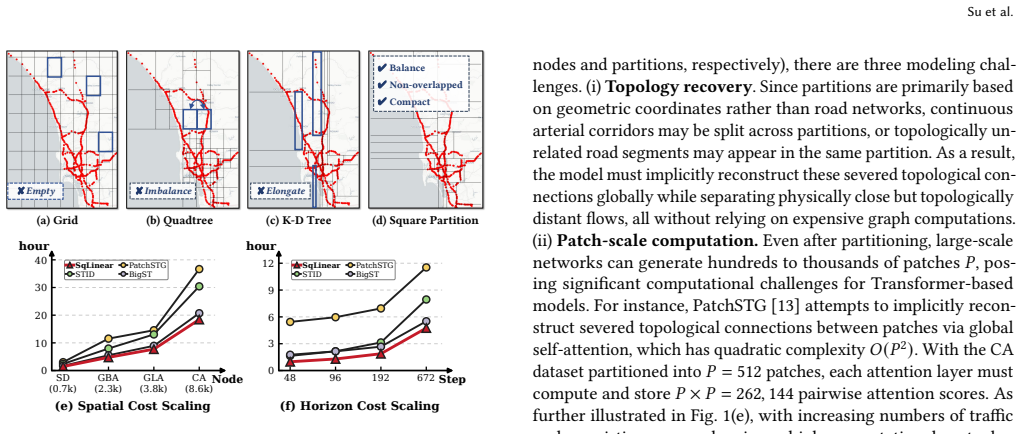
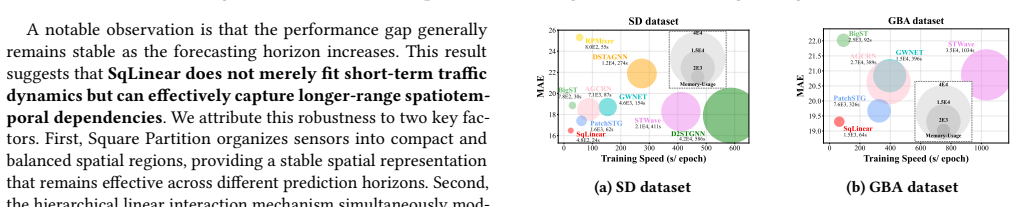
Summary. The paper proposes SqLinear, a traffic-forecasting architecture that combines a geometry-adaptive square partitioning algorithm with a hierarchical linear interaction (HLI) module. The partition algorithm recursively splits sensor nodes along their longest spatial span using capacity-aware split points, producing balanced, non-overlapping, near-square patches without padding when the total node count is an exact multiple of the leaf capacity. The HLI module replaces quadratic-complexity attention with a linear inter-patch low-rank projection plus an intra-patch linear refinement, achieving O(N d^2) time and O(N d) memory. The paper reports state-of-the-art accuracy on four LargeST benchmarks, including an average 2.30% MAE reduction over PatchSTG under the standard 12-step setting and an average 5.81% MAE reduction over strong baselines in long-horizon (96=>672) settings, with reduced training runtime. Theoretical results cover partition utilization, split balance, non-amplification of elongation, low-rank approximation capacity, expressiveness relative to linear baselines, and complexity.
Significance. If the empirical results hold, SqLinear is a practically valuable contribution: it demonstrates that, on large freeway sensor networks, a carefully designed linear-complexity model can outperform attention- and graph-based state-of-the-art baselines, addressing a real scalability bottleneck for city-scale traffic forecasting. The paper's strengths include a principled partitioning scheme with explicit theoretical guarantees (Theorems C.2, C.4, C.6), a clear complexity analysis, extensive experiments across four datasets and ten baselines, and a complete long-horizon study covering 16 dataset-horizon combinations. The central empirical claim is well supported by the reported tables. However, the title-level claim that linear interaction is 'sufficient' for large-scale traffic forecasting is broader than what the evidence supports: the low-rank inter-patch assumption is only weakly validated, the padding-free property is conditional on N=PC, and the paper itself acknowledges a limitation on incident-driven dynamics. These issues are fixable within the scope of a revision.
major comments (3)
- [§4.3.1, Eq. (11), Theorem C.7, Figure 3] The central accuracy claim depends on the low-rank inter-patch projection. Theorem C.7 is a correct Eckart-Young identity, but it only states that the best rank-r approximation error equals the tail singular-value energy of an 'ideal' dependency matrix M; it does not establish that the tail is small for the forecasting task. Figure 3 shows spectral decay of observed patch-wise dependency matrices, but such decay is dominated by strong daily periodicity and regional congestion and does not bound the rank of the conditional dependencies needed for prediction (e.g., residual dynamics after removing periodic components or incident-activated correlations). Moreover, the rank r is not reported anywhere in the experiments, and no error bars are given. It is therefore impossible to assess whether the reported 2.30% average improvement is robust to the choice of r. Please report the value of r us
- [§4.2, Theorem C.2, Abstract] The padding-free guarantee is explicitly conditional on C being selected such that N=PC. For an arbitrary sensor network, such a C may not exist (e.g., if N is prime, the only exact divisors are C=1 and C=N, neither of which yields a useful partition). The abstract and Section 1 claim that SqLinear works 'without performing padding operations' as a general property, and the efficiency comparison against PatchSTG's 43% padding overhead relies on this. Please either state the N=PC condition prominently in the contribution claims or describe a fallback for non-divisible N (e.g., allowing at most one partially filled patch with bounded overhead). As written, the padding-free contribution is narrower than it appears.
- [Appendix D.6, Title, Abstract] The paper admits in D.6 that the linear interaction module 'may have limited capacity to model abrupt and highly nonlinear dynamics, such as those caused by traffic accidents.' This directly qualifies the title claim that balanced square partitioning 'makes linear interaction sufficient' for large-scale traffic forecasting. All four benchmarks are California freeway sensor networks with similar free-flow/congestion regimes; the low-rank and linear-sufficiency evidence may not transfer to dense urban arterials with many weakly coupled independent roads or to incident-rich settings. Please scope the central claim to recurrent congestion dynamics on freeway-scale sensor networks, and discuss whether the architecture can be extended to incident scenarios (e.g., a hybrid linear-nonlinear module). Without such qualification, the 'sufficient' wording overstates the demonstrated scope.
minor comments (8)
- [Abstract and §5.3] The abstract is inconsistent: it says '10 baselines' in the full text but '11 baselines' in the header version, and 'reduces MAE by 5.81%' versus 'up to 6.78%' in different places. Please unify these numbers.
- [Algorithm 1, line 15] Typo: 'SqarePartition' should be 'SquarePartition'.
- [Algorithm 2, line 4] The spatial embedding uses 'X_P' in the algorithm but Eq. (4) uses X_H. Please align the notation.
- [Figure 3] Please specify how the patch-wise dependency matrix is computed (e.g., covariance or correlation of which input features, which layer/aggregation), and define the 'cumulative variance' precisely. This is needed to interpret the low-rank motivation.
- [Notation] The rank is denoted r in Eq. (11) and Theorem C.7 but k in Figure 8 and Appendix D.3. Unify the notation.
- [Theorem C.8] The statement that 'the additional intra-patch operator makes HLI strictly more expressive' is not established by the proof sketch, which shows only containment of linear mixing operator classes. Please state the precise sense of expressiveness and prove strictness, or soften the claim.
- [§4.5.2 and Figure 9] The Topology-First Road Grouping (TFRG) variant can generate highly imbalanced groups (e.g., a long highway vs. a short ramp), yet no theoretical or empirical analysis of its balance is provided. Please add a discussion of its limitations, especially since the paper's main contribution is balanced partitioning.
- [Table 7] Aspect ratios are computed from raw longitude/latitude degrees. Please clarify whether an equal-area projection was used; unprojected degrees can distort aspect ratios, especially at the latitude of California.
Circularity Check
No significant circularity: the low-rank error bound is a standard identity, the partition guarantees follow from the algorithm's own construction, and self-citations are not load-bearing.
full rationale
The derivation chain is not circular. The theorem that could look tautological is Theorem C.7 (Eq. 23), but it is exactly the Eckart-Young-Mirsky identity, and the paper explicitly treats the smallness of the tail as an empirical observation ('when the empirical singular spectrum decays rapidly, the discarded tail energy is small'), supported by Fig. 3, rather than as an input assumption. The expressiveness claim (Theorem C.8) is a rank-containment statement about the spatial-mixing operators of RPMixer and BigST, not a claim that those baselines' accuracies are reproduced. The partition results (Theorems C.2, C.4, C.6) are internal correctness statements about Square Partition's own split rule; they are definitional in the benign sense that a designed algorithm satisfies its design properties, and the paper does not use them as a fitted 'prediction' of MAE. Aspect ratio is explicitly labeled 'an empirical compactness diagnostic rather than a universal guarantee' (Definition C.5), so no universal claim is smuggled in. Self-citations ([14], [39], [46], [63]) appear only as background or framework references and are not load-bearing. The stated limitation in D.6—'may have limited capacity to model abrupt and highly nonlinear dynamics, such as those caused by traffic accidents'—is a scope restriction on the central claim, not evidence that the derivation reduces to its inputs. The headline accuracy numbers are external benchmark results against 10 baselines; no fitted parameter is renamed as a prediction.
Assumptions & free parameters
free parameters (4)
- leaf capacity C =
C=48 (GBA), C=86 (CA); unspecified for SD/GLA
- low-rank dimension r (also called k) =
not reported in main text
- number of HLI layers L =
not reported
- hidden dimensions d_h, d_d, d_w, d_s =
not reported
assumptions (6)
- standard math Eckart-Young-Mirsky theorem: the best rank-r approximation of a matrix is its truncated SVD
- standard math Singular vectors are orthonormal, so the Frobenius residual norm equals the square root of the sum of tail squared singular values
- domain assumption First Law of Geography: nearby traffic sensors are more strongly correlated than distant ones
- domain assumption Patch-wise dependency matrices are approximately low-rank with fast spectral decay
- domain assumption Geographic coordinates are a valid proxy for traffic network topology
- ad hoc to paper A capacity C can always be chosen such that N=PC while preserving balanced, compact patches
Cite this review
Pith. "Pith review of SqLinear: Balanced Square Partitioning Makes Linear Interaction Sufficient for Large-Scale Traffic Forecasting." pith.science (2026). https://pith.science/paper/53T3WR6M
@misc{pith2026260621072,
  author       = {Pith},
  title        = {Pith review of: SqLinear: Balanced Square Partitioning Makes Linear Interaction Sufficient for Large-Scale Traffic Forecasting},
  year         = {2026},
  howpublished = {\url{https://pith.science/paper/53T3WR6M}},
  note         = {Machine review of arXiv:2606.21072}
}
read the original abstract
Traffic prediction is a core task in intelligent transportation systems and urban-scale decision making. Despite the effectiveness of mainstream neural network-based methods, their deployment in real-world settings with thousands of traffic sensors is severely jeopardized by their poor computational scalability. To address this, the community has attempted to incorporate spatial database partitioning techniques to improve model scalability. However, these approaches rely on handcrafted geometric heuristics and often produce irregular or imbalanced data partitions, leading to boundary fragmentation, excessive padding overheads, and degraded model accuracy. In this paper, we propose SqLinear, an efficient and effective architecture for large-scale traffic prediction. First, we design Square Partition, a geometry-adaptive algorithm that partitions massive traffic sensors into balanced, non-overlapping, and compact spatial regions. Unlike existing heuristic-based designs, Square Partition is theoretically grounded and provides provable guarantees on partition utilization and split balance, establishing a high-quality foundation for downstream spatio-temporal modeling. Next, we propose a Hierarchical Linear Interaction (HLI) module that abandons the costly attention mechanisms commonly used in Transformer-based spatio-temporal models. HLI efficiently propagates global inter-region dependencies and refines them at the node level through a lightweight linear interaction scheme, enabling effective spatio-temporal modeling with linear computational complexity. Extensive experiments on four large-scale traffic datasets and 11 baselines show that SqLinear reduces MAE by 2.30% on average under the standard setting and by up to 6.78% under extreme scalability settings, while reducing training runtime by 13.27%--30.84% in spatial- and horizon-scaling scenarios.
Figures


Figures from the paper (8 more)



Reference graph
Works this paper leans on
-
[1]
Evangelos C Alexopoulos. 2010. Introduction to multivariate regression analysis. Hippokratia14, Suppl 1 (2010), 23
2010
-
[2]
Bang An, Xun Zhou, Amin Vahedian, Nick Street, Jinping Guan, and Jun Luo
-
[3]
Lei Bai, Lina Yao, Can Li, Xianzhi Wang, and Can Wang. 2020. Adaptive graph convolutional recurrent network for traffic forecasting. InNeural Information Processing Systems. 17804–17815
2020
-
[4]
Jon Louis Bentley. 1975. Multidimensional binary search trees used for associative searching.Commun. ACM18, 9 (1975), 509–517
1975
-
[5]
Friedman
Jon Louis Bentley and Jerome H. Friedman. 1979. Data Structures for Range Searching.Comput. Surveys11, 4 (1979), 397–409
1979
-
[6]
George EP Box and David A Pierce. 1970. Distribution of residual autocorrelations in autoregressive-integrated moving average time series models.Journal of the American statistical Association65, 332 (1970), 1509–1526
1970
-
[7]
Defu Cao, Yujing Wang, Juanyong Duan, Ce Zhang, Xia Zhu, Congrui Huang, Yunhai Tong, Bixiong Xu, Jing Bai, Jie Tong, and Qi Zhang. 2020. Spectral Tem- poral Graph Neural Network for Multivariate Time-series Forecasting.Neural Information Processing Systems(2020), 17766–17778
2020
-
[8]
Peng Chen, Yingying ZHANG, Yunyao Cheng, Yang Shu, Yihang Wang, Qingsong Wen, Bin Yang, and Chenjuan Guo. 2024. Pathformer: Multi-scale Transformers with Adaptive Pathways for Time Series Forecasting. InInternational Conference on Learning Representations
2024
Show all 72 references
-
[9]
Wei-Lin Chiang, Xuanqing Liu, Si Si, Yang Li, Samy Bengio, and Cho-Jui Hsieh
-
[10]
Zheng Dong, Renhe Jiang, Haotian Gao, Hangchen Liu, Jinliang Deng, Qingsong Wen, and Xuan Song. 2024. Heterogeneity-Informed Meta-Parameter Learning for Spatiotemporal Time Series Forecasting. InACM SIGKDD Conference on Knowledge Discovery and Data Mining. 631–641
2024
-
[11]
Alexey Dosovitskiy, Lucas Beyer, Alexander Kolesnikov, Dirk Weissenborn, Xi- aohua Zhai, Thomas Unterthiner, Mostafa Dehghani, Matthias Minderer, Georg Heigold, Sylvain Gelly, et al . 2020. An Image is Worth 16x16 Words: Trans- formers for Image Recognition at Scale. InInterna...
2020
-
[12]
James Durbin. 1959. Efficient estimation of parameters in moving-average models. Biometrika46, 3/4 (1959), 306–316
1959
-
[13]
Yuchen Fang, Yuxuan Liang, Bo Hui, Zezhi Shao, Liwei Deng, Xu Liu, Xinke Jiang, and Kai Zheng. 2025. Efficient Large-Scale Traffic Forecasting with Trans- formers: A Spatial Data Management Perspective. InACM SIGKDD Conference on Knowledge Discovery and Data Mining. 307–317
2025
-
[14]
Jensen, Xiaofang Zhou, and Kai Zheng
Yuchen Fang, Hao Miao, Yuxuan Liang, Liwei Deng, Yue Cui, Ximu Zeng, Yuyang Xia, Yan Zhao, Torben Bach Pedersen, Christian S. Jensen, Xiaofang Zhou, and Kai Zheng. 2025. Unraveling Spatio-Temporal Foundation Models via the Pipeline Lens: A Comprehensive Review.arXiv preprint a...
2025 arXiv
-
[15]
Yuchen Fang, Yanjun Qin, Haiyong Luo, Fang Zhao, Bingbing Xu, Liang Zeng, and Chenxing Wang. 2023. When spatio-temporal meet wavelets: Disentangled traffic forecasting via efficient spectral graph attention networks. InIEEE International Conference on Data Engineering. 517–529
2023
-
[16]
Friedman, Jon Louis Bentley, and Raphael Ari Finkel
Jerome H. Friedman, Jon Louis Bentley, and Raphael Ari Finkel. 1977. An Al- gorithm for Finding Best Matches in Logarithmic Expected Time.ACM Trans. Math. Software3, 3 (1977), 209–226
1977
-
[17]
Han Gao, Xu Han, Jiaoyang Huang, Jian-Xun Wang, and Liping Liu. 2022. Patchgt: Transformer over non-trainable clusters for learning graph representations. In Learning on Graphs Conference. 1–27
2022
-
[18]
Shengnan Guo, Youfang Lin, Ning Feng, Chao Song, and Huaiyu Wan. 2019. Attention based spatial-temporal graph convolutional networks for traffic flow forecasting. InAAAI Conference on Artificial Intelligence. 922–929
2019
-
[19]
Jindong Han, Weijia Zhang, Hao Liu, Tao Tao, Naiqiang Tan, and Hui Xiong
-
[20]
Xiaoxue Han, Zhuo Feng, and Yue Ning. 2024. A topology-aware graph coars- ening framework for continual graph learning.Neural Information Processing Systems37 (2024), 132491–132523
2024
-
[21]
Jiahao Ji, Jingyuan Wang, Chao Huang, Junjie Wu, Boren Xu, Zhenhe Wu, Junbo Zhang, and Yu Zheng. 2023. Spatio-temporal self-supervised learning for traffic flow prediction. InAAAI Conference on Artificial Intelligence. 4356 – 4364
2023
-
[22]
InProceedings of the VLDB Endowment
BigST: Linear Complexity Spatio-Temporal Graph Neural Network for Traffic Forecasting on Large-Scale Road Networks. InProceedings of the VLDB Endowment. 1081–1090
-
[23]
Guangyin Jin, Yuxuan Liang, Yuchen Fang, Zezhi Shao, Jincai Huang, Junbo Zhang, and Yu Zheng. 2023. Spatio-temporal graph neural networks for predictive learning in urban computing: A survey.IEEE Transactions on Knowledge and Data Engineering(2023), 5388–5408
2023
-
[24]
Weiyang Kong, Kaiqi Wu, Sen Zhang, and Yubao Liu. 2025. GraphSparseNet: A Novel Method for Large Scale Traffic Flow Prediction.Proceedings of the VLDB Endowment18, 7 (2025), 2295–2307
2025
-
[25]
Jiahao Ji, Wentao Zhang, Jingyuan Wang, and Chao Huang. 2025. Seeing the Un- seen: Learning Basis Confounder Representations for Robust Traffic Prediction. InACM International Conference on Information and Knowledge Management. 577–588
2025
-
[26]
Dilfira Kudrat, Zongxia Xie, Yanru Sun, Tianyu Jia, and Qinghua Hu. 2025. Patch- wise Structural Loss for Time Series Forecasting.arXiv preprint arXiv:2503.00877 (2025)
2025 arXiv
-
[27]
Shiyong Lan, Yitong Ma, Weikang Huang, Wenwu Wang, Hongyu Yang, and Pyang Li. 2022. DSTAGNN: Dynamic spatial-temporal aware graph neural network for traffic flow forecasting. InInternational Conference on Machine Learning. 11906–11917
2022
-
[28]
Xiangjie Kong, Wenfeng Zhou, Guojiang Shen, Wenyi Zhang, Nali Liu, and Yao Yang. 2023. Dynamic graph convolutional recurrent imputation network for spatiotemporal traffic missing data.Knowledge-Based Systems261 (2023), 110188
2023
-
[29]
Yaguang Li, Rose Yu, Cyrus Shahabi, and Yan Liu. 2018. Diffusion Convolutional Recurrent Neural Network: Data-Driven Traffic Forecasting. InInternational Conference on Learning Representations
2018
-
[30]
Zhonghang Li, Lianghao Xia, Jiabin Tang, Yong Xu, Lei Shi, Long Xia, Dawei Yin, and Chao Huang. 2024. UrbanGPT: Spatio-Temporal Large Language Models. In ACM SIGKDD Conference on Knowledge Discovery and Data Mining. 5351–5362
2024
-
[31]
Fuxian Li, Jie Feng, Huan Yan, Guangyin Jin, Fan Yang, Funing Sun, Depeng Jin, and Yong Li. 2023. Dynamic graph convolutional recurrent network for traffic prediction: Benchmark and solution.ACM Transactions on Knowledge Discovery from Data(2023), 1–21
2023
-
[32]
Chenxi Liu, Kethmi Hirushini Hettige, Qianxiong Xu, Cheng Long, Shili Xiang, Gao Cong, Ziyue Li, and Rui Zhao. 2025. ST-LLM+: Graph Enhanced Spatio- Temporal Large Language Models for Traffic Prediction.IEEE Transactions on Knowledge and Data Engineering37, 8 (2025), 4846–4859
2025
-
[33]
Chenxi Liu, Sun Yang, Qianxiong Xu, Zhishuai Li, Cheng Long, Ziyue Li, and Rui Zhao. 2024. Spatial-temporal large language model for traffic prediction. In IEEE International Conference on Mobile Data Management. 31–40
2024
-
[34]
Yuxuan Liang, Haomin Wen, Yuqi Nie, Yushan Jiang, Ming Jin, Dongjin Song, Shirui Pan, and Qingsong Wen. 2024. Foundation models for time series analysis: A tutorial and survey. InACM SIGKDD Conference on Knowledge Discovery and Data Mining. 6555–6565
2024
-
[35]
Xu Liu, Yutong Xia, Yuxuan Liang, Junfeng Hu, Yiwei Wang, Lei Bai, Chao Huang, Zhenguang Liu, Bryan Hooi, and Roger Zimmermann. 2024. LargeST: A benchmark dataset for large-scale traffic forecasting. InNeural Information Processing Systems. 75354–75371
2024
-
[36]
Zhi Liu, Yang Chen, Feng Xia, Jixin Bian, Bing Zhu, Guojiang Shen, and Xiangjie Kong. 2023. TAP: Traffic Accident Profiling via Multi-Task Spatio-Temporal Graph Representation Learning.ACM Transactions on Knowledge Discovery from Data17, 4 (2023), 1–25
2023
-
[37]
Hangchen Liu, Zheng Dong, Renhe Jiang, Jiewen Deng, Jinliang Deng, Quanjun Chen, and Xuan Song. 2023. Spatio-temporal adaptive embedding makes vanilla transformer sota for traffic forecasting. InACM International Conference on Information and Knowledge Management. 4125–4129
2023
-
[38]
Ilya Loshchilov and Frank Hutter. 2017. Decoupled weight decay regularization. arXiv preprint arXiv:1711.05101(2017)
2017 arXiv
-
[39]
Tinghui Luo, Ziquan Fang, Kaixuan Duan, Lu Chen, Panpan Feng, and Mingfan Lu. 2025. Towards Online Spatio-Temporal Prediction: A Knowledge Distillation Driven Continual Learning Approach. InIEEE International Conference on Data Engineering. 2642–2655
2025
-
[40]
Ze Liu, Yutong Lin, Yue Cao, Han Hu, Yixuan Wei, Zheng Zhang, Stephen Lin, and Baining Guo. 2021. Swin transformer: Hierarchical vision transformer using shifted windows. InIEEE/CVF International Conference on Computer Vision. 10012–10022
2021
-
[41]
Moin Hussain Moti, Panagiotis Simatis, and Dimitris Papadias. 2022. Waffle: A workload-aware and query-sensitive framework for disk-based spatial indexing. Proceedings of the VLDB Endowment16, 4 (2022), 670–683
2022
-
[42]
Yuqi Nie, Nam H Nguyen, Phanwadee Sinthong, and Jayant Kalagnanam. 2023. A Time Series is Worth 64 Words: Long-term Forecasting with Transformers. In International Conference on Learning Representations
2023
-
[43]
Tengfei Lyu, Weijia Zhang, Jinliang Deng, and Hao Liu. 2025. AutoSTF: Decou- pled Neural Architecture Search for Cost-Effective Automated Spatio-Temporal Forecasting. InACM SIGKDD Conference on Knowledge Discovery and Data Min- ing. 985–996
2025
-
[44]
Hanan Samet. 1984. The quadtree and related hierarchical data structures.ACM Computing Surveys (CSUR)16, 2 (1984), 187–260
1984
-
[45]
2006.Foundations of multidimensional and metric data structures
Hanan Samet. 2006.Foundations of multidimensional and metric data structures. Morgan Kaufmann
2006
-
[46]
Namuk Park and Songkuk Kim. 2022. How do vision transformers work?arXiv preprint arXiv:2202.06709(2022)
2022 arXiv
-
[47]
Zezhi Shao, Zhao Zhang, Fei Wang, Wei Wei, and Yongjun Xu. 2022. Spatial- temporal identity: A simple yet effective baseline for multivariate time series forecasting. InACM International Conference on Information and Knowledge Management. 4454–4458
2022
-
[48]
Zezhi Shao, Zhao Zhang, Fei Wang, and Yongjun Xu. 2022. Pre-training Enhanced Spatial-temporal Graph Neural Network for Multivariate Time Series Forecasting. InACM SIGKDD Conference on Knowledge Discovery and Data Mining. 1567–1577
2022
-
[49]
Jensen, and Xueqi Cheng
Zezhi Shao, Fei Wang, Yongjun Xu, Wei Wei, Chengqing Yu, Zhao Zhang, Di Yao, Tao Sun, Guangyin Jin, Xin Cao, Gao Cong, Christian S. Jensen, and Xueqi Cheng
-
[50]
Waldo R Tobler. 1970. A computer movie simulating urban growth in the Detroit region.Economic geography46 (1970), 234–240
1970
-
[51]
Ashish Vaswani, Noam Shazeer, Niki Parmar, Jakob Uszkoreit, Llion Jones, Aidan N Gomez, Łukasz Kaiser, and Illia Polosukhin. 2017. Attention is all you need.Neural Information Processing Systems30 (2017)
2017
-
[52]
Senzhang Wang, Jiannong Cao, and S Yu Philip. 2020. Deep learning for spatio- temporal data mining: A survey.IEEE transactions on knowledge and data engi- neering34, 8 (2020), 3681–3700
2020
-
[53]
Zezhi Shao, Zhao Zhang, Wei Wei, Fei Wang, Yongjun Xu, Xin Cao, and Chris- tian S Jensen. 2022. Decoupled dynamic spatial-temporal graph neural network for traffic forecasting. InProceedings of the VLDB Endowment. 2733–2746
2022
-
[54]
Zonghan Wu, Shirui Pan, Guodong Long, Jing Jiang, Xiaojun Chang, and Chengqi Zhang. 2020. Connecting the dots: Multivariate time series forecasting with graph neural networks. InACM SIGKDD Conference on Knowledge Discovery and Data Mining. 753–763
2020
-
[55]
Zonghan Wu, Shirui Pan, Guodong Long, Jing Jiang, and Chengqi Zhang. 2019. Graph wavenet for deep spatial-temporal graph modeling. InInternational Joint Conference on Artificial Intelligence. 1907–1913
2019
-
[56]
Zhenda Xie, Yutong Lin, Zhuliang Yao, Zheng Zhang, Qi Dai, Yue Cao, and Han Hu. 2021. Self-supervised learning with swin transformers.arXiv preprint arXiv:2105.04553(2021)
2021 arXiv
-
[57]
Yuxuan Wang, Haixu Wu, Jiaxiang Dong, Yong Liu, Mingsheng Long, and Jianmin Wang. 2024. Deep time series models: A comprehensive survey and benchmark. arXiv preprint arXiv:2407.13278(2024)
2024 arXiv
-
[58]
Yueyang Yao, Xingyuan Dai, and Yisheng Lv. 2025. Leveraging Heterogeneous Experts with Advantageous Pattern Memory Learning for Traffic Prediction. In IEEE International Conference on Data Engineering. 3342–3355
2025
-
[59]
Chin-Chia Michael Yeh, Yujie Fan, Xin Dai, Uday Singh Saini, Vivian Lai, Prince Osei Aboagye, Junpeng Wang, Huiyuan Chen, Yan Zheng, Zhongfang Zhuang, et al. 2024. RPMixer: Shaking Up Time Series Forecasting with Random Projections for Large Spatial-Temporal Data. InACM SIGKDD...
2024
-
[60]
Bing Yu, Haoteng Yin, and Zhanxing Zhu. 2018. Spatio-Temporal Graph Con- volutional Networks: A Deep Learning Framework for Traffic Forecasting. In International Joint Conference on Artificial Intelligence. 3634–3640
2018
-
[61]
Haiqiang Yang, Zihan Li, and Yashuai Qi. 2024. Predicting traffic propagation flow in urban road network with multi-graph convolutional network.Complex & Intelligent Systems10, 1 (2024), 23–35
2024
-
[62]
Zhuoning Yuan, Xun Zhou, and Tianbao Yang. 2018. Hetero-ConvLSTM: A deep learning approach to traffic accident prediction on heterogeneous spatio- temporal data. InACM SIGKDD Conference on Knowledge Discovery and Data Mining. 984–992
2018
-
[63]
Zhihao Zeng, Ziquan Fang, Yuting Huang, Qilong Wang, Lu Chen, and Yunjun Gao. 2025. Heterogeneous-Aware Traffic Prediction: A Privacy-Preserving Feder- ated Learning Framework . InIEEE International Conference on Data Engineering. 419–432
2025
-
[64]
Cheng Zhang, Haocheng Wan, Xinyi Shen, and Zizhao Wu. 2022. Patchformer: An efficient point transformer with patch attention. InProceedings of the IEEE/CVF conference on computer vision and pattern recognition. 11799–11808
2022
-
[65]
Yuan Yuan, Jingtao Ding, Jie Feng, Depeng Jin, and Yong Li. 2024. UniST: A Prompt-Empowered Universal Model for Urban Spatio-Temporal Prediction. In ACM SIGKDD Conference on Knowledge Discovery and Data Mining. 4095–4106
2024
-
[66]
Yiji Zhao, Zihao Zhong, Ao Wang, Haomin Wen, Ming Jin, Yuxuan Liang, Huaiyu Wan, and Hao Wu. 2026. FaST: Efficient and Effective Long-Horizon Forecasting for Large-Scale Spatial-Temporal Graphs via Mixture-of-Experts. InProceedings of the 32nd ACM SIGKDD Conference on Knowledg...
2026
-
[67]
Chuanpan Zheng, Xiaoliang Fan, Cheng Wang, and Jianzhong Qi. 2020. Gman: A graph multi-attention network for traffic prediction. InAAAI Conference on Artificial Intelligence. 1234–1241
2020
-
[68]
Qi Zheng, Zihao Yao, and Yaying Zhang. 2025. ST-ReP: Learning Predictive Representations Efficiently for Spatial-Temporal Forecasting. InAAAI Conference on Artificial Intelligence, Vol. 39. 13419–13427. SqLinear Appendix Directory Appendix A Related Work11 Appendix B Algorithm...
2025
-
[69]
Weijia Zhang, Le Zhang, Jindong Han, Hao Liu, Yanjie Fu, Jingbo Zhou, Yu Mei, and Hui Xiong. 2024. Irregular Traffic Time Series Forecasting Based on Asynchronous Spatio-Temporal Graph Convolutional Networks. InACM SIGKDD Conference on Knowledge Discovery and Data Mining. 4302–4313
2024
-
[2019]
InACM SIGKDD Conference on Knowledge Discovery and Data Mining
Cluster-GCN: An efficient algorithm for training deep and large graph convolutional networks. InACM SIGKDD Conference on Knowledge Discovery and Data Mining. 257–266
-
[2024]
InIEEE International Conference on Data Mining
LISA: Learning-Integrated Space Partitioning Framework for Traffic Acci- dent Forecasting on Heterogeneous Spatiotemporal Data. InIEEE International Conference on Data Mining. 11–20
-
[2025]
Su et al
Exploring Progress in Multivariate Time Series Forecasting: Comprehensive Benchmarking and Heterogeneity Analysis.IEEE Transactions on Knowledge and Data Engineering37, 1 (2025), 291–305. Su et al
2025
Reviewed August 3, 2026 · model on record in the stance chip above.
Discussion (0). Continue with ORCID to comment.