Context-Aware Generative AI for Automated Telecom Test Script Generation
Pith reviewed 2026-06-26 13:58 UTC · model grok-4.3
The pith
A live knowledge graph with delta detection and a guided AI agent automatically adapts telecom test cases to ongoing system changes.
A machine-rendered reading of the paper's core claim, the machinery that carries it, and where it could break.
Core claim
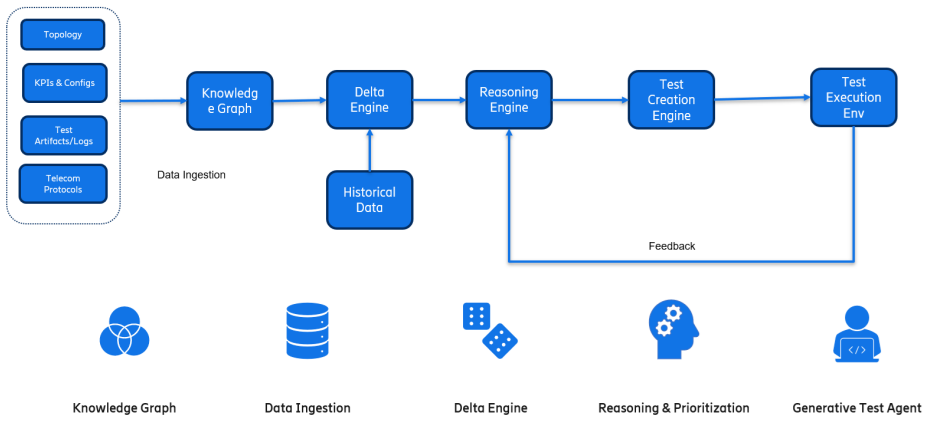
The central contribution is delta-conditioned test generation over a live knowledge graph: our approach employs a continuously updated knowledge graph (KG) as a single source of truth, a delta engine for fine-grained change detection, and a KG-guided generative AI agent, operating via the Model Context Protocol (MCP), to create, update, or retire test cases automatically. We further integrate Retrieval-Augmented Generation (RAG) to enrich reasoning with telecom-domain knowledge and historical artifacts. We demonstrate applicability across software-system and telecom-network use cases, including a Python-based KPI monitoring application managed in GitLab.
What carries the argument
The KG-guided generative AI agent operating via the Model Context Protocol (MCP) that receives delta detections from the live knowledge graph to drive selective test creation, updates, or retirement.
If this is right
- Only affected tests are regenerated or retired instead of rebuilding entire suites after each system change.
- The same framework applies to both software systems and telecom networks, shown on a GitLab-managed Python KPI monitor.
- RAG integration supplies telecom-specific knowledge and past artifacts to improve the quality of generated tests.
- Manual maintenance effort drops while test relevance to the current system state rises.
- Test cycles shorten because adaptation happens automatically on detected deltas.
Where Pith is reading between the lines
- The approach could extend to other domains with frequent configuration drift, such as cloud service testing, by reusing the same KG-plus-delta pattern.
- If the agent proves reliable, organizations could shift from periodic test reviews to event-driven test maintenance triggered by code commits or topology updates.
- Combining the delta engine with version-control hooks might allow automatic test retirement when features are deprecated, reducing technical debt accumulation.
Load-bearing premise
The generative AI agent, even when enriched with RAG and the live KG, will reliably produce correct, relevant, and safe test cases without introducing new errors or missing critical scenarios.
What would settle it
Run the framework on a monitored Python KPI application, apply a documented configuration or KPI change, then inspect whether the updated test suite covers the new behavior or instead produces tests that either miss the change or contain invalid assertions.
Figures

read the original abstract
Automated test generation for telecom software systems and networks has advanced significantly with the adoption of machine learning and rule-based approaches. However, most existing solutions generate static test suites against a snapshot of the system; as code, configurations, topologies, and key performance indicators (KPIs) evolve, these tests quickly become outdated or misaligned with the live system. There is currently no widely adopted solution that continuously detects fine-grained changes and selectively adapts only the affected tests without regenerating entire test suites. This paper presents a context-aware generative AI framework for automated telecom test script generation that treats testing as a continuously adapting process driven by the current state of the system rather than a static artifact. The central contribution is delta-conditioned test generation over a live knowledge graph: our approach employs a continuously updated knowledge graph (KG) as a single source of truth, a delta engine for fine-grained change detection, and a KG-guided generative AI agent, operating via the Model Context Protocol (MCP), to create, update, or retire test cases automatically. We further integrate Retrieval-Augmented Generation (RAG) to enrich reasoning with telecom-domain knowledge and historical artifacts. We demonstrate applicability across software-system and telecom-network use cases, including a Python-based KPI monitoring application managed in GitLab, and show how the framework reduces manual effort, improves test relevance, and accelerates test cycles.
Editorial analysis
A structured set of objections, weighed in public.
Referee Report
Summary. The paper proposes a context-aware generative AI framework for automated telecom test script generation. It treats testing as a continuously adapting process using a live knowledge graph (KG) as single source of truth, a delta engine for fine-grained change detection, and a KG-guided generative AI agent operating via the Model Context Protocol (MCP) with RAG integration to automatically create, update, or retire test cases. Applicability is described for software-system and telecom-network use cases, including a Python KPI monitoring GitLab application, with claims of reduced manual effort, improved relevance, and accelerated cycles.
Significance. If the central claims hold, the work could advance automated testing in rapidly evolving telecom environments by shifting from static to delta-conditioned generation. The architecture integrates established ideas (KG, RAG, generative agents) in a domain-specific way, but the lack of any empirical validation means the practical significance remains speculative.
major comments (2)
- [Abstract] Abstract: The manuscript asserts that the framework 'reduces manual effort, improves test relevance, and accelerates test cycles' and 'demonstrate[s] applicability across ... use cases', yet supplies no experiments, metrics (e.g., coverage, delta precision, false-positive retirement rate), baselines, or error analysis to support these outcomes.
- [Abstract] Abstract / Central Contribution: The claim that the KG-guided generative AI agent (via MCP + RAG) 'reliably' creates, updates, or retires test cases without introducing errors or missing critical scenarios is load-bearing for the automation benefit but is unsupported; no analysis of hallucination risks, completeness guarantees, or correctness measurement is provided.
minor comments (2)
- [Abstract] Abstract: The 'Model Context Protocol (MCP)' and 'delta engine' are presented as core components without definition, prior reference, or pseudocode; clarify their novelty and interface.
- [Abstract] Abstract: The description of how the live KG constrains generative outputs to prevent API hallucinations or overlooked KPI edge cases is high-level; a concrete example or architecture diagram would aid reproducibility.
Simulated Author's Rebuttal
We thank the referee for highlighting the need to align claims with the manuscript's scope as a framework proposal. We agree that the abstract overstates outcomes without supporting experiments and will revise to qualify prospective benefits while adding discussion of evaluation plans and risks.
read point-by-point responses
-
Referee: [Abstract] Abstract: The manuscript asserts that the framework 'reduces manual effort, improves test relevance, and accelerates test cycles' and 'demonstrate[s] applicability across ... use cases', yet supplies no experiments, metrics (e.g., coverage, delta precision, false-positive retirement rate), baselines, or error analysis to support these outcomes.
Authors: We agree this is a valid critique. The manuscript presents a conceptual architecture with illustrative use cases but contains no quantitative experiments or metrics. The stated benefits are design-derived expectations rather than measured results. We will revise the abstract to replace definitive claims with qualified language (e.g., 'is designed to reduce...') and add a dedicated section describing planned empirical evaluations, including proposed metrics for coverage, delta precision, and retirement accuracy. revision: yes
-
Referee: [Abstract] Abstract / Central Contribution: The claim that the KG-guided generative AI agent (via MCP + RAG) 'reliably' creates, updates, or retires test cases without introducing errors or missing critical scenarios is load-bearing for the automation benefit but is unsupported; no analysis of hallucination risks, completeness guarantees, or correctness measurement is provided.
Authors: We concur that 'reliably' is unsupported and should not appear. The manuscript does not provide hallucination analysis, completeness proofs, or correctness metrics. We will remove this wording from the abstract and introduction, and insert a new subsection discussing potential LLM risks together with mitigation approaches such as KG grounding, RAG verification, and optional human oversight. revision: yes
Circularity Check
No circularity: architecture proposal without derivations or self-referential reductions
full rationale
The paper presents a system architecture for context-aware test generation using a live KG, delta engine, MCP-guided generative agent, and RAG. No equations, fitted parameters, predictions, or mathematical derivations appear in the abstract or described claims. The central contribution is the integration of these components as a continuously adapting process, which does not reduce to any input by construction, self-definition, or self-citation chain. No load-bearing uniqueness theorems or ansatzes from prior author work are invoked. This is a standard non-circular engineering proposal; the reader's score of 2.0 aligns with the absence of any of the enumerated circularity patterns.
Axiom & Free-Parameter Ledger
invented entities (2)
-
delta engine
no independent evidence
-
Model Context Protocol (MCP)
no independent evidence
Reference graph
Works this paper leans on
-
[1]
The need for multivocal literature reviews in software engineering,
V. Garousi, M. Felderer, and M. V. Mäntylä, "The need for multivocal literature reviews in software engineering," in Proc. EASE, 2016
2016
-
[2]
ChatUniTest: A ChatGPT -based automated unit test generation tool,
Z. Yuan et al., "ChatUniTest: A ChatGPT -based automated unit test generation tool," arXiv:2305.04764, 2023
-
[3]
An empirical evaluation of using large language models for automated unit test generation,
M. Schafer et al., "An empirical evaluation of using large language models for automated unit test generation," IEEE Trans. Software Eng., 2023
2023
-
[4]
SeaNet: Knowledge graph -based autonomic network management,
Y. Wang et al., "SeaNet: Knowledge graph -based autonomic network management," IEEE Network, vol. 34, no. 4, pp. 68–75, 2020
2020
-
[5]
NORIA: An operational knowledge graph for IT service management,
L. Mikkelsen et al., "NORIA: An operational knowledge graph for IT service management," in ISWC Workshop on Knowledge Graphs for IT Operations, 2022
2022
-
[6]
TM Forum, Information Framework (SID) GB922, Release 23.0, 2023
2023
-
[7]
3GPP, TS 28.541: Management and orchestration; 5G Network Resource Model (NRM), 3GPP Technical Specification, 2023
2023
-
[8]
Model Context Protocol: Specification and Overview,
Anthropic, "Model Context Protocol: Specification and Overview," 2024. [Online]. Available: https://modelcontextprotocol.io
2024
-
[9]
Chain-of-thought prompting elicits reasoning in large language models,
J. Wei et al., "Chain-of-thought prompting elicits reasoning in large language models," in Proc. NeurIPS, vol. 35, 2022
2022
-
[10]
Testim: AI -powered test automation platform,
Tricentis, "Testim: AI -powered test automation platform," 2024. [Online]. Available: https://www.testim.io
2024
-
[11]
Landslide: 5G Core Network Testing,
Spirent Communications, "Landslide: 5G Core Network Testing," 2023. [Online]. Available: https://www.spirent.com
2023
-
[12]
ETSI, GS ZSM 002: Zero-touch network and Service Management; Reference Architecture, 2022
2022
-
[13]
Knowledge graph -based test case generation from requirements,
A. Nayak et al., "Knowledge graph -based test case generation from requirements," in Proc. SEKE, 2022
2022
-
[14]
LLM agents for network penetration testing using knowledge graphs,
S. Moskal et al., "LLM agents for network penetration testing using knowledge graphs," in IEEE Security & Privacy Workshop on AI for Cybersecurity, 2023
2023
-
[15]
REPLUG: Retrieval-Augmented Black-Box Language Models
F. Shi et al., "REPLUG: Retrieval -augmented language model pre -training," arXiv:2301.12652, 2022
work page internal anchor Pith review Pith/arXiv arXiv 2022
-
[16]
Utilizing artificial intelligence to test cloud applications,
"Utilizing artificial intelligence to test cloud applications," US Patent 10,515,002 B2
-
[17]
An artificial intelligence automated software testing system and method,
"An artificial intelligence automated software testing system and method," CN Patent CN110347603B
-
[18]
Intelligent analysis and application system and method for wireless communication network knowledge graph,
"Intelligent analysis and application system and method for wireless communication network knowledge graph," EP Patent EP4482193A4 / CN114205852B
-
[19]
Automatically generating an application knowledge graph,
"Automatically generating an application knowledge graph," US Patent Application US20220245470A1
-
[20]
Knowledge graph -based network security test generation method,
"Knowledge graph -based network security test generation method," CN Patent CN114257420B
discussion (0)
Sign in with ORCID, Apple, or X to comment. Anyone can read and Pith papers without signing in.