REVIEW 2 references
Keyless Attention: Value-Space Routing and Value-Only Caching for Efficient Transformers
T0 review · reviewed 2026-08-04 · deepseek-v4-flash
Pith's one-line read Keyless Attention eliminates the key projection, computing softmax(QV^T)V and reducing KV-cache memory by exactly 50%, with comparable or better performance on small-scale models.
The pith
A machine-rendered reading of the paper's core claim, the machinery that carries it, and where it could break.
The reading
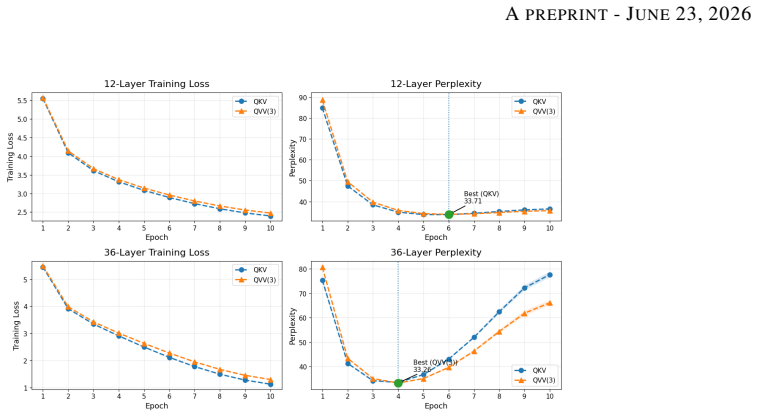
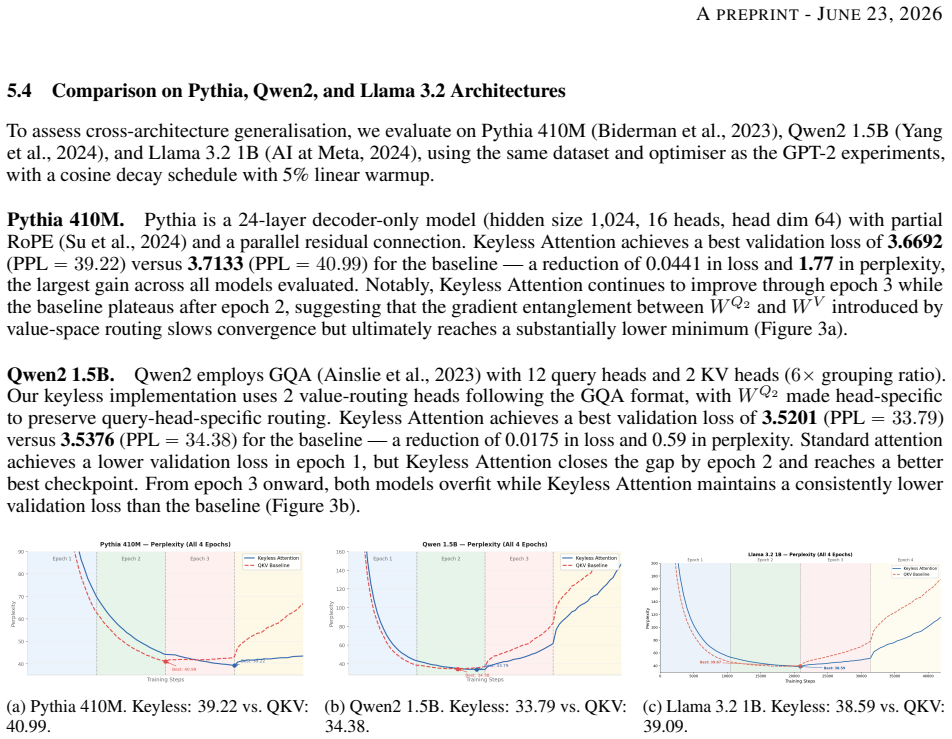
The paper shows a linear-algebra result: in some cases, any standard attention layer can be exactly simulated by a keyless layer by adjusting the query projection. But that equivalence requires a mathematical condition that is not guaranteed in real multi-head models, so the main support is empirical. The authors trained five small to medium language models (up to 1.5B parameters) from scratch on a tiny 30M-token subset of WikiText-103, comparing keyless versus standard attention. They report that keyless matches or slightly outperforms the baseline on perplexity and on four of five zero-shot reasoning tasks, with the cache size cut in half. They also observe that keyless attention overfits less after the best epoch, a claim they attribute to 'gradient entanglement' between query and value projections, though they leave a direct test of this mechanism for future work.
Extended reading notes
Core claim
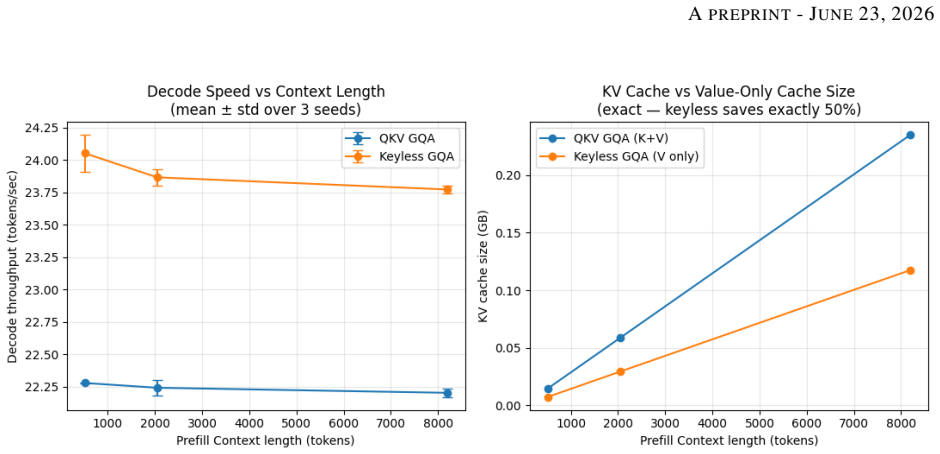
Keyless Attention matches or outperforms standard QKV attention on perplexity in 4 out of 5 models, and outperforms on 4 out of 5 zero-shot downstream benchmarks, while reducing KV cache memory by exactly 50% during autoregressive inference.
Load-bearing premise
The multi-head equivalence theorem (Theorem 2) requires the subspace condition col(Ω_h^T) ⊆ col(W_V_h) for each head, which is not generically satisfied in practical multi-head attention. The empirical results additionally assume that behavior on a 30M-token subset of WikiText-103 transfers to realistic large-scale pretraining—an assumption not validated in this paper.
Editorial analysis
A structured set of objections, weighed in public.
Assumptions & free parameters
free parameters (1)
- factorization depth m =
3
assumptions (2)
- ad hoc to paper Full rank of W_V (single-head) or the subspace condition col(Ω_h^T) ⊆ col(W_V_h) (multi-head) for equivalence theorems.
- domain assumption Training on a 30M-token subset of WikiText-103 approximates real pretraining conditions.
Cite this review
Pith. "Pith review of Keyless Attention: Value-Space Routing and Value-Only Caching for Efficient Transformers." pith.science (2026). https://pith.science/paper/7WBXE6Z5
@misc{pith2026260621848,
  author       = {Pith},
  title        = {Pith review of: Keyless Attention: Value-Space Routing and Value-Only Caching for Efficient Transformers},
  year         = {2026},
  howpublished = {\url{https://pith.science/paper/7WBXE6Z5}},
  note         = {Machine review of arXiv:2606.21848}
}
read the original abstract
Transformer architectures form the foundation of modern natural language processing, yet the Key-Value (KV) cache introduces substantial memory and bandwidth overhead during long-context generation, increasingly bottlenecking large-scale deployment. We propose Keyless Attention, a novel attention mechanism that replaces the conventional key projection with a dedicated value-space routing projection, eliminating key representations from the attention computation entirely and yielding a Value-Only Cache that reduces KV-cache memory by 50% while improving decode throughput. Experiments across multiple models and architectures demonstrate that Keyless Attention achieves comparable perplexity and downstream task performance to standard QKV attention, while consistently reducing KV-cache memory by 50%. Furthermore, Keyless Attention exhibits slower validation loss degradation after the best epoch, indicating improved robustness against overfitting. Ablation studies confirm that the dedicated value-space routing projection is critical, with Keyless Attention outperforming KV-sharing methods that eliminate the key cache without replacing its routing role. Experiments in the pretraining regime further confirm the viability of Keyless Attention in industrial settings.
Figures

Figures from the paper (1 more)
Reference graph
Works this paper leans on
-
[1]
Llama 3.2: Revolutionizing edge AI and vision with open, customizable models
AI at Meta (2024). Llama 3.2: Revolutionizing edge AI and vision with open, customizable models. Meta AI Blog. Ainslie, J., Lee-Thorp, J., de Jong, M., Zemlyanskiy, Y ., Lebrón, F., and Sanghai, S. (2023). GQA: Training generalized multi-query transformer models from multi-head checkpoints. InProceedings of the 2023 Conference on Empirical Methods in Natu...
arXiv 2024
-
[5]
Prabhu, R., Nayak, A., Mohan, J., Ramjee, R., and Panwar, A. (2024). vAttention: Dynamic memory management for serving LLMs without PagedAttention.arXiv preprint arXiv:2405.04437. Radford, A., Wu, J., Child, R., Luan, D., Amodei, D., and Sutskever, I. (2019). Language models are unsupervised multitask learners.OpenAI Blog, 1(8):9. Shazeer, N. (2019). Fast...
arXiv 2024
Reviewed August 4, 2026 · model on record in the stance chip above.
Discussion (0). Sign in to comment.