Metamorphosis of fractional instantons on a twisted T⁴ with a double-trace deformation: a numerical study
Pith reviewed 2026-06-26 11:41 UTC · model grok-4.3
The pith
Numerical lattice study shows monopole-instanton chains collimate into center-vortex sheets in pure Yang-Mills on twisted tori with aligned abelianizations.
A machine-rendered reading of the paper's core claim, the machinery that carries it, and where it could break.
Core claim
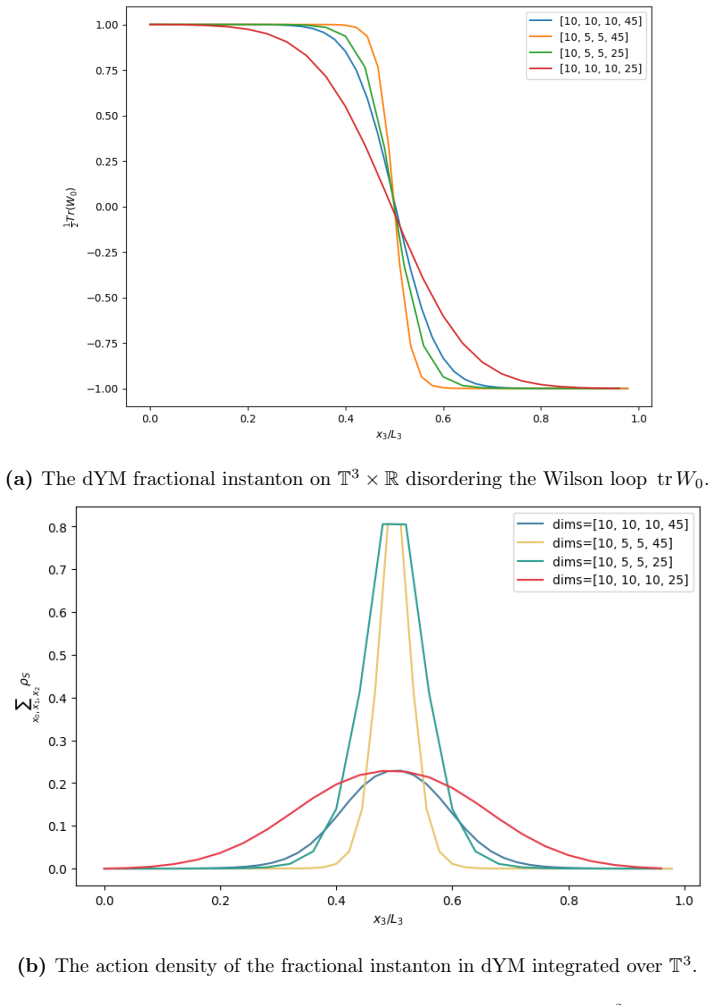
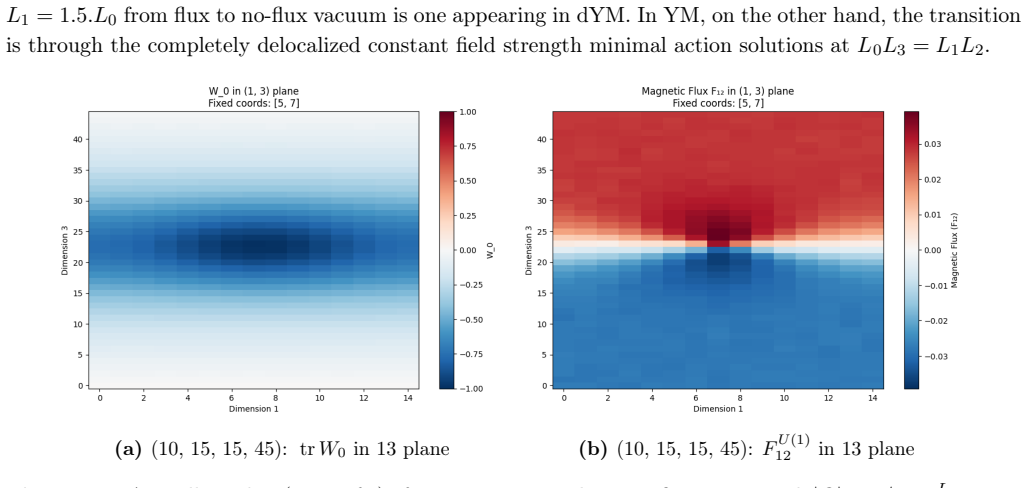
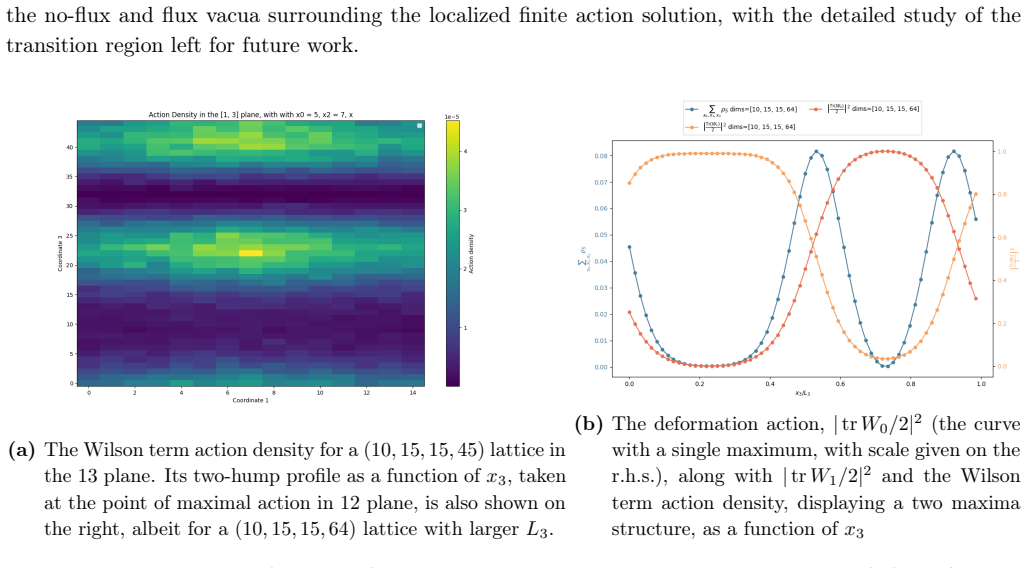
The authors perform numerical minimization of the trace-deformed Yang-Mills lattice action on T^4 with twisted boundary conditions and track the classical minimum-action saddles of fractional topological charge as the twists and period ratios are changed. They observe continuous metamorphosis between monopole-instanton, center-vortex, and fractional-instanton configurations when interpolating between R^{4-k} x T^k geometries. The results indicate that the collimation of monopole flux into vortex sheets persists in the undeformed theory for tori whose shape aligns the two sources of abelianization, while the presence of the deformation potential can make some transitions between distinct mini
What carries the argument
Numerical minimization of the trace-deformed lattice action on T^4 with twisted boundary conditions, used to identify and track the global minimum-action fractional-charge saddle points under changes in geometry and deformation strength.
If this is right
- The analytic collimation picture of monopole-instanton chains holds in pure Yang-Mills theory whenever torus periods align the abelianizations from twists and deformation.
- With nonzero deformation potential some transitions between distinct minimal-action fractional-charge configurations become discontinuous and involve level crossing.
- The type of minimal saddle depends on the relative orientation of the abelianizations induced by the deformation and by the twists.
- The same set of fractional instantons can be continuously deformed into each other by changing the compactification geometry from one to four dimensions.
Where Pith is reading between the lines
- The alignment condition on torus periods suggests that similar flux-collimation behavior could appear in other geometries or even in the decompactification limit when the effective abelian directions remain matched.
- Level-crossing transitions under the deformation may correspond to first-order changes in the dominant non-perturbative configurations as the potential strength is varied.
- Extending the same numerical setup to include dynamical fermions could test whether the observed saddles continue to dominate the vacuum structure and affect chiral properties.
Load-bearing premise
The numerical minimization procedure reliably finds the global minimum-action configurations for each choice of twists and periods rather than becoming trapped in higher-action local minima.
What would settle it
Discovery of a lower-action configuration for a fixed set of twists and periods that fails to exhibit the reported collimation or the expected metamorphosis between monopole and vortex saddles would falsify the identification of the observed configurations as the true minima.
Figures
read the original abstract
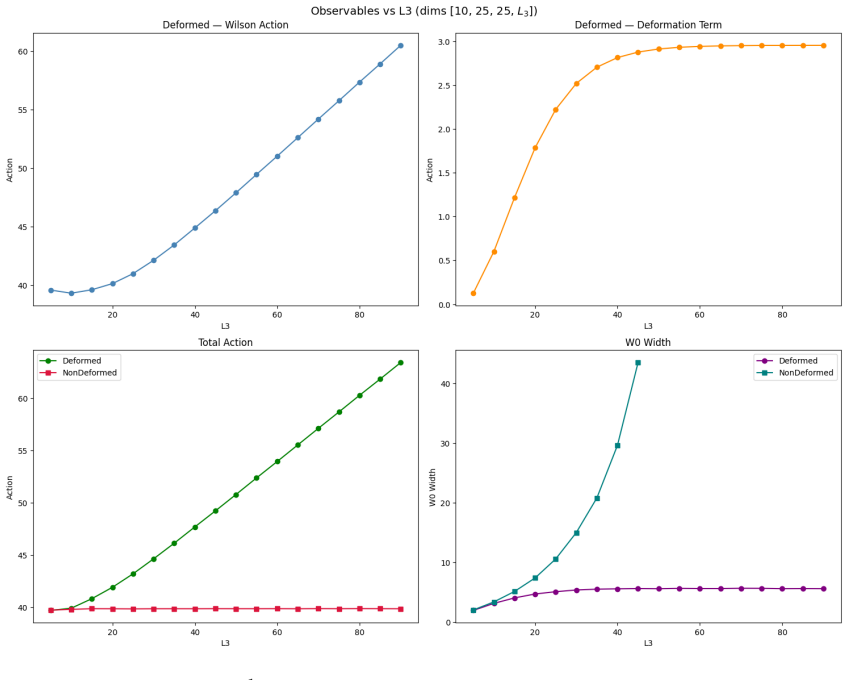
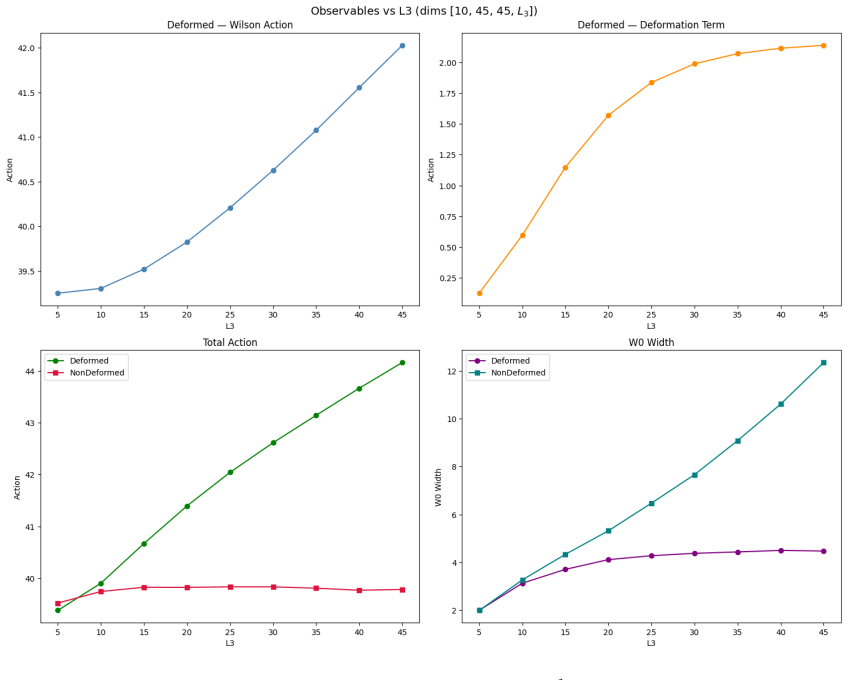
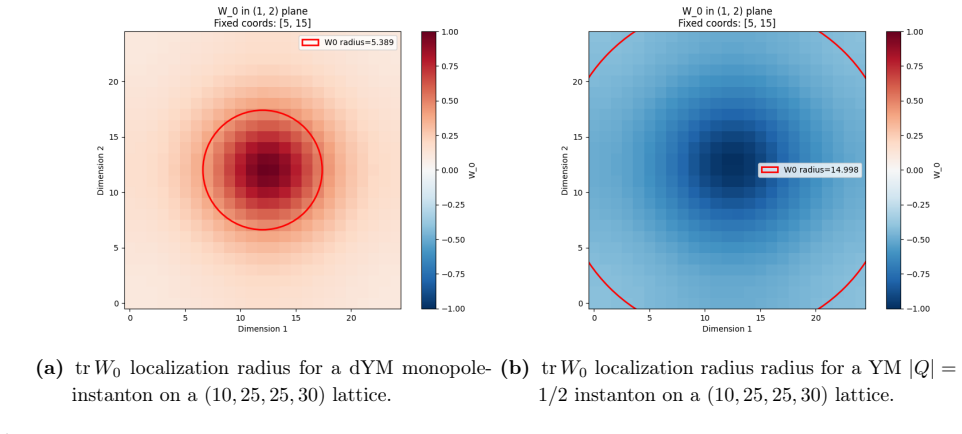
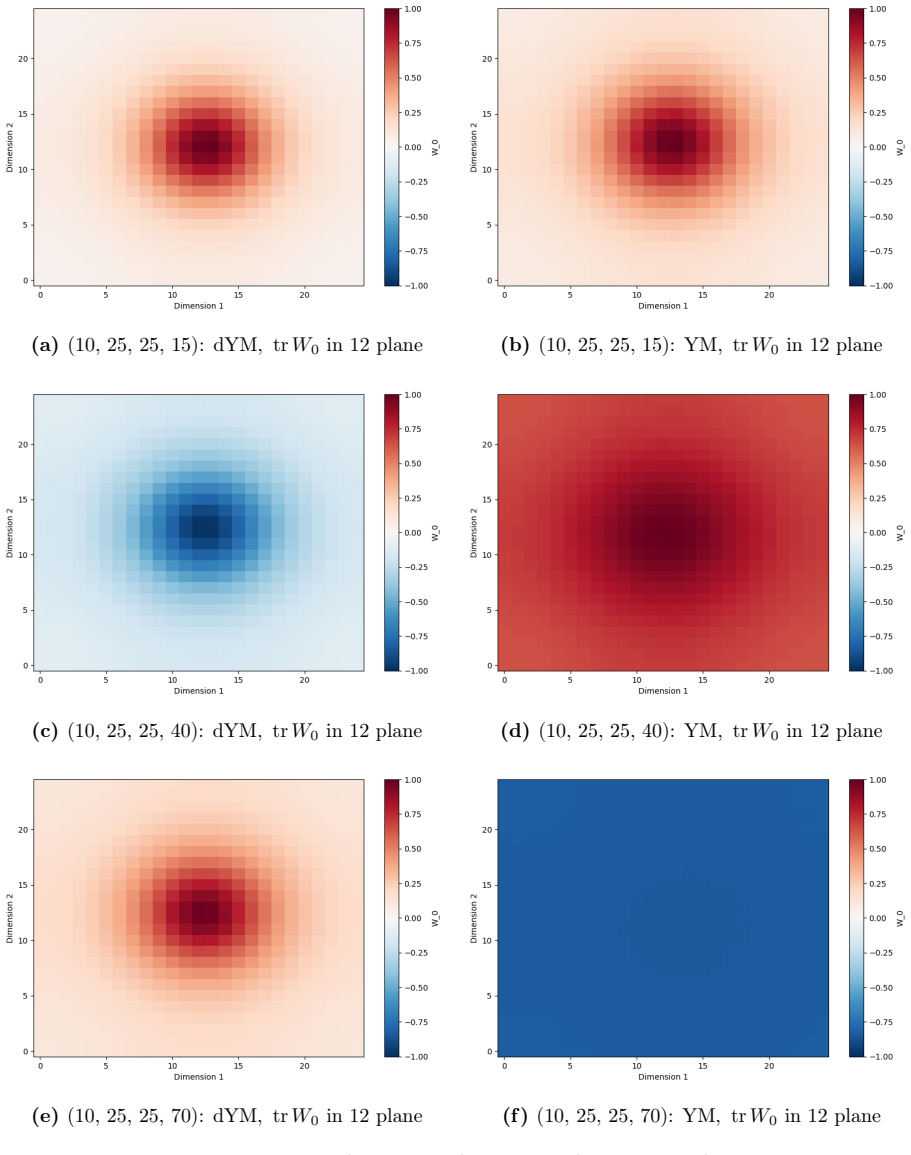
We use numerical minimization of the lattice action of trace-deformed Yang-Mills theory on $T^4$ with twisted boundary conditions to find the classical minimum action configurations of fractional topological charge. We vary the twists and ratios of torus periods to interpolate between different $R^{4-k} \times T^k$ geometries. This allows us to see how the corresponding minimum action saddle point configurations -- monopole-instantons ($k=1$), center vortices ($k=2$), and fractional instantons ($k=3,4$) -- morph into each other. We also study how the transition between them depends on the presence of a deformation potential. In particular, we argue that the recent analytic picture of chains of monopole-instantons collimating their flux into center-vortex sheets, while technically relying on the deformation potential, also holds in pure Yang-Mills theory, for tori whose shape causes the abelianization due to the deformation to align with the one due to the twists. Our results also indicate that with nonzero deformation potential, some transitions between different minimal-action fractional charge configurations may be discontinuous and involve level crossing.
Editorial analysis
A structured set of objections, weighed in public.
Referee Report
Summary. The manuscript numerically minimizes the lattice action of trace-deformed Yang-Mills theory on a twisted T^4, varying twists and period ratios to interpolate between R^{4-k} x T^k geometries. It reports how minimum-action fractional-charge configurations morph among monopole-instantons (k=1), center vortices (k=2), and fractional instantons (k=3,4), and argues that the analytic collimation of monopole-instanton flux into center-vortex sheets holds in pure Yang-Mills when twist-induced and deformation-induced abelianizations align; it also reports that nonzero deformation can produce discontinuous transitions via level crossings.
Significance. If the reported saddles are global minima, the work supplies concrete numerical evidence that the monopole-instanton to center-vortex collimation mechanism survives the removal of the deformation potential under alignment conditions. This strengthens the analytic picture by showing geometry-dependent continuity between different compactification limits and supplies a lattice bridge between deformed and pure Yang-Mills topology.
major comments (2)
- [Numerical method / Results sections] Numerical minimization procedure (likely §3 or §4): the central claim that the observed metamorphosis and pure-YM extrapolation hold rests on the assumption that the reported configurations are global minima for each (twist, period) pair. No evidence is provided of exhaustive searches (multiple random starts, annealing schedules, or comparison against known analytic minima in limiting geometries) that would rule out lower-action local minima capable of altering the reported level crossings or flux patterns.
- [Discussion / Pure YM limit] Pure-YM extrapolation argument (likely §5 or Discussion): the identification of which deformed minima survive when abelianization directions coincide is used to claim validity in pure Yang-Mills, yet the manuscript does not explicitly verify that no lower-action configuration exists in the undeformed theory for the aligned geometries; this step is load-bearing for the main claim but remains an extrapolation without direct confirmation.
minor comments (2)
- [Figures] Figure captions and axis labels should explicitly state the deformation parameter value and the precise twist vector for each panel to allow direct comparison with the alignment condition discussed in the text.
- [Throughout] Notation for the fractional charge Q and the periods L_i should be introduced once with a clear definition before being used in multiple sections; occasional re-use of symbols for different quantities reduces readability.
Simulated Author's Rebuttal
We thank the referee for the constructive comments on our numerical study. We address each major point below, clarifying our numerical procedures and the scope of the pure-YM extrapolation argument.
read point-by-point responses
-
Referee: [Numerical method / Results sections] Numerical minimization procedure (likely §3 or §4): the central claim that the observed metamorphosis and pure-YM extrapolation hold rests on the assumption that the reported configurations are global minima for each (twist, period) pair. No evidence is provided of exhaustive searches (multiple random starts, annealing schedules, or comparison against known analytic minima in limiting geometries) that would rule out lower-action local minima capable of altering the reported level crossings or flux patterns.
Authors: We agree that explicit documentation of global-minimum verification strengthens the results. Our minimizations were initialized from multiple classes of configurations (random SU(N) links, small perturbations of analytic monopole and vortex solutions in the appropriate limits, and twisted instanton-like fields), with the same minimum-action saddles recovered in each case for the reported geometries. Convergence was monitored via action stabilization and topological charge. In the revised manuscript we will add a dedicated paragraph in §3 describing these initialization protocols and the consistency checks performed across random seeds. revision: yes
-
Referee: [Discussion / Pure YM limit] Pure-YM extrapolation argument (likely §5 or Discussion): the identification of which deformed minima survive when abelianization directions coincide is used to claim validity in pure Yang-Mills, yet the manuscript does not explicitly verify that no lower-action configuration exists in the undeformed theory for the aligned geometries; this step is load-bearing for the main claim but remains an extrapolation without direct confirmation.
Authors: The central claim is conditional: when the twist-induced and deformation-induced abelianizations align, the deformed-theory minima reproduce the expected monopole-to-vortex collimation. Because the deformation supplies the potential that stabilizes the abelianization, direct minimization in the strictly undeformed theory lies outside the scope of the present lattice setup. We will expand the discussion section to emphasize that the argument is an extrapolation resting on alignment and continuity of the saddles, and to state explicitly that a fully undeformed confirmation would require a separate method (e.g., cooling or gradient flow without the double-trace term). revision: partial
Circularity Check
No significant circularity; numerical study is self-contained
full rationale
The paper conducts a numerical lattice minimization of the trace-deformed Yang-Mills action on twisted T^4, varying twists and periods to observe how monopole-instanton, center-vortex, and fractional-instanton saddles morph. The claim that the prior analytic picture of flux collimation holds in pure Yang-Mills when deformation and twist abelianizations align is an extrapolation from the computed minimum-action configurations, not a mathematical derivation that reduces any output to fitted inputs or self-citations by construction. No self-definitional steps, fitted predictions renamed as results, or load-bearing self-citation chains appear; the work relies on direct computation rather than tautological re-derivation of its own assumptions.
Axiom & Free-Parameter Ledger
Reference graph
Works this paper leans on
-
[1]
’t Hooft,A Property of Electric and Magnetic Flux in Nonabelian Gauge Theories,Nucl
G. ’t Hooft,A Property of Electric and Magnetic Flux in Nonabelian Gauge Theories,Nucl. Phys. B 153(1979) 141–160
1979
-
[2]
’t Hooft,Aspects of Quark Confinement,Phys
G. ’t Hooft,Aspects of Quark Confinement,Phys. Scripta24(1981) 841–846
1981
-
[3]
M. Unsal and L. G. Yaffe,Center-stabilized Yang-Mills theory: Confinement and large N volume independence,Phys. Rev. D78(2008) 065035, [arXiv:0803.0344]
Pith/arXiv arXiv 2008
-
[4]
J. D. Bjorken,Elements of Quantum Chromodynamics,Prog. Math. Phys.4(12, 1979) 423–561
1979
-
[5]
Luscher,Some Analytic Results Concerning the Mass Spectrum of Yang-Mills Gauge Theories on a Torus,Nucl
M. Luscher,Some Analytic Results Concerning the Mass Spectrum of Yang-Mills Gauge Theories on a Torus,Nucl. Phys. B219(1983) 233–261
1983
-
[6]
A. Arabi Ardehali and D. J. Resnick,Perturbative Coulomb branches onR3 ×S 1: the global D-term potential,arXiv:2604.27066
-
[7]
G. V. Dunne and M. Ünsal,New Nonperturbative Methods in Quantum Field Theory: From Large-N Orbifold Equivalence to Bions and Resurgence,Ann. Rev. Nucl. Part. Sci.66(2016) 245–272, [arXiv:1601.03414]
Pith/arXiv arXiv 2016
-
[8]
E. Poppitz,Notes on Confinement onR3 ×S 1: From Yang-Mills, Super-Yang-Mills, and QCD (adj) to QCD(F),Symmetry14(2022), no. 1 180, [arXiv:2111.10423]
arXiv 2022
-
[9]
A. González-Arroyo,On the fractional instanton liquid picture of the Yang-Mills vacuum and Confinement,arXiv:2302.12356
-
[10]
M. M. Anber and E. Poppitz,Higher-order gaugino condensates on a twistedT4,JHEP02(2025) 114, [arXiv:2408.16058]
arXiv 2025
-
[11]
D. J. Gross, R. D. Pisarski, and L. G. Yaffe,QCD and Instantons at Finite Temperature,Rev. Mod. Phys.53(1981) 43. [12]RTNCollaboration, M. Garcia Perez et al.,Instanton like contributions to the dynamics of Yang-Mills fields on the twisted torus,Phys. Lett. B305(1993) 366–374, [hep-lat/9302007]
Pith/arXiv arXiv 1981
-
[12]
A. Gonzalez-Arroyo and P. Martinez,Investigating Yang-Mills theory and confinement as a function of the spatial volume,Nucl. Phys. B459(1996) 337–354, [hep-lat/9507001]. 32The only advantage for consideringSU(2)is that all quantities entering Eqns. (35)-(37) are explicitly worked out in [51]. 36
Pith/arXiv arXiv 1996
-
[13]
A. Gonzalez-Arroyo and A. Montero,Selfdual vortex - like configurations in SU(2) Yang-Mills theory, Phys. Lett. B442(1998) 273–278, [hep-th/9809037]
Pith/arXiv arXiv 1998
-
[14]
Montero,Vortex configurations in the large N limit,Phys
A. Montero,Vortex configurations in the large N limit,Phys. Lett. B483(2000) 309–314, [hep-lat/0004002]
Pith/arXiv arXiv 2000
-
[15]
van Baal,Some Results for SU(N) Gauge Fields on the Hypertorus,Commun
P. van Baal,Some Results for SU(N) Gauge Fields on the Hypertorus,Commun. Math. Phys.85 (1982) 529
1982
-
[16]
K.-M. Lee and P. Yi,Monopoles and instantons on partially compactified D-branes,Phys. Rev. D56 (1997) 3711–3717, [hep-th/9702107]
Pith/arXiv arXiv 1997
-
[17]
T. C. Kraan and P. van Baal,Monopole constituents inside SU(n) calorons,Phys. Lett. B435(1998) 389–395, [hep-th/9806034]
Pith/arXiv arXiv 1998
-
[18]
Y. Tanizaki and M. Ünsal,Center vortex and confinement in Yang–Mills theory and QCD with anomaly-preserving compactifications,PTEP2022(2022), no. 4 04A108, [arXiv:2201.06166]
arXiv 2022
-
[19]
M. M. Anber and E. Poppitz,Mass-deformed super Yang-Mills theory onT4: sum over twisted sectors,θ-angle, and CP violation,JHEP10(2025) 182, [arXiv:2509.00157]
arXiv 2025
-
[20]
E. Poppitz and M. E. Shalchian T.,String tensions in deformed Yang-Mills theory,JHEP01(2018) 029, [arXiv:1708.08821]
Pith/arXiv arXiv 2018
-
[21]
Greensite,An introduction to the confinement problem, vol
J. Greensite,An introduction to the confinement problem, vol. 972. Springer, 2020
2020
-
[22]
D. R. Junior, G. Krein, L. E. Oxman, and B. R. Soares,Study of the Emergence of a Gluon Mass Scale from Center Vortices Using a Wave-Functional Formalism,Phys. Rev. Lett.136(2026), no. 11 111902, [arXiv:2510.19103]
arXiv 2026
-
[23]
M. M. Anber and E. Poppitz,The gaugino condensate from asymmetric four-torus with twists,JHEP 01(2023) 118, [arXiv:2210.13568]
arXiv 2023
-
[24]
M. M. Anber and E. Poppitz,Multi-fractional instantons in SU(N) Yang-Mills theory on the twisted four-torus,JHEP09(2023) 095, [arXiv:2307.04795]
arXiv 2023
-
[25]
N. Dorey, T. J. Hollowood, V. V. Khoze, and M. P. Mattis,The Calculus of many instantons,Phys. Rept.371(2002) 231–459, [hep-th/0206063]
Pith/arXiv arXiv 2002
-
[26]
’t Hooft,Some Twisted Selfdual Solutions for the Yang-Mills Equations on a Hypertorus, Commun
G. ’t Hooft,Some Twisted Selfdual Solutions for the Yang-Mills Equations on a Hypertorus, Commun. Math. Phys.81(1981) 267–275
1981
-
[27]
F. D. Wandler,Numerical fractional instantons in SU(2): center vortices, monopoles, and a sharp transition between them,arXiv:2406.07636
-
[28]
Y. Hayashi and Y. Tanizaki,Unifying Monopole and Center Vortex as the Semiclassical Confinement Mechanism,Phys. Rev. Lett.133(2024), no. 17 171902, [arXiv:2405.12402]
arXiv 2024
-
[29]
C. Güvendik, T. Schaefer, and M. Ünsal,The metamorphosis of semi-classical mechanisms of confinement: from monopoles onR3 ×S 1 to center-vortices onR2 ×T 2,JHEP11(2024) 163, [arXiv:2405.13696]. 37
arXiv 2024
-
[30]
M. M. Anber and E. Poppitz,On the global structure of deformed Yang-Mills theory and QCD(adj) onR 3 ×S 1,JHEP10(2015) 051, [arXiv:1508.00910]
Pith/arXiv arXiv 2015
-
[31]
D. Gaiotto, A. Kapustin, Z. Komargodski, and N. Seiberg,Theta, Time Reversal, and Temperature, JHEP05(2017) 091, [arXiv:1703.00501]
Pith/arXiv arXiv 2017
-
[32]
A. A. Cox, E. Poppitz, and F. D. Wandler,The mixed 0-form/1-form anomaly in Hilbert space: pouring the new wine into old bottles,JHEP10(2021) 069, [arXiv:2106.11442]
arXiv 2021
-
[33]
M. M. Anber and L. Vincent-Genod,Classification of compactifiedsu(Nc)gauge theories with fermions in all representations,JHEP12(2017) 028, [arXiv:1704.08277]
Pith/arXiv arXiv 2017
-
[34]
Y. Hayashi, Y. Tanizaki, and H. Watanabe,Non-supersymmetric duality cascade of QCD(BF) via semiclassics onR 2 ×T 2 with the baryon-’t Hooft flux,JHEP07(2024) 033, [arXiv:2404.16803]
arXiv 2024
-
[35]
Y. Hayashi and Y. Tanizaki,Semiclassics for the QCD vacuum structure through T2-compactification with the baryon-’t Hooft flux,JHEP08(2024) 001, [arXiv:2402.04320]
arXiv 2024
-
[36]
Y. Hayashi, Y. Tanizaki, and H. Watanabe,Semiclassical analysis of the bifundamental QCD onR 2 ×T 2 with ’t Hooft flux,JHEP10(2023) 146, [arXiv:2307.13954]
arXiv 2023
-
[37]
Y. Tanizaki and M. Ünsal,Semiclassics with ’t Hooft flux background for QCD with 2-index quarks, JHEP08(2022) 038, [arXiv:2205.11339]
arXiv 2022
-
[38]
Y. Hayashi, T. Misumi, and Y. Tanizaki,Monopole-vortex continuity ofN= 1 super Yang-Mills theory onR 2 ×S 1 ×S 1 with ’t Hooft twist,JHEP05(2025) 194, [arXiv:2410.21392]
arXiv 2025
-
[39]
Hayashi, T
Y. Hayashi, T. Misumi, and Y. Tanizaki,On 2d perimeter law inN=1 super Yang-Mills theory on R2 ×S 1 ×S 1 with ’tt Hooft twist from Monopole-Vortex continuity,Int. J. Mod. Phys. A41(2026), no. 07 2548006
2026
-
[40]
M. Nguyen and M. Ünsal,Refined instanton analysis of the 2DCPN−1 model: mass gap, theta dependence, and mirror symmetry,JHEP03(2025) 162, [arXiv:2309.12178]
arXiv 2025
-
[41]
M. Nguyen and M. Ünsal,Self-dual monopole loops, instantons and confinement,arXiv:2509.09625
-
[42]
M. Garcia Perez, A. Gonzalez-Arroyo, J. R. Snippe, and P. van Baal,Instantons from over - improved cooling,Nucl. Phys. B413(1994) 535–552, [hep-lat/9309009]
Pith/arXiv arXiv 1994
-
[43]
P. de Forcrand, M. Garcia Perez, and I.-O. Stamatescu,Improved cooling algorithm for gauge theories,Nucl. Phys. B Proc. Suppl.47(1996) 777–780, [hep-lat/9509064]
Pith/arXiv arXiv 1996
-
[44]
A. Montero,Numerical analysis of fractional charge solutions on the torus,JHEP05(2000) 022, [hep-lat/0004009]
Pith/arXiv arXiv 2000
-
[45]
C. Bonati, M. Cardinali, and M. D’Elia,θdependence in trace deformedSU(3)Yang-Mills theory: a lattice study,Phys. Rev. D98(2018), no. 5 054508, [arXiv:1807.06558]
Pith/arXiv arXiv 2018
-
[46]
A. Athenodorou, M. Cardinali, and M. D’Elia,Spectrum of trace deformed Yang-Mills theories,Phys. Rev. D104(2021), no. 7 074510, [arXiv:2010.03618]. 38
arXiv 2021
- [47]
- [48]
-
[49]
M. Unsal,Magnetic bion condensation: A New mechanism of confinement and mass gap in four dimensions,Phys. Rev. D80(2009) 065001, [arXiv:0709.3269]
Pith/arXiv arXiv 2009
-
[50]
E. Poppitz and F. D. Wandler,Gauge theory geography: charting a path between semiclassical islands, JHEP02(2023) 014, [arXiv:2211.10347]
arXiv 2023
-
[51]
M. García Pérez, A. González-Arroyo, and M. Okawa,Spatial volume dependence for 2+1 dimensional SU(N) Yang-Mills theory,JHEP09(2013) 003, [arXiv:1307.5254]
Pith/arXiv arXiv 2013
-
[52]
M. Garcia Perez, A. Gonzalez-Arroyo, A. Montero, and P. van Baal,Calorons on the lattice: A New perspective,JHEP06(1999) 001, [hep-lat/9903022]
Pith/arXiv arXiv 1999
-
[53]
M. M. Anber, A. A. Cox, and E. Poppitz,On the moduli space of multi-fractional instantons on the twistedT 4,JHEP02(2026) 169, [arXiv:2504.06344]
arXiv 2026
-
[54]
E. Poppitz,D-branes and fractional instantons on a twisted four torus: the moduli space as an N=2 supersymmetric Higgs branch,arXiv:2604.21980
-
[55]
Unsal,Abelian duality, confinement, and chiral symmetry breaking in QCD(adj),Phys
M. Unsal,Abelian duality, confinement, and chiral symmetry breaking in QCD(adj),Phys. Rev. Lett. 100(2008) 032005, [arXiv:0708.1772]
Pith/arXiv arXiv 2008
-
[56]
Witten,Constraints on Supersymmetry Breaking,Nucl
E. Witten,Constraints on Supersymmetry Breaking,Nucl. Phys. B202(1982) 253
1982
-
[57]
Gonzalez Arroyo and C
A. Gonzalez Arroyo and C. P. Korthals Altes,The Spectrum of Yang-Mills Theory in a Small Twisted Box,Nucl. Phys. B311(1988) 433–449
1988
-
[58]
Ünsal,Strongly coupled QFT dynamics via TQFT coupling,JHEP11(2021) 134, [arXiv:2007.03880]
M. Ünsal,Strongly coupled QFT dynamics via TQFT coupling,JHEP11(2021) 134, [arXiv:2007.03880]
arXiv 2021
- [59]
-
[60]
Gonzalez-Arroyo,Yang-Mills fields on the four-dimensional torus
A. Gonzalez-Arroyo,Yang-Mills fields on the four-dimensional torus. Part 1.: Classical theory, in Advanced Summer School on Nonperturbative Quantum Field Physics, pp. 57–91, 6, 1997. hep-th/9807108
Pith/arXiv arXiv 1997
-
[61]
T. C. Kraan and P. van Baal,Periodic instantons with nontrivial holonomy,Nucl. Phys. B533 (1998) 627–659, [hep-th/9805168]
Pith/arXiv arXiv 1998
-
[62]
Duane, A
S. Duane, A. Kennedy, B. J. Pendleton, and D. Roweth,Hybrid monte carlo,Physics Letters B195 (1987), no. 2 216–222. 39
1987
-
[63]
Lippert,The Hybrid Monte Carlo algorithm for quantum chromodynamics,Lect
T. Lippert,The Hybrid Monte Carlo algorithm for quantum chromodynamics,Lect. Notes Phys.508 (1998) 122, [hep-lat/9712019]. 40
Pith/arXiv arXiv 1998
discussion (0)
Sign in with ORCID, Apple, or X to comment. Anyone can read and Pith papers without signing in.