On-orbit Calibration of the Carruthers GCI: Radiometric Sensitivity
Pith reviewed 2026-06-26 09:26 UTC · model grok-4.3
The pith
Stellar photometry and passband inversion recover the Carruthers GCI responsivity to under 7 percent error in both primary channels.
A machine-rendered reading of the paper's core claim, the machinery that carries it, and where it could break.
Core claim
An objective ranking criterion applied to a refined UV stellar spectral library identifies the optimal stars for observation; the measured fluxes of those stars are then inverted to recover the final instrument passband, and the full workflow is shown on synthetic data to achieve passband errors below 7 percent in both primary Lyman-alpha channels.
What carries the argument
The passband inversion algorithm that solves for the wavelength-dependent responsivity from the selected stellar fluxes.
If this is right
- The calibrated passband enables quantitative retrieval of exospheric hydrogen parameters from the simultaneous common-volume UV images.
- The star-selection criterion can be applied on orbit to choose targets that maximize calibration information per observation.
- The same library and inversion framework can be reused for any future broadband UV photometric calibration that relies on stellar standards.
- The two co-aligned imagers share a common passband solution that supports differential measurements between the channels.
Where Pith is reading between the lines
- Real flight data could be cross-checked against the synthetic validation to quantify any additional systematic offsets introduced by the space environment.
- The method supplies a template that other small-satellite UV instruments could adapt when laboratory calibration after launch is unavailable.
- If the recovered passband proves stable over time, repeated star observations could also monitor long-term degradation of the detectors.
- The approach ties the final science data product directly to the CALSPEC absolute flux scale without requiring an on-board calibration lamp.
Load-bearing premise
The synthetic stellar measurements reproduce the statistical properties, noise sources, and background conditions of actual on-orbit star observations with the Carruthers GCI.
What would settle it
Direct comparison of the inverted passband derived from real on-orbit star measurements against independent laboratory or pre-flight calibration data would show whether the error remains below 7 percent.
Figures
read the original abstract
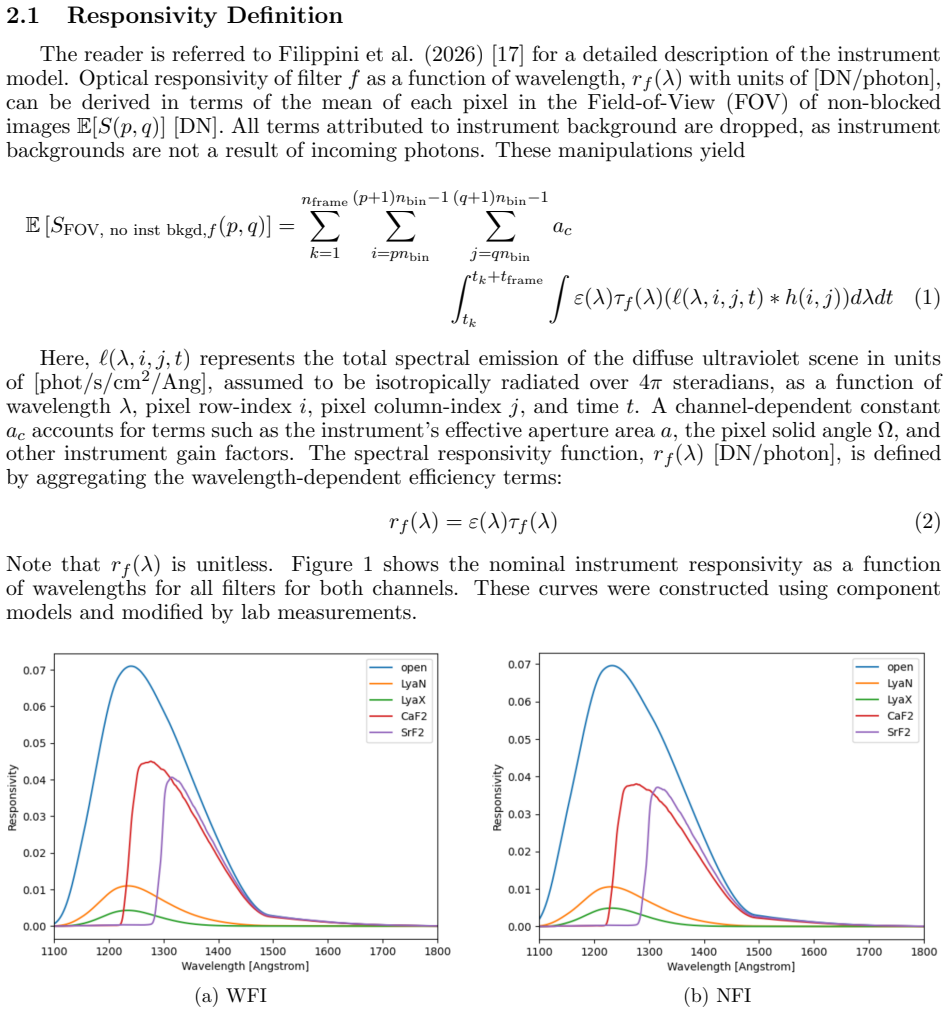
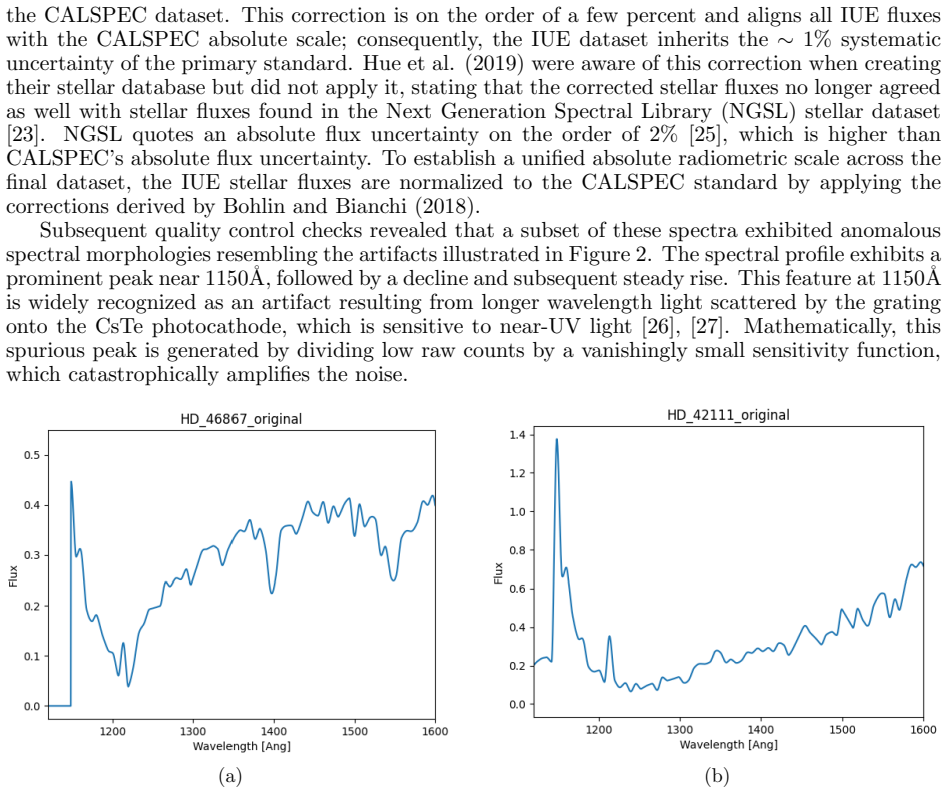
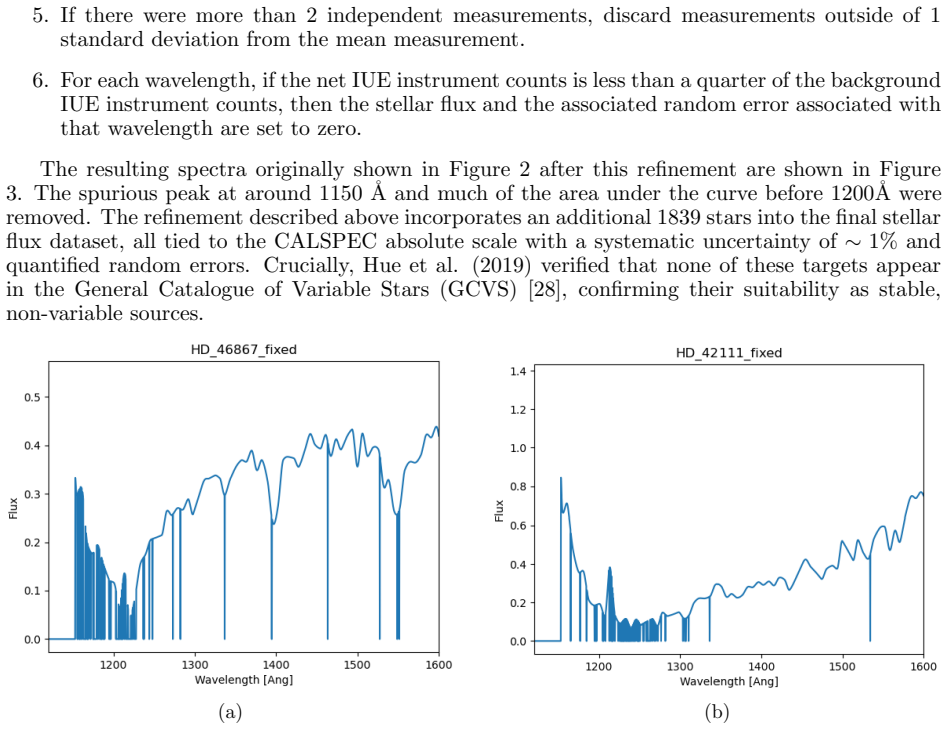
The Carruthers Geocorona Observatory is NASA's first mission dedicated to investigating the fundamental nature of Earth's exosphere. Its primary payload, the GeoCoronal Imager, consists of two co-aligned broadband photometric imagers that support simultaneous, common-volume sensing of ultraviolet emission by exospheric hydrogen atoms. However, accurate parameter retrieval requires precise knowledge of the instrument's wavelength dependent responsivity. To that end, the mission aims to perform photometric measurement of stars and invert the observed fluxes to constrain the final passband. An objective, algorithm-driven ranking criterion identifies the best subset of stars to observe from a refined UV stellar spectral library tied to CALSPEC standards. The entire workflow - including the spectral library, passband inversion, and selection criterion - is validated using synthetically generated stellar measurements, which show that the proposed retrieval algorithm has high recovery fidelity, achieving passband error rates of <7% for both primary Lyman-alpha science channels.
Editorial analysis
A structured set of objections, weighed in public.
Referee Report
Summary. The paper describes an on-orbit radiometric calibration approach for the Carruthers GeoCoronal Imager (GCI) that uses photometric observations of stars drawn from a UV spectral library tied to CALSPEC standards. An objective ranking criterion selects the optimal subset of stars; observed fluxes are then inverted to recover the instrument passband. The full workflow (library, inversion algorithm, and selection) is validated exclusively on synthetically generated stellar measurements, which recover the input passbands to <7% error in the two primary Lyman-alpha science channels.
Significance. If the synthetic validation can be shown to incorporate realistic on-orbit noise, background, and systematics, the method would supply a practical, data-driven route to passband knowledge that is essential for quantitative exospheric hydrogen retrievals. The approach is directly relevant to the mission's core science goals and could be adapted to other UV photometric instruments.
major comments (2)
- [Abstract] Abstract (final sentence): The central claim of <7% passband recovery fidelity rests entirely on synthetically generated stellar measurements, yet the manuscript supplies no quantitative description of the noise model, background levels, pointing jitter, cosmic-ray hits, detector non-uniformity, or time-dependent throughput variations that were (or were not) included. Without this information it is impossible to judge whether the reported error bound applies to actual flight data.
- [Abstract] Abstract: The validation is performed by recovering the same passband that was used to generate the synthetic observations. This constitutes an internal consistency test rather than an independent external validation; the manuscript does not demonstrate that the inversion remains accurate when the true passband differs from the forward model or when unmodeled systematics are present.
Simulated Author's Rebuttal
We thank the referee for the constructive report and the recommendation for major revision. We address each major comment below, indicating planned changes to the manuscript where appropriate.
read point-by-point responses
-
Referee: [Abstract] Abstract (final sentence): The central claim of <7% passband recovery fidelity rests entirely on synthetically generated stellar measurements, yet the manuscript supplies no quantitative description of the noise model, background levels, pointing jitter, cosmic-ray hits, detector non-uniformity, or time-dependent throughput variations that were (or were not) included. Without this information it is impossible to judge whether the reported error bound applies to actual flight data.
Authors: We agree that the manuscript should provide a quantitative description of the synthetic noise model to allow readers to assess applicability to flight data. In the revised version we will add a dedicated subsection in the methods describing the noise sources that were included (Poisson photon noise, background levels, and pointing jitter) together with the specific parameters used. We will also explicitly note which effects (cosmic-ray hits, detector non-uniformity, time-dependent throughput) were not modeled in the current synthetic tests and will be examined once on-orbit data become available. revision: yes
-
Referee: [Abstract] Abstract: The validation is performed by recovering the same passband that was used to generate the synthetic observations. This constitutes an internal consistency test rather than an independent external validation; the manuscript does not demonstrate that the inversion remains accurate when the true passband differs from the forward model or when unmodeled systematics are present.
Authors: This observation is correct. The present validation is an internal consistency test under the assumption that the forward model matches reality. We will revise the abstract and add a short limitations paragraph in the discussion to state this explicitly and to outline planned follow-on tests that inject passband mismatches or additional systematics. These clarifications will prevent over-interpretation of the <7% figure while preserving the value of the controlled synthetic demonstration. revision: yes
Circularity Check
Synthetic validation recovers the exact passband used to generate the test data, reducing the <7% fidelity claim to internal consistency by construction
specific steps
-
fitted input called prediction
[abstract]
"The entire workflow - including the spectral library, passband inversion, and selection criterion - is validated using synthetically generated stellar measurements, which show that the proposed retrieval algorithm has high recovery fidelity, achieving passband error rates of <7% for both primary Lyman-alpha science channels."
The synthetics are generated from the passband model that the inversion is then asked to recover; low reported error therefore demonstrates only that the algorithm can invert its own inputs under the assumed noise model, not that it will achieve <7% error on independent flight data whose background, jitter, and systematics may differ.
full rationale
The paper's central validation claim rests on synthetically generated stellar measurements whose generation necessarily incorporates the target passband as input. Recovering that same passband with low error is then a direct test of invertibility on self-generated data rather than an external check against real on-orbit statistics. This matches the fitted-input-called-prediction pattern exactly, as the reported fidelity is statistically forced once the synthetic noise model and passband are fixed. No other derivation steps in the provided abstract exhibit self-definition or load-bearing self-citation.
Axiom & Free-Parameter Ledger
axioms (1)
- domain assumption The refined UV stellar spectral library tied to CALSPEC standards provides accurate reference spectra for the selected stars.
Reference graph
Works this paper leans on
-
[1]
On-orbit Calibration of the Carruthers GCI: Instrument Effect Correction,
A. M. Zhang, H. Filippini, L. Waldrop, and J. B. McPhate, “On-orbit Calibration of the Carruthers GCI: Instrument Effect Correction,” 2026
2026
-
[2]
On-orbit Calibration of the Carruthers GCI: Radiometric Sensitivity,
A. M. Zhang et al., “On-orbit Calibration of the Carruthers GCI: Radiometric Sensitivity,” 2026
2026
-
[3]
Alignment and calibration of the ICON-FUV instrument: development of a vacuum UV facility,
J. Loicq et al., “Alignment and calibration of the ICON-FUV instrument: development of a vacuum UV facility,” inSpace Telescopes and Instrumentation 2016: Ultraviolet to Gamma Ray, J.-W. A. den Herder, T. Takahashi, and M. Bautz, Eds., ser. Society of Photo-Optical Instrumentation Engineers (SPIE) Conference Series, vol. 9905, Jul. 2016, 99052W, 99052W. d...
-
[4]
Alignment and ground calibration of the Carruthers GeoCoronal Imager
K. Rider et al., “Alignment and ground calibration of the Carruthers GeoCoronal Imager,” in Proceedings Volume 13093, Space Telescopes and Instrumentation 2024: Ultraviolet to Gamma Ray, SPIE; 1309339, 2024.doi:10.1117/12.3018528
-
[5]
Design and performance of the carruthers geocoronal imager,
M. M. Sirk et al., “Design and performance of the carruthers geocoronal imager,” To be submitted to Space Science Reviews, 2026
2026
-
[6]
The international ultraviolet explorer spectral image processing system,
D. A. Klinglesmith III, P. M. Perry, and B. E. Turnrose, “The international ultraviolet explorer spectral image processing system,” inInstrumentation in Astronomy III, SPIE, vol. 172, 1979, pp. 279–291
1979
-
[7]
Hubble space telescope flux calibration. i. stis and calspec,
R. C. Bohlin, S. E. Deustua, and G. de Rosa, “Hubble space telescope flux calibration. i. stis and calspec,”The Astronomical Journal, vol. 158, no. 5, p. 211, 2019
2019
-
[8]
Spicam on mars express: Observing modes and overview of uv spectrom- eter data and scientific results,
J.-L. Bertaux et al., “Spicam on mars express: Observing modes and overview of uv spectrom- eter data and scientific results,”Journal of Geophysical Research: Planets, vol. 111, no. E10, 2006
2006
-
[9]
Solar-stellar irradiance comparison experi- ment ii (solstice ii): Pre-launch and on-orbit calibrations,
W. E. McClintock, M. Snow, and T. N. Woods, “Solar-stellar irradiance comparison experi- ment ii (solstice ii): Pre-launch and on-orbit calibrations,”The Solar Radiation and Climate Experiment (SORCE) Mission Description and Early Results, pp. 259–294, 2005
2005
-
[10]
Uvit imaging of wlm: Demographics of star- forming regions in the nearby dwarf irregular galaxy,
C. Mondal, A. Subramaniam, and K. George, “Uvit imaging of wlm: Demographics of star- forming regions in the nearby dwarf irregular galaxy,”The Astronomical Journal, vol. 156, no. 3, p. 109, 2018
2018
-
[11]
The performance and calibration of wfpc2 on the hubble space tele- scope,
J. A. Holtzman et al., “The performance and calibration of wfpc2 on the hubble space tele- scope,”Publications of the Astronomical Society of the Pacific, vol. 107, no. 708, p. 156, 1995
1995
-
[12]
Bohlin,Photometric Calibration of the International Ultraviolet Explorer (IUE), Low Dis- persion
R. Bohlin,Photometric Calibration of the International Ultraviolet Explorer (IUE), Low Dis- persion. Goddard Space Flight Center, National Aeronautics and Space Administration, 1979
1979
-
[13]
Solar-stellar irradiance compar- ison experiment ii (solstice ii): Examination of the solar-stellar comparison technique,
M. Snow, W. E. Mcclintock, G. Rottman, and T. N. Woods, “Solar-stellar irradiance compar- ison experiment ii (solstice ii): Examination of the solar-stellar comparison technique,”The Solar Radiation and Climate Experiment (SORCE) Mission Description and Early Results, pp. 295–324, 2005
2005
-
[14]
Absolute ultraviolet irradiance of the moon from the lasp lunar albedo measurement and analysis from solstice (llamas) project,
M. Snow, G. M. Holsclaw, W. E. McClintock, and T. Woods, “Absolute ultraviolet irradiance of the moon from the lasp lunar albedo measurement and analysis from solstice (llamas) project,” inCross-Calibration of Far UV Spectra of Solar System Objects and the Heliosphere, Springer, 2013, pp. 227–253
2013
-
[15]
Passband reconstruction from pho- tometry,
M. Weiler, C. Jordi, C. Fabricius, and J. M. Carrasco, “Passband reconstruction from pho- tometry,”Astronomy & Astrophysics, vol. 615, A24, 2018
2018
-
[16]
D. B. Rowe,Multivariate Bayesian statistics: models for source separation and signal unmix- ing. Chapman and Hall/CRC, 2002
2002
-
[17]
Numerical Model Simulation of the Carruthurs Geocoronal Observatory,
H. Filippini et al., “Numerical Model Simulation of the Carruthurs Geocoronal Observatory,” vol. 99999, no. 99999, pp. 0-0, Feb. 2026.doi:0.0
2026
-
[18]
New grids of pure-hydrogen white dwarf nlte model atmospheres and the hst/stis flux calibration,
R. C. Bohlin, I. Hubeny, and T. Rauch, “New grids of pure-hydrogen white dwarf nlte model atmospheres and the hst/stis flux calibration,”The Astronomical Journal, vol. 160, no. 1, p. 21, 2020. 17
2020
-
[19]
A new catalog of ultraviolet stellar spectra for calibration,
M. Snow, A. Reberac, E. Qu´ emerais, J. Clarke, W. McClintock, and T. Woods, “A new catalog of ultraviolet stellar spectra for calibration,” inCross-calibration of far UV spectra of solar system objects and the heliosphere, Springer, 2013, pp. 191–226
2013
-
[20]
In-flight performance of the iue,
A. Boggess et al., “In-flight performance of the iue,”Nature, vol. 275, no. 5679, pp. 377–385, 1978
1978
-
[21]
Techniques and review of absolute flux calibration from the ultraviolet to the mid-infrared,
R. C. Bohlin, K. D. Gordon, and P.-E. Tremblay, “Techniques and review of absolute flux calibration from the ultraviolet to the mid-infrared,”Publications of the Astronomical Society of the Pacific, vol. 126, no. 942, p. 711, 2014
2014
-
[22]
International ultraviolet explorer new spectral image processing system information manual version 2.0,
M. Garhart, M. Smith, B. Turnrose, K. Levay, and R. Thompson, “International ultraviolet explorer new spectral image processing system information manual version 2.0,”IUE NASA Newsletter, vol. 57, pp. 1–267, 1997
1997
-
[23]
In-flight characterization and calibration of the juno-ultraviolet spectrograph (juno-uvs),
V. Hue et al., “In-flight characterization and calibration of the juno-ultraviolet spectrograph (juno-uvs),”The Astronomical Journal, vol. 157, no. 2, p. 90, 2019
2019
-
[24]
A correction for iue uv flux distributions from comparisons with calspec,
R. C. Bohlin and L. Bianchi, “A correction for iue uv flux distributions from comparisons with calspec,”The Astronomical Journal, vol. 155, no. 4, p. 162, 2018
2018
-
[25]
From hubble’s next generation spectral library (ngsl) to absolute fluxes,
S. R. Heap, D. Lindler, S. Heap, and D. Lindler, “From hubble’s next generation spectral library (ngsl) to absolute fluxes,”Calibration and Standardization of Large Surveys and Mis- sions, pp. 1–9, 2012
2012
-
[26]
A recalibration of iue newsips low-dispersion data,
D. Massa and E. L. Fitzpatrick, “A recalibration of iue newsips low-dispersion data,”The Astrophysical Journal Supplement Series, vol. 126, no. 2, p. 517, 2000
2000
-
[27]
An analysis of scattered light in low dispersion iue spectra,
G. Basri, J. Clarke, and B. Haisch, “An analysis of scattered light in low dispersion iue spectra,”Astronomy and Astrophysics (ISSN 0004-6361), vol. 144, no. 1, March 1985, p. 161-170., vol. 144, pp. 161–170, 1985
1985
-
[28]
General catalogue of variable stars: Version gcvs 5.1,
N. Samus’, E. Kazarovets, O. Durlevich, N. Kireeva, and E. Pastukhova, “General catalogue of variable stars: Version gcvs 5.1,”Astronomy Reports, vol. 61, pp. 80–88, 2017
2017
-
[29]
A catalog of stellar lyman-alpha fluxes,
W. Landsman and T. Simon, “A catalog of stellar lyman-alpha fluxes,”Astrophysical Journal, Part 1 (ISSN 0004-637X), vol. 408, no. 1, p. 305-322., vol. 408, pp. 305–322, 1993
1993
-
[30]
The ines system-iv. the iue absolute flux scale,
R. Gonz´ alez-Riestra, A. Cassatella, and W. Wamsteker, “The ines system-iv. the iue absolute flux scale,”Astronomy & Astrophysics, vol. 373, no. 2, pp. 730–745, 2001
2001
-
[31]
A. H. Laufer, J. A. Pirog, and J. R. McNesby, “Effect of Temperature on the Vacuum Ultravi- olet Transmittance of Lithium Fluoride, Calcium Fluoride, Barium Fluoride, and Sapphire,” Optical Society of America, 1965.doi:10.1364/josa.55.000064
-
[32]
L. N. Trefethen and D. Bau,Numerical linear algebra. SIAM, 2022
2022
-
[33]
Information theory and statistical mechanics,
E. T. Jaynes, “Information theory and statistical mechanics,”Physical review, vol. 106, no. 4, p. 620, 1957
1957
-
[34]
Cvxpy: A python-embedded modeling language for convex opti- mization,
S. Diamond and S. Boyd, “Cvxpy: A python-embedded modeling language for convex opti- mization,”Journal of Machine Learning Research, vol. 17, no. 83, pp. 1–5, 2016. 18
2016
discussion (0)
Sign in with ORCID, Apple, or X to comment. Anyone can read and Pith papers without signing in.