Reaction-Network-Level Discovery of Ammonia Synthesis Catalysts via Ten-Million-Scale Generative Exploration
Pith reviewed 2026-06-26 06:37 UTC · model grok-4.3
The pith
Ammonia synthesis catalysts require simultaneous compatibility with four intermediates, which only appears at ten-million-scale generative search.
A machine-rendered reading of the paper's core claim, the machinery that carries it, and where it could break.
Core claim
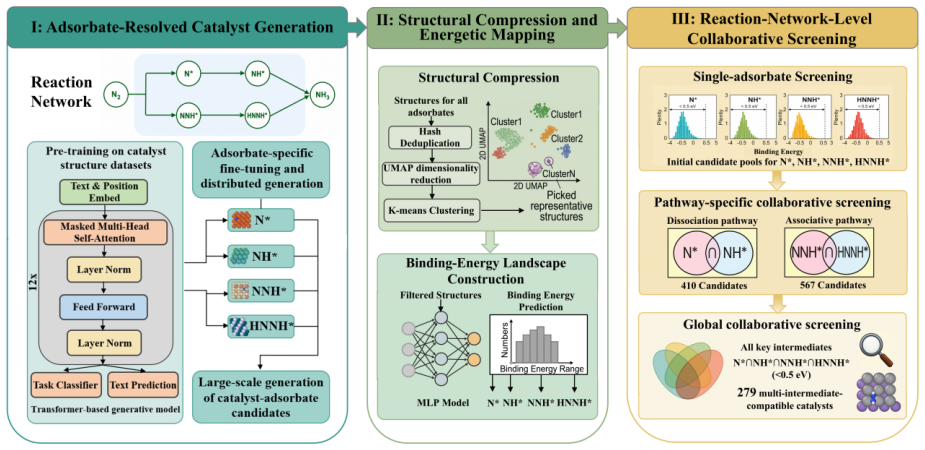
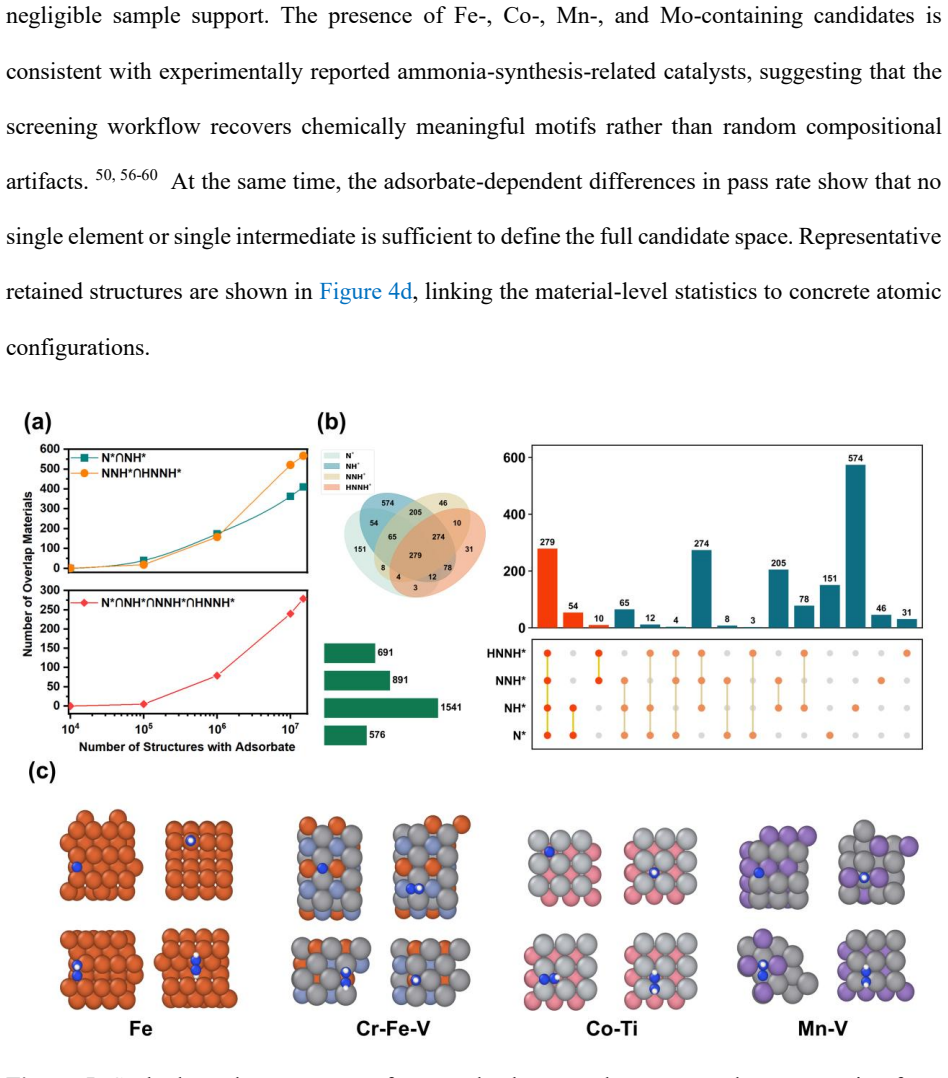
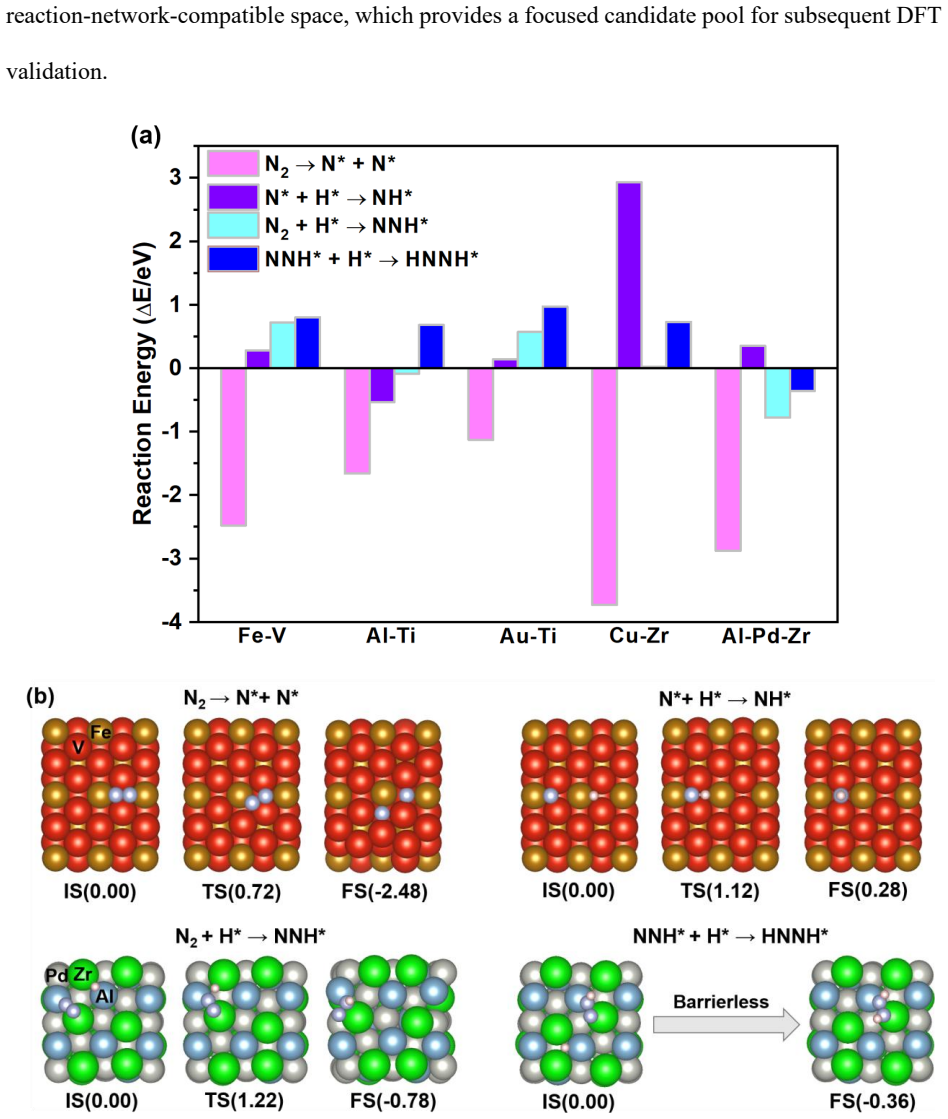
Mapping the adsorption landscapes of N*, NH*, NNH*, and HNNH* with adsorbate-specific generative Transformers and machine-learning potentials at ten-million scale reveals that the four-intermediate compatibility space remains strongly under-sampled at conventional 10^5-10^6 scales and yields exactly 279 target materials; these include traditional Fe- and Ru-based motifs plus previously unexplored families such as Fe-V (dissociative-pathway lead) and Al-Pd-Zr (associative-pathway lead).
What carries the argument
Multi-intermediate reaction-network compatibility, the requirement that a single surface must stabilize all four chosen intermediates (N*, NH*, NNH*, HNNH*) across both dissociative and associative pathways.
If this is right
- The compatibility space stays empty at scales below ten million configurations per adsorbate.
- Fe-V lowers the initial N2 dissociation barrier on the dissociative pathway.
- Al-Pd-Zr stabilizes the associative intermediates efficiently.
- Traditional Fe- and Ru-based motifs are recovered inside the identified set.
Where Pith is reading between the lines
- Adding more intermediates to the compatibility check would further shrink the candidate list.
- The same generative-plus-compatibility workflow could be applied to other multi-pathway catalytic reactions such as CO2 reduction.
- High-throughput synthesis and testing of the new Fe-V and Al-Pd-Zr families would provide the decisive performance data.
Load-bearing premise
The four chosen intermediates and the ten-million generative sampling together are enough to locate materials whose performance will hold under real reaction conditions.
What would settle it
Full microkinetic modeling or experimental turnover measurements on the 279 candidates that show none achieve competitive ammonia rates at industrial conditions would falsify the sufficiency of the four-intermediate criterion.
Figures
read the original abstract
Catalyst discovery for ammonia synthesis is inherently a reaction-network challenge because catalytic performance is governed not by a single adsorbed intermediate, but by a surface's orchestrated compatibility with multiple distinct intermediates across competing dissociative and associative pathways. However, navigating ultra-large chemical spaces under such multi-intermediate constraints remains a formidable bottleneck for conventional screening workflows. Here, we report a reaction-network-level catalyst discovery framework driven by ten-million-scale generative exploration. By coupling adsorbate-specific generative Transformers with high-throughput machine learning potentials, we systematically map the structure-property landscapes of four critical intermediates (N*, NH*, NNH*, and HNNH*). Scale-dependent overlap analysis shows that the full four-intermediate compatibility space remains strongly under-sampled at conventional 105-106 generative scales, emerging exclusively under ten-million-scale exploration. By generating approximately 15 million configurations per adsorbate, followed by structural compression and machine-learning-potential predictions, we identified 279 highly potential target materials. This sparse compatibility space successfully recovers traditional Fe- and Ru-based motifs while uncovering previously unexplored catalyst families. Representative DFT calculations validate pathway-dependent mechanisms: Fe-V emerges as a dissociative-pathway lead by significantly lowering the initial N2 dissociation barrier, whereas Al-Pd-Zr efficiently stabilizes associative intermediates as an associative-pathway lead. These findings establish multi-intermediate reaction-network compatibility as a robust criterion for discovering advanced catalysts from multi-million generative chemical spaces.
Editorial analysis
A structured set of objections, weighed in public.
Referee Report
Summary. The paper claims that a reaction-network-level discovery framework, coupling adsorbate-specific generative Transformers with ML potentials, enables ten-million-scale exploration of compatibility across four intermediates (N*, NH*, NNH*, HNNH*) for ammonia synthesis. At ~15M samples per adsorbate, this identifies a sparse set of 279 candidate materials that recover Fe/Ru motifs and reveal new families (e.g., Fe-V for dissociative, Al-Pd-Zr for associative pathways), with representative DFT calculations validating pathway-dependent mechanisms on two examples. The central result is that full four-intermediate compatibility emerges only at this scale and serves as a robust criterion for advanced catalyst discovery.
Significance. If the multi-intermediate compatibility criterion and the 279-target selection prove predictive, the work would establish a scalable generative route to catalysts optimized for entire reaction networks rather than single intermediates, addressing a key limitation of conventional screening. Strengths include the explicit demonstration that 10^5–10^6 scales undersample the compatibility space and the recovery of known motifs alongside new compositional families. The approach is technically ambitious and could generalize if the reduced network and ML filtering are shown to be reliable.
major comments (3)
- [Abstract and §4] Abstract and §4 (DFT Validation): The statement that 'representative DFT calculations validate pathway-dependent mechanisms' for Fe-V and Al-Pd-Zr provides no quantitative barrier values, error bars, comparison to literature benchmarks, or indication of how many of the 279 candidates were examined. This is load-bearing for the claim that the generative filter yields 'highly potential' targets.
- [§2.2] §2.2 (Intermediate Selection and Scale-Dependent Overlap): The four-intermediate set is used to define the compatibility space without reported sensitivity tests against additional steps (NH2*, NH3*, or competing pathways). No correlation analysis or full-network DFT checks are shown to confirm that compatibility with exactly these four predicts activity under realistic conditions; this directly affects the validity of the 279-target selection and the 'robust criterion' conclusion.
- [§3] §3 (ML Potential Filtering): No training/test set sizes, MAE/RMSE values, or out-of-distribution error statistics are reported for the machine-learning potentials used to filter the 15M configurations per adsorbate. Without these, the reliability of the structural compression and ranking steps that produce the 279 candidates cannot be assessed.
minor comments (2)
- [Figure 2] Figure 2 (overlap analysis): The scale-dependent curves lack reported uncertainties, bootstrap statistics, or details on how the 15M samples were generated and deduplicated.
- [Table 1] Table 1 (candidate list): Composition and structure identifiers for the 279 materials should include a column for the number of intermediates satisfied or the ML-predicted energies to allow reproducibility.
Simulated Author's Rebuttal
We thank the referee for the constructive and detailed report. We address each major comment below and indicate where revisions will be made to strengthen the manuscript.
read point-by-point responses
-
Referee: [Abstract and §4] Abstract and §4 (DFT Validation): The statement that 'representative DFT calculations validate pathway-dependent mechanisms' for Fe-V and Al-Pd-Zr provides no quantitative barrier values, error bars, comparison to literature benchmarks, or indication of how many of the 279 candidates were examined. This is load-bearing for the claim that the generative filter yields 'highly potential' targets.
Authors: We agree that quantitative details are necessary to substantiate the validation. The current manuscript presents the DFT results only qualitatively. In the revised version we will report the specific N2 dissociation barrier on Fe-V, the stabilization energies for associative intermediates on Al-Pd-Zr, associated error estimates, and direct comparisons to literature values for Fe and Ru benchmarks. We will also state explicitly that DFT validation was performed on two representative candidates drawn from the 279. These additions will make the supporting evidence for the 'highly potential' targets fully transparent. revision: yes
-
Referee: [§2.2] §2.2 (Intermediate Selection and Scale-Dependent Overlap): The four-intermediate set is used to define the compatibility space without reported sensitivity tests against additional steps (NH2*, NH3*, or competing pathways). No correlation analysis or full-network DFT checks are shown to confirm that compatibility with exactly these four predicts activity under realistic conditions; this directly affects the validity of the 279-target selection and the 'robust criterion' conclusion.
Authors: The four intermediates were chosen because they capture the essential branching between dissociative and associative pathways, consistent with established mechanisms in the ammonia-synthesis literature. The scale-dependent overlap analysis already demonstrates that four-way compatibility is extremely sparse and appears only at the 10-million scale. We will add an explicit discussion of the rationale for this reduced network and will acknowledge that exhaustive sensitivity tests on NH2*/NH3* or full-network DFT for the entire set of 279 candidates were not performed. We view the current criterion as a practical and predictive filter, but agree that the limitation should be stated clearly. revision: partial
-
Referee: [§3] §3 (ML Potential Filtering): No training/test set sizes, MAE/RMSE values, or out-of-distribution error statistics are reported for the machine-learning potentials used to filter the 15M configurations per adsorbate. Without these, the reliability of the structural compression and ranking steps that produce the 279 candidates cannot be assessed.
Authors: We regret the omission of these performance metrics. The revised §3 will report the exact training and test set sizes, MAE and RMSE values on both in-distribution and out-of-distribution test sets, and any additional error statistics for the ML potentials employed in the filtering and ranking pipeline. This information will allow readers to evaluate the reliability of the 15 M configuration compression step. revision: yes
Circularity Check
No significant circularity; derivation chain is self-contained
full rationale
The paper presents a sequential workflow: adsorbate-specific generative Transformers produce ~15M configurations per intermediate (N*, NH*, NNH*, HNNH*), ML potentials filter them, scale-dependent overlap identifies the sparse four-intermediate compatibility space, and 279 targets are selected for DFT validation on pathway barriers. None of these steps reduce by construction to prior outputs or self-citations; the compatibility criterion is applied externally to the generated ensemble rather than being fitted or redefined from the same data. No equations, parameter fits, or uniqueness theorems are invoked that collapse the discovery back to the inputs. The central claim therefore rests on independent generative sampling and external validation rather than self-referential definition.
Axiom & Free-Parameter Ledger
free parameters (2)
- generative exploration scale
- selection threshold for 279 targets
axioms (2)
- domain assumption The four intermediates N*, NH*, NNH*, HNNH* are sufficient to represent the competing dissociative and associative pathways
- domain assumption ML potentials trained on the generated structures produce reliable enough rankings to select candidates for DFT
Reference graph
Works this paper leans on
-
[1]
R.; Pickard, C
Oganov, A. R.; Pickard, C. J.; Zhu, Q.; Needs, R. J., Structure prediction drives materials discovery. Nature Reviews Materials 2019, 4 (5), 331-348
2019
-
[2]
Liu, X.; Liu, B.; Ding, J.; Deng, Y.; Han, X.; Zhong, C.; Hu, W., Building a Library for Catalysts Research Using High-Throughput Approaches. Adv. Funct. Mater. 2022, 32 (1)
2022
-
[3]
P.; Hou, Y.; Tribukait, H.; Roch, L
Ramirez, A.; Lam, E.; Gutierrez, D. P.; Hou, Y.; Tribukait, H.; Roch, L. M.; Copé ret, C.; Laveille, P., Accelerated exploration of heterogeneous CO2 hydrogenation catalysts by Bayesian-optimized high-throughput and automated experimentation. Chem Catalysis 2024, 4 (2)
2024
-
[4]
Advanced Energy Materials 2026, 16 (6)
Liu, X.; Liang, J.; Wang, Z.; Li, Q.; Deng, Y.; Wang, H., Building Catalyst Exploration Highways by Integrating High -Throughput and Machine Learning Technologies. Advanced Energy Materials 2026, 16 (6)
2026
-
[5]
T.; Davies, D
Butler, K. T.; Davies, D. W.; Cartwright, H.; Isayev, O.; Walsh, A., Machine learning for molecular and materials science. Nature 2018, 559 (7715), 547-555. 24
2018
-
[6]
T., Predicting reaction performance in C -N cross-coupling using machine learning (vol 360, pg eaat7648, 2018)
Ahneman, D. T., Predicting reaction performance in C -N cross-coupling using machine learning (vol 360, pg eaat7648, 2018). Science 2018, 360 (6389), 613-613
2018
-
[7]
P.; Sigman, M
Reid, J. P.; Sigman, M. S., Holistic prediction of enantioselectivity in asymmetric catalysis. Nature 2019, 571 (7765), 343-+
2019
-
[8]
A., III, Identifying Active Sites for CO2 Reduction on Dealloyed Gold Surfaces by Combining Machine Learning with Multiscale Simulations
Chen, Y.; Huang, Y.; Cheng, T.; Goddard, W. A., III, Identifying Active Sites for CO2 Reduction on Dealloyed Gold Surfaces by Combining Machine Learning with Multiscale Simulations. J. Am. Chem. Soc. 2019, 141 (29), 11651-11657
2019
-
[9]
T.; Chmiela, S.; Sauceda, H
Unke, O. T.; Chmiela, S.; Sauceda, H. E.; Gastegger, M.; Poltaysky, I.; Schuett, K. T.; Tkatchenko, A.; Mueller, K. -R., Machine Learning Force Fields. Chem. Rev. 2021, 121 (16), 10142-10186
2021
-
[10]
S., Machine learning assisted high -throughput screening of transition metal single atom based superb hydrogen evolution electrocatalysts
Umer, M.; Umer, S.; Zafari, M.; Ha, M.; Anand, R.; Hajibabaei, A.; Abbas, A.; Lee, G.; Kim, K. S., Machine learning assisted high -throughput screening of transition metal single atom based superb hydrogen evolution electrocatalysts. Journal of Materials Chemistry A 2022, 10 (12), 6679-6689
2022
-
[11]
A.; Goldsmith, B
Esterhuizen, J. A.; Goldsmith, B. R.; Linic, S., Interpretable machine learning for knowledge generation in heterogeneous catalysis. Nat. Catal. 2022, 5 (3), 175-184
2022
-
[12]
Nature Reviews Chemistry 2025, 9 (9), 601-616
Bozal-Ginesta, C.; Pablo -Garcia, S.; Choi, C.; Tarancon, A.; Aspuru -Guzik, A., Developing machine learning for heterogeneous catalysis with experimental and computational data. Nature Reviews Chemistry 2025, 9 (9), 601-616
2025
-
[13]
-K.; Gao, Y
Qi, R.; Zhu, B.; Han, Z. -K.; Gao, Y. High -Throughput Screening of Stable Single -Atom Catalysts in CO2 Reduction Reactions. ACS Catal. 2022, 12, 8269-8278. 25
2022
-
[14]
Han, Z.-K.; Sarker, D.; Ouyang, R.; Mazheika, A.; Gao, Y.; Levchenko, S. V. Single-Atom Alloy Catalysts Designed by First -Principles Calculations and Artificial Intelligence. Nat. Commun. 2021, 12, 1833
2021
-
[15]
Energy and Environmental Material 2023, 6 (1)
Zhang, S.; Lu, S.; Zhang, P.; Tian, J.; Shi, L.; Ling, C.; Zhou, Q.; Wang, J., Accelerated Discovery of Single -Atom Catalysts for Nitrogen Fixation via Machine Learning. Energy and Environmental Material 2023, 6 (1)
2023
-
[16]
-P.; Wang, H
De Breuck, P. -P.; Wang, H. -C.; Rignanese, G. -M.; Botti, S.; Marques, M. A. L., Generative AI for crystal structures: a review. Npj Computational Materials 2025, 11 (1)
2025
-
[17]
Kingma, D. P.; Welling, M. Auto-Encoding Variational Bayes 2013, p. arXiv:1312.6114
Pith/arXiv arXiv 2013
-
[18]
J.; Mohamed, S
Rezende, D. J.; Mohamed, S. In Variational Inference with Normalizing Flows , 32nd International Conference on Machine Learning, Lille, FRANCE, 2015 Jul 07-09; Lille, FRANCE, 2015; pp 1530-1538
2015
-
[19]
Zhao, L.; Zong, H., AI-Driven Decoding of Material Dynamics: From Machine Learning Potentials and Interpretability to Generative Prediction. Adv. Mater. 2025
2025
-
[20]
T.; Shah, M., Diffusion Models in Vision: A Survey
Croitoru, F.-A.; Hondru, V.; Ionescu, R. T.; Shah, M., Diffusion Models in Vision: A Survey. Ieee Transactions on Pattern Analysis and Machine Intelligence 2023, 45 (9), 10850- 10869
2023
-
[21]
D.; Chen, C
Yan, D.; Smith, A. D.; Chen, C. -C., Structure prediction and materials design with generative neural networks. Nature Computational Science 2023, 3 (7), 572-574
2023
-
[22]
Nature 2025, 639 (8055)
Zeni, C.; Pinsler, R.; Zuegner, D.; Fowler, A.; Horton, M.; Fu, X.; Wang, Z.; Shysheya, A.; Crabbe, J.; Ueda, S.; Sordillo, R.; Sun, L.; Smith, J.; Nguyen, B.; Schulz, H.; Lewis, S.; Huang, C.-W.; Lu, Z.; Zhou, Y.; Yang, H.; Hao, H.; Li, J.; Yang, C.; Li, W.; Tomioka, R.; Xie, T., A generative model for inorganic materials design. Nature 2025, 639 (8055). 26
2025
-
[23]
A.; Macknight, R.; Kline, B.; Gomes, G., Autonomous chemical research with large language models
Boiko, D. A.; Macknight, R.; Kline, B.; Gomes, G., Autonomous chemical research with large language models. Nature 2023, 624 (7992), 570-+
2023
-
[24]
M.; Cox, S.; Schilter, O.; Baldassari, C.; White, A
Bran, A. M.; Cox, S.; Schilter, O.; Baldassari, C.; White, A. D.; Schwaller, P., Augmenting large language models with chemistry tools. Nature Machine Intelligence 2024, 6 (5)
2024
-
[25]
S.; Ceder, G.; Persson, K
Dagdelen, J.; Dunn, A.; Lee, S.; Walker, N.; Rosen, A. S.; Ceder, G.; Persson, K. A.; Jain, A., Structured information extraction from scientific text with large language models. Nat. Commun. 2024, 15 (1)
2024
-
[26]
Improving Chemical Understanding of LLMs via SMILES Parsing 2025, p
Jang, Y.; Kim, J.; Ahn, S. Improving Chemical Understanding of LLMs via SMILES Parsing 2025, p. arXiv:2505.16340
arXiv 2025
-
[27]
Large Language Models as Master Key: Unlocking the Secrets of Materials Science with GPT 2023, p
Xie, T.; Wan, Y.; Huang, W.; Zhou, Y.; Liu, Y.; Linghu, Q.; Wang, S.; Kit, C.; Grazian, C.; Zhang, W.; Hoex, B. Large Language Models as Master Key: Unlocking the Secrets of Materials Science with GPT 2023, p. arXiv:2304.02213
arXiv 2023
-
[28]
Flam-Shepherd, D.; Aspuru -Guzik, A. Language models can generate molecules, materials, and protein binding sites directly in three dimensions as XYZ, CIF, and PDB files 2023, p. arXiv:2305.05708
arXiv 2023
-
[29]
M.; Schwaller, P.; Ortega-Guerrero, A.; Smit, B., Leveraging large language models for predictive chemistry
Jablonka, K. M.; Schwaller, P.; Ortega-Guerrero, A.; Smit, B., Leveraging large language models for predictive chemistry. Nature Machine Intelligence 2024, 6 (2), 161-169
2024
-
[30]
S.; Dong, R.; Siriwardane, E
Fu, N.; Wei, L.; Song, Y.; Li, Q.; Xin, R.; Omee, S. S.; Dong, R.; Siriwardane, E. M. D.; Hu, J., Material transformers: deep learning language models for generative materials design. Machine Learning: Science and Technology 2023, 4 (1)
2023
-
[31]
Song, Z.; Fan, L.; Lu, S.; Ling, C.; Zhou, Q.; Wang, J., Inverse design of promising electrocatalysts for CO<sub>2</sub> reduction via generative models and bird swarm algorithm. Nat. Commun. 2025, 16 (1). 27
2025
-
[32]
H.; Back, S., Generative pretrained transformer for heterogeneous catalysts
Mok, D. H.; Back, S., Generative pretrained transformer for heterogeneous catalysts. J. Am. Chem. Soc. 2024, 146 (49), 33712-33722
2024
-
[33]
Generative intelligence explores the chemical space of ten million catalysts
Li, R.; Zhang, S.; Tang, Q.; Mao, Q.; Das, R.; Qi, R.; Zhu, B.; Gao, Y. Generative intelligence explores the chemical space of ten million catalysts. Chem. Sci. 2026, Advance Article
2026
-
[34]
Suryanto, B. H. R.; Matuszek, K.; Choi, J.; Hodgetts, R. Y.; Du, H. -L.; Bakker, J. M.; Kang, C. S. M.; Cherepanov, P. V.; Simonov, A. N.; MacFarlane, D. R., Nitrogen reduction to ammonia at high efficiency and rates based on a phosphonium proton sh uttle. Science 2021, 372 (6547), 1187-+
2021
-
[35]
Z.; Zhang, X.; Comer, B
Iriawan, H.; Andersen, S. Z.; Zhang, X.; Comer, B. M.; Barrio, J.; Chen, P.; Medford, A. J.; Stephens, I. E. L.; Chorkendorff, I.; Shao -Horn, Y., Methods for nitrogen activation by reduction and oxidation. Nature Reviews Methods Primers 2021, 1 (1)
2021
-
[36]
G.; Crooks, R
Chen, J. G.; Crooks, R. M.; Seefeldt, L. C.; Bren, K. L.; Bullock, R. M.; Darensbourg, M. Y.; Holland, P. L.; Hoffman, B.; Janik, M. J.; Jones, A. K.; Kanatzidis, M. G.; King, P.; Lancaster, K. M.; Lymar, S. V.; Pfromm, P.; Schneider, W. F. ; Schrock, R. R., Beyond fossil fuel-driven nitrogen transformations. Science 2018, 360 (6391)
2018
-
[37]
Chem Catalysis 2022, 2 (10), 2590-2613
Fu, X.; Zhang, J.; Kang, Y., Recent advances and challenges of electrochemical ammonia synthesis. Chem Catalysis 2022, 2 (10), 2590-2613
2022
-
[38]
B.; Zhou, Y.; Saccoccio, M.; Li, S.; Salinas, R.; Li, K.; Andersen, S
Fu, X.; Pedersen, J. B.; Zhou, Y.; Saccoccio, M.; Li, S.; Salinas, R.; Li, K.; Andersen, S. Z.; Xu, A.; Deissler, N. H.; Mygind, J. B. V.; Wei, C.; Kibsgaard, J.; Vesborg, P. C. K.; Norskov, J. K.; Chorkendorff, I., Continuous -flow electrosy nthesis of ammonia by nitrogen reduction and hydrogen oxidation. Science 2023, 379 (6633), 707-712. 28
2023
-
[39]
T.; Habibzadeh, F.; Ashtiani, M
Qing, G.; Ghazfar, R.; Jackowski, S. T.; Habibzadeh, F.; Ashtiani, M. M.; Chen, C.-P.; Smith, M. R., III; Hamann, T. W., Recent Advances and Challenges of Electrocatalytic N<sub>2</sub> Reduction to Ammonia. Chem. Rev. 2020, 120 (12), 5437-5516
2020
-
[40]
B.; Li, S.; Sazinas, R.; Zhou, Y.; Andersen, S
Fu, X.; Xu, A.; Pedersen, J. B.; Li, S.; Sazinas, R.; Zhou, Y.; Andersen, S. Z.; Saccoccio, M.; Deissler, N. H.; Mygind, J. B. V.; Kibsgaard, J.; Vesborg, P. C. K.; Norskov, J. K.; Chorkendorff, I., Phenol as proton shuttle and buffer for lith ium-mediated ammonia electrosynthesis. Nat. Commun. 2024, 15 (1)
2024
-
[41]
A.; Shilov, A
Bazhenova, T. A.; Shilov, A. E., NITROGEN-FIXATION IN SOLUTION. Coord. Chem. Rev. 1995, 144, 69-145
1995
-
[42]
Angewandte Chemie-International Edition 2008, 47 (19), 3524-3535
Ertl, G., Reactions at surfaces: From atoms to complexity (Nobel lecture). Angewandte Chemie-International Edition 2008, 47 (19), 3524-3535
2008
-
[43]
M.; Singh, A
McEnaney, J. M.; Singh, A. R.; Schwalbe, J. A.; Kibsgaard, J.; Lin, J. C.; Cargnello, M.; Jaramillo, T. F.; Norskov, J. K., Ammonia synthesis from N2 and H2O using a lithium cycling electrification strategy at atmospheric pressure. Energy Environ. Sci. 2017, 10 (7), 1621-1630
2017
-
[44]
Wang, Q.; Pan, J.; Guo, J.; Hansen, H. A.; Xie, H.; Jiang, L.; Hua, L.; Li, H.; Guan, Y.; Wang, P.; Gao, W.; Liu, L.; Cao, H.; Xiong, Z.; Vegge, T.; Chen, P., Ternary ruthenium complex hydrides for ammonia synthesis via the associative mechanism. Nat. Catal. 2021, 4 (11), 959-+
2021
-
[45]
T.; Lyu, L.-M.; Lin, H.-M.; Chuang, Y.-C.; Cheng, M.-J.; Kuo, C
Talukdar, B.; Kuo, T.-C.; Sneed, B. T.; Lyu, L.-M.; Lin, H.-M.; Chuang, Y.-C.; Cheng, M.-J.; Kuo, C. -H., Enhancement of NH3 Production in Electrochemical N<sub>2</sub> Reduction by the Cu-Rich Inner Surfaces of Beveled CuAu Nanoboxes. Acs Applied Materials & Interfaces 2021, 13 (44), 51839-51848. 29
2021
-
[46]
R.; Cherepanov, P
MacFarlane, D. R.; Cherepanov, P. V.; Choi, J.; Suryanto, B. H. R.; Hodgetts, R. Y.; Bakker, J. M.; Vallana, F. M. F.; Simonov, A. N., A Roadmap to the Ammonia Economy. Joule 2020, 4 (6), 1186-1205
2020
-
[47]
W.; Sun, Z., Emerging two-dimensional materials for the electrocatalytic nitrogen reduction reaction to yield ammonia
Ruan, Y.; He, Z.-H.; Liu, Z.-T.; Wang, W.; Hao, L.; Xu, L.; Robertson, A. W.; Sun, Z., Emerging two-dimensional materials for the electrocatalytic nitrogen reduction reaction to yield ammonia. Journal of Materials Chemistry A 2023, 11 (42), 22590-22607
2023
-
[48]
Acs Catalysis 2021, 11 (10), 6059-6072
Chanussot, L.; Das, A.; Goyal, S.; Lavril, T.; Shuaibi, M.; Riviere, M.; Tran, K.; Heras- Domingo, J.; Ho, C.; Hu, W., Open catalyst 2020 (OC20) dataset and community challenges. Acs Catalysis 2021, 11 (10), 6059-6072
2020
-
[49]
C.; Riehle, K.; Lancia, D
Faver, J. C.; Riehle, K.; Lancia, D. R., Jr.; Milbank, J. B. J.; Kollmann, C. S.; Simmons, N.; Yu, Z.; Matzuk, M. M., Quantitative Comparison of Enrichment from DNA -Encoded Chemical Library Selections. ACS Comb Sci 2019, 21 (2), 75-82
2019
-
[50]
Hattori, M.; Okuyama, N.; Kurosawa, H.; Hara, M., Low -Temperature Ammonia Synthesis on Iron Catalyst with an Electron Donor. J. Am. Chem. Soc. 2023, 145 (14), 7888-7897
2023
-
[51]
Nielsen, A.; Kjaer, J.; Hansen, B., RATE EQUATION AND MECHANISM OF AMMONIA SYNTHESIS AT INDUSTRIAL CONDITIONS. J. Catal. 1964, 3 (1), 68-79
1964
-
[52]
A.; Akhter, P.; Jamil, F.; Cho, K.; Park, Y
Ahsan, A.; Hussain, M.; Rashad, M. A.; Akhter, P.; Jamil, F.; Cho, K.; Park, Y. -K., Critical review on electrocatalytic reduction of nitrogen and nitrate to ammonia. Journal of Industrial and Engineering Chemistry 2025, 149, 313-336
2025
-
[53]
Chem 2019, 5 (10), 2702-2717
Mao, C.; Li, H.; Gu, H.; Wang, J.; Zou, Y.; Qi, G.; Xu, J.; Deng, F.; Shen, W.; Li, J.; Liu, S.; Zhao, J.; Zhang, L., Beyond the Thermal Equilibrium Limit of Ammonia Synthesis with Dual Temperature Zone Catalyst Powered by Solar Light. Chem 2019, 5 (10), 2702-2717. 30
2019
-
[54]
Neurock, M., The microkinetics of heterogeneous catalysis. By J. A. Dumesic, D. F. Rudd, L. M. Aparicio, J. E. Rekoske, and A. A. Treviñ o, ACS Professional Reference Book, American Chemical Society, Washington, DC, 1993, 315 pp. AIChE Journal 1994, 40 (6), 1085-7
1993
-
[55]
-M.; Lee, J
Kim, J.-H.; Dai, T.-Y.; Yang, M.; Seo, J. -M.; Lee, J. S.; Kweon, D. H.; Lang, X. -Y.; Ihm, K.; Shin, T. J.; Han, G. -F.; Jiang, Q.; Baek, J.-B., Achieving volatile potassium promoted ammonia synthesis via mechanochemistry. Nat. Commun. 2023, 14 (1)
2023
-
[56]
Acs Catalysis 2017, 7 (5), 3654-3661
Gao, W.; Wang, P.; Guo, J.; Chang, F.; He, T.; Wang, Q.; Wu, G.; Chen, P., Barium Hydride-Mediated Nitrogen Transfer and Hydrogenation for Ammonia Synthesis: A Case Study of Cobalt. Acs Catalysis 2017, 7 (5), 3654-3661
2017
-
[57]
Kinetic study
Kojima, R.; Aika, K., Cobalt molybdenum bimetallic nitride catalysts for ammonia synthesis Part 2. Kinetic study. Applied Catalysis a-General 2001, 218 (1-2), 121-128
2001
-
[58]
C.; Wang, C., Earth -Abundant Manganese Nitride Catalysts for Mild -Condition Ammonia Synthesis
Qu, W.; Roy, P.; Wang, C.; Ma, L.; Bu, F.; Zhang, X.; He, Z.; Tsapatsis, M.; Bukowski, B. C.; Wang, C., Earth -Abundant Manganese Nitride Catalysts for Mild -Condition Ammonia Synthesis. Acs Catalysis 2025, 15 (6), 4817-4823
2025
-
[59]
Iscience 2024, 27 (9)
Wang, J.; Liu, L.; Li, R.; Wang, S.; Ju, X.; He, T.; Guo, J.; Chen, P., Highly active manganese nitride-europium nitride catalyst for ammonia synthesis. Iscience 2024, 27 (9)
2024
-
[60]
Volpe, L.; Boudart, M., AMMONIA -SYNTHESIS ON MOLYBDENUM NITRIDE. J. Phys. Chem. 1986, 90 (20), 4874-4877
1986
-
[61]
-W.; Hara, M.; Hosono, H., Ammonia synthesis using a stable electride as an electron donor and reversible hydrogen store
Kitano, M.; Inoue, Y.; Yamazaki, Y.; Hayashi, F.; Kanbara, S.; Matsuishi, S.; Yokoyama, T.; Kim, S. -W.; Hara, M.; Hosono, H., Ammonia synthesis using a stable electride as an electron donor and reversible hydrogen store. Nat. Chem. 2012, 4 (11), 934-940
2012
-
[62]
Ammonia synthesis over ruthenium promoted by alkali metal
Aika, K., Activation of nitrogen by alkali metal promoted transition metal I. Ammonia synthesis over ruthenium promoted by alkali metal. J. Catal. 1972, 27 (3), 424-431. 31
1972
-
[63]
Hattori, M.; Iijima, S.; Nakao, T.; Hosono, H.; Hara, M., Solid solution for catalytic ammonia synthesis from nitrogen and hydrogen gases at 50° C. Nat. Commun. 2020, 11 (1)
2020
-
[64]
Chem Catalysis 2021, 1 (5), 1042-1054
Guan, Y.; Zhang, W.; Wang, Q.; Weidenthaler, C.; Wu, A.; Gao, W.; Pei, Q.; Yan, H.; Cui, J.; Wu, H.; Feng, S.; Wang, R.; Cao, H.; Ju, X.; Liu, L.; He, T.; Guo, J.; Chen, P., Barium chromium nitride-hydride for ammonia synthesis. Chem Catalysis 2021, 1 (5), 1042-1054
2021
-
[65]
W.; Hebisch, K
Tricker, A. W.; Hebisch, K. L.; Buchmann, M.; Liu, Y. -H.; Rose, M.; Stavitski, E.; Medford, A. J.; Hatzell, M. C.; Sievers, C., Mechanocatalytic Ammonia Synthesis over TiN in Transient Microenvironments. ACS Energy Lett. 2020, 5 (11), 3362-3367
2020
-
[66]
Chemcatchem 2021, 13 (1), 191-195
Cao, Y.; Saito, A.; Kobayashi, Y.; Ubukata, H.; Tang, Y.; Kageyama, H., Vanadium Hydride as an Ammonia Synthesis Catalyst. Chemcatchem 2021, 13 (1), 191-195
2021
-
[67]
Li, C.; Zhang, Z.; Zheng, Y.; Fang, B.; Ni, J.; Lin, J.; Lin, B.; Wang, X.; Jiang, L., Titanium modified Ru/CeO2 catalysts for ammonia synthesis. Chem. Eng. Sci. 2022, 251. 32 Table of the content Reaction-Network-Guided Exploration of Ultra-large Chemical Spaces for Ammonia Synthesis
2022
discussion (0)
Sign in with ORCID, Apple, or X to comment. Anyone can read and Pith papers without signing in.