Spectral Gating via Damped Oscillations for Adaptive Implicit Neural Representations
Reviewed by Pith2026-06-30 10:30 UTCgrok-4.3pith:FUCXZ4JVopen to challenge →
The pith
Modeling neuron activations as steady-state responses of damped harmonic oscillators allows implicit neural representations to adapt spectral selectivity during training.
A machine-rendered reading of the paper's core claim, the machinery that carries it, and where it could break.
Core claim
The paper claims that by representing neuron activations through the steady-state response of a sinusoidally-forced damped harmonic oscillator and jointly optimizing its parameters with the network weights, the INR adapts its spectral gate to the target signal. Initialized in the stopband, this produces a stable coarse-to-fine learning process that improves reconstruction quality.
What carries the argument
The steady-state response of a sinusoidally-forced damped harmonic oscillator as the neuron activation, with amplitude governing spectral selectivity.
If this is right
- The network learns low-frequency structures before high-frequency details.
- It requires no task-specific hyperparameter tuning.
- It achieves state-of-the-art or competitive results on INR benchmarks.
- The spectral gate expands progressively only when supported by the reconstruction objective.
Where Pith is reading between the lines
- This method could be tested on signals with varying frequency distributions to see if learned parameters reflect the signal spectrum.
- Similar oscillator-based activations might address spectral bias in other neural architectures like transformers or CNNs.
- The approach may simplify deployment of INRs in applications where manual tuning is impractical.
Load-bearing premise
That jointly optimizing the damped oscillator parameters will reliably generate a stable coarse-to-fine spectral curriculum without introducing instabilities or poor convergence.
What would settle it
Running the method on a high-frequency test signal and checking if it either underfits details or overfits noise, contrary to the claimed curriculum.
Figures


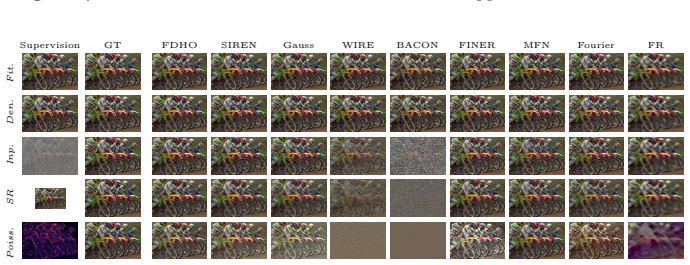


read the original abstract
Implicit Neural Representations (INRs) have been proven successful in encoding continuous signals through coordinate-based networks, yet facing a spectral dilemma: periodic activations capture fine details but act as all-pass filters that memorise noise, while spatially compact activations regularise effectively but suffer from low-frequency bias. Existing attempts to resolve this trade-off introduce computational overhead or tuning frailty. We propose to model each neuron's activation as the steady-state response of a sinusoidally-forced damped harmonic oscillator, whose amplitude naturally governs the network's spectral selectivity during training. By jointly optimising the oscillator parameters alongside the network weights, our method adapts to the target signal's spectral content without explicit regularisation. Initialised in the stopband, the network exhibits a coarse-to-fine learning curriculum that progressively expands its spectral gate, capturing low-frequency structures first and high-frequency details only when justified by the reconstruction objective. Comprehensive experiments show that our approach consistently achieves state-of-the-art or competitive results against established INRs, while requiring no task-specific tuning of any hyperparameters.
Editorial analysis
A structured set of objections, weighed in public.
Referee Report
Summary. The paper proposes Spectral Gating via Damped Oscillations (SGDO) for implicit neural representations (INRs). Each neuron activation is modeled as the steady-state response of a sinusoidally-forced damped harmonic oscillator, with amplitude depending on detuning between forcing frequency and natural frequency plus damping. Oscillator parameters (damping, natural frequency, forcing amplitude) are jointly optimized with network weights; initialization in the stopband is claimed to induce a coarse-to-fine spectral curriculum. The method is asserted to adapt to the target signal's spectral content without explicit regularization or task-specific hyperparameter tuning and to achieve state-of-the-art or competitive reconstruction results.
Significance. If the oscillator-based activation produces stable, data-driven spectral selectivity for the multi-frequency pre-activations typical of coordinate-based INRs, the approach would offer a parameter-efficient alternative to existing spectral-bias mitigations (e.g., positional encodings or explicit Fourier features) while providing an interpretable curriculum effect. The absence of task-specific tuning and the joint-optimization framing are potentially attractive if the underlying frequency-selective mechanism is rigorously justified.
major comments (3)
- [Abstract / method section] Abstract and method description: the steady-state amplitude formula is derived under monochromatic sinusoidal forcing, yet the pre-activation in a coordinate-based INR is a learned linear projection of spatial coordinates and therefore encodes a superposition of frequencies present in the target signal. No additional mechanism (e.g., explicit Fourier decomposition of the input or per-frequency forcing) is described that would extend the monochromatic gain formula to this superposition case; without it the claimed per-neuron spectral gate does not follow directly from the oscillator model.
- [Abstract / §4 (experiments)] Abstract claim of 'coarse-to-fine learning curriculum': the initialization in the stopband and joint optimization are asserted to expand the spectral gate progressively, but the manuscript provides no derivation or stability analysis showing that the joint optimization dynamics avoid suboptimal fixed points or introduce new instabilities when the forcing is broadband rather than monochromatic.
- [§4] Experimental validation: the abstract states 'comprehensive experiments show ... state-of-the-art or competitive results,' yet no ablation isolating the contribution of the oscillator parameters versus standard INR baselines, no error analysis of the monochromatic-to-superposition mapping, and no quantitative measure of the claimed spectral curriculum (e.g., frequency content of learned representations over training) are referenced.
minor comments (2)
- [Method] Notation for the oscillator parameters (damping ratio, natural frequency, forcing amplitude) should be introduced with explicit symbols and ranges in the first method subsection to avoid ambiguity when they are jointly optimized.
- [Abstract] The abstract refers to 'no task-specific tuning of any hyperparameters,' but the oscillator parameters themselves are optimized; clarify whether any initialization or regularization hyperparameters for the oscillator remain fixed across tasks.
Simulated Author's Rebuttal
We thank the referee for their constructive comments, which help improve the clarity and rigor of our work. We address each major comment in detail below.
read point-by-point responses
-
Referee: [Abstract / method section] Abstract and method description: the steady-state amplitude formula is derived under monochromatic sinusoidal forcing, yet the pre-activation in a coordinate-based INR is a learned linear projection of spatial coordinates and therefore encodes a superposition of frequencies present in the target signal. No additional mechanism (e.g., explicit Fourier decomposition of the input or per-frequency forcing) is described that would extend the monochromatic gain formula to this superposition case; without it the claimed per-neuron spectral gate does not follow directly from the oscillator model.
Authors: The oscillator model is linear in the forcing, so the steady-state response to a superposition is the linear combination of monochromatic responses. Thus, the amplitude formula applies component-wise to the frequency content of the pre-activation. The per-neuron natural frequency and damping then provide a frequency-dependent gain that gates the contribution of different spectral components present in the learned projection. We will revise the method section to explicitly state this extension and include a brief derivation. revision: partial
-
Referee: [Abstract / §4 (experiments)] Abstract claim of 'coarse-to-fine learning curriculum': the initialization in the stopband and joint optimization are asserted to expand the spectral gate progressively, but the manuscript provides no derivation or stability analysis showing that the joint optimization dynamics avoid suboptimal fixed points or introduce new instabilities when the forcing is broadband rather than monochromatic.
Authors: We agree that a formal stability analysis would strengthen the theoretical foundation. The curriculum effect arises from initializing natural frequencies in the stopband (high damping or detuned), causing initial suppression of high frequencies, with optimization gradually reducing damping or adjusting frequencies as the loss decreases. While we observe this empirically, we will add a discussion of the optimization dynamics and potential instabilities in the revised manuscript, supported by additional plots of parameter evolution. revision: yes
-
Referee: [§4] Experimental validation: the abstract states 'comprehensive experiments show ... state-of-the-art or competitive results,' yet no ablation isolating the contribution of the oscillator parameters versus standard INR baselines, no error analysis of the monochromatic-to-superposition mapping, and no quantitative measure of the claimed spectral curriculum (e.g., frequency content of learned representations over training) are referenced.
Authors: The current experiments compare against baselines and show competitive results, but we acknowledge the value of targeted ablations. In the revision, we will add: (1) ablations varying oscillator parameters while fixing network architecture, (2) quantitative tracking of spectral content (e.g., via Fourier analysis of activations at different training stages), and (3) discussion of the approximation error in the superposition case. These will be included in an expanded experimental section. revision: yes
Circularity Check
No circularity detected from available text
full rationale
The abstract and skeptic summary describe modeling activations via damped oscillator steady-state response and joint optimization of parameters, but provide no equations, derivations, or self-citations that reduce any claimed prediction or result to its inputs by construction. No load-bearing steps matching the enumerated circularity patterns can be exhibited because the full manuscript equations are not quoted or shown. The central claim of adaptive spectral gating via optimization remains independent of the provided material and does not reduce to a fit or self-referential definition.
Axiom & Free-Parameter Ledger
free parameters (1)
- oscillator parameters (damping, natural frequency, forcing amplitude)
axioms (1)
- domain assumption The steady-state response of a sinusoidally-forced damped harmonic oscillator provides a controllable spectral filter suitable as a neuron activation.
Reference graph
Works this paper leans on
-
[1]
Dover Publications (1964)
Abramowitz, M., Stegun, I.A.: Handbook of Mathematical Functions with Formu- las, Graphs, and Mathematical Tables. Dover Publications (1964)
1964
-
[2]
Academic Press, 7th edn
Arfken, G.B., Weber, H.J., Harris, F.E.: Mathematical Methods for Physicists. Academic Press, 7th edn. (2012)
2012
-
[3]
In: Advances in Neural Information Processing Systems (NeurIPS)
Arora, S., Cohen, N., Hu, W., Luo, Y.: Implicit regularization in deep matrix factorization. In: Advances in Neural Information Processing Systems (NeurIPS). vol. 32 (2019)
2019
-
[4]
In: ICML (2019)
Arora, S., Du, S.S., Hu, W., Li, Z., Wang, R.: Fine-grained analysis of optimiza- tion and generalization for overparameterized two-layer neural networks. In: ICML (2019)
2019
-
[5]
In: ICCV (2021)
Barron, J.T., Mildenhall, B., Tancik, M., Hedman, P., Martin-Brualla, R., Srini- vasan, P.P.: Mip-nerf: A multiscale representation for anti-aliasing neural radiance fields. In: ICCV (2021)
2021
-
[6]
Wireless Engineer7(6), 536–541 (1930)
Butterworth, S.: On the theory of filter amplifiers. Wireless Engineer7(6), 536–541 (1930)
1930
-
[7]
Proceedings of the Institute of Radio Engineers10(1), 57–64 (1922)
Carson, J.R.: Notes on the theory of modulation. Proceedings of the Institute of Radio Engineers10(1), 57–64 (1922)
1922
-
[8]
In: ICLR (2021)
Fathony, R., Sahu, A.K., Willmott, D., Kolter, J.Z.: Multiplicative filter networks. In: ICLR (2021)
2021
-
[9]
In: CVPR (2026)
Feng, H., Aldana, D., Novello, T., De Floriani, L.: Sasnet: Spatially-adaptive sinu- soidal networks for inrs. In: CVPR (2026)
2026
-
[10]
In: NeurIPS (2021)
Hertz, A., Perel, O., Giryes, R., Sorkine-Hornung, O., Cohen-Or, D.: Sape: Spatially-adaptive progressive encoding for neural optimization. In: NeurIPS (2021)
2021
-
[11]
In: NeurIPS (2018)
Jacot, A., Gabriel, F., Hongler, C.: Neural tangent kernel: Convergence and gen- eralization in neural networks. In: NeurIPS (2018)
2018
-
[12]
In: CVPR (2024)
Jayasundara, D., Zhao, H., Labate, D., Patel, V.M.: Mire: Matched implicit neural representations. In: CVPR (2024)
2024
-
[13]
In: ICLR (2025)
Kania, A., Mihajlovic, M., Prokudin, S., Tabor, J., Spurek, P.: Fresh: Frequency shifting for accelerated neural representation learning. In: ICLR (2025)
2025
-
[14]
In: ICLR (2021)
Li, Z., Luo, Y., Lyu, K.: Towards resolving the implicit bias of gradient descent for matrix factorisation: Greedy low-rank learning. In: ICLR (2021)
2021
-
[15]
In: CVPR (2022)
Lindell, D.B., Van Veen, D., Park, J.J., Wetzstein, G.: Bacon: Band-limited coor- dinate networks for multiscale scene representation. In: CVPR (2022)
2022
-
[16]
In: CVPR (2024)
Liu, Z., Zhu, H., Zhang, Q., Fu, J., Deng, W., Ma, Z., Guo, Y., Cao, X.: Finer: Flexible spectral-bias tuning in implicit neural representation by variable-periodic activation functions. In: CVPR (2024)
2024
-
[17]
In: ICLR (2024)
Mihajlovic, M., Prokudin, S., Pollefeys, M., Tang, S.: ResFields: Residual neural fields for spatiotemporal signals. In: ICLR (2024)
2024
-
[18]
In: ECCV (2020)
Mildenhall, B., Srinivasan, P.P., Tancik, M., Barron, J.T., Ramamoorthi, R., Ng, R.: Nerf: Representing scenes as neural radiance fields for view synthesis. In: ECCV (2020)
2020
-
[19]
In: CVPR (2025)
Novello, T., Aldana, D., Araujo, A., Velho, L.: Tuning the frequencies: Robust training for sinusoidal neural networks. In: CVPR (2025)
2025
-
[20]
Prentice Hall, 5th edn
Ogata, K.: Modern Control Engineering. Prentice Hall, 5th edn. (2010)
2010
-
[21]
Cambridge University Press (2010) Spectral Gating via Damped Oscillations 17
Olver, F.W.J., Lozier, D.W., Boisvert, R.F., Clark, C.W.: NIST Handbook of Mathematical Functions. Cambridge University Press (2010) Spectral Gating via Damped Oscillations 17
2010
-
[22]
In: CVPR (2019)
Park,J.J.,Florence,P.,Straub,J.,Newcombe,R.,Lovegrove,S.:Deepsdf:Learning continuous signed distance functions for shape representation. In: CVPR (2019)
2019
-
[23]
In: ECCV (2022)
Ramasinghe, S., Lucey, S.: Beyond periodicity: towards a unifying framework for activations in coordinate-mlps. In: ECCV (2022)
2022
-
[24]
In: CVPR (2023)
Saragadam, V., LeJeune, D., Tan, J., Balakrishnan, G., Veeraraghavan, A., Bara- niuk, R.G.: Wire: Wavelet implicit neural representations. In: CVPR (2023)
2023
-
[25]
In: ICML (2025)
Shi, K., Chen, H., Zhang, L., Gu, S.: Inductive gradient adjustment for spectral bias in implicit neural representations. In: ICML (2025)
2025
-
[26]
In: CVPR (2024)
Shi, K., Zhou, X., Gu, S.: Improved implicit neural representation with fourier reparameterized training. In: CVPR (2024)
2024
-
[27]
In: NeurIPS (2020)
Sitzmann, V., Martel, J.N., Bergman, A.W., Lindell, D.B., Wetzstein, G.: Implicit neural representations with periodic activation functions. In: NeurIPS (2020)
2020
-
[28]
IEEE Transactions on Computational Imaging (2021)
Sun, Y., Liu, J., Xie, M., Wohlberg, B., Kamilov, U.S.: Coil: Coordinate-based internal learning for tomographic imaging. IEEE Transactions on Computational Imaging (2021)
2021
-
[29]
In: NeurIPS (2020)
Tancik, M., Srinivasan, P.P., Mildenhall, B., Fridovich-Keil, S., Raghavan, N., Sing- hal, U., Ramamoorthi, R., Barron, J.T., Ng, R.: Fourier features let networks learn high frequency functions in low dimensional domains. In: NeurIPS (2020)
2020
-
[30]
Cambridge University Press, 2nd edn
Watson, G.N.: A Treatise on the Theory of Bessel Functions. Cambridge University Press, 2nd edn. (1944)
1944
-
[31]
In: CVPR (2022) 18 A
Yüce, G., Ortiz-Jiménez, G., Bekerš, B., Frossard, P.: A structured dictionary perspective on implicit neural representations. In: CVPR (2022) 18 A. Costanzino et al. Spectral Gating via Damped Oscillations for Adaptive Implicit Neural Representations Supplemental Materials Inthisdocument,weproposecomplementaryresultstothemainpaper.First, we provide addit...
2022
-
[32]
sin (ωw(x−x ′)) ω(x−x ′) #+c −c (70) = 1 2c
By substituting back into Eq. (1) [20], we obtain: A(ωr) = ω2 nq ω2n −ω 2n(1−2ξ 2) 2 + 4ξ2ω2nω2n(1−2ξ 2) (10) = ω2 np ω4n +ω 4n(1−2ξ 2)2 −2ω 4n(1−2ξ 2) + 4ξ 2ω4n(1−2ξ 2) (11) = ω2 nq ω4n 1 + (1−2ξ 2)2 −2(1−2ξ 2) + 4ξ 2(1−2ξ 2) (12) = 1q 1 + (1−2ξ 2) (1−2ξ 2)−2 + 4ξ 2 (13) = 1p 1 + (1−2ξ 2)(2ξ2 −1) (14) = 1p 1 + 2ξ 2 −1−4ξ 4 + 2ξ2 (15) = 1p 4ξ2 −4ξ 4 (16) ...
2000
-
[33]
15.FDHOprovides the best results
for the Image Fitting task on Tiger, following our protocol and show the results in Tab. 15.FDHOprovides the best results. Table 15: Image Fitting on Tiger across Additional Baselines. INR FDHOTUNER SASNet SAPE Final PSNR63.79±0.2359.03±2.15 46.60±16.79 38.71±0.65 Peak PSNR63.79±0.2361.51±0.17 48.93±0.31 40.22±0.03 D.3 Additional Qualitative Results We re...
discussion (0)
Sign in with ORCID, Apple, or X to comment. Anyone can read and Pith papers without signing in.