Magnetic-Free Quantum Interference and Universal Josephson Diode Effect Driven by a Supercurrent Gauge Field
Pith reviewed 2026-06-26 06:24 UTC · model grok-4.3
The pith
The Josephson diode effect is a universal property of all Josephson junctions, enabled by a supercurrent gauge field that replaces magnetic flux.
A machine-rendered reading of the paper's core claim, the machinery that carries it, and where it could break.
Core claim
In planar Josephson junctions the supercurrent gauge field generated by high-kinetic-inductance superconductors is physically equivalent to a magnetic field, drives a universal Josephson diode effect without external fields or broken symmetries, and simultaneously enables magnetic-free construction and characterization of finite-momentum superconductivity.
What carries the argument
The supercurrent gauge field (SGF), generated and amplified through high-kinetic-inductance superconductors in novel planar device architectures, which controls supercurrent interference equivalently to magnetic flux.
If this is right
- The Josephson diode effect appears in any Josephson junction as a built-in property once interference is controlled by the gauge field.
- Quantum-interference experiments in superconductors can be performed with purely electrical controls and no magnets.
- Finite-momentum superconducting states can be created and measured using only current-based techniques.
- Broken-symmetry states become detectable through the field-free Josephson diode effect in standard junctions.
Where Pith is reading between the lines
- The all-electric control method could be integrated into denser superconducting circuits that currently require bulky magnets or shielding.
- The same gauge-field approach may extend to other magnetic-field-dependent superconducting phenomena such as vortex dynamics or flux quantization.
- Repeating the measurements in additional material platforms would test whether the universality holds beyond the two junction types reported.
- The technique supplies a practical route to phase-sensitive probes of finite-momentum pairing in candidate topological or unconventional superconductors.
Load-bearing premise
The supercurrent gauge field produced by the high-kinetic-inductance material acts on the junction phase difference exactly as an external magnetic field would, without extra confounding effects from the material or geometry.
What would settle it
If the measured critical-current versus gate-voltage or phase curves under supercurrent-gauge-field control deviate systematically from the interference patterns expected for an equivalent applied magnetic field, or if the diode effect fails to appear in conventional junctions, the claimed equivalence and universality would be refuted.
Figures
read the original abstract
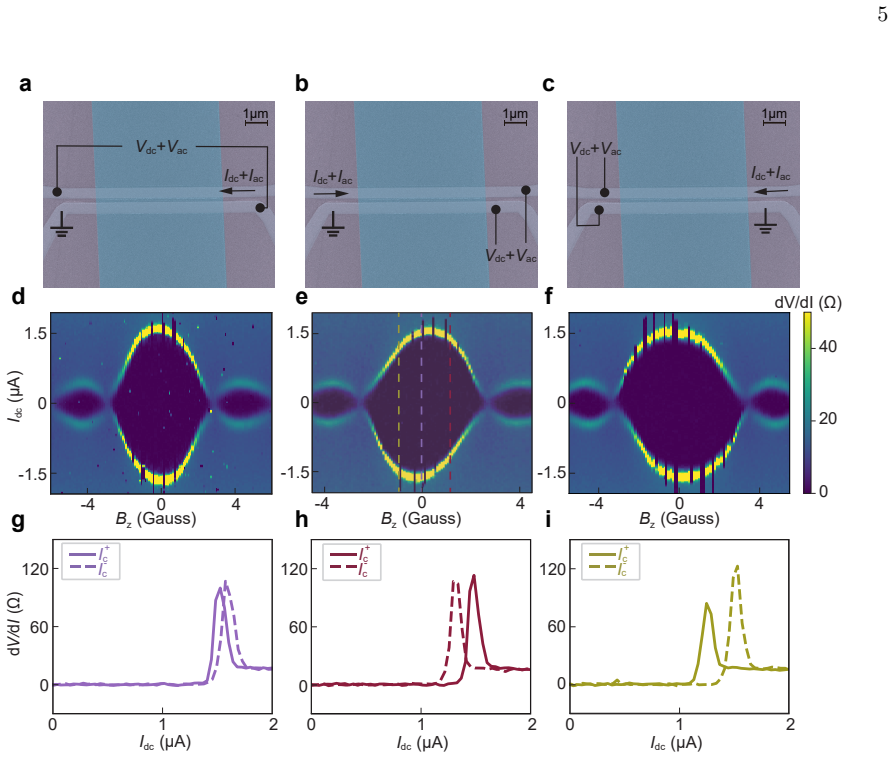
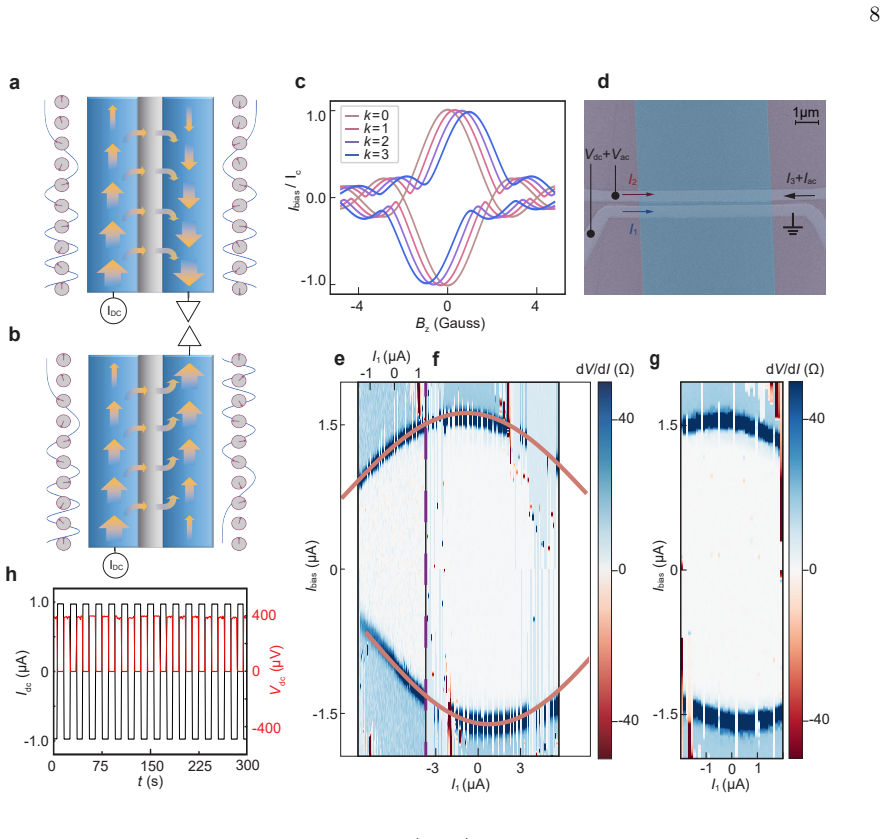
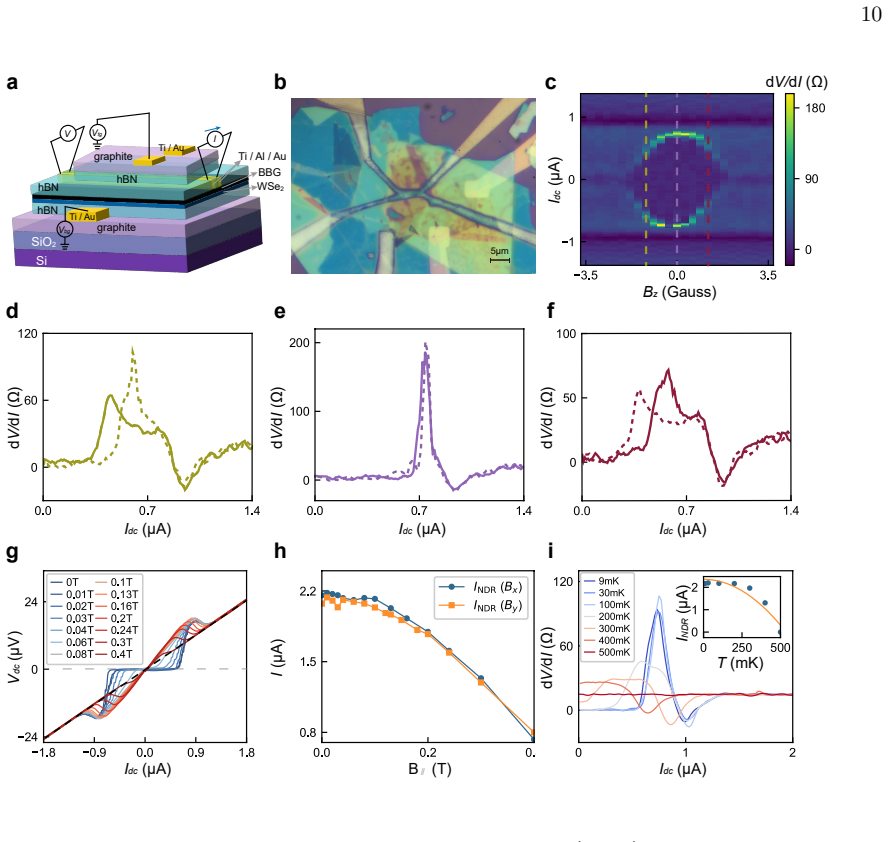
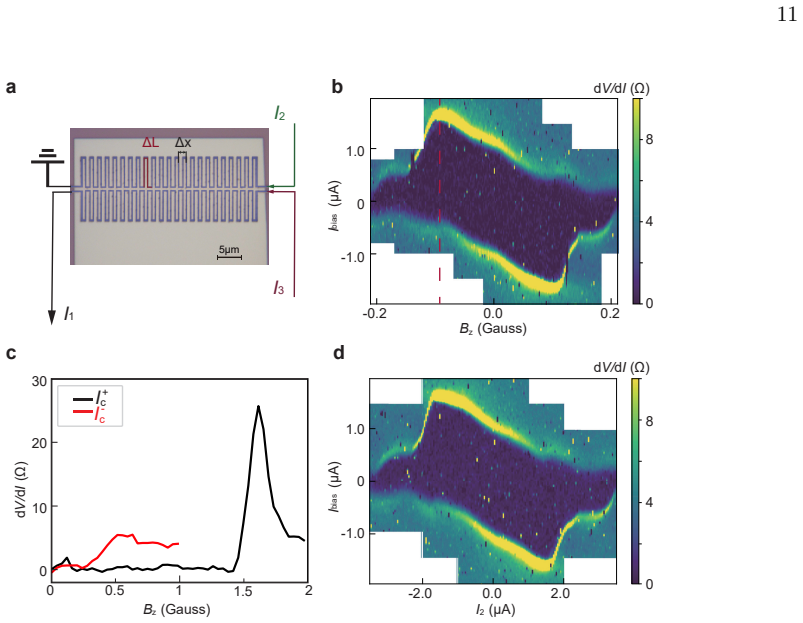
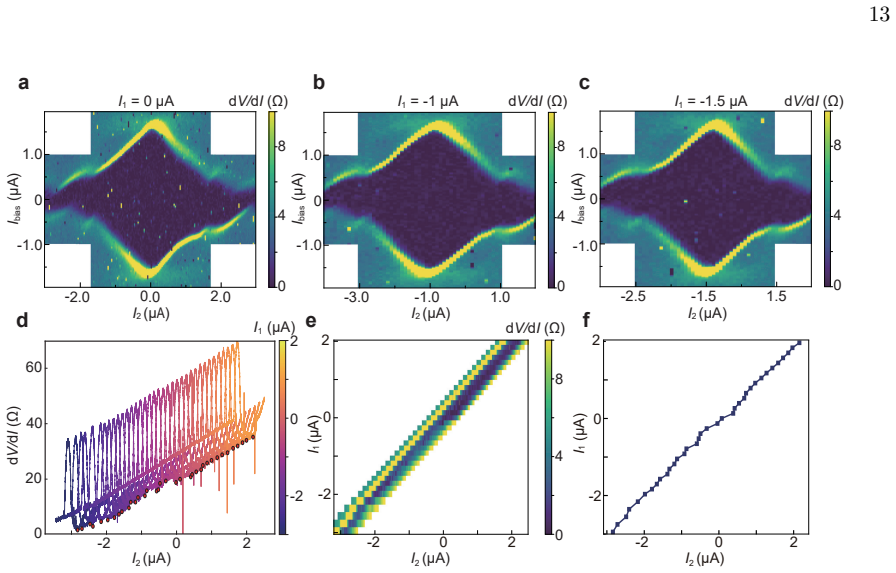
The Josephson effect, a hallmark of superconducting phase coherence, drives modern quantum technologies. However, Josephson-based quantum interference has hitherto been tethered to magnetic fields, despite phase coherence being a quintessential, intrinsic trait of superconductivity. Moreover, the Josephson diode effect (JDE) is typically viewed as an anomalous phenomenon indicative of broken symmetries in exotic phases of matter. Here, in planar Josephson junctions made with $\mathrm{Bi}_2\mathrm{O}_2\mathrm{Se}$ and bilayer graphene, we demonstrate that the JDE is a missing universal property of the Josephson effect. Simultaneously, we present an all-electric technology that replaces magnetic flux for controlling and measuring supercurrent interference. Central to our approach is a supercurrent gauge field (SGF), generated and amplified through high-kinetic-inductance superconductors and novel device architectures. By establishing the physical equivalence between the SGF and a magnetic field, we eliminate the reliance on external fields in quantum interference and reveal a universal, field-free JDE mechanism with broad implications for detecting broken-symmetry states. Finally, we show that the SGF offers capabilities beyond those of a conventional magnetic field by experimentally demonstrating a magnetic-free, phase-sensitive technique to construct and characterize finite-momentum superconductivity, opening new frontiers for exploring novel phases of matter and superconducting quantum architectures.
Editorial analysis
A structured set of objections, weighed in public.
Referee Report
Summary. The paper claims that in planar Josephson junctions fabricated with Bi₂O₂Se and bilayer graphene, a supercurrent gauge field (SGF) generated and amplified by high-kinetic-inductance superconductors is physically equivalent to an external magnetic field. This equivalence enables all-electric control and measurement of supercurrent interference, establishes the Josephson diode effect (JDE) as a universal property of the Josephson effect rather than an anomalous broken-symmetry phenomenon, and provides a magnetic-free, phase-sensitive method to construct and characterize finite-momentum superconductivity.
Significance. If the reported equivalence and experimental controls hold, the result would remove the historical dependence on external magnetic fields for Josephson interference experiments and reframe the JDE as intrinsic. The SGF approach could simplify device architectures in superconducting quantum technologies and open routes to studying novel phases without confounding magnetic effects. The work supplies concrete device geometries, kinetic-inductance modeling, and direct pattern comparisons that, if reproducible, constitute a practical advance.
minor comments (3)
- The abstract and introduction state the SGF–magnetic-field equivalence as established by the data, but the precise metric used to quantify equivalence (e.g., overlap of interference patterns or extracted critical-current ratios) should be stated explicitly in the main text with a quantitative figure of merit.
- Figure captions and methods should include the kinetic-inductance values, junction dimensions, and current-bias ranges for both Bi₂O₂Se and bilayer-graphene devices so that the claimed universality can be assessed against other material systems.
- The symmetry arguments for the universal JDE would benefit from an explicit statement of the minimal set of symmetries that remain unbroken under the SGF, placed in a dedicated subsection or appendix.
Simulated Author's Rebuttal
We thank the referee for their positive assessment of our manuscript and for recommending minor revision. The referee's summary correctly identifies the central claims regarding the supercurrent gauge field (SGF), its equivalence to magnetic flux, the universal nature of the Josephson diode effect, and the implications for finite-momentum superconductivity. No specific major comments were raised in the report.
Circularity Check
No circularity detected; claims rest on experimental demonstration
full rationale
The paper's central claims concern experimental observation of supercurrent gauge field equivalence to magnetic fields and universality of the Josephson diode effect in planar junctions. No load-bearing derivations, self-definitional equations, fitted inputs renamed as predictions, or self-citation chains reducing to unverified premises are present in the abstract or described content. The equivalence is established via direct comparison of interference patterns and device controls, which are externally falsifiable. The derivation chain is therefore self-contained against external benchmarks with no reduction by construction.
Axiom & Free-Parameter Ledger
invented entities (1)
-
supercurrent gauge field (SGF)
no independent evidence
discussion (0)
Sign in with ORCID, Apple, or X to comment. Anyone can read and Pith papers without signing in.