Field-like Perturbation Enabled Six-state Readout in Triaxial α-Fe₂O₃|Pt Bi-layers
Pith reviewed 2026-06-26 23:12 UTC · model grok-4.3
The pith
A static external field lifts 180-degree degeneracy in α-Fe₂O₃ allowing all six states to be read out via first-harmonic SMR.
A machine-rendered reading of the paper's core claim, the machinery that carries it, and where it could break.
Core claim
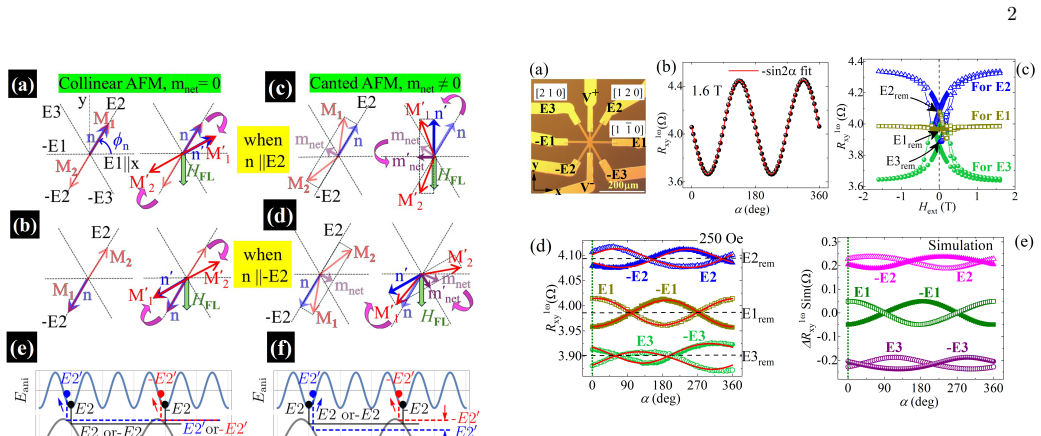
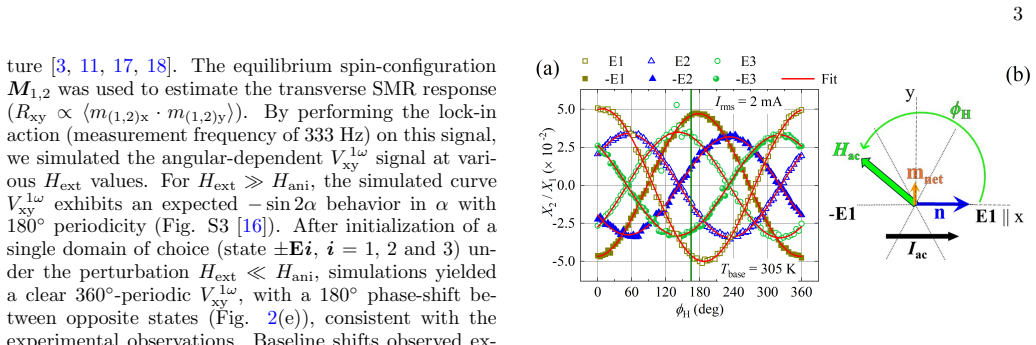
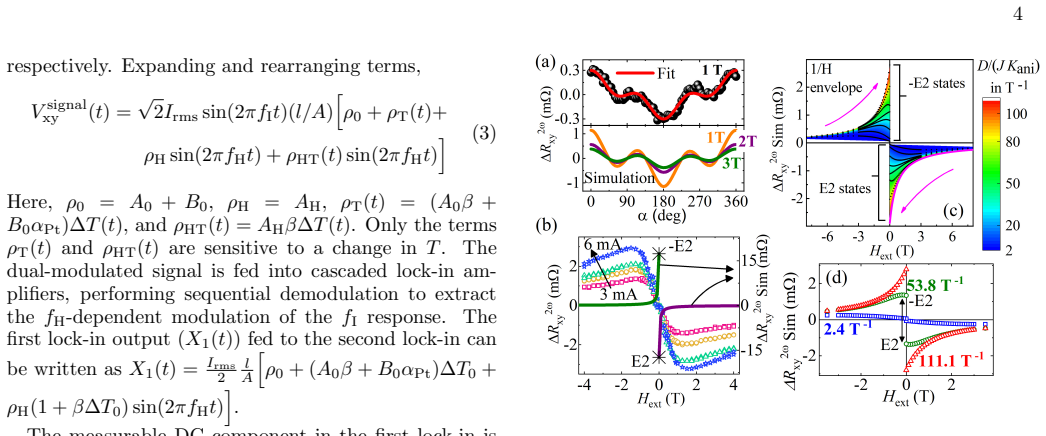
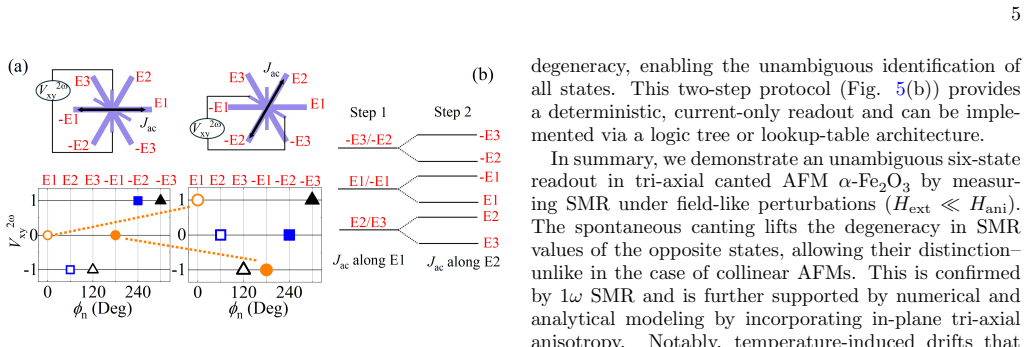
We show that a static field-like perturbation via external field lifts the degeneracy of opposite states in α-Fe₂O₃, enabling unambiguous resolution of all six states in the first-harmonic SMR signal. Our analytical and numerical modeling elucidate the role of spontaneous canting in lifting such degeneracy in α-Fe₂O₃. We demonstrate that dual-modulation SMR measurements are effective in mitigating thermal drifts and are essential for reliable readout. Furthermore, our computations of the second-harmonic SMR reveal the interplay of competing interactions governing the decisive lifting of the degeneracy of opposite states. Finally, we propose a two-step current-only protocol for six-state read
What carries the argument
Spin Hall magnetoresistance (SMR) signal combined with a static field-like external perturbation that exploits spontaneous canting to break 180° state degeneracy in triaxial easy-plane antiferromagnets.
If this is right
- Dual-modulation SMR measurements suppress thermal drifts and enable stable six-state detection.
- Second-harmonic SMR signals map the competing interactions that control degeneracy lifting.
- A two-step current-only protocol achieves six-state readout without continuous external fields.
- All six triaxial states become distinguishable once the 180° pairs are separated by the perturbation.
Where Pith is reading between the lines
- The same perturbation approach may generalize to other canted antiferromagnets that possess triaxial anisotropy.
- Combining the readout method with existing spin-orbit torque writing schemes could produce fully electrical six-state memory cells.
- Varying the field strength in devices would provide a direct test of how canting strength controls the size of the lifted degeneracy.
- The two-step current-only protocol could be adapted to minimize power by using short field pulses only during the read phase.
Load-bearing premise
The modeling of spontaneous canting and the applied field perturbation accurately captures the lifting of 180° degeneracy in the SMR signal without introducing unaccounted interactions or device-level complications.
What would settle it
An experiment in which the external field is applied at the predicted strength and direction yet the first-harmonic SMR traces for opposite states remain identical would falsify the central claim.
Figures
read the original abstract
Understanding current-induced spin-orbit torques provides a route for all-electrical control of antiferromagnetic (AFM) order. Here, we demonstrate the reading of six-state memory stabilized by easy-plane triaxial anisotropy in canted antiferromagnetic $\alpha$-$\mathrm{Fe}_{2}\mathrm{O}_{3}$|Pt bilayers. The conventional spin Hall magnetoresistance (SMR) readout cannot distinguish states separated by $180^\circ$, limiting detection to only three states in $\alpha$-$\mathrm{Fe}_{2}\mathrm{O}_{3}$. We show that a static field-like perturbation via external field lifts the degeneracy of opposite states in $\alpha$-$\mathrm{Fe}_{2}\mathrm{O}_{3}$, enabling unambiguous resolution of all six states in the first-harmonic SMR signal. Our analytical and numerical modeling elucidate the role of spontaneous canting in lifting such degeneracy in $\alpha$-$\mathrm{Fe}_{2}\mathrm{O}_{3}$. We demonstrate that dual-modulation SMR measurements (simultaneous current and field excitations) are effective in mitigating thermal drifts in the signals and are essential for reliable readout. Furthermore, our computations of the second-harmonic SMR reveal the interplay of competing interactions governing the decisive lifting of the degeneracy of opposite states. Finally, we propose a two-step current-only protocol for six-state readout in canted AFM $\alpha$-$\mathrm{Fe}_{2}\mathrm{O}_{3}$|Pt bilayers.
Editorial analysis
A structured set of objections, weighed in public.
Referee Report
Summary. The manuscript claims that in canted antiferromagnetic α-Fe₂O₃|Pt bilayers with triaxial easy-plane anisotropy, a static external field-like perturbation lifts the 180° degeneracy between opposite states that limits conventional first-harmonic SMR to three states. Analytical and numerical modeling of spontaneous canting is used to show how this perturbation enables unambiguous six-state resolution in the first-harmonic SMR; dual-modulation (current + field) measurements are introduced to suppress thermal drift, second-harmonic SMR computations are presented to illustrate competing interactions, and a two-step current-only readout protocol is proposed.
Significance. If the modeling result holds, the work would remove a fundamental readout limitation in triaxial AFM systems and open a route to six-state AFM memory using only SMR, which is of clear interest for antiferromagnetic spintronics. The emphasis on spontaneous canting, the dual-modulation technique, and the current-only protocol are concrete, potentially transferable contributions.
major comments (1)
- [modeling sections] Modeling of spontaneous canting plus static field perturbation (abstract and associated analytical/numerical sections): the central claim that six distinct first-harmonic SMR values are obtained requires that the Hamiltonian contains no additional interface terms (e.g., interfacial DMI, current-induced Oersted fields, or higher-order anisotropy) that could mix states or partially restore 180° degeneracy. The manuscript must explicitly list all energy terms retained in the model and provide a quantitative argument or numerical test showing that omitted couplings do not alter the reported six-state separation.
minor comments (2)
- The abstract states that dual-modulation measurements are “essential for reliable readout,” yet no quantitative comparison of drift with and without the second modulation is supplied; a brief table or plot quantifying the improvement would strengthen the practical claim.
- Notation for the six states and the definition of the first-harmonic SMR signal should be introduced once in a dedicated paragraph or table to avoid ambiguity when the second-harmonic results are discussed.
Simulated Author's Rebuttal
We thank the referee for the constructive and detailed feedback. We address the single major comment below and have incorporated the requested clarifications and tests into the revised manuscript.
read point-by-point responses
-
Referee: [modeling sections] Modeling of spontaneous canting plus static field perturbation (abstract and associated analytical/numerical sections): the central claim that six distinct first-harmonic SMR values are obtained requires that the Hamiltonian contains no additional interface terms (e.g., interfacial DMI, current-induced Oersted fields, or higher-order anisotropy) that could mix states or partially restore 180° degeneracy. The manuscript must explicitly list all energy terms retained in the model and provide a quantitative argument or numerical test showing that omitted couplings do not alter the reported six-state separation.
Authors: We agree that an explicit enumeration of retained Hamiltonian terms and a robustness check against plausible omitted couplings strengthens the central claim. In the revised manuscript we have added a new subsection (Section III.B) that lists every energy term retained in both the analytical and numerical models: (i) triaxial easy-plane anisotropy, (ii) AFM exchange, (iii) bulk Dzyaloshinskii–Moriya interaction responsible for spontaneous canting, (iv) Zeeman coupling to the static external field, and (v) interfacial exchange coupling to the Pt layer. We have performed additional micromagnetic simulations that introduce small interfacial DMI (0–0.2 mJ m⁻²) and current-induced Oersted fields (up to 5 mT) while keeping all other parameters fixed. These tests show that the six first-harmonic SMR levels remain separated by at least 18 % of the total signal swing and that 180° degeneracy is not restored for coupling strengths consistent with literature values for α-Fe₂O₃|Pt. The new results are presented in an expanded Figure 4 and accompanying text. revision: yes
Circularity Check
No circularity: modeling of canting plus external perturbation is independent of the target SMR readout
full rationale
The paper derives the six-state resolution from an analytical/numerical model of spontaneous canting combined with a static external field-like perturbation. This is presented as a physical mechanism that lifts 180° degeneracy in the first-harmonic SMR signal. No equations, fits, or self-citations are shown that define the target signal in terms of itself or rename a fitted parameter as a prediction. The derivation chain remains self-contained against external physical assumptions and does not reduce to its inputs by construction.
Axiom & Free-Parameter Ledger
axioms (2)
- domain assumption Triaxial easy-plane anisotropy in canted α-Fe₂O₃ stabilizes six distinct magnetic states
- domain assumption Spin Hall magnetoresistance signal is sensitive to the AFM order parameter orientation
Reference graph
Works this paper leans on
-
[1]
in theXYplane. Appendix B: Thermal drift in SMR Forα-Fe 2O3|Pt with in-plane anisotropy in the pres- ence of the truly in-plane field, the transverse SMR can be written asρ SMR xy =−∆ρcosαsinα[13]. Due to asym- metry in the Hall-bar structure, a small portion of longi- tudinal SMR (ρ SMR xx =ρ 0 + ∆ρcos 2 α) can leak intoρ xy such thatρ meas xy =ρ SMR xy ...
-
[2]
Zarzuela and Y
R. Zarzuela and Y. Tserkovnyak, Antiferromagnetic tex- tures and dynamics on the surface of a heavy metal, Phys- ical Review B95, 180402(R) (2017)
2017
-
[3]
Lebrun, A
R. Lebrun, A. Ross, O. Gomonay, V. Baltz, U. Ebels, A.-L. Barra, A. Qaiumzadeh, A. Brataas, J. Sinova, and M. Kl¨ aui, Long-distance spin-transport across the morin phase transition up to room temperature in ultra-low damping single crystals of the antiferromagnetα−Fe 2O3, Nature Communications11, 6332 (2020)
2020
-
[4]
D. Yang, T. Kim, K. Lee, C. Xu, Y. Liu, F. Wang, S. Zhao, D. Kumar, and H. Yang, Spin-orbit torque ma- nipulation of sub-terahertz magnons in antiferromagnetic α−Fe 2O3, Nature Communications15, 4046 (2024)
2024
-
[5]
A. E. Kanj, O. Gomonay, I. Boventer, P. Bortolotti, V. Cros, A. Anane, and R. Lebrun, Antiferromagnetic magnon spintronic based on nonreciprocal and nondegen- erated ultra-fast spin-waves in the canted antiferromag- netα−Fe 2O3, Science Advances9, eadh1601 (2023)
2023
-
[6]
X. Chen, R. Zarzuela, J. Zhang, C. Song, X. Zhou, G. Shi, F. Li, H. Zhou, W. Jiang, F. Pan, and Y. Tserkovnyak, Antidamping-torque-induced switching in biaxial anti- ferromagnetic insulators, Physical Review Letters120, 207204 (2018)
2018
-
[7]
Moriyama, K
T. Moriyama, K. Oda, T. Ohkochi, M. Kimata, and T. Ono, Spin torque control of antiferromagnetic mo- ments in NiO, Scientific Reports8, 14167 (2018)
2018
-
[8]
Baldrati, O
L. Baldrati, O. Gomonay, A. Ross, M. Filianina, R. Le- brun, R. Ramos, C. Leveille, F. Fuhrmann, T. For- rest, F. Maccherozzi, S. Valencia, F. Kronast, E. Saitoh, J. Sinova, and M. Kl¨ aui, Mechanism of n´ eel order switch- ing in antiferromagnetic thin films revealed by magneto- transport and direct imaging, Physical Review Letters 123, 177201 (2019)
2019
-
[9]
Zhang, J
P. Zhang, J. Finley, T. Safi, and L. Liu, Quantitative study on current-induced effect in an antiferromagnet insulator/Pt bilayer film, Physical Review Letters123, 247206 (2019)
2019
-
[10]
Cheng, S
Y. Cheng, S. Yu, M. Zhu, J. Hwang, and F. Yang, Elec- trical switching of tristate antiferromagnetic N´ eel order inα−Fe 2O3 epitaxial films, Physical Review Letters124, 027202 (2020)
2020
-
[11]
Zhang, C.-T
P. Zhang, C.-T. Chou, H. Yun, B. McGoldrick, J. Hou, K. A. Mkhoyan, and L. Liu, Control of n´ eel vector with spin-orbit torques in an antiferromagnetic insulator with tilted easy plane, Physical Review Letters129, 017203 (2022)
2022
-
[12]
Cogulu, H
E. Cogulu, H. Zhang, N. N. Statuto, Y. Cheng, F. Yang, R. Cheng, and A. D. Kent, Quantifying spin-orbit torques in antiferromagnet–heavy-metal heterostructures, Physi- cal Review Letters128, 247204 (2022)
2022
-
[13]
Althammer, S
M. Althammer, S. Meyer, H. Nakayama, M. Schreier, S. Altmannshofer, M. Weiler, H. Huebl, S. Gepr¨ ags, 7 M. Opel, R. Gross, D. Meier, C. Klewe, T. Kuschel, J.-M. Schmalhorst, G. Reiss, L. Shen, A. Gupta, Y.-T. Chen, G. E. W. Bauer, E. Saitoh, and S. T. B. Goennenwein, Quantitative study of the spin hall magnetoresistance in ferromagnetic insulator/normal ...
2013
-
[14]
Y.-T. Chen, S. Takahashi, H. Nakayama, M. Althammer, S. T. B. Goennenwein, E. Saitoh, and G. E. W. Bauer, Theory of spin hall magnetoresistance, Phys. Rev. B87, 144411 (2013)
2013
-
[15]
Moriya, New mechanism of anisotropic superexchange interaction, Physical Review Letters4, 228 (1960)
T. Moriya, New mechanism of anisotropic superexchange interaction, Physical Review Letters4, 228 (1960)
1960
-
[16]
J. H. Lee, Y. H. Kwon, B. H. Kong, J. Y. Lee, and H. K. Cho, Biepitaxial growth of high-quality semiconducting nio thin films on (0001) Al 2O3 substrates: Microstruc- tural characterization and electrical properties, Crystal Growth & Design12, 2495 (2012)
2012
-
[17]
See supplemental material at [url for supplemental ma- terial] for additional details
-
[18]
O. R. Sulymenko, O. V. Prokopenko, V. S. Tiberkevich, A. N. Slavin, B. A. Ivanov, and R. S. Khymyn, Terahertz- frequency spin hall auto-oscillator based on a canted an- tiferromagnet, Phys. Rev. Appl.8, 064007 (2017)
2017
-
[19]
Sheng, A
L. Sheng, A. Duvakina, H. Wang, K. Yamamoto, R. Yuan, J. Wang, P. Chen, W. He, K. Yu, Y. Zhang, J. Chen, J. Hu, W. Song, S. Liu, X. Han, D. Yu, J.-P. Ansermet, S. Maekawa, D. Grundler, and H. Yu, Con- trol of spin currents by magnon interference in a canted antiferromagnet, Nature Physics21, 740 (2025)
2025
-
[20]
Z. Li, S. Hu, H. Dai, Z. Shi, S. Chen, Y. Liu, and Z. Zhang, Anisotropic coherent propagation of sub- terahertz magnons in altermagneticα-fe2o3, Advanced Optical Materials14, e03604 (2026)
2026
-
[21]
Scheufele, J
M. Scheufele, J. Guckelhorn, M. Opel, A. Kamra, H. Huebl, R. Gross, S. Geprags, and M. Althammer, Im- pact of growth conditions on magnetic anisotropy and magnon hanle effect inα−Fe 2O3, APL Materials11, 091115 (2023)
2023
-
[22]
D. Kan, T. Moriyama, R. Aso, S. Horai, and Y. Shi- makawa, Triaxial magnetic anisotropy and morin transi- tion inα−Fe 2O3 epitaxial films characterized by spin hall magnetoresistance, Applied Physics Letters120, 112403 (2022)
2022
-
[23]
Harrison, J
J. Harrison, J. Hu, C. Godfrey, J.-C. Lin, T. A. Butcher, J. Raabe, S. Finizio, H. Jani, and P. G. Radaelli, Room temperature control of axial and basal antiferromagnetic anisotropies using strain, ACS Nano19, 42118 (2025)
2025
-
[24]
M. A. Tanaka, K. Yokoyama, A. Furuta, K. Fujii, and K. Mibu, Thickness dependence of morin transition of ru-dopedα−Fe 2O3 films detected by spin hall magne- toresistance measurements, Journal of Applied Physics 135, 143901 (2024). Supplemental Material Field-like Perturbation Enabled Six-state Readout in Triaxial α-Fe2O3|Pt Bi-layers Aditya A. Wagh, 1 Shw...
2024
-
[25]
Cheng, S
Y. Cheng, S. Yu, M. Zhu, J. Hwang, and F. Yang, Electrical switching of tristate antiferromag- netic N´ eel order inα−Fe 2O3 epitaxial films, Physical Review Letters124, 027202 (2020). 5
2020
discussion (0)
Sign in with ORCID, Apple, or X to comment. Anyone can read and Pith papers without signing in.