Ultra-Low-Rate Information Reconciliation: Repetition Coding or Dedicated Codes?
Pith reviewed 2026-06-26 14:28 UTC · model grok-4.3
The pith
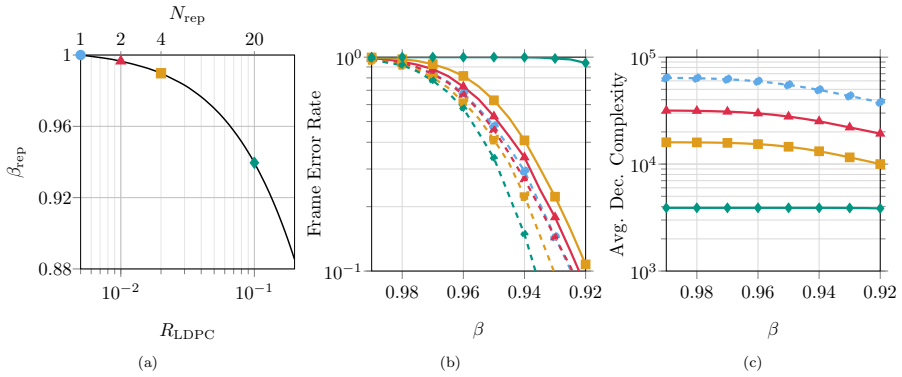
Repetition coding delivers a favorable performance-complexity trade-off versus dedicated codes for ultra-low-rate reconciliation in CV-QKD.
A machine-rendered reading of the paper's core claim, the machinery that carries it, and where it could break.
Core claim
Repetition coding offers a favorable performance-complexity trade-off for ultra-low-rate information reconciliation in CV-QKD, incurring only a moderate error-rate penalty while reducing decoding complexity by 2×, making it attractive for implementation-constrained systems.
What carries the argument
The direct performance-complexity comparison of repetition coding against dedicated ultra-low-rate codes under matched CV-QKD conditions.
If this is right
- CV-QKD implementations with limited hardware can maintain reconciliation at roughly half the decoder cost.
- Moderate error-rate increases remain tolerable when complexity savings enable higher overall system throughput.
- Repetition coding becomes the default choice for ultra-low-rate reconciliation whenever decoder resources are the binding constraint.
- System designers gain a concrete factor-of-two complexity reduction without redesigning the entire reconciliation pipeline.
Where Pith is reading between the lines
- The same repetition approach may extend to other quantum protocols that require ultra-low-rate error correction under hardware limits.
- Further tuning of repetition factors could narrow the error-rate gap without regaining the full complexity cost of dedicated codes.
- In network settings, the complexity savings could allow more parallel reconciliation instances on shared processors.
Load-bearing premise
The dedicated ultra-low-rate codes selected for comparison form a relevant and competitive baseline.
What would settle it
A dedicated code that simultaneously achieves lower error rates and equal or lower decoding complexity than repetition coding under the same CV-QKD parameters would falsify the claimed trade-off advantage.
Figures
read the original abstract
We compare repetition-based ultra-low-rate information reconciliation with dedicated ultra-low-rate codes for CV-QKD. Repetition coding offers a favorable performance-complexity trade-off, incurring only a moderate error-rate penalty while reducing decoding complexity by $2\times$, making it attractive for implementation-constrained systems.
Editorial analysis
A structured set of objections, weighed in public.
Referee Report
Summary. The manuscript compares repetition-based ultra-low-rate information reconciliation against dedicated ultra-low-rate codes in the context of continuous-variable quantum key distribution (CV-QKD). It asserts that repetition coding achieves a favorable performance-complexity trade-off by incurring only a moderate error-rate penalty while halving decoding complexity, rendering it attractive for implementation-constrained systems.
Significance. If the claimed moderate penalty and exact 2× complexity reduction hold under fair, identical CV-QKD operating conditions with competitive dedicated-code baselines, the result would be practically relevant for resource-limited CV-QKD implementations. However, the manuscript supplies no numerical results, simulation parameters, error bars, or explicit baseline definitions, so the significance cannot be evaluated from the supplied text.
major comments (2)
- [Abstract] The central empirical claim (moderate error-rate penalty and exact 2× complexity reduction) is stated in the abstract but is unsupported by any numerical results, tables, figures, simulation details, or error-bar information anywhere in the manuscript. This absence directly undermines verification of the performance-complexity trade-off.
- [Abstract] No definition or justification is given for the 'dedicated ultra-low-rate codes' chosen as the comparison baseline, nor are the CV-QKD operating conditions (e.g., channel parameters, block lengths, or target rates) specified. Without these, it is impossible to assess whether the baseline is relevant and competitive.
Simulated Author's Rebuttal
We thank the referee for the constructive comments on our manuscript. We agree that the claims require explicit supporting evidence and specifications, and we will revise the manuscript accordingly to address these points.
read point-by-point responses
-
Referee: [Abstract] The central empirical claim (moderate error-rate penalty and exact 2× complexity reduction) is stated in the abstract but is unsupported by any numerical results, tables, figures, simulation details, or error-bar information anywhere in the manuscript. This absence directly undermines verification of the performance-complexity trade-off.
Authors: We acknowledge that the current manuscript version does not include numerical results, tables, figures, or error bars to support the stated claims. In the revised version, we will add a results section with simulation data, including error bars, explicit complexity measurements, and all relevant parameters to substantiate the moderate error-rate penalty and exact 2× decoding complexity reduction. revision: yes
-
Referee: [Abstract] No definition or justification is given for the 'dedicated ultra-low-rate codes' chosen as the comparison baseline, nor are the CV-QKD operating conditions (e.g., channel parameters, block lengths, or target rates) specified. Without these, it is impossible to assess whether the baseline is relevant and competitive.
Authors: We agree that definitions, justifications, and operating conditions must be provided. The revision will explicitly define the dedicated ultra-low-rate codes (including their construction and why they serve as competitive baselines), and specify all CV-QKD parameters such as channel transmittance, excess noise, block lengths, and target reconciliation rates to enable assessment of relevance and fairness. revision: yes
Circularity Check
No significant circularity
full rationale
The paper is an empirical performance comparison of repetition coding against dedicated ultra-low-rate codes for CV-QKD information reconciliation. No derivation chain, fitted parameters, or first-principles results are present that could reduce to inputs by construction. The central claim rests on measured error-rate and complexity metrics under identical operating conditions; no self-definitional steps, fitted-input predictions, or load-bearing self-citations appear in the provided abstract or claim description. The work is therefore self-contained against external benchmarks.
Axiom & Free-Parameter Ledger
axioms (1)
- domain assumption CV-QKD systems operate in a regime that requires ultra-low-rate information reconciliation
Reference graph
Works this paper leans on
-
[1]
Parameter Optimization of Rate-Adaptive Continuous-Variable Quantum Key Distribution Systems , year =
Cil, Erdem Eray and Berl, Jonas and Schmalen, Laurent , booktitle =. Parameter Optimization of Rate-Adaptive Continuous-Variable Quantum Key Distribution Systems , year =
-
[2]
, journal =
Smith, Benjamin and Ardakani, Masoud and Yu, Wei and Kschischang, Frank R. , journal =. Design of irregular. 2010 , volume =
2010
-
[3]
Rate-Adaptive Protograph-Based Raptor-Like
Erdem Eray Cil and Laurent Schmalen , booktitle =. Rate-Adaptive Protograph-Based Raptor-Like. Advanced Photonics Congress 2024 , keywords =. 2024 , url =. doi:10.1364/BGPP.2024.JTu1A.51 , abstract =
-
[4]
Gumus, Kadir and Schmalen, Laurent , year =. Low Rate Protograph-Based. doi:10.1109/iswcs49558.2021.9562244 , booktitle =
-
[5]
Multidimensional reconciliation for a continuous-variable quantum key distribution , author =. Phys. Rev. A , volume =. 2008 , month =. doi:10.1103/PhysRevA.77.042325 , url =
-
[6]
2009 , month = Nov, keywords =
Leverrier, Anthony , url =. 2009 , month = Nov, keywords =
2009
-
[7]
Multiedge-type low-density parity-check codes for continuous-variable quantum key distribution , author =. Phys. Rev. A , volume =. 2021 , month =. doi:10.1103/PhysRevA.103.062419 , url =
discussion (0)
Sign in with ORCID, Apple, or X to comment. Anyone can read and Pith papers without signing in.