RetiSEM: Generalising Causal Models for Fragmented Biomedical Data
Pith reviewed 2026-06-26 01:00 UTC · model grok-4.3
The pith
RetiSEM recovers causal graphs from incomplete biomedical data by constraining structural equation models with biological blocks and forbidden edges.
A machine-rendered reading of the paper's core claim, the machinery that carries it, and where it could break.
Core claim
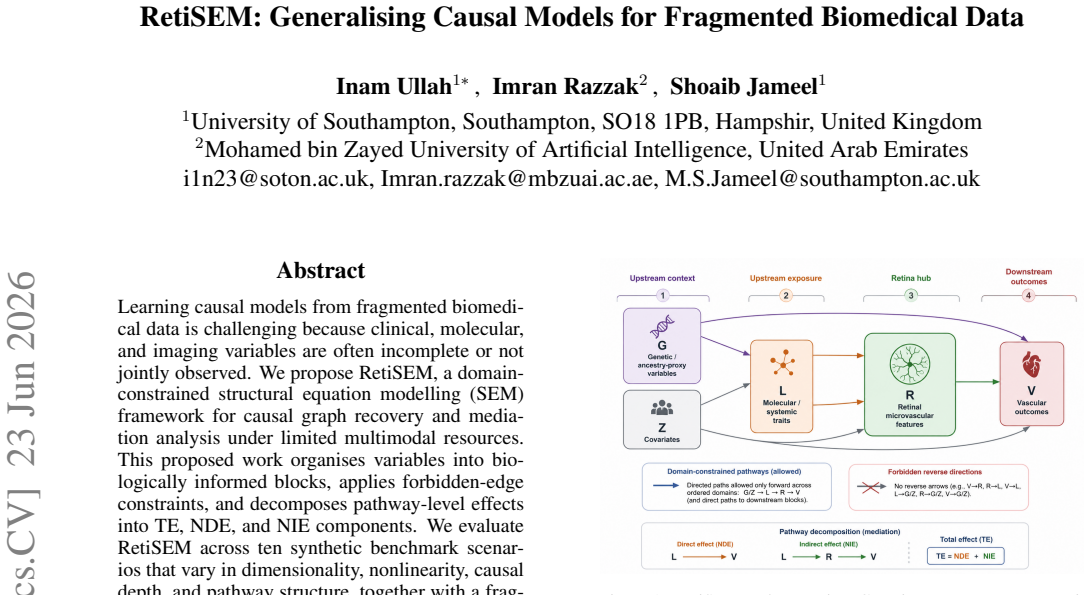
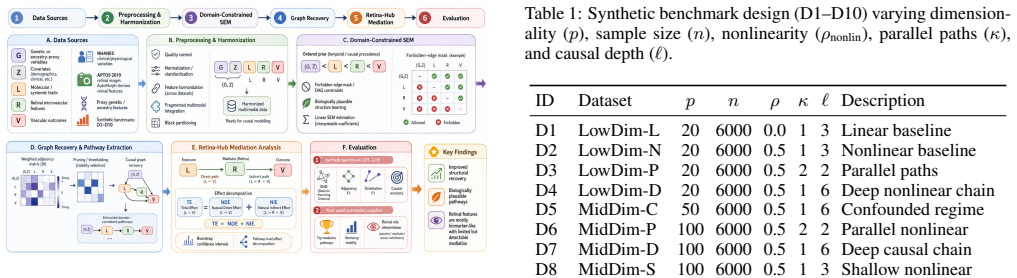
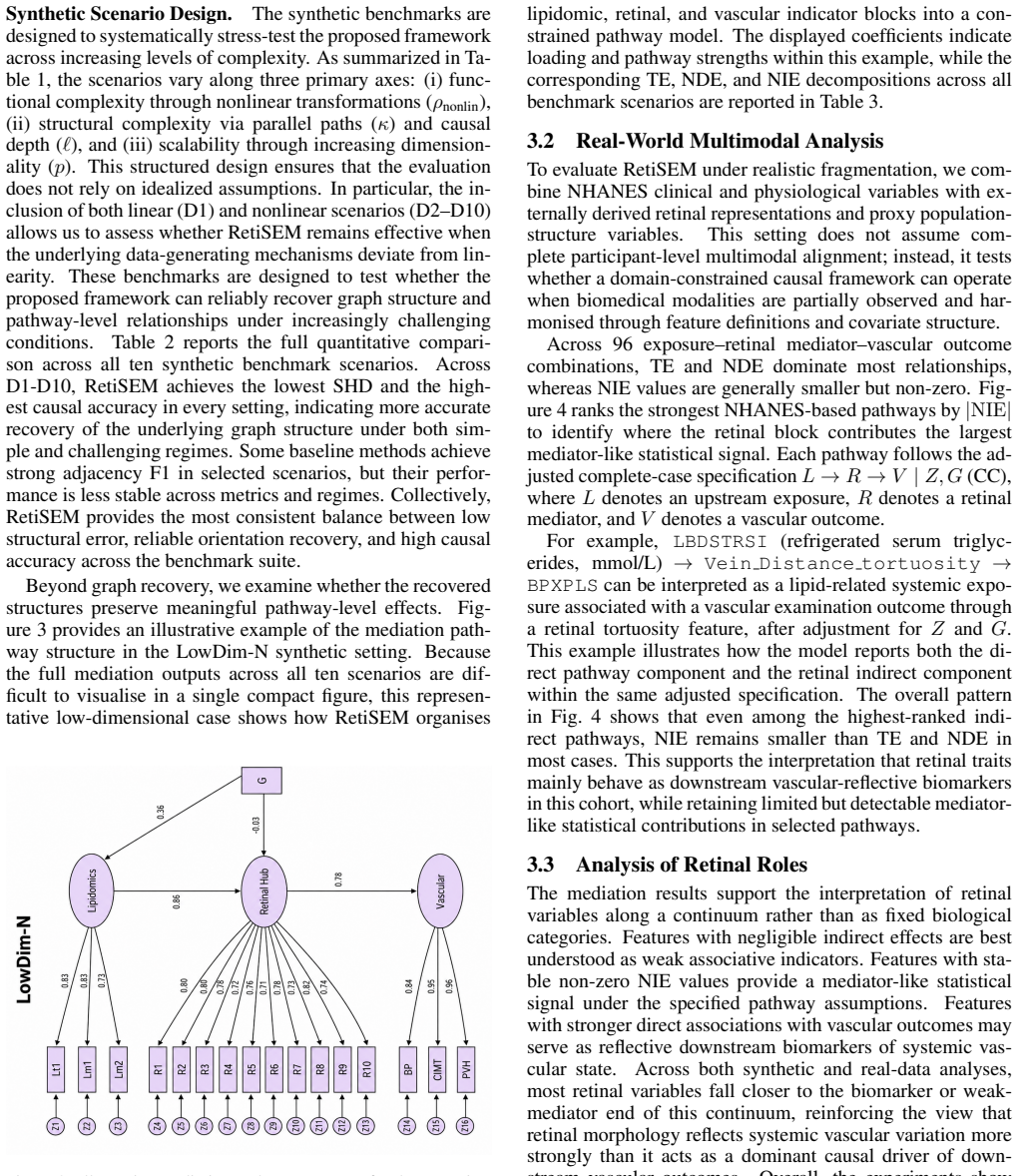
RetiSEM organises variables into biologically informed blocks, applies forbidden-edge constraints, and decomposes pathway-level effects into total effect (TE), natural direct effect (NDE), and natural indirect effect (NIE) components, achieving lower structural error and higher causal accuracy than unconstrained baselines on synthetic benchmarks while showing retinal variables function mainly as downstream biomarkers with smaller indirect effects in the NHANES-retinal setting.
What carries the argument
The domain-constrained SEM framework that organises variables into biologically informed blocks and applies forbidden-edge constraints to recover causal graphs and perform mediation analysis under limited multimodal observation.
If this is right
- Lower structural error holds across benchmarks that vary in dimensionality, nonlinearity, causal depth, and pathway structure.
- Higher causal accuracy is obtained relative to unconstrained baselines on those benchmarks.
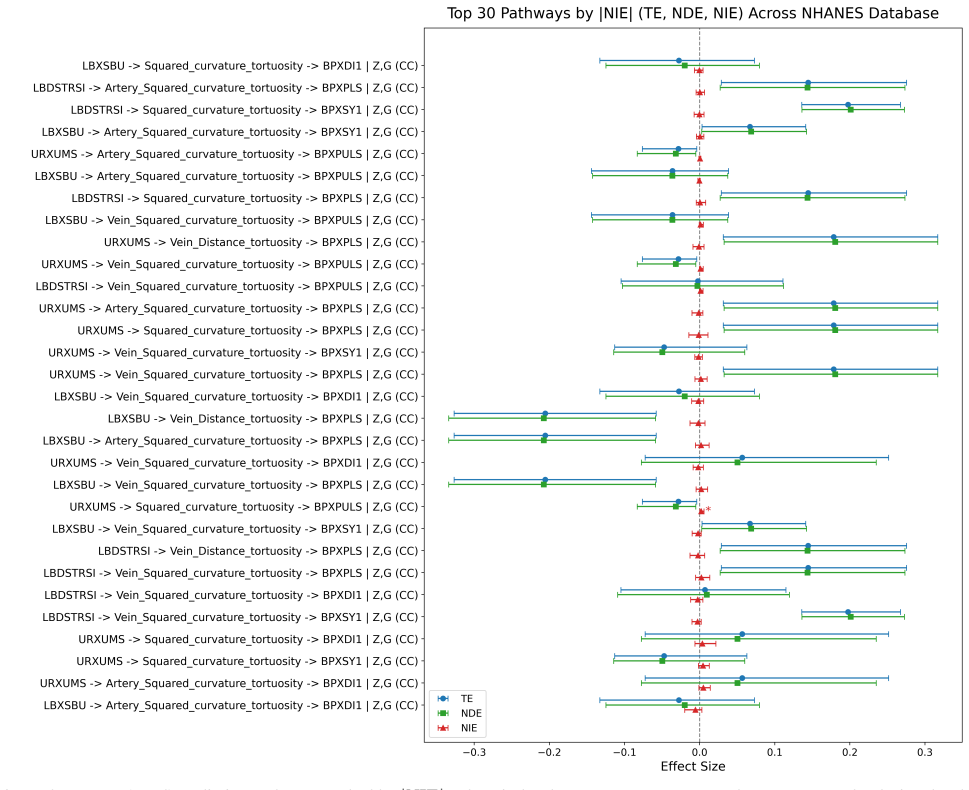
- Retinal variables act primarily as downstream biomarker-like indicators with smaller but detectable indirect effects in the fragmented real-world setting.
- The framework supports testing structured causal hypotheses when full joint observation of multimodal variables is unavailable.
Where Pith is reading between the lines
- The block-and-constraint approach could extend to other settings where variables arrive from separate studies, such as combining genomics and electronic health records.
- If the biological blocks prove stable across populations, the method might reduce the sample size needed for reliable causal estimates in imaging-augmented cohorts.
- Releasing the code allows direct testing of whether alternative block definitions yield different mediation conclusions on the same NHANES-retinal data.
Load-bearing premise
The biologically informed blocks and forbidden-edge constraints supplied by the authors correctly encode the true underlying causal structure.
What would settle it
Demonstrating that an unconstrained SEM achieves equal or lower structural error and equal or higher causal accuracy than RetiSEM on the same ten synthetic benchmarks would falsify the necessity of the domain constraints.
Figures
read the original abstract
Learning causal models from fragmented biomedical data is challenging because clinical, molecular, and imaging variables are often incomplete or not jointly observed. We propose RetiSEM, a domain-constrained structural equation modelling (SEM) framework for causal graph recovery and mediation analysis under limited multimodal resources. This proposed work organises variables into biologically informed blocks, applies forbidden-edge constraints, and decomposes pathway-level effects into TE, NDE, and NIE components. We evaluate RetiSEM across ten synthetic benchmark scenarios that vary in dimensionality, nonlinearity, causal depth, and pathway structure, together with a fragmented real-world setting that combines NHANES clinical variables with externally derived retinal representations. This approach achieves lower structural error and higher causal accuracy than unconstrained baselines across the synthetic benchmarks. In the real-data analysis, retinal variables behave mainly as downstream biomarker-like indicators, with smaller but detectable indirect effects. These findings support our strategy as an interpretable framework for testing structured causal hypotheses in limited-resource biomedical AI. The code and resources for this work are publicly available at: https://github.com/Inamullah-Colab/ReitSEM.
Editorial analysis
A structured set of objections, weighed in public.
Referee Report
Summary. The manuscript proposes RetiSEM, a domain-constrained structural equation modeling framework that organizes variables into biologically informed blocks, imposes forbidden-edge constraints, and decomposes effects into total (TE), natural direct (NDE), and natural indirect (NIE) components for causal graph recovery and mediation analysis from fragmented multimodal biomedical data. It reports evaluation on ten synthetic benchmarks varying in dimensionality, nonlinearity, causal depth, and pathway structure, plus a real-world NHANES clinical dataset augmented with externally derived retinal representations, claiming lower structural error and higher causal accuracy than unconstrained baselines, with retinal variables acting primarily as downstream biomarker-like indicators.
Significance. If the supplied constraints correctly encode biology, RetiSEM supplies an interpretable, hypothesis-driven approach to causal mediation in settings where joint observations of clinical, molecular, and imaging variables are unavailable. Public release of code and resources is a clear reproducibility strength.
major comments (2)
- [Evaluation and real-data analysis sections] The central claims of superior performance on synthetic benchmarks and the interpretation of retinal variables as downstream biomarkers in the NHANES analysis both rest on the unvalidated assumption that the biologically informed blocks and forbidden-edge constraints match the true causal structure. No sensitivity analysis to alternative constraint sets or external validation against ground-truth structure is reported.
- [Synthetic benchmark description] Synthetic data generation is not described in a manner that demonstrates independence from the same block and forbidden-edge choices used by RetiSEM; if the benchmarks were generated consistently with those constraints, the reported gains in structural error and causal accuracy do not establish robustness to constraint misspecification.
minor comments (2)
- [Abstract and results] The abstract states performance gains without error bars, statistical tests, or details on how constraints were selected; the full manuscript should make these explicit in the results tables or text.
- [Methods] Notation for TE/NDE/NIE decomposition should be cross-referenced to the exact equations used in the SEM formulation for clarity.
Simulated Author's Rebuttal
We thank the referee for their constructive feedback, which identifies key areas for strengthening the validation and clarity of our evaluation. We address each major comment below and outline planned revisions.
read point-by-point responses
-
Referee: [Evaluation and real-data analysis sections] The central claims of superior performance on synthetic benchmarks and the interpretation of retinal variables as downstream biomarkers in the NHANES analysis both rest on the unvalidated assumption that the biologically informed blocks and forbidden-edge constraints match the true causal structure. No sensitivity analysis to alternative constraint sets or external validation against ground-truth structure is reported.
Authors: We acknowledge that the reported gains and biomarker interpretation depend on the constraints reflecting true structure, which are derived from established biomedical knowledge on retinal variables as downstream indicators. We agree this assumption requires further scrutiny. In revision, we will add a dedicated sensitivity analysis subsection to the evaluation section. This will test alternative constraint sets (e.g., relaxing selected forbidden edges or altering block boundaries) and quantify effects on structural error and causal accuracy. For the NHANES results, we will expand the discussion to assess robustness of the downstream interpretation under relaxed constraints. While fully external ground-truth validation is not feasible for the real fragmented dataset (as causal structure is unknown), the synthetic benchmarks allow direct comparison to known graphs, and the new analysis will address misspecification concerns. revision: yes
-
Referee: [Synthetic benchmark description] Synthetic data generation is not described in a manner that demonstrates independence from the same block and forbidden-edge choices used by RetiSEM; if the benchmarks were generated consistently with those constraints, the reported gains in structural error and causal accuracy do not establish robustness to constraint misspecification.
Authors: We thank the referee for highlighting the need for explicit description. The synthetic benchmarks were generated independently using standard causal graph simulation methods: random DAGs with controlled variations in node count, edge density, nonlinearity (additive noise models), causal depth, and pathway structures, without applying the biological blocks or forbidden-edge constraints from RetiSEM. This design tests whether domain constraints improve recovery when the true structure may not match them exactly. We will revise the synthetic benchmark description (Section 4.1) to explicitly document the generation procedure, including the random graph model, parameter ranges, and confirmation of independence from RetiSEM's constraints. This clarification will demonstrate that performance improvements reflect the value of incorporating domain knowledge rather than any circularity in benchmark construction. revision: yes
Circularity Check
No significant circularity; results derive from independent benchmark evaluations rather than input constraints by construction.
full rationale
The paper defines RetiSEM via biologically informed blocks and forbidden-edge constraints as modeling choices, then reports empirical performance (lower structural error, higher causal accuracy) on ten synthetic scenarios with varied dimensionality/nonlinearity/depth and on NHANES-retinal data. These outputs are produced by fitting the constrained SEM and comparing to unconstrained baselines; they are not algebraically equivalent to the chosen blocks or edges. No self-citation chains, fitted parameters renamed as predictions, or self-definitional steps appear in the provided text. Synthetic benchmarks serve as external checks, and real-data conclusions rest on an explicit (if untested) modeling assumption rather than reducing the derivation to its inputs.
Axiom & Free-Parameter Ledger
axioms (1)
- domain assumption Biologically informed blocks and forbidden edges accurately reflect the true causal structure
Reference graph
Works this paper leans on
-
[1]
Acosta, Guido J
[Acostaet al., 2022 ] Juli´an N. Acosta, Guido J. Falcone, Pranav Rajpurkar, and Eric J. Topol. Multimodal biomed- ical ai.Nature Medicine, 28:1773–1784,
2022
-
[2]
APTOS 2019 Blindness Detection Data
[Asia Pacific Tele-Ophthalmology Society, 2019] Asia Pacific Tele-Ophthalmology Society. APTOS 2019 Blindness Detection Data. https://www.kaggle.com/ competitions/aptos2019-blindness-detection/data,
2019
-
[3]
[Belloet al., 2022 ] Kevin Bello, Bryon Aragam, and Pradeep Ravikumar
Accessed: 2026-06-05. [Belloet al., 2022 ] Kevin Bello, Bryon Aragam, and Pradeep Ravikumar. Dagma: Learning dags via m-matrices and a log-determinant acyclicity characteri- zation. InAdvances in Neural Information Processing Systems,
2026
-
[4]
Castro, Ian Walker, and Ben Glocker
[Castroet al., 2020 ] Daniel C. Castro, Ian Walker, and Ben Glocker. Causality matters in medical imaging.Nature Communications, 11(1):3673,
2020
-
[5]
Deep end-to-end causal inference.arXiv preprint arXiv:2202.02195,
[Geffneret al., 2022 ] Tomas Geffner, Javier Antoran, Adam Foster, Wenbo Gong, Chao Ma, Emre Kiciman, Amit Sharma, Angus Lamb, Martin Kukla, Nick Pawlowski, Miltiadis Allamanis, and Cheng Zhang. Deep end-to-end causal inference.arXiv preprint arXiv:2202.02195,
arXiv 2022
-
[6]
A general approach to causal mediation analy- sis.Psychological Methods, 15(4):309–334,
[Imaiet al., 2010 ] Kosuke Imai, Luke Keele, and Dustin Tingley. A general approach to causal mediation analy- sis.Psychological Methods, 15(4):309–334,
2010
-
[7]
[McGeechanet al., 2009 ] Kevin McGeechan, Gerald Liew, Petra Macaskill, Les Irwig, Ronald Klein, Barbara E. K. Klein, Jie Jin Wang, Paul Mitchell, Johannes R. Vinger- ling, Paulus T. V . M. Dejong, Jacqueline C. M. Witteman, Monique M. B. Breteler, Jonathan Shaw, Paul Zimmet, and Tien Y . Wong. Meta-analysis: Retinal vessel caliber and risk for coronary h...
2009
-
[8]
NHANES Questionnaires, Datasets, and Related Documentation
[National Center for Health Statistics, 2024] National Cen- ter for Health Statistics. NHANES Questionnaires, Datasets, and Related Documentation. https://wwwn.cdc. gov/nchs/nhanes/,
2024
-
[9]
[Pawlowskiet al., 2020 ] Nick Pawlowski, Daniel C
Accessed: 2026-06-05. [Pawlowskiet al., 2020 ] Nick Pawlowski, Daniel C. Castro, and Ben Glocker. Deep structural causal models for tractable counterfactual inference.Advances in Neural In- formation Processing Systems, 33:857–869,
2026
-
[10]
Varadarajan, Katie Blumer, et al
[Poplinet al., 2018 ] Ryan Poplin, Avinash V . Varadarajan, Katie Blumer, et al. Prediction of cardiovascular risk fac- tors from retinal fundus photographs via deep learning. Nature Biomedical Engineering, 2(3):158–164,
2018
-
[11]
Hoyer, Aapo Hyv ¨arinen, and Antti Kerminen
[Shimizuet al., 2006 ] Shohei Shimizu, Patrik O. Hoyer, Aapo Hyv ¨arinen, and Antti Kerminen. A linear non- gaussian acyclic model for causal discovery.Journal of Machine Learning Research, 7:2003–2030,
2006
-
[12]
MIT Press, 2nd edition,
[Spirteset al., 2000 ] Peter Spirtes, Clark Glymour, and Richard Scheines.Causation, Prediction, and Search. MIT Press, 2nd edition,
2000
-
[13]
VanderWeele.Explanation in Causal Inference: Methods for Mediation and Interaction
[VanderWeele, 2015] Tyler J. VanderWeele.Explanation in Causal Inference: Methods for Mediation and Interaction. Oxford University Press,
2015
-
[14]
[Wanget al., 2025 ] J. Wang, Y . X. Wang, D. Zeng, Z. Zhu, D. Li, Y . Liu, B. Sheng, A. Grzybowski, and T. Y . Wong. Artificial intelligence-enhanced retinal imaging as a biomarker for systemic diseases.Theranostics, 15(8):3223–3233,
2025
-
[15]
Wong and Robert McIntosh
[Wong and McIntosh, 2005] Tien Y . Wong and Robert McIntosh. Systemic associations of retinal microvascular signs: A review of recent population-based studies.Oph- thalmic and Physiological Optics, 25(3):195–204,
2005
-
[16]
Retinal microcirculation: A window into systemic circulation and metabolic disease
[Yuanet al., 2024 ] Yue Yuan, Meiyuan Dong, Song Wen, Xinlu Yuan, and Ligang Zhou. Retinal microcirculation: A window into systemic circulation and metabolic disease. Experimental Eye Research, 242:109885,
2024
-
[17]
Dags with no tears: Contin- uous optimization for structure learning
[Zhenget al., 2018 ] Xun Zheng, Bryon Aragam, Pradeep Ravikumar, and Eric Xing. Dags with no tears: Contin- uous optimization for structure learning. InAdvances in Neural Information Processing Systems,
2018
-
[18]
Wagner, Mark A
[Zhouet al., 2022 ] Yukun Zhou, Siegfried K. Wagner, Mark A. Chia, An Zhao, Moucheng Xu, Robbert Struyven, Daniel C. Alexander, Pearse A. Keane, et al. Automorph: Automated retinal vascular morphology quantification via a deep learning pipeline.Translational Vision Science & Technology, 11(7):12–12, 2022
2022
discussion (0)
Sign in with ORCID, Apple, or X to comment. Anyone can read and Pith papers without signing in.