Visualizing "We the People": Bridging the Perception Gap through Pluralistic Data Storytelling
Pith reviewed 2026-06-26 05:48 UTC · model grok-4.3
The pith
Interactive visualizations of opinion distributions can bridge perception gaps by revealing shared values across political divides.
A machine-rendered reading of the paper's core claim, the machinery that carries it, and where it could break.
Core claim
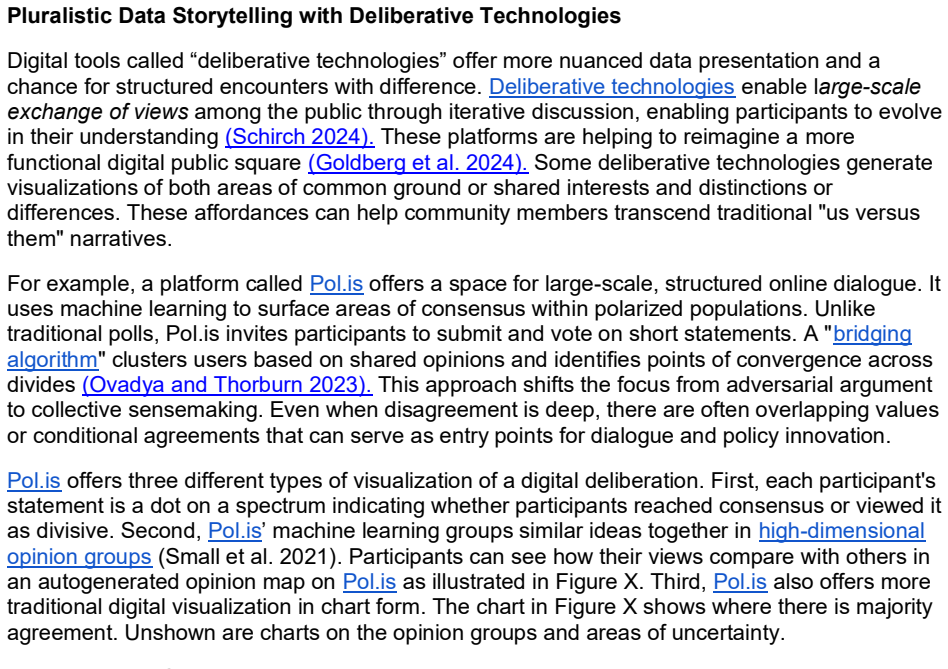
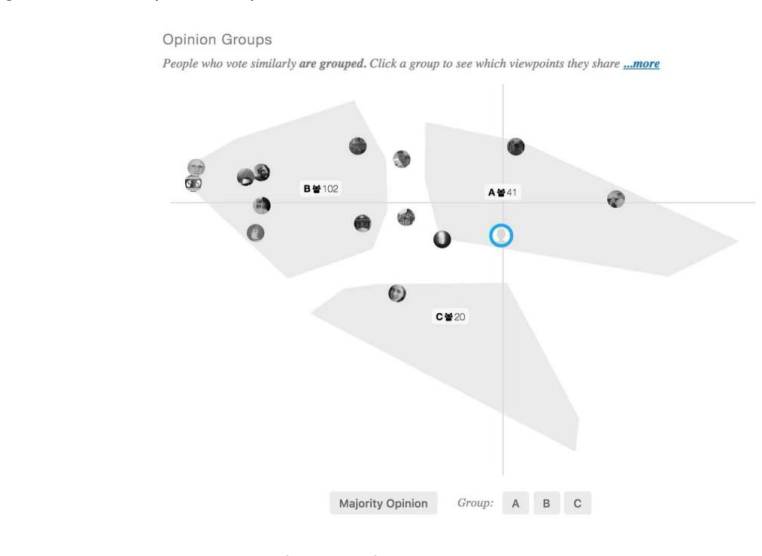
Intentional pluralistic design choices for AI-enabled digital platforms can produce visualizations that emphasize nuance, opinion distribution, and intergroup commonalities. In the examined We the People deliberation, AI synthesized long-form participant inputs into interactive opinion landscapes that humanized diverse viewpoints and revealed hidden areas of substantial broad consensus across congressional districts.
What carries the argument
AI-synthesized interactive opinion landscapes that map high-dimensional opinion spaces from asynchronous deliberative dialogues and highlight both consensus and dissensus.
If this is right
- Platforms adopting these models would move away from contrast-heavy graphics that foster us-versus-them thinking.
- Deliberative processes would surface areas of broad agreement that remain invisible in traditional reporting.
- Democratic culture would gain a scalable method for reducing perceptual gaps between groups.
- AI-supported dialogues could routinely produce shared visual references that make intra-group variation visible.
Where Pith is reading between the lines
- The same mapping approach could be tested on issue-specific debates such as economic policy to check whether consensus patterns hold across domains.
- Media outlets might incorporate these landscapes as alternatives to poll graphics that emphasize splits.
- Long-term use could alter how citizens form estimates of where the public stands on contested values.
Load-bearing premise
That the AI-synthesized opinion landscapes accurately capture and communicate the full range of participant views without introducing new distortions or selection effects.
What would settle it
A study that measures whether exposure to these distribution visualizations actually reduces perceived polarization compared with binary graphics, while checking for measurable AI-induced shifts in how participants view the overall opinion spread.
Figures


read the original abstract
Traditional visual data storytelling relies on binary graphics that depict two simplified groups in conflict. This can increase political polarization by oversimplifying intra-group disagreements and erasing ambiguity and shared ideas or values. This can inadvertently foster "us versus them" thinking. Intentional, pluralistic design choices for AI-enabled digital platforms can produce visualizations that emphasize nuance, opinion distribution, and intergroup commonalities. To demonstrate this potential, we examine deliberative technologies that map high-dimensional opinion spaces and highlight areas of both consensus and dissensus. The paper highlights the We the People deliberation conducted by Jigsaw and the Napolitan Institute in September 2025, which engaged over 2,400 Americans across all 435 congressional districts in an AI-supported, asynchronous dialogue regarding freedom and equality. By utilizing AI to synthesize long-form, text-based participant inputs into interactive "opinion landscapes," the initiative provided an alternative format for pluralistic data storytelling that humanized diverse viewpoints and revealed hidden areas of substantial broad consensus. The paper concludes that shifting from divisive, contrast-heavy visual frameworks to distribution-focused, interactive models represents a highly scalable, low-cost intervention capable of bridging perceptual gaps and cultivating a more resilient, collaborative democratic culture.
Editorial analysis
A structured set of objections, weighed in public.
Referee Report
Summary. The paper describes the We the People deliberation (September 2025, >2400 participants across 435 districts) that used AI to synthesize text inputs into interactive opinion landscapes. It contrasts this distribution-focused, pluralistic visualization approach with traditional binary 'us vs. them' graphics and claims the new format humanizes viewpoints, reveals broad consensus, and offers a scalable intervention for bridging perceptual gaps in democratic discourse.
Significance. If the claimed perceptual and cultural effects were demonstrated, the work would contribute to HCI and civic-tech literature on visualization design for reducing polarization. The case study itself documents a large-scale deployment but provides no outcome data, so its significance remains potential rather than realized.
major comments (1)
- [Abstract and concluding section] Abstract and concluding section: the central claims that the visualizations 'humanized diverse viewpoints and revealed hidden areas of substantial broad consensus' and constitute 'a highly scalable, low-cost intervention capable of bridging perceptual gaps' are unsupported. The manuscript reports no pre/post measures of perceived vs. actual opinion distributions, no viewer or participant attitude-change data, and no comparison against binary visuals.
Simulated Author's Rebuttal
We thank the referee for the detailed review and for identifying the need to distinguish descriptive case-study observations from evaluative claims. The manuscript presents a large-scale deployment as an illustrative example rather than a controlled outcome study. We address the specific concern below.
read point-by-point responses
-
Referee: [Abstract and concluding section] Abstract and concluding section: the central claims that the visualizations 'humanized diverse viewpoints and revealed hidden areas of substantial broad consensus' and constitute 'a highly scalable, low-cost intervention capable of bridging perceptual gaps' are unsupported. The manuscript reports no pre/post measures of perceived vs. actual opinion distributions, no viewer or participant attitude-change data, and no comparison against binary visuals.
Authors: We agree that the manuscript contains no pre/post perceptual measures, attitude-change data, or direct comparisons to binary visualizations, and therefore cannot support causal or outcome claims. The language in the abstract and conclusion was intended to describe the design intent and qualitative features observed during the deliberation (e.g., the emergence of consensus areas in the synthesized landscapes), but we recognize that phrasing such as 'humanized diverse viewpoints' and 'highly scalable... intervention capable of bridging perceptual gaps' risks implying demonstrated effects. We will revise both sections to remove or qualify these statements, reframing the contribution explicitly as a case study of an AI-enabled pluralistic visualization approach and its potential for future evaluation. revision: yes
Circularity Check
No significant circularity; descriptive case study with no derivations
full rationale
The paper presents a descriptive case study of the We the People deliberation and AI-synthesized opinion landscapes without any mathematical derivations, equations, fitted parameters, or predictions. The central claim about bridging perceptual gaps via pluralistic visualizations is offered as a qualitative conclusion from the described project rather than reduced by construction to self-citations, ansatzes, or input data. No load-bearing steps match the enumerated circularity patterns.
Axiom & Free-Parameter Ledger
Reference graph
Works this paper leans on
-
[1]
“Bursting Filter Bubbles in a Digital Age: Opening Minds and Reducing Opinion Polarization through Digital Platforms.” Technology in Society 71 (November): 102136. https://doi.org/10.1016/j.techsoc.2022.102136. Goldberg, Beth, Diana Acosta-Navas, Michiel Bakker, et al
-
[2]
AI and the Future of Digital Public Squares
“AI and the Future of Digital Public Squares.” arXiv:2412.09988. Preprint, arXiv, December
-
[3]
https://doi.org/10.48550/arXiv.2412.09988. Hanel, Paul H. P., Gregory R. Maio, and Antony S. R. Manstead
-
[4]
A New Way to Look at the Data: Similarities Between Groups of People Are Large and Important
“A New Way to Look at the Data: Similarities Between Groups of People Are Large and Important.” Journal of Personality and Social Psychology (United States) 116 (4): 541–62. https://doi.org/10.1037/pspi0000154. Holder, Eli, and Cindy Xiong Bearfield
-
[5]
“Polarizing Political Polls: How Visualization Design Choices Can Shape Public Opinion and Increase Political Polarization.” IEEE Transactions on Visualization and Computer Graphics 30 (1): 1446–56. https://doi.org/10.1109/TVCG.2023.3326512. Jigsaw
-
[6]
Supporting Reflective Public Thought with Considerit
“Supporting Reflective Public Thought with Considerit.” Proceedings of the ACM 2012 Conference on Computer Supported Cooperative Work, February 11, 265–74. https://doi.org/10.1145/2145204.2145249. 13 Markant, Douglas B., Milad Rogha, Alireza Karduni, Ryan Wesslen, and Wenwen Dou
-
[7]
Can Data Visualizations Change Minds? Identifying Mechanisms of Elaborative Thinking and Persuasion
“Can Data Visualizations Change Minds? Identifying Mechanisms of Elaborative Thinking and Persuasion.” 2022 IEEE Workshop on Visualization for Social Good (VIS4Good), October, 1–5. https://doi.org/10.1109/VIS4Good57762.2022.00005. Merkel, Wolfgang, and Anna Lührmann
-
[8]
Resilience of Democracies: Responses to Illiberal and Authoritarian Challenges
“Resilience of Democracies: Responses to Illiberal and Authoritarian Challenges.” Democratization (London) 28 (5): 869–84. https://doi.org/10.1080/13510347.2021.1928081. Ovadya, Aviv, and Luke Thorburn
-
[9]
The Persuasive Power of Data Visualization
“The Persuasive Power of Data Visualization.” IEEE Transactions on Visualization and Computer Graphics 20 (12): 2211–20. https://doi.org/10.1109/TVCG.2014.2346419. Petty, Richard E., and John T. Cacioppo
-
[10]
Elsevier Science & Technology. https://doi.org/10.1016/S0065-2601(08)60214-2. Pew Res. Cent. (Pew Research Center)
-
[11]
Piazza, James A
https://www.pewresearch.org/politics/feature/political-polarization- 1994-2017/. Piazza, James A
1994
-
[12]
Drivers of Political Violence in the United States
“Drivers of Political Violence in the United States.” Journal of Public Policy & Marketing 42 (1): 11–14. https://doi.org/10.1177/07439156221133763. Rutchick, Abraham M., Joshua M. Smyth, and Sara Konrath
-
[13]
Seeing Red (and Blue): Effects of Electoral College Depictions on Political Group Perception
“Seeing Red (and Blue): Effects of Electoral College Depictions on Political Group Perception.” Analyses of Social Issues and Public Policy 9 (1): 269–82. https://doi.org/10.1111/j.1530- 2415.2009.01183.x. Schirch, Lisa
-
[14]
Defending Democracy with Deliberative Technology. Report. University of Notre Dame. https://doi.org/10.7274/25338103.v2. Schirch, Lisa
-
[15]
Polis: Escalar de La Deliberación Mediante El Mapeo de Espacios de Opinión de Alta Dimensión
“Polis: Escalar de La Deliberación Mediante El Mapeo de Espacios de Opinión de Alta Dimensión.” RECERCA. Revista de Pensament i Anàlisi 26 (2). https://doi.org/10.6035/recerca.5516. Stray, Jonathan, Ian Baker, George Beknazar-Yuzbashev, et al
-
[16]
“The Prosocial Ranking Challenge: Reducing Polarization on Social Media without Sacrificing Engagement.” arXiv:2603.19626. Preprint, arXiv, March
-
[17]
https://doi.org/10.48550/arXiv.2603.19626. Tartaglione, JonRobert, and Lee de-Wit
-
[18]
“How the Manner in Which Data Is Visualized Affects and Corrects (Mis)Perceptions of Political Polarization.” British Journal of Social Psychology 64 (1): e12787. https://doi.org/10.1111/bjso.12787. Tufte, Edward R
-
[19]
Megastudy Testing 25 Treatments to Reduce Antidemocratic Attitudes and Partisan Animosity
“Megastudy Testing 25 Treatments to Reduce Antidemocratic Attitudes and Partisan Animosity.” Science 386 (6719): eadh4764. https://doi.org/10.1126/science.adh4764. Yudkin, Daniel Alexander, Stephen Hawkins, and Tim Dixon
-
[20]
The Perception Gap: How False Impressions Are Pulling Americans Apart. More in Common. https://doi.org/10.31234/osf.io/r3h5q
discussion (0)
Sign in with ORCID, Apple, or X to comment. Anyone can read and Pith papers without signing in.