Opening new parameter space windows on galaxy/AGN co-evolution with SKA radio continuum surveys
Pith reviewed 2026-06-25 23:22 UTC · model grok-4.3
The pith
SKAO radio continuum reference surveys will advance galaxy and AGN co-evolution studies by revealing physical properties of sources and calibrating sparser radio observations.
A machine-rendered reading of the paper's core claim, the machinery that carries it, and where it could break.
Core claim
The central claim is that SKAO radio continuum reference surveys, structured as tiered wedding-cake designs plus targeted multi-frequency imaging, will open new parameter space for galaxy/AGN co-evolution research by delivering key physical properties of radio-emitting sources and by providing calibration anchors for observables measured in surveys with sparser spectral coverage.
What carries the argument
Tiered radio continuum reference surveys combined with complementary multi-frequency imaging over extragalactic fields, which together supply spectral information needed to determine source physical properties.
If this is right
- Radio data will constrain the physical mechanisms linking star formation and AGN activity across cosmic time.
- Observables from single-frequency or sparsely sampled radio surveys will become more reliably interpreted through calibration against the multi-frequency reference data.
- Joint coverage of extragalactic fields with other 2030s facilities will create high-value legacy datasets for multi-wavelength co-evolution studies.
- Survey strategies can be adjusted from initial SKAO operations through to full baseline to maximize early science return.
Where Pith is reading between the lines
- The emphasis on multi-frequency calibration could shift planning priorities for other radio arrays toward ensuring at least partial overlap with SKAO fields.
- If the reference surveys succeed, they may enable population studies that test whether current models of AGN feedback over- or under-predict radio source counts at faint levels.
- The described synergies suggest that coordinated field selection with optical and X-ray facilities could become a standard requirement for maximizing return on large radio survey investments.
Load-bearing premise
The SKAO will reach its planned baseline capabilities and that the described multi-frequency imaging over extragalactic fields will be obtained.
What would settle it
If the SKAO reference surveys fail to achieve the planned depths, frequency coverage, or area coverage, the expected gains in physical characterization and calibration for co-evolution studies would not materialize.
Figures
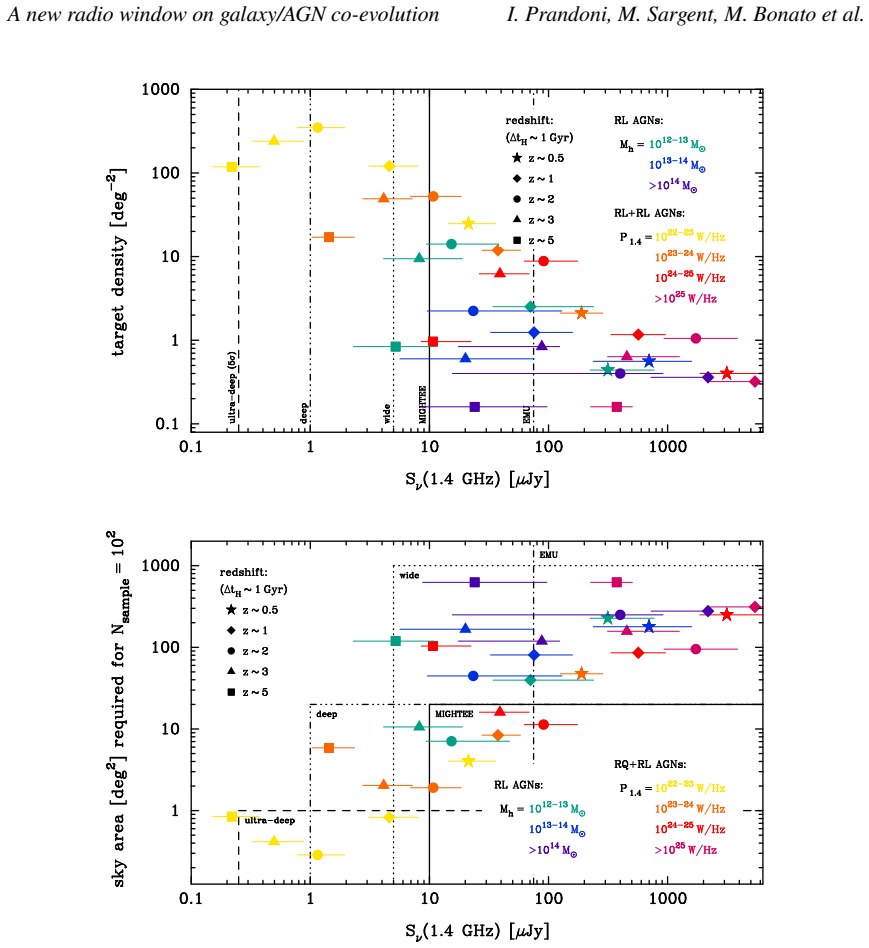
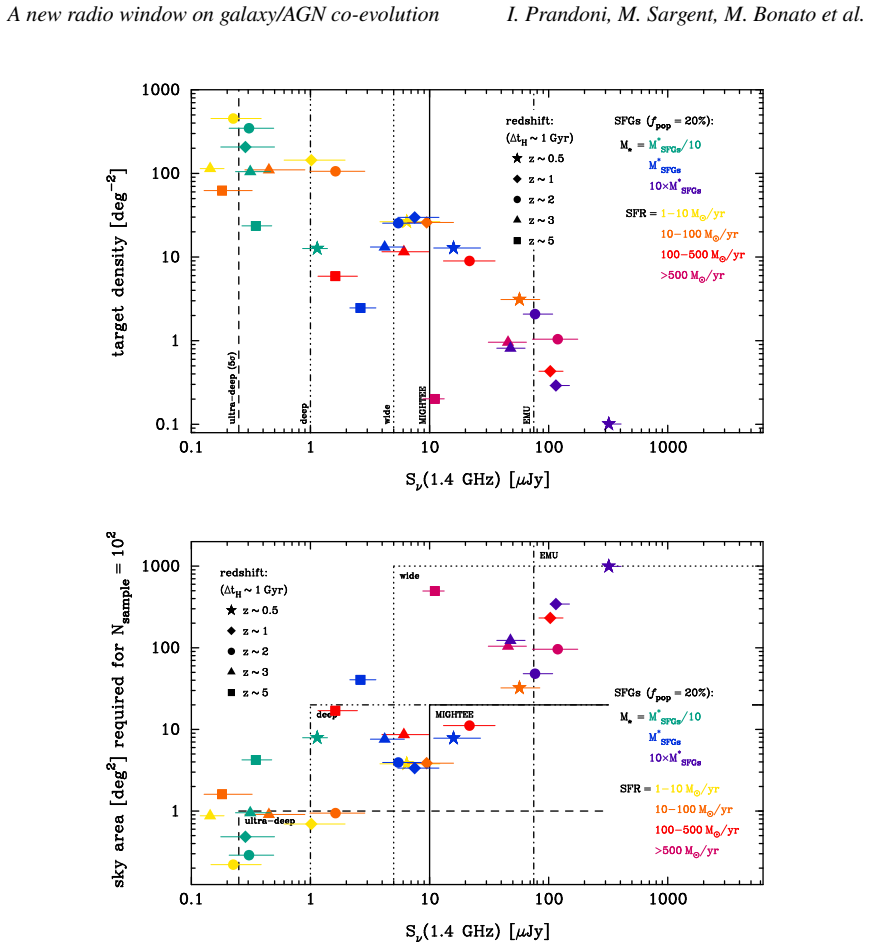
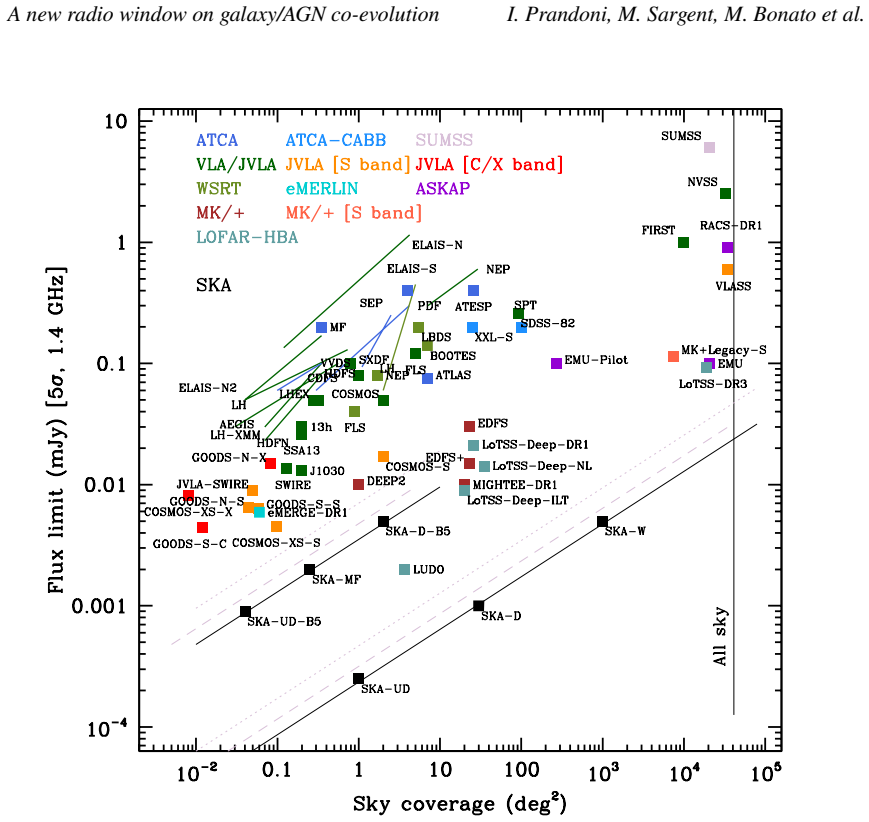
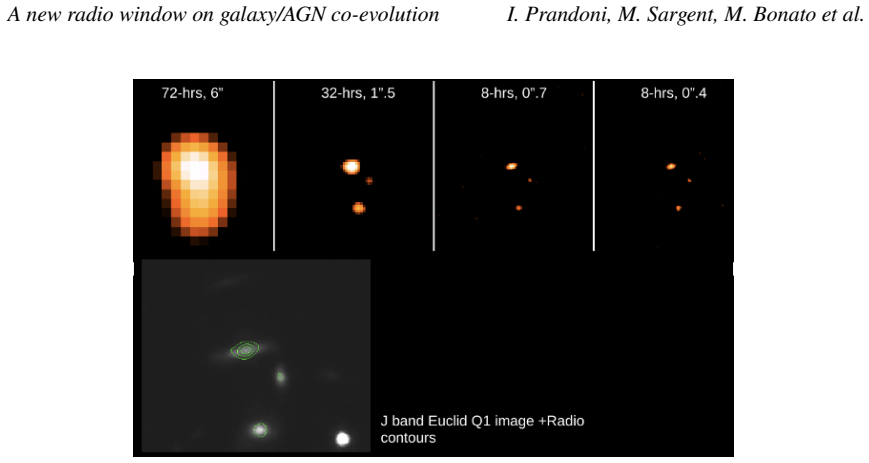
read the original abstract
In this chapter we provide an overview of the science enabled by the SKAO, focusing on galaxy/AGN co-evolution studies. In particular we discuss a number of radio continuum `reference' surveys with the SKAO, highlighting the role they can play in advancing this research field with respect to the pre-SKAO era. Alongside well-explored scenarios for wedding cake-like, tiered extragalactic surveys at specific frequencies, we also address the scope for complementary efforts to obtain deep multi-frequency imaging over parts of (an) extragalactic field(s). In addition to providing key information on the physical properties of the emitting sources, such multi-frequency imaging will make important contributions to the calibration of observables from surveys with sparser radio spectral coverage. In this context, we explore possible pathways that can fully exploit the SKAO from initial (AA*) to baseline capabilities (AA4). Finally, we highlight observational synergies with other major facilities -- for wide field and targeted follow-up science -- that will be operational in the 2030s, and for which joint coverage of extragalactic fields will generate significant legacy value
Editorial analysis
A structured set of objections, weighed in public.
Referee Report
Summary. The manuscript provides an overview of science enabled by the SKAO for galaxy/AGN co-evolution studies via radio continuum reference surveys. It covers tiered 'wedding cake' extragalactic surveys at specific frequencies, the value of complementary deep multi-frequency imaging over extragalactic fields for source physical properties and calibration of sparser-coverage observables, pathways to exploit the observatory from initial (AA*) to baseline (AA4) capabilities, and synergies with other 2030s facilities for legacy value.
Significance. If realized, the described surveys would supply physical-property constraints and calibration support that advance co-evolution studies beyond the pre-SKAO era. As a forward-looking synthesis rather than a source of new empirical results or derivations, the manuscript's primary contribution is to frame the observational strategy and its conditional scientific payoff.
minor comments (1)
- [Abstract] Abstract: the acronyms AA* and AA4 are introduced without definition or reference; a parenthetical gloss or citation to SKAO documentation would aid readers.
Simulated Author's Rebuttal
We thank the referee for their positive assessment of our manuscript and their recommendation to accept. No major comments were raised.
Circularity Check
No significant circularity; overview of future surveys with no derivations or fitted predictions
full rationale
The manuscript is an overview chapter discussing planned SKAO reference surveys and their potential role in galaxy/AGN co-evolution studies. It contains no mathematical derivations, equations, fitted parameters, or predictions that could reduce to self-referential inputs. All claims are explicitly conditional on future observatory performance (AA4 capabilities and complementary multi-frequency imaging) and are scoped as forward-looking science cases rather than empirical results derived from the paper's own content. No self-citation chains, ansatzes, or uniqueness theorems are invoked as load-bearing elements. The central argument stands as self-contained planning discussion without internal reduction to its own assumptions.
Axiom & Free-Parameter Ledger
Reference graph
Works this paper leans on
-
[1]
InAdvancingAstrophysicswiththeSKA–II(AASKAII).2026
J.Afonsoetal. InAdvancingAstrophysicswiththeSKA–II(AASKAII).2026. arXivsearch: Report number AASKAII/Afonso.1. H. S. B. Algera et al.ApJ, 903(2):139, Nov
2026
-
[2]
doi: 10.3847/1538-4357/abb77a. H. S. B. Algera et al. InAdvancing Astrophysics with the SKA – II (AASKAII)
-
[3]
ALMA Observatory
arXiv search: Report number AASKAII/Algera.1. ALMA Observatory. ALMA WSU Factsheet and WSU Program docu- mentation.https://www.almaobservatory.org/en/alma-development/ alma-2030-wideband-sensitivity-upgrade/, 2024a. Accessed 2024-2025. ALMA Observatory. ALMA WSU science case summaries.https://www.almaobservatory. org/en/alma-development/alma-2030-wideband...
2030
-
[4]
doi: 10.1117/12.3018093. O. S. Bait et al. InAdvancing Astrophysics with the SKA – II (AASKAII)
-
[5]
doi: 10.1111/j.1365-2966.2007.11937.x. P. N. Best et al.MNRAS, 523(2):1729–1755, Aug
-
[6]
doi: 10.1093/mnras/stad1308. A. Bonaldi et al.MNRAS, 524(1):993–1007, Sept
-
[7]
doi: 10.1093/mnras/stad1913. M. Bonato et al.MNRAS, 469(2):1912–1923, Aug
-
[8]
doi: 10.1093/mnras/stx974. R. G. Bower et al.MNRAS, 370(2):645–655, Aug
-
[9]
Hydrodynamic models , author =
doi: 10.1111/j.1365-2966.2006.10519.x. R.Braunetal. SKA1Science(Level0)Requirements. TechnicalReportSKA-TEL-SKO-0000007 Rev 2, SKA Organisation,
-
[10]
URLhttps://www.skao.int/sites/default/files/ documents/d1_v2-SKA-TEL-SKO-0000007-02-SKA1_Science_Requirements.pdf. R.Braunetal.arXive-prints,art.arXiv:1912.12699,Dec.2019. doi: 10.48550/arXiv.1912.12699. J.Carpenteretal. TheALMA2030WidebandSensitivityUpgrade,Nov2022. ALMAMemo621. J. J. Condon.Annual Review of Astronomy and Astrophysics, 30:575–611,
-
[11]
29 A new radio window on galaxy/AGN co-evolution I
doi: 10.1146/ annurev.aa.30.090192.003043. 29 A new radio window on galaxy/AGN co-evolution I. Prandoni, M. Sargent, M. Bonato et al. R. T. Coogan et al.MNRAS, 479(1):703–729, Sept
-
[12]
doi: 10.1093/mnras/sty1446. R. T. Coogan et al.MNRAS, 525(3):3413–3438, Nov
-
[13]
doi: 10.1093/mnras/stad2469. L. Costantin et al.ApJ, 946(2):71, Apr
-
[14]
doi: 10.3847/1538-4357/acb926. D. J. Croton.MNRAS, 369(4):1808–1812, July
-
[15]
doi: 10.1111/j.1365-2966.2006.10429.x. E. Daddi et al.ApJL, 846(2):L31, Sept
-
[16]
doi: 10.3847/2041-8213/aa8808. I. Delvecchio et al.A&A, 602:A3, June
-
[17]
C.Dickinsonetal.NewAstronomyReviews,80:1–28,May2018.doi: 10.1016/j.newar.2018.04.001
doi: 10.1051/0004-6361/201629367. C.Dickinsonetal.NewAstronomyReviews,80:1–28,May2018.doi: 10.1016/j.newar.2018.04.001. S. Duivenvoorden et al.MNRAS, 462(1):277–289, Oct
-
[18]
doi: 10.1093/mnras/stw1466. J. S. Dunlop et al.MNRAS, 466(1):861–883, Apr
-
[19]
doi: 10.1093/mnras/stw3088. G. Erfanianfar et al.MNRAS, 455(3):2839–2851, Jan
-
[20]
Euclid Collaboration et al.A&A,
doi: 10.1093/mnras/stv2485. Euclid Collaboration et al.A&A,
-
[21]
URLhttps: //doi.org/10.1051/0004-6361/202554610
doi: 10.1051/0004-6361/202554610. URLhttps: //doi.org/10.1051/0004-6361/202554610. M. Gaspari et al.ApJ, 884(2):169, Oct
-
[22]
doi: 10.3847/1538-4357/ab3c5d. M.J.Hardcastleetal. InAdvancingAstrophysicswiththeSKA–II(AASKAII).2026. arXivsearch: Report number AASKAII/Hardcastle.1. H. Hassani et al.MNRAS, 510(1):11–31, Feb
-
[23]
doi: 10.1093/mnras/stab3202. T. M. Heckman.ApJ, 268:628–631, May
-
[24]
doi: 10.1086/160984. T. M. Heckman and P. N. Best.ARA&A, 52:589–660, Aug
-
[25]
2025, PASA, 42, e071, doi: 10.1017/pasa.2025.10042
doi: 10.1017/pasa.2025.10042. P.F.Hopkinsetal.MNRAS,427(2):968–978,Dec.2012. doi: 10.1111/j.1365-2966.2012.21981.x. M. Jarvis et al. InMeerKAT Science: On the Pathway to the SKA, page 6, Jan
-
[26]
doi: 10.22323/1.277.0006. E. F. Jiménez-Andrade et al.A&A, 625:A114, May
-
[27]
doi: 10.1051/0004-6361/201935178. E. F. Jiménez-Andrade et al.ApJ, 972(1):89, Sept
-
[28]
doi: 10.3847/1538-4357/ad5b5c. W. C. Keel.ApJ, 282:75–84, July
-
[29]
doi: 10.1086/162177. R. Kondapally et al. InAdvancing Astrophysics with the SKA – II (AASKAII)
-
[30]
doi: 10.1088/0004-6256/149/2/61. D. V. Lal, P. Shastri, and D. C. Gabuzda.ApJ, 731(1):68, Apr
-
[32]
doi: 10.3847/1538-4357/adf6dc. S. K. Leslie et al.ApJ, 899(1):58, Aug
-
[33]
K., Schinnerer, E., Liu, D., et al
doi: 10.3847/1538-4357/aba044. F.M.Maccagnietal. InAdvancingAstrophysicswiththeSKA–II(AASKAII).2026. arXivsearch: Report number AASKAII/Maccagni.1. C. Macfarlane et al.MNRAS, 506(4):5888–5907, Oct
-
[34]
doi: 10.1093/mnras/stab1998. M. Magliocchetti.A&ARv, 30(1):6, Dec
-
[35]
doi: 10.1007/s00159-022-00142-1. M. Magliocchetti et al.MNRAS, 464(3):3271–3280, Jan
-
[36]
doi: 10.1093/mnras/stw2541. F. Mazoochi et al.ApJ, 997(1):31, Jan
-
[37]
doi: 10.3847/1538-4357/ae1b93. G. Mazzolari et al.A&A, 687:A120, July
-
[38]
L.McKayetal.arXive-prints,art.arXiv:2509.11846,Sept.2025.doi: 10.48550/arXiv.2509.11846
doi: 10.1051/0004-6361/202348072. L.McKayetal.arXive-prints,art.arXiv:2509.11846,Sept.2025.doi: 10.48550/arXiv.2509.11846. 30 A new radio window on galaxy/AGN co-evolution I. Prandoni, M. Sargent, M. Bonato et al. J. Moldon et al. InAdvancing Astrophysics with the SKA – II (AASKAII)
-
[39]
doi: 10.1051/0004-6361/201834559. C. G. Mundell, P. Ferruit, N. Nagar, and A. S. Wilson.ApJ, 703(1):802–815, Sept
-
[40]
doi: 10.1088/0004-637X/703/1/802. E.Murphyetal. InAdvancingAstrophysicswiththeSquareKilometreArray(AASKA14),page85, Apr
-
[41]
doi: 10.22323/1.215.0085. E. J. Murphy et al.The Astrophysical Journal, 737(2):67, Aug
-
[42]
doi: 10.1088/0004-637X/ 737/2/67. T. W. B. Muxlow et al.MNRAS, 495(1):1188–1208, June
-
[43]
doi: 10.1093/mnras/staa1279. N. M. Nagar, H. Falcke, A. S. Wilson, and J. S. Ulvestad.A&A, 392:53–82, Sept
-
[44]
doi: 10.1051/0004-6361:20020874. N. M. Nagar, H. Falcke, and A. S. Wilson.A&A, 435(2):521–543, May
-
[45]
doi: 10.3847/1538-4357/aaf38a. R. P. Norris et al.PASA, 28(3):215–248, Aug
-
[46]
doi: 10.1071/AS11021. R. P. Norris et al.PASA, 38:e046, Sept
-
[47]
doi: 10.1017/pasa.2021.42. F. Panessa et al. InAdvancing Astrophysics with the SKA – II (AASKAII)
-
[48]
doi: 10.22323/1.215.0067. I. Prandoni et al.The Messenger, 193:14–19, Sep
-
[49]
doi: 10.18727/0722-6691/5361. J. F. Radcliffe et al.A&A, 649:L9, May 2021a. doi: 10.1051/0004-6361/202140791. J. F. Radcliffe et al.A&A, 649:A27, May 2021b. doi: 10.1051/0004-6361/202038591. J. Rhodes et al.ApJSS, 233(2):21, Dec
-
[50]
doi: 10.3847/1538-4365/aa96b0. J. Sabater et al.A&A, 622:A17, Feb
-
[51]
doi: 10.1051/0004-6361/201833883. M. Shuntov et al.A&A, 664:A61, Aug
-
[52]
doi: 10.1051/0004-6361/202243136. J. Silk and G. A. Mamon.Research in Astronomy and Astrophysics, 12(8):917–946, Aug
-
[53]
doi: 10.1088/1674-4527/12/8/004. R. S. Somerville and R. Davé.ARA&A, 53:51–113, Aug
-
[54]
doi: 10.1146/ annurev-astro-082812-140951. F. Tabatabaei et al. In F. Tabatabaei, B. Barbuy, and Y.-S. Ting, editors,Early Disk-Galaxy FormationfromJWSTtotheMilkyWay,volume377ofIAUSymposium,pages43–47,Jan.2024. doi: 10.1017/S1743921323001680. F. Tabatabaei et al.ApJ, 989(1):44, Aug
-
[55]
doi: 10.3847/1538-4357/ade233. F. S. Tabatabaei et al.ApJ, 836(2):185, Feb
-
[56]
doi: 10.3847/1538-4357/836/2/185. F. S. Tabatabaei, P. Minguez, M. A. Prieto, and J. A. Fernández-Ontiveros.Nature Astronomy, 2: 83–89, Nov
-
[57]
doi: 10.1038/s41550-017-0298-7. F.S.Tabatabaeietal. InAdvancingAstrophysicswiththeSKA–II(AASKAII).2026. arXivsearch: Report number AASKAII/Tabatabaei.1. L. J. Tacconi, R. Genzel, and A. Sternberg.ARA&A, 58:157–203, Aug
-
[58]
31 A new radio window on galaxy/AGN co-evolution I
doi: 10.3847/1538-4357/ab32e7. 31 A new radio window on galaxy/AGN co-evolution I. Prandoni, M. Sargent, M. Bonato et al. C. M. Urry and P. Padovani.PASP, 107:803, Sept
-
[59]
doi: 10.1086/133630. S. D. van Dyk and L. C. Ho. In J. A. Zensus, G. B. Taylor, and J. M. Wrobel, editors,IAU Colloquium 164: Radio Emission from Galactic and Extragalactic Compact Sources, volume 144 ofAstronomical Society of the Pacific Conference Series, page 205, Jan
work page internal anchor Pith review doi:10.1086/133630
-
[60]
doi: 10.1093/mnras/stx2486. J. R. Weaver et al.A&A, 677:A184, Sept
-
[61]
doi: 10.1051/0004-6361/202245581. R. H. Wechsler and J. L. Tinker.ARA&A, 56:435–487, Sept
-
[62]
doi: 10.1093/mnras/stac2140. G. Zasowski et al.arXiv e-prints, art. arXiv:2505.10574, May
-
[63]
doi: 10.48550/arXiv.2505. 10574. S. Zhang, B. Liu, and V. Bromm.MNRAS, 528(1):180–197, Feb
-
[64]
doi: 10.1093/mnras/ stad3986. 32
discussion (0)
Sign in with ORCID, Apple, or X to comment. Anyone can read and Pith papers without signing in.