REVIEW 1 major objections 2 minor 300 references
ConSolv: Solvent-Conditional Machine Learning Implicit Solvent Potential
T0 review · 1 major / 2 minor · reviewed 2026-06-25 · grok-4.3
Pith's one-line read A single attention-conditioned MLP predicts solvation free energies across 66 organic solvents using combined experimental and ab initio data.
desk verdict ConSolv adds an attention-based solvent conditioner to an MLP so one model covers 66 organic solvents instead of water-only setups. read the letter →
The pith
A machine-rendered reading of the paper's core claim, the machinery that carries it, and where it could break.
The reading
What carries the argument
attention-based solvent-embedding block that explicitly incorporates solvent effects on solute interactions
What would settle it
Measure solvation free energies for a solvent outside the original 66 and check whether the model's predictions deviate systematically from the new experimental values.
Extended reading notes
Core claim
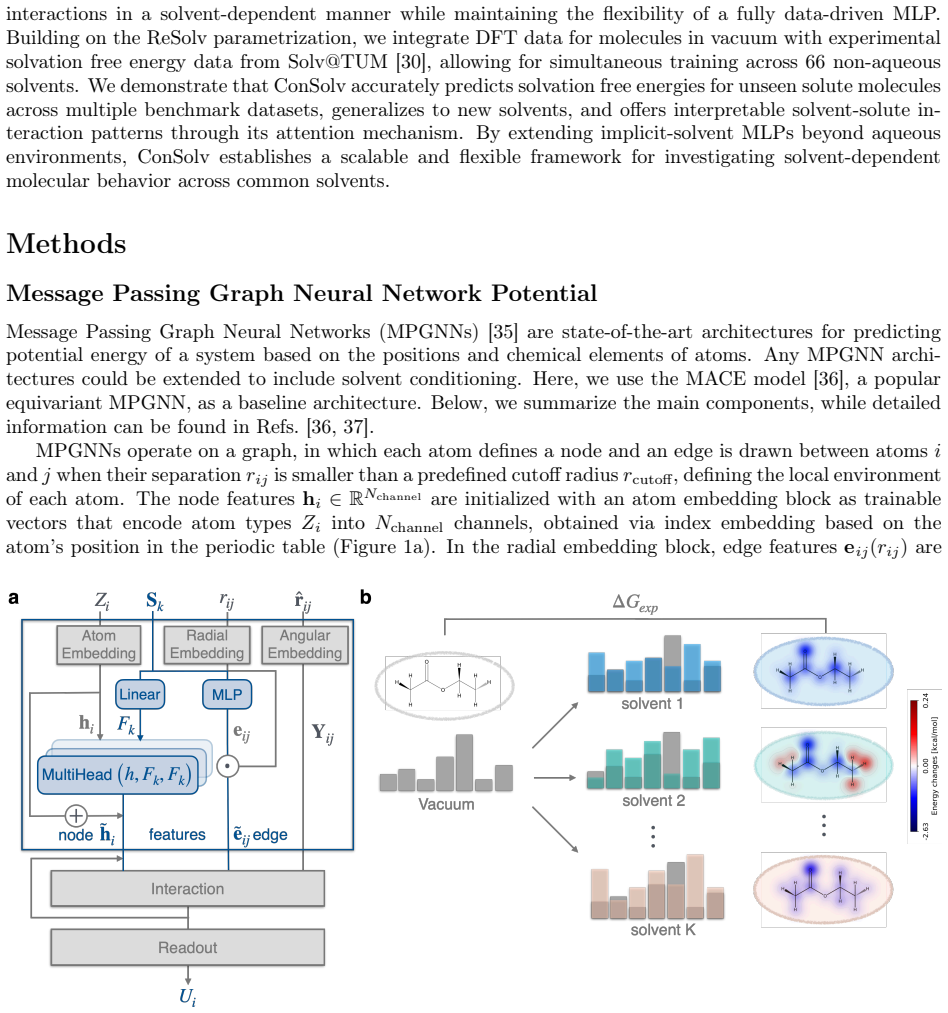
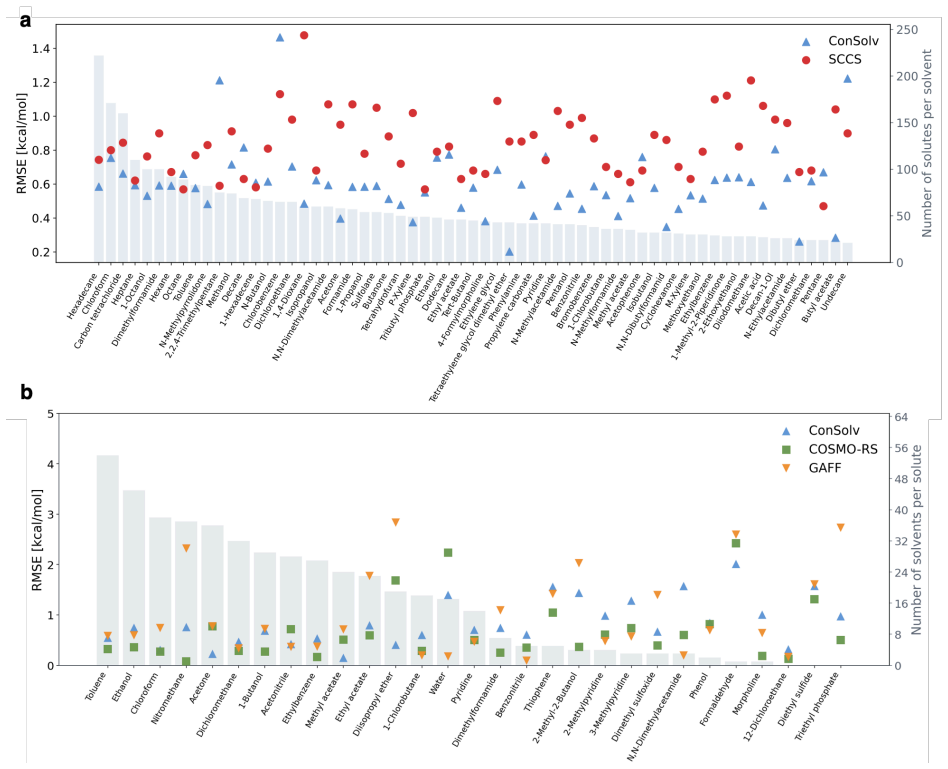
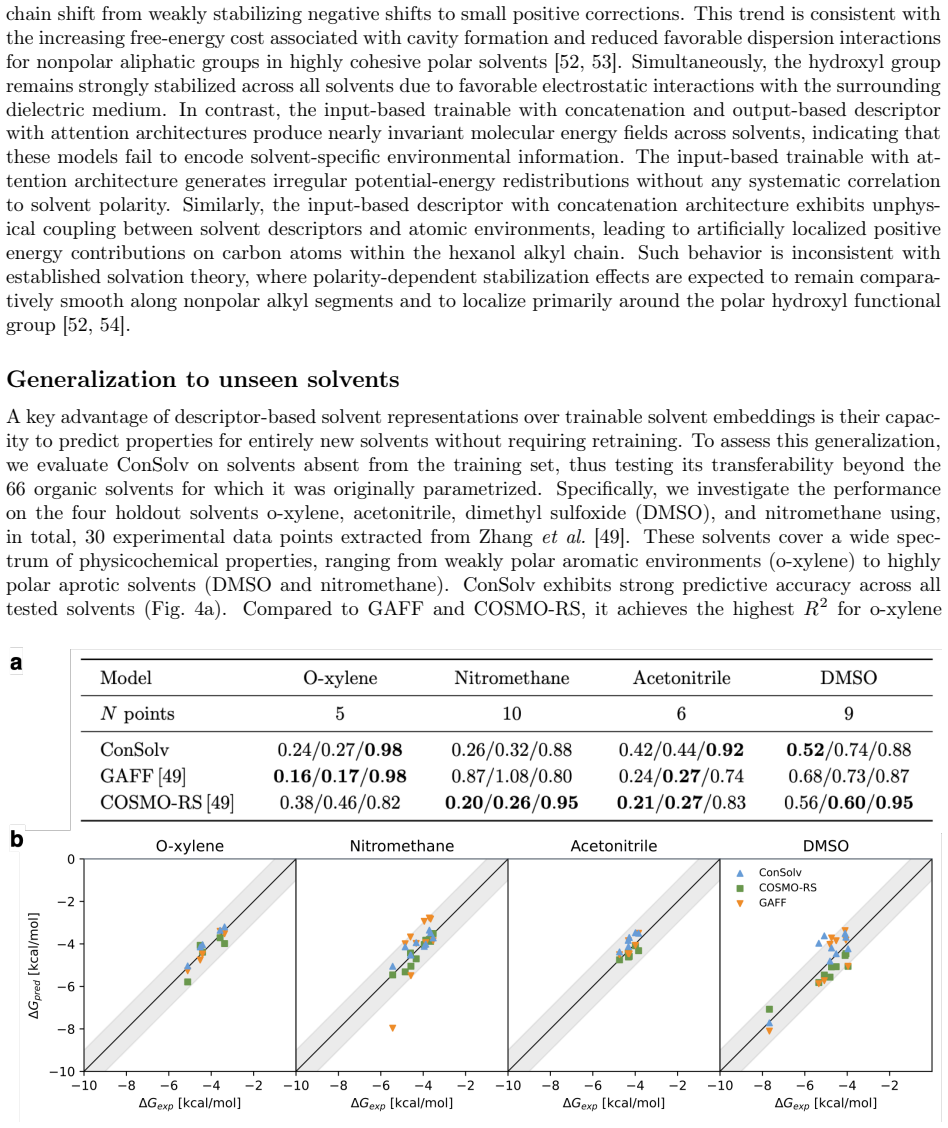
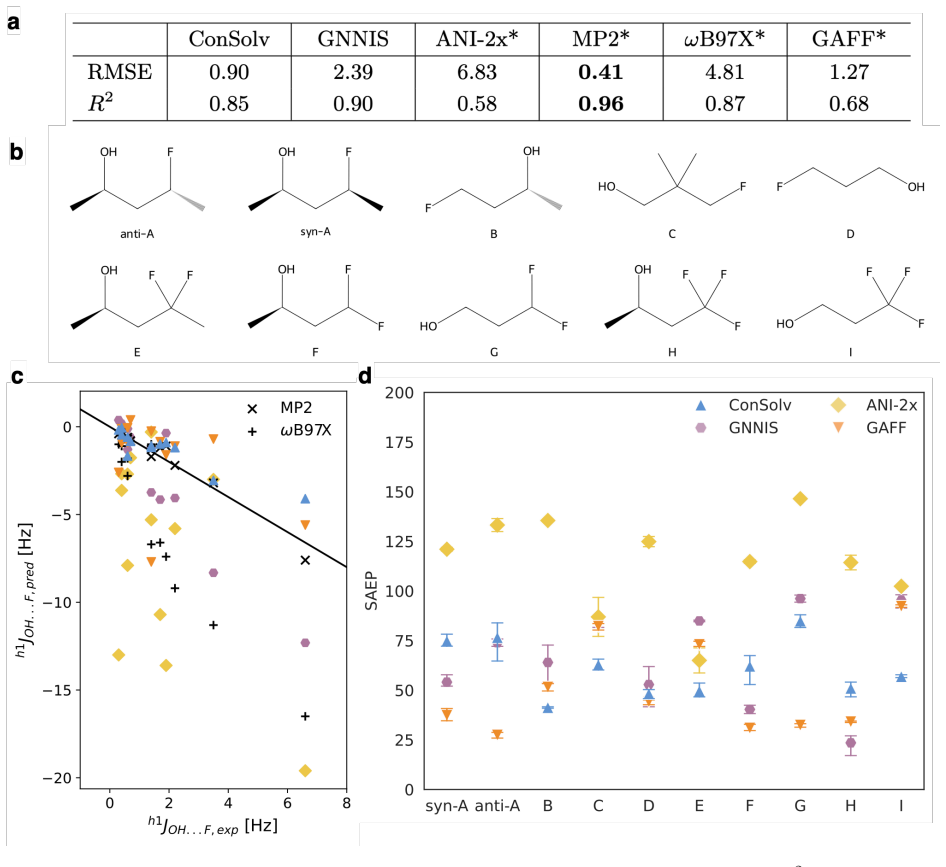
ConSolv is a solvent-conditional MLP that inserts an attention-based solvent-embedding block to modulate solute interactions according to solvent identity. Trained on a combination of experimental solvation free energy data and ab initio calculations, a single set of network weights becomes transferable across 66 common organic solvents, outperforming classical explicit solvent methods and selected ab initio implicit solvent approaches on multiple solvation free energy benchmarks while generalizing to solvents absent from training. The same model also produces NMR chemical shifts for γ-fluorohydrin molecules in chloroform that agree closely with experiment.
Load-bearing premise
The attention-based solvent-embedding block captures the dominant solvent-dependent effects on solute interactions well enough that one set of weights stays accurate for both seen and unseen solvents without per-solvent retraining.
Editorial extensions
If this is right
- Solvation free energy predictions improve over both classical explicit-solvent simulations and selected ab initio implicit models on standard benchmarks.
- The model produces solvation free energies for solvents not encountered during training without additional fitting.
- NMR chemical shifts computed with the implicit solvent model match experimental values for γ-fluorohydrin in chloroform.
- The architecture supports extension to larger chemical spaces or different training data mixtures while retaining a single weight set.
Reading between the lines
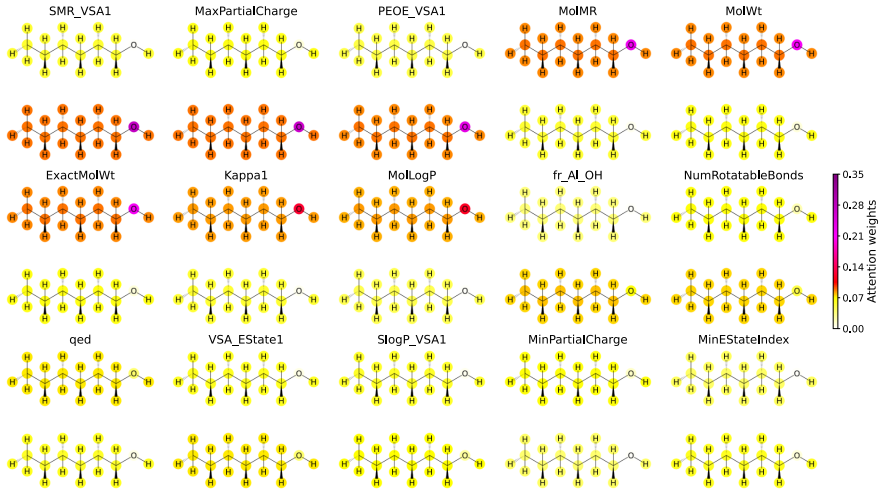
- The attention weights inside the solvent-embedding block could be inspected to rank which solvent properties most influence particular solute interactions.
- Replacing the current training mixture with data from a narrower solvent class might improve accuracy inside that class at the cost of broader transferability.
- Coupling the model to explicit solvent molecules only in the first solvation shell could test whether the implicit treatment already captures the dominant long-range effects.
Editorial analysis
A structured set of objections, weighed in public.
Referee Report
Summary. The manuscript introduces ConSolv, a solvent-conditional MLP architecture featuring an attention-based solvent-embedding block. Trained on a mixture of experimental solvation free energy data and ab initio calculations, the model is presented as transferable across 66 common organic solvents, outperforming classical explicit-solvent methods and selected ab initio implicit-solvent approaches on multiple solvation free energy benchmarks while also generalizing to unseen solvents and reproducing experimental NMR shifts for γ-fluorohydrin in chloroform.
Significance. If the reported transferability and benchmark outperformance are substantiated, the work would meaningfully extend machine-learned implicit solvent models beyond water to a chemically diverse set of organic solvents relevant to synthesis and energy storage, while the attention mechanism provides a route to interpretable solvent-dependent interactions.
major comments (1)
- The central claims of outperformance and generalization to unseen solvents rest on benchmark comparisons whose construction, data splits, error bars, and statistical controls are not visible in the provided text; without these, it is impossible to determine whether the reported gains survive proper controls or reduce to differences in training data composition.
minor comments (2)
- [Abstract] The abstract states that the model 'outperforms classical explicit solvent methods' but does not name the specific methods, force fields, or quantitative metrics (e.g., MAE or RMSE values) used for comparison.
- [Abstract] No information is given on the dimensionality of the solvent embedding, the attention mechanism implementation, or how solvent identity is encoded as input to the MLP.
Simulated Author's Rebuttal
We thank the referee for highlighting the need for greater transparency in our benchmark methodology. We will revise the manuscript to include the requested details on data construction, splits, error bars, and controls, ensuring the claims can be properly evaluated.
read point-by-point responses
-
Referee: The central claims of outperformance and generalization to unseen solvents rest on benchmark comparisons whose construction, data splits, error bars, and statistical controls are not visible in the provided text; without these, it is impossible to determine whether the reported gains survive proper controls or reduce to differences in training data composition.
Authors: We agree that the current text lacks sufficient methodological detail on the benchmarks. In revision we will add an expanded Methods section (and supplementary tables) that explicitly describes: (i) the full composition and sources of the training set (experimental solvation free energies vs. ab initio calculations, with counts per solvent), (ii) the train/validation/test splits, including the precise protocol used to designate 'unseen' solvents, (iii) how error bars were computed (standard deviation across random seeds or bootstrap resampling), and (iv) the statistical tests applied to compare ConSolv against baselines. We will also clarify that all reported test-set molecules and solvents were strictly held out from training. These additions will allow readers to assess whether performance differences arise from the architecture or from data composition. revision: yes
Circularity Check
No significant circularity; model training and generalization claims are independent of test benchmarks
full rationale
The paper trains a solvent-conditional MLP on a combination of experimental solvation free energy data and ab initio calculations, then evaluates transferability on held-out solvents and external NMR benchmarks. No equations, self-citations, or uniqueness theorems are invoked that would make reported predictions equivalent to the training inputs by construction. The attention-based embedding and mixed-data training strategy constitute an architectural choice whose performance is assessed against independent observables rather than being tautological.
Assumptions & free parameters
Cite this review
Pith. "Pith review of ConSolv: Solvent-Conditional Machine Learning Implicit Solvent Potential." pith.science (2026). https://pith.science/paper/GGJR4JQD
@misc{pith2026260624983,
  author       = {Pith},
  title        = {Pith review of: ConSolv: Solvent-Conditional Machine Learning Implicit Solvent Potential},
  year         = {2026},
  howpublished = {\url{https://pith.science/paper/GGJR4JQD}},
  note         = {Machine review of arXiv:2606.24983}
}
abstract
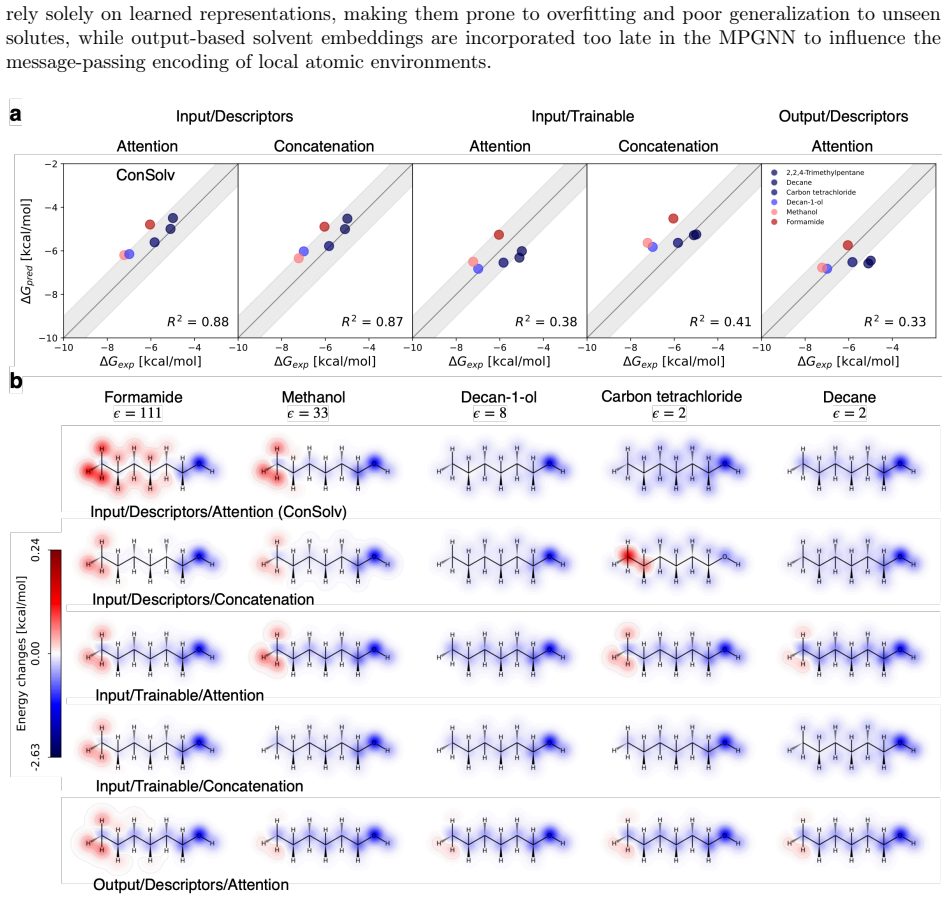
Implicit solvent machine learning potentials (MLPs) offer a powerful route to bridging the gap between accuracy and efficiency in molecular simulations. However, existing models have largely focused on aqueous environments, overlooking the diverse and important roles of non-aqueous solvents in areas such as organic synthesis and battery technology. Here, we present ConSolv, a solvent-conditional MLP architecture that explicitly incorporates solvent effects on solute interactions through an attention-based solvent-embedding block. By combining experimental solvation free energy data with ab initio data, we train a single implicit solvent MLP that is transferable across 66 common organic solvents. ConSolv outperforms classical explicit solvent methods and selected ab initio implicit solvent approaches across multiple solvation free energy benchmarks, and demonstrates generalization to unseen solvents. Beyond solvation free energies, the model shows close agreement with experimental nuclear magnetic resonance (NMR) data for $\gamma$-fluorohydrin molecules in chloroform. ConSolv's architecture is readily extensible to broader chemical spaces and alternative training strategies, while its attention-based design supports explainable artificial intelligence (AI) analysis that can help elucidate complex, solvent-dependent molecular interactions.
Figures
Figures from the paper (3 more)
Reference graph
Works this paper leans on
-
[1]
Uncertainty Quantification for Molecular Models via Stochastic Gradient MCMC , pages =
Thaler, Stephan and Zavadlav, Julija , booktitle =. Uncertainty Quantification for Molecular Models via Stochastic Gradient MCMC , pages =
-
[2]
ACS Nano , year=
Tuning the Dielectric Response of Water in Nanoconfinement through Surface Wettability , author=. ACS Nano , year=
-
[3]
Zavadlav, Julija and Arampatzis, Georgios and Koumoutsakos, Petros , title =. Sci. Rep. , volume =. 2019 , doi =
2019
-
[4]
Open-boundary molecular dynamics of a DNA molecule in a hybrid explicit/implicit salt solution , author=. Biophys. J. , volume=. 2018 , publisher=
2018
-
[5]
Multiscale simulation of protein hydration using the SWINGER dynamical clustering algorithm , author=. J. Chem. Theory Comput. , volume=. 2018 , publisher=
2018
-
[6]
Molecular dynamics simulation of high density DNA arrays , author=. Comput. , volume=. 2018 , publisher=
2018
-
[7]
Adaptive resolution simulations coupling atomistic water to dissipative particle dynamics , author=. J. Chem. Phys. , volume=. 2017 , publisher=
2017
-
[8]
Order and interactions in DNA arrays: Multiscale molecular dynamics simulation , author=. Sci. Rep. , volume=. 2017 , publisher=
2017
Show all 300 references
-
[9]
Adaptive resolution simulation of an atomistic DNA molecule in MARTINI salt solution , author=. Eur. Phys. J. Spec. Top. , volume=. 2016 , publisher=
2016
-
[10]
Adaptive resolution simulation of a DNA molecule in salt solution , author=. J. Chem. Theory Comput. , volume=. 2015 , publisher=
2015
-
[11]
Interface Focus , volume=
SWINGER: a clustering algorithm for concurrent coupling of atomistic and supramolecular liquids , author=. Interface Focus , volume=. 2019 , publisher=
2019
-
[12]
Adaptive resolution simulation of supramolecular water: the concurrent making, breaking, and remaking of water bundles , author=. J. Chem. Theory Comput. , volume=. 2016 , publisher=
2016
-
[13]
Adaptive resolution simulation of polarizable supramolecular coarse-grained water models , author=. J. Chem. Phys. , volume=. 2015 , publisher=
2015
-
[14]
Adaptive resolution simulation of an atomistic protein in MARTINI water , author=. J. Chem. Phys. , volume=. 2014 , publisher=
2014
-
[15]
Multiscale simulation of soft matter: From scale bridging to adaptive resolution , author=. Annu. Rev. Phys. Chem. , volume=. 2008 , publisher=
2008
-
[16]
Discovery of self-assembling -conjugated peptides by active learning-directed coarse-grained molecular simulation , author=. J. Phys. Chem. B , volume=. 2020 , publisher=
2020
-
[17]
A guide to supramolecular polymerizations , author=. Polym. Chem. , volume=. 2020 , publisher=
2020
-
[18]
Calculation of effective interaction potentials from radial distribution functions: A reverse Monte Carlo approach , author=. Phys. Rev. E , volume=. 1995 , publisher=
1995
-
[19]
Deriving effective mesoscale potentials from atomistic simulations , author=. J. Comput. Chem. , volume=. 2003 , publisher=
2003
-
[20]
Faraday Discuss
Systematic coarse-graining of molecular models by the Newton inversion method , author=. Faraday Discuss. , volume=. 2010 , publisher=
2010
-
[21]
EPL , volume=
Interatomic potentials from first-principles calculations: the force-matching method , author=. EPL , volume=. 1994 , publisher=
1994
-
[22]
A multiscale coarse-graining method for biomolecular systems , author=. J. Phys. Chem. B , volume=. 2005 , publisher=
2005
-
[23]
Fitting coarse-grained distribution functions through an iterative force-matching method , author=. J. Chem. Phys. , volume=. 2013 , publisher=
2013
-
[24]
The relative entropy is fundamental to multiscale and inverse thermodynamic problems , author=. J. Chem. Phys. , volume=. 2008 , publisher=
2008
-
[25]
Relative entropy as a universal metric for multiscale errors , author=. Phys. Rev. E , volume=. 2010 , publisher=
2010
-
[26]
Top-down Multiscale Approach To Simulate Peptide Self-Assembly from Monomers , author=. J. Chem. Theory Comput. , volume=. 2019 , publisher=
2019
-
[27]
Polymers , volume=
Mesoscale Simulations of Polymer Solution Self-Assembly: Selection of Model Parameters within an Implicit Solvent Approximation , author=. Polymers , volume=. 2021 , publisher=
2021
-
[28]
Evaluating Classical Force Fields against Experimental Cross-Solvation Free Energies , author=. J. Chem. Theory Comput. , volume=. 2020 , publisher=
2020
-
[29]
Combining molecular dynamics and machine learning to predict self-solvation free energies and limiting activity coefficients , author=. J. Chem. Inf. Model. , volume=. 2020 , publisher=
2020
-
[30]
Validation of the generalized force fields GAFF, CGenFF, OPLS-AA, and PRODRGFF by testing against experimental osmotic coefficient data for small drug-like molecules , author=. J. Chem. Inf. Model. , volume=. 2019 , publisher=
2019
-
[31]
A biomolecular force field based on the free enthalpy of hydration and solvation: the GROMOS force-field parameter sets 53A5 and 53A6 , author=. J. Comput. Chem. , volume=. 2004 , publisher=
2004
-
[32]
Developing force fields when experimental data is sparse: AMBER/GAFF-compatible parameters for inorganic and alkyl oxoanions , author=. Phys. Chem. Chem. Phys. , volume=. 2017 , publisher=
2017
-
[33]
Optimizing solute--water van der waals interactions to reproduce solvation free energies , author=. J. Phys. Chem. B , volume=. 2012 , publisher=
2012
-
[34]
FreeSolv: a database of experimental and calculated hydration free energies, with input files , author=. J. Comput. Aided Mol. Des. , volume=. 2014 , publisher=
2014
-
[35]
Absolute hydration free energies of blocked amino acids: implications for protein solvation and stability , author=. Biophys. J. , volume=. 2013 , publisher=
2013
-
[36]
Fluid Phase Equilib
The correlation and prediction of infinite dilution activity coefficients of compounds in water at 298.15 K , author=. Fluid Phase Equilib. , volume=. 2017 , publisher=
2017
-
[37]
Estimation of solvation quantities from experimental thermodynamic data: Development of the comprehensive compSol databank for pure and mixed solutes , author=. J. Phys. Chem. Ref. Data , volume=. 2017 , publisher=
2017
-
[38]
Solvation thermodynamics of organic molecules by the molecular integral equation theory: approaching chemical accuracy , author=. Chem. Rev. , volume=. 2015 , publisher=
2015
-
[39]
Infinite dilution activity coefficients as constraints for force field parametrization and method development , author=. J. Chem. Theory Comput. , volume=. 2019 , publisher=
2019
-
[40]
SAMPL4, a blind challenge for computational solvation free energies: the compounds considered , author=. J. Comput. Aided Mol. Des. , volume=. 2014 , publisher=
2014
-
[41]
Model performances evaluated for infinite dilution activity coefficients prediction at 298.15 K , author=. Ind. Eng. Chem. Res. , volume=. 2019 , publisher=
2019
-
[42]
Approaches for calculating solvation free energies and enthalpies demonstrated with an update of the FreeSolv database , author=. J. Chem. Eng. Data , volume=. 2017 , publisher=
2017
-
[43]
Extremely precise free energy calculations of amino acid side chain analogs: Comparison of common molecular mechanics force fields for proteins , author=. J. Chem. Phys. , volume=. 2003 , publisher=
2003
-
[44]
Structure and dynamics of the homologous series of alanine peptides: a joint molecular dynamics/NMR study , author=. J. Am. Chem. Soc. , volume=. 2007 , publisher=
2007
-
[45]
PhysNet: a neural network for predicting energies, forces, dipole moments, and partial charges , author=. J. Chem. Theory Comput. , volume=. 2019 , publisher=
2019
-
[46]
Predicting small-molecule solvation free energies: an informal blind test for computational chemistry , author=. J. Med. Chem. , volume=. 2008 , publisher=
2008
-
[47]
Uncovering Differences in Hydration Free Energies and Structures for Model Compound Mimics of Charged Side Chains of Amino Acids , author=. J. Phys. Chem. B , volume=. 2021 , publisher=
2021
-
[48]
The effect of increasing dipolar distance on the activities of aliphatic amino acids in aqueous solution at twenty-five degrees , author=
Thermodynamic properties of solutions of amino acids and related substances IV. The effect of increasing dipolar distance on the activities of aliphatic amino acids in aqueous solution at twenty-five degrees , author=. J. Biol. Chem. , volume=. 1940 , publisher=
1940
-
[49]
Measuring and modeling activity coefficients in aqueous amino-acid solutions , author=. Ind. Eng. Chem. Res. , volume=. 2011 , publisher=
2011
-
[50]
Osmotic pressure simulations of amino acids and peptides highlight potential routes to protein force field parameterization , author=. J. Phys. Chem. B , volume=. 2016 , publisher=
2016
-
[51]
PLoS Comput
Are current atomistic force fields accurate enough to study proteins in crowded environments? , author=. PLoS Comput. Biol. , volume=. 2014 , publisher=
2014
-
[52]
Molecular dynamics simulations of intrinsically disordered proteins: force field evaluation and comparison with experiment , author=. J. Chem. Theory Comput. , volume=. 2015 , publisher=
2015
-
[53]
Improved parameterization of amine--carboxylate and amine--phosphate interactions for molecular dynamics simulations using the CHARMM and AMBER force fields , author=. J. Chem. Theory Comput. , volume=. 2016 , publisher=
2016
-
[54]
Molecular dynamics simulations of 441 two-residue peptides in aqueous solution: Conformational preferences and neighboring residue effects with the Amber ff99SB-ildn-NMR force field , author=. J. Chem. Theory Comput. , volume=. 2015 , publisher=
2015
-
[55]
Are current molecular dynamics force fields too helical? , author=. Biophys. J. , volume=. 2008 , publisher=
2008
-
[56]
CHARMM36m: an improved force field for folded and intrinsically disordered proteins , author=. Nat. Methods , volume=. 2017 , publisher=
2017
-
[57]
Optimization of the additive CHARMM all-atom protein force field targeting improved sampling of the backbone , and side-chain 1 and 2 dihedral angles , author=. J. Chem. Theory Comput. , volume=. 2012 , publisher=
2012
-
[58]
ff19SB: Amino-acid-specific protein backbone parameters trained against quantum mechanics energy surfaces in solution , author=. J. Chem. Theory Comput. , volume=. 2019 , publisher=
2019
-
[59]
Residue-specific force field improving the sample of intrinsically disordered proteins and folded proteins , author=. J. Chem. Inf. Model. , volume=. 2019 , publisher=
2019
-
[60]
Machine learning of solvent effects on molecular spectra and reactions , author=. Chem. Sci. , volume=. 2021 , publisher=
2021
-
[61]
Bioinformatics , volume=
Generalized Born radii computation using linear models and neural networks , author=. Bioinformatics , volume=. 2020 , publisher=
2020
-
[62]
Machine Learning Implicit Solvation for Molecular Dynamics , author=. J. Chem. Phys. , volume=
-
[63]
Machine learning-guided approach for studying solvation environments , author=. J. Chem. Theory Comput. , volume=. 2019 , publisher=
2019
-
[64]
Variational optimization of an all-atom implicit solvent force field to match explicit solvent simulation data , author=. J. Chem. Theory Comput. , volume=. 2013 , publisher=
2013
-
[65]
Machine learning antimicrobial peptide sequences: Some surprising variations on the theme of amphiphilic assembly , author=. Curr. Opin. Colloid Interface Sci. , volume=. 2018 , publisher=
2018
-
[66]
Prediction of amphiphilic cell-penetrating peptide building blocks from protein-derived amino acid sequences for engineering of drug delivery nanoassemblies , author=. J. Phys. Chem. B , volume=. 2020 , publisher=
2020
-
[67]
https://doi.org/10.21203/rs.3.rs-505801/v1 , year=
Self-assembling Peptide Discovery: Overcoming Human Bias With Machine Learning , author=. https://doi.org/10.21203/rs.3.rs-505801/v1 , year=
-
[68]
Beyond Tripeptides Two-Step Active Machine Learning for Very Large Data sets , author=. J. Chem. Theory Comput. , volume=. 2021 , publisher=
2021
-
[69]
Biomacromolecules , volume=
A comprehensive study on self-assembly and gelation of C13-dipeptides—from design strategies to functionalities , author=. Biomacromolecules , volume=. 2019 , publisher=
2019
-
[70]
Molecular co-assembly as a strategy for synergistic improvement of the mechanical properties of hydrogels , author=. Chem. Commun. , volume=. 2017 , publisher=
2017
-
[71]
Biomacromolecules , volume=
Coassembly of C13-Dipeptides: Gelations from Solutions and Precipitations , author=. Biomacromolecules , volume=. 2020 , publisher=
2020
-
[72]
Nanoscale , volume=
The effect of self-sorting and co-assembly on the mechanical properties of low molecular weight hydrogels , author=. Nanoscale , volume=. 2014 , publisher=
2014
-
[73]
Nanoscale , volume=
Expanding the structural diversity of peptide assemblies by coassembling dipeptides with diphenylalanine , author=. Nanoscale , volume=. 2020 , publisher=
2020
-
[74]
Virtual screening for dipeptide aggregation: Toward predictive tools for peptide self-assembly , author=. J. Phys. Chem. Lett. , volume=. 2011 , publisher=
2011
-
[75]
Tunable morphology and functionality of multicomponent self-assembly: A review , author=. Mater. Des. , volume=. 2021 , publisher=
2021
-
[76]
Biomacromolecules , volume=
Self-assembling hydrogels based on a complementary host--guest peptide amphiphile pair , author=. Biomacromolecules , volume=. 2019 , publisher=
2019
-
[77]
How should multicomponent supramolecular gels be characterised? , author=. Chem. Soc. Rev. , volume=. 2018 , publisher=
2018
-
[78]
Multicomponent self-assembly as a tool to harness new properties from peptides and proteins in material design , author=. Chem. Soc. Rev. , volume=. 2018 , publisher=
2018
-
[79]
Theranostics , volume=
Peptide-modulated self-assembly as a versatile strategy for tumor supramolecular nanotheranostics , author=. Theranostics , volume=. 2019 , publisher=
2019
-
[80]
Computational prediction of tripeptide-dipeptide co-assembly , author=. Mol. Phys. , volume=. 2019 , publisher=
2019
-
[81]
ACS Nano , volume=
Expanding the nanoarchitectural diversity through aromatic di-and tri-peptide coassembly: Nanostructures and molecular mechanisms , author=. ACS Nano , volume=. 2016 , publisher=
2016
-
[82]
Exploring the sequence space for (tri-) peptide self-assembly to design and discover new hydrogels , author=. Nat. Chem. , volume=. 2015 , publisher=
2015
-
[83]
Minimalistic peptide supramolecular co-assembly: expanding the conformational space for nanotechnology , author=. Chem. Soc. Rev. , volume=. 2018 , publisher=
2018
-
[84]
ANI-1, A data set of 20 million calculated off-equilibrium conformations for organic molecules , author=. Sci. Data , volume=. 2017 , publisher=
2017
-
[85]
Quantum chemistry structures and properties of 134 kilo molecules , author=. Sci. Data , volume=. 2014 , publisher=
2014
-
[86]
The BioFragment Database (BFDb): An open-data platform for computational chemistry analysis of noncovalent interactions , author=. J. Chem. Phys. , volume=. 2017 , publisher=
2017
-
[87]
Machine learning molecular dynamics for the simulation of infrared spectra , author=. Chem. Sci. , volume=. 2017 , publisher=
2017
-
[88]
Quantum machine learning using atom-in-molecule-based fragments selected on the fly , author=. Nat. Chem. , volume=. 2020 , publisher=
2020
-
[89]
The multiscale coarse-graining method
Noid, WG and Chu, Jhih-Wei and Ayton, Gary S and Krishna, Vinod and Izvekov, Sergei and Voth, Gregory A and Das, Avisek and Andersen, Hans C , journal=. The multiscale coarse-graining method. 2008 , publisher=
2008
-
[90]
PRL , volume=
Generalized neural-network representation of high-dimensional potential-energy surfaces , author=. PRL , volume=. 2007 , publisher=
2007
-
[91]
Atom-centered symmetry functions for constructing high-dimensional neural network potentials , author=. J. Chem. Phys. , volume=. 2011 , publisher=
2011
-
[92]
Advances in Neural Information Processing Systems , file =
Sch. Advances in Neural Information Processing Systems , file =
-
[93]
8th International Conference on Learning Representations,
Klicpera, Johannes and Gro. 8th International Conference on Learning Representations,
-
[94]
arXiv preprint arXiv:2011.14115 , year=
Fast and uncertainty-aware directional message passing for non-equilibrium molecules , author=. arXiv preprint arXiv:2011.14115 , year=
2011
-
[95]
IEEE PAMI , volume=
Neural network ensembles , author=. IEEE PAMI , volume=. 1990 , publisher=
1990
-
[96]
international conference on machine learning , pages=
Dropout as a bayesian approximation: Representing model uncertainty in deep learning , author=. international conference on machine learning , pages=. 2016 , organization=
2016
-
[97]
NPJ Comput
Uncertainty quantification in molecular simulations with dropout neural network potentials , author=. NPJ Comput. Mater. , volume=. 2020 , publisher=
2020
-
[98]
2021 , eprint=
On the Quality of Uncertainty Estimates from Neural Network Potential Ensembles , author=. 2021 , eprint=
2021
-
[99]
The Journal of Chemical Physics , volume=
Fast uncertainty estimates in deep learning interatomic potentials , author=. The Journal of Chemical Physics , volume=. 2023 , publisher=
2023
-
[100]
Fast and accurate uncertainty estimation in chemical machine learning , author=. J. Chem. Theory Comput. , volume=. 2019 , publisher=
2019
-
[101]
arXiv preprint arXiv:1806.01261 , year=
Relational inductive biases, deep learning, and graph networks , author=. arXiv preprint arXiv:1806.01261 , year=
-
[102]
arXiv preprint arXiv:2006.09239 , year=
Posterior network: Uncertainty estimation without OOD samples via density-based pseudo-counts , author=. arXiv preprint arXiv:2006.09239 , year=
2006
-
[103]
Springer Ser
Free energy calculations , author=. Springer Ser. Chem. Phys. , volume=. 2007 , publisher=
2007
-
[104]
Statistical mechanics of fluid mixtures , author=. J. Chem. Phys. , volume=. 1935 , publisher=
1935
-
[105]
Machine learning with physicochemical relationships: solubility prediction in organic solvents and water , author=. Nat. Commun. , volume=. 2020 , publisher=
2020
-
[106]
Prediction of aqueous solubility of compounds based on neural network , author=. Mol. Phys. , volume=. 2020 , publisher=
2020
-
[107]
Perspective: How good is DFT for water? , author=. J. Chem. Phys. , volume=. 2016 , publisher=
2016
-
[108]
Atomic structures and orbital energies of 61,489 crystal-forming organic molecules , author=. Sci. Data , volume=. 2020 , publisher=
2020
-
[109]
The MARTINI force field: coarse grained model for biomolecular simulations , author=. J. Phys. Chem. B , volume=. 2007 , publisher=
2007
-
[110]
Context-independent, temperature-dependent helical propensities for amino acid residues , author=. J. Am. Chem. Soc. , volume=. 2009 , publisher=
2009
-
[111]
Nucleic Acids Res
RCSB Protein Data Bank: biological macromolecular structures enabling research and education in fundamental biology, biomedicine, biotechnology and energy , author=. Nucleic Acids Res. , volume=. 2019 , publisher=
2019
-
[112]
PLoS Comput
Multiscale coarse-graining of the protein energy landscape , author=. PLoS Comput. Biol. , volume=. 2010 , publisher=
2010
-
[113]
Nature , volume=
Highly accurate protein structure prediction with AlphaFold , author=. Nature , volume=. 2021 , publisher=
2021
-
[114]
Schoenholz, Samuel S and Cubuk, Ekin D , booktitle =
-
[115]
Active learning of linearly parametrized interatomic potentials , author=. Comput. Mater. Sci. , volume=. 2017 , publisher=
2017
-
[116]
Less is more: Sampling chemical space with active learning , author=. J. Chem. Phys. , volume=. 2018 , publisher=
2018
-
[117]
Active learning of uniformly accurate interatomic potentials for materials simulation , author=. Phys. Rev. Mater. , volume=. 2019 , publisher=
2019
-
[118]
Uncertainty estimation for molecular dynamics and sampling , author=. J. Chem. Phys. , volume=. 2021 , publisher=
2021
-
[119]
npj Computational Materials , volume=
Single-model uncertainty quantification in neural network potentials does not consistently outperform model ensembles , author=. npj Computational Materials , volume=. 2023 , publisher=
2023
-
[120]
npj Computational Materials , volume=
Machine-learned interatomic potentials by active learning: amorphous and liquid hafnium dioxide , author=. npj Computational Materials , volume=. 2020 , publisher=
2020
-
[121]
Data driven, predictive molecular dynamics for nanoscale flow simulations under uncertainty , author=. J. Phys. Chem. B , volume=. 2013 , publisher=
2013
-
[122]
Proceedings of the 28th international conference on machine learning (ICML-11) , pages=
Bayesian learning via stochastic gradient Langevin dynamics , author=. Proceedings of the 28th international conference on machine learning (ICML-11) , pages=. 2011 , organization=
2011
-
[123]
Anomalous waterlike behavior in spherically-symmetric water models optimized with the relative entropy , author=. Phys. Chem. Chem. Phys. , volume=. 2009 , publisher=
2009
-
[124]
A new multiscale algorithm and its application to coarse-grained peptide models for self-assembly , author=. J. Phys. Chem. B , volume=. 2012 , publisher=
2012
-
[125]
Multiscale modeling of biomolecular systems: in serial and in parallel , author=. Curr. Opin. Struct. Biol. , volume=. 2007 , publisher=
2007
-
[126]
Perspective: Coarse-grained models for biomolecular systems , author=. J. Chem. Phys. , volume=. 2013 , publisher=
2013
-
[127]
Bottom-up coarse-graining of peptide ensembles and helix--coil transitions , author=. J. Chem. Theory Comput. , volume=. 2015 , publisher=
2015
-
[128]
Extended ensemble approach for deriving transferable coarse-grained potentials , author=. J. Chem. Phys. , volume=. 2009 , publisher=
2009
-
[129]
Resolution exchange simulation , author=. Phys. Rev. Lett. , volume=. 2006 , publisher=
2006
-
[130]
Going backward: a flexible geometric approach to reverse transformation from coarse grained to atomistic models , author=. J. Chem. Theory Comput. , volume=. 2014 , publisher=
2014
-
[131]
Backmapping triangulated surfaces to coarse-grained membrane models , author=. Nat. Commun. , volume=. 2020 , publisher=
2020
-
[132]
Martini coarse-grained force field: extension to DNA , author=. J. Chem. Theory Comput. , volume=. 2015 , publisher=
2015
-
[133]
Smart resolution replica exchange: An efficient algorithm for exploring complex energy landscapes , author=. J. Chem. Phys. , volume=. 2007 , publisher=
2007
-
[134]
Proteins , volume=
From coarse-grain to all-atom: toward multiscale analysis of protein landscapes , author=. Proteins , volume=. 2007 , publisher=
2007
-
[135]
Soft Matter , volume=
Multiscale simulation of soft matter systems--from the atomistic to the coarse-grained level and back , author=. Soft Matter , volume=. 2009 , publisher=
2009
-
[136]
Experimental parameterization of an energy function for the simulation of unfolded proteins , author=. Biophys. J. , volume=. 2008 , publisher=
2008
-
[137]
Iterative optimization of molecular mechanics force fields from NMR data of full-length proteins , author=. J. Chem. Theory Comput. , volume=. 2011 , publisher=
2011
-
[138]
Systematic parametrization of polarizable force fields from quantum chemistry data , author=. J. Chem. Theory Comput. , volume=. 2013 , publisher=
2013
-
[139]
International Conference on Learning Representations , year=
Learning protein structure with a differentiable simulator , author=. International Conference on Learning Representations , year=
-
[140]
PNAS , volume=
Designing self-assembling kinetics with differentiable statistical physics models , author=. PNAS , volume=. 2021 , publisher=
2021
-
[141]
Chen, Ricky T. Q. and Rubanova, Yulia and Bettencourt, Jesse and Duvenaud, David , booktitle =
-
[142]
ICLR 2020 Workshop on Integration of Deep Neural Models and Differential Equations , file =
Wang, Wujie and Axelrod, Simon and G. ICLR 2020 Workshop on Integration of Deep Neural Models and Differential Equations , file =
2020
-
[143]
Coarse-Grained Force Fields from the Perspective of Statistical Mechanics: Better Understanding of the Origins of a MARTINI Hangover , author=. J. Chem. Theory Comput. , volume=. 2021 , publisher=
2021
-
[144]
Promising route for the development of a computational framework for self-assembly and phase behavior prediction of ionic surfactants using MARTINI , author=. J. Phys. Chem. B , volume=. 2019 , publisher=
2019
-
[145]
ACS Nano , volume=
Probing the self-assembly mechanism of diphenylalanine-based peptide nanovesicles and nanotubes , author=. ACS Nano , volume=. 2012 , publisher=
2012
-
[146]
Molecular dynamics simulations reveal disruptive self-assembly in dynamic peptide libraries , author=. Org. Biomol. Chem. , volume=. 2017 , publisher=
2017
-
[147]
Comparison of implicit and explicit solvent models for the calculation of solvation free energy in organic solvents , author=. J. Chem. Theory Comput. , volume=. 2017 , publisher=
2017
-
[148]
Implicit solvent models , author=. Biophys. Chem. , volume=. 1999 , publisher=
1999
-
[149]
Implicit solvent models in molecular dynamics simulations: A brief overview , author=. Annu. Rep. Comput. Chem. , volume=. 2008 , publisher=
2008
-
[150]
PNAS , volume=
Can a continuum solvent model reproduce the free energy landscape of a -hairpin folding in water? , author=. PNAS , volume=. 2002 , publisher=
2002
-
[151]
Coarse-grained protein models and their applications , author=. Chem. Rev. , volume=. 2016 , publisher=
2016
-
[152]
Perspective on the Martini model , author=. Chem. Soc. Rev. , volume=. 2013 , publisher=
2013
-
[153]
The martini model in materials science , author=. Adv. Mater. , pages=. 2021 , publisher=
2021
-
[154]
Dry Martini, a coarse-grained force field for lipid membrane simulations with implicit solvent , author=. J. Chem. Theory Comput. , volume=. 2015 , publisher=
2015
-
[155]
Automatic differentiation in machine learning: a survey , author=. J. Mach. Learn. Res. , volume=. 2018 , publisher=
2018
-
[156]
and Arampatzis, G
Kulakova, L. and Arampatzis, G. and Angelikopoulos, P. and Hadjidoukas, P. and Papadimitriou, C. and Koumoutsakos, P. , Journal =. Data driven inference for the repulsive exponent of the Lennard-Jones potential in molecular dynamics simulations , Year =
-
[157]
Rupp and A
M. Rupp and A. Tkatchenko and K.-R. M. Fast and accurate modeling of molecular atomization energies with machine learning , volume =. Phys. Rev. Lett. , pages =
-
[158]
Chmiela and H
S. Chmiela and H. E. Sauceda and K.-R. M. Towards exact molecular dynamics simulations with machine-learned force fields , volume =. Nat. Commun. , pages =
-
[159]
Rowe and V
P. Rowe and V. L. Deringer and P. Gasparotto and G. Cs. An accurate and transferable machine learning potential for carbon , volume =. J. Chem. Phys. , pages =
-
[160]
Machine learning unifies the modeling of materials and molecules , author=. Sci. Adv. , volume=. 2017 , publisher=
2017
-
[161]
DeePCG: Constructing coarse-grained models via deep neural networks , author=. J. Chem. Phys. , volume=. 2018 , publisher=
2018
-
[162]
Machine learning coarse grained models for water , author=. Nat. Commun. , volume=. 2019 , publisher=
2019
-
[163]
ACS Cent
Machine learning of coarse-grained molecular dynamics force fields , author=. ACS Cent. Sci. , volume=. 2019 , publisher=
2019
-
[164]
NPJ Comput
Coarse-graining auto-encoders for molecular dynamics , author=. NPJ Comput. Mater. , volume=. 2019 , publisher=
2019
-
[165]
Ensemble learning of coarse-grained molecular dynamics force fields with a kernel approach , author=. J. Chem. Phys. , volume=. 2020 , publisher=
2020
-
[166]
Coarse graining molecular dynamics with graph neural networks , author=. J. Chem. Phys. , volume=. 2020 , publisher=
2020
-
[167]
Machine learning force fields and coarse-grained variables in molecular dynamics: application to materials and biological systems , author=. J. Chem. Theory Comput. , volume=. 2020 , publisher=
2020
-
[168]
Multi-body effects in a coarse-grained protein force field , author=. J. Chem. Phys. , volume=. 2021 , publisher=
2021
-
[169]
Machine learning meets chemical physics , author=. J. Chem. Phys. , volume=. 2021 , publisher=
2021
-
[170]
Temperature-transferable coarse-graining of ionic liquids with dual graph convolutional neural networks , author=. J. Chem. Phys. , volume=. 2020 , publisher=
2020
-
[171]
Kernel-based machine learning for efficient simulations of molecular liquids , author=. J. Chem. Theory Comput. , volume=. 2020 , publisher=
2020
-
[172]
Accurate and transferable multitask prediction of chemical properties with an atoms-in-molecules neural network , author=. Sci. Adv. , volume=. 2019 , publisher=
2019
-
[173]
Hydration free energies from kernel-based machine learning: Compound-database bias , author=. J. Chem. Phys. , volume=. 2020 , publisher=
2020
-
[174]
Solvent-specific featurization for predicting free energies of solvation through machine learning , author=. J. Chem. Inf. Model. , volume=. 2019 , publisher=
2019
-
[175]
Delfos: deep learning model for prediction of solvation free energies in generic organic solvents , author=. Chem. Sci. , volume=. 2019 , publisher=
2019
-
[176]
Machine learning of accurate energy-conserving molecular force fields , author=. Sci. Adv. , volume=. 2017 , publisher=
2017
-
[177]
Pattern recognition , author=. Mach. Learn. , volume=
-
[178]
F. No. Machine learning for molecular simulation , volume =. Annu. Rev. Phys. Chem. , pages =
-
[179]
K. T. Butler and D. W. Davies and H. Cartwright and O. Isayev and A. Walsh , journal =. Machine learning for molecular and materials science , volume =
-
[180]
Machine Learning Meets Quantum Physics , author=. Lect. Notes Phys. , year=
-
[181]
Dual resolution membrane simulations using virtual sites , author=. J. Phys. Chem. B , volume=. 2020 , publisher=
2020
-
[182]
Ultrashort peptide self-assembly: Front-runners to transport drug and gene cargos , author=. Front. Bioeng. Biotechnol. , volume=. 2020 , publisher=
2020
-
[183]
ACS Nano , volume=
Controlling the physical dimensions of peptide nanotubes by supramolecular polymer coassembly , author=. ACS Nano , volume=. 2016 , publisher=
2016
-
[184]
Soft Matter , volume=
Disruption of diphenylalanine assembly by a Boc-modified variant , author=. Soft Matter , volume=. 2016 , publisher=
2016
-
[185]
Multicomponent peptide assemblies , author=. Chem. Soc. Rev. , volume=. 2018 , publisher=
2018
-
[186]
BioRxiv , year=
Towards chemical accuracy for alchemical free energy calculations with hybrid physics-based machine learning/molecular mechanics potentials , author=. BioRxiv , year=
-
[187]
Effect of concentration on the supramolecular polymerization mechanism via implicit-solvent coarse-grained simulations of water-soluble 1, 3, 5-benzenetricarboxamide , author=. J. Phys. Chem. Lett. , volume=. 2017 , publisher=
2017
-
[188]
Peptide-Based Supramolecular Systems Chemistry , author=. Chem. Rev. , volume=. 2021 , publisher=
2021
-
[189]
ACS Nano , volume=
Deciphering the rules for amino acid co-assembly based on interlayer distances , author=. ACS Nano , volume=. 2019 , publisher=
2019
-
[190]
Fmoc-modified amino acids and short peptides: simple bio-inspired building blocks for the fabrication of functional materials , author=. Chem. Soc. Rev. , volume=. 2016 , publisher=
2016
-
[191]
Biomacromolecules , volume=
Insights into the coassembly of hydrogelators and surfactants based on aromatic peptide amphiphiles , author=. Biomacromolecules , volume=. 2014 , publisher=
2014
-
[192]
PNAS , volume=
Anatomy of a selectively coassembled -sheet peptide nanofiber , author=. PNAS , volume=. 2020 , publisher=
2020
-
[193]
Short peptide-regulated aggregation of porphyrins for photoelectric conversion , author=. Sustain. Energy Fuels , volume=. 2019 , publisher=
2019
-
[194]
Polypeptide-powered batteries , author=. Nat. Rev. Mater. , volume=. 2021 , publisher=
2021
-
[195]
Coarse-grained molecular simulation of the hierarchical self-assembly of -conjugated optoelectronic peptides , author=. J. Phys. Chem. B , volume=. 2017 , publisher=
2017
-
[196]
Self-assembly of diphenylalanine peptide with controlled polarization for power generation , author=. Nat. Commun. , volume=. 2016 , publisher=
2016
-
[197]
Peptide-based novel small molecules and polymers: unexplored optoelectronic materials , author=. J. Mater. Chem. C , volume=. 2021 , publisher=
2021
-
[198]
Supramolecular polymerization through kinetic pathway control and living chain growth , author=. Nat. Rev. Chem. , volume=. 2020 , publisher=
2020
-
[199]
In situ real-time imaging of self-sorted supramolecular nanofibres , author=. Nat. Chem. , volume=. 2016 , publisher=
2016
-
[200]
Multi-stimuli-responsive charge-transfer hydrogel for room-temperature organic ferroelectric thin-film devices , author=. J. Am. Chem. Soc. , volume=. 2016 , publisher=
2016
-
[201]
Controlled tuning of the properties in optoelectronic self-sorted gels , author=. J. Am. Chem. Soc. , volume=. 2018 , publisher=
2018
-
[202]
Charge guides pathway selection in -sheet fibrillizing peptide co-assembly , author=. Commun. Chem. , volume=. 2020 , publisher=
2020
-
[203]
Rational design of peptide-based smart hydrogels for therapeutic applications , author=. Front. Chem. , volume=. 2021 , publisher=
2021
-
[204]
Understanding hydrogelation processes through molecular dynamics , author=. J. Mater. Chem. B , volume=. 2019 , publisher=
2019
-
[205]
Soft Matter , volume=
A review on recent advances in polymer and peptide hydrogels , author=. Soft Matter , volume=. 2020 , publisher=
2020
-
[206]
Extending the applicability of the ANI deep learning molecular potential to sulfur and halogens , author=. J. Chem. Theory Comput. , volume=. 2020 , publisher=
2020
-
[207]
Methods and principles in medicinal chemistry , volume=
Drug bioavailability , author=. Methods and principles in medicinal chemistry , volume=. 2004 , publisher=
2004
-
[208]
Performance and cost assessment of machine learning interatomic potentials , author=. J. Phys. Chem. A , volume=. 2020 , publisher=
2020
-
[209]
Machine learning for interatomic potential models , author=. J. Chem. Phys. , volume=. 2020 , publisher=
2020
-
[210]
2021 , doi =
Machine-learned potentials for next-generation matter simulations , journal =. 2021 , doi =
2021
-
[211]
Gaussian approximation potentials: The accuracy of quantum mechanics, without the electrons , author=. Phys. Rev. Lett. , volume=. 2010 , publisher=
2010
-
[212]
Spectral neighbor analysis method for automated generation of quantum-accurate interatomic potentials , author=. J. Comput. Phys. , volume=. 2015 , publisher=
2015
-
[213]
Multiscale Model
Moment tensor potentials: A class of systematically improvable interatomic potentials , author=. Multiscale Model. Simul. , volume=. 2016 , publisher=
2016
-
[214]
E (3)-equivariant graph neural networks for data-efficient and accurate interatomic potentials , author=. Nat. Commun. , volume=. 2022 , publisher=
2022
-
[215]
Ilyes Batatia and David Peter Kovacs and Gregor N. C. Simm and Christoph Ortner and Gabor Csanyi , booktitle=. 2022 , url=
2022
-
[216]
SpookyNet: Learning force fields with electronic degrees of freedom and nonlocal effects , author=. Nat. Commun. , volume=. 2021 , publisher=
2021
-
[217]
Learning local equivariant representations for large-scale atomistic dynamics , author=. Nat. Commun. , volume=. 2023 , publisher=
2023
-
[218]
Scientific Data , volume=
Dataset for quantum-mechanical exploration of conformers and solvent effects in large drug-like molecules , author=. Scientific Data , volume=. 2024 , publisher=
2024
-
[219]
Scientific Data , volume=
QMugs, quantum mechanical properties of drug-like molecules , author=. Scientific Data , volume=. 2022 , publisher=
2022
-
[220]
Physical Chemistry Chemical Physics , volume=
Towards understanding solvation effects on the conformational entropy of non-rigid molecules , author=. Physical Chemistry Chemical Physics , volume=. 2022 , publisher=
2022
-
[221]
Journal of Molecular Modeling , volume=
Heteroatom and solvent effects on molecular properties of formaldehyde and thioformaldehyde symmetrically disubstituted with heterocyclic groups C 4 H 3 Y (where Y= O--Po) , author=. Journal of Molecular Modeling , volume=. 2017 , publisher=
2017
-
[222]
Chemical Physics Impact , volume=
Unraveling the impact of polar solvation on the molecular geometry, spectroscopy (FT-IR, UV, NMR), reactivity (ELF, NBO, HOMO-LUMO) and antiviral inhibitory potential of Cissampeline by molecular docking approach , author=. Chemical Physics Impact , volume=. 2023 , publisher=
2023
-
[223]
The Journal of Physical Chemistry A , volume=
Solvation effects on the SN 2 reaction between CH3Cl and Cl-in water , author=. The Journal of Physical Chemistry A , volume=. 2001 , publisher=
2001
-
[224]
2003 , publisher=
Molecular theory of solvation , author=. 2003 , publisher=
2003
-
[225]
Approaching coupled cluster accuracy with a general-purpose neural network potential through transfer learning , author=. Nat. Commun. , volume=. 2019 , publisher=
2019
-
[226]
Big data meets quantum chemistry approximations: the -machine learning approach , author=. J. Chem. Theory Comput. , volume=. 2015 , publisher=
2015
-
[227]
IEEE Trans
A survey on transfer learning , author=. IEEE Trans. Knowl. Data Eng. , volume=. 2009 , publisher=
2009
-
[228]
Proceedings of the IEEE conference on computer vision and pattern recognition , pages=
Learning and transferring mid-level image representations using convolutional neural networks , author=. Proceedings of the IEEE conference on computer vision and pattern recognition , pages=. 2014 , note=
2014
-
[229]
Npj Comput
A general and transferable deep learning framework for predicting phase formation in materials , author=. Npj Comput. Mater. , volume=. 2021 , publisher=
2021
-
[230]
Progress in Chemistry , volume=
Conductor-like screening model for real solvents (COSMO-RS) , author=. Progress in Chemistry , volume=
-
[231]
The Journal of Physical Chemistry B , volume=
Generalized Born model: Analysis, refinement, and applications to proteins , author=. The Journal of Physical Chemistry B , volume=. 2004 , publisher=
2004
-
[232]
Journal of Computational Chemistry , volume=
The treatment of solvation by a generalized Born model and a self-consistent charge-density functional theory-based tight-binding method , author=. Journal of Computational Chemistry , volume=. 2002 , publisher=
2002
-
[233]
Scientific Data , volume=
Spice, a dataset of drug-like molecules and peptides for training machine learning potentials , author=. Scientific Data , volume=. 2023 , publisher=
2023
-
[234]
The Journal of Physical Chemistry A , volume=
Machine learning interatomic potentials and long-range physics , author=. The Journal of Physical Chemistry A , volume=. 2023 , publisher=
2023
-
[235]
nature communications , volume=
Efficient interatomic descriptors for accurate machine learning force fields of extended molecules , author=. nature communications , volume=. 2023 , publisher=
2023
-
[236]
arXiv preprint arXiv:2204.02782 , year=
GemNet-OC: developing graph neural networks for large and diverse molecular simulation datasets , author=. arXiv preprint arXiv:2204.02782 , year=
-
[237]
Scientific data , volume=
QM7-X, a comprehensive dataset of quantum-mechanical properties spanning the chemical space of small organic molecules , author=. Scientific data , volume=. 2021 , publisher=
2021
-
[238]
Journal of Chemical Theory and Computation , volume=
Top-down machine learning of coarse-grained protein force fields , author=. Journal of Chemical Theory and Computation , volume=. 2023 , publisher=
2023
-
[239]
Optimized Lennard-Jones parameters for druglike small molecules , author=. J. Chem. Theory Comput. , volume=. 2018 , publisher=
2018
-
[240]
Journal of the Chemical Society, Perkin Transactions 2 , number=
COSMO: a new approach to dielectric screening in solvents with explicit expressions for the screening energy and its gradient , author=. Journal of the Chemical Society, Perkin Transactions 2 , number=. 1993 , publisher=
1993
-
[241]
Fluid Phase Equilibria , volume=
COSMO-RS: a novel and efficient method for the a priori prediction of thermophysical data of liquids , author=. Fluid Phase Equilibria , volume=. 2000 , publisher=
2000
-
[242]
Free energies of solvation in the context of protein folding: Implications for implicit and explicit solvent models , author=. J. Comp. Chem. , volume=. 2016 , publisher=
2016
-
[243]
The Journal of chemical physics , volume=
Revised self-consistent continuum solvation in electronic-structure calculations , author=. The Journal of chemical physics , volume=. 2012 , publisher=
2012
-
[244]
Yao, S and Van, R and Pan, X and Park, JH and Mao, Y and Pu, J and Mei, Y and Shao, Y , title =. RSC Adv. , volume =
-
[245]
Journal of Chemical Theory and Computation , volume=
Two for one: Diffusion models and force fields for coarse-grained molecular dynamics , author=. Journal of Chemical Theory and Computation , volume=. 2023 , publisher=
2023
-
[246]
Durumeric, AEP and Charron, NE and Templeton, C and Musil, F and Bonneau, K and Pasos-Trejo, AS and Chen, Y and Kelkar, A and Noé, F and Clementi, C , title =. Curr. Opin. Struct. Biol. , volume =
-
[247]
Magnetic Resonance in Chemistry , volume =
Kuhn, Stefan and Kolshorn, Heinz and Steinbeck, Christoph and Schlörer, Nils , title =. Magnetic Resonance in Chemistry , volume =
-
[248]
Journal of Chemical Information and Computer Sciences , volume =
Steinbeck, Christoph and Krause, Stefan and Kuhn, Stefan , title =. Journal of Chemical Information and Computer Sciences , volume =
-
[249]
and Nissink, J
Morado, João and Mortenson, Paul N. and Nissink, J. Willem M. and Essex, Jonathan W. and Skylaris, Chris-Kriton , title =. Journal of Chemical Information and Modeling , volume =
-
[250]
and Byrne, Jonathan J
Abraham, Raymond J. and Byrne, Jonathan J. and Griffiths, Lee and Perez, Manuel , title =. Magnetic Resonance in Chemistry , volume =
-
[251]
, title =
Duarte Ramos Matos, Guilherme and Calabrò, Gaetano and Mobley, David L. , title =. Journal of Chemical Theory and Computation , volume =
-
[252]
Pure and applied chemistry , volume=
XML-based IUPAC standard for experimental, predicted, and critically evaluated thermodynamic property data storage and capture (ThermoML)(IUPAC Recommendations 2006) , author=. Pure and applied chemistry , volume=. 2006 , publisher=
2006
-
[253]
2021 , author =
trends in solvent impact on infinite dilution activity coefficients of solutes reviewed and visualized using an algorithm to support selection of solvents for greener fluid separations , journal =. 2021 , author =
2021
-
[254]
A smile is all you need: predicting limiting activity coefficients from SMILES with natural language processing
Winter, Benedikt and Winter, Clemens and Schilling, Johannes and Bardow, André. A smile is all you need: predicting limiting activity coefficients from SMILES with natural language processing. Digital Discovery. 2022
2022
-
[255]
J Chem Phys , volume =
Hille, C and Ringe, S and Deimel, M and Kunkel, C and Acree, WE and Reuter, K and Oberhofer, H , title =. J Chem Phys , volume =
-
[256]
arXiv preprint arXiv:2405.18171 , year=
Computing hydration free energies of small molecules with first principles accuracy , author=. arXiv preprint arXiv:2405.18171 , year=
-
[257]
Journal of Chemical Theory and Computation , volume =
Wang, Xinyan and Li, Jichen and Yang, Lan and Chen, Feiyang and Wang, Yingze and Chang, Junhan and Chen, Junmin and Feng, Wei and Zhang, Linfeng and Yu, Kuang , title =. Journal of Chemical Theory and Computation , volume =. 2023 , doi =
2023
-
[258]
and Toth, David W
Yao, Kun and Herr, John E. and Toth, David W. and Mckintyre, Ryker and Parkhill, John , year =. The. Chemical Science , volume =
-
[259]
Wu, Di and Zhu, Zutao and Zhang, Jun and Wen, Huaqiang and Jin, Saimeng and Shen, Weifeng , year =. An. Industrial & Engineering Chemistry Research , volume =
-
[260]
2022 , journal =
Graph Neural Networks for the Prediction of Infinite Dilution Activity Coefficients , author =. 2022 , journal =
2022
-
[261]
and Izgorodina, Ekaterina I
Low, Kaycee and Coote, Michelle L. and Izgorodina, Ekaterina I. , year =. Explainable. Journal of Chemical Information and Modeling , volume =
-
[262]
Allen, Alice E. A. and Lubbers, Nicholas and Matin, Sakib and Smith, Justin and Messerly, Richard and Tretiak, Sergei and Barros, Kipton , year =. Learning Together:. npj Computational Materials , volume =
-
[263]
2018 , eprint=
On First-Order Meta-Learning Algorithms , author=. 2018 , eprint=
2018
-
[264]
2017 , eprint=
Model-Agnostic Meta-Learning for Fast Adaptation of Deep Networks , author=. 2017 , eprint=
2017
-
[265]
2023 , journal =
Transfer Learning for Chemically Accurate Interatomic Neural Network Potentials , author =. 2023 , journal =
2023
-
[266]
and Reuter, Karsten and Oberhofer, Harald , title =
Hille, Christoph and Ringe, Stefan and Deimel, Martin and Kunkel, Christian and Acree, William E. and Reuter, Karsten and Oberhofer, Harald , title =. 2018 , type =
2018
-
[267]
Journal of Chemical Information and Modeling , volume =
Gebhardt, Julia and Kiesel, Matthias and Riniker, Sereina and Hansen, Niels , title =. Journal of Chemical Information and Modeling , volume =. 2020 , doi =
2020
-
[268]
and Scheurer, Christoph and Br
Case, David A. and Scheurer, Christoph and Br. Static and Dynamic Effects on Vicinal Scalar J Couplings in Proteins and Peptides: A MD/DFT Analysis , journal =. 2000 , doi =
2000
-
[269]
Molecules , volume=
Dmso solubility assessment for fragment-based screening , author=. Molecules , volume=. 2021 , publisher=
2021
-
[270]
Acta Pharmaceutica Sinica B , year=
Solubilization techniques used for poorly water-soluble drugs , author=. Acta Pharmaceutica Sinica B , year=
-
[271]
Electrochimica acta , volume=
Optimization of EC-based multi-solvent electrolytes for low temperature applications of lithium-ion batteries , author=. Electrochimica acta , volume=. 2004 , publisher=
2004
-
[272]
International conference on machine learning , pages=
Unsupervised domain adaptation by backpropagation , author=. International conference on machine learning , pages=. 2015 , organization=
2015
-
[273]
JAX: composable transformations of Python+ NumPy programs , author=
-
[274]
Computer Physics Communications , volume=
LAMMPS-a flexible simulation tool for particle-based materials modeling at the atomic, meso, and continuum scales , author=. Computer Physics Communications , volume=. 2022 , publisher=
2022
-
[275]
Journal of Open Source Software , volume=
FitSNAP: Atomistic machine learning with LAMMPS , author=. Journal of Open Source Software , volume=
-
[276]
arXiv preprint arXiv:2310.18278 , year=
Navigating protein landscapes with a machine-learned transferable coarse-grained model , author=. arXiv preprint arXiv:2310.18278 , year=
-
[277]
GitHub repository https://github.com/kmansouri/OPERA/blob/master/OPERA \_ Data.zip , year=
OPERA , author=. GitHub repository https://github.com/kmansouri/OPERA/blob/master/OPERA \_ Data.zip , year=
-
[278]
SAR and QSAR in Environmental Research , volume=
An automated curation procedure for addressing chemical errors and inconsistencies in public datasets used in QSAR modelling , author=. SAR and QSAR in Environmental Research , volume=. 2016 , publisher=
2016
-
[279]
Journal of chemical theory and computation , volume=
Comparison of implicit and explicit solvent models for the calculation of solvation free energy in organic solvents , author=. Journal of chemical theory and computation , volume=. 2017 , publisher=
2017
-
[280]
The Journal of chemical physics , volume=
Comparison of efficiency and bias of free energies computed by exponential averaging, the Bennett acceptance ratio, and thermodynamic integration , author=. The Journal of chemical physics , volume=. 2005 , publisher=
2005
-
[281]
Journal of Chemical Theory and Computation , volume=
Prediction of solvation free energies with thermodynamic integration using the general amber force field , author=. Journal of Chemical Theory and Computation , volume=. 2014 , publisher=
2014
-
[282]
Journal of chemical theory and computation , volume=
Assessment of GAFF2 and OPLS-AA general force fields in combination with the water models TIP3P, SPCE, and OPC3 for the solvation free energy of druglike organic molecules , author=. Journal of chemical theory and computation , volume=. 2019 , publisher=
2019
-
[283]
Accounts of chemical research , volume=
A universal approach to solvation modeling , author=. Accounts of chemical research , volume=. 2008 , publisher=
2008
-
[284]
Journal of the American Chemical Society , volume=
Rapid Access to Small Molecule Conformational Ensembles in Organic Solvents Enabled by Graph Neural Network-Based Implicit Solvent Model , author=. Journal of the American Chemical Society , volume=. 2025 , publisher=
2025
-
[285]
Journal of chemical theory and computation , volume=
Prediction of absolute solvation free energies using molecular dynamics free energy perturbation and the OPLS force field , author=. Journal of chemical theory and computation , volume=. 2010 , publisher=
2010
-
[286]
Advances in neural information processing systems , volume=
Attention is all you need , author=. Advances in neural information processing systems , volume=
-
[287]
Journal of Chemical Information and Modeling , volume=
Explainable supervised machine learning model to predict solvation Gibbs energy , author=. Journal of Chemical Information and Modeling , volume=. 2023 , publisher=
2023
-
[288]
Chemical Engineering Journal , volume=
Transfer learning for solvation free energies: From quantum chemistry to experiments , author=. Chemical Engineering Journal , volume=. 2021 , publisher=
2021
-
[289]
Journal of the American Chemical Society , volume=
Mace-off: Short-range transferable machine learning force fields for organic molecules , author=. Journal of the American Chemical Society , volume=. 2025 , publisher=
2025
-
[290]
Journal of Chemical Information and Modeling , volume=
Does a machine-learned potential perform better than an optimally tuned traditional force field? A case study on fluorohydrins , author=. Journal of Chemical Information and Modeling , volume=. 2023 , publisher=
2023
-
[291]
Research data supporting
Moore, Harry and Kovacs, David Peter and Browning, Nicholas J and Batatia, Ilyes and Horton, Joshua T and Kapil, Venkat and Witt, William and Magdau, Ioan and Cole, Daniel and Csanyi, Gabor , year=. Research data supporting. doi:10.17863/CAM.107498 , publisher=
-
[292]
The Journal of Physical Chemistry B , volume=
Comparison of charge models for fixed-charge force fields: small-molecule hydration free energies in explicit solvent , author=. The Journal of Physical Chemistry B , volume=. 2007 , publisher=
2007
-
[293]
Journal of Chemical Theory and Computation , volume=
Transferring knowledge from MM to QM: A graph neural network-based implicit solvent model for small organic molecules , author=. Journal of Chemical Theory and Computation , volume=. 2025 , publisher=
2025
-
[294]
Computer Physics Communications , volume=
chemtrain: Learning deep potential models via automatic differentiation and statistical physics , author=. Computer Physics Communications , volume=. 2025 , publisher=
2025
-
[295]
The Journal of Physical Chemistry A , volume=
Refinement and parametrization of COSMO-RS , author=. The Journal of Physical Chemistry A , volume=. 1998 , publisher=
1998
-
[296]
Minnesota solvation database (MNSOL) version 2012 , author=
2012
-
[297]
Force field benchmark of organic liquids. 2. Gibbs energy of solvation , author=. Journal of Chemical Information and Modeling , volume=. 2015 , publisher=
2015
-
[298]
Chemical reviews , year=
Implicit solvation models: equilibria, structure, spectra, and dynamics , author=. Chemical reviews , year=
-
[299]
The Journal of chemical physics , volume=
Schnet--a deep learning architecture for molecules and materials , author=. The Journal of chemical physics , volume=. 2018 , publisher=
2018
-
[300]
2011 , publisher=
Solvents and solvent effects in organic chemistry , author=. 2011 , publisher=
2011
Reviewed June 25, 2026 · model on record in the stance chip above.
Discussion (0). Sign in to comment.