Low-frequency VLBI with the SKA-Low
Pith reviewed 2026-06-25 22:29 UTC · model grok-4.3
The pith
LAMBDA will extend SKA-Low baselines to megameters to enable high-resolution low-frequency VLBI observations.
A machine-rendered reading of the paper's core claim, the machinery that carries it, and where it could break.
Core claim
Construction of LAMBDA stations throughout Australia will extend SKA-Low baselines to the megametre scale, allowing the array to perform VLBI at 50-350 MHz while also serving as an early testbed for calibration strategies and performance characterisation of SKA-Low in a long-baseline network.
What carries the argument
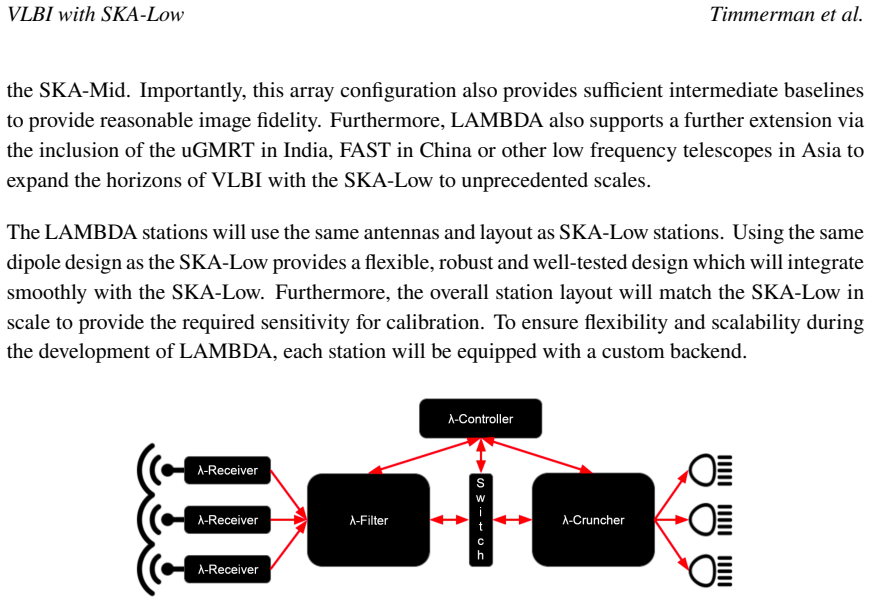
The Low-frequency Australian Megametre-Baseline Demonstrator Array (LAMBDA), consisting of several SKA-Low-like stations that supply the additional long baselines required for VLBI.
If this is right
- SKA-Low gains access to angular resolutions finer than the several-arcsecond baseline design.
- Resolved low-frequency imaging becomes possible for exoplanets, AGN, young stellar objects and supernova remnants.
- Pulsar astrometry, scintillometry, gravitational lensing and FRB localisation gain new observational modes.
- Calibration techniques required for any future megametre extension of SKA-Low can be validated in advance.
Where Pith is reading between the lines
- If LAMBDA meets performance targets, the same station design could be replicated at other longitudes to create a global low-frequency VLBI network.
- Early LAMBDA data would provide direct measurements of ionospheric and instrumental stability over megametre distances at these frequencies.
- The project could serve as a template for adding long baselines to other existing or planned low-frequency arrays.
Load-bearing premise
The new LAMBDA stations can be built, operated and calibrated to the same technical standard as the core SKA-Low stations so that the combined array delivers the expected resolution and sensitivity.
What would settle it
A test observation in which the effective angular resolution or image sensitivity achieved with the LAMBDA stations falls significantly below the values predicted from the baseline lengths and station sensitivities alone.
Figures
read the original abstract
The Square Kilometre Array Observatory (SKAO) will provide unprecedented observational capabilities, revolutionizing radio astronomy in the next decade. Of particular interest for many science areas is the low-frequency component: the SKA-Low. This array, operating at frequencies between 50 and 350 MHz, will be able to observe the Southern hemisphere with an angular resolution of several arcseconds. However, many science cases demand finer angular resolutions than the current design baseline for the SKA-Low. In this chapter, we present the Low-frequency Australian Megametre-Baseline Demonstrator Array (LAMBDA) project: the construction of a several SKA-Low-like stations throughout Australia which can be employed to extend the SKA-Low's baselines to the scale of megameters. This allows LAMBDA to not only probe the scientific opportunities accessible at higher angular resolutions, but also prove the feasibility of a potential extension of the SKA-Low to such baselines. Finally, LAMBDA also serves to characterize the performance of the SKA-Low as part of a Very Long Baseline Interferometry (VLBI) network and by providing an early testbed for the calibration strategies which would be required. With LAMBDA, the SKA-Low will be able to make a major impact in many science areas, including but not limited to exoplanets, resolved active galactic nuclei (AGN), young stellar objects and supernova remnants, pulsar astrometry and scintillometry, gravitational lensing and fast radio bursts (FRBs).
Editorial analysis
A structured set of objections, weighed in public.
Referee Report
Summary. The manuscript proposes the Low-frequency Australian Megametre-Baseline Demonstrator Array (LAMBDA) project, which would construct several SKA-Low-like stations across Australia to extend SKA-Low baselines to megameter scales. This extension is intended to enable low-frequency (50-350 MHz) VLBI with higher angular resolution than the current SKA-Low design, explore new science opportunities, demonstrate the feasibility of a potential SKA-Low extension, and serve as a testbed for VLBI calibration strategies. The authors assert that LAMBDA would allow major scientific impact in areas including exoplanets, resolved AGN, young stellar objects, supernova remnants, pulsar astrometry and scintillometry, gravitational lensing, and FRBs.
Significance. If the technical premise holds, LAMBDA could meaningfully expand the parameter space for low-frequency VLBI with SKA-Low and provide a practical pathfinder for array extensions. The proposal identifies a coherent set of high-impact science cases that would benefit from megameter baselines at these frequencies. No machine-checked proofs, reproducible code, or parameter-free derivations are present, as expected for a project proposal.
major comments (1)
- [Abstract] Abstract: the headline claim that LAMBDA enables major impact across the listed science cases is load-bearing on the untested premise that the additional stations can deliver phase stability and sensitivity matching the SKA-Low core over ~1000 km baselines at 50-350 MHz; no error budget, ionospheric simulation, station design parameters, or calibration algorithm sketch is supplied to support this.
Simulated Author's Rebuttal
We thank the referee for their constructive review and recommendation of major revision. We address the single major comment below.
read point-by-point responses
-
Referee: [Abstract] Abstract: the headline claim that LAMBDA enables major impact across the listed science cases is load-bearing on the untested premise that the additional stations can deliver phase stability and sensitivity matching the SKA-Low core over ~1000 km baselines at 50-350 MHz; no error budget, ionospheric simulation, station design parameters, or calibration algorithm sketch is supplied to support this.
Authors: We agree that the abstract's assertion of major scientific impact rests on the technical premise of achieving comparable phase stability and sensitivity over megameter baselines, and that the manuscript provides no quantitative error budget, ionospheric simulations, station parameters, or calibration details to support it. This manuscript is framed as a high-level science case and project proposal rather than a technical design study; the detailed feasibility analyses cited by the referee are therefore absent by design. We will revise the abstract to qualify the headline claims (e.g., by stating that major impact is contingent on successful demonstration of the required performance). We will also insert a short paragraph in the introduction acknowledging the ionospheric and calibration challenges at 50-350 MHz over ~1000 km baselines and noting that these are the subject of separate ongoing modeling efforts. These changes constitute a partial revision; a full technical error budget and simulations lie outside the present scope and will be addressed in follow-up work. revision: partial
Circularity Check
No circularity: descriptive proposal with no derivations or fitted predictions
full rationale
The paper is a project proposal for the LAMBDA array extension. It contains no equations, parameters, derivations, or quantitative predictions that could reduce to inputs by construction. All claims about scientific impact and VLBI performance are explicitly conditional on future construction, operation, and calibration success, with no self-referential loops or self-citation load-bearing steps. This matches the default expectation of no significant circularity for non-derivational papers.
Axiom & Free-Parameter Ledger
axioms (1)
- domain assumption Additional stations can be built and operated similarly to SKA-Low stations with compatible performance and calibration.
Reference graph
Works this paper leans on
-
[1]
2019 , eprint=
Anticipated Performance of the Square Kilometre Array -- Phase 1 (SKA1) , author=. 2019 , eprint=
2019
-
[2]
2015 , publisher=
Advancing Astrophysics with the Square Kilometre Array (AASKA14) , author=. 2015 , publisher=
2015
-
[3]
Van Haarlem, M. P. and M. W. Wise and A. W. Gunst and. A&A , fjournal =. 2013 , volume =
2013
-
[4]
T. W. Shimwell and H. J. A. R. A&A , fjournal =. 2017 , volume =
2017
-
[5]
T. W. Shimwell and C. Tasse and M. J. Hardcastle and. A&A , fjournal =. 2019 , volume =
2019
-
[6]
T. W. Shimwell and M. J. Hardcastle and C. Tasse and. A&A , fjournal =. 2022 , volume =
2022
-
[7]
Compact steep-spectrum and peaked-spectrum radio sources. , keywords =. doi:10.1007/s00159-021-00131-w , archivePrefix =. 2009.02750 , primaryClass =
-
[8]
The realm of the galaxy protoclusters
The realm of the galaxy protoclusters. A review. , keywords =. doi:10.1007/s00159-016-0100-3 , archivePrefix =. 1610.05201 , primaryClass =
work page internal anchor Pith review Pith/arXiv arXiv doi:10.1007/s00159-016-0100-3
-
[9]
Collimated synchrotron threads linking the radio lobes of ESO 137-006. , keywords =. doi:10.1051/0004-6361/202037800 , archivePrefix =. 2004.03203 , primaryClass =
-
[10]
Intracluster Magnetic Filaments and an Encounter with a Radio Jet. , keywords =. doi:10.3847/1538-4357/ac7c76 , archivePrefix =. 2206.14319 , primaryClass =
-
[11]
American Astronomical Society Meeting Abstracts \#237 , year = 2021, series =
Sub-kpc Magnetic Field Fluctuations around Cygnus A. American Astronomical Society Meeting Abstracts \#237 , year = 2021, series =
2021
-
[12]
Event Horizon Telescope observations of the jet launching and collimation in Centaurus A. Nature Astronomy , keywords =. doi:10.1038/s41550-021-01417-w , archivePrefix =. 2111.03356 , primaryClass =
-
[13]
The -ray spectrum of the core of Centaurus A as observed with H.E.S.S. and Fermi-LAT. , keywords =. doi:10.1051/0004-6361/201832640 , archivePrefix =. 1807.07375 , primaryClass =
-
[14]
Deep Chandra observations of Pictor A. , keywords =. doi:10.1093/mnras/stv2553 , archivePrefix =. 1510.08392 , primaryClass =
-
[15]
Short and long time-scales variability of the H double-peaked profile of Pictor A. , keywords =. doi:10.1093/mnras/stae694 , adsurl =
-
[16]
A spectropolarimetric study of the radio galaxy Pictor A using MeerKAT. , keywords =. doi:10.1093/mnras/stae598 , archivePrefix =. 2402.17647 , primaryClass =
-
[17]
X-Ray Polarimetric Observations of the Western Hotspot of Pictor A. , keywords =. doi:10.3847/2041-8213/adcdfe , adsurl =
-
[18]
Characterization of the Western Pictor A Hotspot in Hard X-Rays with NuSTAR. , keywords =. doi:10.3847/1538-4357/ad5d6d , archivePrefix =. 2402.06218 , primaryClass =
-
[19]
Chandra X-Ray Observations of Pictor A: High-Energy Cosmic Rays in a Radio Galaxy. , keywords =. doi:10.1086/318412 , archivePrefix =. astro-ph/0008467 , primaryClass =
-
[20]
Overall structure and star formation rates
A multifrequency radio continuum study of the Magellanic Clouds - I. Overall structure and star formation rates. , keywords =. doi:10.1093/mnras/sty1960 , adsurl =
-
[21]
Supernova remnants on the outskirts of the Large Magellanic Cloud. , keywords =. doi:10.1051/0004-6361/202452178 , adsurl =
-
[22]
The 1.28 GHz MeerKAT Galactic Center Mosaic. , keywords =. doi:10.3847/1538-4357/ac449a , archivePrefix =. 2201.10541 , primaryClass =
-
[23]
Detection of Sagittarius A* at 330 MHz with the Very Large Array. , keywords =. doi:10.1086/381885 , archivePrefix =. astro-ph/0312219 , primaryClass =
-
[24]
Journal of Astrophysics and Astronomy , keywords =
The many faces of pulsars the case of PSR B0833-45. Journal of Astrophysics and Astronomy , keywords =. doi:10.1007/s12036-018-9544-3 , adsurl =
-
[25]
Pulsar Glitches: A Review. Universe , keywords =. doi:10.3390/universe8120641 , archivePrefix =. 2211.13885 , primaryClass =
-
[26]
The Variable Jet of the Vela Pulsar. , keywords =. doi:10.1086/375531 , archivePrefix =. astro-ph/0305510 , primaryClass =
-
[27]
Radio jets from young stellar objects. , keywords =. doi:10.1007/s00159-018-0107-z , archivePrefix =. 1806.06444 , primaryClass =
-
[28]
GMRT detections of low mass young stars at 323 and 608 MHz
GMRT detections of low-mass young stars at 323 and 608 MHz. , keywords =. doi:10.1093/mnras/stw708 , archivePrefix =. 1603.06836 , primaryClass =
work page internal anchor Pith review Pith/arXiv arXiv doi:10.1093/mnras/stw708
-
[29]
A Magnetized Jet from a Massive Protostar. Science , keywords =. doi:10.1126/science.1195589 , archivePrefix =. 1011.6254 , primaryClass =
-
[30]
On the Origin of the Cosmic Radiation , author =. Phys. Rev. , volume =. 1949 , month =. doi:10.1103/PhysRev.75.1169 , url =
-
[31]
New supernova remnant candidates in the LOFAR Two Metre Sky Survey. , keywords =. doi:10.1051/0004-6361/202450492 , archivePrefix =. 2408.14605 , primaryClass =
-
[32]
Possible discovery of Calvera's supernova remnant. , keywords =. doi:10.1051/0004-6361/202244369 , archivePrefix =. 2207.14141 , primaryClass =
-
[33]
Progenitors of core-collapse supernovae
Progenitors of Core-Collapse Supernovae. , keywords =. doi:10.1146/annurev-astro-082708-101737 , archivePrefix =. 0908.0700 , primaryClass =
work page internal anchor Pith review Pith/arXiv arXiv doi:10.1146/annurev-astro-082708-101737
-
[34]
Effects of plasma on gravitational lensing
Effects of plasma on gravitational lensing. , keywords =. doi:10.1093/mnras/stt2043 , archivePrefix =. 1310.5825 , primaryClass =
work page internal anchor Pith review Pith/arXiv arXiv doi:10.1093/mnras/stt2043
-
[35]
Essentials of Strong Gravitational Lensing. , keywords =. doi:10.1007/s11214-024-01041-w , archivePrefix =. 2401.04165 , primaryClass =
-
[36]
The VLA Frontier Fields Survey: Deep, High-resolution Radio Imaging of the MACS Lensing Clusters at 3 and 6 GHz. , keywords =. doi:10.3847/1538-4357/abdf61 , archivePrefix =. 2103.07806 , primaryClass =
-
[37]
High-resolution imaging with the International LOFAR Telescope: Observations of the gravitational lenses MG 0751+2716 and CLASS B1600+434. , keywords =. doi:10.1051/0004-6361/202141227 , archivePrefix =. 2108.07293 , primaryClass =
-
[38]
Radio imaging of gravitationally lensed radio-quiet quasars. , keywords =. doi:10.1093/mnras/stae916 , archivePrefix =. 2403.19357 , primaryClass =
-
[39]
Fast radio bursts. , keywords =. doi:10.1007/s00159-019-0116-6 , archivePrefix =. 1904.07947 , primaryClass =
work page internal anchor Pith review Pith/arXiv arXiv doi:10.1007/s00159-019-0116-6 1904
-
[40]
The discovery and significance of fast radio bursts. , keywords =. doi:10.1007/s10509-024-04322-6 , archivePrefix =. 2405.19106 , primaryClass =
-
[41]
The Low Frequency Perspective on Fast Radio Bursts. Universe , keywords =. doi:10.3390/universe8010009 , archivePrefix =. 2203.04890 , primaryClass =
-
[42]
Sub-arcsecond imaging with the International LOFAR Telescope. I. Foundational calibration strategy and pipeline. , keywords =. doi:10.1051/0004-6361/202140649 , archivePrefix =. 2108.07283 , primaryClass =
-
[43]
LBCS: The LOFAR Long-Baseline Calibrator Survey. , keywords =. doi:10.1051/0004-6361/201629016 , archivePrefix =. 1608.02133 , primaryClass =
-
[44]
Sub-arcsecond imaging with the International LOFAR Telescope. II. Completion of the LOFAR Long-Baseline Calibrator Survey. , keywords =. doi:10.1051/0004-6361/202140756 , archivePrefix =. 2108.07284 , primaryClass =
-
[45]
Hampson and Wan Cheng and D
Grant A. Hampson and Wan Cheng and D. Humphrey and John D. Bunton and Paul Roberts and Keith Bengston and Ron Beresford and Yuqing Chen , title =. 8th International VLBI Technology Workshop , year =
-
[46]
14th European VLBI Network Symposium and Users Meeting (EVN 2018) , year =
Cimò, Giuseppe and others , title =. 14th European VLBI Network Symposium and Users Meeting (EVN 2018) , year =
2018
-
[47]
The Murchison Widefield Array: The Square Kilometre Array Precursor at Low Radio Frequencies. , keywords =. doi:10.1017/pasa.2012.007 , archivePrefix =. 1206.6945 , primaryClass =
-
[48]
Australian square kilometre array pathfinder: I. system description. , keywords =. doi:10.1017/pasa.2021.1 , archivePrefix =. 2102.01870 , primaryClass =
-
[49]
The South Pole Telescope. Z-Spec: a broadband millimeter-wave grating spectrometer: design, construction, and first cryogenic measurements , year = 2004, editor =. doi:10.1117/12.552473 , archivePrefix =. astro-ph/0411122 , primaryClass =
-
[50]
2018 , volume =
JLTP , fjournal =. 2018 , volume =
2018
-
[51]
The Simons Observatory: science goals and forecasts. , keywords =. doi:10.1088/1475-7516/2019/02/056 , archivePrefix =. 1808.07445 , primaryClass =
-
[52]
LSST: From Science Drivers to Reference Design and Anticipated Data Products. , keywords =. doi:10.3847/1538-4357/ab042c , archivePrefix =. 0805.2366 , primaryClass =
-
[53]
The Messenger , year = 2007, month = mar, volume =
The European Extremely Large Telescope (E-ELT). The Messenger , year = 2007, month = mar, volume =
2007
-
[54]
Radio signatures of star-planet interactions, exoplanets and space weather. Nature Astronomy , keywords =. doi:10.1038/s41550-024-02405-6 , archivePrefix =. 2409.15507 , primaryClass =
-
[55]
Spectral ageing in the lobes of cluster-centre FR II radio galaxies. , keywords =. doi:10.1093/mnras/stv2194 , archivePrefix =. 1509.06757 , primaryClass =
-
[56]
Spectral ageing in the lobes of FR-II radio galaxies: new methods of analysis for broad-band radio data. , keywords =. doi:10.1093/mnras/stt1526 , archivePrefix =. 1308.4137 , primaryClass =
-
[57]
Spectral ageing in the era of big data: integrated versus resolved models. , keywords =. doi:10.1093/mnras/stw3318 , archivePrefix =. 1612.04390 , primaryClass =
-
[58]
The Atacama Large Millimeter/Submillimeter Array. IEEE Proceedings , keywords =. doi:10.1109/JPROC.2009.2020572 , archivePrefix =. 0904.3739 , primaryClass =
-
[59]
Overview of the Observing System and Initial Scientific Accomplishments of the East Asian VLBI Network (EAVN). Galaxies , keywords =. doi:10.3390/galaxies10060113 , archivePrefix =. 2212.07040 , primaryClass =
-
[60]
Radio Sources in the NCP Region Observed with the 21 Centimeter Array. , keywords =. doi:10.3847/0004-637X/832/2/190 , archivePrefix =. 1602.06624 , primaryClass =
-
[61]
International Journal of Modern Physics D , keywords =
The Five-Hundred Aperture Spherical Radio Telescope (fast) Project. International Journal of Modern Physics D , keywords =. doi:10.1142/S0218271811019335 , archivePrefix =. 1105.3794 , primaryClass =
-
[62]
Proceedings of the 16th EVN Symposium , year = 2024, editor =
LAMBDA - a Low-frequency Australian Megametre Baseline Demonstrator Array. Proceedings of the 16th EVN Symposium , year = 2024, editor =
2024
-
[63]
A decade of sub-arcsecond imaging with the International LOFAR Telescope. , keywords =. doi:10.1007/s10509-025-04406-x , archivePrefix =. 2502.06946 , primaryClass =
-
[64]
Science China Physics, Mechanics, and Astronomy , keywords =
The Tianlai Cylinder Pathfinder array: System functions and basic performance analysis. Science China Physics, Mechanics, and Astronomy , keywords =. doi:10.1007/s11433-020-1594-8 , archivePrefix =. 2006.05605 , primaryClass =
-
[65]
Sun and Geosphere , keywords =
New Interplanetary Scintillation Array in China for Space Weather. Sun and Geosphere , keywords =. doi:10.31401/SunGeo.2018.02.05 , adsurl =
-
[66]
Current Science , year = 2017, month = aug, volume =
The upgraded GMRT: opening new windows on the radio Universe. Current Science , year = 2017, month = aug, volume =. doi:10.18520/cs/v113/i04/707-714 , adsurl =
-
[67]
Nature Physical Science , year = 1971, month = apr, volume =
Large Steerable Radio Telescope at Ootacamund, India. Nature Physical Science , year = 1971, month = apr, volume =. doi:10.1038/physci230185a0 , adsurl =
-
[68]
Journal of Astrophysics and Astronomy , keywords =
The Ooty Wide Field Array. Journal of Astrophysics and Astronomy , keywords =. doi:10.1007/s12036-017-9430-4 , archivePrefix =. 1703.00621 , primaryClass =
-
[69]
Current Science , year = 1991, month = jan, volume =
The Giant Metre-Wave Radio Telescope. Current Science , year = 1991, month = jan, volume =
1991
-
[70]
IPRT/AMATERAS: A New Metric Spectrum Observation System for Solar Radio Bursts. , keywords =. doi:10.1007/s11207-011-9919-y , adsurl =
-
[71]
HALCA's Onboard VLBI Observing System. , keywords =. doi:10.1093/pasj/52.6.967 , adsurl =
-
[72]
Early Science with the Korean VLBI Network: Evaluation of System Performance. , keywords =. doi:10.1088/0004-6256/147/4/77 , adsurl =
-
[73]
and Sasao, T
Kobayashi, H. and Sasao, T. and Kawaguchi, N. and Manabe, S. and Omodaka, T. and Kameya, O.and Shibata, K. M. and Miyaji, T. and Honma, M. and Tamura, Y. and Hirota, S. T. and Kuji, S. and Horiai, K. and Sakai, S. and Sato, K. and Iwadate, K. and Kanya, Y. and Ujihara, H. and Jike, T. and Fujii, T. and Oyama, T. and Kurayama, H. and Suda, H. and Sakakibar...
-
[74]
VLBI observations of bright AGN jets with the KVN and VERA Array (KaVA): Evaluation of imaging capability. , keywords =. doi:10.1093/pasj/psu104 , archivePrefix =. 1406.4356 , primaryClass =
-
[75]
Proceedings of the 8th European VLBI Network Symposium , year = 2006, editor =
Japanese VLBI Network. Proceedings of the 8th European VLBI Network Symposium , year = 2006, editor =. doi:10.22323/1.036.0071 , archivePrefix =. astro-ph/0612528 , primaryClass =
-
[76]
BURSTT: Bustling Universe Radio Survey Telescope in Taiwan. , keywords =. doi:10.1088/1538-3873/ac8f71 , archivePrefix =. 2206.08983 , primaryClass =
-
[77]
Technosignature searches with VLBI
Kim,. Technosignature searches with VLBI
-
[78]
Observational Tests of Active Galactic Nuclei Feedback: An Overview of Approaches and Interpretation. Galaxies , keywords =. doi:10.3390/galaxies12020017 , archivePrefix =. 2404.08050 , primaryClass =
-
[79]
A Bright Millisecond Radio Burst of Extragalactic Origin. Science , keywords =. doi:10.1126/science.1147532 , archivePrefix =. 0709.4301 , primaryClass =
-
[80]
Kavanagh and author2 and author3 and author4 and author5 ,title =
Robert D. Kavanagh and author2 and author3 and author4 and author5 ,title =. 2026 ,publisher =
2026
discussion (0)
Sign in with ORCID, Apple, or X to comment. Anyone can read and Pith papers without signing in.