Halo-Independent Quantum Sensor Probes of Low-Velocity Dark Matter
Pith reviewed 2026-06-25 22:44 UTC · model grok-4.3
The pith
Quantum sensors factor the dark matter scattering rate into a detector response and a universal halo function that data can determine directly.
A machine-rendered reading of the paper's core claim, the machinery that carries it, and where it could break.
Core claim
The DM scattering rate is expressed as an integral involving a material- and model-dependent response function multiplied by a universal halo function that encodes the local velocity distribution and is independent of any particular detector. Data from different sensors therefore determine the halo function directly, constraining the velocity distribution in a halo-independent manner for sub-GeV dark matter.
What carries the argument
The universal halo function that factors the velocity distribution out of the rate so it can be extracted from combined data.
If this is right
- Sensors with different material responses probe complementary parts of the DM velocity distribution.
- The halo function can be reconstructed from mock data drawn from several benchmark local halo models.
- Quantum sensors with sub-eV thresholds reach low DM velocities that are difficult for conventional detectors.
- The framework supplies a new route to mapping the local DM velocity distribution.
Where Pith is reading between the lines
- If the separation holds, the same data could test specific proposed halo models that differ at low velocities.
- Adding more sensor materials would tighten the reconstruction of the halo function.
- The method could be combined with results from higher-threshold detectors to cross-check velocity constraints.
Load-bearing premise
The response functions of different sensor materials must be sufficiently distinct and accurately calculable so the halo function can be isolated from their combined measurements.
What would settle it
Applying the framework to mock data generated with a known benchmark halo model using both Al TES and TiN MKID sensors and failing to recover the input halo function would show the separation does not work.
Figures
read the original abstract
We present a halo-independent framework for sub-GeV dark matter (DM) direct detection using quantum sensors with sub-eV energy thresholds. Such detectors enable access to low DM velocities and may be sensitive to departures from the Standard Halo Model that are challenging to probe with conventional direct DM detection experiments. The method expresses the DM scattering event rate in terms of a detector and particle model-dependent response function, and a universal halo function common to all experiments to be determined from data. This allows the local DM velocity distribution to be constrained. As representative implementations, we consider TES (Al) and MKID (TiN)-like sensors and show that their differing material responses probe complementary regimes of the DM velocity distribution. Applying the framework to mock data derived from several benchmark local halo models, we demonstrate how the assumed halo function could be reconstructed. This framework demonstrates the potential of quantum sensors as a new avenue for mapping the local DM velocity distribution.
Editorial analysis
A structured set of objections, weighed in public.
Referee Report
Summary. The manuscript presents a halo-independent framework for sub-GeV DM direct detection with quantum sensors. The scattering rate in each experiment i is expressed as R_i(E) = ∫ K_i(v) f(v) dv, where K_i(v) is a detector- and particle-physics response function and f(v) is a universal halo function to be determined from data. Using mock data generated from benchmark halo models, the authors apply the framework to Al TES and TiN MKID sensors and demonstrate reconstruction of f(v).
Significance. If the reconstruction is robust, the approach would allow constraints on the local DM velocity distribution at low velocities without assuming the Standard Halo Model, using the complementary responses of different sensor materials. This is a potentially useful addition to direct-detection methodology.
major comments (2)
- [Mock-data reconstruction section] The central claim that f(v) can be reconstructed from combined data rests on the response kernels K_Al(v) and K_TiN(v) being sufficiently linearly independent over the low-velocity range. The manuscript should supply a quantitative diagnostic (e.g., condition number of the discretized operator, singular-value spectrum, or normalized overlap ∫ K_Al(v) K_TiN(v) dv) in the section describing the mock-data analysis and inversion procedure.
- [Framework and response-function definitions] The abstract states that the response functions 'probe complementary regimes,' yet no explicit statement is given of the velocity range over which the kernels differ or of any regularization used in the inversion. This information is load-bearing for the claim that the inverse problem is well-posed even with perfect data.
minor comments (2)
- Notation for the halo function f(v) and the response functions should be introduced with a single, consistent definition early in the text and used uniformly thereafter.
- The mock-data figures would benefit from an additional panel or table showing the reconstructed f(v) together with the input benchmark models and the associated uncertainty bands.
Simulated Author's Rebuttal
We thank the referee for their constructive comments, which help clarify the presentation of our halo-independent framework. We respond to each major comment below.
read point-by-point responses
-
Referee: [Mock-data reconstruction section] The central claim that f(v) can be reconstructed from combined data rests on the response kernels K_Al(v) and K_TiN(v) being sufficiently linearly independent over the low-velocity range. The manuscript should supply a quantitative diagnostic (e.g., condition number of the discretized operator, singular-value spectrum, or normalized overlap ∫ K_Al(v) K_TiN(v) dv) in the section describing the mock-data analysis and inversion procedure.
Authors: We agree that a quantitative diagnostic would strengthen the central claim. In the revised manuscript we will add the condition number of the discretized response matrix (computed over the velocity grid used in the mock-data inversion) to the mock-data reconstruction section. This will explicitly demonstrate the degree of linear independence between K_Al(v) and K_TiN(v). revision: yes
-
Referee: [Framework and response-function definitions] The abstract states that the response functions 'probe complementary regimes,' yet no explicit statement is given of the velocity range over which the kernels differ or of any regularization used in the inversion. This information is load-bearing for the claim that the inverse problem is well-posed even with perfect data.
Authors: We will add an explicit paragraph in the framework section stating the velocity interval (roughly 20–150 km/s) over which the two kernels differ by more than an order of magnitude, together with the Tikhonov regularization parameter and its selection criterion used in the inversion. These additions will make the well-posedness statement quantitative. revision: yes
Circularity Check
No significant circularity: standard inverse-problem decomposition with data-driven halo function
full rationale
The paper defines the scattering rate via the integral decomposition R_i(E) = ∫ K_i(v) f(v) dv where K_i is the calculable detector+particle response for each sensor and f(v) is the universal halo function extracted from data. This is a definitional setup for halo-independent analyses rather than a derivation that reduces a claimed prediction back to a fitted input. The reconstruction demonstration uses mock data generated from benchmark halo models to recover f(v), which is a consistency test of the inverse problem and does not constitute a self-referential prediction. No self-citation load-bearing steps, uniqueness theorems imported from the same authors, or ansatzes smuggled via citation are present in the provided text. The framework remains self-contained because the response functions are stated to be model-dependent and independently calculable while f(v) is constrained externally by combined experimental rates.
Axiom & Free-Parameter Ledger
axioms (1)
- domain assumption The DM scattering rate can be factored into a detector/particle response function and a universal halo function.
Reference graph
Works this paper leans on
-
[1]
observed
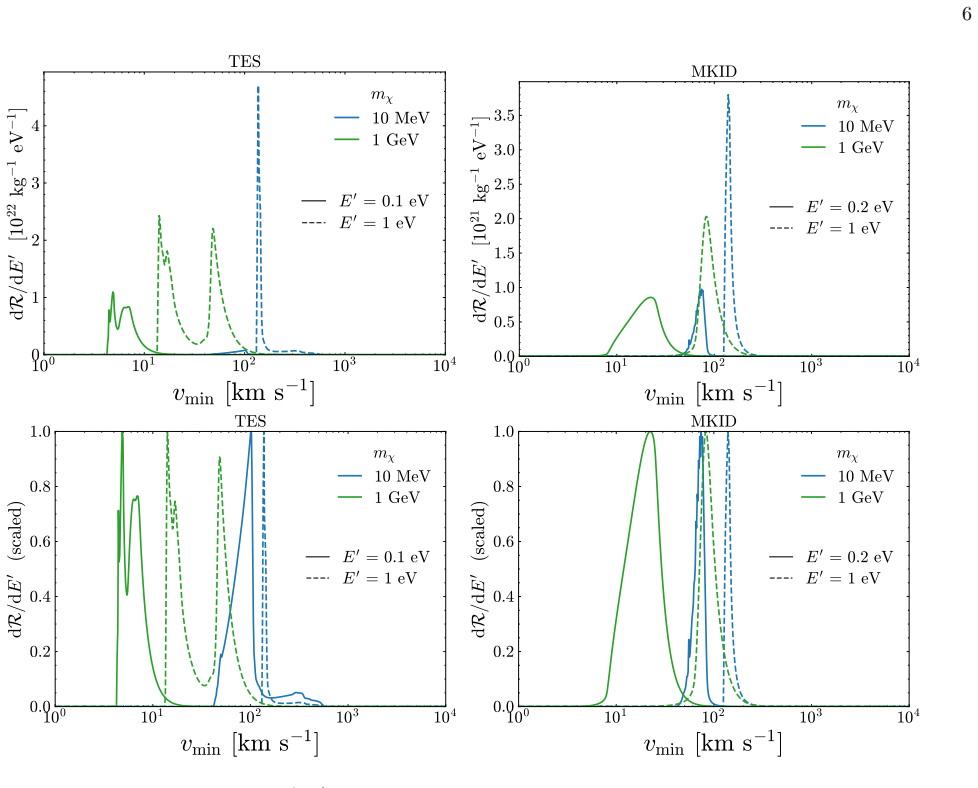
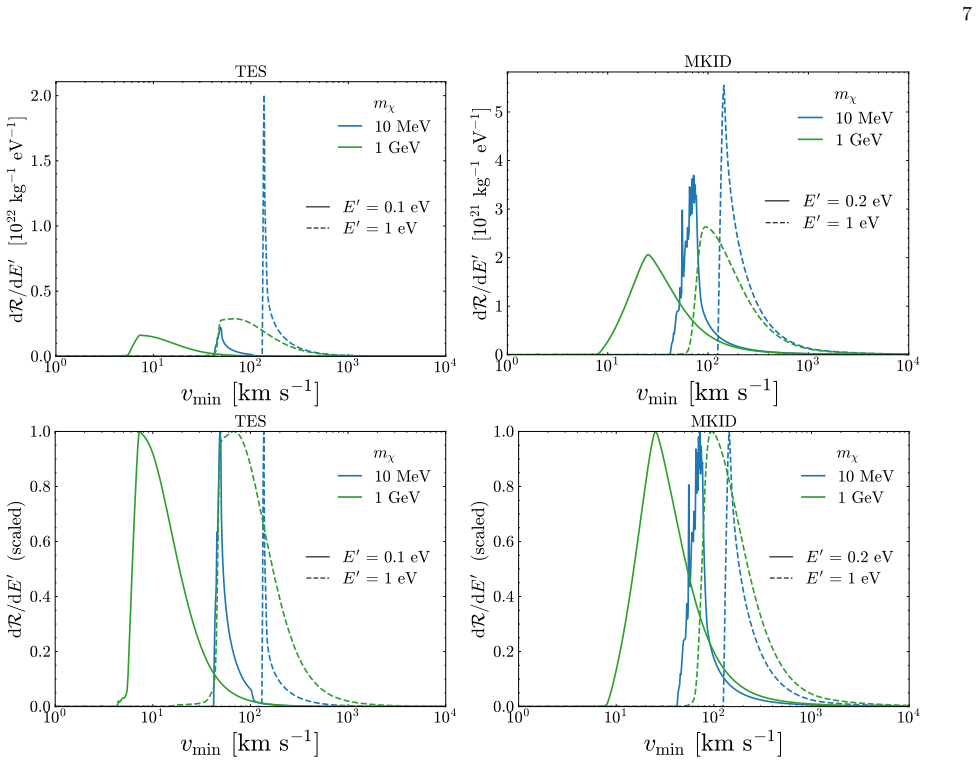
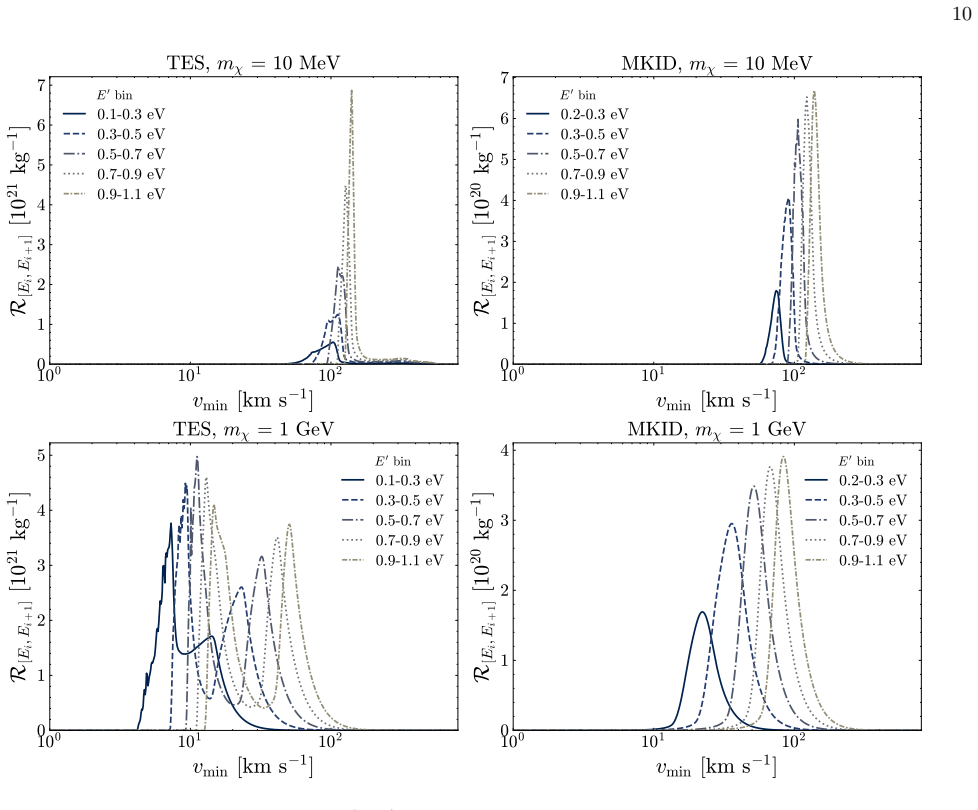
The lower edge of this range is not determined solely by the detector threshold. The threshold enters through the efficiencyϵ(E′) in Eq. (14), whereas thev min depen- dence follows from the kinematic minimumv ∗evaluated over the true deposited energiesEselected by the res- olution functionG(E,E ′) and weighted by the material responseS(q,E). The finite en...
-
[2]
Par- ticle dark matter: Evidence, candidates and constraints,
Gianfranco Bertone, Dan Hooper, and Joseph Silk, “Par- ticle dark matter: Evidence, candidates and constraints,” Phys. Rept.405, 279–390 (2005), arXiv:hep-ph/0404175
Pith/arXiv arXiv 2005
-
[3]
Dark Matter Candidates from Parti- cle Physics and Methods of Detection,
Jonathan L. Feng, “Dark Matter Candidates from Parti- cle Physics and Methods of Detection,” Ann. Rev. As- tron. Astrophys.48, 495–545 (2010), arXiv:1003.0904 [astro-ph.CO]
Pith/arXiv arXiv 2010
-
[4]
First Dark Matter Search Results from the LUX-ZEPLIN (LZ) Experiment,
J. Aalbers et al. (LZ), “First Dark Matter Search Results from the LUX-ZEPLIN (LZ) Experiment,” Phys. Rev. Lett.131, 041002 (2023), arXiv:2207.03764 [hep-ex]
Pith/arXiv arXiv 2023
-
[5]
Search for New Physics in Electronic Recoil Data from XENONnT,
E. Aprile et al. (XENON), “Search for New Physics in Electronic Recoil Data from XENONnT,” Phys. Rev. Lett.129, 161805 (2022), arXiv:2207.11330 [hep-ex]
arXiv 2022
-
[6]
Dark Matter Search Re- sults from the PandaX-4T Commissioning Run,
Yue Meng et al. (PandaX-4T), “Dark Matter Search Re- sults from the PandaX-4T Commissioning Run,” Phys. Rev. Lett.127, 261802 (2021), arXiv:2107.13438 [hep- ex]
arXiv 2021
-
[7]
Snowmass2021 Cosmic Frontier Dark Matter Direct Detection to the Neutrino Fog,
D. S. Akerib et al., “Snowmass2021 Cosmic Frontier Dark Matter Direct Detection to the Neutrino Fog,” in Snowmass 2021 (2022) arXiv:2203.08084 [hep-ex]
arXiv 2021
-
[8]
Rouven Essig et al., “Snowmass2021 Cosmic Frontier: The landscape of low-threshold dark matter direct de- tection in the next decade,” in Snowmass 2021 (2022) arXiv:2203.08297 [hep-ph]
arXiv 2021
-
[9]
Direct Detection of Sub-GeV Dark Matter,
Rouven Essig, Jeremy Mardon, and Tomer Volansky, “Direct Detection of Sub-GeV Dark Matter,” Phys. Rev. D85, 076007 (2012), arXiv:1108.5383 [hep-ph]
Pith/arXiv arXiv 2012
-
[10]
Su- perconducting Detectors for Superlight Dark Matter,
Yonit Hochberg, Yue Zhao, and Kathryn M. Zurek, “Su- perconducting Detectors for Superlight Dark Matter,” Phys. Rev. Lett.116, 011301 (2016), arXiv:1504.07237 [hep-ph]
Pith/arXiv arXiv 2016
-
[11]
Detecting Superlight Dark Matter with Fermi-Degenerate Materials,
Yonit Hochberg, Matt Pyle, Yue Zhao, and Kathryn M. Zurek, “Detecting Superlight Dark Matter with Fermi-Degenerate Materials,” JHEP08, 057 (2016), arXiv:1512.04533 [hep-ph]
Pith/arXiv arXiv 2016
-
[12]
Light Dark Matter: Models and Constraints,
Simon Knapen, Tongyan Lin, and Kathryn M. Zurek, “Light Dark Matter: Models and Constraints,” Phys. Rev. D96, 115021 (2017), arXiv:1709.07882 [hep-ph]
Pith/arXiv arXiv 2017
-
[13]
Ex- tended calculation of dark matter-electron scattering in crystal targets,
Sin´ ead M. Griffin, Katherine Inzani, Tanner Trickle, Zhengkang Zhang, and Kathryn M. Zurek, “Ex- tended calculation of dark matter-electron scattering in crystal targets,” Phys. Rev. D104, 095015 (2021), arXiv:2105.05253 [hep-ph]
arXiv 2021
-
[14]
Transition-Edge Sen- sors,
K. D. Irwin and G. C. Hilton, “Transition-Edge Sen- sors,” in Cryogenic Particle Detection, Topics in Applied Physics, Vol. 99, edited by Christian Enss (Springer, Berlin, Heidelberg, 2005) pp. 63–150
2005
-
[15]
First direct search for light dark matter interactions in a transition-edge sen- sor,
Christina Schwemmbauer et al., “First direct search for light dark matter interactions in a transition-edge sen- sor,” (2025), arXiv:2506.18982 [physics.ins-det]
arXiv 2025
-
[16]
An optical transition- edge sensor with high energy resolution,
Kaori Hattori, Toshio Konno, Yoshitaka Miura, Sachiko Takasu, and Daiji Fukuda, “An optical transition- edge sensor with high energy resolution,” Supercond. Sci. Technol.35, 095002 (2022), arXiv:2204.01903 [physics.ins-det]
arXiv 2022
-
[17]
Light dark matter detection with sub-eV transition-edge sensors,
Muping Chen, Volodymyr Takhistov, Kazunori Nakayama, and Kaori Hattori, “Light dark matter detection with sub-eV transition-edge sensors,” Phys. Rev. D113, 036006 (2026), arXiv:2506.10070 [hep-ph]
arXiv 2026
-
[18]
A broad- band superconducting detector suitable for use in large arrays,
Peter K. Day, Henry G. LeDuc, Benjamin A. Mazin, Anastasios Vayonakis, and Jonas Zmuidzinas, “A broad- band superconducting detector suitable for use in large arrays,” Nature425, 817–821 (2003)
2003
-
[19]
A WIMP Dark Matter Detector Using MKIDs,
S. Golwala, J. Gao, D. Moore, B. Mazin, M. Eckart, B. Bumble, P. Day, H. G. Leduc, and J. Zmuidzinas, “A WIMP Dark Matter Detector Using MKIDs,” Journal of Low Temperature Physics151, 550–556 (2008)
2008
-
[20]
Detecting Light Dark Matter with Kinetic In- ductance Detectors,
Jiansong Gao, Yonit Hochberg, Benjamin V. Lehmann, Sae Woo Nam, Paul Szypryt, Michael R. Vissers, and Tao Xu, “Detecting Light Dark Matter with Kinetic In- ductance Detectors,” (2024), arXiv:2403.19739 [hep-ph]
arXiv 2024
-
[21]
The Local Dark Matter Density,
J. I. Read, “The Local Dark Matter Density,” J. Phys. G41, 063101 (2014), arXiv:1404.1938 [astro-ph.GA]
Pith/arXiv arXiv 2014
-
[22]
On the local dark matter density,
Jo Bovy and Scott Tremaine, “On the local dark matter density,” Astrophys. J.756, 89 (2012), arXiv:1205.4033 [astro-ph.GA]
Pith/arXiv arXiv 2012
-
[23]
Velocity substructure from Gaia and direct searches for dark matter,
Ciaran A. J. O’Hare, N. Wyn Evans, Christopher McCabe, GyuChul Myeong, and Vasily Belokurov, “Velocity substructure from Gaia and direct searches for dark matter,” Phys. Rev. D101, 023006 (2020), arXiv:1909.04684 [astro-ph.GA]
arXiv 2020
-
[24]
Detecting cold dark-matter candidates,
Andrzej K. Drukier, Katherine Freese, and David N. Spergel, “Detecting cold dark-matter candidates,” Phys. Rev. D33, 3495–3508 (1986)
1986
-
[25]
Review of mathematics, numerical factors, and corrections for dark matter ex- periments based on elastic nuclear recoil,
J. D. Lewin and P. F. Smith, “Review of mathematics, numerical factors, and corrections for dark matter ex- periments based on elastic nuclear recoil,” Astroparticle Physics6, 87–112 (1996)
1996
-
[26]
Thin, thick and dark discs in LCDM,
J. I. Read, G. Lake, O. Agertz, and Victor P. Debattista, “Thin, thick and dark discs in LCDM,” Mon. Not. Roy. Astron. Soc.389, 1041–1057 (2008), arXiv:0803.2714 [astro-ph]
Pith/arXiv arXiv 2008
-
[27]
JiJi Fan, Andrey Katz, Lisa Randall, and Matthew Reece, “Dark-Disk Universe,” Phys. Rev. Lett.110, 211302 (2013), arXiv:1303.3271 [hep-ph]
Pith/arXiv arXiv 2013
-
[28]
Direct and indirect detection of dissipative dark matter,
JiJi Fan, Andrey Katz, and Jessie Shelton, “Direct and indirect detection of dissipative dark matter,” JCAP06, 059 (2014), arXiv:1312.1336 [hep-ph]
Pith/arXiv arXiv 2014
-
[29]
Exothermic Double-Disk Dark Matter,
Matthew McCullough and Lisa Randall, “Exothermic Double-Disk Dark Matter,” JCAP10, 058 (2013), arXiv:1307.4095 [hep-ph]
Pith/arXiv arXiv 2013
-
[30]
Dissipative Dark Mat- ter and the Andromeda Plane of Satellites,
Lisa Randall and Jakub Scholtz, “Dissipative Dark Mat- ter and the Andromeda Plane of Satellites,” JCAP09, 057 (2015), arXiv:1412.1839 [astro-ph.GA]
Pith/arXiv arXiv 2015
-
[31]
Constraining a Thin Dark Matter Disk with Gaia,
Katelin Schutz, Tongyan Lin, Benjamin R. Safdi, and Chih-Liang Wu, “Constraining a Thin Dark Matter Disk with Gaia,” Phys. Rev. Lett.121, 081101 (2018), arXiv:1711.03103 [astro-ph.GA]
Pith/arXiv arXiv 2018
-
[32]
Axel Widmark, Chervin F. P. Laporte, Pablo F. de Salas, and Giacomo Monari, “Weighing the Galactic disk using phase-space spirals - II. Most stringent constraints on a thin dark disk using Gaia EDR3,” Astron. Astrophys. 653, A86 (2021), arXiv:2105.14030 [astro-ph.GA]
arXiv 2021
-
[33]
ClearPotential: Revealing Lo- cal Dark Matter in Three Dimensions,
Eric Putney, David Shih, Sung Hak Lim, and Matthew R. Buckley, “ClearPotential: Revealing Lo- cal Dark Matter in Three Dimensions,” (2025), arXiv:2512.09989 [astro-ph.GA]
arXiv 2025
-
[34]
Resonant Enhancements in WIMP Cap- ture by the Earth,
Andrew Gould, “Resonant Enhancements in WIMP Cap- ture by the Earth,” Astrophys. J.321, 571 (1987)
1987
-
[35]
David A. Neufeld, Glennys R. Farrar, and Christopher F. McKee, “Dark Matter that Interacts with Baryons: Den- sity Distribution within the Earth and New Constraints 18 on the Interaction Cross-section,” Astrophys. J.866, 111 (2018), arXiv:1805.08794 [astro-ph.CO]
Pith/arXiv arXiv 2018
-
[36]
Accelerat- ing Earth-bound dark matter,
David McKeen, Marianne Moore, David E. Morrissey, Maxim Pospelov, and Harikrishnan Ramani, “Accelerat- ing Earth-bound dark matter,” Phys. Rev. D106, 035011 (2022), arXiv:2202.08840 [hep-ph]
arXiv 2022
-
[37]
Integrat- ing Out Astrophysical Uncertainties,
Patrick J. Fox, Jia Liu, and Neal Weiner, “Integrat- ing Out Astrophysical Uncertainties,” Phys. Rev. D83, 103514 (2011), arXiv:1011.1915 [hep-ph]
Pith/arXiv arXiv 2011
-
[38]
Patrick J. Fox, Graham D. Kribs, and Tim M. P. Tait, “Interpreting Dark Matter Direct Detection Indepen- dently of the Local Velocity and Density Distribution,” Phys. Rev. D83, 034007 (2011), arXiv:1011.1910 [hep- ph]
Pith/arXiv arXiv 2011
-
[39]
Resolv- ing astrophysical uncertainties in dark matter direct de- tection,
Mads T. Frandsen, Felix Kahlhoefer, Christopher Mc- Cabe, Subir Sarkar, and Kai Schmidt-Hoberg, “Resolv- ing astrophysical uncertainties in dark matter direct de- tection,” JCAP01, 024 (2012), arXiv:1111.0292 [hep-ph]
Pith/arXiv arXiv 2012
-
[40]
Halo indepen- dent comparison of direct dark matter detection data,
Paolo Gondolo and Graciela B. Gelmini, “Halo indepen- dent comparison of direct dark matter detection data,” JCAP12, 015 (2012), arXiv:1202.6359 [hep-ph]
Pith/arXiv arXiv 2012
-
[41]
Astrophysics independent bounds on the annual mod- ulation of dark matter signals,
Juan Herrero-Garcia, Thomas Schwetz, and Jure Zupan, “Astrophysics independent bounds on the annual mod- ulation of dark matter signals,” Phys. Rev. Lett.109, 141301 (2012), arXiv:1205.0134 [hep-ph]
Pith/arXiv arXiv 2012
-
[42]
The unbearable lightness of being: CDMS versus XENON,
Mads T. Frandsen, Felix Kahlhoefer, Christopher Mc- Cabe, Subir Sarkar, and Kai Schmidt-Hoberg, “The unbearable lightness of being: CDMS versus XENON,” JCAP07, 023 (2013), arXiv:1304.6066 [hep-ph]
Pith/arXiv arXiv 2013
-
[43]
Halo-independent analysis of direct detection data for light WIMPs,
Eugenio Del Nobile, Graciela B. Gelmini, Paolo Gondolo, and Ji-Haeng Huh, “Halo-independent analysis of direct detection data for light WIMPs,” JCAP10, 026 (2013), arXiv:1304.6183 [hep-ph]
Pith/arXiv arXiv 2013
-
[44]
Halo-independent meth- ods for inelastic dark matter scattering,
Nassim Bozorgnia, Juan Herrero-Garcia, Thomas Schwetz, and Jure Zupan, “Halo-independent meth- ods for inelastic dark matter scattering,” JCAP07, 049 (2013), arXiv:1305.3575 [hep-ph]
Pith/arXiv arXiv 2013
-
[45]
Generalized Halo Independent Com- parison of Direct Dark Matter Detection Data,
Eugenio Del Nobile, Graciela Gelmini, Paolo Gondolo, and Ji-Haeng Huh, “Generalized Halo Independent Com- parison of Direct Dark Matter Detection Data,” JCAP 10, 048 (2013), arXiv:1306.5273 [hep-ph]
Pith/arXiv arXiv 2013
-
[46]
Update on Light WIMP Limits: LUX, lite and Light,
Eugenio Del Nobile, Graciela B. Gelmini, Paolo Gon- dolo, and Ji-Haeng Huh, “Update on Light WIMP Limits: LUX, lite and Light,” JCAP03, 014 (2014), arXiv:1311.4247 [hep-ph]
Pith/arXiv arXiv 2014
-
[47]
Direct detection of Light Anapole and Magnetic Dipole DM,
Eugenio Del Nobile, Graciela B. Gelmini, Paolo Gon- dolo, and Ji-Haeng Huh, “Direct detection of Light Anapole and Magnetic Dipole DM,” JCAP06, 002 (2014), arXiv:1401.4508 [hep-ph]
Pith/arXiv arXiv 2014
-
[48]
A new halo- independent approach to dark matter direct detection analysis,
Brian Feldstein and Felix Kahlhoefer, “A new halo- independent approach to dark matter direct detection analysis,” JCAP08, 065 (2014), arXiv:1403.4606 [hep- ph]
Pith/arXiv arXiv 2014
-
[49]
Taking Halo-Independent Dark Matter Methods Out of the Bin,
Patrick J. Fox, Yonatan Kahn, and Matthew McCul- lough, “Taking Halo-Independent Dark Matter Methods Out of the Bin,” JCAP10, 076 (2014), arXiv:1403.6830 [hep-ph]
Pith/arXiv arXiv 2014
-
[50]
Direct detection of light Ge-phobic
Graciela B. Gelmini, Andreea Georgescu, and Ji-Haeng Huh, “Direct detection of light Ge-phobic” exothermic dark matter,” JCAP07, 028 (2014), arXiv:1404.7484 [hep-ph]
Pith/arXiv arXiv 2014
-
[51]
Halo Independent Direct Detection of Momentum-Dependent Dark Matter,
John F. Cherry, Mads T. Frandsen, and Ian M. Shoemaker, “Halo Independent Direct Detection of Momentum-Dependent Dark Matter,” JCAP10, 022 (2014), arXiv:1405.1420 [hep-ph]
Pith/arXiv arXiv 2014
-
[52]
Update on the Halo-Independent Comparison of Direct Dark Matter Detection Data,
Eugenio Del Nobile, Graciela B. Gelmini, Paolo Gondolo, and Ji-Haeng Huh, “Update on the Halo-Independent Comparison of Direct Dark Matter Detection Data,” Phys. Procedia61, 45–54 (2015), arXiv:1405.5582 [hep- ph]
Pith/arXiv arXiv 2015
-
[53]
Stefano Scopel and KookHyun Yoon, “A systematic halo- independent analysis of direct detection data within the framework of Inelastic Dark Matter,” JCAP08, 060 (2014), arXiv:1405.0364 [astro-ph.CO]
Pith/arXiv arXiv 2014
-
[54]
Quantifying (dis)agreement between direct detection experiments in a halo-independent way,
Brian Feldstein and Felix Kahlhoefer, “Quantifying (dis)agreement between direct detection experiments in a halo-independent way,” JCAP12, 052 (2014), arXiv:1409.5446 [hep-ph]
Pith/arXiv arXiv 2014
-
[55]
What is the probability that direct detection experiments have observed Dark Matter?
Nassim Bozorgnia and Thomas Schwetz, “What is the probability that direct detection experiments have observed Dark Matter?” JCAP12, 015 (2014), arXiv:1410.6160 [astro-ph.CO]
Pith/arXiv arXiv 2014
-
[56]
Mattias Blennow, Juan Herrero-Garcia, and Thomas Schwetz, “A halo-independent lower bound on the dark matter capture rate in the Sun from a direct detection signal,” JCAP05, 036 (2015), arXiv:1502.03342 [hep-ph]
Pith/arXiv arXiv 2015
-
[57]
Reevaluation of spin- dependent WIMP-proton interactions as an explana- tion of the DAMA data,
Eugenio Del Nobile, Graciela B. Gelmini, Andreea Georgescu, and Ji-Haeng Huh, “Reevaluation of spin- dependent WIMP-proton interactions as an explana- tion of the DAMA data,” JCAP08, 046 (2015), arXiv:1502.07682 [hep-ph]
Pith/arXiv arXiv 2015
-
[58]
Halo-Independent Direct Detec- tion Analyses Without Mass Assumptions,
Adam J. Anderson, Patrick J. Fox, Yonatan Kahn, and Matthew McCullough, “Halo-Independent Direct Detec- tion Analyses Without Mass Assumptions,” JCAP10, 012 (2015), arXiv:1504.03333 [hep-ph]
Pith/arXiv arXiv 2015
-
[59]
Mattias Blennow, Juan Herrero-Garcia, Thomas Schwetz, and Stefan Vogl, “Halo-independent tests of dark matter direct detection signals: local DM density, LHC, and thermal freeze-out,” JCAP08, 039 (2015), arXiv:1505.05710 [hep-ph]
Pith/arXiv arXiv 2015
-
[60]
Generalized spin-dependent WIMP-nucleus interactions and the DAMA modulation effect,
Stefano Scopel, Kook-Hyun Yoon, and Jong-Hyun Yoon, “Generalized spin-dependent WIMP-nucleus interactions and the DAMA modulation effect,” JCAP07, 041 (2015), arXiv:1505.01926 [astro-ph.CO]
Pith/arXiv arXiv 2015
-
[61]
A novel approach to derive halo-independent limits on dark matter properties,
Francesc Ferrer, Alejandro Ibarra, and Sebastian Wild, “A novel approach to derive halo-independent limits on dark matter properties,” JCAP09, 052 (2015), arXiv:1506.03386 [hep-ph]
Pith/arXiv arXiv 2015
-
[62]
Halo-independent upper limits on the dark matter scat- tering cross section with nucleons,
Sebastian Wild, Francesc Ferrer, and Alejandro Ibarra, “Halo-independent upper limits on the dark matter scat- tering cross section with nucleons,” J. Phys. Conf. Ser. 718, 042063 (2016)
2016
-
[63]
Extended Maximum Likeli- hood Halo-independent Analysis of Dark Matter Direct Detection Data,
Graciela B. Gelmini, Andreea Georgescu, Paolo Gon- dolo, and Ji-Haeng Huh, “Extended Maximum Likeli- hood Halo-independent Analysis of Dark Matter Direct Detection Data,” JCAP11, 038 (2015), arXiv:1507.03902 [hep-ph]
Pith/arXiv arXiv 2015
-
[64]
Assessing Compatibility of Direct Detection Data: Halo-Independent Global Likelihood Analyses,
Graciela B. Gelmini, Ji-Haeng Huh, and Samuel J. Witte, “Assessing Compatibility of Direct Detection Data: Halo-Independent Global Likelihood Analyses,” JCAP10, 029 (2016), arXiv:1607.02445 [hep-ph]
Pith/arXiv arXiv 2016
-
[65]
Updated Con- straints on the Dark Matter Interpretation of CDMS-II-Si Data,
Samuel J. Witte and Graciela B. Gelmini, “Updated Con- straints on the Dark Matter Interpretation of CDMS-II-Si Data,” JCAP05, 026 (2017), arXiv:1703.06892 [hep-ph]
Pith/arXiv arXiv 2017
-
[66]
Halo-independent determination of the unmodulated WIMP signal in DAMA: the isotropic case,
Paolo Gondolo and Stefano Scopel, “Halo-independent determination of the unmodulated WIMP signal in DAMA: the isotropic case,” JCAP09, 032 (2017), arXiv:1703.08942 [hep-ph]. 19
Pith/arXiv arXiv 2017
-
[67]
Optimized ve- locity distributions for direct dark matter detection,
Alejandro Ibarra and Andreas Rappelt, “Optimized ve- locity distributions for direct dark matter detection,” JCAP08, 039 (2017), arXiv:1703.09168 [hep-ph]
Pith/arXiv arXiv 2017
-
[68]
Unified Halo-Independent Formalism From Con- vex Hulls for Direct Dark Matter Searches,
Graciela B. Gelmini, Ji-Haeng Huh, and Samuel J. Witte, “Unified Halo-Independent Formalism From Con- vex Hulls for Direct Dark Matter Searches,” JCAP12, 039 (2017), arXiv:1707.07019 [hep-ph]
Pith/arXiv arXiv 2017
-
[69]
Riccardo Catena, Alejandro Ibarra, Andreas Rappelt, and Sebastian Wild, “Halo-independent comparison of direct detection experiments in the effective theory of dark matter-nucleon interactions,” JCAP07, 028 (2018), arXiv:1801.08466 [hep-ph]
Pith/arXiv arXiv 2018
-
[70]
Halo-independent analysis of direct dark matter detection through electron scattering,
Muping Chen, Graciela B. Gelmini, and Volodymyr Takhistov, “Halo-independent analysis of direct dark matter detection through electron scattering,” JCAP12, 048 (2021), arXiv:2105.08101 [hep-ph]
arXiv 2021
-
[71]
Halo-independent dark matter electron scat- tering analysis with in-medium effects,
Muping Chen, Graciela B. Gelmini, and Volodymyr Takhistov, “Halo-independent dark matter electron scat- tering analysis with in-medium effects,” Phys. Lett. B 841, 137922 (2023), arXiv:2209.10902 [hep-ph]
arXiv 2023
-
[72]
Extracting halo independent information from dark matter electron scat- tering data,
Elias Bernreuther, Patrick J. Fox, Benjamin Lillard, Anna-Maria Taki, and Tien-Tien Yu, “Extracting halo independent information from dark matter electron scat- tering data,” JCAP03, 047 (2024), arXiv:2311.04957 [hep-ph]
arXiv 2024
-
[73]
Two U(1)’s and Epsilon Charge Shifts,
Bob Holdom, “Two U(1)’s and Epsilon Charge Shifts,” Phys. Lett. B166, 196–198 (1986)
1986
-
[74]
Dark Sectors 2016 Workshop: Community Report,
Jim Alexander et al., “Dark Sectors 2016 Workshop: Community Report,” (2016) arXiv:1608.08632 [hep-ph]
Pith/arXiv arXiv 2016
-
[75]
python package for dark matter scattering in di- electric targets,
Simon Knapen, Jonathan Kozaczuk, and Tongyan Lin, “python package for dark matter scattering in di- electric targets,” Phys. Rev. D105, 015014 (2022), arXiv:2104.12786 [hep-ph]
arXiv 2022
-
[76]
Electrodynamics of solids: Optical properties of electrons in matter,
Martin Dressel and George Gr¨ uner, “Electrodynamics of solids: Optical properties of electrons in matter,” (2002)
2002
-
[77]
Quantum theory of many-particle systems,
A. L. Fetter and J. D. Walecka, “Quantum theory of many-particle systems,” (2003)
2003
-
[78]
Solid state physics: Principles and modern applications,
J. J. Quinn and K. S. Yi, “Solid state physics: Principles and modern applications,” (2018)
2018
-
[79]
Lindhard Dielectric Function in the Relaxation-Time Approximation,
N. D. Mermin, “Lindhard Dielectric Function in the Relaxation-Time Approximation,” Phys. Rev. B1, 2362– 2363 (1970)
1970
-
[80]
A model dielectric function for low and very high momentum transfer,
Maarten Vos, “A model dielectric function for low and very high momentum transfer,” Nuclear Instruments and Methods in Physics Research Section B: Beam Interac- tions with Materials and Atoms366, 6–12 (2016)
2016
discussion (0)
Sign in with ORCID, Apple, or X to comment. Anyone can read and Pith papers without signing in.