REVIEW 3 minor 38 references
Sponsored group signatures let existing members sponsor new anonymous signers while revealing the sponsor upon opening.
Reviewed by Pith at T0; open to challenge. T0 means a machine referee read the full paper against a public rubric. the ladder, T0–T4 →
SPGS extends dynamic group signatures with sponsor sponsorship, sponsor opening, and sponsored-member linkability, realized generically from group signatures, commitments, and NIZK proofs, and applied to AGAT for smart-environment access.
T0 review reviewed 2026-06-25 challenge →
load-bearing objection SPGS adds sponsor opening and sponsored-member linkability to group signatures via a modular generic construction, then uses it for an AGAT guest-access token.
Sponsored Group Signature and its Application to Privacy-preserving Guest Access in Smart Environments
The pith
A machine-rendered reading of the paper's core claim, the machinery that carries it, and where it could break.
The reading
Core claim
The central claim is that SPGS can be securely realized by composing a dynamic group signature scheme with a commitment scheme and a knowledge-sound NIZK proof of knowledge. This yields a scheme in which all signatures stay anonymous, sponsored signatures are linkable within the sponsor's view, and opening a sponsored signature identifies the sponsor rather than only the signer. The construction is then applied to produce an efficient Anonymous Guest Access Token protocol when combined with an IND-CPA public-key encryption scheme.
What carries the argument
The SPGS sponsored-join mechanism, which uses a dynamic group signature combined with commitments and NIZK proofs to enforce sponsor accountability and selective linkability on sponsored signatures.
Load-bearing premise
The underlying dynamic group signature scheme, commitment scheme, and knowledge-sound NIZK proof of knowledge are secure in the model required by the construction.
What would settle it
An adversary that produces a valid sponsored signature whose opening fails to identify the correct sponsor, or that links two sponsored signatures without the sponsor's secret, while the three underlying primitives remain unbroken.
If this is right
- SPGS directly yields a construction for Anonymous Guest Access Tokens that lets temporary guests access building resources anonymously.
- Sponsors can efficiently identify and distinguish signatures from their own sponsored members via linkability.
- The generic construction is secure whenever its three component primitives are secure.
- The resulting guest-access protocol can be instantiated with existing efficient schemes for practical deployment.
Where Pith is reading between the lines
- The sponsor-accountability property could support delegated access control in other distributed systems where a central manager is undesirable.
- Selective linkability might simplify revocation or auditing tasks inside sponsored subgroups without affecting the anonymity of the larger group.
Editorial analysis
A structured set of objections, weighed in public.
Referee Report
Summary. The paper introduces Sponsored Group Signature (SPGS), a two-level extension of dynamic group signatures in which level-1 members can sponsor level-2 members to join the group. Signatures remain anonymous, but sponsored signatures are linkable and can be opened to reveal the sponsor (who is held accountable). The authors formalize the SPGS syntax and security via game-based definitions, give a generic construction from a dynamic group signature scheme, a commitment scheme, and a knowledge-sound NIZKPoK, prove security of the construction by reduction to the underlying primitives, supply an explicit instantiation, and show how SPGS combined with IND-CPA public-key encryption yields an Anonymous Guest Access Token (AGAT) protocol for privacy-preserving guest access in smart buildings.
Significance. If the reductions are correct, the work supplies a cleanly motivated primitive that relaxes the join process while preserving anonymity and adding sponsor accountability and sponsored-member linkability; the generic construction from standard primitives and the direct AGAT application are practical strengths. Explicit credit is due for the reduction to IND-CPA encryption and for supplying a concrete instantiation that can be evaluated with existing schemes.
minor comments (3)
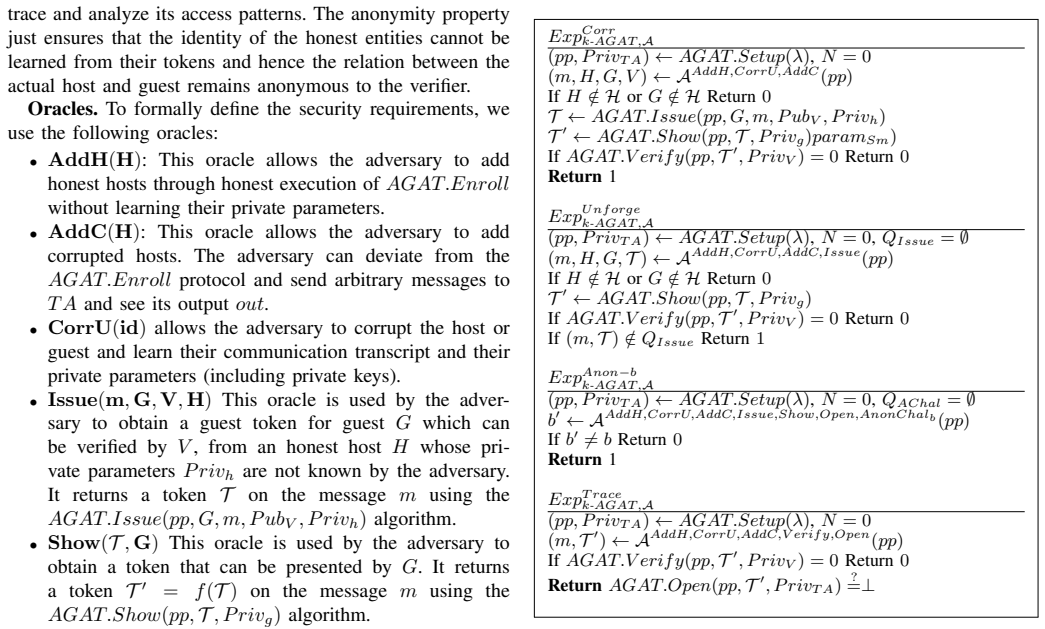
- The formal security definitions (games for anonymity, sponsor opening, and linkability) are stated at a high level in the abstract; the manuscript should include the complete game descriptions with oracles and winning conditions in the main body so that the reduction steps can be checked line-by-line.
- The efficiency discussion of the AGAT protocol would benefit from an explicit table (or reference to one) comparing communication and computation costs of the chosen instantiation against a baseline guest-access scheme.
- Notation for the two membership levels and the sponsor-opening algorithm should be introduced once in a dedicated subsection and used consistently thereafter to avoid overloading symbols already standard in dynamic group signatures.
Simulated Author's Rebuttal
We thank the referee for the positive summary, significance assessment, and recommendation of minor revision. The report contains no major comments, so we provide no point-by-point responses below.
Circularity Check
No significant circularity identified
full rationale
The paper formalizes SPGS via a game-based security definition and supplies a generic construction from three standard primitives (dynamic group signature, commitment scheme, knowledge-sound NIZKPoK) together with an explicit security reduction. An instantiation and an application reduction to IND-CPA encryption are also given. These steps follow the conventional cryptographic reduction paradigm; no equation or definition reduces the claimed properties to fitted parameters, self-referential inputs, or a load-bearing self-citation chain. The derivation remains self-contained against external security assumptions on the underlying primitives.
Axiom & Free-Parameter Ledger
axioms (3)
- domain assumption Security of the underlying dynamic group signature scheme
- domain assumption Security of the commitment scheme
- domain assumption Knowledge soundness of the NIZK proof of knowledge
invented entities (1)
-
Sponsored Group Signature (SPGS)
no independent evidence
Cite this review
Pith. "Pith review of Sponsored Group Signature and its Application to Privacy-preserving Guest Access in Smart Environments." pith.science (2026). https://pith.science/paper/DGZS4CRE
@misc{pith2026260625248,
  author       = {Pith},
  title        = {Pith review of: Sponsored Group Signature and its Application to Privacy-preserving Guest Access in Smart Environments},
  year         = {2026},
  howpublished = {\url{https://pith.science/paper/DGZS4CRE}},
  note         = {Machine review of arXiv:2606.25248}
}
read the original abstract
Group signatures are privacy preserving signature schemes in which a group member can anonymously sign messages on behalf of the group, while providing accountability, by allowing the signature of a misbehaving group member be ``opened'' and the identity of the signer be revealed. In group signature members are admitted to the group by a (trusted) group manager. We motivate the need for a flexible mechanism in applications, such as privacy preserving access in smart environments, and propose a two-level member-join group signature that we call SPonsored Group Signature (SPGS) where group members of level 1 can ``sponsor'' new members, in level 2, to join the group. This relaxation of user join comes with additional accountability mechanisms: we require that the signature of a sponsored member can be opened to the identity of the sponsor (that is sponsor is responsible for the sponsored member), and while all signatures are anonymous, for the sponsored members, the signatures are linkable. This allows a sponsor to efficiently identify an undesirable sponsored member. We formalize SPGS scheme, define its security using a game-based approach, and give a generic construction of SPGS that uses a (dynamic) group signature scheme, a commitment scheme, and a knowledge-sound non-interactive zero knowledge proof of knowledge, and prove its security. We also give an instantiation of our construction. To show applicability of SPGS in practice, we consider the problem of providing guest access in a smart building, and introduce Anonymous Guest Access Token (AGAT) that allows a temporary guest to anonymously access (a subset of) the building resources. We show how SPGS can be used (together with an IND-CPA secure public key encryption scheme) to give a direct construction for AGAT, and show the efficiency of our guest access protocol when it is instantiated with existing schemes.
Figures


Reference graph
Works this paper leans on
-
[1]
Group signatures,
D. Chaum and E. Van Heyst, “Group signatures,” inWorkshop on the Theory and Application of of Cryptographic Techniques. Springer, 1991, pp. 257–265
1991
-
[2]
Linkable group signature for auditing anonymous communication,
H. Zheng, Q. Wu, B. Qin, L. Zhong, S. He, and J. Liu, “Linkable group signature for auditing anonymous communication,” inAustralasian Conference on Information Security and Privacy. Springer, 2018, pp. 304–321
2018
-
[3]
Linkable spontaneous anonymous group signature for ad hoc groups,
J. K. Liu, V . K. Wei, and D. S. Wong, “Linkable spontaneous anonymous group signature for ad hoc groups,” inAustralasian Conference on Information Security and Privacy. Springer, 2004, pp. 325–335
2004
-
[4]
Foundations of fully dynamic group signatures,
J. Bootle, A. Cerulli, P. Chaidos, E. Ghadafi, and J. Groth, “Foundations of fully dynamic group signatures,” inInt. Conference on Applied Cryptography and Network Security. Springer, 2016, pp. 117–136
2016
-
[5]
Dgm: Ad ynamic and revocable g roup m erkle signature,
M. Buser, J. K. Liu, R. Steinfeld, A. Sakzad, and S.-F. Sun, “Dgm: Ad ynamic and revocable g roup m erkle signature,” inEuropean Symposium on Research in Computer Security. Springer, 2019, pp. 194–214
2019
-
[6]
Foundations of group signatures: The case of dynamic groups,
M. Bellare, H. Shi, and C. Zhang, “Foundations of group signatures: The case of dynamic groups,” inCryptographers’ track at the RSA conference. Springer, 2005, pp. 136–153
2005
-
[7]
New group signature schemes,
L. Chen and T. P. Pedersen, “New group signature schemes,” inWork- shop on the Theory and Application of of Cryptographic Techniques. Springer, 1994, pp. 171–181
1994
-
[8]
A group signature scheme from lattice assumptions,
S. D. Gordon, J. Katz, and V . Vaikuntanathan, “A group signature scheme from lattice assumptions,” inInternational conference on the theory and application of cryptology and information security. Springer, 2010, pp. 395–412
2010
-
[9]
Efficient group signature schemes for large groups,
J. Camenisch and M. Stadler, “Efficient group signature schemes for large groups,” inAnnual international cryptology conference. Springer, 1997, pp. 410–424
1997
-
[10]
A group signature scheme with improved efficiency,
J. Camenisch and M. Michels, “A group signature scheme with improved efficiency,” inInternational Conference on the Theory and Application of Cryptology and Information Security. Springer, 1998, pp. 160–174
1998
-
[11]
Efficient group signature scheme using lattices,
M. Abhilash and B. Amberker, “Efficient group signature scheme using lattices,”International Journal of Information Technology, vol. 14, no. 4, pp. 1845–1854, 2022
2022
-
[12]
A code-based group signature scheme,
Q. Alamélou, O. Blazy, S. Cauchie, and P. Gaborit, “A code-based group signature scheme,”Designs, Codes and Cryptography, vol. 82, no. 1, pp. 469–493, 2017
2017
-
[13]
Group signatures and more from isogenies and lattices: Generic, simple, and efficient,
W. Beullens, S. Dobson, S. Katsumata, Y .-F. Lai, and F. Pintore, “Group signatures and more from isogenies and lattices: Generic, simple, and efficient,” inAnnual International Conference on the Theory and Applications of Cryptographic Techniques. Springer, 2022, pp. 95–126
2022
-
[14]
Dgmt: A fully dynamic group signature from symmetric-key primitives,
M. Fadavi, S. Karati, A. Erfanian, and R. Safavi-Naini, “Dgmt: A fully dynamic group signature from symmetric-key primitives,”Cryptogra- phy, vol. 9, no. 1, p. 12, 2025
2025
-
[15]
Randomizable proofs and delegatable anonymous credentials,
M. Belenkiy, J. Camenisch, M. Chase, M. Kohlweiss, A. Lysyanskaya, and H. Shacham, “Randomizable proofs and delegatable anonymous credentials,” inAdvances in Cryptology-CRYPTO 2009: 29th Annual International Cryptology Conference, Santa Barbara, CA, USA, August 16-20, 2009. Proceedings. Springer, 2009, pp. 108–125
2009
-
[16]
Delegatable anonymous credentials,
M. Belenkiy, J. Camenisch, M. Chase, M. Kohlweiss, A. Lysyanskaya, and et al., “Delegatable anonymous credentials,”Cryptology ePrint Archive, 2008
2008
-
[17]
Practical delegatable anonymous credentials from equivalence class signatures,
O. Mir, D. Slamanig, B. Bauer, and R. Mayrhofer, “Practical delegatable anonymous credentials from equivalence class signatures,”Proceedings on Privacy Enhancing Technologies, 2023
2023
-
[18]
Delegatable anonymous credentials from mercurial signatures,
E. C. Crites and A. Lysyanskaya, “Delegatable anonymous credentials from mercurial signatures,” inCryptographers’ Track at the RSA Con- ference. Springer, 2019, pp. 535–555
2019
-
[19]
Delegatable attribute-based anonymous credentials from dynamically malleable signatures,
J. Blömer and J. Bobolz, “Delegatable attribute-based anonymous credentials from dynamically malleable signatures,” inInternational Conference on Applied Cryptography and Network Security. Springer, 2018, pp. 221–239
2018
-
[20]
Short linkable ring signatures for e-voting, e-cash and attestation,
P. P. Tsang and V . K. Wei, “Short linkable ring signatures for e-voting, e-cash and attestation,” inInternational Conference on Information Security Practice and Experience. Springer, 2005, pp. 48–60
2005
-
[21]
Linkable ring signature with unconditional anonymity,
J. K. Liu, M. H. Au, W. Susilo, and J. Zhou, “Linkable ring signature with unconditional anonymity,”IEEE Transactions on Knowledge and Data Engineering, vol. 26, no. 1, pp. 157–165, 2013
2013
-
[22]
Many- time linkable ring signatures,
N. Tran, K. Nguyen, D. Liu, J. Pieprzyk, and W. Susilo, “Many- time linkable ring signatures,” inInternational Conference on Provable Security. Springer, 2025, pp. 3–22
2025
-
[23]
Accountable tracing signatures,
M. Kohlweiss and I. Miers, “Accountable tracing signatures,”Cryptology ePrint Archive, 2014
2014
-
[24]
Bifurcated signatures: folding the accountability vs. anonymity dilemma into a single private signing scheme,
B. Libert, K. Nguyen, T. Peters, and M. Yung, “Bifurcated signatures: folding the accountability vs. anonymity dilemma into a single private signing scheme,” inAnnual International Conference on the Theory and Applications of Cryptographic Techniques. Springer, 2021, pp. 521– 552
2021
-
[25]
Traceable signatures,
A. Kiayias, Y . Tsiounis, and M. Yung, “Traceable signatures,” inInter- national Conference on the Theory and Applications of Cryptographic Techniques. Springer, 2004, pp. 571–589
2004
-
[26]
Secure proxy signature schemes for delegation of signing rights,
A. Boldyreva, A. Palacio, and B. Warinschi, “Secure proxy signature schemes for delegation of signing rights,”Journal of Cryptology, vol. 25, no. 1, pp. 57–115, 2012
2012
-
[27]
Short group signatures,
D. Boneh, X. Boyen, and H. Shacham, “Short group signatures,” in Annual int. cryptology conference. Springer, 2004, pp. 41–55
2004
-
[28]
Trusted internet of things (iot) device network-layer onboarding and lifecycle management: Enhancing internet protocol-based iot device and network security,
M. Fagan, J. Marron, P. Watrobski, M. Souppaya, W. Barker, C. Deane, J. Klosterman, C. Rearick, B. Mulugeta, S. Symingtonet al., “Trusted internet of things (iot) device network-layer onboarding and lifecycle management: Enhancing internet protocol-based iot device and network security,” NIST, Tech. Rep., 2023
2023
-
[29]
Ace-oauth – a new standard for lightweight authorization and access control,
E. Blog, “Ace-oauth – a new standard for lightweight authorization and access control,” 2025. [Online]. Available: https://www.ericsson.com/ en/blog/2023/7/ace-oauth-standard-for-lightweight-authorization
2025
-
[30]
J. H. U. ISI. (2018) Charm-crypto documentation. [Online]. Available: https://jhuisi.github.io/charm/
2018
-
[31]
Foundations of fully dynamic group signatures,
J. Bootle, A. Cerulli, P. Chaidos, E. Ghadafi, and J. Groth, “Foundations of fully dynamic group signatures,”Journal of Cryptology, vol. 33, no. 4, pp. 1822–1870, 2020
2020
-
[32]
Anonymous counting tokens,
F. Benhamouda, M. Raykova, and K. Seth, “Anonymous counting tokens,” inInternational Conference on the Theory and Application of Cryptology and Information Security. Springer, 2023, pp. 245–278
2023
-
[33]
How not to prove yourself: Pitfalls of the fiat-shamir heuristic and applications to helios,
D. Bernhard, O. Pereira, and B. Warinschi, “How not to prove yourself: Pitfalls of the fiat-shamir heuristic and applications to helios,” in International Conference on the Theory and Application of Cryptology and Information Security. Springer, 2012, pp. 626–643
2012
-
[34]
On signatures of knowledge,
M. Chase and A. Lysyanskaya, “On signatures of knowledge,” inAnnual International Cryptology Conference. Springer, 2006, pp. 78–96
2006
-
[35]
Zero-knowledge proofs of knowledge without interaction,
A. De Santis and G. Persiano, “Zero-knowledge proofs of knowledge without interaction,” in33rd Annual Symposium on Foundations of Computer Science. IEEE Computer Society, 1992, pp. 427–436
1992
-
[36]
Necessary and sufficient assumptions for non-interactive zero-knowledge proofs of knowledge for all np relations,
A. De Santis, G. Di Crescenzo, and G. Persiano, “Necessary and sufficient assumptions for non-interactive zero-knowledge proofs of knowledge for all np relations,” inInternational Colloquium on Au- tomata, Languages, and Programming. Springer, 2000, pp. 451–462. APPENDIX Bootle et al. [31] proposed a framework to model and define the security requirements...
2000
-
[37]
The sponsored-member signature in our generic construction can be seen as a group signature and a SOK (with weaker security than [34])
(which is equivalent to a commitment scheme 4 [36]) and a simulation-sound non-interactive zero knowledge proof, one can construct a signature of knowledge for any languageL. The sponsored-member signature in our generic construction can be seen as a group signature and a SOK (with weaker security than [34]). One can also use the generic SOK con- structio...
-
[38]
Ifσ ′ 0 ̸=σ ′ 1 and one (or both)σ ′ b have not been queried toSignHUoracle before, meaning that (σ′ b, P kb,Sm,·)/∈Q Sign the adversary aborts. This game is indistinguishable from the previous one since ifσ ′ b has not been queried before, then it should have been forged which happens only with negligible probability sinceGS is non-frameable. We can see ...
This paper was first reviewed by grok-4.3 on June 25, 2026.
discussion (0)
Sign in with ORCID, Apple, or X to comment. Anyone can read and Pith papers without signing in.