Cosmological Galaxy Formation Modelling in the Era of the Square Kilometre Array
Pith reviewed 2026-06-25 21:30 UTC · model grok-4.3
The pith
Galaxy formation models must combine simulations across scales with forward modeling to interpret Square Kilometre Array observations of cold gas and radio emission.
A machine-rendered reading of the paper's core claim, the machinery that carries it, and where it could break.
Core claim
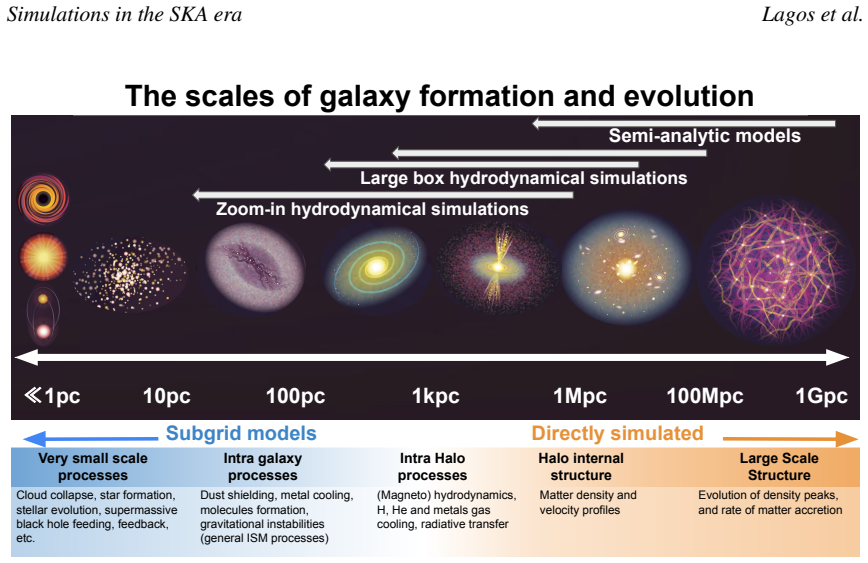
Cosmological hydrodynamical simulations and semi-analytic models now jointly reproduce many observed gas properties, yet the challenge of bridging physical scales from sub-parsec star formation to gigaparsec cosmic structure remains. A coordinated wedding-cake strategy that unites simulations of different scales, forward modelling of observables to ensure fair comparison with data, and integration of AI-driven emulators will enable theoretical models to both interpret and guide SKA science on the cold gas and radio continuum of galaxies across cosmic time.
What carries the argument
The wedding-cake strategy that unites simulations of different scales, together with forward modelling of observables.
If this is right
- Models will predict atomic hydrogen, molecular gas distributions, and radio continuum from star formation and active galactic nuclei across cosmic time.
- Forward modelling will produce simulated observables that can be compared directly to SKA data without selection biases.
- AI-driven emulators will speed up exploration of model parameters and uncertainty quantification.
- Theoretical models will shift from post-observation interpretation to active prediction and experimental design for SKA surveys.
Where Pith is reading between the lines
- The same coordinated multi-scale approach could be adapted to prepare models for other upcoming large radio or optical surveys.
- Success of the strategy might isolate specific physical processes that still require new implementations in the simulations.
- One could test the framework by applying it to predict SKA-detectable signals in particular galaxy types or redshift ranges not yet observed.
Load-bearing premise
The scale-bridging challenge can be solved by coordinating existing simulations of different resolutions and adding forward modelling plus emulators, without needing fundamental new physics.
What would settle it
SKA observations revealing gas properties or radio emission patterns that remain irreproducible by any combination of current hydrodynamical and semi-analytic models after forward modelling and emulator application.
Figures
read the original abstract
Over the past decade, galaxy formation simulations have advanced dramatically, transforming our ability to model the interstellar medium (ISM) and predict galaxies' radio emission. Yet the challenge of bridging physical scales--from sub-parsec star formation to gigaparsec cosmic structure--remains. The Square Kilometre Array (SKA) will map the cold gas and radio continuum of galaxies across cosmic time, demanding models that couple physical realism with cosmological reach. This chapter reviews the state-of-the-art in cosmological galaxy formation modelling in preparation for the SKA. We outline progress in simulating atomic hydrogen (HI), molecular gas, and radio continuum emission from both star formation and active galactic nuclei, highlighting how cosmological hydrodynamical simulations and semi-analytic models now jointly reproduce many observed gas properties. We emphasise the need for a coordinated, ``wedding-cake'' strategy that unites simulations of different scales, for forward modelling of observables to ensure fair comparison with data, and for the integration of new technologies such as AI-driven emulators to accelerate progress. Together, these efforts will enable theoretical models to both interpret and guide SKA science, turning simulations from passive interpreters into active engines for discovery.
Editorial analysis
A structured set of objections, weighed in public.
Referee Report
Summary. This review chapter summarizes advances in cosmological hydrodynamical simulations and semi-analytic models for predicting atomic (HI) and molecular gas properties as well as radio continuum emission from star formation and AGN. It states that these models now jointly reproduce many observed gas properties, identifies the persistent challenge of bridging sub-parsec to gigaparsec scales, and advocates a coordinated 'wedding-cake' multi-scale simulation strategy together with forward modeling of observables and AI-driven emulators to prepare for and interpret SKA data.
Significance. As a synthesis of the literature on ISM and radio modeling in cosmological contexts, the chapter provides a timely overview for the community ahead of SKA operations. Its emphasis on practical coordination strategies and new computational tools (emulators, forward modeling) offers guidance that could help turn existing simulation frameworks into more effective tools for both interpreting and planning SKA observations, provided the cited progress is accurately represented.
minor comments (1)
- The abstract paragraph on the 'wedding-cake' strategy would benefit from a brief parenthetical definition or cross-reference to the section where the term is first introduced in the main text, to aid readers unfamiliar with the concept.
Simulated Author's Rebuttal
We thank the referee for their positive and constructive review. We are pleased that the manuscript is viewed as a timely synthesis providing useful guidance for the community ahead of SKA operations, and we appreciate the recommendation to accept.
Circularity Check
Review paper with no derivations or predictions that reduce to inputs
full rationale
This document is a review chapter summarizing published progress in hydrodynamical simulations and semi-analytic models for HI, molecular gas, and radio continuum. It advocates a wedding-cake multi-scale strategy, forward modeling, and AI emulators but presents no new equations, parameter fits, quantitative predictions, or derivation chains. All cited results come from external literature; the text contains no self-contained technical claims that could be circular by construction. This matches the default expectation of no significant circularity for review-style papers.
Axiom & Free-Parameter Ledger
Reference graph
Works this paper leans on
-
[1]
2026 ,publisher =
Ran Wang and author2 and author3 and author4 and author5 ,title =. 2026 ,publisher =
2026
-
[2]
Hardcastle and author2 and author3 and author4 and author5 ,title =
Martin J. Hardcastle and author2 and author3 and author4 and author5 ,title =. 2026 ,publisher =
2026
-
[3]
Duncan and author2 and author3 and author4 and author5 ,title =
Kenneth J. Duncan and author2 and author3 and author4 and author5 ,title =. 2026 ,publisher =
2026
-
[4]
2026 ,publisher =
Manisha Caleb and author2 and author3 and author4 and author5 ,title =. 2026 ,publisher =
2026
-
[5]
Mahony and author2 and author3 and author4 and author5 ,title =
Elizabeth K. Mahony and author2 and author3 and author4 and author5 ,title =. 2026 ,publisher =
2026
-
[6]
Tabatabaei and author2 and author3 and author4 and author5 ,title =
Fatemeh S. Tabatabaei and author2 and author3 and author4 and author5 ,title =. 2026 ,publisher =
2026
-
[7]
2026 ,publisher =
Hiddo Sunny Bouwe Algera and author2 and author3 and author4 and author5 ,title =. 2026 ,publisher =
2026
-
[8]
2026 ,publisher =
Baerbel Koribalski and author2 and author3 and author4 and author5 ,title =. 2026 ,publisher =
2026
-
[9]
2026 ,publisher =
Hengxing Pan and author2 and author3 and author4 and author5 ,title =. 2026 ,publisher =
2026
-
[10]
2026 ,publisher =
Nathan Deg and author2 and author3 and author4 and author5 ,title =. 2026 ,publisher =
2026
-
[11]
2026 ,publisher =
Erik Rosolowsky and author2 and author3 and author4 and author5 ,title =. 2026 ,publisher =
2026
-
[12]
2026 ,publisher =
Erwin de Blok and author2 and author3 and author4 and author5 ,title =. 2026 ,publisher =
2026
-
[13]
2026 ,publisher =
Tommaso Ronconi and author2 and author3 and author4 and author5 ,title =. 2026 ,publisher =
2026
-
[14]
2026 ,publisher =
Federico Lelli and author2 and author3 and author4 and author5 ,title =. 2026 ,publisher =
2026
-
[15]
2005, MNRAS, 364, L18, doi: 10.1111/j.1745-3933.2005.00096.x
The HIPASS catalogue: _ HI and environmental effects on the HI mass function of galaxies. , eprint =. doi:10.1111/j.1745-3933.2005.00029.x , adsurl =
-
[16]
The effects of local stellar radiation and dust depletion on non-equilibrium interstellar chemistry. , keywords =. doi:10.1093/mnras/stac2338 , archivePrefix =. 2208.02288 , primaryClass =
-
[17]
Quenching massive galaxies across cosmic time with the semi-analytic model SHARK V2.0. , keywords =. doi:10.1093/mnras/stae1024 , archivePrefix =. 2309.02310 , primaryClass =
-
[18]
The Global Schmidt Law in Star-forming Galaxies. , keywords =. doi:10.1086/305588 , archivePrefix =. astro-ph/9712213 , primaryClass =
work page internal anchor Pith review Pith/arXiv arXiv doi:10.1086/305588
-
[19]
Emergence and cosmic evolution of the Kennicutt-Schmidt relation driven by interstellar turbulence. , keywords =. doi:10.1051/0004-6361/202347917 , archivePrefix =. 2309.06485 , primaryClass =
-
[20]
Kennicutt-Schmidt relation of galaxies over 13 billion years in the COLIBRE hydrodynamical simulations. , keywords =. doi:10.1093/mnras/stag947 , archivePrefix =. 2512.11309 , primaryClass =
work page internal anchor Pith review Pith/arXiv arXiv doi:10.1093/mnras/stag947
-
[21]
WALLABY Pilot Survey: Characterizing Low-rotation Kinematically Modeled Galaxies. , keywords =. doi:10.3847/1538-4357/ae1003 , archivePrefix =. 2510.02522 , primaryClass =
-
[22]
Dynamical disequilibrium in dwarf galaxies: rethinking gas dynamics, rotation curves, and dark matter inference. , keywords =. doi:10.1093/mnras/stag356 , archivePrefix =. 2512.11033 , primaryClass =
-
[23]
The physical drivers of gas turbulence in simulated disc galaxies. , keywords =. doi:10.1093/mnras/stad2119 , archivePrefix =. 2210.09673 , primaryClass =
-
[24]
HI-selected Galaxies in Hierarchical Models of Galaxy Formation and Evolution
H I-selected galaxies in hierarchical models of galaxy formation and evolution. , keywords =. doi:10.1093/mnras/stw2901 , archivePrefix =. 1610.02042 , primaryClass =
work page internal anchor Pith review Pith/arXiv arXiv doi:10.1093/mnras/stw2901
-
[25]
First results from the TNG50 simulation: the evolution of stellar and gaseous discs across cosmic time. , keywords =. doi:10.1093/mnras/stz2338 , archivePrefix =. 1902.05553 , primaryClass =
-
[26]
The diverse star formation histories of early massive, quenched galaxies in modern galaxy formation simulations. , keywords =. doi:10.1093/mnras/stae2626 , archivePrefix =. 2409.16916 , primaryClass =
-
[27]
The CAMELS project: Cosmology and Astrophysics with MachinE Learning Simulations
The CAMELS Project: Cosmology and Astrophysics with Machine-learning Simulations. , keywords =. doi:10.3847/1538-4357/abf7ba , archivePrefix =. 2010.00619 , primaryClass =
-
[28]
Cosmological baryon spread and impact on matter clustering in CAMELS. , keywords =. doi:10.1093/mnras/stae817 , archivePrefix =. 2307.11832 , primaryClass =
-
[29]
A unified multi-wavelength model of galaxy formation
A unified multiwavelength model of galaxy formation. , keywords =. doi:10.1093/mnras/stw1888 , archivePrefix =. 1509.08473 , primaryClass =
work page internal anchor Pith review Pith/arXiv arXiv doi:10.1093/mnras/stw1888
-
[30]
The effect of the environment on the H I scaling relations. , keywords =. doi:10.1111/j.1365-2966.2011.18822.x , archivePrefix =. 1103.5889 , primaryClass =
-
[31]
Simulating Galaxy Formation with the IllustrisTNG Model
Simulating galaxy formation with the IllustrisTNG model. , keywords =. doi:10.1093/mnras/stx2656 , archivePrefix =. 1703.02970 , primaryClass =
work page internal anchor Pith review Pith/arXiv arXiv doi:10.1093/mnras/stx2656
-
[32]
The EAGLE simulations of galaxy formation: calibration of subgrid physics and model variations
The EAGLE simulations of galaxy formation: calibration of subgrid physics and model variations. , keywords =. doi:10.1093/mnras/stv725 , archivePrefix =. 1501.01311 , primaryClass =
work page internal anchor Pith review Pith/arXiv arXiv doi:10.1093/mnras/stv725
-
[33]
COLIBRE: calibrating subgrid feedback in cosmological simulations that include a cold gas phase
COLIBRE: calibrating subgrid feedback in cosmological simulations that include a cold gas phase. , keywords =. doi:10.1093/mnras/stag300 , archivePrefix =. 2509.04067 , primaryClass =
work page internal anchor Pith review Pith/arXiv arXiv doi:10.1093/mnras/stag300
-
[34]
Efficient Long-range Active Galactic Nuclei (AGNs) Feedback Affects the Low-redshift Ly Forest. , keywords =. doi:10.3847/2041-8213/acb7f1 , archivePrefix =. 2210.02467 , primaryClass =
-
[35]
The FLAMINGO project: baryon effects on the matter power spectrum. , keywords =. doi:10.1093/mnras/staf569 , archivePrefix =. 2410.17109 , primaryClass =
-
[36]
The effect of baryons on redshift space distortions and cosmic density and velocity fields in the EAGLE simulation. , keywords =. doi:10.1093/mnrasl/slw081 , archivePrefix =. 1603.03328 , primaryClass =
work page internal anchor Pith review Pith/arXiv arXiv doi:10.1093/mnrasl/slw081
-
[37]
Tracing the quenching journey across cosmic time. , keywords =. doi:10.1051/0004-6361/202349045 , archivePrefix =. 2401.06211 , primaryClass =
-
[38]
The EAGLE project: Simulating the evolution and assembly of galaxies and their environments
The EAGLE project: simulating the evolution and assembly of galaxies and their environments. , keywords =. doi:10.1093/mnras/stu2058 , archivePrefix =. 1407.7040 , primaryClass =
work page internal anchor Pith review Pith/arXiv arXiv doi:10.1093/mnras/stu2058
-
[39]
A New Public Release of the GIZMO Code
A New Public Release of the GIZMO Code. arXiv e-prints , keywords =. doi:10.48550/arXiv.1712.01294 , archivePrefix =. 1712.01294 , primaryClass =
work page internal anchor Pith review Pith/arXiv arXiv doi:10.48550/arxiv.1712.01294
-
[40]
E pur si muove: Galilean-invariant cosmological hydrodynamical simulations on a moving mesh. , keywords =. doi:10.1111/j.1365-2966.2009.15715.x , archivePrefix =. 0901.4107 , primaryClass =
-
[41]
SWIFT: A modern highly-parallel gravity and smoothed particle hydrodynamics solver for astrophysical and cosmological applications. , keywords =. doi:10.1093/mnras/stae922 , archivePrefix =. 2305.13380 , primaryClass =
-
[42]
Galaxy assembly and evolution in the P-Millennium simulation: Galaxy clustering. , keywords =. doi:10.1051/0004-6361/202452029 , archivePrefix =. 2409.02194 , primaryClass =
-
[43]
The radio galaxy population in the SIMBA simulations. , keywords =. doi:10.1093/mnras/stab654 , archivePrefix =. 2010.11225 , primaryClass =
-
[44]
Environmental effects on satellite galaxies from the perspective of cold gas. , keywords =. doi:10.1093/mnras/stae162 , archivePrefix =. 2401.07158 , primaryClass =
-
[45]
xGASS: total cold gas scaling relations and molecular-to-atomic gas ratios of galaxies in the local Universe. , keywords =. doi:10.1093/mnras/sty089 , archivePrefix =. 1802.02373 , primaryClass =
work page internal anchor Pith review Pith/arXiv arXiv doi:10.1093/mnras/sty089
-
[46]
The impact of ram pressure on cluster galaxies, insights from GAEA and TNG. , keywords =. doi:10.1051/0004-6361/202553915 , archivePrefix =. 2504.12863 , primaryClass =
-
[47]
On the influence of environment on star forming galaxies
On the influence of environment on star-forming galaxies. , keywords =. doi:10.1093/mnras/sty2131 , archivePrefix =. 1808.01628 , primaryClass =
work page internal anchor Pith review Pith/arXiv arXiv doi:10.1093/mnras/sty2131
-
[48]
Exploring the Statistical Properties of Double Radio Relics in the TNG-cluster and TNG300 Simulations. , keywords =. doi:10.3847/1538-4357/ae3245 , archivePrefix =. 2510.21632 , primaryClass =
-
[49]
An orbital perspective on the starvation, stripping, and quenching of satellite galaxies in the EAGLE simulations. , keywords =. doi:10.1093/mnras/stac2042 , archivePrefix =. 2205.08414 , primaryClass =
-
[50]
Physical drivers of galaxies' cold-gas content: exploring environmental and evolutionary effects with Dark Sage. , keywords =. doi:10.1093/mnras/stx1596 , archivePrefix =. 1706.07434 , primaryClass =
work page internal anchor Pith review Pith/arXiv arXiv doi:10.1093/mnras/stx1596
-
[51]
Cold gas properties of the Herschel Reference Survey. III. Molecular gas stripping in cluster galaxies. , keywords =. doi:10.1051/0004-6361/201322313 , archivePrefix =. 1402.0326 , primaryClass =
work page internal anchor Pith review Pith/arXiv arXiv doi:10.1051/0004-6361/201322313
-
[52]
Angular momentum-related probe of cold gas deficiencies. , keywords =. doi:10.1093/mnras/staa514 , archivePrefix =. 2002.09083 , primaryClass =
-
[53]
The Messenger , year = 2023, month = mar, volume =
The 4MOST Hemisphere Survey of the Nearby Universe (4HS). The Messenger , year = 2023, month = mar, volume =. doi:10.18727/0722-6691/5312 , adsurl =
-
[54]
4MOST Consortium Survey 7: Wide-Area VISTA Extragalactic Survey (WAVES)
4MOST Consortium Survey 7: Wide-Area VISTA Extragalactic Survey (WAVES). The Messenger , keywords =. doi:10.18727/0722-6691/5126 , archivePrefix =. 1903.02473 , primaryClass =
work page internal anchor Pith review Pith/arXiv arXiv doi:10.18727/0722-6691/5126 1903
-
[55]
Unveiling the atomic hydrogen-halo mass relation via spectral stacking. , keywords =. doi:10.1093/mnras/stab1925 , archivePrefix =. 2102.12203 , primaryClass =
-
[56]
Ingredients for 21cm intensity mapping
Ingredients for 21 cm Intensity Mapping. , keywords =. doi:10.3847/1538-4357/aadba0 , archivePrefix =. 1804.09180 , primaryClass =
work page internal anchor Pith review Pith/arXiv arXiv doi:10.3847/1538-4357/aadba0
-
[57]
The physical drivers of the atomic hydrogen-halo mass relation. , keywords =. doi:10.1093/mnras/staa2251 , archivePrefix =. 2006.12102 , primaryClass =
-
[58]
The atomic hydrogen content of the post-reionization Universe , volume=
The atomic hydrogen content of the post-reionization Universe. , keywords =. doi:10.1093/mnras/staa604 , archivePrefix =. 1909.02242 , primaryClass =
-
[59]
Galaxy formation in the Planck Millennium: the atomic hydrogen content of dark matter halos
Galaxy formation in the Planck Millennium: the atomic hydrogen content of dark matter haloes. , keywords =. doi:10.1093/mnras/sty3427 , archivePrefix =. 1808.08276 , primaryClass =
work page internal anchor Pith review Pith/arXiv arXiv doi:10.1093/mnras/sty3427
-
[60]
The Clustering of ALFALFA Galaxies: Dependence on H I Mass, Relationship with Optical Samples, and Clues of Host Halo Properties. , keywords =. doi:10.1088/0004-637X/776/1/43 , archivePrefix =. 1308.2661 , primaryClass =
work page internal anchor Pith review Pith/arXiv arXiv doi:10.1088/0004-637x/776/1/43
-
[61]
The Weak Clustering of Gas-Rich Galaxies
The Weak Clustering of Gas-rich Galaxies. , keywords =. doi:10.1086/508799 , archivePrefix =. astro-ph/0608633 , primaryClass =
work page internal anchor Pith review Pith/arXiv arXiv doi:10.1086/508799
-
[62]
Evidence for the inside-out formation of Galactic discs
Grand unification of AGN activity in the CDM cosmology. , keywords =. doi:10.1111/j.1365-2966.2010.17427.x , archivePrefix =. 0911.1128 , primaryClass =
-
[63]
A hybrid active galactic nucleus feedback model with spinning black holes, winds and jets. , keywords =. doi:10.1093/mnras/stag324 , archivePrefix =. 2509.05179 , primaryClass =
-
[64]
Radio galaxies in SIMBA: a MIGHTEE comparison. , keywords =. doi:10.1093/mnras/stae2724 , archivePrefix =. 2412.09824 , primaryClass =
-
[65]
A simulation-based analytic model of radio galaxies
A simulation-based analytic model of radio galaxies. , keywords =. doi:10.1093/mnras/stx3358 , archivePrefix =. 1801.00667 , primaryClass =
work page internal anchor Pith review Pith/arXiv arXiv doi:10.1093/mnras/stx3358
-
[66]
BRAiSE: Synthetic polarisation in RMHD AGN jet simulations. , keywords =. doi:10.1017/pasa.2025.10101 , archivePrefix =. 2506.19541 , primaryClass =
-
[67]
3D hybrid fluid-particle jet simulations and the importance of synchrotron radiative losses. , keywords =. doi:10.1051/0004-6361/202450978 , archivePrefix =. 2409.05256 , primaryClass =
-
[68]
2023, MNRAS, 526, 4978, doi: 10.1093/mnras/stad2419
The FLAMINGO project: cosmological hydrodynamical simulations for large-scale structure and galaxy cluster surveys. , keywords =. doi:10.1093/mnras/stad2419 , archivePrefix =. 2306.04024 , primaryClass =
-
[69]
NEUTRALUNIVERSEMACHINE: Predictions of H I gas in different theoretical models. , keywords =. doi:10.1051/0004-6361/202452697 , archivePrefix =. 2410.19340 , primaryClass =
-
[70]
Modeling the atomic-to-molecular transition in cosmological simulations of galaxy formation
Modeling the Atomic-to-molecular Transition in Cosmological Simulations of Galaxy Formation. , keywords =. doi:10.3847/1538-4365/aae387 , archivePrefix =. 1806.02341 , primaryClass =
work page internal anchor Pith review Pith/arXiv arXiv doi:10.3847/1538-4365/aae387
-
[71]
Resolution criteria to avoid artificial clumping in Lagrangian hydrodynamic simulations with a multiphase interstellar medium. , keywords =. doi:10.1093/mnras/stad3935 , archivePrefix =. 2310.10721 , primaryClass =
-
[72]
Variation of galactic cold gas reservoirs with stellar mass
Variation of galactic cold gas reservoirs with stellar mass. , keywords =. doi:10.1093/mnras/stu2532 , archivePrefix =. 1412.0852 , primaryClass =
work page internal anchor Pith review Pith/arXiv arXiv doi:10.1093/mnras/stu2532
-
[73]
Which galaxies dominate the neutral gas content of the Universe?
Which galaxies dominate the neutral gas content of the Universe?. , keywords =. doi:10.1093/mnras/stu266 , archivePrefix =. 1310.4178 , primaryClass =
work page internal anchor Pith review Pith/arXiv arXiv doi:10.1093/mnras/stu266
-
[74]
Line Overlap and Self-Shielding of Molecular Hydrogen in Galaxies
Line Overlap and Self-Shielding of Molecular Hydrogen in Galaxies. , keywords =. doi:10.1088/0004-637X/795/1/37 , archivePrefix =. 1406.4129 , primaryClass =
work page internal anchor Pith review Pith/arXiv arXiv doi:10.1088/0004-637x/795/1/37
-
[75]
Shark: introducing an open source, free and flexible semi-analytic model of galaxy formation
Shark: introducing an open source, free, and flexible semi-analytic model of galaxy formation. , keywords =. doi:10.1093/mnras/sty2440 , archivePrefix =. 1807.11180 , primaryClass =
work page internal anchor Pith review Pith/arXiv arXiv doi:10.1093/mnras/sty2440
-
[76]
Origin of the galaxy H I size-mass relation. , keywords =. doi:10.1093/mnras/stz2513 , archivePrefix =. 1908.11149 , primaryClass =
-
[77]
The Variation of the Gas Content of Galaxy Groups and Pairs Compared to Isolated Galaxies. , keywords =. doi:10.3847/1538-4357/ac49ea , archivePrefix =. 2201.03575 , primaryClass =
-
[78]
Global H I asymmetries in IllustrisTNG: a diversity of physical processes disturb the cold gas in galaxies. , keywords =. doi:10.1093/mnras/staa3200 , archivePrefix =. 2010.05422 , primaryClass =
-
[79]
Exploring the angular momentum - atomic gas content connection with EAGLE and IllustrisTNG. , keywords =. doi:10.1093/mnras/stad2805 , archivePrefix =. 2307.02722 , primaryClass =
-
[80]
Introducing the NEWHORIZON simulation: Galaxy properties with resolved internal dynamics across cosmic time. , keywords =. doi:10.1051/0004-6361/202039429 , archivePrefix =. 2009.10578 , primaryClass =
discussion (0)
Sign in with ORCID, Apple, or X to comment. Anyone can read and Pith papers without signing in.