Quark Reggeization in QCD from the Wilson line formalism
Pith reviewed 2026-06-25 20:33 UTC · model grok-4.3
The pith
An interpolating operator of semi-infinite Wilson lines yields the nonlinear rapidity evolution for the Reggeized quark in QCD.
A machine-rendered reading of the paper's core claim, the machinery that carries it, and where it could break.
Core claim
The central claim is that an interpolating operator for the Reggeized quark, built from semi-infinite Wilson lines, obeys a nonlinear rapidity renormalization-group equation obtained via the background-field method in the eikonal approximation; this equation reproduces the one-loop quark Regge trajectory in the positive-signature dilute limit while exhibiting signature mixing that disappears at large Nc, thereby enabling all-order analyses of high-energy amplitudes with t-channel quark exchange entirely in the Wilson-line formalism.
What carries the argument
Interpolating operator for the Reggeized quark expressed in terms of semi-infinite Wilson lines, with its nonlinear rapidity renormalization-group evolution derived using the background-field method.
If this is right
- The positive-signature channel reproduces the characteristic power-law scaling dictated by the one-loop quark Regge trajectory.
- The negative-signature channel exhibits mixing between Reggeized quark and gluon exchanges.
- In the large-Nc limit this mixing disappears and Regge-pole behaviour emerges without the need for signature projection.
- The framework enables a systematic all-order analysis of high-energy QCD amplitudes with t-channel quark quantum-number exchange in terms of eikonal Wilson lines.
Where Pith is reading between the lines
- The nonlinear evolution equation could be solved in specific kinematic regimes to generate resummed predictions for quark-exchange amplitudes beyond leading log.
- The Wilson-line operator may furnish a bridge to other high-energy factorization schemes that treat quark Reggeons.
- Numerical or analytic solutions of the evolution in the dilute regime could be compared against existing perturbative calculations of quark Reggeization.
Load-bearing premise
The eikonal approximation together with the background-field method at leading logarithmic accuracy fully captures the nonlinear evolution of the Wilson-line operators without missing higher-order or non-eikonal corrections.
What would settle it
An explicit extraction of the one-loop quark Regge trajectory from the derived evolution equation that matches the known result, or a direct measurement of the predicted power-law energy dependence in a high-energy scattering process dominated by t-channel quark exchange.
Figures
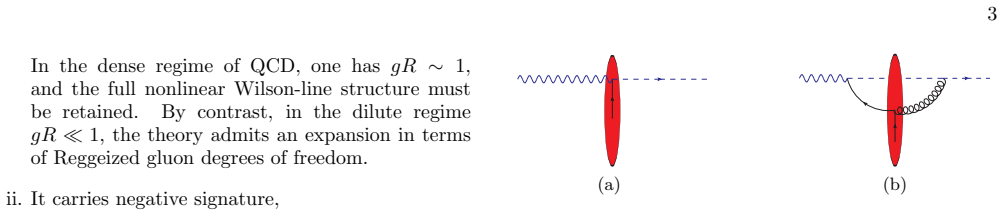
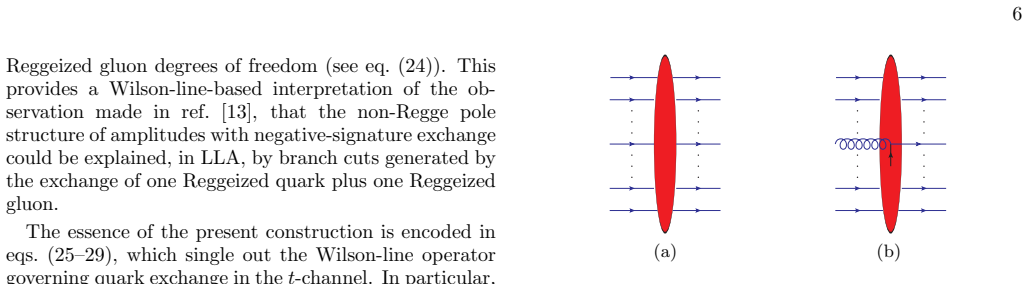
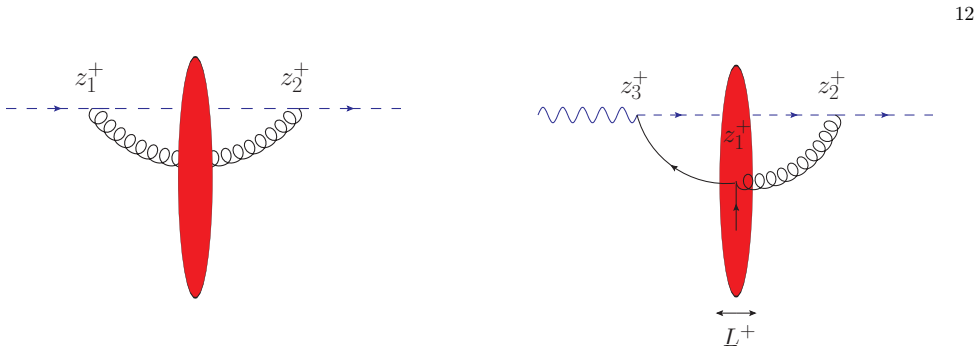
read the original abstract
We derive quark Reggeization in QCD at leading logarithmic accuracy within the eikonal Wilson-line (shockwave) approach. An interpolating operator for the Reggeized quark is identified in terms of semi-infinite Wilson lines, and its nonlinear rapidity renormalization-group evolution is derived using the background-field method. In the dilute limit, after projecting onto operators of definite signature, the positive-signature channel reproduces the characteristic power-law scaling dictated by the one-loop quark Regge trajectory, whereas the negative-signature channel exhibits mixing between Reggeized quark and gluon exchanges. In the large-$N_c$ limit, this mixing disappears, and Regge-pole behaviour emerges without the need for signature projection, recovering the expected degeneracy by signature. This paves the way to a systematic all-order analysis of high-energy QCD amplitudes with $t$-channel quark quantum-number exchange in terms of eikonal Wilson lines.
Editorial analysis
A structured set of objections, weighed in public.
Referee Report
Summary. The manuscript derives quark Reggeization in QCD at leading logarithmic accuracy in the eikonal Wilson-line (shockwave) formalism. It identifies an interpolating operator for the Reggeized quark built from semi-infinite Wilson lines and obtains its nonlinear rapidity renormalization-group evolution equation via the background-field method. In the dilute limit, after projection onto definite-signature operators, the positive-signature channel reproduces the one-loop quark Regge trajectory power-law scaling, the negative-signature channel exhibits mixing with gluon exchange, and this mixing vanishes in the large-N_c limit, recovering signature degeneracy.
Significance. If the derivation holds, the work supplies a parameter-free Wilson-line framework for systematic LLA analysis of high-energy QCD amplitudes with t-channel quark quantum numbers, extending the established gluon case. The explicit reproduction of the known one-loop trajectory provides an internal consistency test, and the approach uses only standard eikonal and background-field techniques without ad-hoc parameters or fitted inputs.
Simulated Author's Rebuttal
We thank the referee for their positive assessment of the manuscript and for recommending acceptance. There are no major comments requiring a point-by-point response.
Circularity Check
No significant circularity; derivation self-contained
full rationale
The paper starts from the standard eikonal Wilson-line shockwave formalism and background-field method to identify the interpolating operator for the Reggeized quark and derive its nonlinear rapidity RG evolution equation at LLA. The only explicit verification is that, after signature projection in the dilute limit, the positive-signature channel reproduces the known one-loop power-law scaling of the quark Regge trajectory. This is presented as a consistency check against an external benchmark result, not as a fitted parameter renamed as prediction or a self-referential definition. No load-bearing self-citations, uniqueness theorems imported from prior author work, or ansatze smuggled via citation are used to force the central result. The derivation chain remains independent of its own outputs.
Axiom & Free-Parameter Ledger
axioms (2)
- domain assumption Eikonal approximation holds for the high-energy limit of QCD scattering
- domain assumption Leading logarithmic accuracy is sufficient to derive the evolution
invented entities (1)
-
Interpolating operator for the Reggeized quark
no independent evidence
Reference graph
Works this paper leans on
-
[1]
L. N. Lipatov, Sov. J. Nucl. Phys.23, 338 (1976)
1976
-
[2]
V. S. Fadin, E. A. Kuraev, and L. N. Lipatov, Phys. Lett. B60, 50 (1975)
1975
-
[3]
E. A. Kuraev, L. N. Lipatov, and V. S. Fadin, Sov. Phys. JETP44, 443 (1976)
1976
-
[4]
E. A. Kuraev, L. N. Lipatov, and V. S. Fadin, Sov. Phys. JETP45, 199 (1977)
1977
-
[5]
I. I. Balitsky and L. N. Lipatov, Sov. J. Nucl. Phys.28, 822 (1978)
1978
-
[6]
Caron-Huot, JHEP05, 093 (2015), 1309.6521
S. Caron-Huot, JHEP05, 093 (2015), 1309.6521
Pith/arXiv arXiv 2015
-
[7]
V. S. Fadin, M. I. Kotsky, and R. Fiore, Phys. Lett. B 359, 181 (1995)
1995
-
[8]
V. S. Fadin, R. Fiore, and M. I. Kotsky, Phys. Lett. B 387, 593 (1996), hep-ph/9605357
Pith/arXiv arXiv 1996
-
[9]
M. Braun and G. P. Vacca, Phys. Lett. B477, 156 (2000), hep-ph/9910432
Pith/arXiv arXiv 2000
-
[10]
V. S. Fadin, R. Fiore, M. I. Kotsky, and A. Papa, Phys. Lett. B495, 329 (2000), hep-ph/0008057
Pith/arXiv arXiv 2000
-
[11]
V. S. Fadin and A. Papa, Nucl. Phys. B640, 309 (2002), hep-ph/0206079
Pith/arXiv arXiv 2002
-
[12]
V. S. Fadin and V. E. Sherman, Pisma Zh. Eksp. Teor. Fiz.23, 599 (1976)
1976
-
[13]
V. S. Fadin and V. E. Sherman, Sov. Phys. JETP45, 861 (1977)
1977
-
[14]
A. V. Bogdan and V. S. Fadin, Nucl. Phys. B740, 36 (2006), hep-ph/0601117
Pith/arXiv arXiv 2006
-
[15]
A. V. Bogdan, V. Del Duca, V. S. Fadin, and E. W. N. Glover, JHEP03, 032 (2002), hep-ph/0201240
Pith/arXiv arXiv 2002
-
[16]
L. V. Gribov, E. M. Levin, and M. G. Ryskin, Phys. Rept.100, 1 (1983)
1983
-
[17]
L. D. McLerran and R. Venugopalan, Phys. Rev. D50, 2225 (1994), hep-ph/9402335
Pith/arXiv arXiv 1994
- [18]
-
[19]
Y. V. Kovchegov, Phys. Rev. D60, 034008 (1999), hep- ph/9901281
arXiv 1999
-
[20]
Y. V. Kovchegov, Phys. Rev. D61, 074018 (2000), hep- ph/9905214
arXiv 2000
-
[21]
J. Jalilian-Marian, A. Kovner, L. D. McLerran, and H. Weigert, Phys. Rev. D55, 5414 (1997), hep- ph/9606337
arXiv 1997
-
[22]
J. Jalilian-Marian, A. Kovner, A. Leonidov, and H. Weigert, Nucl. Phys. B504, 415 (1997), hep- ph/9701284
arXiv 1997
-
[23]
J. Jalilian-Marian, A. Kovner, A. Leonidov, and H. Weigert, Phys. Rev. D59, 014014 (1998), hep- ph/9706377
arXiv 1998
-
[24]
J. Jalilian-Marian, A. Kovner, and H. Weigert, Phys. Rev. D59, 014015 (1998), hep-ph/9709432
Pith/arXiv arXiv 1998
-
[25]
A. Kovner, J. G. Milhano, and H. Weigert, Phys. Rev. D 62, 114005 (2000), hep-ph/0004014
Pith/arXiv arXiv 2000
- [26]
-
[27]
E. Iancu, A. Leonidov, and L. D. McLerran, Nucl. Phys. A692, 583 (2001), hep-ph/0011241
Pith/arXiv arXiv 2001
-
[28]
E. Iancu, A. Leonidov, and L. D. McLerran, Phys. Lett. B510, 133 (2001), hep-ph/0102009
Pith/arXiv arXiv 2001
-
[29]
E. Ferreiro, E. Iancu, A. Leonidov, and L. McLerran, Nucl. Phys. A703, 489 (2002), hep-ph/0109115
Pith/arXiv arXiv 2002
-
[30]
T. Altinoluk, G. Beuf, A. Czajka, and A. Tymowska, Phys. Rev. D104, 014019 (2021), 2012.03886
arXiv 2021
-
[31]
T. Altinoluk, G. Beuf, and S. Mulani, Phys. Rev. D111, 034028 (2025), 2411.15047
arXiv 2025
-
[32]
F. Cougoulic, Y. V. Kovchegov, A. Tarasov, and Y. Tawabutr, JHEP07, 095 (2022), 2204.11898
arXiv 2022
- [33]
- [34]
- [35]
-
[36]
G. A. Chirilli (2026), 2603.30000
Pith/arXiv arXiv 2026
-
[37]
G. A. Chirilli (2026), 2603.23428
Pith/arXiv arXiv 2026
-
[38]
J. Jalilian-Marian, Phys. Rev. D99, 014043 (2019), 1809.04625
Pith/arXiv arXiv 2019
-
[39]
J. Jalilian-Marian, Phys. Rev. D96, 074020 (2017), 1708.07533
Pith/arXiv arXiv 2017
- [40]
- [41]
-
[42]
L. N. Lipatov, Nucl. Phys. B365, 614 (1991)
1991
-
[43]
R. Kirschner, L. N. Lipatov, and L. Szymanowski, Nucl. Phys. B425, 579 (1994), hep-th/9402010
Pith/arXiv arXiv 1994
-
[44]
R. Kirschner, L. N. Lipatov, and L. Szymanowski, Phys. Rev. D51, 838 (1995), hep-th/9403082
Pith/arXiv arXiv 1995
-
[45]
G. Chachamis, M. Hentschinski, J. D. Madrigal Mar- tinez, and A. Sabio Vera, Nucl. Phys. B876, 453 (2013), 1307.2591
Pith/arXiv arXiv 2013
-
[46]
M. Nefedov and V. Saleev, Mod. Phys. Lett. A32, 1750207 (2017), 1709.06246
Pith/arXiv arXiv 2017
-
[47]
I. Z. Rothstein and I. W. Stewart, JHEP08, 025 (2016), 1601.04695
arXiv 2016
- [48]
-
[49]
A. Gao, I. Moult, S. Raman, G. Ridgway, and I. W. Stewart (2024), 2411.09692
arXiv 2024
-
[50]
A. Gao, I. Moult, S. Raman, G. Ridgway, and I. W. Stewart, JHEP05, 328 (2024), 2401.00931
arXiv 2024
-
[51]
I. Moult, M. P. Solon, I. W. Stewart, and G. Vita, JHEP 02, 134 (2018), 1709.09174
Pith/arXiv arXiv 2018
- [52]
-
[53]
V. Del Duca and E. W. N. Glover, JHEP10, 035 (2001), hep-ph/0109028
Pith/arXiv arXiv 2001
-
[54]
V. Del Duca, G. Falcioni, L. Magnea, and L. Vernazza, Phys. Lett. B732, 233 (2014), 1311.0304
Pith/arXiv arXiv 2014
-
[55]
V. Del Duca, G. Falcioni, L. Magnea, and L. Vernazza, JHEP02, 029 (2015), 1409.8330
Pith/arXiv arXiv 2015
-
[56]
V. Del Duca, E. Laenen, L. Magnea, L. Vernazza, and 8 C. D. White, JHEP11, 057 (2017), 1706.04018
Pith/arXiv arXiv 2017
-
[57]
S. Caron-Huot, E. Gardi, and L. Vernazza, JHEP06, 016 (2017), 1701.05241
Pith/arXiv arXiv 2017
-
[58]
V. S. Fadin, PoSDIS2017, 042 (2018)
2018
-
[59]
V. S. Fadin and L. N. Lipatov, Eur. Phys. J. C78, 439 (2018), 1712.09805
Pith/arXiv arXiv 2018
-
[60]
G. Falcioni, E. Gardi, C. Milloy, and L. Vernazza, Phys. Rev. D103, L111501 (2021), 2012.00613
arXiv 2021
- [61]
- [62]
-
[63]
G. Falcioni, E. Gardi, N. Maher, C. Milloy, and L. Ver- nazza, JHEP03, 053 (2022), 2111.10664
arXiv 2022
-
[64]
G. Falcioni, E. Gardi, N. Maher, C. Milloy, and L. Ver- nazza, Phys. Rev. Lett.128, 132001 (2022), 2112.11098
arXiv 2022
-
[65]
E. P. Byrne, V. Del Duca, L. J. Dixon, E. Gardi, and J. M. Smillie, JHEP08, 271 (2022), 2204.12459
arXiv 2022
-
[66]
V. S. Fadin, M. Fucilla, and A. Papa, JHEP04, 137 (2023), 2302.09868
arXiv 2023
-
[67]
F. Buccioni, F. Caola, F. Devoto, and G. Gambuti, JHEP 03, 129 (2025), 2411.14050
arXiv 2025
- [68]
-
[69]
S. Caron-Huot, E. Gardi, J. Reichel, and L. Vernazza, JHEP03, 098 (2018), 1711.04850
arXiv 2018
-
[70]
S. Caron-Huot, E. Gardi, J. Reichel, and L. Vernazza, JHEP08, 116 (2020), 2006.01267
arXiv 2020
-
[71]
V. S. Fadin, Phys. Part. Nucl. Lett.20, 341 (2023)
2023
-
[72]
Y. V. Kovchegov, D. Pitonyak, and M. D. Sievert, Phys. Rev. D95, 014033 (2017), 1610.06197
Pith/arXiv arXiv 2017
-
[73]
G. A. Chirilli, JHEP01, 118 (2019), 1807.11435
Pith/arXiv arXiv 2019
- [74]
-
[75]
T. Altinoluk, N. Armesto, and G. Beuf, Phys. Rev. D 108, 074023 (2023), 2303.12691
arXiv 2023
-
[76]
I. Balitsky and G. A. Chirilli, Phys. Rev. D88, 111501 (2013), 1309.7644
Pith/arXiv arXiv 2013
-
[77]
T. Altinoluk, G. Beuf, J. Favrel, and M. Fucilla, JHEP 06, 124 (2026), 2512.16788
arXiv 2026
-
[78]
A. Kovner, M. Lublinsky, and Y. Mulian, Phys. Rev. D 89, 061704 (2014), 1310.0378
Pith/arXiv arXiv 2014
-
[79]
G. Brunello, S. Caron-Huot, G. Crisanti, M. Giroux, and S. Smith, JHEP11, 055 (2025), 2508.03794
arXiv 2025
-
[80]
G. A. Chirilli, JHEP06, 096 (2021), 2101.12744
arXiv 2021
discussion (0)
Sign in with ORCID, Apple, or X to comment. Anyone can read and Pith papers without signing in.