Unveiling the Trans-Neptunian Region with the SKA
Pith reviewed 2026-06-25 20:05 UTC · model grok-4.3
The pith
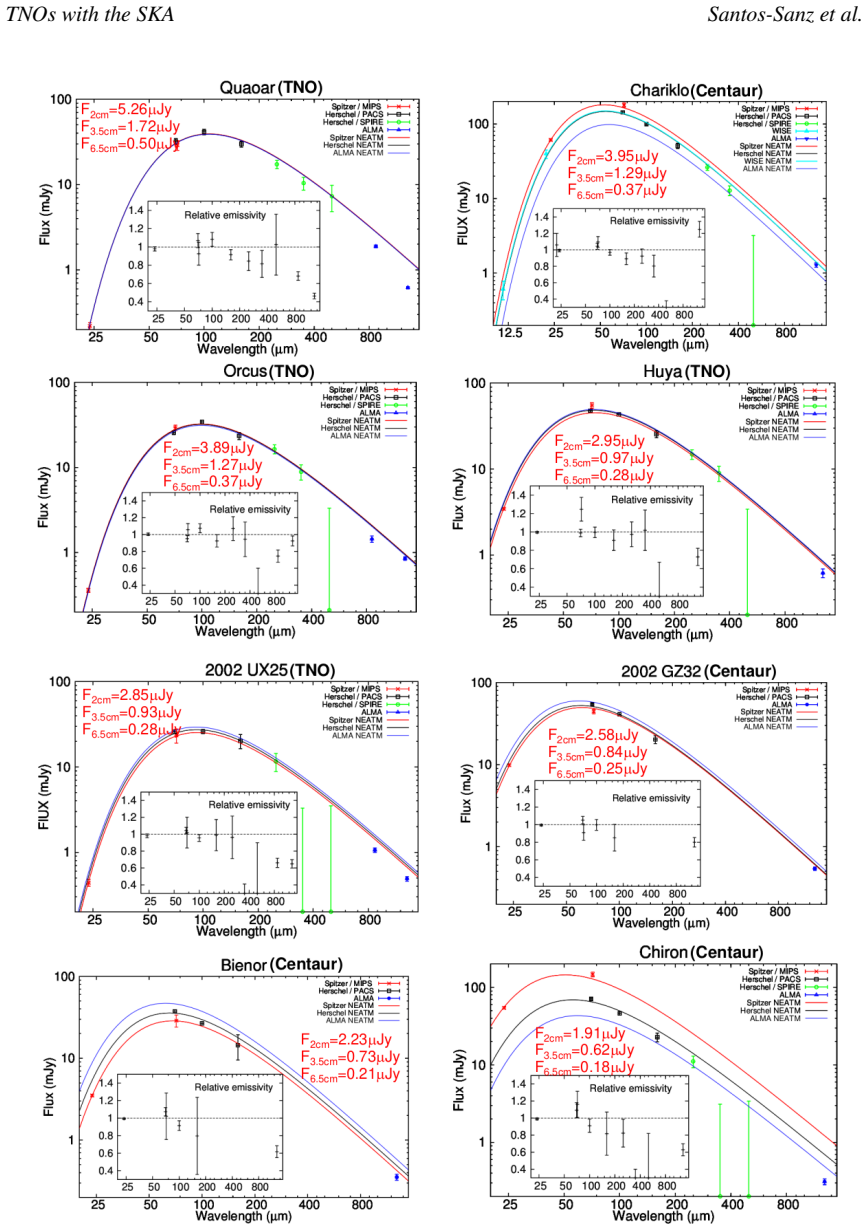
The SKA-AA4 will enable thermal detections of several brightest TNOs and Centaurs at centimetre wavelengths.
A machine-rendered reading of the paper's core claim, the machinery that carries it, and where it could break.
Core claim
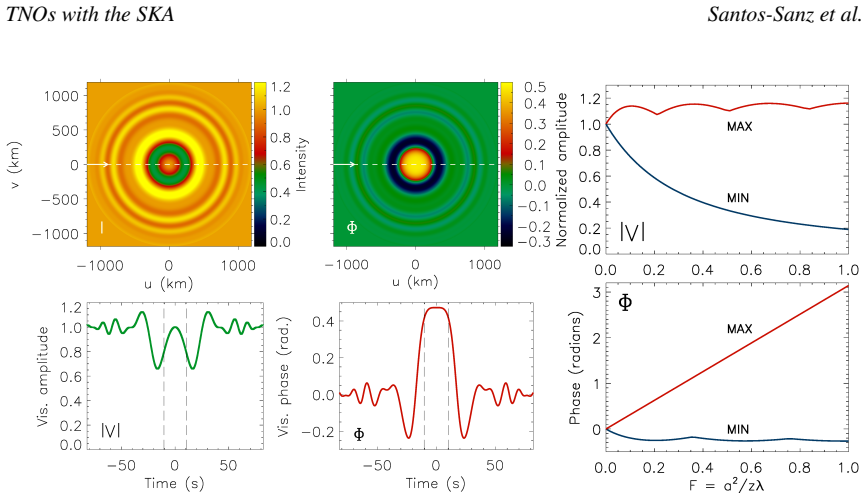
SKA-AA4's unprecedented sensitivity will enable thermal detections of several of the brightest TNOs and Centaurs at centimetre wavelengths, extending radiometric studies beyond the capabilities of current radio facilities. Combined with shorter-wavelength observations and occultation measurements, these data will provide new constraints on spectral emissivity behaviour, thermophysical properties, and subsurface structure. At its highest angular resolutions, SKA-AA4 may partially resolve the largest systems, enabling investigations of surface heterogeneity, extended structures such as rings, and the partial resolution of some wide binary systems. Radio occultation observations can additionall
What carries the argument
SKA-AA4 sensitivity at centimetre wavelengths for thermal emission detection from TNOs and Centaurs
If this is right
- Thermal detections of several brightest TNOs and Centaurs, extending radiometric studies beyond current radio facilities.
- New constraints on spectral emissivity behaviour, thermophysical properties, and subsurface structure when combined with shorter-wavelength data.
- Partial resolution of largest systems to study surface heterogeneity, rings, and wide binary systems.
- Feasibility of radio occultation observations for independent constraints on sizes, shapes, atmospheres, rings, or satellites.
Where Pith is reading between the lines
- Centimetre data could fill gaps in wavelength coverage when merged with ALMA and JWST results for the same objects.
- Establishing centimetre studies as a routine complement to occultation campaigns would broaden the toolkit for outer Solar System characterisation.
- Radio occultations might detect thin atmospheres or small satellites that are hard to see at other wavelengths.
Load-bearing premise
Assumed thermal emission models, object sizes, and SKA sensitivity calculations will accurately predict detectable signals without significant unaccounted systematics or calibration issues.
What would settle it
No detectable thermal emission from the predicted brightest TNOs and Centaurs in SKA-AA4 observations, or large mismatches between measured signals and the model predictions.
Figures
read the original abstract
We explore the potential of the SKA staged delivery AA4 (SKA-AA4) to detect and characterise the thermal emission of trans-Neptunian objects (TNOs) and Centaurs at centimetre wavelengths. These distant icy bodies preserve important information on the formation and evolution of the outer Solar System and provide a valuable link to planetary systems observed around other stars. The unprecedented sensitivity of SKA-AA4 will enable thermal detections of several of the brightest TNOs and Centaurs, extending radiometric studies beyond the capabilities of current radio facilities. Combined with shorter-wavelength observations and occultation measurements, these data will provide new constraints on spectral emissivity behaviour, thermophysical properties, and subsurface structure. At its highest angular resolutions, SKA-AA4 may partially resolve the largest systems, enabling investigations of surface heterogeneity, extended structures such as rings, and the partial resolution of some wide binary systems. We also assess the feasibility of radio occultation observations, which can provide independent constraints on object sizes, shapes, atmospheres, rings, or satellites. Together with observations from ALMA, JWST, and occultation campaigns, SKA-AA4 will establish centimetre-wavelength studies as a powerful new tool for investigating the thermal and structural properties of outer Solar System bodies.
Editorial analysis
A structured set of objections, weighed in public.
Referee Report
Summary. The manuscript explores the potential of the SKA staged delivery AA4 (SKA-AA4) to detect and characterise the thermal emission of trans-Neptunian objects (TNOs) and Centaurs at centimetre wavelengths. It claims that the unprecedented sensitivity will enable thermal detections of several of the brightest objects, extending radiometric studies beyond current facilities; combined with shorter-wavelength and occultation data these will yield new constraints on spectral emissivity, thermophysical properties and subsurface structure; at highest resolutions SKA-AA4 may partially resolve the largest systems and investigate surface heterogeneity, rings or wide binaries; and radio occultation observations are feasible for independent size, shape, atmosphere, ring or satellite constraints. The assessment relies on standard thermal emission models, literature object parameters and published SKA sensitivity estimates.
Significance. If the forward predictions hold, the work positions centimetre-wavelength observations as a new complementary tool for outer-Solar-System studies, linking TNO/Centaur properties to exoplanetary systems and extending radiometric techniques. The paper receives credit for grounding its claims in published SKA sensitivity figures and standard models rather than introducing new empirical results or derivations.
minor comments (2)
- The central feasibility claims would be strengthened by an explicit table (or section) listing the specific brightest TNOs and Centaurs expected to be detectable, together with their assumed diameters, albedos, predicted flux densities at the relevant frequencies, and integration times required to reach a stated S/N threshold.
- The discussion of radio occultation feasibility would benefit from a short quantitative estimate of the required baseline sensitivity or integration time for a typical TNO, even if only order-of-magnitude, to allow readers to judge the practicality of the proposed observations.
Simulated Author's Rebuttal
We thank the referee for their positive summary, recognition of the manuscript's significance, and recommendation for minor revision. No major comments were raised in the report.
Circularity Check
No significant circularity identified
full rationale
The manuscript is an exploratory feasibility study that presents forward predictions of SKA-AA4 detectability for TNOs and Centaurs. These rely on standard radiometric emission models, object parameters drawn from the published literature, and externally published SKA sensitivity estimates. No equations, fitted parameters, self-citations, or derivations appear that reduce the central claims to the paper's own inputs by construction. The assessment is therefore self-contained against external benchmarks and receives the default non-circularity finding.
Axiom & Free-Parameter Ledger
Reference graph
Works this paper leans on
-
[1]
doi: 10.1038/s41550-026-02846-1. J. M. Bauer et al.The Astrophysical Journal, 773(1):22,
-
[2]
doi: 10.1088/0004-637X/773/1/22. G. J. Black, D. B. Campbell, and P . D. Nicholson.Icarus, 191:702–711,
-
[3]
doi: 10.1016/j. icarus.2007.06.015. F. Braga-Ribas et al.Nature, 508:72–75,
work page doi:10.1016/j 2007
-
[4]
doi: 10.1038/nature13155. F. Braga-Ribas et al.A&A, 676:A72, Aug
-
[5]
doi: 10.1051/0004-6361/202346749. M. E. Brown and B. J. Butler.The Astronomical Journal, 154(1):19,
-
[6]
doi: 10.3847/1538-3881/ aa74e5. M. E. Brown and B. J. Butler.The Astronomical Journal, 156(4):164,
-
[7]
doi: 10.3847/2041-8213/adb977. M. N. De Prá et al.Nature Astronomy, 9:252–261, Feb
-
[8]
doi: 10.1038/s41550-024-02276-x. F. E. DeMeo and B. Carry.Nature, 505:629–634,
-
[9]
doi: 10.1038/nature12908. S. Fornasier et al.Astronomy & Astrophysics, 555:A15,
-
[10]
doi: 10.1051/0004-6361/201220477. D. W . Gerdes et al.The Astrophysical Journal Letters, 839(1):L15,
-
[11]
doi: 10.3847/2041-8213/ aa693f. J. Harju et al.The Astronomical Journal, 156(4):155, Oct
-
[12]
doi: 10.3847/1538-3881/aad45b. A. W . Harris.Icarus, 131(2):291–301,
-
[13]
doi: 10.1006/icar.1997.5865. Ž. Ivezićet al.The Astrophysical Journal Supplement Series, 873(2):111,
-
[14]
doi: 10.3847/2041-8213/ad8dcb. L. A. Lebofsky et al.Icarus, 68(2):239–251,
-
[15]
doi: 10.1016/0019-1035(86)90021-7. K. Lehtinen et al.The Astrophysical Journal Letters, 822(1):L21,
-
[16]
doi: 10.3847/2041-8205/ 822/1/L21. E. Lellouch et al.Astronomy & Astrophysics, 557:A60,
-
[17]
doi: 10.1051/0004-6361/201321325. E. Lellouch et al.A&A, 608:A45,
-
[18]
URL https: //doi.org/10.1051/0004-6361/201731676
doi: 10.1051/0004-6361/201731676. URL https: //doi.org/10.1051/0004-6361/201731676. J. Licandro et al.Nature Astronomy, 9:245–251, Feb
-
[19]
14 TNOs with the SKA Santos-Sanz et al
doi: 10.1038/s41550-024-02417-2. 14 TNOs with the SKA Santos-Sanz et al. LSST Solar System Science Collaboration. Lsst solar system science roadmap. https:// docushare.lsstcorp.org/docushare/dsweb/Get/Document-37615/,
-
[20]
Accessed: 2025-08-12. M. Marsset et al.PlantSciJ, 4(9):160, Sept
2025
-
[21]
doi: 10.3847/PSJ/ace7d0. M. K. McClure et al.Nature Astronomy, 7:431–443, Apr
-
[22]
doi: 10.1038/s41550-022-01875-w. M. Mommert et al.Astronomy & Astrophysics, 541:A93,
-
[24]
doi: 10.1038/s41586-022-05629-6. A. Moullet et al.Icarus, 213(1):382–392,
-
[25]
doi: 10.1016/j.icarus.2011.03.010. T. Müller, E. Lellouch, and S. Fornasier. Trans-Neptunian objects and Centaurs at thermal wave- lengths. In D. Prialnik, M. A. Barucci, and L. Y oung, editors,The Trans-Neptunian Solar System, pages 153–181
-
[26]
doi: 10.1016/B978-0-12-816490-7.00007-2. T. G. Müller et al.Earth, Moon, and Planets, 105:209–219,
-
[27]
doi: 10.1007/s11038-009-9359-6. M. Müller and P . J. Barnes.Icarus, 187(2):556–567,
-
[28]
doi: 10.1016/j.icarus.2006.10.027. J. L. Ortiz et al.Nature, 491(7425):566–569, Nov
-
[29]
doi: 10.1038/nature11597. J. L. Ortiz et al.Astronomy & Astrophysics, 576:A18,
-
[30]
doi: 10.1051/0004-6361/201425302. J. L. Ortiz et al.Nature, 550:219–223,
-
[31]
doi: 10.1038/nature24051. J. L. Ortiz et al.A&A, 676:L12, Aug
-
[32]
doi: 10.1051/0004-6361/202347025. S. J. Ostro et al.Icarus, 183:479–490,
-
[33]
doi: 10.1016/j.icarus.2006.03.013. C. L. Pereira et al.A&A, 673:L4, May
-
[34]
doi: 10.1051/0004-6361/202346365. C. L. Pereira et al.ApJL, 992(2):L19, Oct
-
[35]
doi: 10.3847/2041-8213/ae0b6d. N. Pinilla-Alonso et al. DiSCo-TNOs: Discovering the composition of the trans-Neptunian objects, icy embryos for planet formation. JWST Proposal. Cycle 1, ID. #2418, Mar
-
[36]
doi: 10.1086/682252. P . A. Ries and M. A. Janssen.Icarus, 257:88–102,
-
[37]
doi: 10.1016/j.icarus.2015.05.024. P . Santos-Sanz et al.Astronomy & Astrophysics, 541:A92,
-
[40]
doi: 10.48550/arXiv.2510. 06366. J. A. Stansberry et al.The Solar System Beyond Neptune, pages 161–179,
-
[41]
doi: 10.1364/AO.53.003540. A. J. Verbiscer et al.Planet. Sci. J., 3(4):95, Apr
-
[42]
doi: 10.3847/PSJ/ac63a6. P . Vernazza et al.Astronomy & Astrophysics, 699:A167, July
-
[43]
doi: 10.1051/0004-6361/ 202555084. E. Vilenius et al.Astronomy & Astrophysics, 541:A94,
-
[44]
doi: 10.1051/0004-6361/201118749. E. Vilenius et al.Astronomy & Astrophysics, 564:A35,
-
[45]
doi: 10.1051/0004-6361/201322878. E. Vilenius et al.A&A, 618:A136, Oct
-
[46]
doi: 10.1051/0004-6361/201732564. W . J. Webster and K. J. Johnston.Icarus, 78:82–97,
-
[47]
15 TNOs with the SKA Santos-Sanz et al
doi: 10.1016/0019-1035(89)90067-9. 15 TNOs with the SKA Santos-Sanz et al. C. Xie et al.Nature, 641(8063):608–611, May
-
[48]
doi: 10.1038/s41586-025-08920-4. 16
discussion (0)
Sign in with ORCID, Apple, or X to comment. Anyone can read and Pith papers without signing in.