The Web4 Agent Economy: A Large-Scale Empirical Study of the Landscape, Challenges, and Opportunities
Pith reviewed 2026-06-25 19:50 UTC · model grok-4.3
The pith
Autonomous agents process millions of daily machine-to-machine crypto payments on immature infrastructure for identity, authorization, and interoperability.
A machine-rendered reading of the paper's core claim, the machinery that carries it, and where it could break.
Core claim
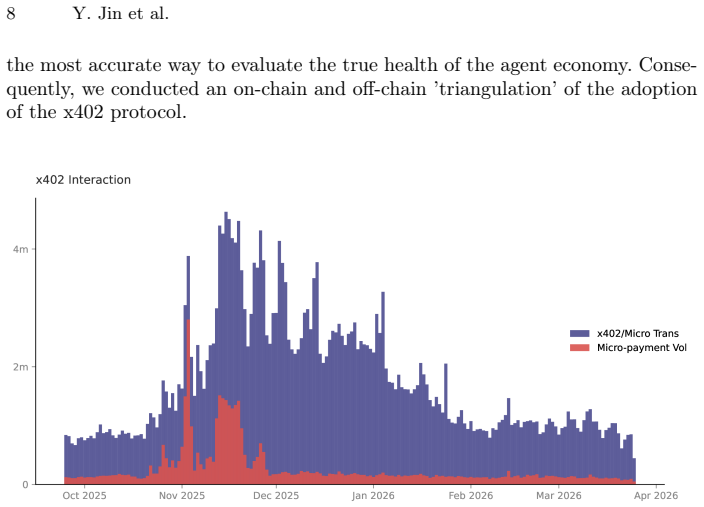
Autonomous agents have established a highly active machine-to-machine payment economy, processing millions of daily transactions. However, this growth is built on immature infrastructure, including identity/authorization practice, cross-environment operation, and payment interoperability. Community responses are visible but unevenly distributed across repositories, and payment interoperability remains the most persistent unresolved bottleneck.
What carries the argument
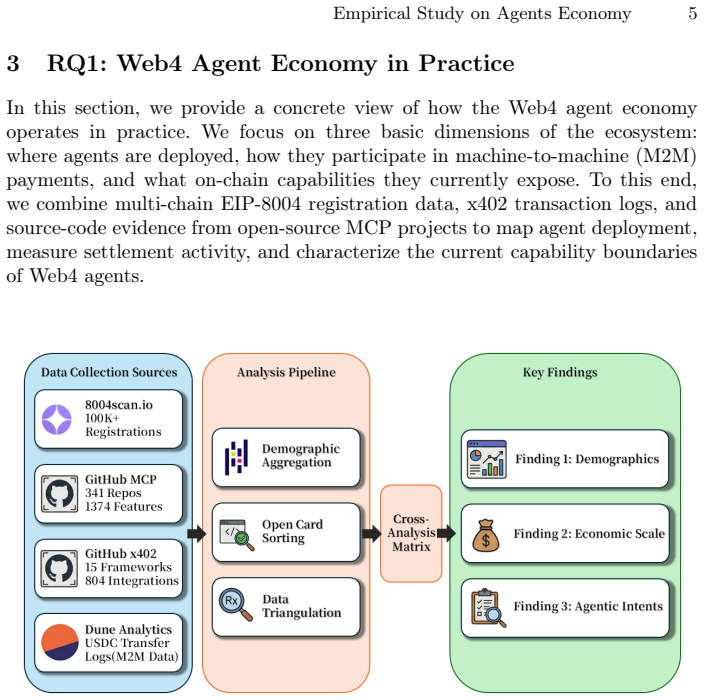
Empirical aggregation and analysis of four datasets (99,448 identity registrations, 317,596,323 transaction logs, 341 MCP project codebases, 349 GitHub issues) to quantify agent deployment, transaction activity, engineering challenges, and community responses.
If this is right
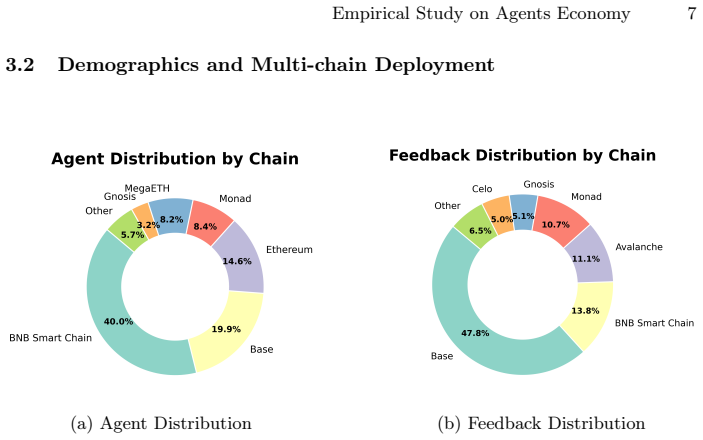
- Agents are actively deployed across multiple chains and already execute large volumes of payments for tools and other agents.
- Developers encounter concrete engineering challenges centered on identity and authorization practices, cross-environment operation, and payment interoperability.
- Community discussion of these challenges is present in GitHub repositories but distributed unevenly across projects.
- Payment interoperability stands out as the single most persistent and unresolved bottleneck in current issue data.
Where Pith is reading between the lines
- If payment interoperability were resolved first, overall agent adoption could accelerate because the other two challenge areas depend on reliable value transfer.
- The observed transaction volume suggests that future measurement studies could track the same datasets over time to test whether infrastructure maturity improves in step with economic activity.
- The uneven distribution of community responses implies that smaller or newer repositories may require targeted tooling or documentation rather than relying on organic issue resolution.
- Standardized benchmarks for cross-environment operation could be derived directly from the transaction patterns already visible in the logs.
Load-bearing premise
The four collected datasets are treated as representative of the overall Web4 agent ecosystem without stated sampling frames or coverage estimates.
What would settle it
A comprehensive scan of on-chain activity that finds daily agent-driven transaction volume far below one million or that shows mature, widely adopted solutions for identity and payment interoperability would falsify the central claim of an active yet immature economy.
Figures
read the original abstract
The Internet is transitioning from Web3 toward Web4, where autonomous agents serve as independent economic actors. These agents can now hold crypto wallets, execute on-chain trades, and pay for external API calls. This transition calls for a new infrastructure stack capable of supporting key agent operations, including agent-to-tool interaction, agent-to-agent payments, and verifiable agent identity, represented by emerging protocols such as the Model Context Protocol, x402, and EIP-8004. Despite growing industrial interest in these protocols, the real-world Web4 agent ecosystem remains largely underexplored. To bridge this gap, we conduct the first large-scale empirical study of the Web4 ecosystem. Specifically, our study targets three interconnected questions: how Web4 agents are deployed and used in practice; what engineering challenges developers face when building Web4 agents; how current project communities respond to these challenges. To answer these questions, we analyze 99,448 multi-chain identity registrations, 317,596,323 transaction logs, the source code of 341 MCP projects, and 349 filtered GitHub issues. Our findings reveal that autonomous agents have established a highly active machine-to-machine payment economy, processing millions of daily transactions. However, this growth is built on immature infrastructure, including identity/authorization practice, cross-environment operation, and payment interoperability. Our follow-up analysis shows that community responses are visible but unevenly distributed across repositories, and payment interoperability remains the most persistent unresolved bottleneck. Overall, this study reveals a critical gap between the rapid growth of the Web4 agent economy and its fragile underlying infrastructure, highlighting future directions for building a more secure Web4 agent ecosystem.
Editorial analysis
A structured set of objections, weighed in public.
Referee Report
Summary. The paper claims to conduct the first large-scale empirical study of the Web4 agent ecosystem by analyzing four datasets—99,448 multi-chain identity registrations, 317,596,323 transaction logs, source code from 341 MCP projects, and 349 filtered GitHub issues—to address how Web4 agents are deployed, engineering challenges faced by developers, and community responses. It concludes that autonomous agents have established a highly active machine-to-machine payment economy processing millions of daily transactions, but this rests on immature infrastructure (identity/authorization, cross-environment operation, payment interoperability), with uneven community responses and payment interoperability as the main unresolved bottleneck.
Significance. If the datasets prove representative and the collection methodology is sound, the study provides a valuable empirical baseline for the emerging Web4 agent economy in software engineering research. The scale of the transaction logs offers concrete quantification of activity levels, and integrating transaction data with project code and issue analysis allows identification of practical gaps between protocol growth and infrastructure maturity. This could inform future work on agent interoperability and verifiable identity protocols.
major comments (2)
- [Abstract] Abstract and data description sections: No sampling frames, coverage estimates, inclusion/exclusion criteria, or bias controls are stated for any of the four datasets, particularly the 317,596,323 transaction logs and 341 MCP projects. The central claim that autonomous agents have 'established a highly active machine-to-machine payment economy' across the Web4 ecosystem, along with the 'immature infrastructure' diagnosis, rests directly on treating these corpora as representative; without this, the headline numbers and generalizability cannot be evaluated.
- [Findings] Findings on transaction volume and infrastructure maturity: The assertion of 'millions of daily transactions' and identification of specific bottlenecks (e.g., payment interoperability) is derived from the transaction logs and GitHub issues without reported controls for dominance by high-volume contracts/chains or selection bias in project visibility. This directly affects the load-bearing conclusion that growth is 'built on immature infrastructure' ecosystem-wide.
minor comments (2)
- [Abstract] Abstract: 'Web4' is introduced without a concise definition or citation to prior work distinguishing it from Web3; this affects clarity for readers outside the immediate subfield.
- [Data] Dataset descriptions: The filtering process for the 349 GitHub issues is mentioned but not detailed (e.g., keywords or exclusion rules), which would aid reproducibility even if not central to the claims.
Simulated Author's Rebuttal
We thank the referee for the constructive feedback. We agree that the manuscript requires additional methodological transparency to support claims of representativeness and to qualify the generalizability of the findings. We address each major comment below and will incorporate revisions in the next version.
read point-by-point responses
-
Referee: [Abstract] Abstract and data description sections: No sampling frames, coverage estimates, inclusion/exclusion criteria, or bias controls are stated for any of the four datasets, particularly the 317,596,323 transaction logs and 341 MCP projects. The central claim that autonomous agents have 'established a highly active machine-to-machine payment economy' across the Web4 ecosystem, along with the 'immature infrastructure' diagnosis, rests directly on treating these corpora as representative; without this, the headline numbers and generalizability cannot be evaluated.
Authors: We agree this information is missing and necessary for evaluating the claims. The datasets were drawn from specific public sources (multi-chain identity registries, on-chain logs tied to MCP and related protocols, GitHub repositories matching MCP keywords, and filtered issues), but the original submission did not document sampling frames, coverage estimates, explicit inclusion/exclusion rules, or bias controls. In revision we will add a dedicated data collection subsection that specifies the exact sources and chains, states inclusion/exclusion criteria for projects and issues, reports any available coverage information or known gaps, and discusses potential selection and visibility biases. We will also adjust the abstract and conclusion language to reflect the scope of the observed data rather than claiming ecosystem-wide representativeness. revision: yes
-
Referee: [Findings] Findings on transaction volume and infrastructure maturity: The assertion of 'millions of daily transactions' and identification of specific bottlenecks (e.g., payment interoperability) is derived from the transaction logs and GitHub issues without reported controls for dominance by high-volume contracts/chains or selection bias in project visibility. This directly affects the load-bearing conclusion that growth is 'built on immature infrastructure' ecosystem-wide.
Authors: We accept that the current text lacks these controls. The volume figures are aggregates from the full transaction corpus, and the bottleneck identification draws from issue analysis, but no checks for high-volume dominance or project-visibility bias were reported. In the revision we will add (1) a breakdown of transaction volume distribution across contracts and chains to assess dominance effects, (2) explicit discussion of selection bias in the GitHub sample, and (3) appropriate caveats or sensitivity statements when linking the observed patterns to the broader conclusion about infrastructure maturity. If the data allow, supplementary tables or figures will be included. revision: yes
Circularity Check
Empirical measurement study with no derivations or self-referential reductions
full rationale
The paper conducts a large-scale empirical analysis of four collected datasets (identity registrations, transaction logs, MCP projects, and GitHub issues) to describe the Web4 agent ecosystem and its challenges. It contains no equations, fitted parameters, predictions derived from models, or load-bearing self-citations. All claims are presented as direct observations from the data without any reduction by construction to inputs. This is a standard descriptive measurement study whose central findings rest on the representativeness of the datasets rather than any circular derivation chain.
Axiom & Free-Parameter Ledger
Forward citations
Cited by 1 Pith paper
-
Agent-to-Agent Finance: Blockchain Payments and Trust Infrastructure for Autonomous AI Agents
Agent-to-agent finance is framed as the machine-mediated financial layer where autonomous agents use programmable settlement, smart wallets, and decentralized registries to transact while maintaining verifiability.
Reference graph
Works this paper leans on
-
[1]
OSL & Allium: Monthly Stablecoin Transfer Volume Hits Record $1.8 Tril- lion in February, USDC On-Chain Activity Surges.https://www.osl.com/ hk-en/bits/article/stablecoin-transfer-volume-record-usdc-surges, last accessed 2026/04/01
2026
-
[2]
Talos & Coin Metrics: State of the Network: The Curious Case of USDC onBase.https://www.talos.com/insights/state-of-the-network-351,lastac- cessed 2026/04/01
2026
-
[3]
8004scan.io: 8004scan: The Web3 Agent Explorer.https://www.8004scan.io, last accessed 2026/04/01
2026
-
[4]
ethereum.org/EIPS/eip-8004, last accessed 2026/04/01
Ethereum Improvement Proposals: EIP-8004: Trustless Agents.https://eips. ethereum.org/EIPS/eip-8004, last accessed 2026/04/01
2026
-
[5]
H., Olickel, H., Saxena, P., Hobor, A.: Making smart contracts smarter
Luu, L., Chu, D. H., Olickel, H., Saxena, P., Hobor, A.: Making smart contracts smarter. In: Proceedings of the 2016 ACM SIGSAC conference on computer and communications security, pp. 254–269 (2016)
2016
-
[6]
K.: Measuring ethereum-based erc20 token networks
Victor, F., Lüders, B. K.: Measuring ethereum-based erc20 token networks. In: Financial Cryptography and Data Security: 23rd International Conference, FC 2019, pp. 113–129. Springer International Publishing (2019)
2019
-
[7]
arXiv preprint arXiv:2210.03629 (2022) (Published in ICLR 2023)
Yao, S., Zhao, J., Yu, D., Du, N., Shafran, I., Narasimhan, K., Cao, Y.: React: Syn- ergizing reasoning and acting in language models. arXiv preprint arXiv:2210.03629 (2022) (Published in ICLR 2023)
Pith/arXiv arXiv 2022
-
[8]
& Wen, J.: A survey on large language model based autonomous agents
Wang, L., Ma, C., Feng, X., Zhang, Z., Yang, H., Zhang, J., ... & Wen, J.: A survey on large language model based autonomous agents. Frontiers of Computer Science 18(6), 186345 (2024)
2024
-
[9]
Paradigm Research.https://www.paradigm.xyz/2023/06/intents, last accessed 2026/04/01
Konstantopoulos, G., Kilbourn, Q.: Intent-Based Architectures and Their Risks. Paradigm Research.https://www.paradigm.xyz/2023/06/intents, last accessed 2026/04/01
2023
-
[10]
Internet Engineering Task Force (IETF), RFC 7231.https: //datatracker.ietf.org/doc/html/rfc7231, last accessed 2026/04/01
Fielding, R., Reschke, J.: Hypertext Transfer Protocol (HTTP/1.1): Seman- tics and Content. Internet Engineering Task Force (IETF), RFC 7231.https: //datatracker.ietf.org/doc/html/rfc7231, last accessed 2026/04/01
2026
-
[11]
Lightning Labs: L402: Lightning Native Paywalls and Macaroons.https: //docs.lightning.engineering/the-lightning-network/l402, last accessed 2026/04/01
2026
-
[12]
Jin et al
Anthropic: Model Context Protocol (MCP) Official Documentation.https:// modelcontextprotocol.io, last accessed 2026/04/01 20 Y. Jin et al
2026
-
[13]
Open World- wide Application Security Project
OWASP: OWASP Top 10 for Large Language Model Applications. Open World- wide Application Security Project. https://owasp.org/www-project-top-10-for-large-language-model-applications/, last accessed 2026/04/01
2026
-
[14]
arXiv preprint arXiv:2302.12173 (2023)
Greshake, K., Abdelnabi, S., Mishra, S., Endres, C., Holz, T., Fritz, M.: Not what you’vesignedupfor:CompromisingReal-WorldLLM-IntegratedApplicationswith Indirect Prompt Injection. arXiv preprint arXiv:2302.12173 (2023)
Pith/arXiv arXiv 2023
-
[15]
W3C Recommendation
Sporny, M., Guy, A., Sabadello, M., Reed, D.: Decentralized Identifiers (DIDs) v1.0: Core architecture, data model, and representations. W3C Recommendation. https://www.w3.org/TR/did-core/, last accessed 2026/04/01
2026
-
[16]
arXiv preprint arXiv:2603.04168 (2026)
Pan,Z.,Li,Y.,Guan,Z., Hu,J.,Chen,Z.: OMNIINTENT:A trustedintent-centric framework for user-friendly Web3. arXiv preprint arXiv:2603.04168 (2026)
arXiv 2026
-
[17]
Official Specification.https://x402.org, last accessed 2026/04/01
Coinbase: x402 Payment Required | Internet-Native Payments Standard. Official Specification.https://x402.org, last accessed 2026/04/01
2026
-
[18]
IEEE Access4, 2292–2303 (2016)
Christidis, K., Devetsikiotis, M.: Blockchains and smart contracts for the internet of things. IEEE Access4, 2292–2303 (2016)
2016
-
[19]
arXiv preprint arXiv:2503.23278 (2025)
Hou, X., Zhao, Y., Wang, S., Wang, H.: Model Context Protocol (MCP): Landscape, security threats, and future research directions. arXiv preprint arXiv:2503.23278 (2025)
Pith/arXiv arXiv 2025
-
[20]
M., Li, H., Fallahzadeh, E., Rajbahadur, G
Hasan, M. M., Li, H., Fallahzadeh, E., Rajbahadur, G. K., Adams, B., Hassan, A. E.: Model Context Protocol (MCP) at First Glance: Studying the Security and Maintainability of MCP Servers. arXiv preprint arXiv:2506.13538 (2025)
Pith/arXiv arXiv 2025
-
[21]
Rosenfeld Media (2009)
Spencer, D.: Card sorting: Designing usable categories. Rosenfeld Media (2009)
2009
-
[22]
Qualitative research in psychology3(2), 77–101 (2006)
Braun, V., Clarke, V.: Using thematic analysis in psychology. Qualitative research in psychology3(2), 77–101 (2006)
2006
-
[23]
A., Damian, D.: Selecting empirical meth- ods for software engineering research
Easterbrook, S., Singer, J., Storey, M. A., Damian, D.: Selecting empirical meth- ods for software engineering research. In: Guide to advanced empirical software engineering, pp. 285–311. Springer (2008)
2008
-
[24]
GitHub repository.https://github.com/coinbase/agentkit, last accessed 2026/04/01
Coinbase: AgentKit: Empowering AI Agents with Blockchain Capabilities. GitHub repository.https://github.com/coinbase/agentkit, last accessed 2026/04/01
2026
-
[25]
GitHub: GitHub REST API documentation.https://docs.github.com/en/rest, last accessed 2026/04/01
2026
-
[26]
com/, last accessed 2026/04/01
Dune: Dune Analytics: Community-driven crypto data platform.https://dune. com/, last accessed 2026/04/01
2026
-
[27]
Ethereum project yellow paper151(2014), 1–32 (2014).https://ethereum
Wood, G.: Ethereum: A secure decentralised generalised transaction ledger. Ethereum project yellow paper151(2014), 1–32 (2014).https://ethereum. github.io/yellowpaper/paper.pdf
2014
-
[28]
Frontiers in Blockchain8, 1591907 (2025)
Gürpinar, T.: Towards web 4.0: frameworks for autonomous AI agents and de- centralized enterprise coordination. Frontiers in Blockchain8, 1591907 (2025). https://doi.org/10.3389/fbloc.2025.1591907
-
[29]
Liu, J.: AI Agents in Blockchain: Applications in Cryptocurrency Trading.https://medium.com/@gwrx2005/ ai-agents-in-blockchain-applications-in-cryptocurrency-trading-355f11bff04d, last accessed 2026/04/05
2026
-
[30]
Blockchain: Research and Applications 5(1), 100173 (2024)
Huang, R., Chen, J., Wang, Y., Bi, T., Nie, L., Zheng, Z.: An overview of Web3 technology: Infrastructure, applications, and popularity. Blockchain: Research and Applications 5(1), 100173 (2024)
2024
-
[31]
In: International Conference on Computing and Communication Systems (I3CS’15), Shillong, India, pp
Nath, K., Iswary, R.: What comes after Web 3.0? Web 4.0 and the Future. In: International Conference on Computing and Communication Systems (I3CS’15), Shillong, India, pp. 337–341 (2015) Empirical Study on Agents Economy 21
2015
-
[32]
In: 2023 IEEE 9th World Forum on Internet of Things (WF-IoT), pp
Zhou, Z., Li, Z., Zhang, X., Sun, Y., Xu, H.: A review of gaps between Web 4.0 and Web 3.0 intelligent network infrastructure. In: 2023 IEEE 9th World Forum on Internet of Things (WF-IoT), pp. 1–6. IEEE (2023)
2023
-
[33]
Available at SSRN 6683919 (2026)
Kobayashi, Y.: Web4: A Design Paradigm for the Persistence of Self-Circulating Token Economies. Available at SSRN 6683919 (2026)
2026
-
[34]
Palatov, D., GPT4o, Deepseek, Grok, Claude, Gemini, Manus: WEB4: A Compre- hensive Architecture for Trust-Native Distributed Intelligence (2026)
2026
discussion (0)
Sign in with ORCID, Apple, or X to comment. Anyone can read and Pith papers without signing in.