Residual orbital magnetization governs the anomalous Hall effect in altermagnets
Pith reviewed 2026-06-25 19:45 UTC · model grok-4.3
The pith
The anomalous Hall effect in altermagnets is governed by residual orbital magnetization through the generalized Středa relation.
A machine-rendered reading of the paper's core claim, the machinery that carries it, and where it could break.
Core claim
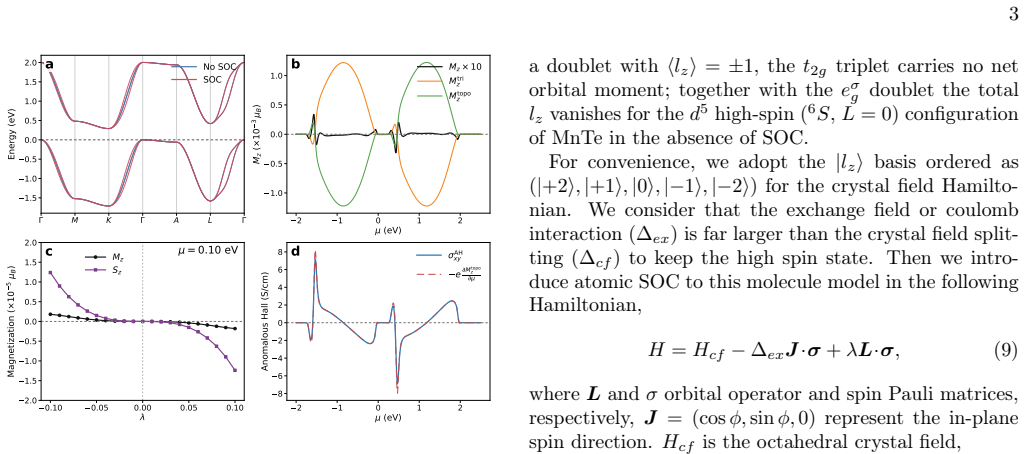
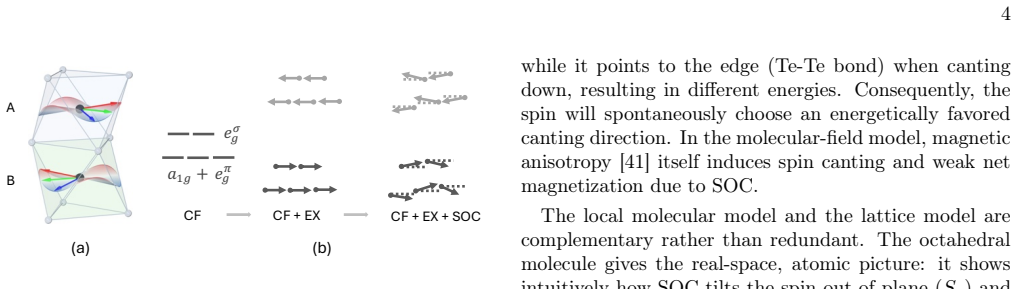
The generalized Středa relation ties the intrinsic anomalous Hall conductivity σ_xy to the orbital magnetization M_z by σ_xy = -e ∂M_z/∂μ. In MnTe-type altermagnets a microscopic mechanism generates net orbital moment from the interplay of local crystal field and spin-orbit coupling, in which magnetic anisotropy produces weak net magnetization without invoking exchange between neighboring spins such as Dzyaloshinskii-Moriya interaction.
What carries the argument
The generalized Středa relation connecting anomalous Hall conductivity to the chemical-potential derivative of topological orbital magnetization.
If this is right
- Small remanent magnetization in altermagnets contributes to the anomalous Hall response through its orbital component.
- Net orbital magnetization arises from crystal field and spin-orbit coupling combined with magnetic anisotropy alone.
- Residual orbital and spin magnetization is an intrinsic thermodynamic property governing anomalous transport in altermagnets and noncollinear antiferromagnets.
Where Pith is reading between the lines
- The relation would allow direct prediction of Hall conductivity from orbital magnetization data as a function of chemical potential or doping.
- Crystal-field engineering could provide a route to tune the strength of the anomalous Hall effect in altermagnetic materials.
- The same residual-magnetization mechanism may operate in other classes of unconventional antiferromagnets beyond the MnTe family.
Load-bearing premise
The orbital component of the small remanent magnetization generated by crystal field and spin-orbit coupling determines the Hall response independently of Dzyaloshinskii-Moriya interactions.
What would settle it
A measurement or calculation in a MnTe-type altermagnet showing that the anomalous Hall conductivity does not equal -e times the derivative of orbital magnetization with respect to chemical potential.
Figures
read the original abstract
In altermagnets that exhibit anomalous Hall effect, the small remanent magnetization exists but has been treated as too small to be relevant to the Hall response. In this work, we point out that this dismissal is incomplete because the generalized St\v{r}eda relation ties the intrinsic anomalous Hall conductivity ($\sigma_{xy}$) to the orbital magnetization ($M_z$, the topological component from the modern orbital magnetization) by $\sigma_{xy}=-e\frac{\partial M_z}{\partial \mu}$. We reveal a microscopic mechanism to generate net orbital moment from the interplay of local crystal field and spin-orbit coupling for MnTe-type altermagnets, in which the magnetic anisotropy generates weak net magnetization without invoking exchange between neighboring spins (e.g., Dzyaloshinskii-Moriya interaction). Our work indicates that residual orbital and spin magnetization is an intrinsic thermodynamic property that governs anomalous transport in unconventional antiferromagnets, including altermagnets and noncollinear antiferromagnets.
Editorial analysis
A structured set of objections, weighed in public.
Referee Report
Summary. The manuscript claims that residual orbital magnetization governs the anomalous Hall effect (AHE) in altermagnets via the generalized Středa relation σ_xy = -e ∂M_z/∂μ. It identifies a microscopic mechanism in MnTe-type altermagnets whereby local crystal field, spin-orbit coupling, and magnetic anisotropy produce net orbital (and spin) magnetization without requiring Dzyaloshinskii-Moriya interaction, positioning this residual magnetization as an intrinsic thermodynamic property relevant to transport in altermagnets and noncollinear antiferromagnets.
Significance. If the central relation and mechanism are shown to yield appreciable ∂M_z/∂μ at the Fermi level, the work would supply a thermodynamic link between weak remanent magnetization and intrinsic AHE in altermagnets, potentially unifying explanations across unconventional antiferromagnets by emphasizing local crystal-field effects over inter-spin exchange.
major comments (2)
- [Abstract] Abstract (equation σ_xy=-e ∂M_z/∂μ): The Středa relation connects conductivity to the chemical-potential derivative of orbital magnetization, not to the magnitude of residual M_z. The proposed crystal-field + SOC + anisotropy mechanism is shown to generate net M_z, but the manuscript supplies no calculation or argument establishing that |∂M_z/∂μ| is large enough in the relevant doping or energy window to account for observed AHE conductivities.
- [Abstract] Abstract: No derivation steps, band-structure calculations, or numerical checks are presented to verify that the local crystal-field mechanism produces a non-negligible slope ∂M_z/∂μ while remaining independent of DM interaction; without such evidence the claim that residual magnetization 'governs' AHE remains unsupported.
minor comments (1)
- The phrase 'modern orbital magnetization' is used without a reference or brief definition of the modern theory of orbital magnetization.
Simulated Author's Rebuttal
We thank the referee for their careful reading and constructive comments. We address the major points below and will revise the manuscript to incorporate additional supporting calculations and derivations as outlined.
read point-by-point responses
-
Referee: [Abstract] Abstract (equation σ_xy=-e ∂M_z/∂μ): The Středa relation connects conductivity to the chemical-potential derivative of orbital magnetization, not to the magnitude of residual M_z. The proposed crystal-field + SOC + anisotropy mechanism is shown to generate net M_z, but the manuscript supplies no calculation or argument establishing that |∂M_z/∂μ| is large enough in the relevant doping or energy window to account for observed AHE conductivities.
Authors: We agree that the generalized Středa relation specifically links σ_xy to ∂M_z/∂μ. The manuscript shows that the crystal-field + SOC + anisotropy mechanism produces a net orbital magnetization whose magnitude varies with electronic filling, implying a nonzero derivative at the Fermi level. However, we acknowledge that the current text does not contain explicit numerical estimates or comparisons to measured AHE values. In revision we will add density-functional-theory and tight-binding calculations for representative MnTe-type compounds that quantify |∂M_z/∂μ| in the relevant energy window and confirm that the resulting σ_xy matches the order of experimentally reported conductivities. revision: yes
-
Referee: [Abstract] Abstract: No derivation steps, band-structure calculations, or numerical checks are presented to verify that the local crystal-field mechanism produces a non-negligible slope ∂M_z/∂μ while remaining independent of DM interaction; without such evidence the claim that residual magnetization 'governs' AHE remains unsupported.
Authors: The mechanism is constructed from the local point-group symmetry and magnetic anisotropy of MnTe-type altermagnets, which generate a net orbital moment without inter-spin DM exchange. The Středa relation then directly supplies the thermodynamic link to transport. We recognize that the manuscript presents this argument at a conceptual level without the requested derivation details or numerical verification. We will expand the revised version with an appendix containing the explicit perturbative derivation of the orbital moment from crystal-field and SOC terms, together with band-structure results that demonstrate both the μ-dependence of M_z and its independence from DM interactions. revision: yes
Circularity Check
No circularity: Středa relation is external identity; microscopic mechanism is independent derivation
full rationale
The paper invokes the generalized Středa relation σ_xy = -e ∂M_z/∂μ as a known thermodynamic identity linking Hall conductivity to the chemical-potential derivative of orbital magnetization, then separately derives a microscopic mechanism (local crystal field + SOC + magnetic anisotropy) that produces net orbital moment in MnTe-type altermagnets without DM exchange. Neither step defines one quantity in terms of the other, fits a parameter to data and renames the output a prediction, nor relies on a self-citation chain whose load-bearing premise is unverified. The derivation chain therefore remains self-contained against external benchmarks and does not reduce by construction to its inputs.
Axiom & Free-Parameter Ledger
axioms (1)
- domain assumption The generalized Středa relation σ_xy = -e ∂M_z / ∂μ holds and directly governs the anomalous Hall conductivity in these systems.
Reference graph
Works this paper leans on
-
[1]
Šmejkal, J
L. Šmejkal, J. Sinova, and T. Jungwirth, Beyond conven- tional ferromagnetism and antiferromagnetism: A phase with nonrelativistic spin and crystal rotation symmetry, Physical Review X12, 031042 (2022)
2022
-
[2]
Šmejkal, J
L. Šmejkal, J. Sinova, and T. Jungwirth, Emerging re- search landscape of altermagnetism, Physical Review X 12, 040501 (2022)
2022
-
[3]
Mazin, Editorial: Altermagnetism — a new punch line of fundamental magnetism, Physical Review X12, 040002 (2022)
I. Mazin, Editorial: Altermagnetism — a new punch line of fundamental magnetism, Physical Review X12, 040002 (2022). 5
2022
-
[4]
I. I. Mazin, Altermagnetism in MnTe: Origin, predicted manifestations, and routes to detwinning, Physical Re- view B107, L100418 (2023)
2023
-
[5]
Q. Liu, X. Dai, and S. Blügel, Different facets of uncon- ventional magnetism, Nature Physics21, 329 (2025)
2025
-
[6]
C. Song, H. Bai, Z. Zhou, L. Han, H. Reichlova, J. H. Dil, J. Liu, X. Chen, and F. Pan, Altermagnets as a new class of functional materials, Nature Reviews Materials 10.1038/s41578-025-00779-1 (2025)
-
[7]
C. Wu, K. Sun, E. Fradkin, and S.-C. Zhang, Fermi liquid instabilities in the spin channel, Physical Review B75, 115103 (2007)
2007
-
[8]
L.-D. Yuan, Z. Wang, J.-W. Luo, E. I. Rashba, and A. Zunger, Giant momentum-dependent spin splitting in centrosymmetric low-Z antiferromagnets, Physical Re- view B102, 014422 (2020)
2020
-
[9]
H.-Y. Ma, M. Hu, N. Li, J. Liu, W. Yao, J.-F. Jia, and J. Liu, Multifunctional antiferromagnetic materials with giant piezomagnetism and noncollinear spin current, Na- ture Communications12, 2846 (2021)
2021
-
[10]
Y. Liu, X. Chen, Y. Yu, J. Etxebarria, J. M. Perez-Mato, and Q. Liu, Symmetry classification of magnetic orders using oriented spin space groups, Nature652, 869 (2026)
2026
-
[11]
Jungwirth, R
T. Jungwirth, R. M. Fernandes, E. Fradkin, A. H. Mac- Donald, J. Sinova, and L. Šmejkal, Altermagnetism: An unconventional spin-ordered phase of matter, Newton1 (2025)
2025
-
[12]
R. D. Gonzalez Betancourt, J. Zubáč, R. Gonzalez- Hernandez, K. Geishendorf, Z. Šobáň, G. Springholz, K. Olejník, L. Šmejkal, J. Sinova, T. Jungwirth, S. T. B. Goennenwein, A. Thomas, H. Reichlová, J. Železný, and D. Kriegner, Spontaneous anomalous hall effect arising from an unconventional compensated magnetic phase in a semiconductor, Physical Review Le...
2023
-
[13]
K. P. Kluczyk, K. Gas, M. J. Grzybowski, P. Skupiński, M. A. Borysiewicz, T. Fąs, J. Suffczyński, J. Z. Do- magala, K. Grasza, A. Mycielski, M. Baj, K. H. Ahn, K. Výborný, M. Sawicki, and M. Gryglas-Borysiewicz, Coexistence of anomalous hall effect and weak magne- tization in a nominally collinear antiferromagnet MnTe, Physical Review B110, 155201 (2024)
2024
-
[14]
Nakatsuji, N
S. Nakatsuji, N. Kiyohara, and T. Higo, Large anomalous Hall effect in a non-collinear antiferromagnet at room temperature, Nature527, 212 (2015)
2015
-
[15]
A. K. Nayak, J. E. Fischer, Y. Sun, B. Yan, J. Karel, A. C. Komarek, C. Shekhar, N. Kumar, W. Schnelle, J. Kübler, C. Felser, and S. S. P. Parkin, Large anoma- lous Hall effect driven by a nonvanishing Berry curvature in the noncolinear antiferromagnet Mn3Ge, Science Ad- vances2, e1501870 (2016)
2016
-
[16]
H. Chen, Q. Niu, and A. H. MacDonald, Anomalous hall effect arising from noncollinear antiferromagnetism, Phys. Rev. Lett.112, 017205 (2014)
2014
-
[17]
Zhang, Y
Y. Zhang, Y. Sun, H. Yang, J. Železný, S. P. P. Parkin, C. Felser, and B. Yan, Strong anisotropic anomalous hall effect and spin hall effect in the chiral antiferromagnetic compoundsmn 3x(x= Ge, sn, ga, ir, rh, and pt), Phys. Rev. B95, 075128 (2017)
2017
-
[18]
Nagaosa, J
N. Nagaosa, J. Sinova, S. Onoda, A. H. MacDonald, and N. P. Ong, Anomalous hall effect, Rev. Mod. Phys.82, 1539 (2010)
2010
-
[19]
I. I. Mazin and K. D. Belashchenko, Origin of the gos- samer ferromagnetism in MnTe, Physical Review B110, 214436 (2024)
2024
-
[20]
D. Jo, D. Go, Y. Mokrousov, P. M. Oppeneer, S.-W. Cheong, and H.-W. Lee, Weak ferromagnetism in alter- magnets from alternatingg-tensor anisotropy, Phys. Rev. Lett.134, 196703 (2025)
2025
-
[21]
Autieri, R
C. Autieri, R. M. Sattigeri, G. Cuono, and A. Fakhre- dine, Staggered dzyaloshinskii-moriya interaction induc- ing weak ferromagnetism in centrosymmetric altermag- nets and weak ferrimagnetism in noncentrosymmetric al- termagnets, Phys. Rev. B111, 054442 (2025)
2025
-
[22]
Šmejkal, A
L. Šmejkal, A. H. MacDonald, J. Sinova, S. Nakatsuji, and T. Jungwirth, Anomalous hall antiferromagnets, Na- ture Reviews Materials7, 482 (2022)
2022
-
[23]
P. A. McClarty and J. G. Rau, Landau theory of alter- magnetism, Phys. Rev. Lett.132, 176702 (2024)
2024
-
[24]
Chen, T.-C
H. Chen, T.-C. Wang, D. Xiao, G.-Y. Guo, Q. Niu, and A. H. MacDonald, Manipulating anomalous hall anti- ferromagnets with magnetic fields, Phys. Rev. B101, 104418 (2020)
2020
-
[25]
C. Chen Ye, K. Tenzin, J. Sławińska, and C. Au- tieri, Dominant orbital magnetization in the proto- typical altermagnet MnTe, arXiv2505.08675(2025), arXiv:2505.08675 [cond-mat.mtrl-sci]
arXiv 2025
-
[26]
Z. Liu, S. Asai, S. Takahashi, H. Saito, T. Nakajima, and T. Masuda, Observation of altermagnetic order switch- ing in bulk mnte by polarized neutron diffraction, arXiv preprint arXiv:2605.21616 (2026)
Pith/arXiv arXiv 2026
-
[27]
Takagi, R
R. Takagi, R. Hirakida, Y. Settai, R. Oiwa, H. Tak- agi, A. Kitaori, K. Yamauchi, H. Inoue, J.-i. Yamaura, D.Nishio-Hamane,et al.,Spontaneoushalleffectinduced by collinear antiferromagnetic order at room tempera- ture, Nature Materials24, 63 (2025)
2025
-
[28]
A. Badura, W. H. Campos, V. K. Bharadwaj, I. Kounta, L. Michez, M. Petit, J. Rial, M. Leiviskä, V. Baltz, F. Krizek, D. Kriegner, J. Železný, J. Zemen, S. Telkamp, S. Sailler, M. Lammel, R. Jaeschke-Ubiergo, A. B. Hel- lenes, R. González-Hernández, J. Sinova, T. Jungwirth, S. T. B. Goennenwein, L. Šmejkal, and H. Reichlova, Observation of the anomalous ne...
arXiv 2025
-
[29]
Xiao, M.-C
D. Xiao, M.-C. Chang, and Q. Niu, Berry phase effects on electronic properties, Rev. Mod. Phys.82, 1959 (2010)
1959
-
[30]
Jiang, S
X. Jiang, S. A. Akbar Ghorashi, D. Lu, and J. Cano, Altermagnetism induced surface chern insulator, Nano Letters (2026)
2026
-
[31]
D. Xiao, J. Shi, and Q. Niu, Berry phase correction to electron density of states in solids, Physical Review Let- ters95, 137204 (2005)
2005
-
[32]
Ceresoli, T
D. Ceresoli, T. Thonhauser, D. Vanderbilt, and R. Resta, Orbital magnetization in crystalline solids: Multi-band insulators, Cherninsulators, andmetals,PhysicalReview B74, 024408 (2006)
2006
-
[33]
J. Shi, G. Vignale, D. Xiao, and Q. Niu, Quantum the- ory of orbital magnetization and its generalization to in- teracting systems, Physical Review Letters99, 197202 (2007)
2007
-
[34]
Souza and D
I. Souza and D. Vanderbilt, Dichroicf-sum rule and the orbital magnetization of crystals, Phys. Rev. B77, 054438 (2008)
2008
-
[35]
M. Roig, A. Kreisel, Y. Yu, B. M. Andersen, and D. F. Agterberg, Minimal models and transport properties of unconventional altermagnets, Physical Review B110, 144412 (2024). 6
2024
-
[36]
See Supplemental Materials for the four-bandg-wave tight-binding model (parameters, Brillouin-zone and Středa-evaluation conventions, band structure, and the bulksin(3ϕ)angular dependence ofM z andS z) and for the local atomicd-shell octahedral model (orbital op- erators, crystal-field matrix, trigonal distortion,sin(3ϕ) third-harmonic derivation and pert...
-
[37]
L.-J. Zhou, S. Li, Z.-J. Yan, Y. Zhao, H. Rong, Z. Xiong, Y. Zhao, P. Xiao, L. K. Lai, H. Bae, H. Liu, C.-X. Liu, B. Yan, C.-Z. Chang, H. Wang, and C. R. Du, Imag- ing surface magnetization in altermagnetic MnTe films, arXiv 10.48550/arxiv.2605.25241 (2026), 2605.25241
work page internal anchor Pith review Pith/arXiv arXiv doi:10.48550/arxiv.2605.25241 2026
-
[38]
Šmejkal, R
L. Šmejkal, R. González-Hernández, T. Jungwirth, and J. Sinova, Crystal time-reversal symmetry breaking and spontaneousHalleffectincollinearantiferromagnets,Sci- ence Advances6, eaaz8809 (2020)
2020
-
[39]
Z. Zhou, X. Cheng, M. Hu, R. Chu, H. Bai, L. Han, J. Liu, F. Pan, and C. Song, Manipulation of the alter- magnetic order in crsb via crystal symmetry, Nature638, 645 (2025)
2025
-
[40]
Khodas, S
M. Khodas, S. Mu, I. I. Mazin, and K. D. Belashchenko, Tuning of altermagnetism by strain, Phys. Rev. B113, 104422 (2026)
2026
-
[41]
Moriya, Theory of magnetism of nif2, Phys
T. Moriya, Theory of magnetism of nif2, Phys. Rev.117, 635 (1960)
1960
discussion (0)
Sign in with ORCID, Apple, or X to comment. Anyone can read and Pith papers without signing in.