Complex frequency-dependent quadrature squeezing in semiconductor lasers
Pith reviewed 2026-06-26 01:32 UTC · model grok-4.3
The pith
Semiconductor lasers produce frequency-dependent and complex quadrature squeezing.
A machine-rendered reading of the paper's core claim, the machinery that carries it, and where it could break.
Core claim
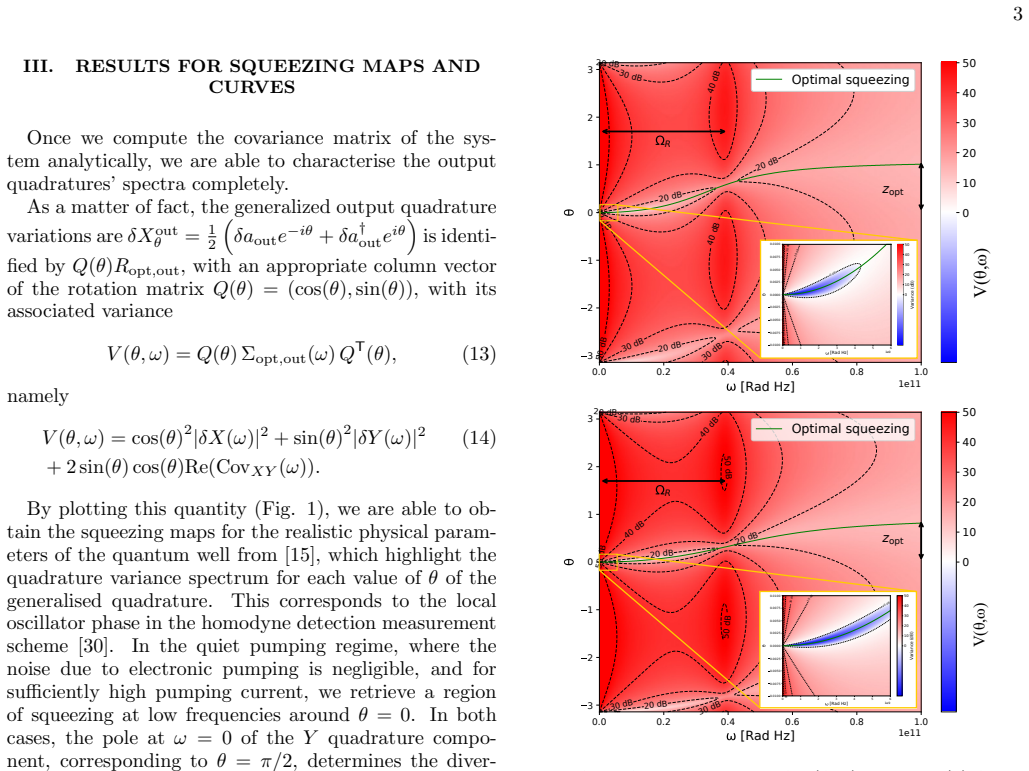
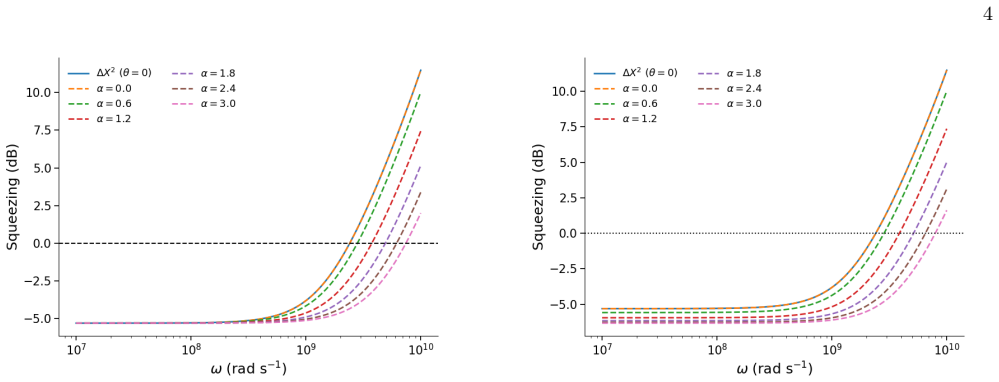
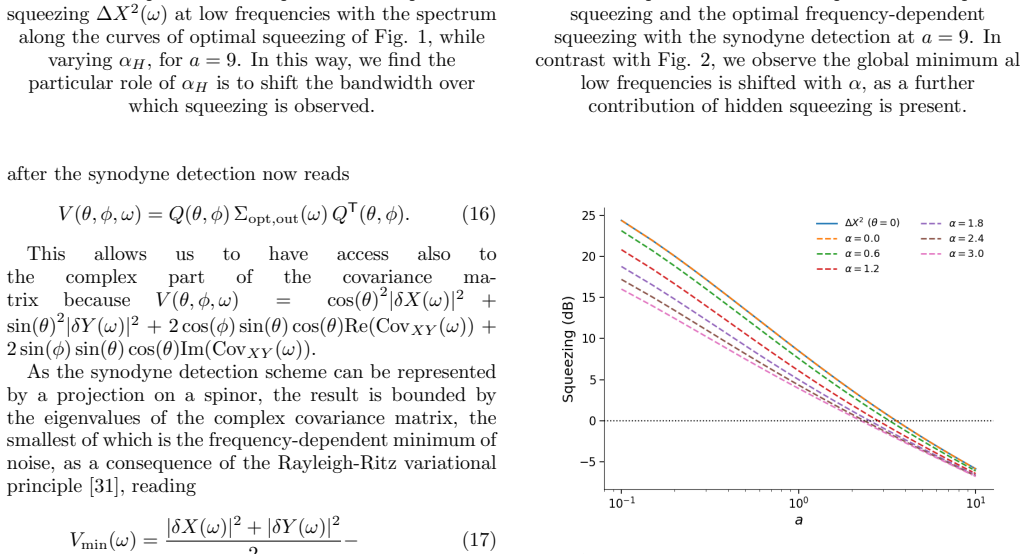
Using a fully quantum Langevin approach on a quantum well laser, the frequency-resolved squeezing map and optimal squeezing curves show both frequency-dependent squeezing and complex or hidden squeezing for the first time in a semiconductor laser. The linewidth enhancement factor is shown to influence the appearance of these features.
What carries the argument
The frequency-resolved squeezing map derived from the fully quantum Langevin equations, which tracks squeezing strength across frequencies and exposes its frequency dependence plus complex character.
If this is right
- Semiconductor lasers become viable platforms for generating non-classical light.
- The alpha factor controls the emergence of frequency-dependent and complex squeezing.
- These lasers gain potential uses in quantum communication and sensing.
Where Pith is reading between the lines
- Frequency dependence could allow selection of specific noise-reduction bands for targeted quantum protocols.
- Complex squeezing might require adjusted detection methods to observe fully in laser outputs.
- Similar calculations on other laser architectures could test whether the features are general.
Load-bearing premise
The fully quantum Langevin equations accurately describe the laser dynamics and produce the reported squeezing behavior without hidden approximations that would remove the frequency dependence or complex nature.
What would settle it
An experiment that measures the quadrature noise spectrum of an actual quantum well laser over a broad frequency range and checks whether the observed squeezing matches the calculated frequency dependence and complex features.
Figures
read the original abstract
We present a comprehensive study of quadrature squeezing in a quantum well laser based on a fully quantum Langevin approach. We compute the frequency-resolved squeezing map of the laser field and identify optimal squeezing curves, revealing, for the first time to our knowledge, both frequency-dependent squeezing and complex or hidden squeezing in a semiconductor laser. We further analyse the role of the linewidth enhancement factor (alpha factor) in the emergence of these features. Our results establish semiconductor lasers as a platform for the generation of non-classical light and open new perspectives for their application in quantum communication and sensing.
Editorial analysis
A structured set of objections, weighed in public.
Referee Report
Summary. The manuscript presents a fully quantum Langevin treatment of a quantum-well semiconductor laser and computes the frequency-resolved squeezing spectrum of the output field. It reports the existence of frequency-dependent squeezing together with complex (phase-dependent or 'hidden') squeezing, identifies optimal quadrature curves, and examines how these features depend on the linewidth-enhancement factor α. The central claim is that both phenomena appear for the first time in this class of lasers and establish semiconductor lasers as sources of non-classical light.
Significance. If the reported squeezing maps and optimal curves are robust, the work supplies a concrete, experimentally accessible route to frequency-tunable non-classical light from a compact, electrically driven source. The explicit treatment of the α-factor links a well-known laser parameter to quadrature squeezing, which could guide device engineering for quantum communication and sensing. The use of a fully quantum Langevin framework rather than semiclassical approximations is a methodological strength when the derivations and noise spectra are fully documented.
major comments (2)
- [§3] §3 (Langevin equations and linearization): the derivation of the frequency-dependent squeezing spectrum relies on linearization around the steady state and truncation of higher-order noise correlations. No explicit check is provided against the validity of this truncation for the reported frequency range or against an alternative noise model (e.g., inclusion of nonlinear gain saturation or non-Markovian effects). If these approximations alter the shape of the squeezing spectrum or the phase of the optimal quadrature, the claimed frequency dependence and complex character become model-specific rather than intrinsic.
- [Fig. 4] Fig. 4 and associated text (optimal squeezing curves): the manuscript states that complex squeezing appears for certain α values, yet the definition of the complex squeezing parameter and the precise quadrature phase that is optimized are not given explicitly. Without this definition it is impossible to verify whether the reported 'hidden' squeezing is a genuine physical feature or an artifact of the chosen quadrature reference frame.
minor comments (2)
- [Introduction] The abstract and introduction cite 'first time to our knowledge' without a systematic comparison to prior semiclassical or quantum treatments of squeezing in semiconductor lasers (e.g., works on α-factor-induced phase noise). A short literature table would strengthen the novelty claim.
- [§4] Notation for the squeezing spectrum (e.g., S(ω) versus the normalized quadrature variance) is introduced without a dedicated equation; readers must infer the normalization from context.
Simulated Author's Rebuttal
We thank the referee for their careful reading of the manuscript and for providing constructive feedback. We respond to each major comment below.
read point-by-point responses
-
Referee: [§3] §3 (Langevin equations and linearization): the derivation of the frequency-dependent squeezing spectrum relies on linearization around the steady state and truncation of higher-order noise correlations. No explicit check is provided against the validity of this truncation for the reported frequency range or against an alternative noise model (e.g., inclusion of nonlinear gain saturation or non-Markovian effects). If these approximations alter the shape of the squeezing spectrum or the phase of the optimal quadrature, the claimed frequency dependence and complex character become model-specific rather than intrinsic.
Authors: We acknowledge that an explicit check of the linearization validity would strengthen the presentation. The linearization is the standard approach in quantum Langevin treatments of lasers above threshold, where intensity and phase fluctuations remain small compared to the mean field. In the revision we will add a short paragraph (with supporting estimates) showing that higher-order correlations remain negligible over the frequency window examined for the operating parameters used. We will also note the limitations of the Markovian assumption and why nonlinear gain saturation is expected to be a higher-order correction in this regime. revision: partial
-
Referee: [Fig. 4] Fig. 4 and associated text (optimal squeezing curves): the manuscript states that complex squeezing appears for certain α values, yet the definition of the complex squeezing parameter and the precise quadrature phase that is optimized are not given explicitly. Without this definition it is impossible to verify whether the reported 'hidden' squeezing is a genuine physical feature or an artifact of the chosen quadrature reference frame.
Authors: We agree that the definition must be stated explicitly. The complex (or hidden) squeezing is the minimum noise variance obtained by optimizing the quadrature phase at each frequency; the optimal phase itself becomes frequency-dependent when the α-factor introduces cross-correlations between amplitude and phase noise. In the revised manuscript we will insert the explicit expression for the squeezing parameter S(ω,θ) and the condition for the optimal θ(ω), together with a short derivation showing that the effect originates from the α-dependent noise spectrum rather than from an arbitrary reference-frame choice. revision: yes
Circularity Check
No significant circularity; derivation appears self-contained in modeling approach
full rationale
The abstract and description present a computational study using a fully quantum Langevin approach to generate frequency-resolved squeezing maps and analyze the alpha factor's role. No equations, parameter-fitting procedures, or self-citations are quoted that reduce predictions to inputs by construction. The central results (frequency-dependent and complex squeezing) are framed as outputs of the model rather than tautological redefinitions or fitted renamings. Without load-bearing steps that collapse to self-definition or self-citation chains, the derivation chain does not exhibit circularity.
Axiom & Free-Parameter Ledger
Reference graph
Works this paper leans on
-
[1]
The matrixσ P contains the contribution due to the polarization in the noise of the electromagnetic fieldF A
In short, the matrix reads σopt,in = 1 4 √ 2π I2 (C3) The scalarσ car =⟨F N(ω)FN(ω′)⟩= 2⟨D N N⟩ δ(ω+ω ′)√ 2π is the noise associated to the carrier’s number [13], with 2⟨DN N⟩=ξΛ +γ nrN+R sp + (2R′ sp −g(N))N p,(C4) evaluated at the stationary state. The matrixσ P contains the contribution due to the polarization in the noise of the electromagnetic fieldF...
-
[2]
Schnabel, Squeezed states of light and their appli- cations in laser interferometers, Physics Reports684, 1 (2017)
R. Schnabel, Squeezed states of light and their appli- cations in laser interferometers, Physics Reports684, 1 (2017)
2017
-
[3]
J. Aasi, J. Abadie, B. P. Abbott,et al., Enhanced sen- sitivity of the ligo gravitational wave detector by using squeezed states of light, Nature Photonics7, 613 (2013)
2013
-
[4]
Oelker, R
E. Oelker, R. E. S. Polzik, J. Abadie,et al., Frequency- dependent squeezing for advanced ligo, Physical Review Letters116, 041102 (2016)
2016
-
[5]
M. A. Taylor, J. Janousek, V. Daria, J. Knittel, B. Hage, H.-A. Bachor, and W. P. Bowen, Biological measurement beyond the quantum noise limit using squeezed light, Na- ture Photonics7, 229 (2013)
2013
-
[6]
Genovese, Real applications of quantum metrology, Journal of Optics18, 073002 (2016)
M. Genovese, Real applications of quantum metrology, Journal of Optics18, 073002 (2016)
2016
-
[7]
E. Waks, C. Santori, and Y. Yamamoto, Security aspects of quantum key distribution with sub-poisson light, Phys. Rev. A66, 042315 (2002)
2002
-
[8]
C. S. Jacobsen, L. S. Madsen, V. C. Usenko, R. Filip, and U. L. Andersen, Complete elimination of information leakage in continuous-variable quantum communication channels, npj Quantum Information4, 32 (2018)
2018
-
[9]
Hosseinidehaj, M
N. Hosseinidehaj, M. S. Winnel, and T. C. Ralph, Sim- ple and loss-tolerant free-space quantum key distribution using a squeezed laser, Physical Review A95, 012317 (2017)
2017
-
[10]
Machida and Y
S. Machida and Y. Yamamoto, Observation of sub- poissonian photon statistics in a semiconductor laser, Physical Review Letters60, 792 (1988)
1988
-
[11]
Yamamoto, Quantum noise and squeezing in semicon- ductor lasers, IEEE Journal of Quantum Electronics27, 1312 (1991)
Y. Yamamoto, Quantum noise and squeezing in semicon- ductor lasers, IEEE Journal of Quantum Electronics27, 1312 (1991)
1991
-
[12]
Davidovich, Sub-poissonian processes in quantum op- tics, Reviews of Modern Physics68, 127 (1996)
L. Davidovich, Sub-poissonian processes in quantum op- tics, Reviews of Modern Physics68, 127 (1996)
1996
-
[13]
C. W. Gardiner and P. Zoller,Quantum Noise: A Handbook of Markovian and Non-Markovian Quantum Stochastic Methods with Applications to Quantum Op- tics, 3rd ed., Springer Series in Synergetics, Vol. 56 (Springer, 2004)
2004
-
[14]
W. W. Chow, S. W. Koch, and M. S. III,Semiconductor- Laser Physics(Springer-Verlag, Berlin, Heidelberg, 1994)
1994
-
[15]
Yamamoto, S
Y. Yamamoto, S. Machida, and O. Nilsson, Amplitude squeezing in a pump-noise-suppressed laser oscillator, Physical Review A34, 4025 (1986)
1986
-
[16]
L. A. Coldren, S. W. Corzine, and M. L. Maˇ sanovi´ c, Diode Lasers and Photonic Integrated Circuits, 2nd ed. (Wiley, 2012)
2012
-
[17]
Gensty, J
T. Gensty, J. von Staden, and W. Els¨ aßer, Investiga- tions on the generation of light with sub-shot intensity noise with quantum cascade lasers, Institute of Applied Physics, Darmstadt University of Technology (2004)
2004
-
[18]
J.-L. Vey, C. Degen, K. Auen, and W. Elsaesser, Quan- tum noise and polarization properties of vertical-cavity surface-emitting lasers, Physical Review A59, 3185 (1999)
1999
-
[19]
Travagnin, Effects of pauli blocking on semiconductor laser intensity and phase noise spectra, Physical Review A64, 013818 (2001)
M. Travagnin, Effects of pauli blocking on semiconductor laser intensity and phase noise spectra, Physical Review A64, 013818 (2001)
2001
-
[20]
C. H. Henry, Theory of the linewidth of semiconductor lasers, IEEE Journal of Quantum Electronics18, 259 (1982)
1982
-
[21]
F. A. S. Barbosa, A. S. Coelho, K. N. Cassemiro, P. Nussenzveig, C. Fabre, M. Martinelli, and A. S. Villar, Beyond spectral homodyne detection: Complete quan- tum measurement of spectral modes of light, Physical Review Letters111, 200402 (2013)
2013
-
[22]
F. A. S. Barbosa, A. S. Coelho, K. N. Cassemiro, P. Nussenzveig, C. Fabre, A. S. Villar, and M. Martinelli, Quantum state reconstruction of spectral field modes: Homodyne and resonator detection schemes, Physical Review A88, 052113 (2013)
2013
-
[23]
Gouzien, L
E. Gouzien, L. Labont´ e, J. Etesse, A. Zavatta, S. Tanzilli, V. D’Auria, and G. Patera, Hidden and detectable squeezing from microresonators, Phys. Rev. Res.5, 023178 (2023)
2023
-
[24]
Dioum, V
B. Dioum, V. D’Auria, and G. Patera, Hidden quantum correlations in cavity-based quantum optics, Phys. Rev. A112, 023705 (2025)
2025
-
[25]
L. F. Buchmann, S. Schreppler, J. Kohler, N. Speth- mann, and D. M. Stamper-Kurn, Complex squeezing and force measurement beyond the standard quantum limit, Physical Review Letters117, 030801 (2016)
2016
-
[26]
Dioum, V
B. Dioum, V. D’Auria, A. Zavatta, O. Pfister, and G. Pa- tera, Universal quantum frequency comb measurements by spectral mode-matching, Optica Quantum2, 413 (2024)
2024
-
[27]
Gouzien, S
E. Gouzien, S. Tanzilli, V. D’Auria, and G. Patera, Mor- phing supermodes: A full characterization for enabling multimode quantum optics, Physical Review Letters125, 103601 (2020)
2020
-
[28]
Here we define the quadrature variations in terms ofδA andδA † with the conventionδX= δA+δA† 2 andδY= δA−δA† 2i
-
[29]
The notation used in this work for the Fourier transform is R(ω) = Z +∞ −∞ dt√ 2π eiωtR(t) and R(t) = Z +∞ −∞ dω√ 2π e−iωtR(ω)
-
[30]
C. W. Gardiner and M. J. Collett, Input and output in damped quantum systems: Quantum stochastic differen- tial equations and the master equation, Physical Review A31, 3761 (1985)
1985
-
[31]
M. J. Collett, R. Loudon, and C. W. Gardiner, Quantum theory of optical homodyne and heterodyne detection, Journal of Modern Optics34, 881 (1987)
1987
-
[32]
R. A. Horn and C. R. Johnson,Matrix Analysis, 2nd ed. (Cambridge University Press, Cambridge, 2012)
2012
-
[33]
M. O. Scully and M. S. Zubairy,Quantum Optics(Cam- bridge University Press, Cambridge, 1997)
1997
-
[34]
Y. Zhao, K. Ding, Y. Huang, and F. Grillot, Broadband amplitude squeezing at room temperature in electrically driven quantum dot lasers, Physical Review Research6, L032021 (2024)
2024
-
[35]
K. Ding, Y. Zhao, Y. Huang, and F. Grillot, Observation of amplitude squeezing in a constant-current-driven dis- tributed feedback quantum dot laser, APL Quantum1, 026104 (2024). 9
2024
-
[36]
Faist,Quantum Cascade Lasers, 1st ed
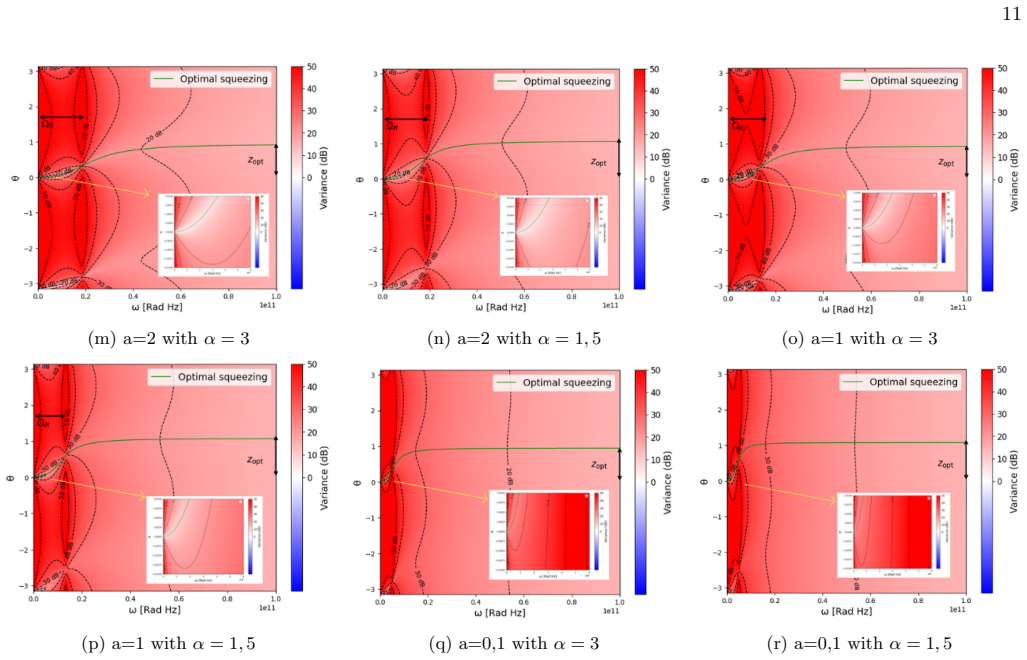
J. Faist,Quantum Cascade Lasers, 1st ed. (Oxford Uni- versity Press, 2013). 10 (a) a=8 withα= 1,5 (b) a=8 withα= 3 (c) a=7 withα= 1.5 (d) a=7 withα= 3 (e) a=6 withα= 1.5 (f) a=6 withα= 3 (g) a=5 withα= 3 (h) a=5 withα= 1.5 (i) a=4 withα= 3 (j) a=4 withα= 1,5 (k) a=3 withα= 3 (l) a=3 withα= 1,5 11 (m) a=2 withα= 3 (n) a=2 withα= 1,5 (o) a=1 withα= 3 (p) a=...
2013
discussion (0)
Sign in with ORCID, Apple, or X to comment. Anyone can read and Pith papers without signing in.