Geometry-Aware MCTS for Extremal Problems in Combinatorial Geometry
Pith reviewed 2026-06-26 01:28 UTC · model grok-4.3
The pith
Geometry-aware MCTS finds record grid configurations by updating valid moves incrementally and pruning symmetries.
A machine-rendered reading of the paper's core claim, the machinery that carries it, and where it could break.
Core claim
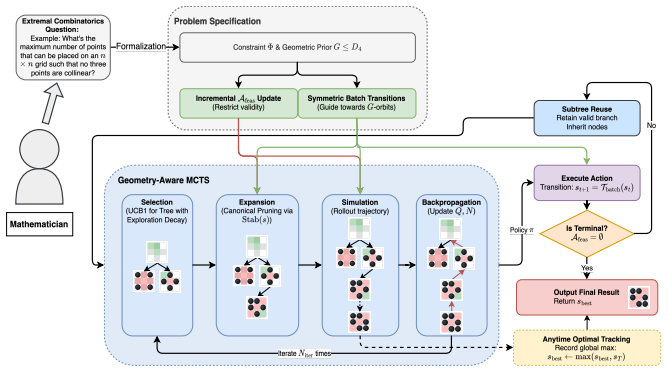
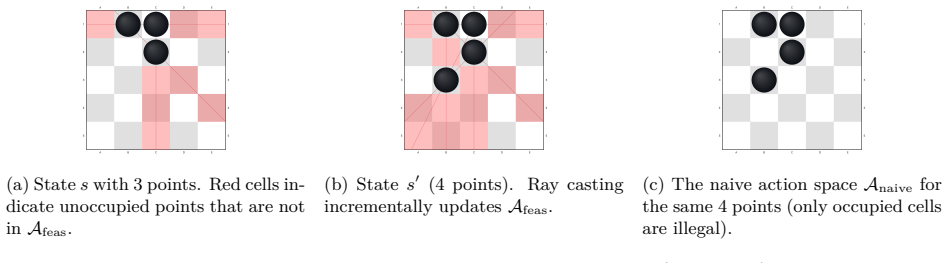
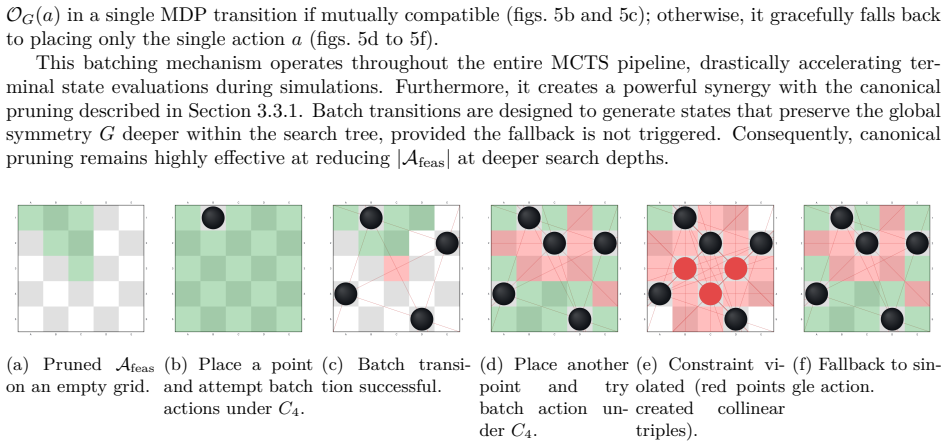
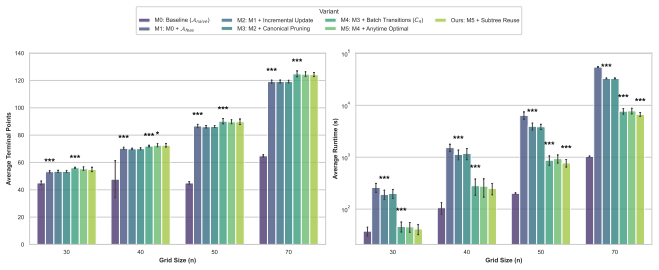
By strictly enforcing geometric constraints through incremental updates to the feasible action space and exploiting geometric symmetries via canonical pruning during node expansion together with symmetric batch transitions, the Geometry-Aware MCTS framework produces configurations that improve the best-known computational results on five of the six extremal problems examined.
What carries the argument
Geometry-Aware Monte Carlo Tree Search that maintains an incrementally updated feasible action space to enforce global geometric constraints while applying canonical pruning of symmetric configurations.
If this is right
- The same incremental enforcement can be applied to other global geometric constraints beyond collinearity.
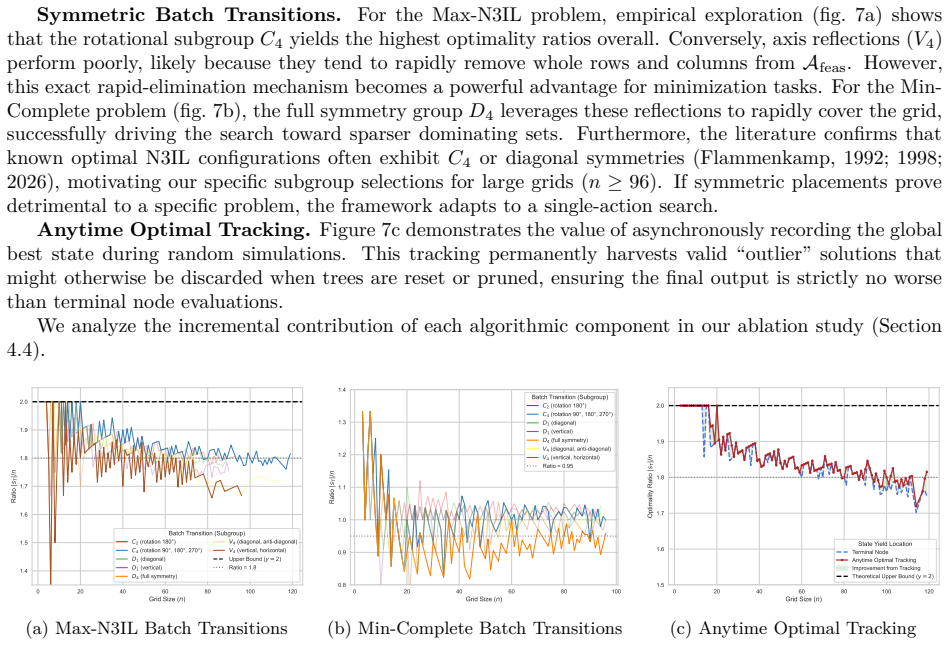
- Symmetric batch transitions scale the discovery of promising partial solutions without expanding the full branching factor.
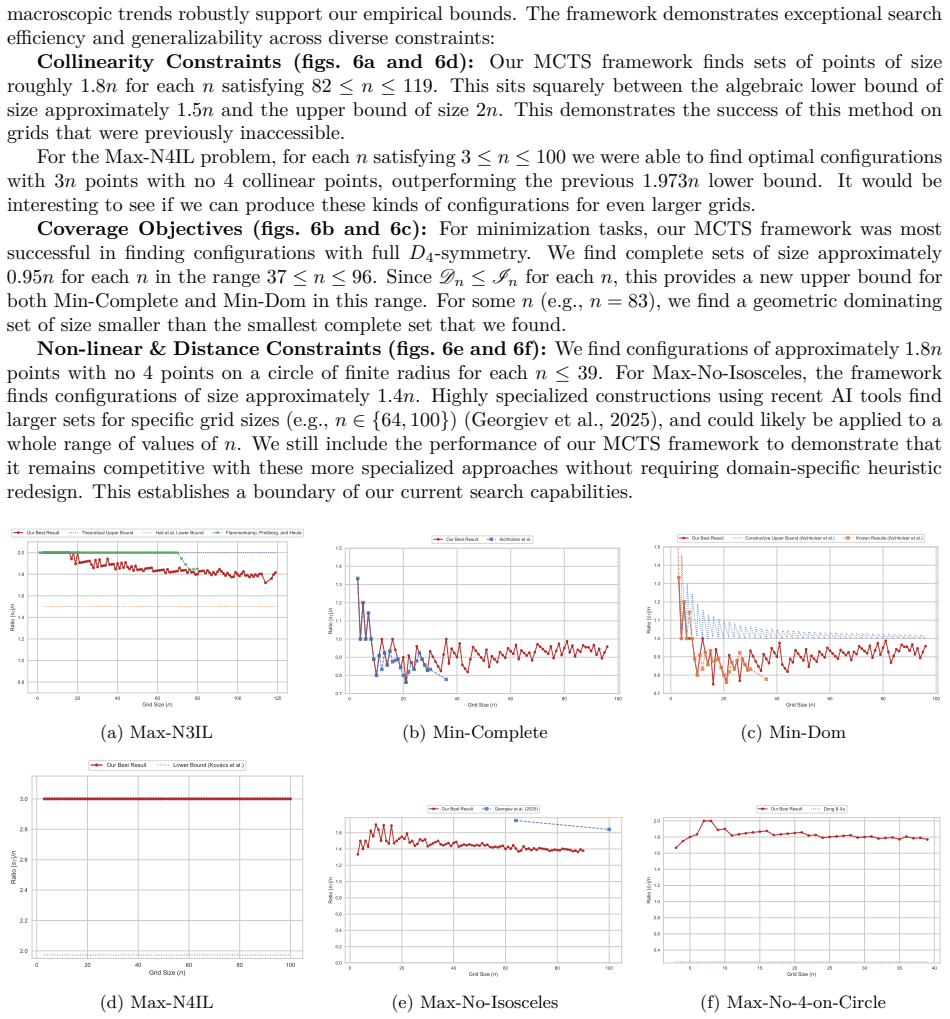
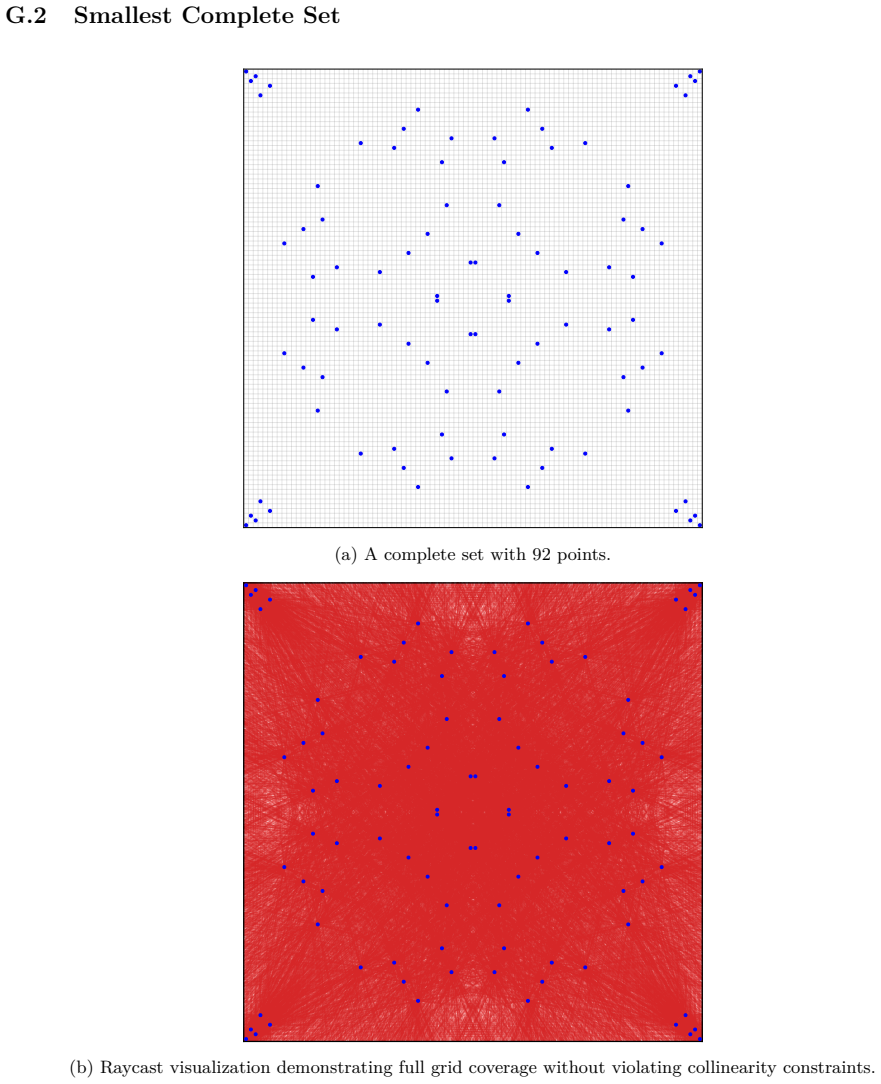
- New upper bounds of roughly 0.95n are obtained for the Smallest Complete Set problem on the tested grids.
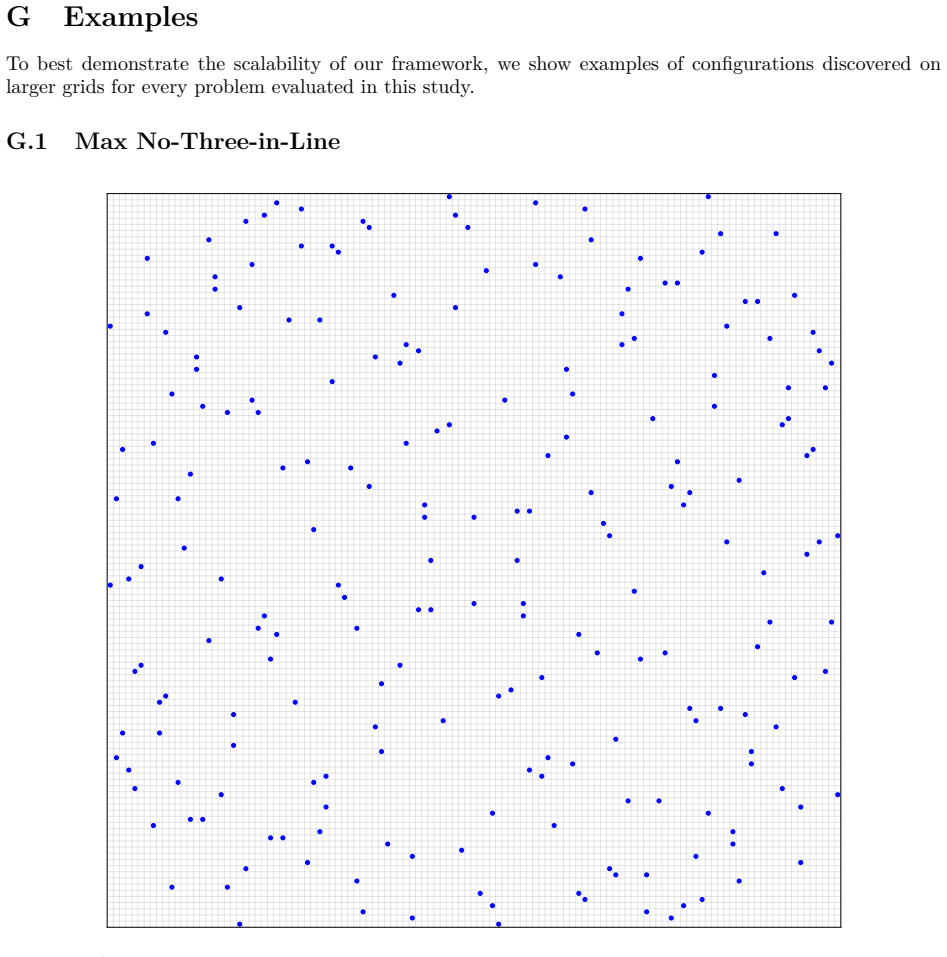
- The framework yields configurations of size roughly 1.8n for Max-N3IL on grids from size 82 to 119.
Where Pith is reading between the lines
- The same incremental-action mechanism could be tested on non-grid point sets or on problems whose constraints involve distances rather than lines.
- If the pruning step is made probabilistic, the method might trade completeness for further speed on still larger grids.
- The approach suggests that domain-specific action-space maintenance can make MCTS competitive with specialized solvers on other sparse-reward combinatorial tasks.
Load-bearing premise
The incremental updates to the feasible action space and the canonical pruning of symmetric configurations correctly preserve all optimal solutions while eliminating only duplicates or invalid states.
What would settle it
Discovery of a valid configuration strictly larger than the reported sizes for any of the five improved problems on a grid within the tested range, found by an independent exhaustive or randomized search that the MCTS method misses.
Figures
read the original abstract
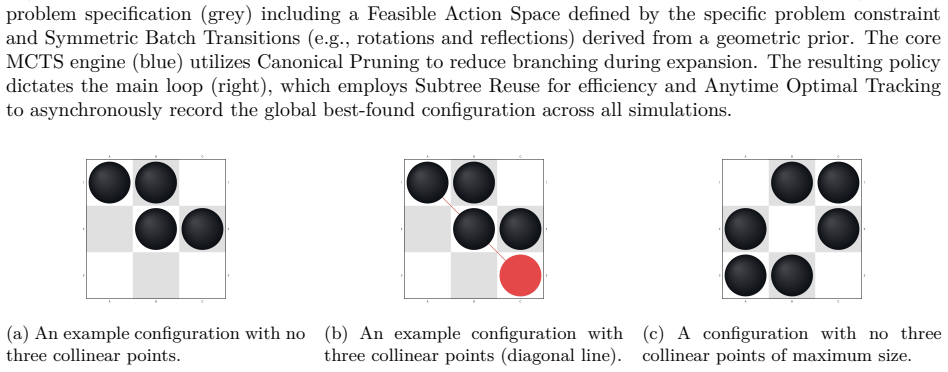
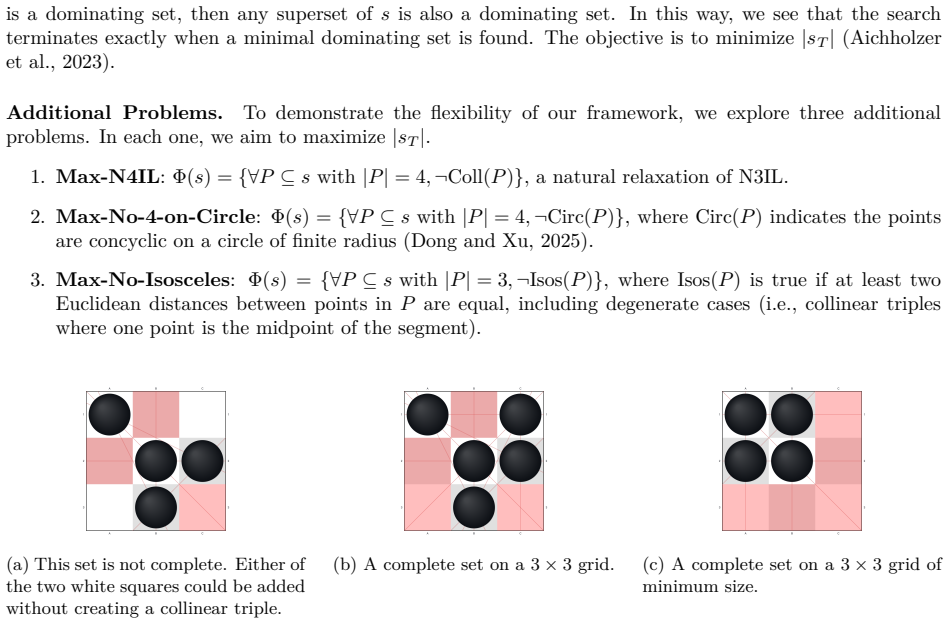
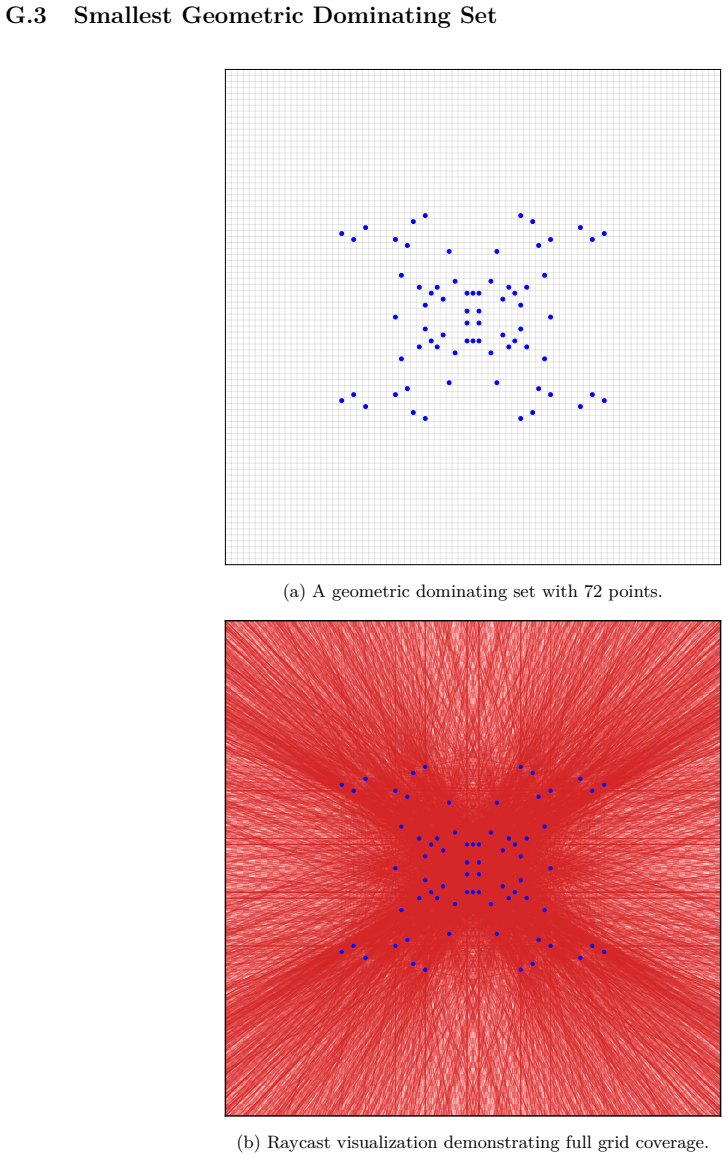
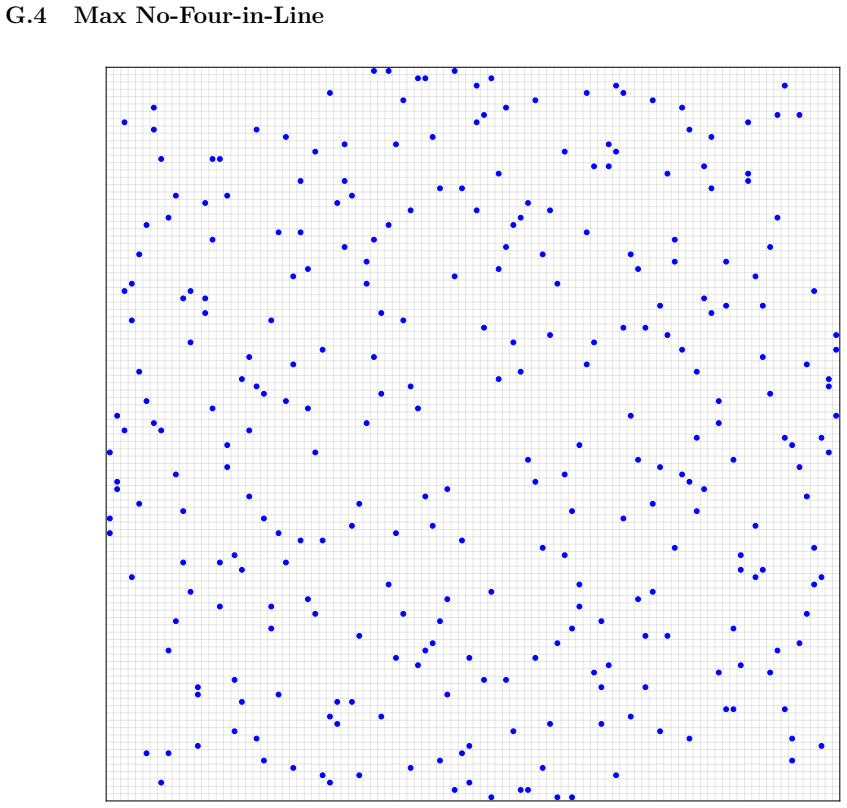
We study certain extremal problems in combinatorial geometry that ask about configurations of points in an $n \times n$ grid that satisfy strict, global geometric constraints. Classical exact solvers suffer from combinatorial explosion for these types of problems, and standard reinforcement learning and transformer-based models struggle with the sparse reward "validity cliff" and quadratic token-consumption limits. To overcome these bottlenecks, we propose a Geometry-Aware Monte Carlo Tree Search (MCTS) framework. Our approach strictly enforces geometric constraints through incremental updates to the feasible action space. For constraints about collections of collinear points, like those that occur in the classic No-Three-in-Line problem (Max-N3IL), this mechanism reduces the constraint checking complexity from $O(n^3)$ to $O(n^2)$. To improve search efficiency, we exploit geometric symmetries in two ways: canonical pruning during node expansion to reduce the branching factor, and symmetric batch transitions to accelerate the discovery of promising configurations. We perform extensive experiments and establish new best-known computational results on five out of six of the problems that we considered. Notably, for Max-N3IL we find configurations of size roughly $1.8 n$ for grids of size $82 \le n \le 119$. For the Smallest Complete Set problem, we find configurations of size roughly $0.95 n$, providing new upper bounds within the tested grids. This work establishes Geometry-Aware MCTS as a highly adaptable framework for discovering novel configurations in combinatorial geometry.
Editorial analysis
A structured set of objections, weighed in public.
Referee Report
Summary. The paper proposes a Geometry-Aware MCTS framework for extremal problems in combinatorial geometry on n×n grids. It enforces geometric constraints (e.g., collinearity) via incremental feasible-action updates that reduce checking from O(n³) to O(n²), and exploits symmetries via canonical pruning during expansion and symmetric batch transitions. Experiments claim new best-known results on five of six problems, including point-set sizes of roughly 1.8n for Max-N3IL on grids 82≤n≤119 and 0.95n for the Smallest Complete Set problem.
Significance. If the reported configurations are correct, the work supplies improved upper bounds on several long-studied extremal problems and demonstrates a scalable search method for sparse-reward geometric constraint satisfaction where exhaustive solvers and standard RL/transformer approaches fail. The incremental-update and symmetry mechanisms are a concrete algorithmic contribution that could transfer to other combinatorial-geometry search tasks.
major comments (2)
- [Abstract] Abstract (paragraph on constraint enforcement and symmetry exploitation): the claim that incremental updates to the feasible action space and canonical pruning 'preserve all optimal solutions' is asserted without an invariant, inductive argument, or exhaustive verification on small instances. Because MCTS is not exhaustive, any pruning error that discards an orbit containing a larger valid configuration would directly falsify the new best-known sizes reported for Max-N3IL and Smallest Complete Set; this is load-bearing for the central experimental claims.
- [Abstract] Abstract (experimental results paragraph): the new best-known results are presented without any mention of implementation details, verification procedures (e.g., post-search exhaustive checking of the returned configurations), baseline comparisons, number of independent runs, or error bars, making it impossible to assess whether the reported sizes are reproducible or superior to prior methods.
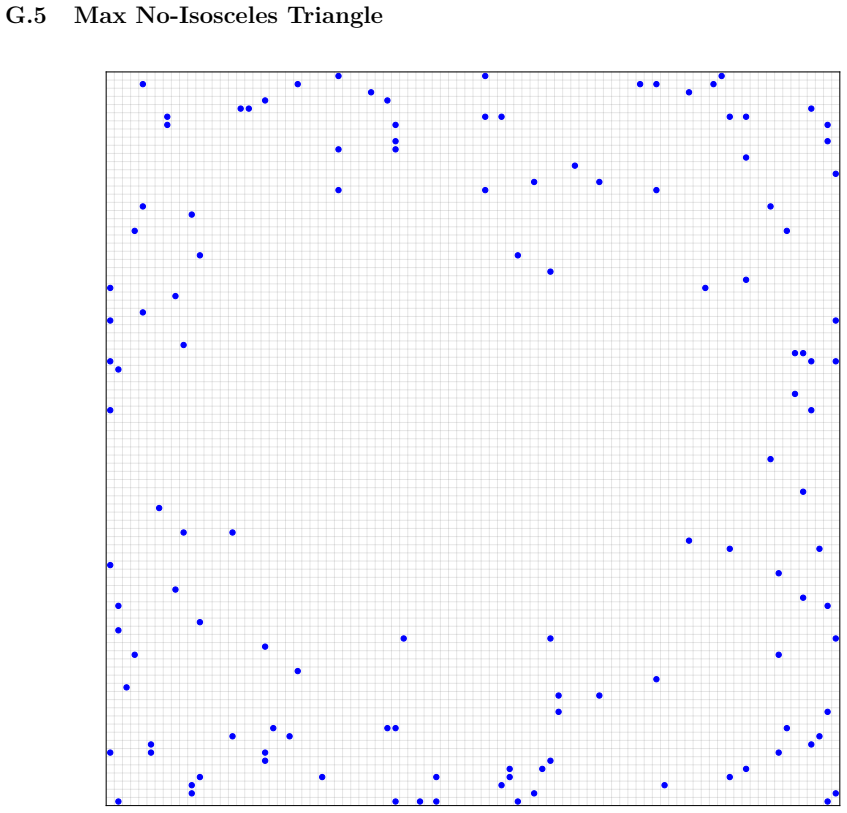
minor comments (2)
- [Abstract] The O(n³)→O(n²) complexity reduction for collinearity constraints is stated but the precise incremental mask update rule is not shown; a short pseudocode or equation in the methods section would clarify the mechanism.
- [Abstract] Notation for grid size n versus configuration size is used without an explicit definition of the objective function (e.g., maximize |P| subject to no-three-in-line) in the abstract; adding this would aid readers unfamiliar with the problems.
Simulated Author's Rebuttal
Thank you for the thorough review of our manuscript arXiv:2606.26399. We address each of the major comments point by point below and will incorporate revisions to strengthen the rigor and clarity of the claims.
read point-by-point responses
-
Referee: [Abstract] Abstract (paragraph on constraint enforcement and symmetry exploitation): the claim that incremental updates to the feasible action space and canonical pruning 'preserve all optimal solutions' is asserted without an invariant, inductive argument, or exhaustive verification on small instances. Because MCTS is not exhaustive, any pruning error that discards an orbit containing a larger valid configuration would directly falsify the new best-known sizes reported for Max-N3IL and Smallest Complete Set; this is load-bearing for the central experimental claims.
Authors: We agree that an explicit invariant or inductive argument would strengthen the presentation. The full manuscript (Section 3.2) explains that incremental updates maintain feasibility by construction—only actions satisfying the collinearity constraints are retained, reducing checks from O(n³) to O(n²)—and canonical pruning operates on symmetry orbits after confirming the representative configuration. However, the abstract does not include a formal statement or small-n verification. We will add a concise invariant argument in Section 3.3 and report exhaustive verification results on instances with n ≤ 10 (where optima are known from prior work) to confirm no superior configurations are discarded. This revision directly addresses the load-bearing concern. revision: yes
-
Referee: [Abstract] Abstract (experimental results paragraph): the new best-known results are presented without any mention of implementation details, verification procedures (e.g., post-search exhaustive checking of the returned configurations), baseline comparisons, number of independent runs, or error bars, making it impossible to assess whether the reported sizes are reproducible or superior to prior methods.
Authors: The main text (Section 4) provides these details: all reported configurations undergo post-search exhaustive validity checking against the geometric constraints, results are compared to prior best-known values from the literature, and each problem instance was run independently 10 times with aggregated statistics. To make the abstract self-contained, we will revise the experimental paragraph to briefly note the verification procedure and comparisons. We will also ensure variance measures appear in the results tables of the revised manuscript. These changes improve assessability without altering the reported findings. revision: yes
Circularity Check
No circularity: algorithmic search with experimental results
full rationale
The paper introduces a Geometry-Aware MCTS algorithm that enforces constraints incrementally and prunes symmetries, then reports new computational upper bounds obtained by running the search on specific grid sizes. No mathematical derivation, first-principles prediction, or fitted parameter is claimed; the headline results are direct outputs of the implemented procedure rather than quantities that reduce to the inputs by construction. The pruning and update mechanisms are presented as engineering choices whose correctness is asserted but not derived from prior self-citations in a load-bearing way. This is a standard experimental contribution with no self-definitional or renaming circularity.
Axiom & Free-Parameter Ledger
Reference graph
Works this paper leans on
-
[1]
doi: 10.1016/j.comgeo.2022.101913
ISSN 0925-7721. doi: 10.1016/j.comgeo.2022.101913. Thomas F. Bloom and Olof Sisask. An improvement to the Kelley-Meka bounds on three-term arithmetic progressions,
-
[2]
URLhttps://arxiv.org/abs/2309.02353. Cameron B. Browne, Edward Powley, Daniel Whitehouse, Simon M. Lucas, Peter I. Cowling, Philipp Rohlf- shagen, Stephen Tavener, Diego Perez, Spyridon Samothrakis, and Simon Colton. A survey of Monte Carlo tree search methods.IEEE Transactions on Computational Intelligence and AI in Games, 4(1): 1–43,
-
[3]
and Powley, Edward and Whitehouse, Daniel and others , year =
doi: 10.1109/TCIAIG.2012.2186810. Tristan Cazenave. Monte Carlo permutation search,
-
[4]
URLhttps://arxiv.org/abs/2510.06381. François Charton, Jordan S. Ellenberg, Adam Zsolt Wagner, and Geordie Williamson. PatternBoost: Con- structions in mathematics with a little help from AI,
-
[5]
URLhttps://arxiv.org/abs/2411.00566. Rémi Coulom. Efficient selectivity and backup operators in Monte-Carlo tree search. In H. Jaap van den Herik, Paolo Ciancarini, and H. H. L. M. (Jeroen) Donkers, editors,Computers and Games, pages 72–83, Berlin, Heidelberg,
-
[6]
URLhttps: //arxiv.org/abs/2506.18113. Henry E. Dudeney.Amusements in Mathematics. Nelson, Edinburgh,
-
[7]
Progress in the no-three-in-line-problem , journal =
ISSN 0097-3165. doi: 10.1016/0097-3165(92)90012-J. Achim Flammenkamp. Progress in the No-Three-in-Line problem, II.Journal of Combinatorial Theory, Series A, 81(1):108–113,
-
[8]
Progress in the No-Three-in-Line Problem, II , journal =
ISSN 0097-3165. doi: 10.1006/jcta.1997.2829. Achim Flammenkamp. The No-Three-in-Line problem,
-
[9]
de/achim/no3in/readme.html
URLhttps://wwwhomes.uni-bielefeld. de/achim/no3in/readme.html. Accessed: 2026-04-08. Bogdan Georgiev, Javier Gómez-Serrano, Terence Tao, and Adam Zsolt Wagner. Mathematical exploration and discovery at scale,
2026
-
[10]
URLhttps://arxiv.org/abs/2511.02864. Richard K. Guy and Patrick A. Kelly. The No-Three-In-Line problem.Canadian Mathematical Bulletin, 11 (4):527–531,
-
[11]
1https://rcic.uci.edu/hpc3/hpc3.html 13 R
doi: 10.4153/CMB-1968-062-3. 1https://rcic.uci.edu/hpc3/hpc3.html 13 R. R. Hall, T. H. Jackson, A. Sudbery, and K. Wild. Some advances in the no-three-in-line problem.Journal of Combinatorial Theory, Series A, 18(3):336–341,
-
[12]
doi: 10.1016/0097-3165(75) 90043-6
ISSN 0097-3165. doi: 10.1016/0097-3165(75) 90043-6. Jorik Jooken, Pieter Leyman, Tony Wauters, and Patrick De Causmaecker. Exploring search space trees using an adapted version of Monte Carlo tree search for combinatorial optimization problems.Computers & Operations Research, 150:106070,
-
[13]
doi: 10.1016/j.cor.2022.106070
ISSN 0305-0548. doi: 10.1016/j.cor.2022.106070. Przemysław Klęsk. MCTS-NC: A thorough GPU parallelization of Monte Carlo tree search implemented in Python via numba.cuda.SoftwareX, 30:102139,
-
[14]
doi: 10.1016/j.softx.2025.102139
ISSN 2352-7110. doi: 10.1016/j.softx.2025.102139. Levente Kocsis and Csaba Szepesvári. Bandit based Monte-Carlo planning. In Johannes Fürnkranz, To- bias Scheffer, and Myra Spiliopoulou, editors,Machine Learning: ECML 2006, pages 282–293, Berlin, Heidelberg,
-
[15]
URLhttps://arxiv.org/abs/2508.07632. Wen-Ding Li and Kevin Ellis. Is programming by example solved by LLMs? In A. Globerson, L. Mackey, D. Belgrave, A. Fan, U. Paquet, J. Tomczak, and C. Zhang, editors,Advances in Neural Information Pro- cessing Systems, volume 37, pages 44761–44790. Curran Associates, Inc.,
-
[16]
Yannic Neuhaus, Nicolas Flammarion, Matthias Hein, and Francesco Croce
doi: 10.52202/079017-1422. Yannic Neuhaus, Nicolas Flammarion, Matthias Hein, and Francesco Croce. On the out-of-distribution generalization of reasoning in multimodal LLMs for simple visual planning tasks,
-
[17]
URLhttps: //arxiv.org/abs/2602.15460. Alexander Novikov, Ngân V˜ u, Marvin Eisenberger, Emilien Dupont, Po-Sen Huang, Adam Zsolt Wagner, Sergey Shirobokov, Borislav Kozlovskii, Francisco J. R. Ruiz, Abbas Mehrabian, M. Pawan Kumar, Abigail See, Swarat Chaudhuri, George Holland, Alex Davies, Sebastian Nowozin, Pushmeet Kohli, and Matej Balog. AlphaEvolve: ...
-
[18]
URLhttps://arxiv. org/abs/2506.13131. Thomas Prellberg. Constraint satisfaction programming for the No-three-in-line Problem,
-
[19]
URLhttps: //arxiv.org/abs/2602.07751. Rushil Raghavan. Improved bounds for 3-progressions,
-
[20]
URLhttps://arxiv.org/abs/2603.27045. Pranav Ramanathan, Thomas Prellberg, Matthew Lewis, Prathamesh Dinesh Joshi, Raj Abhijit Dandekar, Rajat Dandekar, and Sreedath Panat. Three methods, one problem: Classical and AI approaches to no-three-in-line,
-
[21]
Bernardino Romera-Paredes, Mohammadamin Barekatain, Alexander Novikov, Matej Balog, M
URLhttps://arxiv.org/abs/2512.11469. Bernardino Romera-Paredes, Mohammadamin Barekatain, Alexander Novikov, Matej Balog, M. Pawan Ku- mar, Emilien Dupont, Francisco J. R. Ruiz, Jordan S. Ellenberg, Pengming Wang, Omar Fawzi, Pushmeet Kohli, and Alhussein Fawzi. Mathematical discoveries from program search with large language models. Nature, 625(7995):468–475,
-
[22]
Pawan and Dupont, Emilien and Ruiz, Francisco J
doi: 10.1038/s41586-023-06924-6. Ben Ruijl, Jos Vermaseren, Aske Plaat, and Jaap van den Herik. Combining simulated annealing and Monte Carlo tree search for expression simplification,
-
[23]
URLhttps://arxiv.org/abs/1312.0841. Stephan Schiffel. Symmetry detection in general game playing.Proceedings of the AAAI Conference on Artificial Intelligence, 24(1):980–985, July
-
[24]
David Silver, Aja Huang, Chris J
doi: 10.1609/aaai.v24i1.7649. David Silver, Aja Huang, Chris J. Maddison, Arthur Guez, Laurent Sifre, George van den Driessche, Julian Schrittwieser, Ioannis Antonoglou, Veda Panneershelvam, Marc Lanctot, Sander Dieleman, Do- minik Grewe, John Nham, Nal Kalchbrenner, Ilya Sutskever, Timothy Lillicrap, Madeleine Leach, Koray Kavukcuoglu, Thore Graepel, and...
-
[25]
doi: 10.1038/nature16961. 14 David Silver, Thomas Hubert, Julian Schrittwieser, Ioannis Antonoglou, Matthew Lai, Arthur Guez, Marc Lanctot, Laurent Sifre, Dharshan Kumaran, Thore Graepel, Timothy Lillicrap, Karen Simonyan, and Demis Hassabis. A general reinforcement learning algorithm that masters chess, shogi, and Go through self-play.Science, 362(6419):...
-
[26]
doi: 10.1126/science.aar6404. Dennis J. N. J. Soemers, Chiara F. Sironi, Torsten Schuster, and Mark H. M. Winands. Enhancements for real-time Monte-Carlo tree search in general video game playing. In2016 IEEE Conference on Computa- tional Intelligence and Games (CIG), pages 1–8,
-
[27]
Tom Vodopivec, Spyridon Samothrakis, and Branko Šter
doi: 10.1109/CIG.2016.7860448. Tom Vodopivec, Spyridon Samothrakis, and Branko Šter. On Monte Carlo tree search and reinforcement learning.Journal of Artificial Intelligence Research, 60:881–936,
-
[28]
doi: 10.1613/jair.5507. Adam Zsolt Wagner. Constructions in combinatorics via neural networks,
-
[29]
Yutong Wang, Pengliang Ji, Chaoqun Yang, Kaixin Li, Ming Hu, Jiaoyang Li, and Guillaume Sartoretti
URLhttps://arxiv.org/ abs/2104.14516. Yutong Wang, Pengliang Ji, Chaoqun Yang, Kaixin Li, Ming Hu, Jiaoyang Li, and Guillaume Sartoretti. MCTS-Judge: Test-time scaling in LLM-as-a-judge for code correctness evaluation,
-
[30]
Zhi Zheng, Zhuoliang Xie, Zhenkun Wang, and Bryan Hooi
URLhttps: //arxiv.org/abs/2502.12468. Zhi Zheng, Zhuoliang Xie, Zhenkun Wang, and Bryan Hooi. Monte Carlo tree search for comprehensive exploration in LLM-based automatic heuristic design,
-
[31]
Xu Zhuang, Yuxiang Yao, Po-Chu Hsu, Xiaokang Wang, and Peikai Qi
URLhttps://arxiv.org/abs/2501.08603. Xu Zhuang, Yuxiang Yao, Po-Chu Hsu, Xiaokang Wang, and Peikai Qi. Machine learning and LLM-boost symbolic regression for predictingQ-gonality of modular curves. In2nd AI for Math Workshop @ ICML 2025,
arXiv 2025
-
[32]
A Related Works We categorize existing approaches to the extremal problems into two distinct streams: theoretical mathe- matical constructions and constrained tree search
URLhttps://openreview.net/forum?id=LDcFa3E5vJ. A Related Works We categorize existing approaches to the extremal problems into two distinct streams: theoretical mathe- matical constructions and constrained tree search. A.1 Mathematical Bounds and Constructions A.1.1 No-3-in-Line Early work focused on number-theoretic constructions to establish foundationa...
1975
-
[33]
Consequently, whilethemaximumsizeisguaranteedtogrowlinearlywithn, wedonotevenhaveaconjecture for howf circ(n)grows withn. A.1.5 No-Isosceles-Triangle Letf iso(n)denote the maximum size of a subset of[n]2 containing no three points that form an isosceles triangle, including degenerate collinear configurations. The best known lower bound is: fiso(n)≥c n√log...
2024
-
[34]
This was further improved by Raghavan (2026), giving fiso(n)≤exp(−O((logn)1/6(log logn)−1))n
2026
-
[35]
A.2 Monte Carlo Tree Search Monte Carlo Tree Search (MCTS) was introduced by Coulom (2007) as a framework combining selective tree search with random rollout evaluations
Like in the problems about sizes of dominating sets, the upper and lower bounds here have different orders of magnitude. A.2 Monte Carlo Tree Search Monte Carlo Tree Search (MCTS) was introduced by Coulom (2007) as a framework combining selective tree search with random rollout evaluations. The UCT algorithm of Kocsis and Szepesvári (2006) provided a prin...
2007
-
[36]
Max Depth
confirm that this approach yields configurations that significantly exceed the best-known constructive lower bound of≈1.5nand closely approach the conjectured density of≈1.814n (Guy and Kelly, 1968), suggesting thatO(n6)may be capable of identifying structures that approach the current conjectured bounds. Generality Across Problem Variants.TheO(n 3)per-it...
1968
-
[37]
independent dominating set
within this modest memory budget, we empirically highlight the effectiveness of our geometry- aware pruning and incremental update mechanisms in mitigating the curse of dimensionality. Hardware Heterogeneity and Control:The HPC cluster is a heterogeneous environment comprising various CPU architectures (e.g., Intel Skylake, Cascade Lake, and Ice Lake). To...
2026
discussion (0)
Sign in with ORCID, Apple, or X to comment. Anyone can read and Pith papers without signing in.