Nautilus: Fast Time-Resolved Spectroscopy of GKM Stellar Flares and Their Implications for Planetary Habitability
Pith reviewed 2026-06-26 00:40 UTC · model grok-4.3
The pith
Nautilus Space Observatory can deliver fast-cadence NUV-to-NIR spectroscopy of GKM dwarf flares to build a library of empirical spectral templates.
A machine-rendered reading of the paper's core claim, the machinery that carries it, and where it could break.
Core claim
The Nautilus Space Observatory concept can provide a unique opportunity to obtain fast-cadence, precisely flux-calibrated, moderate-resolution NUV-to-NIR spectroscopy of flares across a large sample of GKM dwarfs. These observations will measure the time-dependent flare energy budget from the near-UV/blue continuum to the optical and near-infrared continuum, while resolving key chromospheric lines that trace the underlying flare physics, enabling a statistical library of empirical flare spectral templates organized by flare energy, flare phase, and host-star spectral type.
What carries the argument
The Nautilus Space Observatory concept for obtaining fast time-resolved NUV-to-NIR spectroscopy of flares, which supplies the time-dependent energy budget and resolved chromospheric lines needed to build the empirical spectral template library.
If this is right
- A practical bridge between observed flare properties and the radiation inputs required for planetary atmospheric evolution and habitability simulations.
- Empirical templates that capture how flare temperatures and spectral shapes vary with energy, phase, and stellar type.
- Time-resolved data on G- and K-dwarfs to complement existing M-dwarf observations.
- Better accounting for enhanced UV/XUV radiation and stellar proton events that drive photochemistry and atmospheric escape.
Where Pith is reading between the lines
- The library could revise estimates of total flare energy delivered to planets, altering modeled rates of atmospheric loss.
- Resolved line profiles might link specific flare phases to distinct photochemical pathways in exoplanet atmospheres.
- Organizing templates by stellar type could reveal whether G- and K-dwarf flares require separate modeling from M-dwarf flares.
Load-bearing premise
Current atmospheric and habitability models rely on simplified flare inputs that can be meaningfully improved by time-resolved spectroscopic data, and that optical-based observations systematically underestimate UV flare energy.
What would settle it
A set of Nautilus-style observations showing that flare spectral shapes and temperatures do not vary significantly with energy, phase, or stellar type, and that optical-to-UV conversions already capture the full energy budget within 10 percent, would remove the need for the proposed library.
Figures
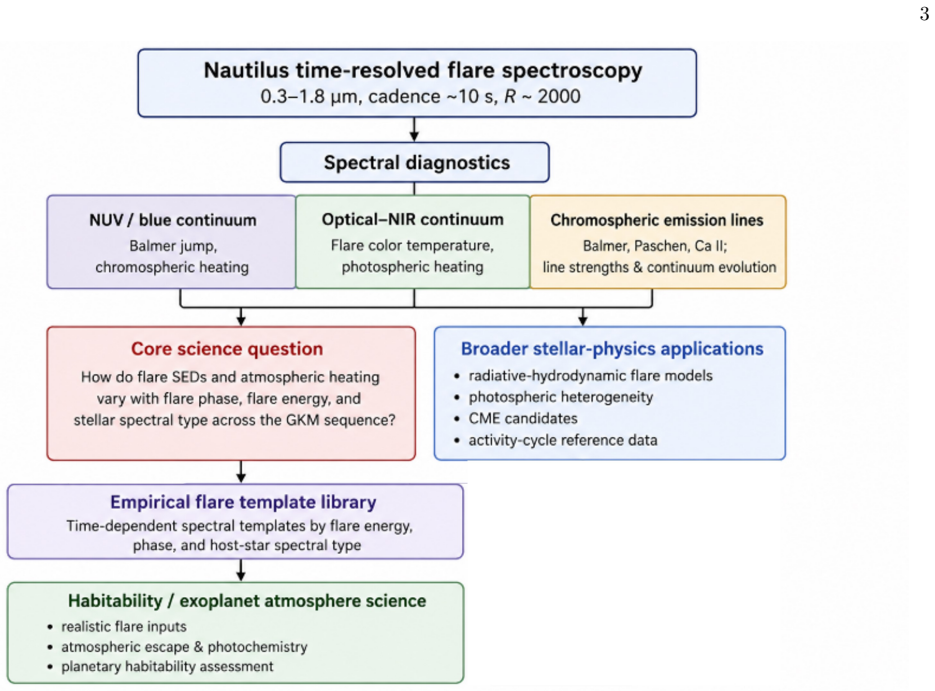
read the original abstract
Low-mass GKM dwarfs are prime targets for finding habitable-zone Earth-sized planets, but their frequent flares, especially on M~dwarfs, can strongly affect planetary atmospheres through enhanced UV/XUV radiation and stellar proton events, which can drive complex photochemistry and accelerate atmospheric escape. Current atmospheric and habitability models of planets around low-mass stars often rely on simplified flare inputs, such as fixed-temperature blackbodies or approximate optical-to-UV/XUV conversions. However, recent observations show that M~dwarfs' flare temperatures and spectral shapes can vary significantly with flare energy, phase, and stellar type, and that optical-based flare observations may underestimate the flare energy in the UV. Time-resolved spectroscopic flare observations of G- and K-dwarfs also remain rare compared to those of M dwarfs. Here, we propose that the Nautilus Space Observatory concept can provide a unique opportunity to obtain fast-cadence, precisely flux-calibrated, moderate-resolution NUV-to-NIR spectroscopy of flares across a large sample of GKM dwarfs. These observations will measure the time-dependent flare energy budget from the near-UV/blue continuum to the optical and near-infrared continuum, while resolving key chromospheric lines that trace the underlying flare physics. We aim to construct a statistical library of empirical flare spectral templates organized by flare and stellar properties, including flare energy, flare phase, and host-star spectral type. This library will provide a practical bridge between observed stellar flare properties and the radiation inputs required for planetary atmospheric evolution and habitability simulations.
Editorial analysis
A structured set of objections, weighed in public.
Referee Report
Summary. The manuscript proposes the Nautilus Space Observatory concept to obtain fast-cadence, precisely flux-calibrated, moderate-resolution NUV-to-NIR spectroscopy of flares across a large sample of GKM dwarfs. The goal is to construct a statistical library of empirical flare spectral templates organized by flare energy, phase, and host-star spectral type, providing improved radiation inputs for planetary atmospheric evolution and habitability simulations that currently rely on simplified blackbody or optical-to-UV scalings.
Significance. If realized, the proposed flare template library would supply time-resolved, multi-wavelength spectral data that directly addresses documented variability in flare properties, offering a practical empirical bridge to habitability models and potentially refining assessments of UV/XUV-driven photochemistry and atmospheric escape around low-mass stars.
Simulated Author's Rebuttal
We thank the referee for their positive assessment of the manuscript and for recommending acceptance. No major comments were provided in the report.
Circularity Check
No significant circularity
full rationale
The document is a mission concept proposal whose central claim is that the Nautilus observatory enables fast-cadence NUV-to-NIR spectroscopy of GKM flares at scale to build empirical spectral templates. No equations, fitted parameters, derivations, or load-bearing self-citations appear; the text motivates the need for new data by referencing existing limitations in habitability models and prior observations without reducing any prediction or result to its own inputs by construction. The argument is forward-looking and self-contained against external benchmarks.
Axiom & Free-Parameter Ledger
invented entities (1)
-
Nautilus Space Observatory
no independent evidence
Reference graph
Works this paper leans on
-
[1]
Apai, D., Milster, T. D., Kim, D. W., et al. 2019, AJ, 158, 83, doi: 10.3847/1538-3881/ab2631
-
[2]
2005, SoPh, 229, 135, doi: 10.1007/s11207-005-4721-3
Gerontidou, M. 2005, SoPh, 229, 135, doi: 10.1007/s11207-005-4721-3
-
[3]
2026, ApJL, 998, L31, doi: 10.3847/2041-8213/ae3f2b
Berardo, D., de Wit, J., Gillon, M., et al. 2026, ApJL, 998, L31, doi: 10.3847/2041-8213/ae3f2b
-
[4]
Chen, H., De Luca, P., Hochman, A., & Komacek, T. D. 2025, AJ, 170, 40, doi: 10.3847/1538-3881/add33e do Amaral, L. N. R., Shkolnik, E. L., Loyd, R. O. P., &
-
[5]
2025, ApJ, 985, 100, doi: 10.3847/1538-4357/adc932
Peacock, S. 2025, ApJ, 985, 100, doi: 10.3847/1538-4357/adc932
-
[6]
Dressing, C. D., & Charbonneau, D. 2015, ApJ, 807, 45, doi: 10.1088/0004-637X/807/1/45
-
[7]
2018, MNRAS, 476, 908, doi: 10.1093/mnras/sty212
Fang, X.-S., Zhao, G., Zhao, J.-K., & Bharat Kumar, Y. 2018, MNRAS, 476, 908, doi: 10.1093/mnras/sty212
-
[8]
2024, AJ, 168, 60, doi: 10.3847/1538-3881/ad4edf
Kowalski, A. 2024, AJ, 168, 60, doi: 10.3847/1538-3881/ad4edf
-
[9]
Hilton, E. J., West, A. A., Hawley, S. L., & Kowalski, A. F. 2010, AJ, 140, 1402, doi: 10.1088/0004-6256/140/5/1402
-
[10]
Howard, W. S., Corbett, H., Law, N. M., et al. 2020, ApJ, 902, 115, doi: 10.3847/1538-4357/abb5b4
-
[11]
Howard, W. S., Kowalski, A. F., Flagg, L., et al. 2023, ApJ, 959, 64, doi: 10.3847/1538-4357/acfe75
-
[12]
Howard, W. S., MacGregor, M. A., Feinstein, A. D., et al. 2025a, AJ, 169, 27, doi: 10.3847/1538-3881/ad93ce
-
[13]
Howard, W. S., Kowalski, A. F., Radica, M., et al. 2025b, ApJL, 994, L31, doi: 10.3847/2041-8213/ae1960 Iba˜ nez Bustos, R. V., Buccino, A. P., Nardetto, N., et al. 2025, A&A, 696, A230, doi: 10.1051/0004-6361/202450348
-
[14]
Jackman, J. A. G., Shkolnik, E. L., Million, C., et al. 2023, MNRAS, 519, 3564, doi: 10.1093/mnras/stac3135
-
[15]
Jeffers, S. V., Kiefer, R., & Metcalfe, T. S. 2023, SSRv, 219, 54, doi: 10.1007/s11214-023-01000-x Klocov´ a, T., Czesla, S., Khalafinejad, S., Wolter, U., &
-
[16]
Schmitt, J. H. M. M. 2017, A&A, 607, A66, doi: 10.1051/0004-6361/201630068
-
[17]
2021, A&A, 646, A34, doi: 10.1051/0004-6361/202039003
Koller, F., Leitzinger, M., Temmer, M., et al. 2021, A&A, 646, A34, doi: 10.1051/0004-6361/202039003
-
[18]
Kostogryz, N. M., Shapiro, A. I., Witzke, V., et al. 2024, Nature Astronomy, 8, 929, doi: 10.1038/s41550-024-02252-5
-
[19]
Kowalski, A. F., Hawley, S. L., Wisniewski, J. P., et al. 2013, ApJS, 207, 15, doi: 10.1088/0067-0049/207/1/15
-
[20]
Kowalski, A. F., Osten, R. A., Notsu, Y., et al. 2025, ApJ, 978, 81, doi: 10.3847/1538-4357/ad9395
-
[21]
Kowalski, A. F., Wisniewski, J. P., Hawley, S. L., et al. 2019, ApJ, 871, 167, doi: 10.3847/1538-4357/aaf058
-
[22]
2011, A&A, 530, A84, doi: 10.1051/0004-6361/201015930
Kretzschmar, M. 2011, A&A, 530, A84, doi: 10.1051/0004-6361/201015930
-
[23]
Lin, C.-L., Apai, D., Giampapa, M. S., & Ip, W.-H. 2024, AJ, 168, 234, doi: 10.3847/1538-3881/ad7956
-
[24]
2025, AJ, 170, 297, doi: 10.3847/1538-3881/ae0c0a
Lin, C.-L., Huang, L.-C., Hou, W.-J., Hsiao, H.-Y., & Ip, W.-H. 2025, AJ, 170, 297, doi: 10.3847/1538-3881/ae0c0a
-
[25]
2025, ApJL, 978, L32, doi: 10.3847/2041-8213/ad93cc
Lu, H.-P., Tian, H., Zhang, L.-Y., et al. 2025, ApJL, 978, L32, doi: 10.3847/2041-8213/ad93cc
-
[26]
J., Ilin, E., Oshagh, M., et al
Maas, A. J., Ilin, E., Oshagh, M., et al. 2022, A&A, 668, A111, doi: 10.1051/0004-6361/202243869
-
[27]
Montes, D., Saar, S. H., Collier Cameron, A., & Unruh, Y. C. 1999, MNRAS, 305, 45, doi: 10.1046/j.1365-8711.1999.02373.x
-
[28]
2021, Nature Astronomy, 6, 241, doi: 10.1038/s41550-021-01532-8
Namekata, K., Maehara, H., Honda, S., et al. 2021, Nature Astronomy, 6, 241, doi: 10.1038/s41550-021-01532-8
-
[29]
2022, ApJL, 926, L5, doi: 10.3847/2041-8213/ac4df0
Namekata, K., Maehara, H., Honda, S., et al. 2022, ApJL, 926, L5, doi: 10.3847/2041-8213/ac4df0
-
[30]
2026, Nature Astronomy, 10, 64, doi: 10.1038/s41550-025-02691-8
Namekata, K., France, K., Chae, J., et al. 2026, Nature Astronomy, 10, 64, doi: 10.1038/s41550-025-02691-8
-
[31]
Niraula, P., Rackham, B. V., de Wit, J., et al. 2026, arXiv e-prints, arXiv:2603.24585, doi: 10.48550/arXiv.2603.24585
-
[32]
Notsu, Y., Kowalski, A. F., Maehara, H., et al. 2024, ApJ, 961, 189, doi: 10.3847/1538-4357/ad062f
-
[33]
R., Barclay, T., Youngblood, A., et al
Paudel, R. R., Barclay, T., Youngblood, A., et al. 2024, ApJ, 971, 24, doi: 10.3847/1538-4357/ad487d
-
[34]
Rackham, B. V., & de Wit, J. 2024, AJ, 168, 82, doi: 10.3847/1538-3881/ad5833
-
[35]
Rauscher, E., & Marcy, G. W. 2006, PASP, 118, 617, doi: 10.1086/503021
-
[36]
Schmidt, S. J., Kowalski, A. F., Hawley, S. L., et al. 2012, ApJ, 745, 14, doi: 10.1088/0004-637X/745/1/14 9
-
[37]
2010, Astrobiology, 10, 751, doi: 10.1089/ast.2009.0376
Hawley, S. 2010, Astrobiology, 10, 751, doi: 10.1089/ast.2009.0376
-
[38]
I., Kostogryz, N., Seager, S., et al
Shapiro, A. I., Kostogryz, N., Seager, S., et al. 2026, ApJL, 998, L7, doi: 10.3847/2041-8213/ae328b
-
[39]
2019, Astrobiology, 19, 64, doi: 10.1089/ast.2017.1794
Davenport, J. 2019, Astrobiology, 19, 64, doi: 10.1089/ast.2017.1794
-
[40]
Vasilyev, V., Reinhold, T., Shapiro, A. I., et al. 2024, Science, 386, 1301, doi: 10.1126/science.adl5441
-
[41]
2019, A&A, 623, A49, doi: 10.1051/0004-6361/201834264
Vida, K., Leitzinger, M., Kriskovics, L., et al. 2019, A&A, 623, A49, doi: 10.1051/0004-6361/201834264
discussion (0)
Sign in with ORCID, Apple, or X to comment. Anyone can read and Pith papers without signing in.