Context-Aware Synthesis of Optimization Pipelines for Warehouse Optimization
Pith reviewed 2026-06-26 05:12 UTC · model grok-4.3
The pith
CASOP framework automatically synthesizes over one million valid optimization pipelines for warehouse order fulfillment using semantic context and a subproblem taxonomy.
A machine-rendered reading of the paper's core claim, the machinery that carries it, and where it could break.
Core claim
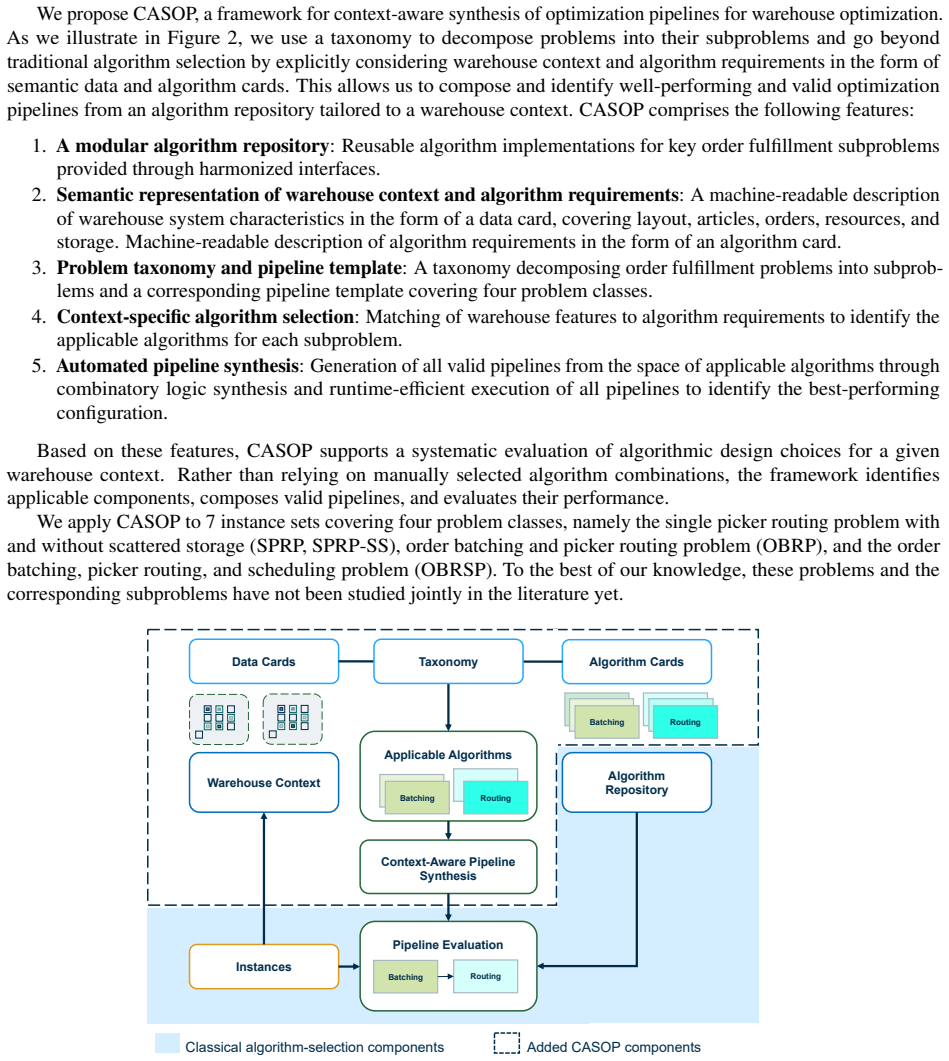
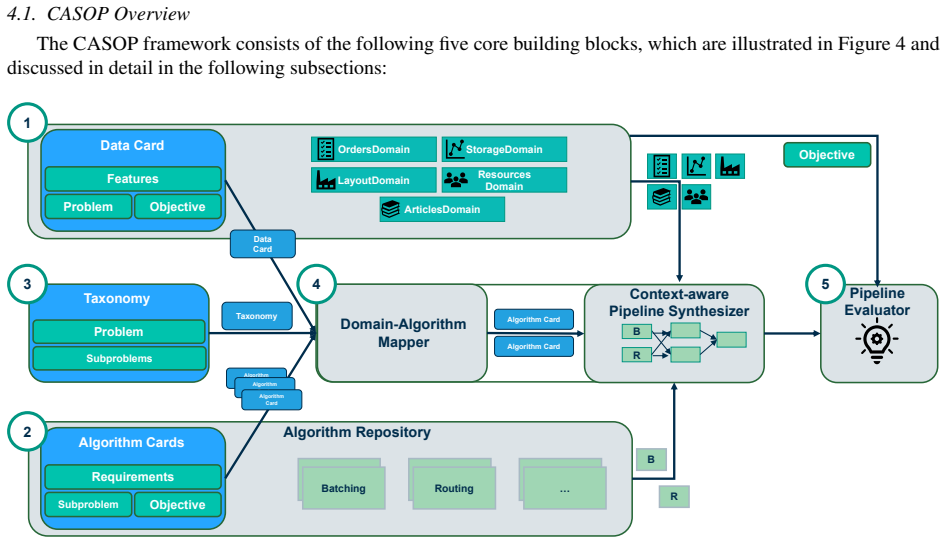
With Context-Aware Synthesis of Optimization Pipelines (CASOP), the authors propose a framework comprising a modular repository of algorithms, semantic data and algorithm cards, a taxonomy structuring order fulfillment into subproblems, a pipeline synthesizer that identifies applicable algorithms and composes all valid pipelines for a given context, and a pipeline evaluator. When demonstrated on seven benchmark instance sets, the framework generated 1,063,044 valid pipelines, supporting the automatic synthesis and selection of valid, high-performing algorithmic pipelines for warehouse operations.
What carries the argument
The pipeline synthesizer, which uses the taxonomy of subproblems and semantic cards describing warehouse context and algorithm requirements to select and compose algorithms from the modular repository into valid optimization pipelines.
If this is right
- Researchers can evaluate performance across a large number of context-specific pipeline variants rather than limited hand-selected combinations.
- Practitioners gain a tool to automatically generate and rank pipelines suited to their particular warehouse setup, data availability, and organizational boundaries.
- New algorithms can be added to the repository and automatically incorporated into future pipeline syntheses without manual reconfiguration.
- Support for decomposed approaches in warehouse systems where full integration is impractical due to differing responsibilities or limited data.
Where Pith is reading between the lines
- The method could extend to other multi-decision logistics problems if similar taxonomies and semantic descriptions are created for those domains.
- Comparing the synthesized pipelines against integrated optimization models on the same instances might show when decomposition is preferable.
- Validating the generated pipelines on operational warehouse data could test if the semantic cards capture all relevant real-world constraints.
Load-bearing premise
The semantic data and algorithm cards together with the taxonomy are assumed to be sufficient to correctly identify applicable algorithms and compose only valid pipelines without missing critical interactions or producing invalid combinations that would fail in practice.
What would settle it
Executing one of the synthesized pipelines on a real warehouse instance and observing that it violates constraints or performs worse than expected due to unmodeled interactions between subproblems would falsify the claim that the framework produces only valid and effective pipelines.
Figures
read the original abstract
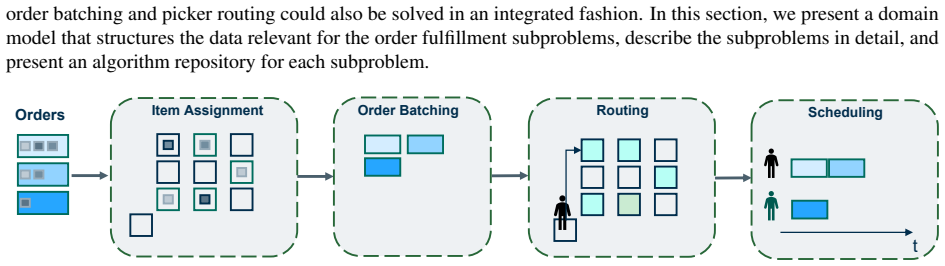
Order fulfillment in manual picker-to-goods warehouses involves interconnected decisions such as item assignment, order batching, and picker routing. While integrated models capture interactions between these decisions, practical warehouse systems often require decomposed approaches due to organizational boundaries, differing responsibilities, or limited data availability. Existing studies primarily evaluate algorithms for isolated subproblems or fixed subproblem combinations for specific warehouse settings, but lack a general mechanism to determine applicable algorithm configurations, compose them into valid solution pipelines, and assess their performance. With Context-Aware Synthesis of Optimization Pipelines (CASOP), we propose a framework for constructing and evaluating context-specific optimization pipelines and apply these to order fulfillment. The framework comprises: (1) a modular repository of algorithms for common order fulfillment problems; (2) semantic data and algorithm cards to describe warehouse context and algorithm requirements; (3) a taxonomy that structures order fulfillment problems into relevant subproblems; (4) a pipeline synthesizer that identifies applicable algorithms for a given warehouse context and composes all valid optimization pipelines; and (5) a pipeline evaluator that assesses all resulting pipelines. We demonstrate the framework on 7 benchmark instance sets covering four problem classes, resulting in 1,063,044 valid pipelines. The framework supports researchers and practitioners in designing, automatically synthesizing, and selecting valid, high-performing algorithmic pipelines for warehouse operations. The software is open-source and available at https://github.com/kit-dsm/ware_ops_pipes and https://github.com/kit-dsm/ware_ops_algos. Keywords: Warehouse optimization, Algorithm selection, Pipeline synthesis, Order fulfillment
Editorial analysis
A structured set of objections, weighed in public.
Referee Report
Summary. The manuscript proposes the Context-Aware Synthesis of Optimization Pipelines (CASOP) framework for order fulfillment in manual picker-to-goods warehouses. The framework consists of a modular repository of algorithms, semantic data and algorithm cards, a taxonomy of subproblems, a pipeline synthesizer that composes valid pipelines from applicable algorithms, and a pipeline evaluator. It is demonstrated on 7 benchmark instance sets covering four problem classes, resulting in the generation of 1,063,044 valid optimization pipelines. The associated software is released as open source.
Significance. If the validity of the synthesized pipelines holds under external scrutiny, the work provides a systematic, automated approach to exploring combinations of algorithms for interconnected warehouse subproblems (item assignment, order batching, picker routing) where integrated models are impractical. The open-source release of both the pipeline synthesizer and algorithm repository is a concrete strength that supports reproducibility and community extension.
major comments (2)
- [Abstract] Abstract: the central demonstration reports 1,063,044 valid pipelines on seven benchmarks but supplies no performance numbers on the underlying problems, no comparison against any baselines, and no external check (runtime execution of sampled pipelines, expert audit of a subset, or comparison to published valid configurations) that the pipelines are actually valid or solve the problems correctly.
- [Framework description] Framework components (semantic cards, taxonomy, synthesizer): the claim that the synthesizer produces only valid pipelines rests entirely on the manually authored semantic data/algorithm cards and problem taxonomy being complete and accurate with respect to all relevant interactions; no verification of this assumption is provided, which directly undermines the reported count of valid pipelines.
minor comments (1)
- [Abstract] The two GitHub repository links in the abstract could be presented more clearly (e.g., one primary link with a note on the companion repository).
Simulated Author's Rebuttal
We thank the referee for the constructive comments on our manuscript. We respond to each major comment below, clarifying the scope of the work while acknowledging where revisions can strengthen the presentation.
read point-by-point responses
-
Referee: [Abstract] Abstract: the central demonstration reports 1,063,044 valid pipelines on seven benchmarks but supplies no performance numbers on the underlying problems, no comparison against any baselines, and no external check (runtime execution of sampled pipelines, expert audit of a subset, or comparison to published valid configurations) that the pipelines are actually valid or solve the problems correctly.
Authors: The manuscript's primary contribution is the CASOP framework for automated synthesis of pipelines via semantic cards and taxonomy, with the reported count demonstrating the synthesizer's output scale across benchmarks. Performance numbers, baselines, and runtime execution of pipelines fall outside the stated scope, as the work focuses on composition of semantically valid pipelines rather than empirical benchmarking or solution quality assessment. 'Valid' in the paper refers to compatibility under the defined rules, not to correctness in solving the problems. Executing over one million pipelines is computationally infeasible for this study. We will revise to add an explicit limitations paragraph clarifying this scope and noting that empirical validation is left for future work. revision: partial
-
Referee: [Framework description] Framework components (semantic cards, taxonomy, synthesizer): the claim that the synthesizer produces only valid pipelines rests entirely on the manually authored semantic data/algorithm cards and problem taxonomy being complete and accurate with respect to all relevant interactions; no verification of this assumption is provided, which directly undermines the reported count of valid pipelines.
Authors: The validity of synthesized pipelines is determined by the manually curated semantic cards and taxonomy, which encode compatibility constraints drawn from the warehouse optimization literature. No automated or external verification (e.g., expert audit of completeness) is included in the current manuscript. We agree this reliance constitutes an assumption whose strength is not independently demonstrated. In revision we will add a dedicated limitations subsection explicitly stating this dependence on manual curation, discussing potential incompleteness risks, and emphasizing that the open-source repository enables community inspection and extension of the cards and taxonomy. revision: yes
Circularity Check
No circularity: framework enumeration on external benchmarks is self-contained computation
full rationale
The paper defines a framework (cards, taxonomy, synthesizer) and reports the count of pipelines it produces when run on 7 external benchmark sets. This count is a direct computational output of the rules the authors supplied; it is not a fitted parameter renamed as prediction, not derived from a self-citation chain, and not equivalent to its inputs by construction. No equations appear, no uniqueness theorems are invoked, and the central result does not reduce to a tautology. The validity assumption noted by the skeptic is an empirical completeness claim, not a circular derivation step. The work is therefore scored 0.
Axiom & Free-Parameter Ledger
invented entities (1)
-
CASOP pipeline synthesizer
no independent evidence
Reference graph
Works this paper leans on
-
[1]
URL: https://press.aboutamazon.com/fulfillment-and -delivery
Fulfillment and delivery. URL: https://press.aboutamazon.com/fulfillment-and -delivery. image reproduced with permission. Accessed: 2026-05-13. de Assis, R.F., de Paula Ferreira, W., Ouhimmou, M.,
2026
-
[2]
Order picking dataset from a warehouse of a footwear manufacturing company. Data in Brief 61, 111837. doi:10.1016/j.dib.2025.111837. Bahçeci, U., Öncan, T.,
-
[3]
International Journal of Production Research 60, 5892–5911
An evaluation of several combinations of routing and storage location assignment policies for the order batching problem. International Journal of Production Research 60, 5892–5911. doi: 10.1080/ 00207543.2021.1973684. Beeks, M., Afshar, R.R., Zhang, Y ., Dijkman, R., Van Dorst, C., De Looijer, S.,
arXiv 2021
-
[4]
Algorithm selection for allocating pods within robotic mobile fulfillment systems: A hyper-heuristic approach. IEEE Access 13, 14010–14028. doi:10.1109/ACCESS.2025.3530842. Bessai, J., Dudenhefner, A., Düdder, B., Martens, M., Rehof, J.,
-
[5]
Artificial Intelligence 237, 41–58
ASlib: A benchmark library for algorithm selection. Artificial Intelligence 237, 41–58. doi:10.1016/j.artint.2016.04.003. Bock, S., Bomsdorf, S., Boysen, N., Schneider, M.,
-
[6]
European Journal of Operational Research 322, 1–14
A survey on the Traveling Salesman Problem and its variants in a warehousing context. European Journal of Operational Research 322, 1–14. doi: 10.1016/j.ejor.2024.04 .014. Boysen, N., de Koster, R.,
-
[7]
European Journal of Operational Research 320, 449–464
50 years of warehousing research: An operations research perspective. European Journal of Operational Research 320, 449–464. doi:10.1016/j.ejor.2024.03.026. Boysen, N., de Koster, R., Weidinger, F.,
-
[8]
European Journal of Operational Research 277, 396–411
Warehousing in the e-commerce era: A survey. European Journal of Operational Research 277, 396–411. doi:10.1016/j.ejor.2018.08.023. Briant, O., Cambazard, H., Cattaruzza, D., Catusse, N., Ladier, A.L., Ogier, M.,
-
[9]
European Journal of Operational Research 285, 497–512
An efficient and general approach for the joint order batching and picker routing problem. European Journal of Operational Research 285, 497–512. doi:10.1016/j.ejor.2020.01.059. 25 Briant, O., Cambazard, H., Cattaruzza, D., Catusse, N., Ladier, A.L., Ogier, M.,
-
[10]
URL: https://arxiv.org/abs/2303.17834 , arXiv:2303.17834
Lower and upper bounds for the joint batching, routing and sequencing problem. URL: https://arxiv.org/abs/2303.17834 , arXiv:2303.17834. arXiv preprint arXiv:2303.17834. Cals, B., Zhang, Y ., Dijkman, R., Van Dorst, C.,
-
[11]
Expert Systems with Applications 255, 124589
Deep reinforcement learning driven cost minimization for batch order scheduling in robotic mobile fulfillment systems. Expert Systems with Applications 255, 124589. doi:10.1016/j.eswa.2024.124589. Clarke, G., Wright, J.W.,
-
[12]
European Journal of Operational Research 182, 481–501
Design and control of warehouse order picking: A literature review. European Journal of Operational Research 182, 481–501. doi:10.1016/j.ejor.2006.07.009. Graham, R.L.,
-
[13]
SIAM Journal on Applied Mathematics 17, 416–429
Bounds on multiprocessing timing anomalies. SIAM Journal on Applied Mathematics 17, 416–429. doi:10.1137/0117039. Gu, J., Goetschalckx, M., McGinnis, L.F.,
-
[14]
European Journal of Operational Research 177, 1–21
Research on warehouse operation: A comprehensive review. European Journal of Operational Research 177, 1–21. doi:10.1016/j.ejor.2006.02.025. Henn, S., Koch, S., Doerner, K.F., Strauss, C., Wäscher, G.,
-
[15]
Metaheuristics for the Order Batching Problem in Manual Order Picking Systems. Business Research 3, 82–105. doi:10.1007/BF03342717. Heßler, K., Irnich, S.,
-
[16]
Technical Report LM-2022-03
Modeling and Exact Solution of Picker Routing and Order Batching Problems. Technical Report LM-2022-03. Chair of Logistics Management, Gutenberg School of Management and Economics, Johannes Gutenberg University Mainz. Mainz, Germany. Heßler, K., Irnich, S.,
2022
-
[17]
INFORMS Journal on Computing 36, 1417–1435
Exact solution of the single-picker routing problem with scattered storage. INFORMS Journal on Computing 36, 1417–1435. doi:10.1287/ijoc.2023.0075. Klein, J.F., Wurster, M., Stricker, N., Lanza, G., Furmans, K.,
-
[18]
Towards ontology-based autonomous intralo- gistics for agile remanufacturing production systems, in: 2021 26th IEEE International Conference on Emerging Technologies and Factory Automation (ETFA ), pp. 01–07. doi:10.1109/ETFA45728.2021.9613486. Knoll, D., Waldmann, J., Reinhart, G.,
-
[19]
The single picker routing problem with scattered storage: modeling and evaluation of routing and storage policies. OR Spectrum 46, 909–951. doi:10.1007/s00291-024-00760-4. Mäckel, D., Winkels, J., Schumacher, C.,
-
[20]
Synthesis of scheduling heuristics by composition and recombination, in: Optimization and Learning, Springer International Publishing. pp. 283–293. doi: 10.1007/978-3-030-85672 -4_21. 26 Mages, A., Mieth, C., Hetzler, J., Kallat, F., Rehof, J., Riest, C., Schäfer, T.,
-
[21]
In: 2022 Winter Simulation Conference (WSC)
Automatic component-based synthesis of user-configured manufacturing simulation models, in: 2022 Winter Simulation Conference (WSC), pp. 1841–1852. doi:10.1109/WSC57314.2022.10015425. Meyer, A., Kutabi, H., Bessai, J., Scholtyssek, D.,
-
[22]
CLS-Luigi: Analytics pipeline synthesis, in: Learning and Intelligent Optimization, Springer. pp. 269–284. doi:10.1007/978-3-031-75623-8_21. Mitchell, M., Wu, S., Zaldivar, A., Barnes, P., Vasserman, L., Hutchinson, B., Spitzer, E., Raji, I.D., Gebru, T.,
-
[23]
Model Cards for Model Reporting, in: Proceedings of the Conference on Fairness, Accountability, and Transparency, pp. 220–229. doi:10.1145/3287560.3287596. Muter, I., Öncan, T.,
-
[24]
An exact solution approach for the order batching problem. IIE Transactions 47, 728–738. doi:10.1080/0740817X.2014.991478. Müller, D., Müller, M.G., Kress, D., Pesch, E.,
-
[25]
European Journal of Operational Research 302, 874–891
An algorithm selection approach for the flexible job shop scheduling problem: Choosing constraint programming solvers through machine learning. European Journal of Operational Research 302, 874–891. doi:10.1016/j.ejor.2022.01.034. Negri, E., Perotti, S., Fumagalli, L., Marchet, G., Garetti, M.,
-
[26]
Computers in Industry 88, 19–34
Modelling internal logistics systems through ontologies. Computers in Industry 88, 19–34. doi:10.1016/j.compind.2017.03.004. Oxenstierna, J., Malec, J., Krueger, V .,
-
[27]
Layout-agnostic order-batching optimization, in: International Conference on Computational Logistics, pp. 115–129. doi:10.1007/978-3-030-87672-2_8. Pardo, E.G., Gil-Borrás, S., Alonso-Ayuso, A., Duarte, A.,
-
[28]
European Journal of Operational Research 313, 1–24
Order batching problems: Taxonomy and literature review. European Journal of Operational Research 313, 1–24. doi:10.1016/j.ejor.2023.02.019. Petersen, C.G.,
-
[29]
International Journal of Operations & Production Management 17, 1098–1111
An evaluation of order picking routeing policies. International Journal of Operations & Production Management 17, 1098–1111. doi:10.1108/01443579710177860. Petersen, C.G., Schmenner, R.W.,
-
[30]
Results in Control and Optimization 12, 100281
A classification approach to order picking systems and policies: Integrating automation and optimization for future research. Results in Control and Optimization 12, 100281. doi:10.1016/j.rico.2023.100281. Pohl, K., Böckle, G., van der Linden, F.J.,
-
[31]
1776–1826
Data cards: Purposeful and transparent dataset documentation for responsible AI, in: Proceedings of the 2022 ACM Conference on Fairness, Accountability, and Transparency, pp. 1776–1826. Ratliff, H.D., Rosenthal, A.S.,
2022
-
[32]
Operations Research 31, 507–521
Order-Picking in a Rectangular Warehouse: A Solvable Case of the Traveling Salesman Problem. Operations Research 31, 507–521. doi:10.1287/opre.31.3.507. Spotify,
-
[33]
URL: https://luigi.readthedocs.io/en/stable/
Luigi documentation. URL: https://luigi.readthedocs.io/en/stable/. accessed: 2025-09-11. Valle, C.A., Beasley, J.E., da Cunha, A.S.,
2025
-
[34]
European Journal of Operational Research 262, 817–834
Optimally solving the joint order batching and picker routing problem. European Journal of Operational Research 262, 817–834. doi:10.1016/j.ejor.2017.03.069. van Gils, T., Caris, A., Ramaekers, K., Braekers, K.,
-
[35]
European Journal of Operational Research 277, 814–830
Formulating and solving the integrated batching, routing, and picker scheduling problem in a real-life spare parts warehouse. European Journal of Operational Research 277, 814–830. doi:10.1016/j.ejor.2019.03.012. Weidinger, F.,
-
[36]
Computers & Operations Research 95, 139–150
Picker routing in rectangular mixed shelves warehouses. Computers & Operations Research 95, 139–150. doi:10.1016/j.cor.2018.03.012. 27 Weidinger, F., Boysen, N., Schneider, M.,
-
[37]
European Journal of Operational Research 274, 501–515
Picker routing in the mixed-shelves warehouses of e-commerce retailers. European Journal of Operational Research 274, 501–515. doi:10.1016/j.ejor.2018.10.021. Wildt, C., Weidinger, F., Boysen, N.,
-
[38]
Picker routing in scattered storage warehouses: an evaluation of solution methods based on TSP transformations. OR Spectrum 47, 35–66. doi:10.1007/s00291-024-00780-0. Winkels, J., Özkul, F., Sutherland, R., Löhn, J., Wenzel, S., Rehof, J.,
-
[39]
Component-based synthesis of structural variants of simulation models for changeable material flow systems, in: 2024 Winter Simulation Conference (WSC), pp. 1657–1668. doi:10.1109/WSC63780.2024.10838927. Xu, L., Hutter, F., Hoos, H.H., Leyton-Brown, K.,
-
[40]
AutoMMLab: Automatically generating deployable models from language instructions for computer vision tasks, in: Proceedings of the AAAI Conference on Artificial Intelligence, pp. 22056–22064. doi:10.1609/aaai.v39i21.34358. Žulj, I., Kramer, S., Schneider, M.,
-
[41]
European Journal of Operational Research 264, 653–664
A hybrid of adaptive large neighborhood search and tabu search for the order- batching problem. European Journal of Operational Research 264, 653–664. doi: 10.1016/j.ejor.2017.06.056. 28
discussion (0)
Sign in with ORCID, Apple, or X to comment. Anyone can read and Pith papers without signing in.