Observation of Non-Hermitian Skin Dynamics in the Liouvillian Regime
Pith reviewed 2026-06-26 02:28 UTC · model grok-4.3
The pith
Non-Hermitian skin dynamics in a photonic lattice reveal a crossover from coherence-enhanced to decoherence-enhanced transport in open quantum walks.
A machine-rendered reading of the paper's core claim, the machinery that carries it, and where it could break.
Core claim
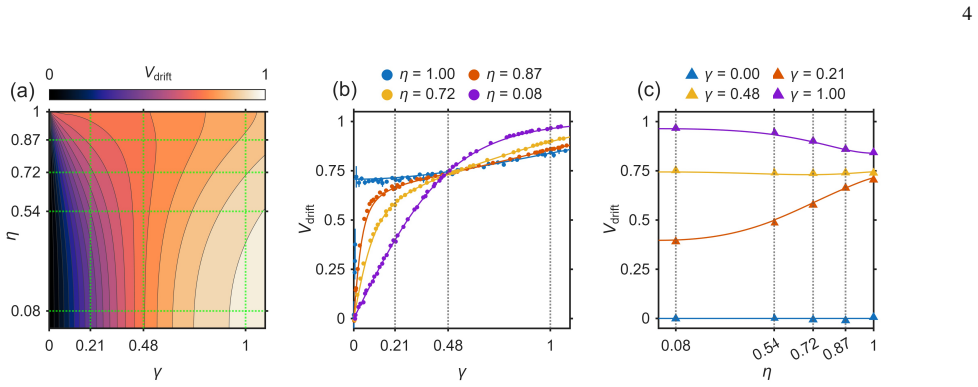
In the Liouvillian regime realized by the photonic mesh lattice, non-Hermitian skin dynamics serve as a probe that measures center-of-mass drift across independent coherence and non-Hermiticity parameters, directly demonstrating a crossover from coherence-enhanced to decoherence-enhanced transport together with programmable interface accumulation and instantaneous-channel drift.
What carries the argument
Non-Hermitian skin dynamics used as a probe of center-of-mass drift in the tunable Liouvillian open-system quantum walk.
If this is right
- Directional transport evolves continuously from coherent quantum walks to incoherent classical walks.
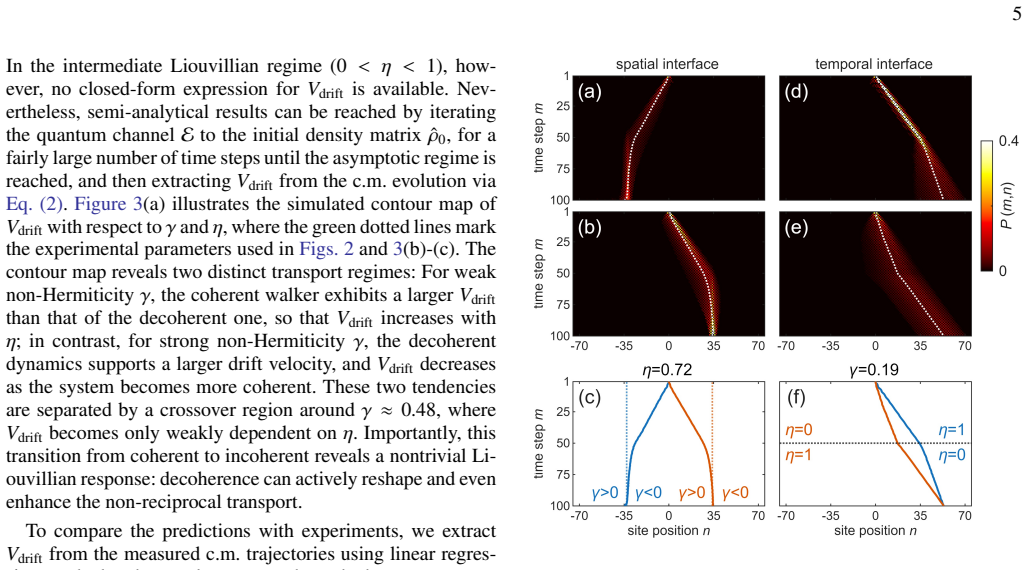
- Spatial and temporal interfaces can be programmed to produce accumulation and long-time drift governed by the instantaneous channel.
- Decoherence actively reshapes non-Hermitian transport rather than only degrading it.
- The photonic platform enables quantitative simulation of open quantum dynamics that matches quantum-channel theory.
Where Pith is reading between the lines
- The same crossover might appear in other dissipative platforms if non-Hermitian skin modes remain measurable.
- Programmable interfaces could be used to steer transport in noisy quantum networks by tuning dephasing locally.
- The observed decoherence enhancement suggests that controlled noise could improve directed transport in certain open-system devices.
Load-bearing premise
The controlled phase noise and non-reciprocal gain-loss imbalance in the photonic mesh lattice accurately realize the intended tunable open-system quantum walk without significant uncontrolled environmental effects.
What would settle it
A direct measurement of center-of-mass drift that shows no crossover from coherence-enhanced to decoherence-enhanced transport when the coherence parameter is varied while holding non-Hermiticity fixed.
Figures
read the original abstract
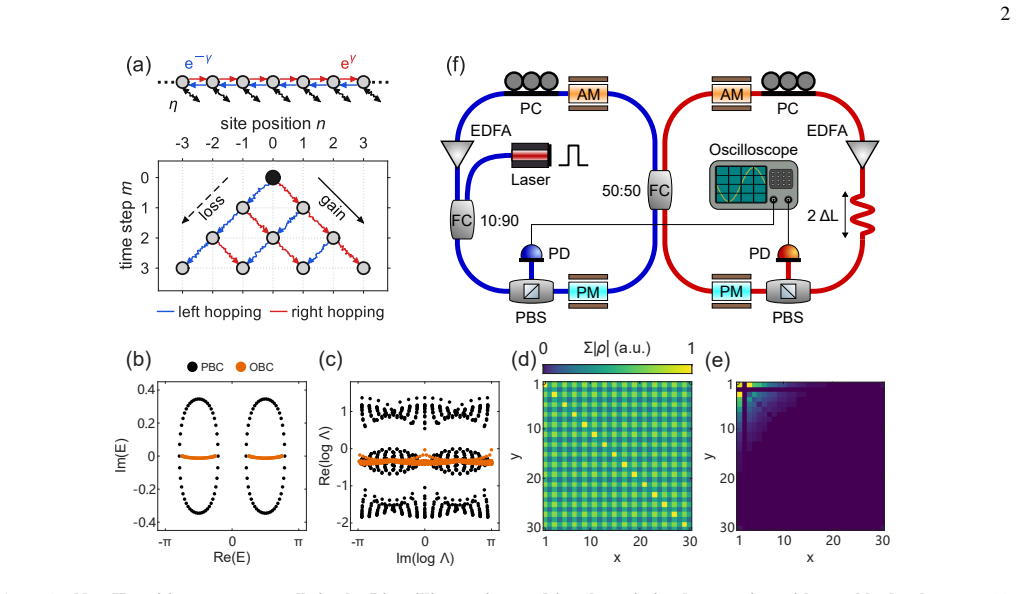
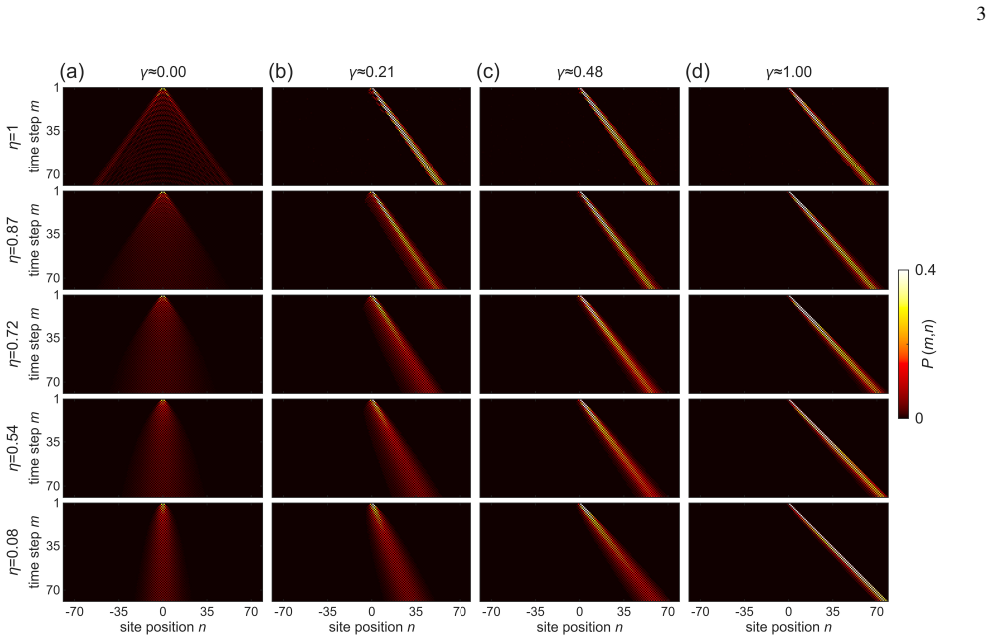
Open quantum systems generally do not perfectly preserve phase coherence: coupling to uncontrolled environments requires a density-matrix description based on the Liouvillian framework beyond pure-state wave evolution. Realizing and probing such dynamics in a programmable platform is therefore essential for connecting coherent physics to realistic dissipative settings. Here we implement a tunable open-system quantum walk in a photonic mesh lattice, where controlled phase noise produces adjustable dephasing and non-reciprocal gain-loss imbalance provides an independently tunable non-Hermitian drive. This allows us to continuously interpolate between coherent quantum walks and incoherent classical walks, and to observe how directional transport evolves in the Liouvillian regime. Using non-Hermitian skin dynamics as a probe, we measure the center-of-mass drift over both the coherence and non-Hermiticity parameters, revealing a crossover from coherence-enhanced to decoherence-enhanced transport in quantitative agreement with quantum-channel simulations. We further program spatial and temporal interfaces to demonstrate interface accumulation and a long-time drift governed by the instantaneous channel. Our results establish a controllable photonic platform for simulating open quantum dynamics and show that decoherence can actively reshape non-Hermitian transport.
Editorial analysis
A structured set of objections, weighed in public.
Referee Report
Summary. The manuscript reports an experimental implementation of a tunable open-system quantum walk in a photonic mesh lattice. Controlled phase noise introduces adjustable dephasing while non-reciprocal gain-loss imbalance provides an independent non-Hermitian drive, allowing continuous interpolation between coherent quantum walks and incoherent classical walks. Using non-Hermitian skin dynamics as a probe, the authors measure center-of-mass drift across coherence and non-Hermiticity parameters, reporting a crossover from coherence-enhanced to decoherence-enhanced transport in quantitative agreement with quantum-channel simulations. They further demonstrate interface accumulation at spatial and temporal boundaries and long-time drift governed by the instantaneous channel.
Significance. If the experimental controls realize the intended Liouvillian dynamics without significant uncontrolled effects, the work provides a programmable photonic platform for simulating open quantum systems and shows that decoherence can actively reshape non-Hermitian transport. This bridges coherent and dissipative regimes in a controllable setting.
major comments (2)
- [Abstract] Abstract: The claim of 'quantitative agreement with quantum-channel simulations' is presented without any reported error bars, statistical methods, data exclusion criteria, or verification of lattice parameters, preventing assessment of whether the data support the stated agreement.
- [Results] Results section (center-of-mass drift measurements): The interpretation of the observed crossover as Liouvillian dynamics rests on the assumption that the phase noise and gain-loss controls accurately realize the intended open-system quantum walk without significant modeling mismatches or environmental effects; explicit validation of this assumption is required for the central claim.
minor comments (1)
- [Methods] Clarify in the methods how the quantum-channel simulations are parameterized to match the experimental controls of phase noise and gain-loss imbalance.
Simulated Author's Rebuttal
We thank the referee for their detailed review and constructive feedback on our manuscript. We address each major comment below and indicate the revisions planned for the resubmitted version.
read point-by-point responses
-
Referee: [Abstract] Abstract: The claim of 'quantitative agreement with quantum-channel simulations' is presented without any reported error bars, statistical methods, data exclusion criteria, or verification of lattice parameters, preventing assessment of whether the data support the stated agreement.
Authors: We agree that the abstract would benefit from greater precision on this point. In the revised manuscript we will update the abstract to state that the quantitative agreement refers to the center-of-mass drift data shown in the Results section, where error bars represent the standard deviation over repeated experimental runs and the statistical methods are described in the Methods. Lattice-parameter verification will be added to the supplementary information. revision: yes
-
Referee: [Results] Results section (center-of-mass drift measurements): The interpretation of the observed crossover as Liouvillian dynamics rests on the assumption that the phase noise and gain-loss controls accurately realize the intended open-system quantum walk without significant modeling mismatches or environmental effects; explicit validation of this assumption is required for the central claim.
Authors: We acknowledge that explicit validation strengthens the central claim. In the revised manuscript we will add a dedicated subsection (or expanded Methods) that presents direct comparisons between measured dephasing rates and the intended Liouvillian rates, limiting-case checks against coherent and fully incoherent walks, and controls for residual environmental effects. These additions will be supported by new figures or panels. revision: yes
Circularity Check
No significant circularity
full rationale
The paper is an experimental observation of non-Hermitian skin dynamics in a photonic mesh lattice realizing tunable Liouvillian dynamics via controlled phase noise and gain-loss imbalance. The central result is a measured crossover in center-of-mass drift, reported in quantitative agreement with separate quantum-channel simulations. No derivation chain, parameter fitting presented as prediction, self-citation load-bearing premise, or ansatz smuggling is present in the abstract or described protocol; the claims rest on direct experimental control and external simulation comparison rather than any reduction to inputs by construction.
Axiom & Free-Parameter Ledger
Reference graph
Works this paper leans on
-
[1]
Breuer and F
H.-P. Breuer and F. Petruccione,The theory of open quantum systems(OUP Oxford, 2002)
2002
-
[2]
W. H. Zurek, Reviews of Modern Physics75, 715 (2003)
2003
-
[3]
W. H. Zurek, Physics Today44, 36 (1991)
1991
-
[4]
Lindblad, Communications in Mathematical Physics48, 119 (1976)
G. Lindblad, Communications in Mathematical Physics48, 119 (1976)
1976
-
[5]
Gorini, A
V . Gorini, A. Kossakowski, and E. C. G. Sudarshan, Journal of Mathematical Physics17, 821 (1976)
1976
-
[6]
Diehl, E
S. Diehl, E. Rico, M. A. Baranov, and P. Zoller, Nature Physics 7, 971 (2011)
2011
-
[7]
Verstraete, M
F. Verstraete, M. M. Wolf, and J. Ignacio Cirac, Nature Physics 5, 633 (2009)
2009
-
[8]
El-Ganainy, K
R. El-Ganainy, K. G. Makris, M. Khajavikhan, Z. H. Mussli- mani, S. Rotter, and D. N. Christodoulides, Nature Physics14, 11 (2018)
2018
-
[9]
Ashida, Z
Y . Ashida, Z. Gong, and M. Ueda, Advances in Physics69, 249 (2020)
2020
-
[10]
E. J. Bergholtz, J. C. Budich, and F. K. Kunst, Reviews of Mod- ern Physics93, 015005 (2021)
2021
-
[11]
K. Ding, C. Fang, and G. Ma, Nature Reviews Physics4, 745 (2022)
2022
-
[12]
Yao and Z
S. Yao and Z. Wang, Physical Review Letters121, 086803 (2018)
2018
-
[13]
Helbig, T
T. Helbig, T. Hofmann, S. Imhof, M. Abdelghany, T. Kiess- ling, L. W. Molenkamp, C. H. Lee, A. Szameit, M. Greiter, and R. Thomale, Nature Physics16, 747 (2020)
2020
-
[14]
Weidemann, M
S. Weidemann, M. Kremer, T. Helbig, T. Hofmann, A. Steg- maier, M. Greiter, R. Thomale, and A. Szameit, Science368, 311 (2020)
2020
-
[15]
Okuma, K
N. Okuma, K. Kawabata, K. Shiozaki, and M. Sato, Physical Review Letters124, 086801 (2020)
2020
-
[16]
Zhang, T
X. Zhang, T. Zhang, M.-H. Lu, and Y .-F. Chen, Advances in Physics: X7, 2109431 (2022)
2022
-
[17]
Okuma and M
N. Okuma and M. Sato, Annual Review of Condensed Matter Physics14, 83 (2023)
2023
-
[18]
J. T. Gohsrich, A. Banerjee, and F. K. Kunst, Europhysics Let- ters150, 60001 (2025)
2025
-
[19]
D. S. Borgnia, A. J. Kruchkov, and R.-J. Slager, Physical Re- view Letters124, 056802 (2020)
2020
-
[20]
Zhang, Z
K. Zhang, Z. Yang, and C. Fang, Physical Review Letters125, 126402 (2020)
2020
-
[21]
H.-Y . Wang, F. Song, and Z. Wang, Physical Review X14, 021011 (2024)
2024
-
[22]
Regensburger, C
A. Regensburger, C. Bersch, B. Hinrichs, G. Onishchukov, A. Schreiber, C. Silberhorn, and U. Peschel, Physical Review Letters107, 233902 (2011)
2011
-
[23]
M.-A. Miri, A. Regensburger, U. Peschel, and D. N. Christo- doulides, Physical Review A—Atomic, Molecular, and Optical Physics86, 023807 (2012)
2012
-
[24]
Wimmer, A
M. Wimmer, A. Regensburger, M.-A. Miri, C. Bersch, D. N. Christodoulides, and U. Peschel, Nature Communications6, 7782 (2015)
2015
-
[25]
Weidemann, M
S. Weidemann, M. Kremer, S. Longhi, and A. Szameit, Nature 601, 354 (2022)
2022
-
[26]
Marques Muniz, F
A. Marques Muniz, F. Wu, P. Jung, M. Khajavikhan, D. Chris- todoulides, and U. Peschel, Science379, 1019 (2023)
2023
-
[27]
L. Yu, H. Xue, R. Guo, E. A. Chan, Y . Y . Terh, C. Soci, B. Zhang, and Y . Chong, Nature632, 63 (2024)
2024
-
[28]
J. Feis, S. Weidemann, T. Sheppard, H. M. Price, and A. Szameit, Nature Photonics19, 518 (2025)
2025
-
[29]
Z. Pang, O. Abdelghani, M. Solja ˇci´c, and Y . Yang, Optica12, 1794 (2025)
2025
-
[30]
Schreiber, K
A. Schreiber, K. N. Cassemiro, V . Potoˇcek, A. G´abris, P. J. Mos- ley, E. Andersson, I. Jex, and C. Silberhorn, Physical Review Letters104, 050502 (2010)
2010
-
[31]
Schreiber, K
A. Schreiber, K. Cassemiro, V . Potoˇcek, A. G ´abris, I. Jex, and C. Silberhorn, Physical Review Letters106, 180403 (2011)
2011
-
[32]
Regensburger, C
A. Regensburger, C. Bersch, M.-A. Miri, G. Onishchukov, D. N. Christodoulides, and U. Peschel, Nature488, 167 (2012)
2012
-
[33]
Boutari, A
J. Boutari, A. Feizpour, S. Barz, C. D. Franco, M. Kim, W. Kolthammer, and I. Walmsley, Journal of Optics18, 094007 (2016)
2016
-
[34]
Neves and G
L. Neves and G. Puentes, Entropy20, 731 (2018)
2018
-
[35]
Longhi, Light: Science & Applications13, 95 (2024)
S. Longhi, Light: Science & Applications13, 95 (2024)
2024
-
[36]
K. Wang, L. Xiao, S. Longhi, and P. Xue, arXiv preprint arXiv:2604.12739 (2026)
Pith/arXiv arXiv 2026
-
[37]
Kitagawa, E
T. Kitagawa, E. Berg, M. Rudner, and E. Demler, Physical Re- view B—Condensed Matter and Materials Physics82, 235114 (2010)
2010
-
[38]
J. K. Asb ´oth and H. Obuse, Physical Review B88, 121406 (2013)
2013
-
[39]
M. S. Rudner, N. H. Lindner, E. Berg, and M. Levin, Physical Review X3, 031005 (2013)
2013
-
[40]
Yokomizo and S
K. Yokomizo and S. Murakami, Physical Review Letters123, 066404 (2019)
2019
-
[41]
M. A. Nielsen and I. L. Chuang,Quantum computation and quantum information(Cambridge university press, 2010)
2010
-
[42]
F. Song, S. Yao, and Z. Wang, Physical Review Letters123, 170401 (2019)
2019
-
[43]
P. G. Kwiat, A. J. Berglund, J. B. Altepeter, and A. G. White, Science290, 498 (2000)
2000
-
[44]
T. A. Brun, H. A. Carteret, and A. Ambainis, Physical Review 7 A67, 032304 (2003)
2003
-
[45]
T. A. Brun, H. A. Carteret, and A. Ambainis, Physical Review Letters91, 130602 (2003)
2003
-
[46]
Ko ˇs´ık, V
J. Ko ˇs´ık, V . Bu ˇzek, and M. Hillery, Physical Review A—Atomic, Molecular, and Optical Physics74, 022310 (2006)
2006
-
[47]
Kendon, Mathematical Structures in Computer Science17, 1169 (2007)
V . Kendon, Mathematical Structures in Computer Science17, 1169 (2007)
2007
-
[48]
J. D. Whitfield, C. A. Rodr ´ıguez-Rosario, and A. Aspuru- Guzik, Physical Review A—Atomic, Molecular, and Optical Physics81, 022323 (2010)
2010
-
[49]
Annabestani, S
M. Annabestani, S. J. Akhtarshenas, and M. R. Abolhassani, Physical Review A—Atomic, Molecular, and Optical Physics 81, 032321 (2010)
2010
-
[50]
M. A. Broome, A. Fedrizzi, B. P. Lanyon, I. Kassal, A. Aspuru- Guzik, and A. G. White, Physical Review Letters104, 153602 (2010)
2010
-
[51]
Geraldi, A
A. Geraldi, A. Laneve, L. D. Bonavena, L. Sansoni, J. Ferraz, A. Fratalocchi, F. Sciarrino, ´A. Cuevas, and P. Mataloni, Phys- ical Review Letters123, 140501 (2019)
2019
- [52]
-
[53]
Kraus, A
K. Kraus, A. B ¨ohm, J. D. Dollard, and W. Wootters,States, ef- fects, and operations fundamental notions of quantum theory: Lectures in mathematical physics at the university of Texas at Austin(Springer, 1983)
1983
-
[54]
M. S. Rudner and L. Levitov, Physical Review Letters102, 065703 (2009)
2009
-
[55]
Longhi, Physical Review B102, 201103 (2020)
S. Longhi, Physical Review B102, 201103 (2020)
2020
-
[56]
C.-H. Liu, K. Zhang, Z. Yang, and S. Chen, Physical Review Research2, 043167 (2020)
2020
-
[57]
T. Haga, M. Nakagawa, R. Hamazaki, and M. Ueda, Physical Review Letters127, 070402 (2021)
2021
-
[58]
Okuma and M
N. Okuma and M. Sato, Physical Review B103, 085428 (2021)
2021
-
[59]
Yang, Q.-D
F. Yang, Q.-D. Jiang, and E. J. Bergholtz, Physical Review Re- search4, 023160 (2022)
2022
-
[60]
Kawabata, T
K. Kawabata, T. Numasawa, and S. Ryu, Physical Review X13, 021007 (2023)
2023
-
[61]
Ekman and E
C. Ekman and E. J. Bergholtz, Physical Review Research6, L032067 (2024)
2024
-
[62]
Y .-M. Hu, Z. Wang, B. Lian, and Z. Wang, Physical Review Letters135, 260401 (2025)
2025
-
[63]
Longhi, Quantum Science and Technology11, 025042 (2026)
S. Longhi, Quantum Science and Technology11, 025042 (2026)
2026
discussion (0)
Sign in with ORCID, Apple, or X to comment. Anyone can read and Pith papers without signing in.