From Approximate Floquet Engineering to Full Floquet Theory: Coherent Control of Chiral Spin Systems in Spintronics
Pith reviewed 2026-06-26 04:29 UTC · model grok-4.3
The pith
Full Floquet-space modeling reveals DMI-induced tilting and multi-frequency dynamics in driven chiral spin systems.
A machine-rendered reading of the paper's core claim, the machinery that carries it, and where it could break.
Core claim
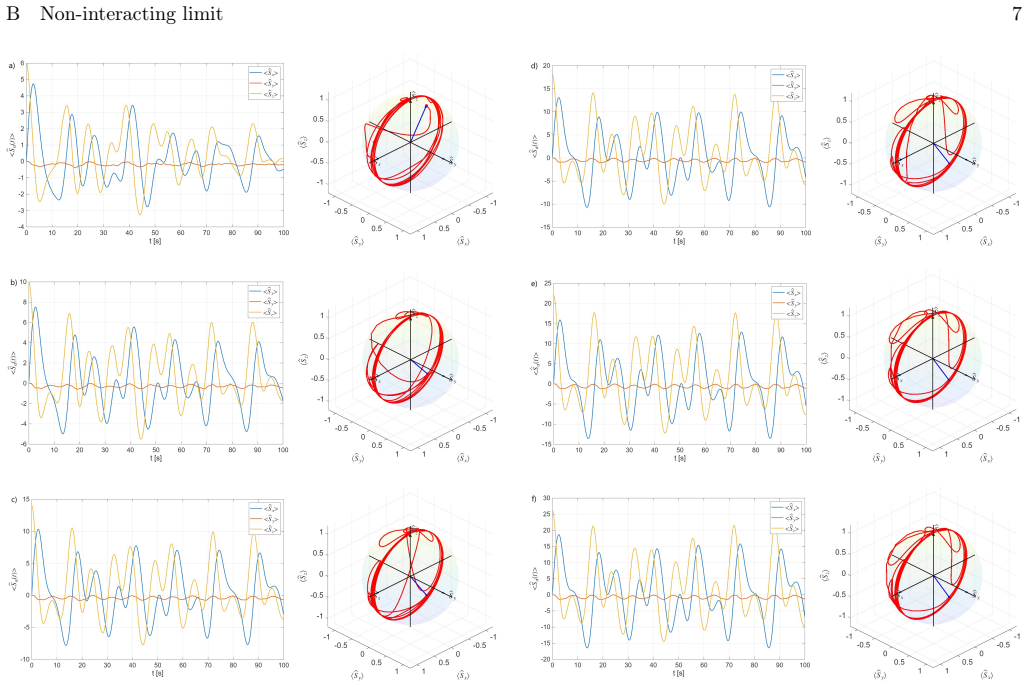
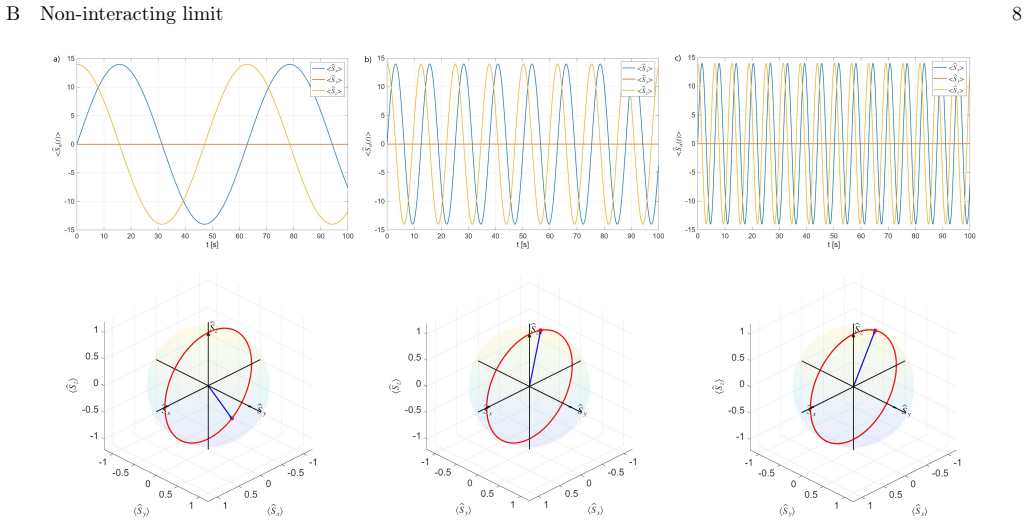
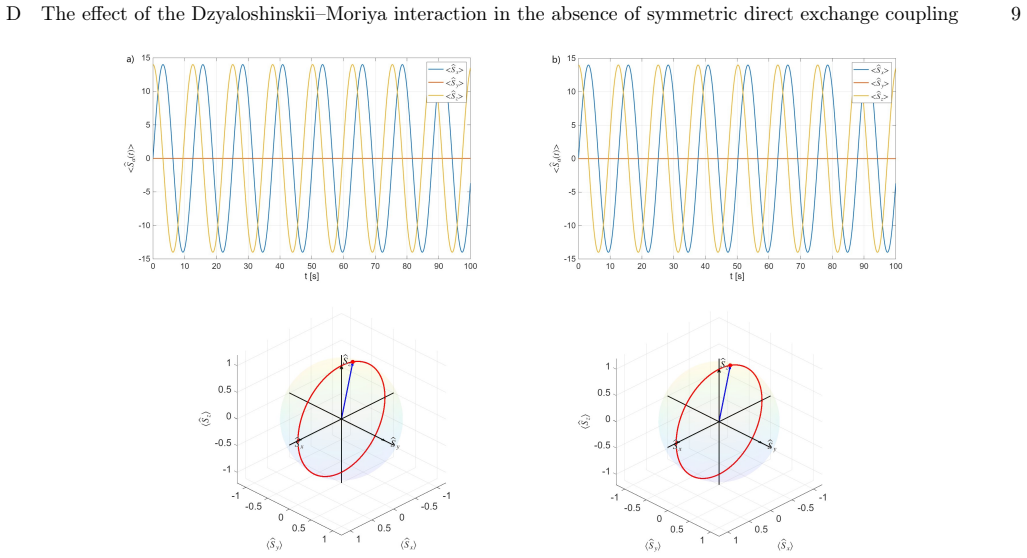
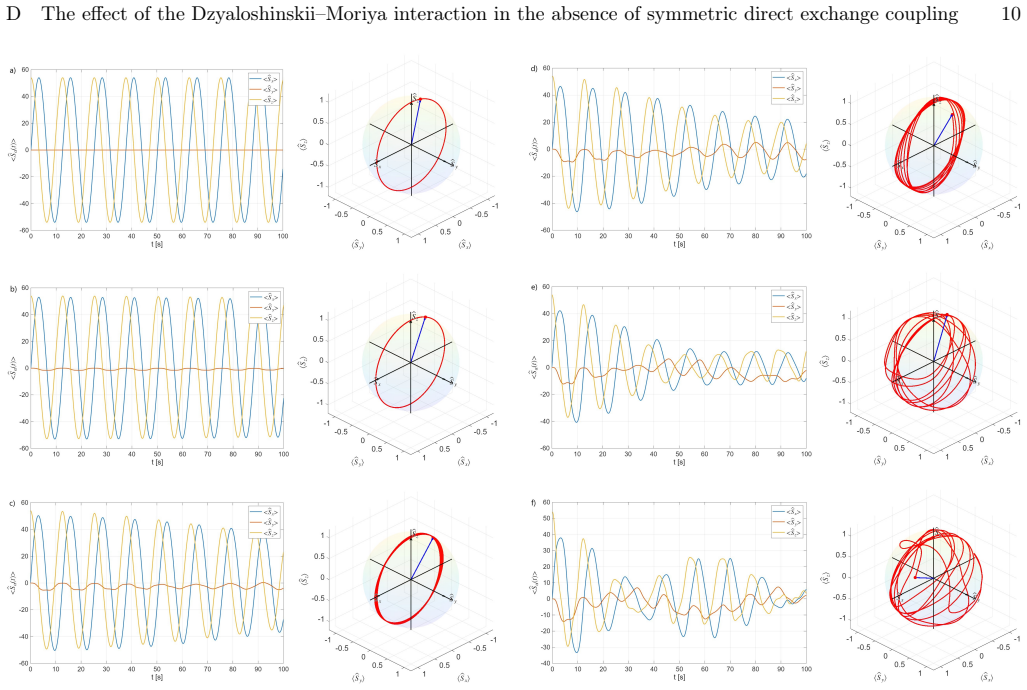
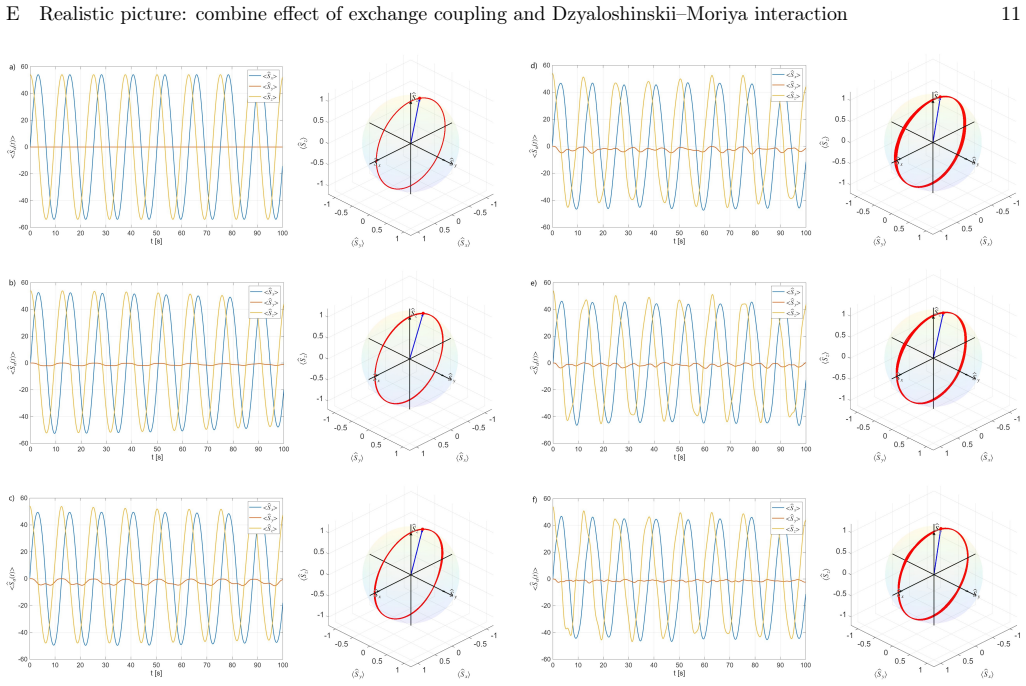
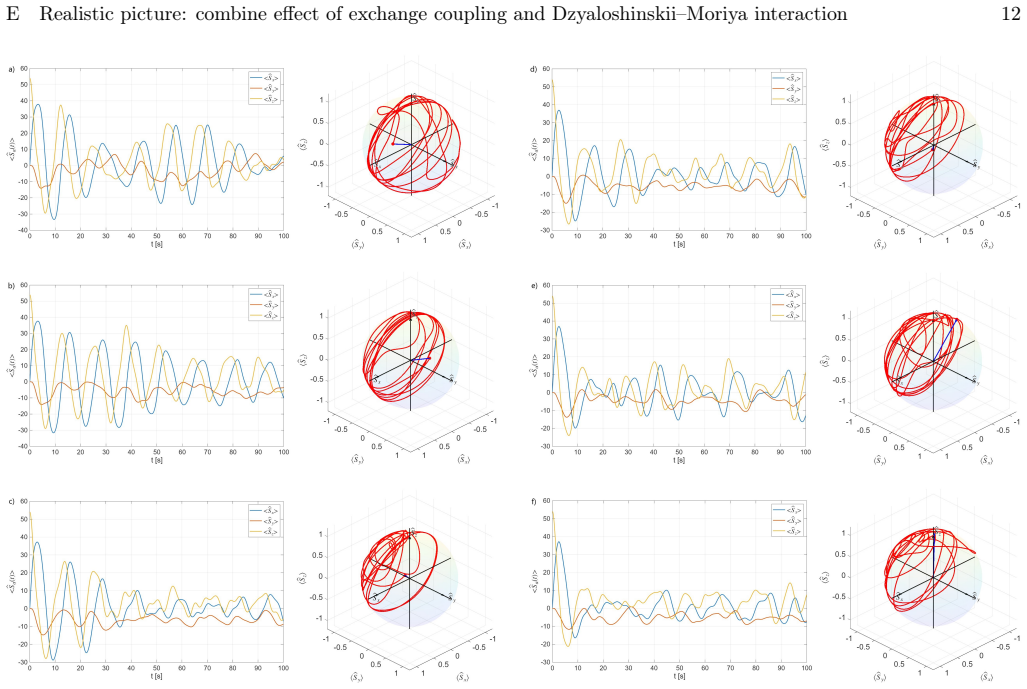
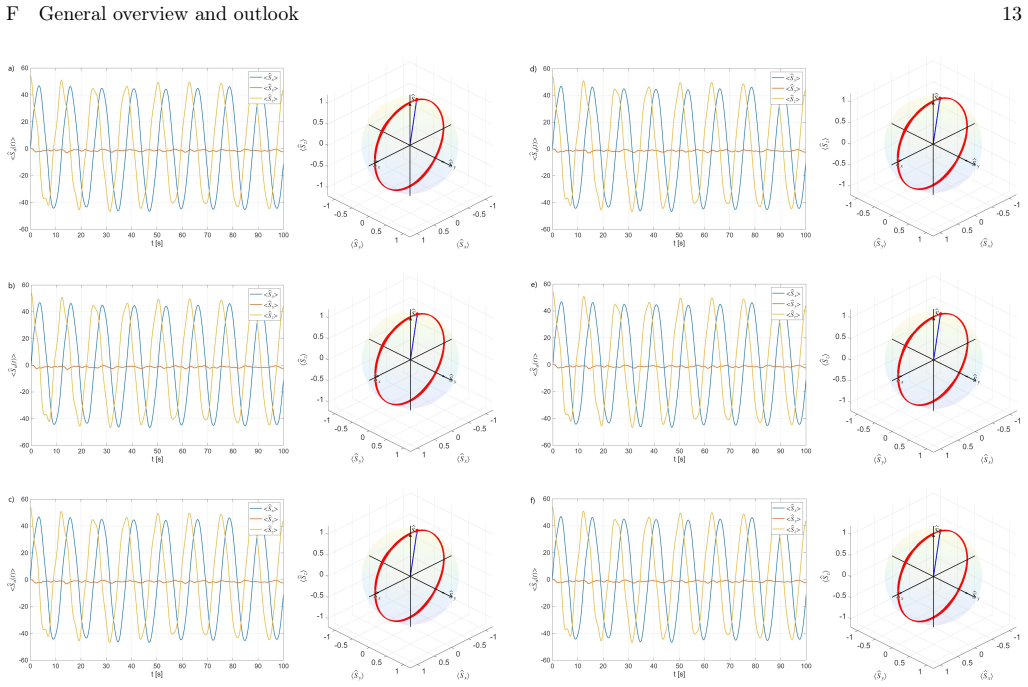
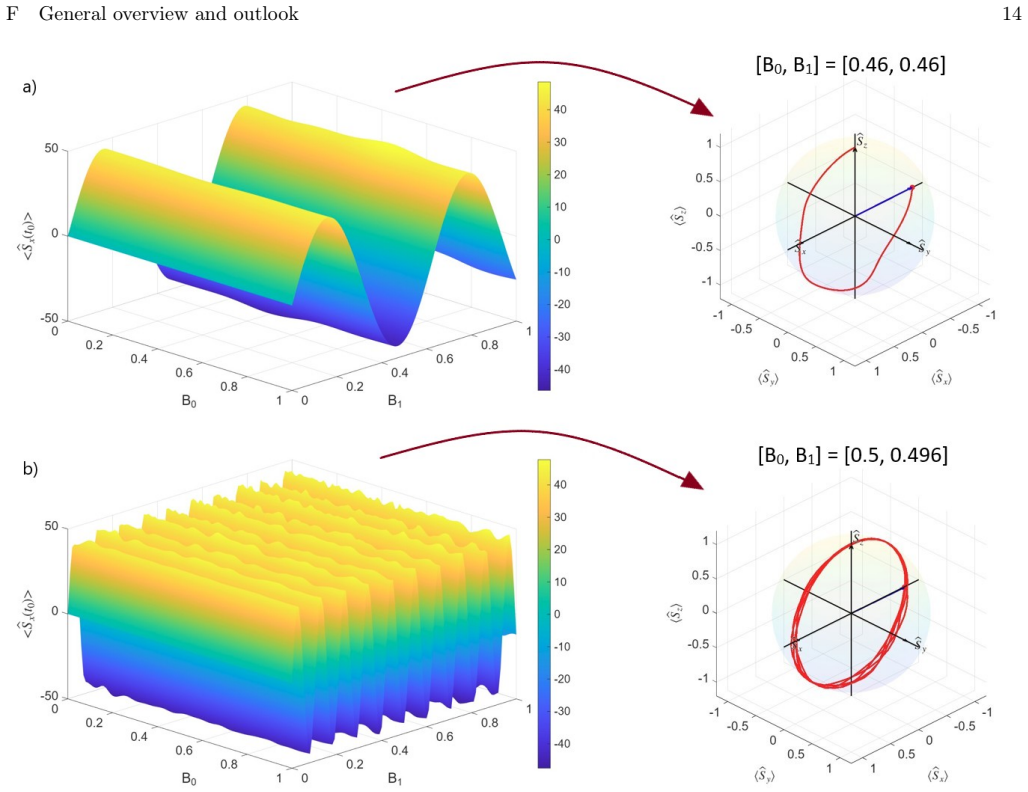
A full Floquet-space formalism adapted from NMR methods, when applied to periodically driven spins that include both isotropic exchange J and chiral DMI, recovers the expected driven dynamics in the non-interacting case, leaves collective spin averages unaltered by exchange alone under symmetric initial conditions, and generates finite Sy, suppressed Sz, and tilted elliptical Bloch trajectories once DMI is introduced, with the chiral signatures becoming pronounced for open boundaries and the joint J-plus-DMI case producing multi-frequency evolution.
What carries the argument
The full Floquet-space formalism that enlarges the Hilbert space with a Fourier-mode index to convert the time-periodic Hamiltonian into a time-independent infinite-dimensional matrix whose truncation yields the stroboscopic evolution.
If this is right
- DMI alone produces observable chiral spin correlations visible as a nonzero Sy expectation value and tilted elliptical trajectories.
- Open boundary conditions amplify the DMI-induced effects relative to periodic boundaries.
- Simultaneous presence of exchange and DMI converts the motion into strongly perturbed multi-frequency dynamics.
- The non-interacting limit is recovered exactly, confirming consistency with simpler coherent-rotation pictures when interactions vanish.
Where Pith is reading between the lines
- The same Floquet construction could be used to scan drive amplitudes or frequencies that cancel or enhance specific chiral components for targeted control.
- Extension to larger spin clusters would require only increasing the retained Fourier dimension while monitoring the same convergence diagnostics already shown.
- Because boundary conditions visibly modulate the chiral response, device geometries with engineered edges may offer an additional tuning knob.
Load-bearing premise
Truncation of the Fourier-mode expansion in the Floquet space is sufficient to capture the true long-time dynamics for the chosen parameters and boundary conditions.
What would settle it
An exact time-dependent Schrödinger simulation or laboratory measurement for the same Hamiltonian, initial state, and drive parameters that deviates from the Floquet prediction by more than the truncation error would show the truncation is insufficient.
Figures
read the original abstract
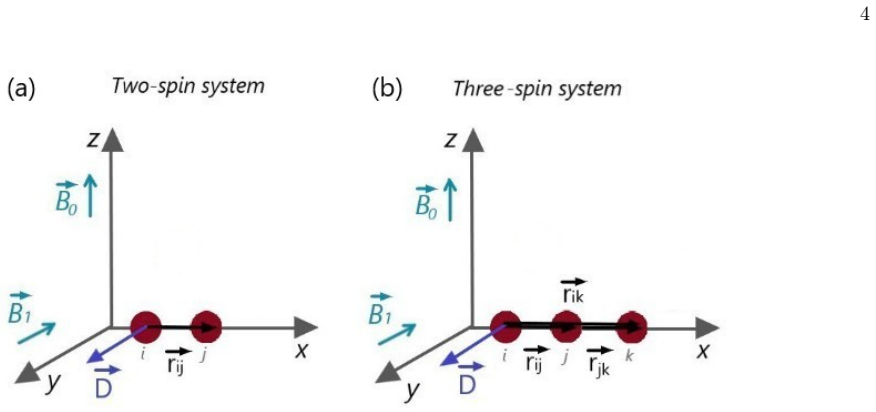
Coherent control of interacting spin systems under time-periodic driving is a central challenge in spin-based quantum technologies. Here we demonstrate the applicability of a full Floquet-space formalism, adapted from Nuclear Magnetic Resonance (NMR) methodologies, to model the dynamics of driven coupled electron spins in the presence of a static magnetic field B0 and a transverse oscillating field B1. The framework explicitly includes isotropic exchange coupling J and the chiral Dzyaloshinskii-Moriya antisymmetric exchange interaction (DMI), and its numerical convergence is systematically validated with respect to Fourier-space truncation. In the non-interacting limit, the expected driven-spin dynamics is recovered, with the oscillation periodicity governed by B1. Exchange coupling alone does not modify the collective spin expectation values under the chosen initial condition, consistent with symmetry considerations. In contrast, increasing DMI generates a finite expectation value of Sy, suppresses the expectation value of Sz, and produces tilted, elliptical Bloch-sphere trajectories, reflecting the emergence of chiral spin-spin correlations. These effects are pronounced for open boundary conditions, while remaining nearly negligible in the periodic boundary case. When exchange coupling and DMI coexist, the dynamics becomes strongly perturbed and multi-frequency in nature. Together, these results demonstrate that full Floquet-space modeling provides a robust and predictive framework for analyzing and engineering coherent dynamics in driven interacting spin systems beyond simple coherent-rotation regimes.
Editorial analysis
A structured set of objections, weighed in public.
Referee Report
Summary. The manuscript introduces a full Floquet-space formalism, adapted from NMR methods, to simulate the coherent dynamics of driven coupled electron spins under static field B0 and transverse oscillating field B1, explicitly incorporating isotropic exchange J and Dzyaloshinskii-Moriya interaction (DMI). It recovers standard driven-spin oscillations in the non-interacting limit, shows that J alone leaves collective expectations unchanged under the chosen initial condition, demonstrates that DMI induces finite <Sy>, suppresses <Sz>, and produces tilted elliptical Bloch-sphere trajectories (stronger under open boundaries), and finds multi-frequency dynamics when J and DMI coexist. The authors state that numerical convergence with respect to Fourier-space truncation has been systematically validated.
Significance. If the reported convergence can be placed on a quantitative footing, the framework would supply a practical numerical route to predict chiral effects and multi-frequency dynamics in driven spin systems that lie outside simple coherent-rotation regimes, with potential utility for spintronic device design and quantum control protocols. The explicit treatment of boundary-condition dependence and the coexistence of J and DMI are constructive features.
major comments (1)
- [Abstract] Abstract: the assertion that 'its numerical convergence is systematically validated with respect to Fourier-space truncation' supplies no thresholds, residual norms, observable-difference metrics, or truncation-order comparisons. Because the central claims concern long-time chiral observables (finite <Sy>, suppressed <Sz>, boundary-condition contrast, and multi-frequency behavior), the lack of these quantitative checks leaves open the possibility that the reported phenomena are truncation artifacts; this is load-bearing for the claim that full Floquet-space modeling reliably captures the DMI-induced effects.
Simulated Author's Rebuttal
We thank the referee for the careful reading of our manuscript and the constructive feedback. We address the major comment point by point below.
read point-by-point responses
-
Referee: [Abstract] Abstract: the assertion that 'its numerical convergence is systematically validated with respect to Fourier-space truncation' supplies no thresholds, residual norms, observable-difference metrics, or truncation-order comparisons. Because the central claims concern long-time chiral observables (finite <Sy>, suppressed <Sz>, boundary-condition contrast, and multi-frequency behavior), the lack of these quantitative checks leaves open the possibility that the reported phenomena are truncation artifacts; this is load-bearing for the claim that full Floquet-space modeling reliably captures the DMI-induced effects.
Authors: We agree that the abstract would benefit from explicit quantitative details on the convergence validation to address concerns about potential truncation artifacts. In the revised manuscript we will update the abstract to report the specific Fourier truncation orders tested, the observable-difference metrics (changes in <Sy>, <Sz> and trajectory parameters), and the thresholds at which convergence is achieved. This will be done without altering the underlying claims, as the systematic validation is already performed in the full text. revision: yes
Circularity Check
No significant circularity; derivation is self-contained numerical demonstration
full rationale
The paper applies an established full Floquet-space formalism (adapted from external NMR methodologies) to numerically model driven spin systems including isotropic exchange J and DMI. It recovers the expected non-interacting driven dynamics governed by B1, shows that exchange alone leaves collective expectations unchanged (consistent with symmetry), and demonstrates DMI-induced effects such as finite <Sy> and tilted trajectories. These are presented as direct numerical outcomes rather than redefinitions or fitted predictions renamed as results. No load-bearing step reduces by construction to self-citation chains, ansatzes smuggled via prior work, or uniqueness theorems from the same authors. Convergence with respect to Fourier truncation is asserted as validated, but the central claims rest on observable outputs from the model equations, not tautological equivalence to inputs. The framework is therefore independent of the target phenomena.
Axiom & Free-Parameter Ledger
Reference graph
Works this paper leans on
-
[1]
Qadri, K
Z. Qadri, K. R. Mote, P. K. Madhu, and A. Equbal, En- hancing spin coherence times in solid-state nmr using tai- lored heteronuclear spin decoupling, Prog. Nucl. Magn. Reson. Spectrosc.152, 101586 (2026)
2026
-
[2]
Ernst, Heteronuclear spin decoupling in solid-state nmr under magic-angle sample spinning, J
M. Ernst, Heteronuclear spin decoupling in solid-state nmr under magic-angle sample spinning, J. Magn. Reson. 162, 1 (2003)
2003
-
[3]
Hodgkinson, Heteronuclear decoupling in the nmr of solids, Prog
P. Hodgkinson, Heteronuclear decoupling in the nmr of solids, Prog. Nucl. Magn. Reson. Spectrosc.46, 197 (2005)
2005
-
[4]
Ladizhansky, R
V. Ladizhansky, R. S. Palani, M. Mardini, and R. G. Griffin, Dipolar recoupling in rotating solids, Chem. Rev. 124, 12844 (2024)
2024
-
[5]
M. D. Gelenter, A. J. Dregni, and M. Hong, Pulsed third-spin-assisted recoupling nmr for obtaining long- range 13c-13c and 15n-13c distance restraints, J. Phys. Chem. B124, 7138 (2020)
2020
-
[6]
J. P. Carvalho, A. B. Nielsen, E. Baligács, N. Wili, and N. C. Nielsen, Bridging dynamic nuclear polarization and solid-state nmr dipolar recoupling: From static single crystal to spinning powders, J. Phys. Chem. Lett.16, 4363 (2025)
2025
-
[7]
Yudilevich, A
D. Yudilevich, A. Salhov, I. Schaefer, K. Herb, A. Ret- zker, and A.Finkler, Coherent manipulation of nuclear spins in the strong driving regime, New J. Phys25, 113042 (2023)
2023
-
[8]
Greilich, S
A. Greilich, S. E. Economou, S. Spatzek, D. R. Yakovlev, D. Reuter, A. D. Wieck, T. L. Reinecke, and M. Bayer, Ultrafast optical rotations of electron spins in quantum dots, Nat. Phys.5, 262 (2009)
2009
-
[9]
S. J. Lockyer, A. Chiesa, A. Brookfield, G. A. Timco, G. F. S. Whitehead, E. J. L. McInnes, and S. C. R. E. P. Winpenny, Five-spin supramolecule for simulating quan- tum decoherence of bell states, J. Am. Chem. Soc.144, 16086 (2022)
2022
-
[10]
Y. Wang, Z. Liu, S. Zhou, S. Gao, and S. Jiang, Quantum coherent manipulation of magnetic molecules, J. Am. Chem. Soc.68, 2174 (2023)
2023
-
[11]
Laplane, N
P.Jobez1, C. Laplane, N. Timoney, N. Gisin1, A. F. P. Goldner, and M. Afzelius, Coherent spin control at the quantum level in an ensemble-based optical memory, Phys. Rev. Lett.114, 230502 (2015)
2015
-
[12]
J. B. dos Reis Lino and T. C. Ramalho, Exploring through-space spin–spin couplings for quantum informa- tion processing: Facing the challenge of coherence time and control quantum states, J. Phys. Chem. A123, 1372–1379 (2019)
2019
-
[13]
Bodenstedt, D
S. Bodenstedt, D. Moll, S. Glöggler, M. W. Mitchell, and M. C. D. Tayler, Decoupling of spin decoherence paths near zero magnetic field, J. Phys. Chem. Lett.13, 98–104 (2022)
2022
-
[14]
Zhang, H
Z. Zhang, H. Fu, and J. Wang, Nonequilibrium-induced enhancement of dynamical quantum coherence and en- tanglement of spin arrays, Phys. Rev. B95, 144306 (2017)
2017
-
[15]
Sutton and S
B. Sutton and S. Datta, Manipulating quantum informa- tion with spin torque, Sci. Rep.5, 17912 (2015)
2015
-
[16]
Meier, G
L. Meier, G. Salis, C. Ellenberger, K. Ensslin, and E. Gini, Stray-field-induced modification of coherent spin dynamics, Appl. Phys. Lett.88, 172501 (2006)
2006
-
[17]
J. L. Song and F. Zhou, Tunable quantum-fluctuation- controlled coherent spin dynamics, Phys. Rev. A77, 033628 (2008)
2008
-
[18]
Harvey-Collard, J
P. Harvey-Collard, J. Dijkema, G. Zheng, A. Sammak, G. Scappucci, and L. M. K. Vandersypen, Coherent spin- spin coupling mediated by virtual microwave photons, Phys. Rev. X12, 021026 (2022)
2022
-
[19]
X. Chen, R. Adam, D. E. Burgler, F. Wang, Z. Lu, L. Pan, S. Heidtfeld, C. Greb, M. Liu, Q. Liu, J. Wang, C. M. Schneider, and D. Cao, Ultrafast demagnetization in ferromagnetic materials: Origins and progress, Phys. Rep.1102, 1 (2025)
2025
-
[20]
Corna, L
A. Corna, L. Bourdet, R. Maurand, A. Crippa, D. Kotekar-Patil, H. Bohuslavskyi, R. Lavieville, L. Hutin, S. Barraud, Z. Jehl, M. Vinet, S. D. Franceschi, Y.-M. Niquet, and M. Sanquer, Electrically driven elec- tron spin resonance mediated by spin–valley–orbit cou- pling in a silicon quantum dot, Npj Quantum Inf.4, 6 (2018)
2018
-
[21]
Nowack, F
K. Nowack, F. H. L. Koppens, Y. V. Nazarov, and L. M. K. Vandersypen, Coherent control of a single elec- tron spin with electric fields, Science318, 1430 (2007)
2007
-
[22]
F. H. L. Koppens, C. Buizert, K. J. Tielrooij, I. T. Vink, K. C. Nowack, T. Meunier, L. P. Kouwenhoven, and L. M. K. Vandersypen, Driven coherent oscillations of a single electron spin in a quantum dot, Nature442, 766–771 (2006)
2006
-
[23]
Yoneda, T
J. Yoneda, T. Otsuka, T. Nakajima, T. Takakura, T. Obata, M. Pioro-Ladrière, H. Lu, C. Palmstrøm, A. C. Gossard, and S. Tarucha, Fast electrical control of single electron spins in quantum dots with vanishing influence from nuclear spins, Phys. Rev. Lett.113, 267601 (2014)
2014
-
[24]
A.Kirilyuk, A.V.Kimel,andT.Rasing,Ultrafastoptical manipulation of magnetic order, Rev. Mod. Phys.82, 039904 (2016)
2016
-
[25]
N.Dikshit, A
S. N.Dikshit, A. Nisar, B. Dixit, B. Kaur, A. K. Shukla, A. Kumar, J. Chen, J.-P. Wang, H. Fulara, and B. K. Kaushik, Optically assisted ultrafast spintronics: A re- view, Phys. Rep.1140, 1 (2025)
2025
-
[26]
Schmerber, E
W.Zhang, P.Maldonado, Z.Jin, T.S.Seifert, J.Arabski, G. Schmerber, E. Beaurepaire, M. B. nad T. Kampfrath, P.M.Oppeneer,andD.Turchinovich,Ultrafastterahertz magnetometry, Nat. Commun.11, 4247 (2020)
2020
-
[27]
Z. Wang, T. Sun, Z. Jiang, M. Yuan, Y. Huang, Y. Ren, D. Hou, T. Li, X. Liu, X. Luo, Y. Chai, A. Kimel, Y. Sun, and Z. Sheng, Acceleration of ultrafast demagnetization in van der waals ferromagnet fe3gete2 in high magnetic field, Natl. Sci. Rev.12, nwaf185 (2025)
2025
-
[28]
Mondal, L
R. Mondal, L. Rózsa, M. Farle, P. M. Oppeneer, U. Nowak, and M. Cherkasskii, Inertial effects in ultra- fast spin dynamics, J. Magn. Magn. Mater.579, 170830 (2023)
2023
-
[29]
Goldman and J
N. Goldman and J. Dalibard, Periodically driven quan- tum systems: effective hamiltonians and engineered gauge fields, Phys. Rev. X4, 031027 (2014)
2014
-
[30]
Bordia, H
P. Bordia, H. Luschen, U. Schneider, M. Knap, and I. Bloch, Periodically driving a many-body localized quantum system, Nat. Phys.13, 460 (2017)
2017
-
[31]
Bluvstein, A
D. Bluvstein, A. Omran, H. Levine, A. Keesling, G. Se- meghini, S. Ebadi, T. T. Wang, A. A. Michailidis, N. Maskara, W. W. Ho, S. Choi, M. Serbyn, M. Greiner, V. Vuletic, and M. D. Lukin, Controlling quantum many- 25 body dynamics in driven rydberg atom arrays, Science 371, 1355 (2021)
2021
-
[32]
Geier, N
S. Geier, N. Thaicharoen, C. Hainaut, T. Franz, A. Salzinger, A. Tebben, D. Grimshandl, G. Zurn, and M. Weidemuller, Floquet hamiltonian engineering of an isolated many-body spin system, Science374, 1149 (2021)
2021
-
[33]
Kumar, S
U. Kumar, S. Banerjee, and S.-Z. Lin, Floquet engineer- ing of kitaev quantum magnets, Commun. Phys.5, 157 (2022)
2022
-
[34]
Yambe and S
R. Yambe and S. Hayami, Symmetry analysis of light- induced magnetic interactions via floquet engineering, Phys. Rev. B108, 064420 (2023)
2023
-
[35]
H. Liu, H. Cao, and S. Meng, Floquet engineering of se- lective magnon–magnon coupling in synthetic antiferro- magnets, Appl. Phys. Lett.98, 100705 (2023)
2023
-
[36]
M. Lei, R. Fukumori, C.-J. Wu, E. B. S. Economou, J. Choi, and A. Faraon, Quantum thermalization and floquet engineering in a spin ensemble with a clock tran- sition, Nat. Phys.21, 1196–1202 (2025)
2025
-
[37]
Chen, F.-J
Q.-H. Chen, F.-J. Huang, Y.-P. Fu, and H. Su, Floquet no-go theorem and engineering topological magnons, Phys. Rev. B111, 064426 (2025)
2025
-
[38]
T. O. Levante, M. Baldus, B. Meier, and R. Ernst, For- malizedquantummechanicalfloquettheoryanditsappli- cation to sample spinning in nuclear magnetic resonance, Mol. Phys.86, 1195–1212 (1995)
1995
-
[39]
Filip, X
C. Filip, X. Filip, D. E. Demco, and S. Hafner, Spin dynamics under magic angle spinning by floquet, Mol. Phys.92, 757 (1997)
1997
-
[40]
Scholz, B
I. Scholz, B. H. Meier, and M. Ernst, Operator-based triple-mode floquet theory in solid-state nmr, J. Chem. Phys.127, 204504 (2007)
2007
-
[41]
Scholz, J
I. Scholz, J. D. van Beek, and M. Ernst, Operator-based floquet theory in solid-state nmr, Solid State Nucl. Magn. Reson.37, 39 (2010)
2010
-
[42]
K. L. Ivanov, K. R. Mote, M. Ernst, A. Equbal, and P. K. Madhu, Floquet theory in magnetic resonance: Formal- ism and applications, Prog. Nucl. Magn. Reson. Spec- trosc.126-127, 17 (2021)
2021
-
[43]
Chavez and M
M. Chavez and M. Ernst, A continuous approach to flo- quet theory for pulse-sequence optimization in solid-state nmr, J. Chem. Phys.157, 184103 (2022)
2022
-
[44]
Chavez and M
M. Chavez and M. Ernst, Continuous floquet theory in solid-state nmr, J. Chem. Phys.160, 244111 (2024)
2024
-
[45]
Sticlet, R
D. Sticlet, R. Tetean, and C. Tiusan, Skyrmionic qubits stabilized by dzyaloshinskii-moriya interaction as plat- forms for qubits and quantum gates, Phys. Rev. B112, 195435 (2025)
2025
-
[46]
Psaroudaki and C
C. Psaroudaki and C. Panagopoulos, Skyrmion qubits: A new class of quantum logic elements based on nanoscale magnetization, Phys. Rev. Lett.127, 067201 (2021)
2021
-
[47]
C. P. C. Psaroudaki, E. Peraticos, Skyrmion qubits: Challenges for future quantum computing applications, Appl. Phys. Lett.123, 260501 (2023)
2023
-
[48]
J.Xia, X.Zhang, X.Liu, Y.Zhou,andM.Ezawa,Univer- sal quantum computation based on nanoscale skyrmion helicity qubits in frustrated magnets, Phys. Rev. Lett. 130, 106701 (2023)
2023
-
[49]
A. P. Petrović, C. Psaroudaki, P. Fischer, M. Garst, and C. Panagopoulos,Colloquium: Quantum properties and functionalities of magnetic skyrmions, Rev. Mod. Phys. 97, 031001 (2025)
2025
-
[50]
Katcko, E
K. Katcko, E. Urbain, F. Ngassam, L. Kandpal, B. Chowrira, F. Schleicher, U. Halisdemir, D. Wang, T. Scherer, D. Mertz, B. Leconte, N. Beyer, D. Spor, P. Panissod, A. Boulard, J. Arabski, C. Kieber, E. Ster- nitzky, V. DaCosta, M. Hehn, F. Montaigne, A. Ba- houka, W. Weber, E. Beaurepaire, C. Kübel, D. Lacour, M. Alouani, S. Boukari, and M. Bowen, Encodin...
2021
-
[51]
Z. Li, H. Zhang, G. Li, J. Guo, Q. Wang, Y. Deng, Y. Hu, X. Hu, C. Liu, M. Qin, X. Shen, R. Yu, X. Gao, Z. Liao, J. Liu, Z. Hou, Y. Zhu, and X. Fu, Room-temperature sub-100-nm neel-type skyrmions in non-stoichiometric van der waals ferromagnet fe3-xgate2 with ultrafast laser writability, Nat. Commun.15, 1017 (2024)
2024
-
[52]
H. Liu, C. Zhang, C. Liu, A. Chen, D. Zheng, Y. Peng, J. Wei, Q. Liu, J. Wang, S. Zhang, and X. Zhang, Writ- ing and deleting skyrmions by electron beam in van der waals ferromagnet fe3gete2, Appl. Phys. Lett.29, 053102 (2024)
2024
discussion (0)
Sign in with ORCID, Apple, or X to comment. Anyone can read and Pith papers without signing in.