Stellar black hole binaries from two common envelope evolution phases in triple stellar systems
Pith reviewed 2026-06-26 03:18 UTC · model grok-4.3
The pith
A triple-star channel with two common envelope phases produces merging binary black holes that match the observed effective spin distribution.
A machine-rendered reading of the paper's core claim, the machinery that carries it, and where it could break.
Core claim
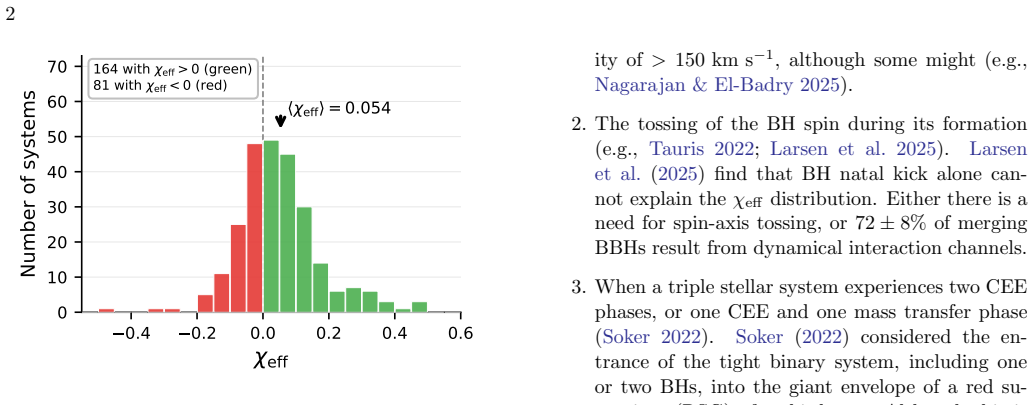
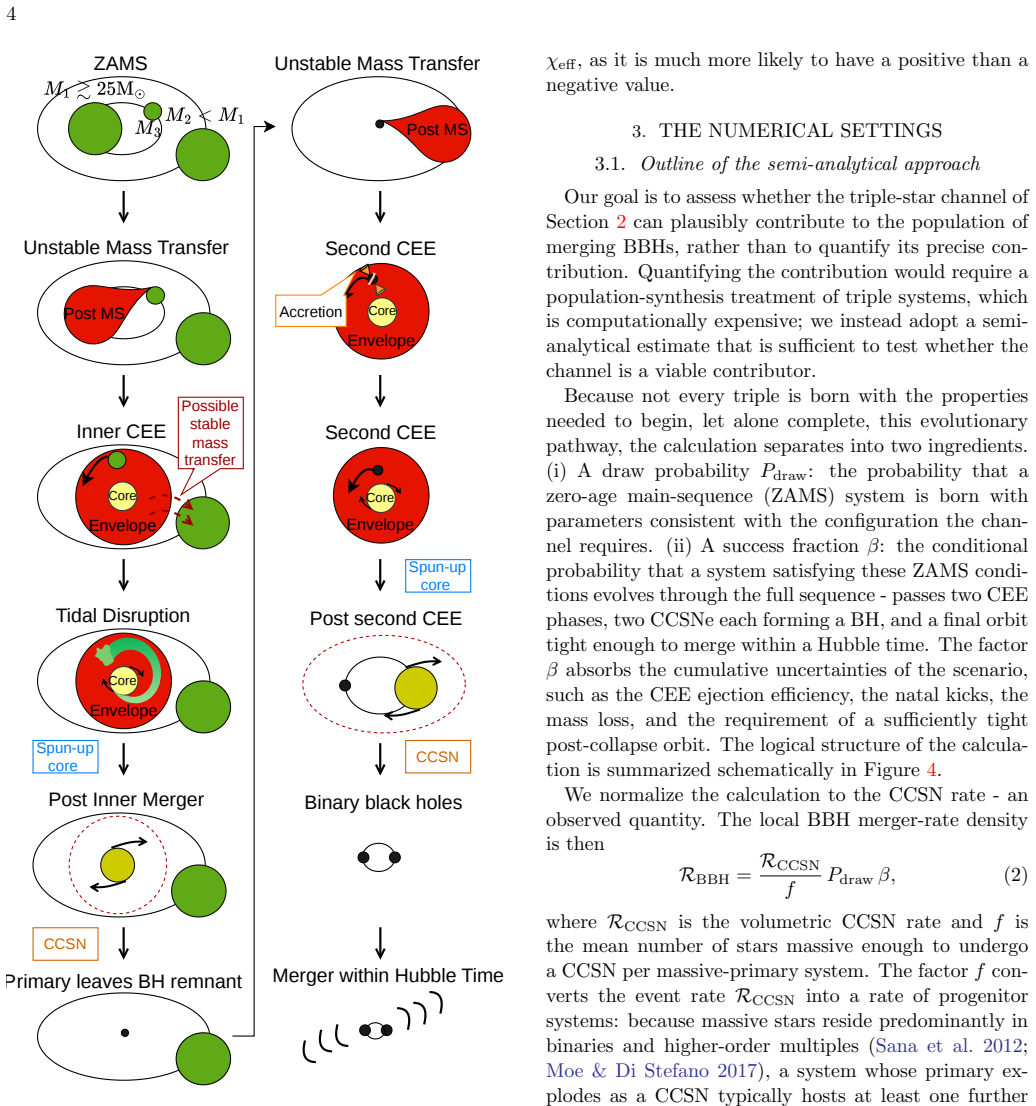
We propose a triple-star evolutionary channel involving two common envelope evolution (CEE) phases to form close binary black hole (BBH) systems with an average positive effective inspiral spin χ_eff and a tail of systems having χ_eff<0. The first BH progenitor engulfs a low-mass star during the post-main-sequence evolution. The tertiary star spirals in and spins up the core, which forms the first BH at the first core-collapse supernova (CCSN) explosion. Its spin is along the orbital angular momentum of the inner binary, which can be highly inclined to the outer binary angular momentum. The secondary star later engulfs the BH in a second CEE phase and explodes as a CCSN to form the second BH
What carries the argument
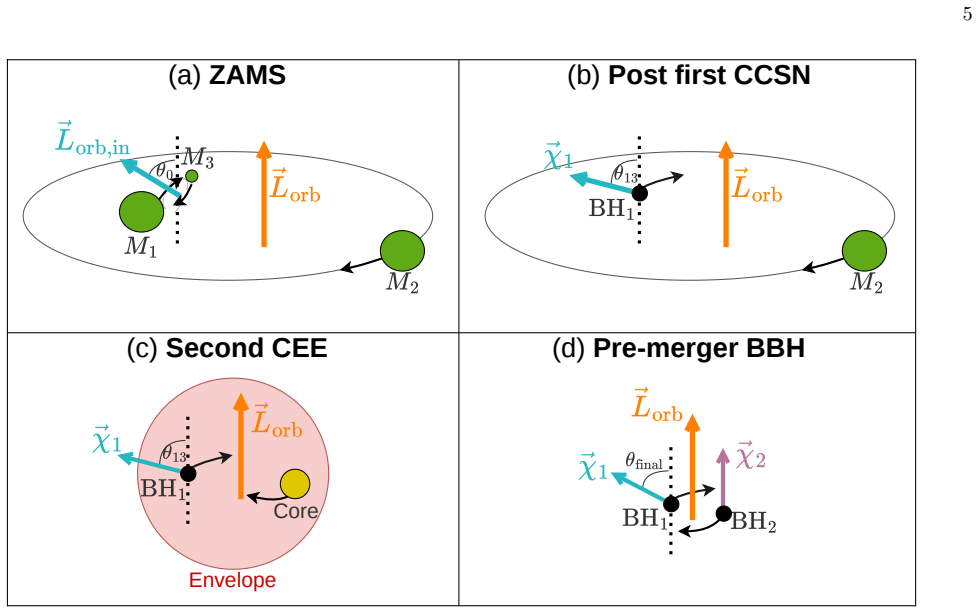
The two successive common envelope phases in a hierarchical triple, in which the first phase sets the first black hole spin along the inclined inner orbit while the second phase sets the second black hole spin closer to the final binary orbit.
If this is right
- The channel can account for a substantial share of the merging binary black holes detected by gravitational-wave observatories.
- It produces a population whose effective spins are on average positive yet include a negative tail without fine-tuning.
- The first black hole spin remains misaligned with the final orbit while the second black hole spin is more aligned.
- The formation efficiency reaches up to twice the observed merging rate relative to core-collapse supernovae.
Where Pith is reading between the lines
- Future catalogs with better spin measurements could quantify how large a fraction of events arise from this triple channel versus isolated binary evolution.
- The same geometry may operate in other compact-object binaries formed inside triples, such as neutron-star black-hole systems.
- The required initial triple distributions and stability criteria can be tested against upcoming large-scale stellar surveys.
Load-bearing premise
The tertiary star spirals in during the first common envelope phase and spins up the core so that the first black hole spin aligns with the inner binary angular momentum, which is often inclined relative to the outer binary.
What would settle it
A measured fraction of merging binary black holes with negative effective spin that lies well outside the range produced by this channel, or an observed merging rate that exceeds twice the core-collapse supernova rate after accounting for selection effects.
Figures
read the original abstract
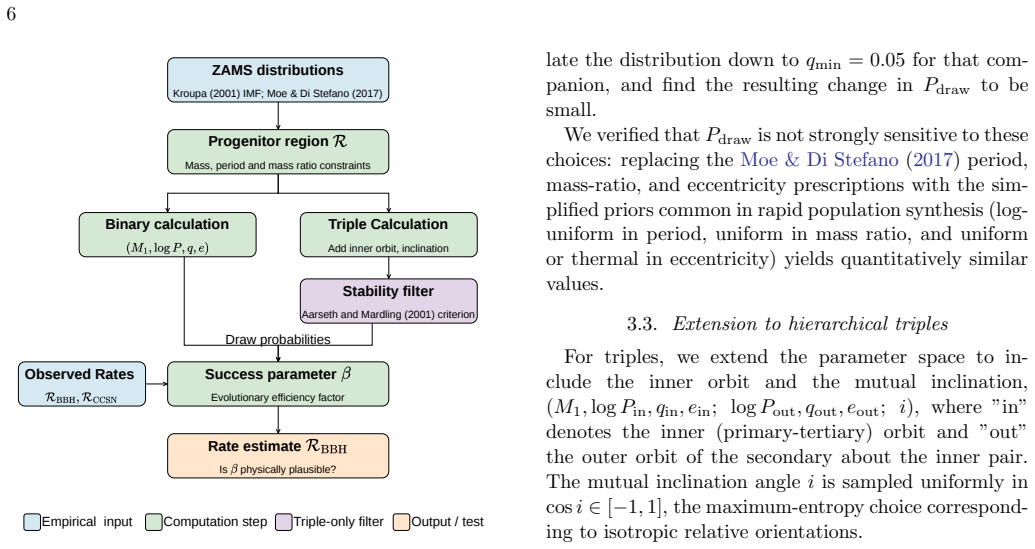
We propose a triple-star evolutionary channel involving two common envelope evolution (CEE) phases to form close binary black hole (BBH) systems with an average positive effective inspiral spin $\chi_{\rm eff}$ and a tail of systems having $\chi_{\rm eff}<0$, as observed by gravitational wave detectors. $\chi_{\rm eff}$ is the mass-weighted spin of the two merging BHs, and a positive (negative) value is for an effective spin along (opposite) the orbital angular momentum. The first BH progenitor engulfs a low-mass star during the post-main-sequence evolution. The tertiary star spirals in and spins up the core, which forms the first BH at the first core-collapse supernova (CCSN) explosion. Its spin is along the orbital angular momentum of the inner binary, which can be highly inclined to the outer binary angular momentum. The secondary star later engulfs the BH in a second CEE phase and explodes as a CCSN to form the second BH with a spin that is more aligned with the orbital angular momentum of the two BHs. We use empirically calibrated initial distributions of triple-star systems consisting of two massive stars and impose a hierarchical stability criterion. We compare the predicted ratio of merging BBHs to CCSN explosion rates and find it is up to a factor of 2 larger than the observed rate. This channel can significantly contribute to the population of observed merging BBHs and can explain their qualitative spin distribution.
Editorial analysis
A structured set of objections, weighed in public.
Referee Report
Summary. The manuscript proposes a triple-star evolutionary channel involving two common envelope evolution (CEE) phases to form close binary black hole (BBH) systems. It claims this produces merging BBHs with an average positive effective inspiral spin χ_eff and a tail of negative χ_eff values, matching gravitational-wave observations. Using empirically calibrated initial distributions of triple systems and a hierarchical stability criterion, the predicted ratio of merging BBHs to core-collapse supernova (CCSN) rates is up to a factor of 2 larger than observed, suggesting the channel can significantly contribute to the observed population and explain the qualitative spin distribution.
Significance. If the spin-alignment assumptions hold, the channel provides a geometric explanation for the observed χ_eff distribution via the two CEE phases without additional tuning. The rate comparison, based on empirical initial distributions, indicates competitiveness with other channels. Strengths include the direct use of observed triple-star distributions and the falsifiable prediction for both rate and spin properties.
major comments (2)
- [Abstract and model description] Abstract and § on spin evolution: The assumption that the tertiary star's spiral-in during the first CEE spins up the core such that the first BH spin aligns with the inner binary orbital angular momentum (inclined to the outer binary) is stated without hydrodynamical results, parameter studies for the relevant mass ratios/separations, or citations to supporting simulations. This alignment is load-bearing for the claim of both positive mean χ_eff and negative tail; if the first-BH spin direction is instead drawn from a broader distribution, the mechanism for the qualitative spin distribution collapses independent of the rate comparison.
- [Rate comparison] Rate comparison section: The claim that the predicted merging BBH to CCSN rate ratio is up to a factor of 2 larger than observed depends on the specific implementation of the hierarchical stability criterion, common-envelope efficiency, and selection of merging systems; without quantitative details or sensitivity tests on these, it is unclear whether the factor-of-2 comparison robustly supports the 'significantly contribute' conclusion.
minor comments (1)
- [Abstract] Notation for χ_eff should be defined at first use with explicit reference to the standard LIGO/Virgo definition (mass-weighted sum of spin components along orbital angular momentum).
Simulated Author's Rebuttal
We thank the referee for their insightful comments, which have helped us improve the clarity and robustness of our manuscript. We address each major comment below and outline the revisions we will make.
read point-by-point responses
-
Referee: [Abstract and model description] Abstract and § on spin evolution: The assumption that the tertiary star's spiral-in during the first CEE spins up the core such that the first BH spin aligns with the inner binary orbital angular momentum (inclined to the outer binary) is stated without hydrodynamical results, parameter studies for the relevant mass ratios/separations, or citations to supporting simulations. This alignment is load-bearing for the claim of both positive mean χ_eff and negative tail; if the first-BH spin direction is instead drawn from a broader distribution, the mechanism for the qualitative spin distribution collapses independent of the rate comparison.
Authors: We acknowledge that the alignment of the first BH spin with the inner binary orbital angular momentum is presented as a model assumption without new hydrodynamical simulations or dedicated parameter studies in this manuscript. This assumption follows from the expectation that angular momentum transfer during the tertiary's spiral-in in the first CEE phase aligns the core spin with the inner orbit. We will revise the relevant sections to explicitly identify this as an assumption, cite existing literature on angular momentum transport in CEE, and add a short discussion of how a broader spin distribution would modify the predicted χ_eff distribution. Even under moderate deviations from perfect alignment, the geometric effect of the two successive CEE phases (inclining the inner binary relative to the outer orbit, followed by alignment of the second BH) continues to produce a positive mean χ_eff with a negative tail, preserving the qualitative match to observations. revision: partial
-
Referee: [Rate comparison] Rate comparison section: The claim that the predicted merging BBH to CCSN rate ratio is up to a factor of 2 larger than observed depends on the specific implementation of the hierarchical stability criterion, common-envelope efficiency, and selection of merging systems; without quantitative details or sensitivity tests on these, it is unclear whether the factor-of-2 comparison robustly supports the 'significantly contribute' conclusion.
Authors: We agree that additional quantitative details and sensitivity tests are required to demonstrate the robustness of the rate comparison. In the revised manuscript we will expand the rate section to specify the exact hierarchical stability criterion adopted, the value(s) chosen for the common-envelope efficiency parameter, and the precise criteria used to identify merging systems. We will also include sensitivity tests in which these parameters are varied over plausible ranges, showing that the predicted merging BBH to CCSN rate ratio remains within a factor of approximately two of the observed value across most of the explored parameter space. These additions will strengthen the conclusion that the channel can contribute significantly to the observed population. revision: yes
Circularity Check
No circularity: spin alignment is an explicit physical assumption, not a derived or fitted output
full rationale
The paper proposes a triple-star channel with two CEE phases and states the resulting spin alignments as direct physical consequences of the spiraling-in process (first BH spin along inner-binary orbit, second more aligned with final BBH orbit). These alignments are inputs to the qualitative spin-distribution claim rather than outputs derived from equations or data fits within the paper. Rate comparisons rely on empirically calibrated initial triple distributions and a hierarchical stability criterion, with no reduction of predictions to those inputs by construction. No self-citation load-bearing steps, ansatzes smuggled via citation, or uniqueness theorems appear in the provided text. The derivation chain is therefore self-contained; any weakness lies in the justification of the alignment assumption, not in circularity.
Axiom & Free-Parameter Ledger
free parameters (1)
- initial distributions of triple-star systems
axioms (1)
- domain assumption hierarchical stability criterion
Reference graph
Works this paper leans on
-
[1]
Numerical simulations of the random angular momentum in convection: Implications for supergiant collapse to form black holes. , keywords =. doi:10.1093/mnras/stab3776 , archivePrefix =. 2107.09068 , primaryClass =
-
[2]
Delayed explosions of red supergiants following 'failed' supernovae
Numerical simulations of the random angular momentum in convection - II. Delayed explosions of red supergiants following 'failed' supernovae. , keywords =. doi:10.1093/mnras/stad2328 , archivePrefix =. 2301.05237 , primaryClass =
-
[3]
Spitzer Observations of Dust Destruction in the Puppis A Supernova Remnant. , keywords =. doi:10.1088/0004-637X/725/1/585 , adsurl =
-
[4]
Comparative Morphological Analysis of Puppis A at Radio, Infrared, Optical, and X-Ray Wavelengths. , keywords =. doi:10.1086/168378 , adsurl =
-
[5]
Planetary Nebula Image Catalogue: HST data
-
[6]
Research Notes of the American Astronomical Society , keywords =
The Jets and the Neutron Star Kick Velocity of the Supernova Remnant CTB 1. Research Notes of the American Astronomical Society , keywords =. doi:10.3847/2515-5172/ad1392 , archivePrefix =. 2312.02026 , primaryClass =
-
[7]
Relativistic MHD simulations of core-collapse GRB jets: 3D instabilities and magnetic dissipation
Relativistic MHD simulations of core-collapse GRB jets: 3D instabilities and magnetic dissipation. , keywords =. doi:10.1093/mnras/stv2591 , archivePrefix =. 1508.02721 , primaryClass =
work page internal anchor Pith review Pith/arXiv arXiv doi:10.1093/mnras/stv2591
-
[8]
Core-collapse supernova explosion theory. , keywords =. doi:10.1038/s41586-020-03059-w , archivePrefix =. 2009.14157 , primaryClass =
-
[9]
The most complete and detailed X-ray view of the SNR Puppis A
The most complete and detailed X-ray view of the SNR Puppis A. , keywords =. doi:10.1051/0004-6361/201321401 , archivePrefix =. 1305.1275 , primaryClass =
work page internal anchor Pith review Pith/arXiv arXiv doi:10.1051/0004-6361/201321401
-
[10]
American Astronomical Society Meeting Abstracts \#215 , year = 2010, series =
Three-Dimensional Kinematics of the Supernova Remnant Puppis A. American Astronomical Society Meeting Abstracts \#215 , year = 2010, series =
2010
-
[11]
Izvestiya Ordena Trudovogo Krasnogo Znameni Krymskoj Astrofizicheskoj Observatorii , year = 1952, month = jan, volume =
Third list of diffuse emission nebulae. Izvestiya Ordena Trudovogo Krasnogo Znameni Krymskoj Astrofizicheskoj Observatorii , year = 1952, month = jan, volume =
1952
-
[12]
Triggering jet-driven explosions of core-collapse supernovae by accretion from convective regions
Triggering jet-driven explosions of core-collapse supernovae by accretion from convective regions. , keywords =. doi:10.1093/mnras/stu257 , archivePrefix =. 1401.1597 , primaryClass =
work page internal anchor Pith review Pith/arXiv arXiv doi:10.1093/mnras/stu257
-
[13]
Angular momentum fluctuations in the convective helium shell of massive stars
Angular Momentum Fluctuations in the Convective Helium Shell of Massive Stars. , keywords =. doi:10.3847/0004-637X/827/1/40 , archivePrefix =. 1505.05756 , primaryClass =
work page internal anchor Pith review Pith/arXiv arXiv doi:10.3847/0004-637x/827/1/40
-
[14]
The Peculiar Ejecta Rings in the O-Rich Supernova Remnant Puppis A: Evidence of a Binary Interaction?. , keywords =. doi:10.3847/1538-4357/ad0156 , archivePrefix =. 2310.00661 , primaryClass =
-
[15]
Evidence for proton acceleration and escape from the Puppis A SNR using Fermi-LAT observations. arXiv e-prints , keywords =. doi:10.48550/arXiv.2308.14848 , archivePrefix =. 2308.14848 , primaryClass =
-
[16]
Black Hole to Photosphere: 3D GRMHD Simulations of Collapsars Reveal Wobbling and Hybrid Composition Jets. , keywords =. doi:10.3847/2041-8213/ac7530 , archivePrefix =. 2204.12501 , primaryClass =
-
[17]
The chemical signature of jet-driven hypernovae. , keywords =. doi:10.1093/mnras/staa3819 , archivePrefix =. 2010.06766 , primaryClass =
-
[18]
Constraining the fraction of core-collapse supernovae harbouring choked jets with high-energy neutrinos. , keywords =. doi:10.1093/mnras/stz3245 , archivePrefix =. 1906.07399 , primaryClass =
-
[19]
Hubble Space Telescope Observations and Geometric Models of Compact Multipolar Planetary Nebulae. , keywords =. doi:10.1088/0004-637X/787/1/25 , adsurl =
-
[20]
X-Ray Studies of the Supernova Remnant N132D. I. Morphology. , keywords =. doi:10.1086/165043 , adsurl =
-
[21]
Fermi-LAT and WMAP Observations of the Puppis A Supernova Remnant. , keywords =. doi:10.1088/0004-637X/759/2/89 , adsurl =
-
[22]
Chandra X-Ray Observation of a Mature Cloud-Shock Interaction in the Bright Eastern Knot Region of Puppis A. , keywords =. doi:10.1086/497298 , archivePrefix =. astro-ph/0508243 , primaryClass =
work page internal anchor Pith review Pith/arXiv arXiv doi:10.1086/497298
-
[23]
X-ray Emitting Ejecta in Puppis A Observed with Suzaku
X-Ray-emitting Ejecta in Puppis A Observed with Suzaku. , keywords =. doi:10.1086/528925 , archivePrefix =. 0712.3208 , primaryClass =
work page internal anchor Pith review Pith/arXiv arXiv doi:10.1086/528925
-
[24]
Discovery of Fast-Moving X-Ray--Emitting Ejecta Knots in the Oxygen-Rich Supernova Remnant Puppis A
Discovery of Fast-Moving X-Ray-Emitting Ejecta Knots in the Oxygen-Rich Supernova Remnant Puppis A. , keywords =. doi:10.1086/586891 , archivePrefix =. 0805.1369 , primaryClass =
work page internal anchor Pith review Pith/arXiv arXiv doi:10.1086/586891
-
[25]
Discovery of X-Ray-Emitting O-Ne-Mg-Rich Ejecta in the Galactic Supernova Remnant Puppis A
Discovery of X-ray-emitting O-Ne-Mg-rich Ejecta in the Galactic Supernova Remnant Puppis A. , keywords =. doi:10.1088/0004-637X/714/2/1725 , archivePrefix =. 1004.4132 , primaryClass =
work page internal anchor Pith review Pith/arXiv arXiv doi:10.1088/0004-637x/714/2/1725
-
[26]
Dynamics of X-Ray-emitting Ejecta in the Oxygen-rich Supernova Remnant Puppis A Revealed by the XMM-Newton Reflection Grating Spectrometer. , keywords =. doi:10.1088/0004-637X/768/2/182 , archivePrefix =. 1303.6607 , primaryClass =
work page internal anchor Pith review Pith/arXiv arXiv doi:10.1088/0004-637x/768/2/182
-
[27]
Discovery of a one-sided radio filament of PSR J0538+2817 in S147: escape of relativistic PWN leptons into surrounding supernova remnant?. , keywords =. doi:10.1093/mnras/stad3452 , archivePrefix =. 2309.13670 , primaryClass =
-
[28]
Jet-Induced Explosions of Core Collapse Supernovae
Jet-induced Explosions of Core Collapse Supernovae. , keywords =. doi:10.1086/312305 , archivePrefix =. astro-ph/9904419 , primaryClass =
work page internal anchor Pith review Pith/arXiv arXiv doi:10.1086/312305
-
[29]
Wide-field X-ray observations of the supernova remnant Puppis A with the SRG/ART-XC telescope. , keywords =. doi:10.1093/mnras/stab3647 , archivePrefix =. 2107.05586 , primaryClass =
-
[30]
Three-dimensional Adaptive Mesh Refinement Simulations of Long-duration Gamma-Ray Burst Jets inside Massive Progenitor Stars. , keywords =. doi:10.1088/0004-637X/767/1/19 , archivePrefix =. 1212.0539 , primaryClass =
work page internal anchor Pith review Pith/arXiv arXiv doi:10.1088/0004-637x/767/1/19
-
[31]
, keywords =
Optical observations of supernova remnants: the filamentary nebula Simeiz 147. , keywords =
-
[32]
From the weakest to most powerful explosions
Core-collapse supernova diversities . From the weakest to most powerful explosions. , keywords =
-
[33]
The IAC morphological catalog of northern Galactic planetary nebulae
-
[34]
The intermediate r-process in core-collapse supernovae driven by the magneto-rotational instability
The Intermediate r-process in Core-collapse Supernovae Driven by the Magneto-rotational Instability. , keywords =. doi:10.3847/2041-8213/aa5dee , archivePrefix =. 1611.02280 , primaryClass =
work page internal anchor Pith review Pith/arXiv arXiv doi:10.3847/2041-8213/aa5dee 2041
-
[35]
Nucleosynthesis in jet-driven and jet-associated supernovae. arXiv e-prints , keywords =. doi:10.48550/arXiv.2303.12458 , archivePrefix =. 2303.12458 , primaryClass =
-
[36]
Modeling the Evolution from Massive Stars to Supernovae and Supernova Remnants. arXiv e-prints , keywords =. doi:10.48550/arXiv.2311.05612 , archivePrefix =. 2311.05612 , primaryClass =
-
[37]
Exploding core collapse supernovae with jittering jets. , keywords =. doi:10.1111/j.1365-2966.2011.18671.x , archivePrefix =. 1103.1554 , primaryClass =
-
[38]
A Planar Jitternig-Jets Pattern in Core-Collapse Supernova Explosions
A planar jittering-jets pattern in core collapse supernova explosions. , keywords =. doi:10.1093/mnras/stu1129 , archivePrefix =. 1403.5152 , primaryClass =
work page internal anchor Pith review Pith/arXiv arXiv doi:10.1093/mnras/stu1129
-
[39]
Black hole accretion discs and luminous transients in failed supernovae from non-rotating supergiants. , keywords =. doi:10.1093/mnrasl/slz031 , archivePrefix =. 1811.12427 , primaryClass =
work page internal anchor Pith review Pith/arXiv arXiv doi:10.1093/mnrasl/slz031
-
[40]
A high resolution HI study towards the supernova remnant Puppis A and its environments
A high-resolution H I study towards the supernova remnant Puppis A and its environments. , keywords =. doi:10.1093/mnras/stw2219 , archivePrefix =. 1609.01779 , primaryClass =
work page internal anchor Pith review Pith/arXiv arXiv doi:10.1093/mnras/stw2219
-
[41]
New perspectives on the supernova remnant Puppis A based on a radio polarization study
New perspectives on the supernova remnant Puppis A based on a radio polarization study. , keywords =. doi:10.1093/mnras/sty751 , archivePrefix =. 1803.07104 , primaryClass =
work page internal anchor Pith review Pith/arXiv arXiv doi:10.1093/mnras/sty751
-
[42]
The Starfish Twins: Two Young Planetary Nebulae with Extreme Multipolar Morphology. , keywords =. doi:10.1086/312748 , adsurl =
-
[43]
Supplying angular momentum to the jittering jets explosion mechanism using inner convection layers. , keywords =. doi:10.1093/mnrasl/slab105 , archivePrefix =. 2107.08779 , primaryClass =
-
[44]
Remnant masses of core collapse supernovae in the jittering jets explosion mechanism. , keywords =. doi:10.1093/mnras/stac1075 , archivePrefix =. 2112.10697 , primaryClass =
-
[45]
The implications of large binding energies of massive stripped core collapse supernova progenitors on the explosion mechanism. , keywords =. doi:10.1093/mnras/stad889 , archivePrefix =. 2301.05144 , primaryClass =
-
[46]
Applying the jet feedback mechanism to core-collapse supernova explosions. , keywords =. doi:10.1111/j.1365-2966.2009.15862.x , archivePrefix =. 0909.5276 , primaryClass =
-
[47]
Research in Astronomy and Astrophysics , keywords =
Amplifying magnetic fields of a newly born neutron star by stochastic angular momentum accretion in core collapse supernovae. Research in Astronomy and Astrophysics , keywords =. doi:10.1088/1674-4527/20/2/24 , archivePrefix =. 1903.08349 , primaryClass =
-
[48]
Research in Astronomy and Astrophysics , keywords =
Imprints of the Jittering Jets Explosion Mechanism in the Morphology of the Supernova Remnant SNR 0540-69.3. Research in Astronomy and Astrophysics , keywords =. doi:10.1088/1674-4527/ac49e6 , archivePrefix =. 2109.10230 , primaryClass =
-
[49]
Research in Astronomy and Astrophysics , keywords =
The Role of Jets in Exploding Supernovae and in Shaping their Remnants. Research in Astronomy and Astrophysics , keywords =. doi:10.1088/1674-4527/ac9782 , archivePrefix =. 2208.04875 , primaryClass =
-
[50]
Research in Astronomy and Astrophysics , keywords =
The Neutron Star to Black Hole Mass Gap in the Frame of the Jittering Jets Explosion Mechanism (JJEM). Research in Astronomy and Astrophysics , keywords =. doi:10.1088/1674-4527/ace9b3 , archivePrefix =. 2304.05705 , primaryClass =
-
[51]
Research in Astronomy and Astrophysics , keywords =
Classifying Core Collapse Supernova Remnants by Their Morphology as Shaped by the Last Exploding Jets. Research in Astronomy and Astrophysics , keywords =. doi:10.1088/1674-4527/acf446 , archivePrefix =. 2307.15666 , primaryClass =
-
[52]
Hints of point-symmetric structures in SN 1987A: The jittering jets explosion mechanism. , keywords =. doi:10.1016/j.newast.2023.102154 , archivePrefix =. 2309.07863 , primaryClass =
-
[53]
The Open Journal of Astrophysics , keywords =
Jet - counter-jet asymmetry in the jittering jets explosion mechanism of supernovae. arXiv e-prints , keywords =. doi:10.48550/arXiv.2311.03286 , archivePrefix =. 2311.03286 , primaryClass =
-
[54]
Three-dimensional numerical simulations of structured gamma-ray burst jets. , keywords =. doi:10.1093/mnras/stac3401 , archivePrefix =. 2207.07925 , primaryClass =
-
[55]
The collapse and three-dimensional explosion of three-dimensional massive-star supernova progenitor models. , keywords =. doi:10.1093/mnras/stab3702 , archivePrefix =. 2109.10920 , primaryClass =
-
[56]
The Jittering Jets Explosion Mechanism in Electron Capture Supernovae. , keywords =. doi:10.3847/1538-4357/ad487f , archivePrefix =. 2401.06652 , primaryClass =
-
[57]
The Energy Sources of Superluminous Supernovae
The Energy Sources of Superluminous Supernovae. Research in Astronomy and Astrophysics , keywords =. doi:10.1088/1674-4527/19/5/63 , archivePrefix =. 1902.07943 , primaryClass =
work page internal anchor Pith review Pith/arXiv arXiv doi:10.1088/1674-4527/19/5/63 1902
-
[58]
Production and Distribution of ^ 44 Ti and ^ 56 Ni in a Three-dimensional Supernova Model Resembling Cassiopeia A. , keywords =. doi:10.3847/1538-4357/aa72de , archivePrefix =. 1610.05643 , primaryClass =
work page internal anchor Pith review Pith/arXiv arXiv doi:10.3847/1538-4357/aa72de
-
[59]
Three-Dimensional Simulations of Core-Collapse Supernovae: From Shock Revival to Shock Breakout
Three-dimensional simulations of core-collapse supernovae: from shock revival to shock breakout. , keywords =. doi:10.1051/0004-6361/201425025 , archivePrefix =. 1409.5431 , primaryClass =
work page internal anchor Pith review Pith/arXiv arXiv doi:10.1051/0004-6361/201425025
-
[60]
Neutron Star Kicks by the Gravitational Tug-boat Mechanism in Asymmetric Supernova Explosions: Progenitor and Explosion Dependence. , keywords =. doi:10.3847/1538-4357/aa618e , archivePrefix =. 1611.07562 , primaryClass =
work page internal anchor Pith review Pith/arXiv arXiv doi:10.3847/1538-4357/aa618e
-
[61]
Gravitational waves from 3D core-collapse supernova models: The impact of moderate progenitor rotation. , keywords =. doi:10.1093/mnras/stz990 , archivePrefix =. 1810.07638 , primaryClass =
work page internal anchor Pith review Pith/arXiv arXiv doi:10.1093/mnras/stz990
-
[62]
Neutrino emission characteristics of black hole formation in three-dimensional simulations of stellar collapse. , keywords =. doi:10.1103/PhysRevD.101.123013 , archivePrefix =. 1910.12971 , primaryClass =
-
[63]
Core-collapse supernova neutrino emission and detection informed by state-of-the-art three-dimensional numerical models. , keywords =. doi:10.1093/mnras/staa2691 , archivePrefix =. 2007.05000 , primaryClass =
-
[64]
Characteristic time variability of gravitational-wave and neutrino signals from three-dimensional simulations of non-rotating and rapidly rotating stellar core collapse. , keywords =. doi:10.1093/mnras/stab228 , archivePrefix =. 2010.03882 , primaryClass =
-
[65]
Radio Images of 3C 58: Expansion and Motion of its Wisp
Radio Images of 3C 58: Expansion and Motion of Its Wisp. , keywords =. doi:10.1086/504584 , archivePrefix =. astro-ph/0603197 , primaryClass =
work page internal anchor Pith review Pith/arXiv arXiv doi:10.1086/504584
-
[66]
The Proper Motion of PSR J0205+6449 in 3C 58
The proper motion of PSR J0205+6449 in 3C 58. , keywords =. doi:10.1093/mnras/stt353 , archivePrefix =. 1302.5625 , primaryClass =
work page internal anchor Pith review Pith/arXiv arXiv doi:10.1093/mnras/stt353
-
[67]
The Parkes-MIT-NRAO Surveys. IV. Maps fpr the Southern Survey Covering -88degrees < delta < -37degrees. , keywords =. doi:10.1086/116707 , adsurl =
-
[68]
The distribution of radioactive $^{44}$Ti in Cassiopeia A
The Distribution of Radioactive ^ 44 Ti in Cassiopeia A. , keywords =. doi:10.3847/1538-4357/834/1/19 , archivePrefix =. 1612.02774 , primaryClass =
work page internal anchor Pith review Pith/arXiv arXiv doi:10.3847/1538-4357/834/1/19
-
[69]
Supernova remnant S147 and its associated neutron star(s)
Supernova remnant S 147 and its associated neutron star(s). , keywords =. doi:10.1051/0004-6361:20054114 , archivePrefix =. astro-ph/0508595 , primaryClass =
work page internal anchor Pith review Pith/arXiv arXiv doi:10.1051/0004-6361:20054114
-
[70]
A JWST Survey of the Supernova Remnant Cassiopeia A. , keywords =. doi:10.3847/2041-8213/ad324b , archivePrefix =. 2401.02477 , primaryClass =
-
[71]
The Three-Dimensional Structure of Cassiopeia A
The Three-dimensional Structure of Cassiopeia A. , keywords =. doi:10.1088/0004-637X/725/2/2038 , archivePrefix =. 1011.3858 , primaryClass =
work page internal anchor Pith review Pith/arXiv arXiv doi:10.1088/0004-637x/725/2/2038 2038
-
[72]
Planetary Nebula Morphologies Indicate a Jet-Driven Explosion of SN 1987A and Other Core-Collapse Supernovae. Galaxies , keywords =. doi:10.3390/galaxies12030029 , archivePrefix =. 2404.14843 , primaryClass =
-
[73]
New Constraints on the Structure and Evolution of the Pulsar Wind Nebula 3C 58
New Constraints on the Structure and Evolution of the Pulsar Wind Nebula 3C 58. , keywords =. doi:10.1086/424814 , archivePrefix =. astro-ph/0405380 , primaryClass =
work page internal anchor Pith review Pith/arXiv arXiv doi:10.1086/424814
-
[74]
The Open Journal of Astrophysics , keywords =
Comparing jet-shaped point symmetry in cluster cooling flows and supernovae. The Open Journal of Astrophysics , keywords =. doi:10.33232/001c.120279 , archivePrefix =. 2403.08544 , primaryClass =
-
[75]
Handbook of Supernovae , year = 2017, editor =
Supernova of AD 1181 and its Remnant: 3C 58. Handbook of Supernovae , year = 2017, editor =. doi:10.1007/978-3-319-21846-5_47 , adsurl =
-
[76]
The Open Journal of Astrophysics , keywords =
Jet - counter-jet asymmetry in the jittering jets explosion mechanism of supernovae. The Open Journal of Astrophysics , keywords =. doi:10.21105/astro.2311.03286 , archivePrefix =. 2311.03286 , primaryClass =
-
[77]
Hubble Space Telescope Observations of Oxygen-rich Supernova Remnants in the Magellanic Clouds. III. WFPC2 Imaging of the Young, Crab-like Supernova Remnant SNR 0540-69.3. , keywords =. doi:10.1086/503313 , adsurl =
-
[78]
A detailed look at the thermal and nonthermal X-ray emission from the Vela supernova remnant with SRG/eROSITA. , keywords =. doi:10.1051/0004-6361/202346691 , archivePrefix =. 2306.10975 , primaryClass =
-
[79]
Three-dimensional neutrino-driven supernovae: Neutron star kicks, spins, and asymmetric ejection of nucleosynthesis products. , keywords =. doi:10.1051/0004-6361/201220636 , archivePrefix =. 1210.8148 , primaryClass =
work page internal anchor Pith review Pith/arXiv arXiv doi:10.1051/0004-6361/201220636
-
[80]
A Detailed Kinematic Map of Cassiopeia A's Optical Main Shell and Outer High-Velocity Ejecta
A Detailed Kinematic Map of Cassiopeia A's Optical Main Shell and Outer High-velocity Ejecta. , keywords =. doi:10.1088/0004-637X/772/2/134 , archivePrefix =. 1306.2310 , primaryClass =
work page internal anchor Pith review Pith/arXiv arXiv doi:10.1088/0004-637x/772/2/134
discussion (0)
Sign in with ORCID, Apple, or X to comment. Anyone can read and Pith papers without signing in.