REVIEW 2 major objections 5 minor 42 references
Explaining Temporal Graph Neural Networks via Feature-induced Information Flow
T0 review · 2 major / 5 minor · reviewed 2026-07-15 · grok-4.5
Pith's one-line read Event relevance scores that follow every pathway an event can influence an ETGNN prediction, including the latent memory updates that carry long-range dependencies.
desk verdict Solid, usable XAI extension for ETGNNs: modular NRM + full event-flow relevance that actually recovers long-range chains the baselines miss. read the letter →
The pith
A machine-rendered reading of the paper's core claim, the machinery that carries it, and where it could break.
The reading
What carries the argument
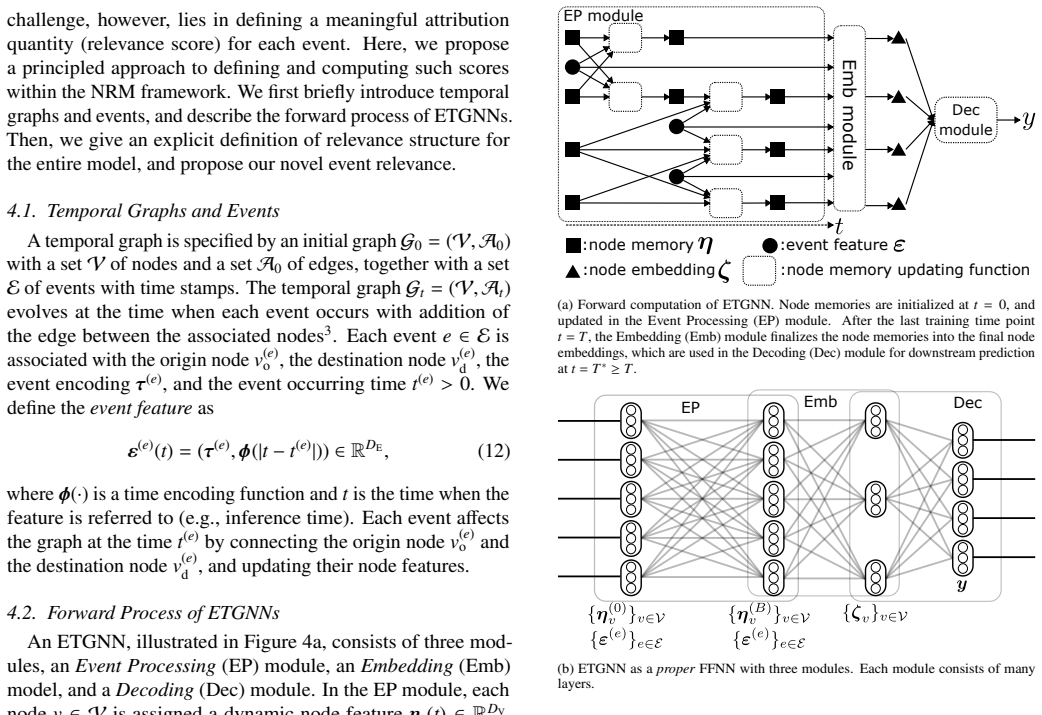
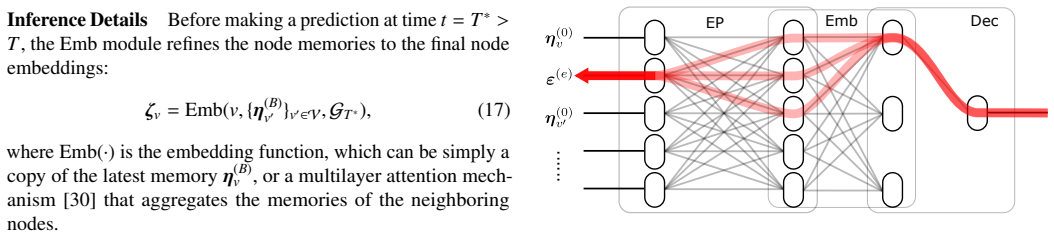
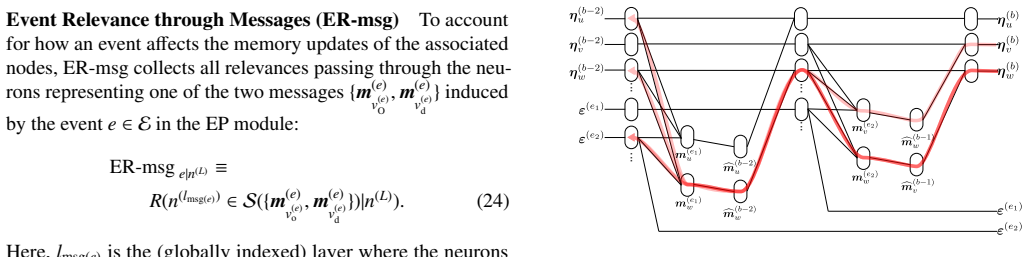
Event Relevance (ER) inside the Normalized Relevance Measure framework, obtained by modular decomposition of the ETGNN into Event-Processing, Embedding and Decoding modules so that walk relevance can be defined and propagated through every event-associated variable.
What would settle it
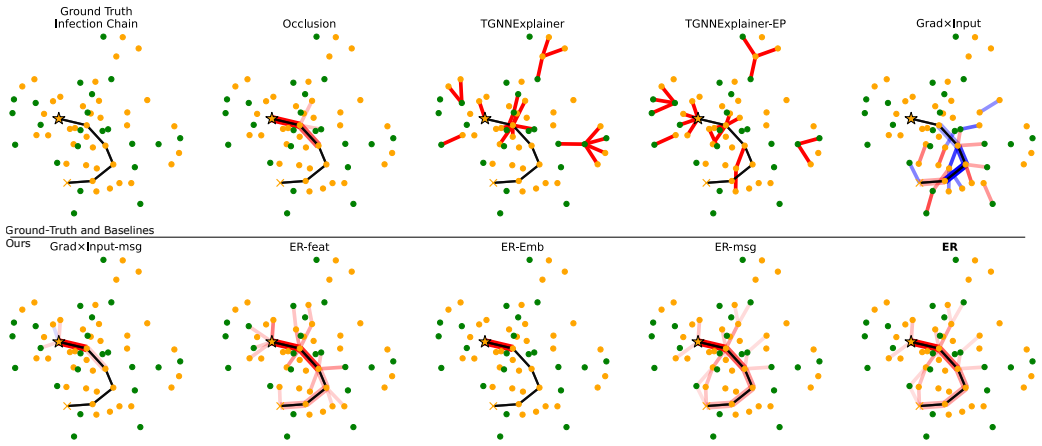
On a synthetic infection graph whose single ground-truth infection chain is known, compute top-k Event Relevance; if that chain is systematically ranked below the chains recovered by a baseline that ignores memory updates, the central claim fails.
Extended reading notes
Core claim
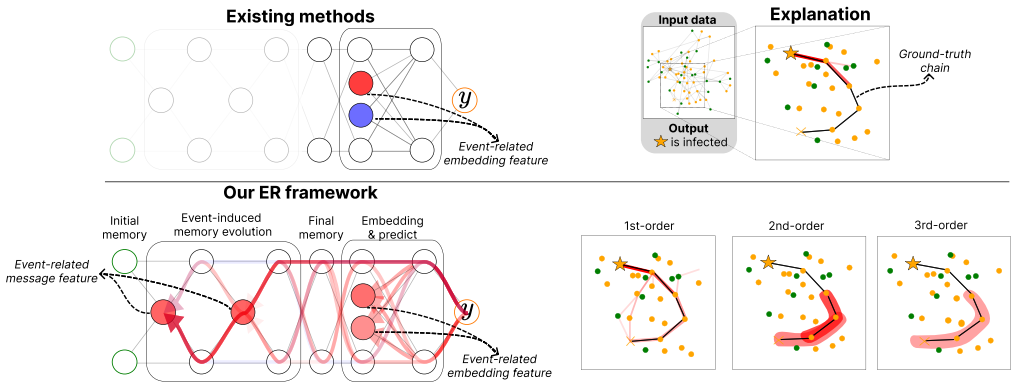
The contribution of an event to an ETGNN prediction is the relevance of the union of all walks that touch either the event feature itself or any of the messages the event induces during memory evolution; this quantity, called Event Relevance, is strictly more faithful than attributions that look only at the final embedding stage.
Load-bearing premise
That the chosen layer-wise relevance-propagation rules, once the network is rewritten as a proper feed-forward graph, correctly measure how much each event actually drives the model’s output.
Editorial analysis
A structured set of objections, weighed in public.
Referee Report
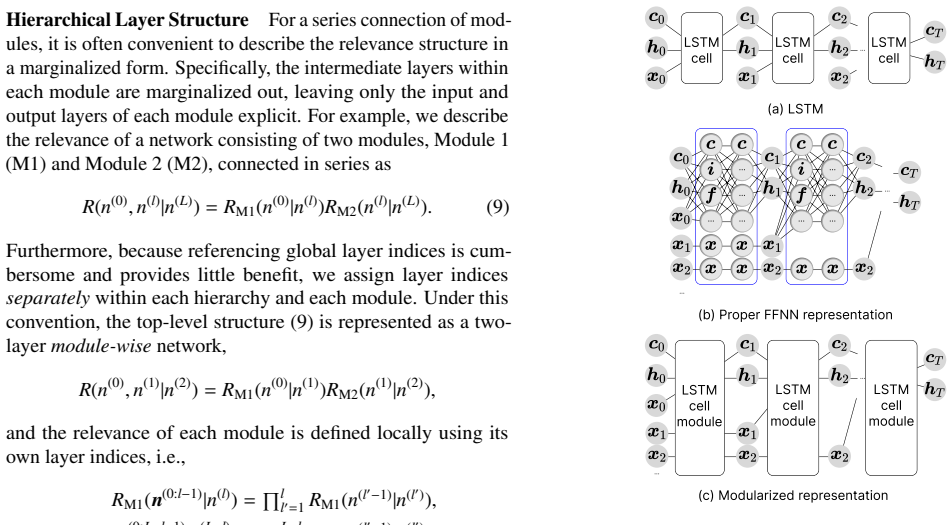
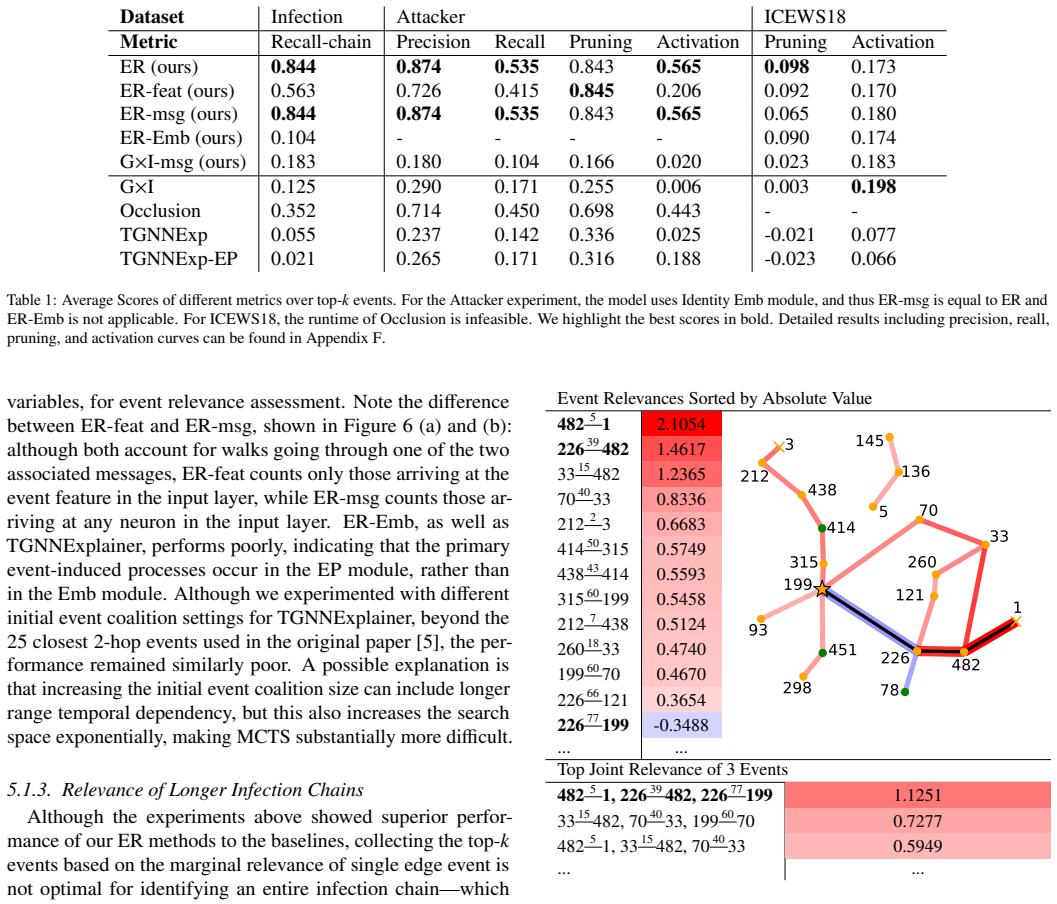
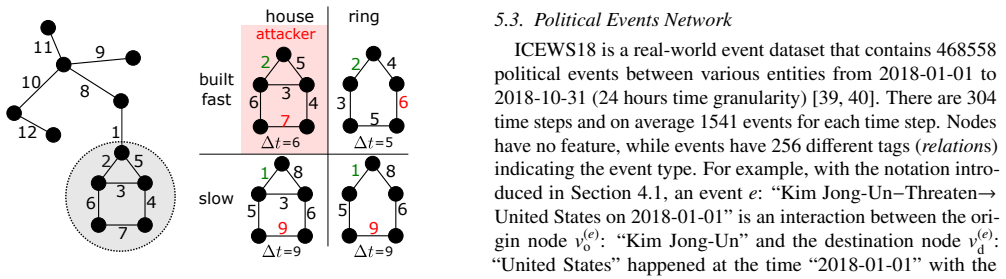
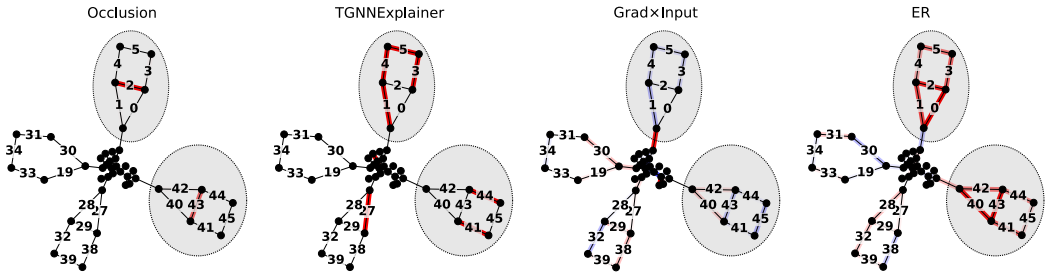
Summary. The paper proposes Event Relevance (ER), an LRP-style attribution method for Event-based Temporal Graph Neural Networks that attributes predictions to events by tracing the full event-induced information flow, including pathways through event-induced messages that update node memories in the Event Processing module. Building on the Normalized Relevance Measure (NRM) framework, the authors introduce a modular decomposition procedure (series/parallel connections, hierarchical layer indexing, local relevance) that makes NRM tractable for complex ETGNN architectures. They define ER-feat, ER-msg, ER-Emb, full ER, and joint multi-event relevance, and evaluate on synthetic infection-chain and attacker-motif datasets with ground-truth explanations plus the real-world ICEWS18 political event network. Qualitative heatmaps and quantitative metrics (Recall-chain, Precision/Recall, pruning/activation) show that ER and ER-msg substantially outperform TGNNExplainer, Occlusion, Grad imes Input, and the Emb-only baseline ER-Emb, especially for long-range temporal dependencies.
Significance. If the results hold, the work is a clear advance for XAI on temporal graphs: existing ETGNN explainers largely ignore the EP/memory pathway that carries long-range event interactions, and the paper supplies both a principled NRM-based definition that includes those pathways and synthetic benchmarks with verifiable ground-truth chains/motifs. The modular NRM extension is reusable beyond ETGNNs (illustrated on LSTM), and joint multi-event relevance is a natural higher-order capability that is demonstrated on infection chains. Strengths include explicit relevance factorizations in the appendices, multiple complementary evaluation metrics, and consistent qualitative/quantitative gains over strong baselines. The main free parameters (LRP-γ, ε) are conventional rather than circular.
major comments (2)
- [Section 5, Appendix C] Section 5 and Appendix C: the central claim that higher ER scores identify the events the model actually uses rests on the faithfulness of the chosen LRP rules (LRP-γ with γ=0.1 for linear layers; LRP-all for element-wise multiplications in GRU/attention) after modular conversion to a proper FFNN. This is a standard LRP assumption, but the manuscript does not report sensitivity to γ (or alternative rules such as LRP-0/ε) nor any sanity check that the modular factorization preserves conservation on the full ETGNN. A short ablation or conservation diagnostic would make the load-bearing faithfulness claim more robust.
- [Table 1, Appendix F] Table 1 and Appendix F: quantitative scores are reported as averages over top-k without error bars, confidence intervals, or statistical tests across episodes/graphs. Given that the superiority claim is quantitative (e.g., Recall-chain 0.844 vs ≤0.35 on Infection; large Precision/Recall gaps on Attacker), variability across samples should be shown so that the ranking is not driven by a few easy instances.
minor comments (5)
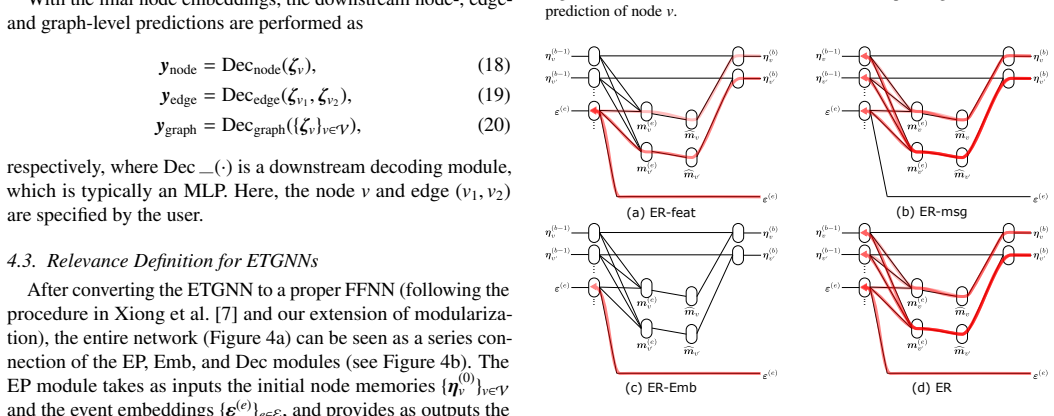
- [Figure 1, Section 4.4] Figure 1 and Section 4.4: the relation ER = ER-msg + ER-Emb (and why ER-feat is weaker) is clear in the text but would benefit from a one-sentence reminder in the figure caption that walks through messages but not the event feature itself are counted only by ER-msg.
- [Section 5.3, Table 2] Section 5.3 / Table 2: human-interpretability on ICEWS18 is argued via news-article alignment for a few selected events. A brief note on how the predicted events were chosen (and that Occlusion is infeasible) would reduce selection-bias concerns for readers.
- [Sections 3–4] Notation: global vs hierarchical/local layer indices (n^(l), l_msg(e), S^(l)(X)) are carefully defined but dense; a short notation table or consistent reminder when switching hierarchies would help.
- [Throughout] Typos / wording: e.g., "genereal architectures" (Sec. 3.1), "straightforwared" (footnote 5), "reall" in Table 1 caption; also arXiv id 2606.27201 appears future-dated relative to typical numbering.
- [Section 2.4, Section 5] Related work: TempME is cited but not run as a baseline; a short justification (or a limited comparison) would complete the experimental picture.
Circularity Check
No significant circularity; ER definitions and empirical claims rest on independent ground-truth/perturbation evaluations, with only ordinary self-citation of the authors' concurrent NRM framework.
-
self citation load bearing
[Sec. 2.2, Abstract, Sec. 3 intro, Eq. (21)]
"Our method is built upon the recent Normalized Relevance Measure (NRM) framework [7], a generalized procedure following the higher-order XAI method GNN-LRP [8] to define the relevance of arbitrary sets of neurons... This framework enables explicit quantification of the entire event-induced information flow, and guarantees comparability of relevance scores across layers."
NRM [7] is concurrent work by the identical author set (Xiong, Schnake, Müller, Nakajima). The paper treats its signed-measure axioms, marginal/conditional operations, and cross-layer comparability as given premises that underwrite ER. The citation is not machine-checked or externally falsified independently of the present authors; however it is not load-bearing for the empirical superiority claims, which rest on ground-truth chains and pruning curves, so the circularity is minor.
full rationale
The paper is an XAI methods paper whose central claims (ER recovers full event-induced walks including messages, outperforms TGNNExplainer/Occlusion/Grad imes Input on Infection Recall-chain, Attacker precision/recall, and ICEWS pruning) are evaluated against external synthetic ground-truth chains/motifs and model-output perturbations that do not depend on the NRM definitions themselves. The modular series/parallel decomposition (Eqs. 7–9, Sec. 3.2) and hierarchical indexing are constructive extensions that assemble walk relevances once LRP rules are fixed; they do not redefine the target quantities in terms of the outputs. The sole self-citation is to the concurrent NRM framework [7] (same author set), which supplies the signed-measure language and comparability guarantees; this is ordinary framework reuse, not a load-bearing uniqueness theorem or fitted ansatz that forces the reported superiority. γ=0.1 and LRP-all are conventional hyperparameters, not parameters fitted to the evaluation metrics and then re-presented as predictions. No self-definitional loop, fitted-input-as-prediction, or renaming of a known result appears in the derivation chain from proper-FFNN conversion through ER-feat/ER-msg/ER to the tables and figures. Score 1 only for the minor self-citation; the derivation is otherwise self-contained against external benchmarks.
Assumptions & free parameters
free parameters (2)
- LRP-γ hyper-parameter γ =
0.1
- numerical stabilizer ε =
1e-6
assumptions (4)
- domain assumption Normalized Relevance Measure axioms (R(∅)=0, R(W)=1, additivity over disjoint walk sets) and the backward-Markov factorization of walk relevance.
- domain assumption Any architecture can be virtually converted into a proper FFNN by unfolding, copying intermediate inputs/outputs and inserting duplication layers for skip connections.
- domain assumption LRP-γ (γ=0.1) for linear layers and LRP-all for element-wise multiplications correctly redistribute relevance.
- ad hoc to paper Event-induced messages m(e) are the intermediate variables that mediate long-range temporal dependencies and therefore must be included in event relevance.
invented entities (2)
-
Event Relevance (ER) and its variants ER-feat, ER-msg, ER-Emb, joint multi-event ER
-
Modular decomposition procedure for NRM
Cite this review
Pith. "Pith review of Explaining Temporal Graph Neural Networks via Feature-induced Information Flow." pith.science (2026). https://pith.science/paper/KE5OCKBA
@misc{pith2026260627201,
  author       = {Pith},
  title        = {Pith review of: Explaining Temporal Graph Neural Networks via Feature-induced Information Flow},
  year         = {2026},
  howpublished = {\url{https://pith.science/paper/KE5OCKBA}},
  note         = {Machine review of arXiv:2606.27201}
}
read the original abstract
Event-based Temporal Graph Neural Networks (ETGNNs) have demonstrated strong performance across a wide range of applications, including social network analysis, epidemic tracing, recommender systems, and political event forecasting. However, their increasing complexity poses significant challenges for explainability. Existing explanation methods focus only on a subset of the information flow within ETGNNs, typically tracing contributions from the event-related embeddings to the output. Consequently, they overlook the important pathways through event-induced variables, which mediate interactions between nodes and thereby play a central role in capturing long-range temporal dependencies. To overcome this limitation, we propose a novel attribution method that analyzes the entire information flow through all event-associated variables. Our method is built upon the recent Normalized Relevance Measure (NRM) framework, which enables explicit quantification of information flow originating from event embeddings as well as information flow passing through event-induced variables. It also ensures comparability of latent variables across layers, and supports higher-order analysis of interactions between events. To handle the architectural complexity of ETGNNs, we extend the NRM framework with a modular decomposition procedure that facilitates the systematic construction of relevance structure for complex neural architectures. We evaluate our approach on two synthetic datasets for epidemic tracing and social dynamics, as well as a real-world dataset of political event networks. Our qualitative and quantitative experiments show that our method consistently outperforms existing explanation approaches while producing more human-interpretable explanations.
Figures

Figures from the paper (8 more)
Reference graph
Works this paper leans on
-
[1]
C. Gao, X. Wang, X. He, Y . Li, Graph neural networks for recommender system, in: WSDM, ACM, 2022, pp. 1623–1625
2022
-
[2]
S. Deng, H. Rangwala, Y . Ning, Learning dynamic context graphs for predicting social events, in: KDD, ACM, 2019, pp. 1007–1016
2019
-
[3]
Cencetti, G
G. Cencetti, G. Santin, A. Longa, E. Pigani, A. Barrat, C. Cattuto, S. Lehmann, M. Salathé, B. Lepri, Digital prox- imity tracing on empirical contact networks for pandemic control, Nat. Commun. 12 (1) (2021) 1655
2021
-
[4]
L. Zhao, Y . Song, C. Zhang, Y . Liu, P. Wang, T. Lin, M. Deng, H. Li, T-GCN: A temporal graph convolutional network for traffic prediction, IEEE Trans. Intell. Transp. Syst. 21 (9) (2020) 3848–3858
2020
-
[5]
W. Xia, M. Lai, C. Shan, Y . Zhang, X. Dai, X. Li, D. Li, Explaining temporal graph models through an explorer- navigator framework, in: ICLR, OpenReview.net, 2023
2023
-
[6]
J. Chen, R. Ying, Tempme: Towards the explainability of temporal graph neural networks via motif discovery, in: NeurIPS, 2023
2023
- [7]
-
[8]
Schnake, O
T. Schnake, O. Eberle, J. Lederer, S. Nakajima, K. T. Schütt, K.-R. Müller, G. Montavon, Higher-order explana- tions of graph neural networks via relevant walks, IEEE Trans. Pattern Anal. Mach. Intell. 44 (11) (2022) 7581– 7596
2022
Show all 42 references
-
[9]
S. Bach, A. Binder, G. Montavon, F. Klauschen, K.-R. Müller, W. Samek, On pixel-wise explanations for non- linear classifier decisions by layer-wise relevance propaga- tion, PloS one 10 (7) (2015) e0130140
2015
-
[10]
Achtibat, S
R. Achtibat, S. M. V . Hatefi, M. Dreyer, A. Jain, T. Wie- gand, S. Lapuschkin, W. Samek, Attnlrp: Attention-aware layer-wise relevance propagation for transformers, in: ICML, V ol. 235 of Proceedings of Machine Learning Re- search, PMLR/OpenReview.net, 2024, pp. 135–168
2024
-
[11]
Kauffmann, J
J. Kauffmann, J. Dippel, L. Ruff, W. Samek, K.-R. Müller, G. Montavon, Explainable ai reveals clever hans effects in unsupervised learning models, Nature Machine Intelli- gence 7 (3) (2025) 412–422
2025
-
[12]
what is relevant in a text document?
L. Arras, F. Horn, G. Montavon, K.-R. Müller, W. Samek, "what is relevant in a text document?": An interpretable machine learning approach, PLOS ONE 12 (8) (2017) 1– 23
2017
-
[13]
A. Ali, T. Schnake, O. Eberle, G. Montavon, K.-R. Müller, L. Wolf, XAI for transformers: Better explanations through conservative propagation, in: ICML, Proceedings of Ma- chine Learning Research, PMLR, 2022, pp. 435–451
2022
-
[14]
Esders, T
M. Esders, T. Schnake, J. Lederer, A. Kabylda, G. Mon- tavon, A. Tkatchenko, K.-R. Müller, Analyzing atomic interactions in molecules as learned by neural networks, J. Chem. Theory Comput. 21 (2) (2025) 714–729
2025
-
[15]
Montavon, S
G. Montavon, S. Lapuschkin, A. Binder, W. Samek, K.-R. Müller, Explaining nonlinear classification decisions with deep taylor decomposition, Pattern Recognit. 65 (2017) 211–222
2017
-
[16]
Samek, G
W. Samek, G. Montavon, S. Lapuschkin, C. J. Anders, K.- R. Müller, Explaining deep neural networks and beyond: A review of methods and applications, Proc. IEEE 109 (3) (2021) 247–278
2021
-
[17]
Montavon, A
G. Montavon, A. Binder, S. Lapuschkin, W. Samek, K.-R. Müller, Layer-wise relevance propagation: An overview, in: Explainable AI, Springer, 2019, pp. 193–209
2019
-
[18]
Arras, J
L. Arras, J. A. Arjona-Medina, M. Widrich, G. Montavon, M. Gillhofer, K.-R. Müller, S. Hochreiter, W. Samek, Ex- plaining and interpreting LSTMs, in: Explainable AI: In- terpreting, Explaining and Visualizing Deep Learning, V ol. 11700, Springer, 2019, pp. 211–238
2019
-
[19]
Xiong, T
P. Xiong, T. Schnake, G. Montavon, K.-R. Müller, S. Naka- jima, Efficient computation of higher-order subgraph attri- bution via message passing, in: ICML, PMLR, 2022, pp. 24478–24495
2022
-
[20]
J. Chen, T. Ma, C. Xiao, Fastgcn: Fast learning with graph convolutional networks via importance sampling, in: ICLR (Poster), OpenReview.net, 2018
2018
-
[21]
W. L. Hamilton, Z. Ying, J. Leskovec, Inductive repre- sentation learning on large graphs, in: NIPS, 2017, pp. 1024–1034
2017
-
[22]
T. N. Kipf, M. Welling, Semi-supervised classification with graph convolutional networks, in: 5th International Con- ference on Learning Representations, ICLR 2017, Toulon, France, April 24-26, 2017, Conference Track Proceedings, 2017
2017
-
[23]
K. T. Schütt, H. E. Sauceda, P.-J. Kindermans, A. Tkatchenko, K.-R. Müller, Schnet–a deep learning ar- chitecture for molecules and materials, J. Chem. Phys. 148 (24) (2018) 241722
2018
-
[24]
H. Yuan, H. Yu, S. Gui, S. Ji, Explainability in graph neural networks: A taxonomic survey, IEEE Trans. Pattern Anal. Mach. Intell. 45 (5) (2023) 5782–5799
2023
-
[25]
W. Ju, Z. Fang, Y . Gu, Z. Liu, Q. Long, Z. Qiao, Y . Qin, J. Shen, F. Sun, Z. Xiao, J. Yang, J. Yuan, Y . Zhao, Y . Wang, X. Luo, M. Zhang, A comprehensive survey on deep 14 graph representation learning, Neural Networks 173 (2024) 106207
2024
-
[26]
Monti, D
F. Monti, D. Boscaini, J. Masci, E. Rodolà, J. Svoboda, M. M. Bronstein, Geometric deep learning on graphs and manifolds using mixture model cnns, in: CVPR, IEEE Computer Society, 2017, pp. 5425–5434
2017
-
[27]
Rossi, B
E. Rossi, B. Chamberlain, F. Frasca, D. Eynard, F. Monti, M. M. Bronstein, Temporal graph networks for deep learn- ing on dynamic graphs, CoRR abs/2006.10637 (2020)
2006 arXiv
-
[28]
Y . Ma, Z. Guo, Z. Ren, J. Tang, D. Yin, Streaming graph neural networks, in: SIGIR, ACM, 2020, pp. 719–728
2020
-
[29]
Kumar, X
S. Kumar, X. Zhang, J. Leskovec, Predicting dynamic embedding trajectory in temporal interaction networks, in: KDD, ACM, 2019, pp. 1269–1278
2019
-
[30]
D. Xu, C. Ruan, E. Körpeoglu, S. Kumar, K. Achan, Induc- tive representation learning on temporal graphs, in: ICLR, OpenReview.net, 2020
2020
-
[31]
R. S. Trivedi, M. Farajtabar, P. Biswal, H. Zha, Dyrep: Learning representations over dynamic graphs, in: ICLR (Poster), OpenReview.net, 2019
2019
-
[32]
Kocsis, C
L. Kocsis, C. Szepesvári, Bandit based monte-carlo plan- ning, in: ECML, V ol. 4212 of Lecture Notes in Computer Science, Springer, 2006, pp. 282–293
2006
-
[33]
Tishby, F
N. Tishby, F. C. N. Pereira, W. Bialek, The informa- tion bottleneck method, CoRR physics/0004057 (2000). arXiv:physics/0004057
2000 arXiv
-
[34]
K. Cho, B. van Merrienboer, Ç. Gülçehre, D. Bahdanau, F. Bougares, H. Schwenk, Y . Bengio, Learning phrase representations using RNN encoder-decoder for statistical machine translation, in: EMNLP, ACL, 2014, pp. 1724– 1734
2014
-
[35]
Shrikumar, P
A. Shrikumar, P. Greenside, A. Kundaje, Learning impor- tant features through propagating activation differences, in: ICML, PMLR, 2017, pp. 3145–3153
2017
-
[36]
Ancona, E
M. Ancona, E. Ceolini, C. Öztireli, M. Gross, Towards bet- ter understanding of gradient-based attribution methods for deep neural networks, in: ICLR (Poster), OpenReview.net, 2018
2018
-
[37]
Samek, A
W. Samek, A. Binder, G. Montavon, S. Lapuschkin, K.-R. Müller, Evaluating the visualization of what a deep neural network has learned, IEEE Trans. Neural Netw. Learn. Syst. 28 (11) (2017) 2660–2673
2017
-
[38]
Blücher, J
S. Blücher, J. Vielhaben, N. Strodthoff, Preddiff: Explana- tions and interactions from conditional expectations, Artif. Intell. 312 (2022) 103774
2022
-
[39]
W. Jin, M. Qu, X. Jin, X. Ren, Recurrent event network: Autoregressive structure inferenceover temporal knowl- edge graphs, in: EMNLP (1), Association for Computa- tional Linguistics, 2020, pp. 6669–6683
2020
-
[40]
Boschee, J
E. Boschee, J. Lautenschlager, S. O’Brien, S. Shellman, J. Starz, M. Ward, ICEWS Coded Event Data (2015)
2015
-
[41]
Montavon, Gradient-based vs
G. Montavon, Gradient-based vs. propagation-based ex- planations: An axiomatic comparison, in: Explainable AI: Interpreting, Explaining and Visualizing Deep Learning, Springer International Publishing, Cham, 2019, pp. 253– 265
2019
-
[42]
Shinzo Abe−Express intent to meet or negotiate→North Korea
L. Arras, G. Montavon, K.-R. Müller, W. Samek, Explain- ing recurrent neural network predictions in sentiment analy- sis, in: W ASSA@EMNLP, Association for Computational Linguistics, 2017, pp. 159–168. Appendix A. Modularized NRM for LSTM Here we give details of example applic...
2017
Reviewed July 15, 2026 · model on record in the stance chip above.
Discussion (0). Sign in to comment.