Bootstrapping two-loop six-gluon amplitudes in QCD
Pith reviewed 2026-06-29 04:14 UTC · model grok-4.3
The pith
The maximal-weight symbol of the planar two-loop six-gluon amplitude in massless QCD is fixed for all MHV configurations by a symbol bootstrap.
A machine-rendered reading of the paper's core claim, the machinery that carries it, and where it could break.
Core claim
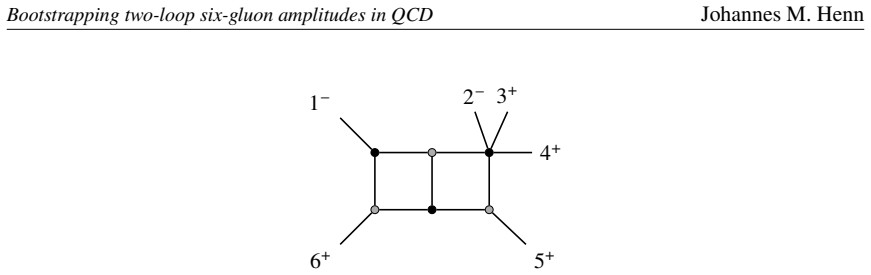
Combining input from four-dimensional leading singularities with the two-loop six-particle function space, the symbol bootstrap determines the maximal-weight symbol of the planar two-loop six-gluon amplitude in massless QCD for the −−++++ helicity configuration and subsequently for all MHV configurations. The answer is fixed uniquely by physical consistency conditions, requires a reduced alphabet of only 137 symbol letters, and yields previously unknown two-loop triple-collinear and double-soft splitting functions.
What carries the argument
The symbol bootstrap that multiplies the two-loop six-particle function space by rational prefactors obtained from four-dimensional leading singularities classified via on-shell diagrams.
If this is right
- The planar two-loop six-gluon MHV amplitudes are fixed without evaluating any Feynman integrals directly.
- Only 137 symbol letters are needed instead of the full expected alphabet.
- New two-loop triple-collinear and double-soft splitting functions become available as immediate byproducts.
- The same prefactor construction applies at arbitrary multiplicity.
Where Pith is reading between the lines
- The method supplies a practical route to maximal-weight terms at three loops once the corresponding function space is known.
- Extension to non-planar topologies would require only a classification of the relevant leading singularities.
- The reduced alphabet may point to hidden relations among symbol letters that hold beyond six particles.
Load-bearing premise
The rational prefactors that multiply the highest-weight special functions of planar QCD amplitudes are completely determined by four-dimensional leading singularities.
What would settle it
An explicit two-loop computation of any MHV six-gluon amplitude whose maximal-weight symbol differs from the bootstrapped result in at least one coefficient.
Figures
read the original abstract
The maximally transcendental, or most complicated, terms of gauge-theory scattering amplitudes have long been singled out, following Lipatov and collaborators, as those parts of a QCD amplitude that most closely mirror maximally supersymmetric Yang--Mills theory. We report on a programme that turns this observation into a practical computational tool. We show that the rational prefactors multiplying the highest-weight special functions of planar QCD amplitudes are governed by four-dimensional leading singularities, which can be classified and evaluated using on-shell diagrams. The resulting prefactors are manifestly conformally invariant and admit compact spinor-helicity expressions that hold for arbitrary multiplicity. Combining this input with the recently established two-loop six-particle function space, we set up a symbol bootstrap and determine, for the first time, the maximal-weight symbol of the planar two-loop six-gluon amplitude in massless QCD, first for the ${-}{-}{+}{+}{+}{+}$ helicity configuration and subsequently for all MHV configurations. The answer is fixed uniquely by physical consistency conditions, requires a reduced alphabet of only $137$ symbol letters, and yields as a byproduct previously unknown two-loop triple-collinear and double-soft splitting functions. We summarise the method and the results, and outline the directions they open up.
Editorial analysis
A structured set of objections, weighed in public.
Referee Report
Summary. The manuscript claims that rational prefactors in planar QCD amplitudes are determined by four-dimensional leading singularities via on-shell diagrams, which are then combined with the two-loop six-particle function space to set up a symbol bootstrap. This uniquely fixes the maximal-weight symbol of the planar two-loop six-gluon amplitude for the --++++ helicity configuration and all MHV cases, using physical consistency conditions, a reduced 137-letter alphabet, and yielding new triple-collinear and double-soft splitting functions as byproducts.
Significance. If the result holds, the work converts the observation that maximally transcendental terms in QCD mirror those in SYM into a practical tool, delivering the first determination of this six-gluon two-loop symbol and new splitting functions. The compact spinor-helicity expressions for arbitrary multiplicity and the reduced alphabet are notable strengths that could extend to higher loops and multiplicities.
major comments (2)
- [Abstract] Abstract, paragraph 2: the claim that four-dimensional leading singularities via on-shell diagrams fully govern the rational prefactors multiplying highest-weight functions is load-bearing for the ansatz. The manuscript must demonstrate that no additional rational structures appear at two loops in QCD that are invisible to strictly 4D on-shell diagrams, as any incompleteness would invalidate the subsequent unique determination of the 137-letter symbol.
- [Bootstrap setup] The section on the symbol bootstrap: the assertion that physical consistency conditions fix the symbol uniquely requires an explicit accounting of the dimension of the function space versus the number and independence of the imposed conditions (e.g., collinear limits, soft limits, or other physical constraints) to confirm that no residual freedom remains.
minor comments (2)
- Ensure the main text provides the explicit list or a machine-readable file for the 137 symbol letters, as this is essential for reproducibility of the bootstrap result.
- Clarify the precise overlap between the two-loop six-particle function space construction and the present work to allow readers to assess any shared assumptions.
Simulated Author's Rebuttal
We thank the referee for their positive evaluation of the work and for the constructive major comments. We address each point below and indicate the revisions that will be made to strengthen the manuscript.
read point-by-point responses
-
Referee: [Abstract] Abstract, paragraph 2: the claim that four-dimensional leading singularities via on-shell diagrams fully govern the rational prefactors multiplying highest-weight functions is load-bearing for the ansatz. The manuscript must demonstrate that no additional rational structures appear at two loops in QCD that are invisible to strictly 4D on-shell diagrams, as any incompleteness would invalidate the subsequent unique determination of the 137-letter symbol.
Authors: The manuscript demonstrates this by explicitly constructing all rational prefactors for the six-gluon MHV amplitudes via 4D on-shell diagrams, yielding compact spinor-helicity expressions that are conformally invariant and consistent with all known lower-multiplicity and lower-loop results. The bootstrap then produces a unique symbol that satisfies every physical constraint, providing a strong a-posteriori consistency check. Nevertheless, to make the argument fully explicit we will add a short dedicated paragraph (in the introduction or the on-shell-diagram section) that recalls why, at two-loop order in planar QCD, no additional rational structures invisible to 4D leading singularities are expected for the maximal-weight sector; this paragraph will reference the known structure of infrared poles and the observed maximal-transcendentality matching with SYM. revision: partial
-
Referee: [Bootstrap setup] The section on the symbol bootstrap: the assertion that physical consistency conditions fix the symbol uniquely requires an explicit accounting of the dimension of the function space versus the number and independence of the imposed conditions (e.g., collinear limits, soft limits, or other physical constraints) to confirm that no residual freedom remains.
Authors: We agree that an explicit dimension count will make the uniqueness statement more transparent. The two-loop six-particle function space is taken from the referenced work (dimension known and finite), and the physical conditions (triple-collinear, double-soft, single-soft, and consistency with five-point amplitudes) supply an over-complete but linearly independent set of linear equations on the symbol coefficients. In the revised manuscript we will insert a concise paragraph (or short appendix table) that states the dimension of the ansatz, enumerates the independent constraints, and notes that the resulting linear system is over-determined yet admits a unique solution; the independence of the constraints is verified by direct linear-algebra rank computation on the symbol level. revision: yes
Circularity Check
Self-citation on function space creates modest load-bearing dependence but leading-singularity input remains independent
specific steps
-
self citation load bearing
[abstract]
"Combining this input with the recently established two-loop six-particle function space, we set up a symbol bootstrap and determine, for the first time, the maximal-weight symbol of the planar two-loop six-gluon amplitude in massless QCD, first for the −−++++ helicity configuration and subsequently for all MHV configurations. The answer is fixed uniquely by physical consistency conditions"
The uniqueness of the 137-letter symbol is asserted to follow from the function space plus consistency conditions; because the function space originates in prior work by overlapping authors (Henn et al.), the load-bearing step that forces uniqueness reduces to that self-cited input without an external machine-checked or independently falsifiable verification cited in the abstract.
full rationale
The derivation combines a claimed demonstration that rational prefactors are governed by 4D leading singularities (evaluated via on-shell diagrams) with the two-loop six-particle function space to fix the symbol uniquely via physical consistency conditions. The function space is described as 'recently established' and shares authors with the present work, introducing a self-citation that supports the uniqueness claim. However, no equation reduces by construction to a fitted parameter or prior self-result, the leading-singularity step is presented as shown here rather than imported, and no ansatz is smuggled via citation. The central result therefore retains independent content from the on-shell diagram classification and consistency conditions.
Axiom & Free-Parameter Ledger
axioms (2)
- domain assumption The rational prefactors multiplying the highest-weight special functions are governed by four-dimensional leading singularities classifiable via on-shell diagrams.
- domain assumption Physical consistency conditions uniquely determine the maximal-weight symbol once the function space and leading-singularity prefactors are supplied.
Reference graph
Works this paper leans on
-
[1]
H. Elvang and Y.-t. Huang,Scattering Amplitudes in Gauge Theory and Gravity, Cambridge University Press (2015) [arXiv:1308.1697]
Pith/arXiv arXiv 2015
-
[2]
Notes Phys.1021(2024) [arXiv:2306.05976]
S.Badger,J.Henn,J.C.PlefkaandS.Zoia,ScatteringAmplitudesinQuantumFieldTheory, Lect. Notes Phys.1021(2024) [arXiv:2306.05976]
arXiv 2024
- [3]
-
[4]
J. Henn, A. Matijašić, J. Miczajka, T. Peraro, Y. Xu and Y. Zhang,Complete function space for planar two-loop six-particle scattering amplitudes,Phys. Rev. Lett.135(2025) 031601 [arXiv:2501.01847]
arXiv 2025
-
[5]
G. De Laurentis, H. Ita, M. Klinkert and V. Sotnikov,Double-virtual NNLO QCD cor- rections for five-parton scattering. I. The gluon channel,Phys. Rev. D109(2024) 094023 [arXiv:2311.10086]
arXiv 2024
-
[6]
G.DeLaurentis,H.Ita,B.PageandV.Sotnikov,Compacttwo-loopQCDcorrectionsfor𝑉 𝑗 𝑗 production in proton collisions,JHEP06(2025) 093 [arXiv:2503.10595]
arXiv 2025
-
[7]
A. V. Kotikov and L. N. Lipatov,DGLAP and BFKL equations in theN=4supersymmetric gauge theory,Nucl. Phys. B661(2003) 19 [hep-ph/0208220]
Pith/arXiv arXiv 2003
-
[8]
A. V. Kotikov, L. N. Lipatov, A. I. Onishchenko and V. N. Velizhanin,Three loop universal anomalous dimension of the Wilson operators inN=4SUSY Yang-Mills model,Phys. Lett. B595(2004) 521 [hep-th/0404092]
Pith/arXiv arXiv 2004
-
[9]
D. J. Broadhurst, J. A. Gracey and D. Kreimer,Beyond the triangle and uniqueness re- lations: non-zeta counterterms at large𝑁from positive knots,Z. Phys. C75(1997) 559 [hep-th/9607174]
Pith/arXiv arXiv 1997
-
[10]
Catani,The singular behaviour of QCD amplitudes at two loop order,Phys
S. Catani,The singular behaviour of QCD amplitudes at two loop order,Phys. Lett. B427 (1998) 161 [hep-ph/9802439]
Pith/arXiv arXiv 1998
-
[11]
S. M. Aybat, L. J. Dixon and G. F. Sterman,The two-loop soft anomalous dimension matrix and resummation at next-to-next-to-leading pole,Phys. Rev. D74(2006) 074004 [hep-ph/0607309]
Pith/arXiv arXiv 2006
-
[12]
T.Gehrmann,J.M.HennandT.Huber,Thethree-loopformfactorinN=4superYang-Mills, JHEP03(2012) 101 [arXiv:1112.4524]
Pith/arXiv arXiv 2012
-
[13]
L.J.Dixon,Theprincipleofmaximaltranscendentalityandthefour-loopcollinearanomalous dimension,JHEP01(2018) 075 [arXiv:1712.07274]
Pith/arXiv arXiv 2018
-
[14]
S. Carrôlo, D. Chicherin, J. Henn, Q. Yang and Y. Zhang,Bootstrapping six-gluon QCD amplitudes,Phys. Rev. Lett.136(2026) 18, 181602 [arXiv:2510.20565]
arXiv 2026
-
[15]
S. Carrôlo, D. Chicherin, J. Henn, Q. Yang and Y. Zhang,QCD scattering amplitudes and prescriptive unitarity, [arXiv:2602.02783]
-
[16]
D.Chicherin,J.M.HennandG.Papathanasiou,ClusteralgebrasforFeynmanintegrals,Phys. Rev. Lett.126(2021) 091603 [arXiv:2012.12285]
arXiv 2021
-
[17]
N. Arkani-Hamed, J. L. Bourjaily, F. Cachazo and J. Trnka,Local integrals for planar scat- tering amplitudes,JHEP06(2012) 125 [arXiv:1012.6032]
Pith/arXiv arXiv 2012
-
[18]
J. M. Henn,Multiloop integrals in dimensional regularization made simple,Phys. Rev. Lett. 110(2013) 251601 [arXiv:1304.1806]. 7 Bootstrapping two-loop six-gluon amplitudes in QCDJohannes M. Henn
Pith/arXiv arXiv 2013
-
[19]
J. M. Henn and W. J. Torres Bobadilla,Maximal transcendental weight contribution of scat- tering amplitudes,JHEP03(2022) 174 [arXiv:2112.08900]
arXiv 2022
-
[20]
N. Arkani-Hamed, J. L. Bourjaily, F. Cachazo, A. B. Goncharov, A. Postnikov and J. Trnka, Grassmannian Geometry of Scattering Amplitudes, Cambridge University Press (2016) [arXiv:1212.5605]
Pith/arXiv arXiv 2016
-
[21]
Witten,Perturbative gauge theory as a string theory in twistor space,Commun
E. Witten,Perturbative gauge theory as a string theory in twistor space,Commun. Math. Phys.252(2004) 189 [hep-th/0312171]
Pith/arXiv arXiv 2004
-
[22]
J.Henn,B.PowerandS.Zoia,Conformalinvarianceoftheone-loopall-plushelicityscattering amplitudes,JHEP02(2020) 019 [arXiv:1911.12142]
arXiv 2020
-
[23]
S. Abreu, J. Dormans, F. Febres Cordero, H. Ita, B. Page and V. Sotnikov,Analytic form of the planar two-loop five-parton scattering amplitudes in QCD,JHEP05(2019) 084 [arXiv:1904.00945]
Pith/arXiv arXiv 2019
-
[24]
B. Agarwal, F. Buccioni, F. Devoto, G. Gambuti et al.,Five-parton scattering in QCD at two loops,Phys. Rev. D109(2024) 094025 [arXiv:2311.09870]
arXiv 2024
-
[25]
L. Bossinger, J. Drummond, R. Glew, Ö. Gürdoğan and R. Wright,Singularities of massless scattering and cluster algebras, [arXiv:2507.01015]
-
[26]
A. Pokraka, M. Spradlin, A. Volovich and H.-C. Weng,Symbol alphabets in QCD and flag cluster algebras,JHEP03(2026) 120 [arXiv:2506.11895]
arXiv 2026
-
[27]
J. L. Bourjaily, E. Herrmann and J. Trnka,Prescriptive unitarity,JHEP06(2017) 059 [arXiv:1704.05460]
Pith/arXiv arXiv 2017
-
[28]
Z. Bern, L. J. Dixon, D. C. Dunbar and D. A. Kosower,One loop𝑛point gauge theory amplitudes, unitarity and collinear limits,Nucl. Phys. B425(1994) 217 [hep-ph/9403226]
Pith/arXiv arXiv 1994
-
[29]
A. B. Goncharov, M. Spradlin, C. Vergu and A. Volovich,Classical polylogarithms for amplitudes and Wilson loops,Phys. Rev. Lett.105(2010) 151605 [arXiv:1006.5703]
Pith/arXiv arXiv 2010
-
[30]
S. Caron-Huot, L. J. Dixon, J. M. Drummond, F. Dulat, J. Foster, Ö. Gürdoğan et al.,The SteinmannclusterbootstrapforN=4superYang-Millsamplitudes,PoSCORFU2019(2020) 003 [arXiv:2005.06735]
arXiv 2020
-
[31]
J.M.Henn,WhatcanwelearnaboutQCDandcolliderphysicsfromN=4sYM?,Ann.Rev. Nucl. Part. Sci.71(2021) 153 [arXiv:2006.00361]
arXiv 2021
- [32]
-
[33]
S. Caron-Huot, D. Chicherin, J. Henn, Y. Zhang and S. Zoia,Multi-Regge limit of the two- loop five-point amplitudes inN=4sYM andN=8supergravity,JHEP10(2020) 188 [arXiv:2003.03120]
arXiv 2020
-
[34]
D. C. Dunbar,The six gluon one-loop amplitude,Nucl. Phys. B Proc. Suppl.183(2008) 122 [arXiv:0901.1202]
Pith/arXiv arXiv 2008
- [35]
discussion (0)
Sign in with ORCID, Apple, or X to comment. Anyone can read and Pith papers without signing in.