Inferring Cosmology and Astrophysics from the High-redshift 21cm Signal with SKA-Low
Pith reviewed 2026-06-29 03:23 UTC · model grok-4.3
The pith
The initial SKA-Low configuration can measure galaxy and IGM properties from the 21 cm signal during reionisation by combining multiple statistics.
A machine-rendered reading of the paper's core claim, the machinery that carries it, and where it could break.
Core claim
Combining the power spectrum with higher-order statistics, moments, and morphological descriptors of the 21 cm field breaks parameter degeneracies and allows inference of galaxy and IGM properties; the initial SKA-Low configuration is already capable of producing early science results on these quantities.
What carries the argument
Higher-order statistics and morphological measurements applied to the 21 cm signal, which extract information from the patchy, non-Gaussian evolution of ionised regions and temperature fluctuations.
If this is right
- Multiple complementary statistics are required to separate astrophysical from cosmological effects in the 21 cm signal.
- Semi-numerical and emulator-based models are needed to predict the range of higher-order statistics for parameter inference.
- Bayesian and simulation-based inference frameworks can map observed statistics back to underlying galaxy and IGM physics.
- The AA* configuration suffices for initial constraints on reionisation timing and galaxy properties.
Where Pith is reading between the lines
- If foreground cleaning preserves higher-order moments, the same statistics could be applied to intensity-mapping surveys at other frequencies.
- Validation against mock observations would test whether current modeling frameworks accurately capture the non-Gaussian morphology.
- Extending the analysis to full SKA-Low sensitivity would tighten limits on the timing of Cosmic Dawn once early results are in hand.
Load-bearing premise
The non-Gaussian features of the 21 cm signal driven by patchy ionisation and spin-temperature fluctuations contain extractable information beyond what the power spectrum provides.
What would settle it
SKA-Low data in which adding the bispectrum, signal moments, or morphological measures produces no improvement in constraints on reionisation parameters compared with the power spectrum alone.
Figures
read the original abstract
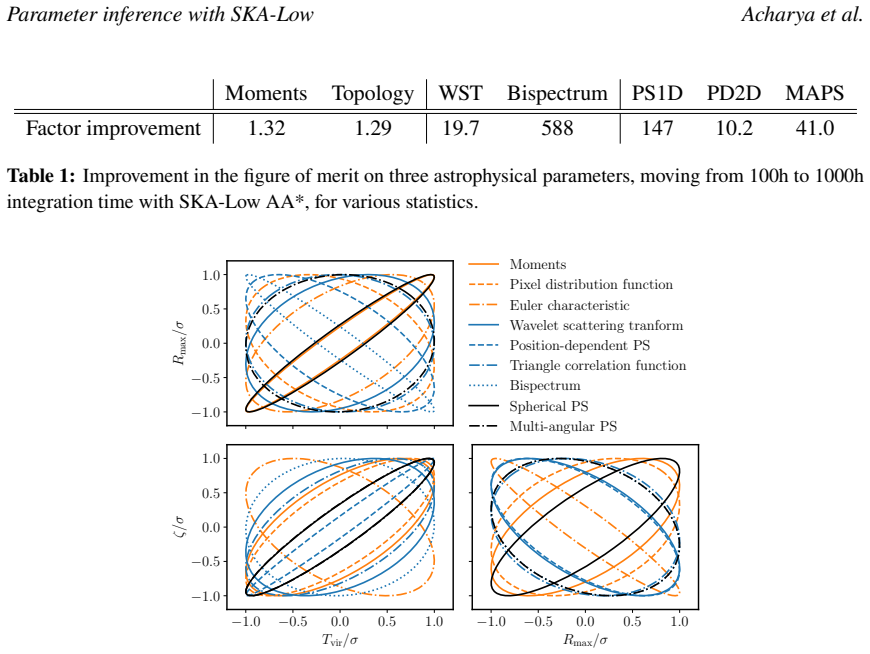
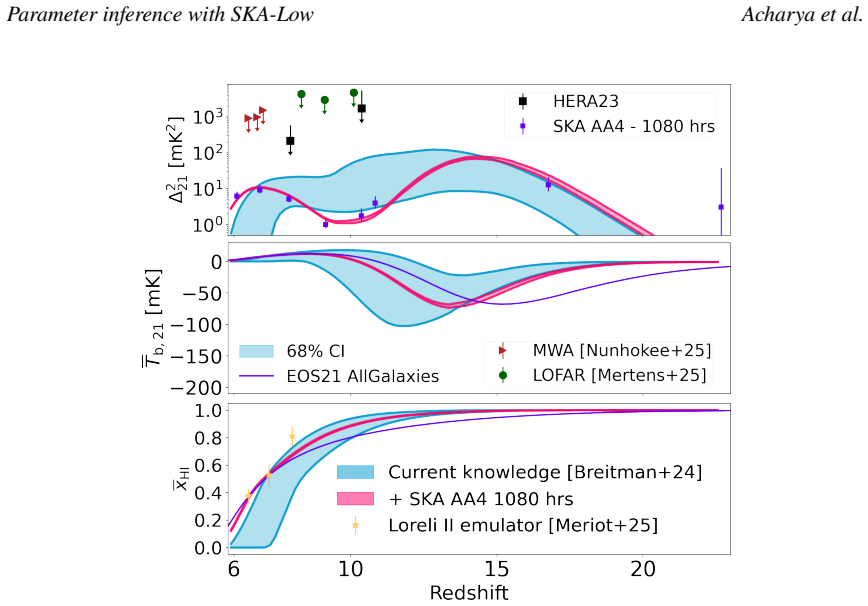
The Square Kilometre Array's low frequency telescope (SKA-Low) will enable inference of astrophysical and cosmological parameters from the redshifted 21 cm signal, probing the Cosmic Dawn and Epoch of Reionisation. While the power spectrum is the primary target for initial detection, the inherently non-Gaussian nature of the 21 cm signal, driven by the patchy evolution of ionised regions and spin temperature fluctuations, encodes rich information accessible through higher-order statistics and morphological measurements. Extracting these constraints requires diverse inference tools, encompassing both sophisticated modelling frameworks (analytical, semi-numerical, numerical, and emulators) used to predict the 21 cm signal, and advanced inference techniques (Bayesian, simulation-based, field-level) to connect statistics to the underlying physics. This chapter reviews these tools and explores the constraining power of different statistical probes accessible with SKA-Low, including the power spectrum, statistics beyond order two, moments of the signal distribution, and morphological measures. Combining these complementary statistics is crucial for breaking parameter degeneracies and unveiling the properties of the early Universe. We specifically assess the potential of the initial SKA-Low configuration (AA*) to measure galaxy and IGM properties, demonstrating its capability for early science results. This chapter forms part of a comprehensive set detailing the Epoch of Reionisation and Cosmic Dawn science case for the SKA-Low telescope.
Editorial analysis
A structured set of objections, weighed in public.
Referee Report
Summary. The manuscript is a review chapter synthesizing existing modeling frameworks (analytical to emulators), inference methods (Bayesian to field-level), and statistical probes (power spectrum through morphological measures) for inferring astrophysical and cosmological parameters from the high-redshift 21 cm signal with SKA-Low. It emphasizes that the non-Gaussian nature of the signal encodes additional information accessible via higher-order statistics and morphological measures, and specifically assesses the potential of the initial AA* configuration to measure galaxy and IGM properties for early science results, stressing the value of combining complementary statistics to break degeneracies.
Significance. If the synthesis accurately represents the literature, the chapter offers a useful consolidated overview of tools for 21 cm cosmology with SKA-Low and provides practical guidance on the early-science capabilities of the AA* configuration. The focus on combining statistics to address degeneracies aligns with standard approaches in the field and could inform observational strategies.
minor comments (2)
- [Abstract] Abstract: The claim that the AA* configuration demonstrates capability for early science results on galaxy and IGM properties is presented without quantitative forecasts, error budgets, or specific references to the underlying simulations or analyses that support this assessment.
- [Abstract] Abstract: No citations are provided for the reviewed modeling frameworks, inference techniques, or statistical probes, which reduces the immediate utility of the chapter as a reference for readers seeking primary sources.
Simulated Author's Rebuttal
We thank the referee for their positive and accurate summary of the manuscript, which correctly identifies it as a review chapter on inference tools for the 21 cm signal with SKA-Low. The recommendation for minor revision is noted. No specific major comments were provided in the report.
Circularity Check
Review paper: no derivations or self-referential predictions
full rationale
The manuscript is explicitly a review chapter synthesizing external literature on 21cm modeling frameworks (analytical to emulators), inference techniques (Bayesian to field-level), and statistical probes (power spectrum to morphological measures). No new equations, parameter fits, or predictions are derived within the paper itself. The central claim—that the AA* SKA-Low configuration can measure galaxy and IGM properties—rests on standard external premises about non-Gaussian signal information, without any reduction to inputs defined or fitted inside this work. No self-citations function as load-bearing justifications for uniqueness theorems or ansatzes. The derivation chain is absent, so no circular steps exist.
Axiom & Free-Parameter Ledger
Reference graph
Works this paper leans on
-
[1]
Excursion Set Mass Functions for Hierarchical Gaussian Fluctuations. , keywords =. doi:10.1086/170520 , adsurl =
-
[2]
Fjelde, Tor Erlend and Xu, Kai and Widmann, David and Tarek, Mohamed and Pfiffer, Cameron and Trapp, Martin and Axen, Seth D. and Sun, Xianda and Hauru, Markus and Yong, Penelope and Tebbutt, Will and Ghahramani, Zoubin and Ge, Hong , title =. 2025 , publisher =. doi:10.1145/3711897 , note =
-
[3]
1993 , OPTkey =
Fundamentals of statistical signal processing: estimation theory , publisher =. 1993 , OPTkey =
1993
-
[5]
arXiv preprint arXiv:2510.14877 , year=
Implicit inference of the reionization history with higher-order statistics of the 21-cm signal , author=. arXiv preprint arXiv:2510.14877 , year=
-
[6]
Impact of instrument and data characteristics in the interferometric reconstruction of the 21 cm power spectrum. , keywords =. doi:10.1093/mnras/stad090 , archivePrefix =. 2210.03721 , primaryClass =
-
[7]
Data Analysis for Precision 21 cm Cosmology. , keywords =. doi:10.1088/1538-3873/ab5bfd , archivePrefix =. 1907.08211 , primaryClass =
-
[8]
Retrieving cosmological information from small-scale CMB foregrounds. II. The kinetic Sunyaev Zel'dovich effect. , keywords =. doi:10.1051/0004-6361/202243351 , archivePrefix =. 2202.08698 , primaryClass =
-
[9]
Inferring the properties of the sources of reionization using the morphological spectra of the ionized regions. , keywords =. doi:10.1093/mnras/stab107 , archivePrefix =. 2011.08260 , primaryClass =
-
[10]
Robust statistics toward detection of the 21 cm signal from the Epoch of Reionisation
Robust statistics towards detection of the 21 cm signal from the Epoch of Reionization. , keywords =. doi:10.1093/mnras/stz1207 , archivePrefix =. 1904.11623 , primaryClass =
work page internal anchor Pith review Pith/arXiv arXiv doi:10.1093/mnras/stz1207 1904
-
[11]
Exploring the evolution of Reionisation using a wavelet transform and the light cone effect
Exploring the evolution of reionization using a wavelet transform and the light cone effect. , keywords =. doi:10.1093/mnras/stw1310 , archivePrefix =. 1605.07256 , primaryClass =
work page internal anchor Pith review Pith/arXiv arXiv doi:10.1093/mnras/stw1310
-
[12]
Gridded and direct Epoch of Reionisation bispectrum estimates using the Murchison Widefield Array
Gridded and direct Epoch of Reionisation bispectrum estimates using the Murchison Widefield Array. , keywords =. doi:10.1017/pasa.2019.15 , archivePrefix =. 1905.07161 , primaryClass =
work page internal anchor Pith review Pith/arXiv arXiv doi:10.1017/pasa.2019.15 2019
-
[13]
2011, MNRAS, 411, 955, doi: 10.1111/j.1365-2966.2010.17731.x
Fast Hamiltonian sampling for large-scale structure inference. , keywords =. doi:10.1111/j.1365-2966.2010.16897.x , archivePrefix =. 0911.2496 , primaryClass =
-
[14]
Proceedings of the Twenty-First International Conference on Artificial Intelligence and Statistics , pages =
Turing: A Language for Flexible Probabilistic Inference , author =. Proceedings of the Twenty-First International Conference on Artificial Intelligence and Statistics , pages =. 2018 , editor =
2018
-
[15]
2021, ApJ, 907, 44, doi: 10.3847/1538-4357/abd245
Villanueva-Domingo, Pablo and Villaescusa-Navarro, Francisco , year=. Removing Astrophysics in 21 cm Maps with Neural Networks , volume=. , publisher=. doi:10.3847/1538-4357/abd245 , number=
-
[16]
James Bradbury and Roy Frostig and Peter Hawkins and Matthew James Johnson and Chris Leary and Dougal Maclaurin and George Necula and Adam Paszke and Jake Vander
-
[17]
Chen and Martin Jankowiak and Fritz Obermeyer and Neeraj Pradhan and Theofanis Karaletsos and Rohit Singh and Paul A
Eli Bingham and Jonathan P. Chen and Martin Jankowiak and Fritz Obermeyer and Neeraj Pradhan and Theofanis Karaletsos and Rohit Singh and Paul A. Szerlip and Paul Horsfall and Noah D. Goodman , title =. J. Mach. Learn. Res. , volume =. 2019 , url =
2019
-
[18]
arXiv preprint arXiv:1912.11554 , year=
Composable Effects for Flexible and Accelerated Probabilistic Programming in NumPyro , author=. arXiv preprint arXiv:1912.11554 , year=
Pith/arXiv arXiv 1912
-
[19]
2025 , eprint=
Field-level Reconstruction from Foreground-Contaminated 21-cm Maps , author=. 2025 , eprint=
2025
-
[20]
2023 , eprint=
Simulation-based Inference of Reionization Parameters from 3D Tomographic 21 cm Light-cone Images -- II: Application of Solid Harmonic Wavelet Scattering Transform , author=. 2023 , eprint=
2023
-
[21]
2023 , eprint=
3D ScatterNet: Inference from 21 cm Light-cones , author=. 2023 , eprint=
2023
-
[22]
2023 , eprint=
Reconstruction of Cosmological Initial Density Field with Observations from the Epoch of Reionization , author=. 2023 , eprint=
2023
-
[23]
How Much Information Can Be Extracted from Galaxy Clustering at the Field Level? , volume=
Nguyen, Nhat-Minh and Schmidt, Fabian and Tucci, Beatriz and Reinecke, Martin and Kostić, Andrija , year=. How Much Information Can Be Extracted from Galaxy Clustering at the Field Level? , volume=. , publisher=. doi:10.1103/physrevlett.133.221006 , number=
-
[24]
A ``Rosetta Stone'' for Studies of Spatial Variation in Astrophysical Data: Power Spectra, Semivariograms, Structure Functions, and More. , keywords =. doi:10.1088/1538-3873/ade502 , archivePrefix =. 2407.14068 , primaryClass =
-
[26]
Reconstructing the epoch of reionisation with Planck PR4. , keywords =. doi:10.1051/0004-6361/202555196 , archivePrefix =. 2504.13254 , primaryClass =
-
[27]
Quantifying the redshift space distortion of the bispectrum I: primordial non-Gaussianity. , keywords =. doi:10.1093/mnras/staa279 , archivePrefix =. 2001.10243 , primaryClass =
-
[28]
Inferring IGM parameters from the redshifted 21-cm power spectrum using Artificial Neural Networks. , keywords =. doi:10.1088/1475-7516/2025/06/003 , archivePrefix =. 2407.03523 , primaryClass =
-
[29]
The Epoch of Reionization 21 cm Bispectrum at z = 8.2 from MWA Data. I. Foregrounds and Preliminary Upper Limits. , keywords =. doi:10.3847/1538-4357/ae0463 , archivePrefix =. 2507.04964 , primaryClass =
-
[30]
Impact of the redshift space distortions on the signal from the Epoch of Reionization
Redshifted 21-cm bispectrum - I. Impact of the redshift space distortions on the signal from the Epoch of Reionization. , keywords =. doi:10.1093/mnras/staa3168 , archivePrefix =. 2007.06584 , primaryClass =
-
[31]
From ANN to BNN: Inferring Reionization Parameters using Uncertainty-aware Emulators of 21-cm Summaries. arXiv e-prints , keywords =. doi:10.48550/arXiv.2508.13261 , archivePrefix =. 2508.13261 , primaryClass =
-
[32]
Impact of the Epoch of Reionization sources on the 21-cm bispectrum. , keywords =. doi:10.1088/1475-7516/2024/10/003 , archivePrefix =. 2406.03118 , primaryClass =
-
[33]
Redshifted 21-cm bispectrum - II. Impact of the spin temperature fluctuations and redshift space distortions on the signal from the Cosmic Dawn. , keywords =. doi:10.1093/mnras/stab216 , archivePrefix =. 2012.11616 , primaryClass =
-
[34]
Inside-out or outside-in: the topology of reionization in the photon-starved regime suggested by Ly forest data. , keywords =. doi:10.1111/j.1365-2966.2008.14383.x , archivePrefix =. 0806.1524 , primaryClass =
-
[35]
Constrainingquasar and intergalactic medium properties through bubble detection in redshifted 21-cm maps. , keywords =. doi:10.1111/j.1365-2966.2012.21914.x , archivePrefix =. 1111.6354 , primaryClass =
-
[36]
The effect of peculiar velocities on the epoch of reionization (EoR) 21-cm signal
The effect of peculiar velocities on the epoch of reionization 21-cm signal. , keywords =. doi:10.1093/mnras/stt1144 , archivePrefix =. 1209.4762 , primaryClass =
work page internal anchor Pith review Pith/arXiv arXiv doi:10.1093/mnras/stt1144
-
[37]
2019 , eprint=
Anticipated Performance of the Square Kilometre Array -- Phase 1 (SKA1) , author=. 2019 , eprint=
2019
-
[38]
2015 , publisher=
Advancing Astrophysics with the Square Kilometre Array (AASKA14) , author=. 2015 , publisher=
2015
-
[39]
Cosmic Reionization and the 21-cm signal: Comparison between an analytical model and a simulation
Santos, Mario G. and Amblard, Alexandre and Pritchard, Jonathan and Trac, Hy and Cen, Renyue and Cooray, Asantha. Cosmic Reionization and the 21-cm signal: Comparison between an analytical model and a simulation. Astrophys. J. 2008. doi:10.1086/592487. arXiv:0708.2424
work page internal anchor Pith review Pith/arXiv arXiv doi:10.1086/592487 2008
-
[40]
2007, MNRAS, 377, 352, doi: 10.1111/j.1365-2966.2007.11611.x
Pritchard, Jonathan R. and Furlanetto, Steven R. 21 cm fluctuations from inhomogeneous X-ray heating before reionization. Mon. Not. Roy. Astron. Soc. 2007. doi:10.1111/j.1365-2966.2007.11519.x. arXiv:astro-ph/0607234
-
[41]
Detecting the Earliest Galaxies Through Two New Sources of 21cm Fluctuations
Barkana, Rennan and Loeb, Abraham. Detecting the earliest galaxies through two new sources of 21cm fluctuations. Astrophys. J. 2005. doi:10.1086/429954. arXiv:astro-ph/0410129
work page internal anchor Pith review Pith/arXiv arXiv doi:10.1086/429954 2005
-
[42]
The Evolving Power Spectrum for the light cone Epoch of Reionization (EoR) 21-cm signal. arXiv e-prints , keywords =. doi:10.48550/arXiv.2503.21499 , archivePrefix =. 2503.21499 , primaryClass =
-
[43]
, volume=
Characteristic scales during reionization , author=. , volume=. 2006 , publisher=
2006
-
[44]
, volume=
Fluctuations in the high-redshift Lyman--Werner and Ly radiation backgrounds , author=. , volume=. 2012 , publisher=
2012
-
[45]
, volume=
Analytic formulation of 21 cm signal from cosmic dawn: Ly fluctuations , author=. , volume=. 2019 , publisher=
2019
-
[46]
, volume=
An Analytic Formulation of the 21 cm Signal from the Early Phase of the Epoch of Reionization , author=. , volume=. 2018 , publisher=
2018
-
[47]
21CMEMU: an emulator of 21CMFAST summary observables. , keywords =. doi:10.1093/mnras/stad3849 , archivePrefix =. 2309.05697 , primaryClass =
-
[48]
A fast method of reionization parameter space exploration using GPR trained SCRIPT. , keywords =. doi:10.1093/mnras/stad2984 , archivePrefix =. 2305.04839 , primaryClass =
-
[49]
Experimental Astronomy , publisher=
SARAS 3 CD/EoR radiometer: design and performance of the receiver , volume=. Experimental Astronomy , publisher=. 2021 , month=jan, pages=. doi:10.1007/s10686-020-09697-2 , number=
-
[50]
Improving constraints on the reionization parameters using 21-cm bispectrum. , keywords =. doi:10.1088/1475-7516/2022/04/045 , archivePrefix =. 2108.07279 , primaryClass =
-
[51]
Generative Models of 21cm EoR Lightcones with 3D Scattering Transforms. arXiv e-prints , keywords =. doi:10.48550/arXiv.2506.10061 , archivePrefix =. 2506.10061 , primaryClass =
-
[52]
Analyzing the 21cm forest with Wavelet Scattering Transform: Insight into non-Gaussian features of the 21cm forest. , keywords =. doi:10.1103/nxr4-14gb , archivePrefix =. 2504.14656 , primaryClass =
-
[53]
21cm-line bispectrum as method to probe Cosmic Dawn and Epoch of Reionization
21 cm line bispectrum as a method to probe cosmic dawn and epoch of reionization. , keywords =. doi:10.1093/mnras/stw482 , archivePrefix =. 1507.01335 , primaryClass =
work page internal anchor Pith review Pith/arXiv arXiv doi:10.1093/mnras/stw482
-
[54]
Simulation-based Inference of Reionization Parameters from 3D Tomographic 21 cm Light-cone Images. II. Application of Solid Harmonic Wavelet Scattering Transform. , keywords =. doi:10.3847/1538-4357/ad5ff0 , archivePrefix =. 2310.17602 , primaryClass =
-
[55]
A bubble size distribution model for the Epoch of Reionization. , keywords =. doi:10.1051/0004-6361/202244108 , archivePrefix =. 2208.14044 , primaryClass =
-
[56]
2005, MNRAS, 364, 1105, doi: 10.1111/j.1365-2966.2005.09655.x
Bharadwaj, Somnath and Pandey, Sanjay K. Probing non-Gaussian features in the HI distribution at the epoch of reionization. Mon. Not. Roy. Astron. Soc. 2005. doi:10.1111/j.1365-2966.2005.08836.x. arXiv:astro-ph/0410581
-
[57]
Using the sample variance of 21 cm maps as a tracer of the ionisation topology. , keywords =. doi:10.1051/0004-6361/202140515 , archivePrefix =. 2102.04352 , primaryClass =
-
[58]
, volume=
Imaging the redshifted 21 cm pattern around the first sources during the cosmic dawn using the SKA , author=. , volume=. 2017 , publisher=
2017
-
[59]
On the detection of a cosmic dawn signal in the radio background. Nature Astronomy , keywords =. doi:10.1038/s41550-022-01610-5 , archivePrefix =. 2112.06778 , primaryClass =
-
[60]
An absorption profile centred at 78 megahertz in the sky-averaged spectrum
An absorption profile centred at 78 megahertz in the sky-averaged spectrum. , keywords =. doi:10.1038/nature25792 , archivePrefix =. 1810.05912 , primaryClass =
work page internal anchor Pith review Pith/arXiv arXiv doi:10.1038/nature25792
-
[61]
System design and calibration of SITARA a global 21 cm short spacing interferometer prototype. , keywords =. doi:10.1017/pasa.2022.13 , archivePrefix =. 2203.10466 , primaryClass =
-
[62]
Publications of the Astronomical Society of Australia , volume=
Measuring the global 21-cm signal with the MWA-II: improved characterisation of lunar-reflected radio frequency interference , author=. Publications of the Astronomical Society of Australia , volume=. 2023 , publisher=
2023
-
[63]
, volume=
Measuring the global 21-cm signal with the MWA-I: improved measurements of the Galactic synchrotron background using lunar occultation , author=. , volume=. 2018 , publisher=
2018
-
[64]
, volume=
Chromatic effects in the 21 cm global signal from the cosmic dawn , author=. , volume=. 2014 , publisher=
2014
-
[65]
Wavelet-based statistics for enhanced 21cm EoR parameter constraints. , keywords =. doi:10.1051/0004-6361/202348444 , archivePrefix =. 2311.00036 , primaryClass =
-
[66]
Constraining the EoR model parameters with the 21cm bispectrum
Constraining the epoch-of-reionization model parameters with the 21-cm bispectrum. , keywords =. doi:10.1093/mnras/stx530 , archivePrefix =. 1608.00372 , primaryClass =
work page internal anchor Pith review Pith/arXiv arXiv doi:10.1093/mnras/stx530
-
[67]
, volume=
The impact of spin-temperature fluctuations on the 21-cm moments , author=. , volume=. 2015 , publisher=
2015
-
[68]
, volume=
Distinguishing models of reionization using future radio observations of 21-cm 1-point statistics , author=. , volume=. 2014 , publisher=
2014
-
[69]
Measuring the Redshift of Reionization with a Modest Array of Low-Frequency Dipoles
Measuring the redshift of reionization with a modest array of low-frequency dipoles. , keywords =. doi:10.1088/1475-7516/2011/04/038 , archivePrefix =. 1006.5460 , primaryClass =
work page internal anchor Pith review Pith/arXiv arXiv doi:10.1088/1475-7516/2011/04/038 2011
-
[70]
Detection and extraction of signals from the epoch of reionization using higher-order one-point statistics. , keywords =. doi:10.1111/j.1365-2966.2008.14209.x , archivePrefix =. 0809.2428 , primaryClass =
-
[71]
Sensitivity of the Hydrogen Epoch of Reionization Array and its build-out stages to one-point statistics from redshifted 21 cm observations. , keywords =. doi:10.1093/mnras/stx3099 , archivePrefix =. 1708.00036 , primaryClass =
work page internal anchor Pith review Pith/arXiv arXiv doi:10.1093/mnras/stx3099
-
[72]
Measurements of one-point statistics in 21-cm intensity maps via foreground avoidance strategy. , keywords =. doi:10.1093/mnras/stac2826 , archivePrefix =. 2204.01124 , primaryClass =
-
[73]
2007, MNRAS, 377, 352, doi: 10.1111/j.1365-2966.2007.11611.x
The difference PDF of 21-cm fluctuations: a powerful statistical tool for probing cosmic reionization. , keywords =. doi:10.1111/j.1365-2966.2007.12729.x , archivePrefix =. 0705.3246 , primaryClass =
-
[74]
, volume =
Bag, Satadru and Mondal, Rajesh and Sarkar, Prakash and Bharadwaj, Somnath and Sahni, Varun , title =. , volume =. 2018 , doi =
2018
-
[75]
Exploring reionization and high-z galaxy observables with recent multiredshift MWA upper limits on the 21-cm signal. , keywords =. doi:10.1093/mnras/staa3494 , archivePrefix =. 2008.02639 , primaryClass =
-
[76]
Monthly Notices of the Royal Astronomical Society , volume=
Signatures of X-rays in the early Universe , author=. Monthly Notices of the Royal Astronomical Society , volume=. 2013 , publisher=
2013
-
[77]
, archivePrefix = "arXiv", eprint =
Efficient Simulations of Early Structure Formation and Reionization. , archivePrefix = "arXiv", eprint =. doi:10.1086/521806 , adsurl =
-
[78]
, archivePrefix = "arXiv", eprint =
The distribution of bubble sizes during reionization. , archivePrefix = "arXiv", eprint =. doi:10.1093/mnras/stw1542 , adsurl =
-
[79]
2011, MNRAS, 411, 955, doi: 10.1111/j.1365-2966.2010.17731.x
21CMFAST: a fast, seminumerical simulation of the high-redshift 21-cm signal. , archivePrefix = "arXiv", eprint =. doi:10.1111/j.1365-2966.2010.17731.x , adsurl =
-
[80]
Simulations and Analytic Calculations of Bubble Growth during Hydrogen Reionization. , eprint =. doi:10.1086/509597 , adsurl =
-
[81]
Simulating cosmic reionization at large scales - I. The geometry of reionization. , eprint =. doi:10.1111/j.1365-2966.2006.10502.x , adsurl =
-
[82]
arXiv e-prints , keywords =
Stages of Reionization as revealed by the Minkowski Functionals. arXiv e-prints , keywords =
discussion (0)
Sign in with ORCID, Apple, or X to comment. Anyone can read and Pith papers without signing in.