Standard-quantum-limit-surpassing vector polarimetry using Rydberg atoms in an SU(1,1) interferometer
Pith reviewed 2026-06-29 04:35 UTC · model grok-4.3
The pith
Rydberg atoms in an SU(1,1) interferometer measure RF polarization angles with sensitivity surpassing the SQL.
A machine-rendered reading of the paper's core claim, the machinery that carries it, and where it could break.
Core claim
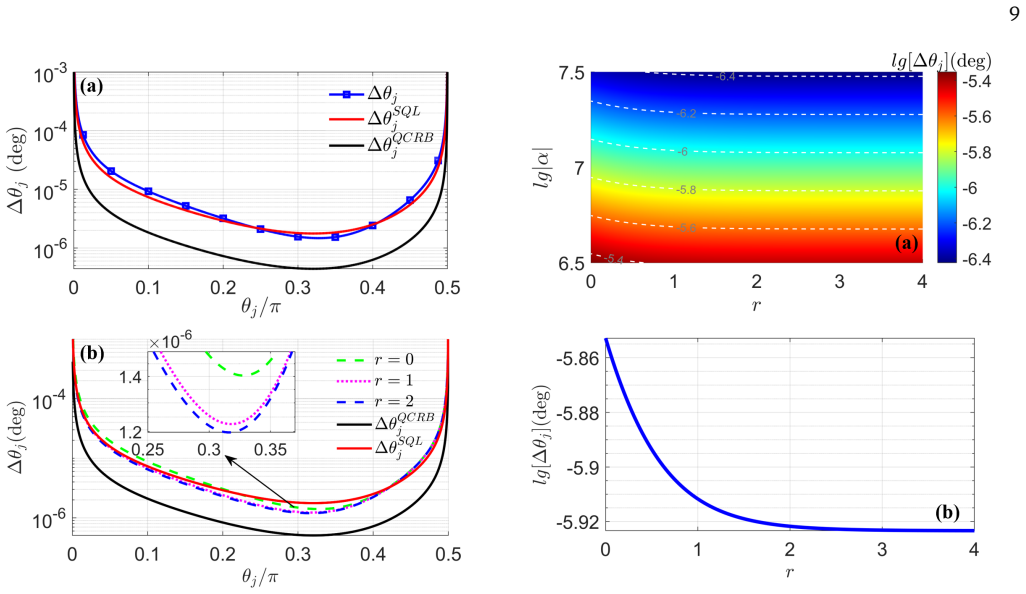
Under a static magnetic field the asymmetry in Zeeman-sublevel coupling lets the Rydberg atom's absorption index encode the polarization angles of an incident RF field; when this index is read out by homodyne detection inside an SU(1,1) interferometer the angular sensitivity exceeds the standard quantum limit for either dual coherent or coherent-plus-squeezed-vacuum inputs, with the best value falling below 10^{-6} degree.
What carries the argument
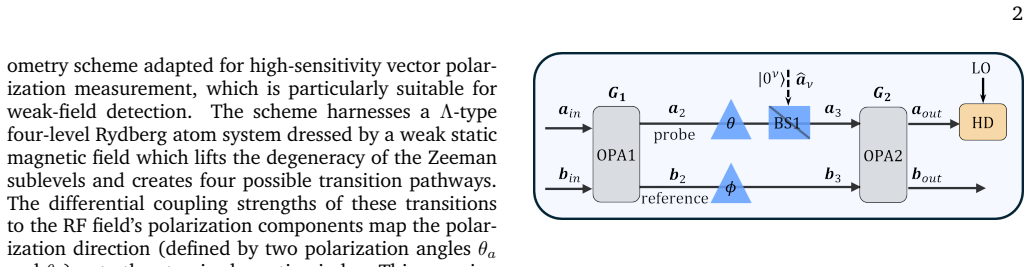
The SU(1,1) interferometer that amplifies the homodyne signal from the Rydberg atom's absorption index, whose value is set by the asymmetric Zeeman coupling to RF polarization components.
Load-bearing premise
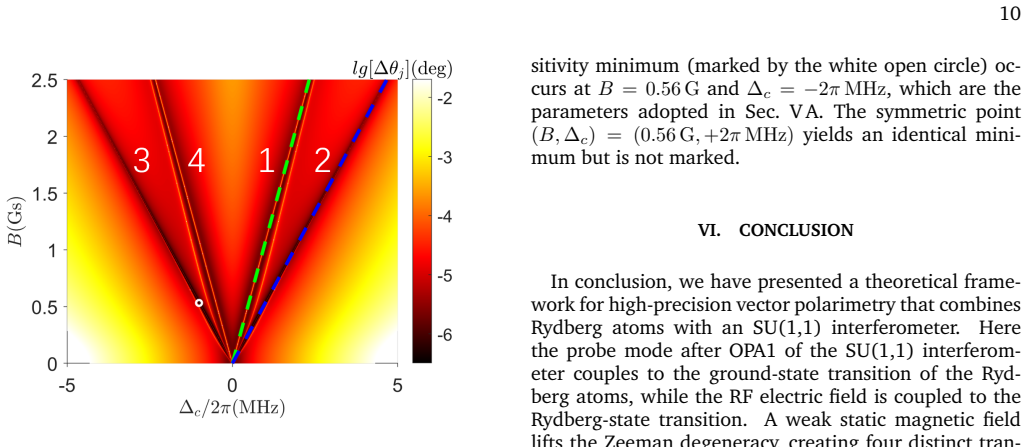
The asymmetry in coupling between the Zeeman sublevels of the Rydberg atom and the RF field's polarization components under a static magnetic field enables polarization angles to be determined from the atomic absorption index.
What would settle it
An experiment that records polarization-angle sensitivity no better than the calculated SQL for the same input states over the same angular range.
Figures
read the original abstract
Vector polarimetry is an important application frontier for Rydberg-atom-based sensing. While prior research has largely concentrated on developing novel measurement schemes, high-sensitivity vector polarimetry remains an open question. Here we propose a theoretical framework for high-sensitivity detection of radio-frequency (RF) electric field polarization direction, which is particularly suitable for weak-field detection. Under a static magnetic field, the asymmetry in coupling between the Zeeman sublevels of the Rydberg atom and the RF field's polarization components enables the polarization angles to be determined from the atomic absorption index, which is retrieved via homodyne detection by incorporating the Rydberg atom system into an SU(1,1) interferometer. We derive the sensitivity of the polarization angles along with the corresponding standard quantum limit (SQL) and quantum Cram\'{e}r--Rao bound (QCRB). Our results demonstrate a sensitivity surpassing the SQL across wide angular ranges using either dual coherent states or a coherent state combined with a squeezed vacuum state as input. Significantly, the optimal sensitivity reaches below \SI{e-6}{\degree}, with sensitivities better than \SI{e-3}{\degree} maintained over most of the angular domain. This work establishes a foundation for high-precision vector polarimetry, thereby advancing the development of Rydberg-atom-based quantum sensing and contributing to a deeper understanding of light--matter interactions.
Editorial analysis
A structured set of objections, weighed in public.
Referee Report
Summary. The manuscript proposes a theoretical framework for high-sensitivity vector polarimetry of weak RF electric fields using Rydberg atoms placed inside an SU(1,1) interferometer. A static magnetic field induces asymmetry in the coupling of Zeeman sublevels to the RF polarization components, allowing the two polarization angles to be recovered from the atomic absorption index, which is measured by homodyne detection. Sensitivities and the corresponding SQL and QCRB are derived for inputs consisting of dual coherent states or a coherent state plus squeezed vacuum; the results show SQL-beating over wide angular ranges, with optimal sensitivity below 10^{-6}° and values better than 10^{-3}° over most of the domain.
Significance. If the derivations hold, the work provides a concrete route to sub-SQL vector polarimetry with Rydberg atoms, extending existing scalar sensing techniques to polarization direction. The explicit comparison to both SQL and QCRB, together with the use of an SU(1,1) interferometer to reach sensitivities below 10^{-6}°, constitutes a useful addition to the quantum-sensing literature.
major comments (1)
- [Framework and sensitivity derivation] The central claim that polarization angles can be determined from the absorption index rests on the mapping being locally invertible. The manuscript should explicitly show in the derivation of the absorption index (around the framework section following the abstract) that ∂(absorption index)/∂θ never vanishes inside the reported angular domain; without this, the local sensitivity and the SQL/QCRB comparisons become undefined at stationary points.
minor comments (2)
- [Abstract and §2] The abstract states that sensitivities and bounds are derived, yet the main text should include at least one explicit expression for the absorption index as a function of the two angles before the sensitivity formulas are presented.
- [Figures] Figure captions should state the precise input states (coherent amplitudes, squeezing parameter) used for each plotted curve to allow direct comparison with the analytic expressions.
Simulated Author's Rebuttal
We thank the referee for their positive evaluation and the constructive comment on ensuring local invertibility. We address the point below and will incorporate the requested verification in the revised manuscript.
read point-by-point responses
-
Referee: [Framework and sensitivity derivation] The central claim that polarization angles can be determined from the absorption index rests on the mapping being locally invertible. The manuscript should explicitly show in the derivation of the absorption index (around the framework section following the abstract) that ∂(absorption index)/∂θ never vanishes inside the reported angular domain; without this, the local sensitivity and the SQL/QCRB comparisons become undefined at stationary points.
Authors: We agree that an explicit check is required to confirm the mapping is locally invertible everywhere in the reported domain. The absorption index is derived from the imaginary part of the atomic susceptibility under the static magnetic field, which breaks the symmetry between Zeeman sublevels and produces an angle-dependent response. In the revised manuscript we will add, immediately after the absorption-index derivation, an analytic evaluation (or numerical confirmation over a dense grid) of both partial derivatives showing they remain strictly non-zero throughout the angular ranges where sensitivities are claimed. This addition will be placed in the framework section and will also note any isolated boundary points where the derivative approaches zero (if any) and confirm they lie outside the domain of interest. revision: yes
Circularity Check
No circularity; derivation self-contained from quantum optics principles
full rationale
The provided abstract and framework description present a theoretical derivation of polarization-angle sensitivity from the atomic absorption index via homodyne detection in an SU(1,1) interferometer, relying on the stated Zeeman-sublevel asymmetry under static B-field. No equations, self-citations, or claims are visible that reduce any 'prediction' or sensitivity result to a fitted input, self-definition, or load-bearing prior result by the same authors. The central claims (SQL surpassing, sub-10^{-6}° sensitivity) are positioned as derived quantities rather than tautological renamings or constructions, making the chain independent of its own outputs.
Axiom & Free-Parameter Ledger
axioms (2)
- standard math Standard quantum mechanics and quantum optics govern the atom-light interaction and interferometer dynamics.
- domain assumption A static magnetic field produces Zeeman splitting that creates asymmetric coupling to RF polarization components.
Reference graph
Works this paper leans on
-
[1]
ˆU1 and⟨·⟩is the average value under the state ˆS(ξ1)|ψin⟩|0ν⟩. Substituting the explicit expression ofU 1 and simplifying yields the QFI in the compact form: Fj(θj) = 4T 2 1 1−T 2 1 ⟨ ˆMi⟩ × ∂ϵ ∂θj 2 ,(9) where ˆMi = ˆa† 2ˆa2 (withi=c, qdenotes different input configuration), whose expectation values are taken with respect to the states ˆS(ξ1)|ψin⟩|0ν⟩. ...
-
[2]
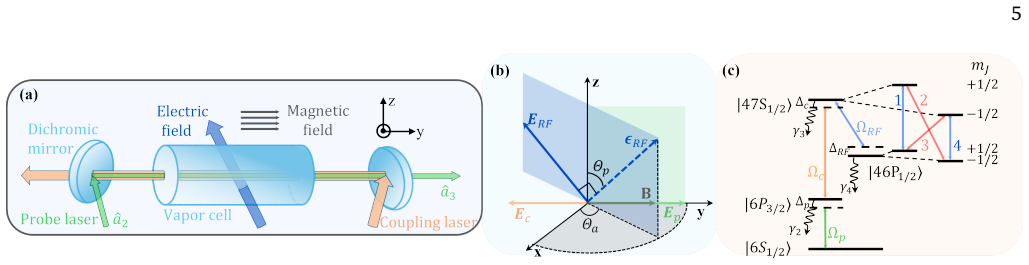
Con- sequently , the electric field can be expressed as ERF =E RF (cosθ a sinθ p ˆx+ sinθ a sinθ p ˆy+ cosθ p ˆz) =E RF +1X q=−1 αqϵq = +1X q=−1 E(q) RF , (18) 5 FIG
In this basis, ϵ0 represents theπ-polarized unit vector driving∆m= 0 transitions, whileϵ ±1 correspond to theσ ±-circularly po- larized unit vectors driving∆m=±1transitions. Con- sequently , the electric field can be expressed as ERF =E RF (cosθ a sinθ p ˆx+ sinθ a sinθ p ˆy+ cosθ p ˆz) =E RF +1X q=−1 αqϵq = +1X q=−1 E(q) RF , (18) 5 FIG. 2. (a) Schematic...
-
[3]
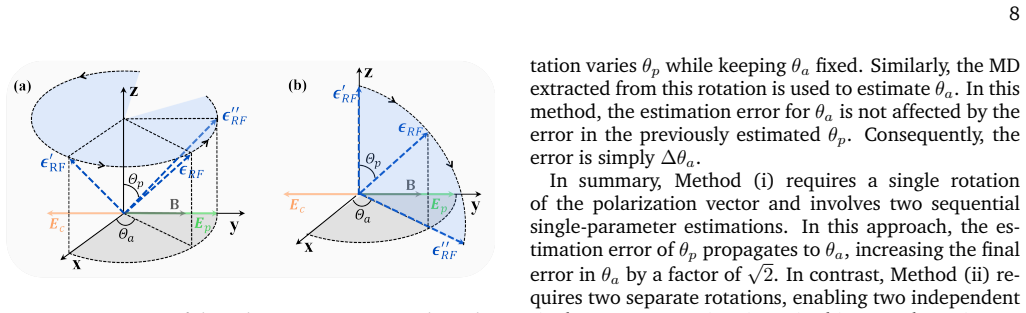
in this case, the estimates ofθ p andθ a are decoupled, and their errors do not affect one another
In contrast, Method (ii) re- quires two separate rotations, enabling two independent single-parameter estimations. in this case, the estimates ofθ p andθ a are decoupled, and their errors do not affect one another. Both methods require at least two measure- ments to determine the two angles. In the subsequent sensitivity analysis, we adopt Method (ii) as ...
-
[4]
Rydberg atoms cambridge monographs on atomic, molecular and chemical physic.Cambridge Uni- versity Press, Cambridge, 1994
TF Gallaghar. Rydberg atoms cambridge monographs on atomic, molecular and chemical physic.Cambridge Uni- versity Press, Cambridge, 1994
1994
-
[5]
Rydberg atom quantum technologies.Journal of Physics B: Atomic, Molecular and Optical Physics, 53(1):012002, dec 2019
C S Adams, J D Pritchard, and J P Shaffer. Rydberg atom quantum technologies.Journal of Physics B: Atomic, Molecular and Optical Physics, 53(1):012002, dec 2019
2019
-
[6]
Gordon, Christopher L
Joshua A. Gordon, Christopher L. Holloway , Steve Jef- ferts, and Tom Heavner. Quantum-based si traceable electric-field probe. In2010 IEEE International Sympo- sium on Electromagnetic Compatibility, pages 321–324, 2010
2010
-
[7]
Holloway , Joshua A
Christopher L. Holloway , Joshua A. Gordon, Steven Jefferts, Andrew Schwarzkopf, David A. Anderson, Stephanie A. Miller, Nithiwadee Thaicharoen, and Georg Raithel. Broadband rydberg atom-based electric-field probe for si-traceable, self-calibrated measurements.IEEE Transactions on Antennas and Propagation, 62(12):6169– 6182, 2014
2014
-
[8]
Microwave electrometry with rydberg atoms in a vapour cell using bright atomic resonances.Nature physics, 8(11):819–824, 2012
Jonathon A Sedlacek, Arne Schwettmann, Harald K ¨ubler, Robert L¨ow, Tilman Pfau, and James P Shaffer. Microwave electrometry with rydberg atoms in a vapour cell using bright atomic resonances.Nature physics, 8(11):819–824, 2012
2012
-
[9]
Simons, Abdulaziz H
Matthew T. Simons, Abdulaziz H. Haddab, Joshua A. Gor- don, and Christopher L. Holloway . A rydberg atom-based mixer: Measuring the phase of a radio frequency wave. Applied Physics Letters, 114(11):114101, 03 2019
2019
-
[10]
Anderson, R.E
D.A. Anderson, R.E. Sapiro, L.F. Gonc ¸alves, R. Cardman, and G. Raithel. Optical radio-frequency phase measure- ment with an internal-state rydberg atom interferometer. Phys. Rev. Appl., 17:044020, Apr 2022
2022
-
[11]
Transfer phase of microwave to beat amplitude in a rydberg atom-based mixer by zeeman modulation.Journal of Physics B: Atomic, Molecular and Optical Physics, 54(16):165501, 2021
Feng-Dong Jia, Huai-Yu Zhang, Xiu-Bin Liu, Jiong Mei, Yong-Hong Yu, Zhao-Qing Lin, Hai-Yue Dong, Ya Liu, Jian Zhang, Feng Xie, et al. Transfer phase of microwave to beat amplitude in a rydberg atom-based mixer by zeeman modulation.Journal of Physics B: Atomic, Molecular and Optical Physics, 54(16):165501, 2021
2021
-
[12]
An all-optical phase detector by amplitude modulation of the local field in a rydberg atom- based mixer.Chinese Physics B, 31(9):090703, 2022
Xiu-Bin Liu, Feng-Dong Jia, Huai-Yu Zhang, Jiong Mei, Wei-Chen Liang, Fei Zhou, Yong-Hong Yu, Ya Liu, Jian Zhang, Feng Xie, et al. An all-optical phase detector by amplitude modulation of the local field in a rydberg atom- based mixer.Chinese Physics B, 31(9):090703, 2022
2022
-
[13]
Quadrupole interaction- based detection of oam microwaves using rydberg atoms
Zheyuan Wang and Chao Zhang. Quadrupole interaction- based detection of oam microwaves using rydberg atoms. IEEE MICROWAVE AND WIRELESS TECHNOLOGY LET - TERS, 2025
2025
-
[14]
Rydberg atom-based oam-fdm integration for high-capacity microwave com- munications.IEEE Microwave and Wireless T echnology Let- ters, 2026
Zheyuan Wang and Chao Zhang. Rydberg atom-based oam-fdm integration for high-capacity microwave com- munications.IEEE Microwave and Wireless T echnology Let- ters, 2026
2026
-
[15]
Precise measurement of microwave polar- ization using a rydberg atom-based mixer.Optics Express, 31(6):10449–10457, 2023
Yuhan Wang, Fengdong Jia, Jianhai Hao, Yue Cui, Fei Zhou, Xiubin Liu, Jiong Mei, Yonghong Yu, Ya Liu, Jian Zhang, et al. Precise measurement of microwave polar- ization using a rydberg atom-based mixer.Optics Express, 31(6):10449–10457, 2023
2023
-
[16]
Measurement of microwave polarization us- ing two polarization orthogonal local microwave electric fields in a rydberg atom-based mixer.Optics Express, 32(22):38372–38383, 2024
Weibo Yin, Jianan Zhang, Fengdong Jia, Yuhan Wang, Yuxiang Wang, Jianhai Hao, Yue Cui, Ya Liu, and Zhip- ing Zhong. Measurement of microwave polarization us- ing two polarization orthogonal local microwave electric fields in a rydberg atom-based mixer.Optics Express, 32(22):38372–38383, 2024
2024
-
[17]
Complete three-dimensional vector polarimetry with a rydberg-atom rf electrometer.Physical Review Applied, 22(6):064012, 2024
Peter K Elgee, Kevin C Cox, Joshua C Hill, Paul D Kunz, and David H Meyer. Complete three-dimensional vector polarimetry with a rydberg-atom rf electrometer.Physical Review Applied, 22(6):064012, 2024
2024
-
[18]
Atom-based vector microwave electrometry using ru- bidium rydberg atoms in a vapor cell.Physical review let- ters, 111(6):063001, 2013
JA Sedlacek, A Schwettmann, Harald K¨ubler, and JP Shaf- fer. Atom-based vector microwave electrometry using ru- bidium rydberg atoms in a vapor cell.Physical review let- ters, 111(6):063001, 2013
2013
-
[19]
Atom- based radio-frequency field calibration and polarization measurement using cesium n dj floquet states.Physical Review Applied, 8(1):014028, 2017
Yuechun Jiao, Liping Hao, Xiaoxuan Han, Suying Bai, Georg Raithel, Jianming Zhao, and Suotang Jia. Atom- based radio-frequency field calibration and polarization measurement using cesium n dj floquet states.Physical Review Applied, 8(1):014028, 2017
2017
-
[20]
A vapor-cell atomic sensor for radio-frequency field detec- tion using a polarization-selective field enhancement res- onator.Applied Physics Letters, 113(7), 2018
David A Anderson, Eric G Paradis, and Georg Raithel. A vapor-cell atomic sensor for radio-frequency field detec- tion using a polarization-selective field enhancement res- onator.Applied Physics Letters, 113(7), 2018
2018
-
[21]
Polarization-Aware DoA Detection Relying on a Single Rydberg Atomic Receiver
Yuanbin Chen, Chau Yuen, Darmindra Arumugam, Chong Meng Samson See, M´erouane Debbah, and Lajos Hanzo. Polarization-aware doa detection relying on a single ry- dberg atomic receiver.arXiv preprint arXiv:2508.17179, 2025
work page internal anchor Pith review Pith/arXiv arXiv 2025
-
[22]
Ryd- berg states of alkali atoms in atomic vapour as si-traceable field probes and communications receivers.Nature Re- views Physics, 6(10):606–620, 2024
Noah Schlossberger, Nikunjkumar Prajapati, Samuel Berweger, Andrew P Rotunno, Alexandra B Artusio- Glimpse, Matthew T Simons, Abrar A Sheikh, Eric B Nor- rgard, Stephen P Eckel, and Christopher L Holloway . Ryd- berg states of alkali atoms in atomic vapour as si-traceable field probes and communications receivers.Nature Re- views Physics, 6(10):606–620, 2024
2024
-
[23]
Quantum sensing of microwave electric fields based on rydberg atoms.Reports on Progress in Physics, 86(10):106001, 2023
Jinpeng Yuan, Wenguang Yang, Mingyong Jing, Hao Zhang, Yuechun Jiao, Weibin Li, Linjie Zhang, Liantuan Xiao, and Suotang Jia. Quantum sensing of microwave electric fields based on rydberg atoms.Reports on Progress in Physics, 86(10):106001, 2023
2023
-
[24]
Atomic super- heterodyne receiver based on microwave-dressed rydberg spectroscopy .Nature Physics, 16(9):911–915, 2020
Mingyong Jing, Ying Hu, Jie Ma, Hao Zhang, Linjie Zhang, Liantuan Xiao, and Suotang Jia. Atomic super- heterodyne receiver based on microwave-dressed rydberg spectroscopy .Nature Physics, 16(9):911–915, 2020
2020
-
[25]
Enhancement of electromagnetically induced transparency based rydberg- atom electrometry through population repumping.Ap- 12 plied Physics Letters, 119(21), 2021
Nikunjkumar Prajapati, Amy K Robinson, Samuel Berweger, Matthew T Simons, Alexandra B Artusio- Glimpse, and Christopher L Holloway . Enhancement of electromagnetically induced transparency based rydberg- atom electrometry through population repumping.Ap- 12 plied Physics Letters, 119(21), 2021
2021
-
[26]
Enhanced metrology at the critical point of a many-body rydberg atomic system.Nature Physics, 18(12):1447–1452, 2022
Dong-Sheng Ding, Zong-Kai Liu, Bao-Sen Shi, Guang-Can Guo, Klaus Mølmer, and Charles S Adams. Enhanced metrology at the critical point of a many-body rydberg atomic system.Nature Physics, 18(12):1447–1452, 2022
2022
-
[27]
Nonlinearity-enhanced continuous microwave detection based on stochastic resonance.Science Advances, 10(41):eado8130, 2024
Kang-Da Wu, Chongwu Xie, Chuan-Feng Li, Guang- Can Guo, Chang-Ling Zou, and Guo-Yong Xiang. Nonlinearity-enhanced continuous microwave detection based on stochastic resonance.Science Advances, 10(41):eado8130, 2024
2024
-
[28]
Cavity-enhanced optical bistability of rydberg atoms.Optics Letters, 48(11):2865–2868, 2023
Qinxia Wang, Zhihui Wang, Yanxin Liu, Shijun Guan, Jun He, Chang-Ling Zou, Pengfei Zhang, Gang Li, and Tian- cai Zhang. Cavity-enhanced optical bistability of rydberg atoms.Optics Letters, 48(11):2865–2868, 2023
2023
-
[29]
Qinxia Wang, Yukang Liang, Zhihui Wang, Shijun Guan, Pengfei Yang, Pengfei Zhang, Gang Li, and Tiancai Zhang. High-precision measurement of microwave electric field by cavity-enhanced critical behavior in a many-body ryd- berg atomic system.Science China Physics, Mechanics & Astronomy, 68(6):1–6, 2025
2025
-
[30]
Approaching the standard quantum limit of a rydberg-atom microwave electrometer, 2023
Tu Haitao, Liao Kaiyu, He Guodong, et al. Approaching the standard quantum limit of a rydberg-atom microwave electrometer, 2023
2023
-
[31]
Quantum-enhanced electrometer based on microwave-dressed rydberg atoms.Phys
Shuhe Wu, Dong Zhang, Zhengchun Li, Minwei Shi, Peiyu Yang, Jinxian Guo, Wei Du, Guzhi Bao, and Weip- ing Zhang. Quantum-enhanced electrometer based on microwave-dressed rydberg atoms.Phys. Rev. Appl., 20:064028, Dec 2023
2023
-
[32]
Theo- retical analysis of an electrometer based on microwave- dressed rydberg atoms using a quantum interferometer
Dong Zhang, Minwei Shi, Ding Huang, Yiquan Yang, Wei Du, Shuhe Wu, Guzhi Bao, and Weiping Zhang. Theo- retical analysis of an electrometer based on microwave- dressed rydberg atoms using a quantum interferometer. Optics Express, 33(3):5253–5261, 2025
2025
-
[33]
Distributed quantum sensing in a continuous- variable entangled network.Nature Physics, 16(3):281– 284, 2020
Xueshi Guo, Casper R Breum, Johannes Borregaard, Shuro Izumi, Mikkel V Larsen, Tobias Gehring, Matthias Christandl, Jonas S Neergaard-Nielsen, and Ulrik L An- dersen. Distributed quantum sensing in a continuous- variable entangled network.Nature Physics, 16(3):281– 284, 2020
2020
-
[34]
Advances in quantum metrology .Nature photonics, 5(4):222–229, 2011
Vittorio Giovannetti, Seth Lloyd, and Lorenzo Maccone. Advances in quantum metrology .Nature photonics, 5(4):222–229, 2011
2011
-
[35]
Quantum fisher information for density matri- ces with arbitrary ranks.Communications in Theoretical Physics, 61(1):45, 2014
Jing Liu, Xiao-Xing Jing, Wei Zhong, and Xiao-Guang Wang. Quantum fisher information for density matri- ces with arbitrary ranks.Communications in Theoretical Physics, 61(1):45, 2014
2014
-
[36]
Estima- tion of imbert-fedorov shifts based on su (1, 1) interfer- ometer breaking through the shot-noise limit.Physical Review A, 111(6):062615, 2025
Yuetao Chen, Jing Wang, Qiang Ma, Gaiqing Chen, Meng- meng Luo, Shoukang Chang, and Shaoyan Gao. Estima- tion of imbert-fedorov shifts based on su (1, 1) interfer- ometer breaking through the shot-noise limit.Physical Review A, 111(6):062615, 2025
2025
-
[37]
Multi-parameter quantum metrology .Ad- vances in Physics: X, 1(4):621–639, 2016
Magdalena Szczykulska, Tillmann Baumgratz, and Ani- mesh Datta. Multi-parameter quantum metrology .Ad- vances in Physics: X, 1(4):621–639, 2016
2016
-
[38]
Mengyao Zhou, Hongmei Ma, Liqing Chen, Weiping Zhang, and Chun-Hua Yuan. Holevo cram\’{e}r-rao bound for multi-parameter estimation in nonlinear inter- ferometers.arXiv preprint arXiv:2502.02855, 2025
-
[39]
Overcoming quantum metrology singularity through sequential measurements.Physical Review Letters, 135(1):010401, 2025
Yaoling Yang, Victor Montenegro, and Abolfazl Bayat. Overcoming quantum metrology singularity through sequential measurements.Physical Review Letters, 135(1):010401, 2025
2025
-
[40]
Polarization-insensitive microwave electrometry using ry- dberg atoms.Physical review applied, 21(4):044025, 2024
Matthew Cloutman, Matthew Chilcott, Alexander Elliott, J Susanne Otto, Amita B Deb, and Niels Kjærgaard. Polarization-insensitive microwave electrometry using ry- dberg atoms.Physical review applied, 21(4):044025, 2024
2024
-
[41]
Quantum and atom optics
Daniel A Steck. Quantum and atom optics. 2007
2007
-
[42]
Cesium d line data
Daniel A Steck. Cesium d line data. 2003
2003
-
[43]
Arc 3.0: An expanded python toolbox for atomic physics calculations.Computer Physics Communications, 261:107814, 2021
Elizabeth J Robertson, Nikola ˇSibali´c, Robert M Potvliege, and Matthew PA Jones. Arc 3.0: An expanded python toolbox for atomic physics calculations.Computer Physics Communications, 261:107814, 2021
2021
discussion (0)
Sign in with ORCID, Apple, or X to comment. Anyone can read and Pith papers without signing in.