Ontology-Guided Evidence Path Inference for Multi-hop Knowledge Graph Question Answering
Pith reviewed 2026-06-29 04:02 UTC · model grok-4.3
The pith
A relation-centric ontology graph enables bidirectional retrieval that suppresses noisy mixed-type paths in multi-hop KGQA.
A machine-rendered reading of the paper's core claim, the machinery that carries it, and where it could break.
Core claim
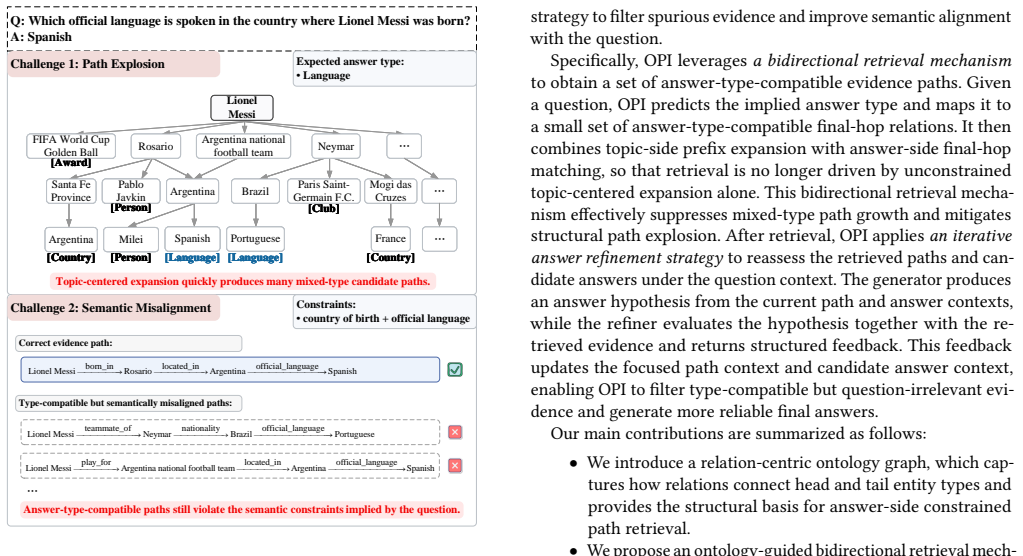
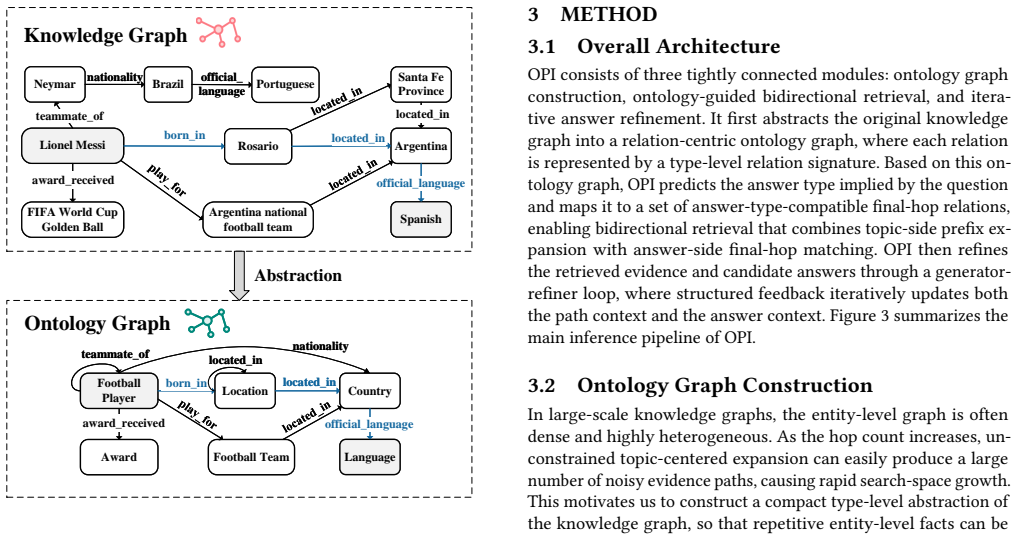
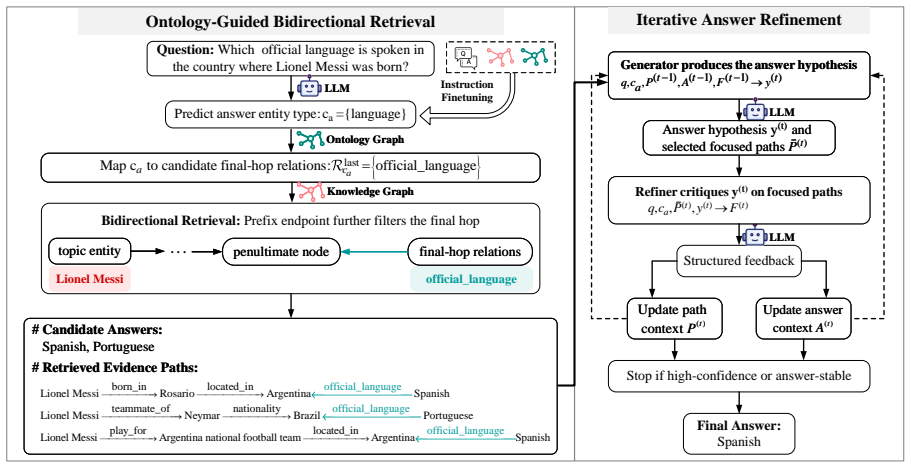
OPI introduces a relation-centric ontology graph to capture the head-tail type constraints of relations, providing a compact interface for answer-side constraints. Based on this ontology graph, OPI first introduces a bidirectional retrieval mechanism by mapping the predicted answer type to compatible final-hop relations and combining topic-side prefix expansion with answer-side final-hop matching, thereby suppressing noisy mixed-type expansion. OPI further adopts an iterative refinement strategy to reassess retrieved paths and candidate answers under the question context, filtering type-compatible but question-irrelevant evidence for more reliable answer prediction.
What carries the argument
The relation-centric ontology graph that encodes head-tail type constraints of relations, used to map answer types to final-hop relations for guided bidirectional retrieval.
If this is right
- Suppresses noisy mixed-type expansion through answer-side final-hop matching.
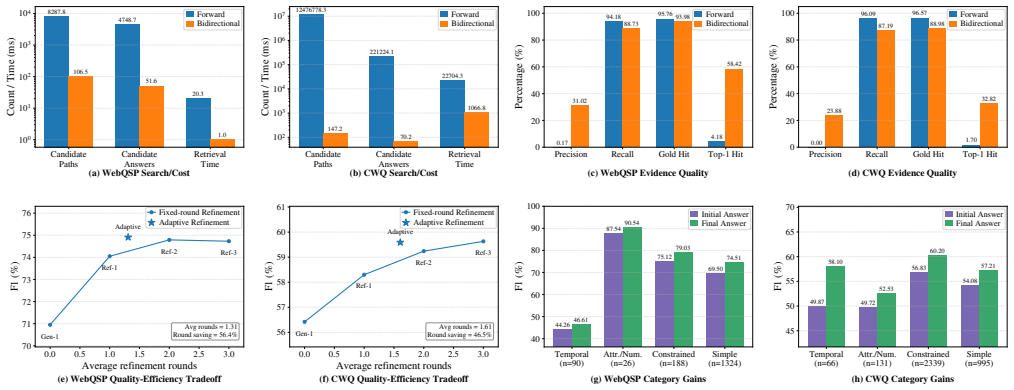
- Improves Hit@1/F1 by 4.6/5.0 points on WebQSP over strongest priors.
- Improves Hit@1/F1 by 8.9/3.3 points on CWQ over strongest priors.
- Achieves near-saturated Hit@1 on MetaQA using the retrieval module alone.
Where Pith is reading between the lines
- The same type-constraint mechanism could be tested on single-hop KGQA to isolate its contribution to multi-hop cases.
- If the ontology is learned from data rather than provided, the framework might extend to knowledge graphs without explicit type annotations.
- The iterative refinement step suggests that question-context filtering can be layered on top of other retrieval methods that lack type guidance.
Load-bearing premise
The relation-centric ontology graph accurately encodes head-tail type constraints and that mapping a predicted answer type to final-hop relations will suppress noisy mixed-type expansion.
What would settle it
Running the method on a benchmark where the ontology graph's type mappings are deliberately altered or removed, checking whether performance drops below the strongest prior baselines on WebQSP or CWQ.
Figures
read the original abstract
Knowledge graph question answering (KGQA) aims to answer natural-language questions by reasoning over structured facts. Existing multi-hop KGQA methods mainly rely on topic-centered expansion, which faces two key challenges: the search space rapidly grows with noisy mixed-type paths, and retrieved paths may fail to satisfy the semantic constraints of complex questions. To address these challenges, we propose OPI, an ontology-guided evidence path inference framework for multi-hop KGQA. OPI introduces a relation-centric ontology graph to capture the head-tail type constraints of relations, providing a compact interface for answer-side constraints. Based on this ontology graph, OPI first introduces a bidirectional retrieval mechanism by mapping the predicted answer type to compatible final-hop relations and combining topic-side prefix expansion with answer-side final-hop matching, thereby suppressing noisy mixed-type expansion. OPI further adopts an iterative refinement strategy to reassess retrieved paths and candidate answers under the question context, filtering type-compatible but question-irrelevant evidence for more reliable answer prediction. Experiments on WebQSP, CWQ, and MetaQA show that OPI substantially reduces the search space, improves Hit@1/F1 by 4.6/5.0 points on WebQSP and 8.9/3.3 points on CWQ over the strongest prior results, and achieves near-saturated Hit@1 on MetaQA with the retrieval module alone.
Editorial analysis
A structured set of objections, weighed in public.
Referee Report
Summary. The manuscript presents OPI, an ontology-guided evidence path inference framework for multi-hop KGQA. It constructs a relation-centric ontology graph to encode head-tail type constraints of relations, enabling bidirectional retrieval (topic-side prefix expansion combined with answer-side final-hop matching via predicted answer types) to prune noisy mixed-type paths, followed by iterative refinement to filter contextually irrelevant evidence. Experiments on WebQSP, CWQ, and MetaQA report search-space reduction and gains of 4.6/5.0 Hit@1/F1 points on WebQSP and 8.9/3.3 on CWQ over prior results, plus near-saturated Hit@1 on MetaQA using retrieval alone.
Significance. If the ontology faithfully encodes KG constraints and the gains prove robust, the bidirectional mechanism offers a principled interface for answer-side semantic constraints that could improve both efficiency and reliability in multi-hop KGQA. The reported near-saturation on MetaQA with the retrieval module alone is a notable empirical strength.
major comments (1)
- [Section 3] Section 3 (Ontology Graph Construction and Bidirectional Retrieval): The relation-centric ontology graph is load-bearing for the claimed search-space reduction and performance gains, as it supplies the type-compatible final-hop relations used to suppress mixed-type expansion. No quantitative check (e.g., coverage, precision, or error rate of the encoded head-tail constraints against the KG for relations appearing in the test sets) is reported, leaving open whether the mechanism reliably prunes paths or whether gains could arise from the iterative refinement step alone.
minor comments (1)
- [Abstract] Abstract and §5 (Experiments): Performance deltas are stated without reference to the exact strongest baselines, without error bars, and without data-selection or random-seed details, which would strengthen reproducibility claims.
Simulated Author's Rebuttal
We thank the referee for the constructive feedback on the manuscript. Below we address the single major comment point by point.
read point-by-point responses
-
Referee: [Section 3] Section 3 (Ontology Graph Construction and Bidirectional Retrieval): The relation-centric ontology graph is load-bearing for the claimed search-space reduction and performance gains, as it supplies the type-compatible final-hop relations used to suppress mixed-type expansion. No quantitative check (e.g., coverage, precision, or error rate of the encoded head-tail constraints against the KG for relations appearing in the test sets) is reported, leaving open whether the mechanism reliably prunes paths or whether gains could arise from the iterative refinement step alone.
Authors: We agree that an explicit quantitative validation of the ontology graph would strengthen the claims. The relation-centric ontology graph is constructed by extracting every observed (head-type, relation, tail-type) triple directly from the full KG; therefore the encoded constraints match the KG exactly for every relation that appears in it. This yields 100% coverage and precision (zero error rate) by construction for all relations, including those in the test sets. While the original submission did not include a dedicated table or paragraph reporting these statistics, we will add one to Section 3 in the revision, listing the number of test-set relations, the number of unique head-tail type pairs per relation, and explicit confirmation of full coverage. The reported search-space reduction already isolates the effect of the ontology-guided final-hop matching; to further separate its contribution from iterative refinement we will also expand the ablation experiments accordingly. revision: yes
Circularity Check
No significant circularity detected in claimed derivation.
full rationale
The paper's central contribution is an algorithmic framework (relation-centric ontology graph construction, bidirectional retrieval, iterative refinement) whose performance is measured by empirical gains on external benchmarks (WebQSP, CWQ, MetaQA) against prior methods. No equations, fitted parameters, or self-citations appear that reduce any prediction or uniqueness claim to a definitional identity or input by construction. The ontology is presented as an extracted interface from the KG for type constraints, and the reported improvements are treated as falsifiable experimental outcomes rather than tautological restatements of the method itself.
Axiom & Free-Parameter Ledger
Reference graph
Works this paper leans on
-
[1]
Dhruv Agarwal, Rajarshi Das, Sopan Khosla, and Rashmi Gangadharaiah. 2024. Bring your own KG: Self-supervised program synthesis for zero-shot KGQA. In Findings of the association for computational linguistics: NAACL 2024. Association for Computational Linguistics, Mexico City, Mexico, 896–919
2024
-
[2]
Hamed Babaei Giglou, Jennifer D’Souza, and Sören Auer. 2023. LLMs4OL: Large language models for ontology learning. InInternational Semantic Web Conference. Springer, 408–427
2023
-
[3]
Kurt Bollacker, Colin Evans, Praveen Paritosh, Tim Sturge, and Jamie Taylor
-
[4]
InProceedings of the 2008 ACM SIGMOD international conference on Management of data
Freebase: a collaboratively created graph database for structuring human knowledge. InProceedings of the 2008 ACM SIGMOD international conference on Management of data. Association for Computing Machinery, Vancouver, BC, Canada, 1247–1250
2008
-
[5]
Deyan Chen and Hong Zhao. 2018. Research on the method of extracting domain knowledge from the freebase RDF dumps.IEEE Access6 (2018), 50306–50322
2018
-
[6]
2024.DeepSeek-V3 Technical Report
DeepSeek-AI, Aixin Liu, Bei Feng, Bing Xue, Bingxuan Wang, Bochao Wu, Chengda Lu, Chenggang Zhao, Chengqi Deng, Chenyu Zhang, Chong Ruan, et al. 2024.DeepSeek-V3 Technical Report. Technical Report arXiv:2412.19437. DeepSeek-AI. https://arxiv.org/abs/2412.19437
Pith/arXiv arXiv 2024
-
[7]
Lianhong Ding, Na Ding, Qi Tao, and Peng Shi. 2025. Enhancing graph multi-hop reasoning for question answering with llms: An approach based on adaptive path generation.Journal of Intelligent Information Systems63, 5 (2025), 1455–1485
2025
-
[8]
Xin Luna Dong. 2023. Generations of Knowledge Graphs: The Crazy Ideas and the Business Impact.Proc. VLDB Endow.16, 12 (Aug. 2023), 4130–4137. https://doi.org/10.14778/3611540.3611636
-
[9]
Giacomo Frisoni, Alessio Cocchieri, Alex Presepi, Gianluca Moro, and Zaiqiao Meng. 2024. To Generate or to Retrieve? On the Effectiveness of Artificial Contexts for Medical Open-Domain Question Answering. InProceedings of the 62nd Annual Meeting of the Association for Computational Linguistics (Volume 1: Long Papers), Lun-Wei Ku, Andre Martins, and Vivek ...
-
[10]
Maurice Funk, Simon Hosemann, Jean Christoph Jung, and Carsten Lutz. 2023. Towards ontology construction with language models. InJoint proceedings of the 1st workshop on Knowledge Base Construction from Pre-Trained Language Models (KBC-LM) and the 2nd challenge on Language Models for Knowledge Base Construction (LM-KBC) co-located with the 22nd Internatio...
2023
-
[11]
Congcong Ge, Xiaoze Liu, Lu Chen, Yunjun Gao, and Baihua Zheng. 2021. LargeEA: aligning entities for large-scale knowledge graphs.Proceedings of the VLDB Endowment15, 2 (Oct. 2021), 237–245. https://doi.org/10.14778/3489496. 3489504
-
[12]
Gaole He, Yunshi Lan, Jing Jiang, Wayne Xin Zhao, and Ji-Rong Wen. 2021. Improving multi-hop knowledge base question answering by learning interme- diate supervision signals. InProceedings of the 14th ACM international conference on web search and data mining. Association for Computing Machinery, Online, 553–561
2021
-
[13]
Yixin Ji, Kaixin Wu, Juntao Li, Wei Chen, Mingjie Zhong, Xu Jia, and Min Zhang
-
[14]
InFindings of the Associa- tion for Computational Linguistics: EMNLP 2024
Retrieval and reasoning on KGs: Integrate knowledge graphs into large language models for complex question answering. InFindings of the Associa- tion for Computational Linguistics: EMNLP 2024. Association for Computational Linguistics, Miami, Florida, USA, 7598–7610
2024
-
[15]
Jinhao Jiang, Kun Zhou, Zican Dong, Keming Ye, Wayne Xin Zhao, and Ji-Rong Wen. 2023. Structgpt: A general framework for large language model to reason over structured data. InProceedings of the 2023 Conference on Empirical Meth- ods in Natural Language Processing. Association for Computational Linguistics, Singapore, 9237–9251
2023
-
[16]
Jinhao Jiang, Kun Zhou, Wayne Xin Zhao, Yaliang Li, and Ji-Rong Wen. 2023. Reasoninglm: Enabling structural subgraph reasoning in pre-trained language models for question answering over knowledge graph. InProceedings of the 2023 Conference on Empirical Methods in Natural Language Processing. Association for Computational Linguistics, Singapore, 3721–3735
2023
-
[17]
Jinhao Jiang, Kun Zhou, Wayne Xin Zhao, Yang Song, Chen Zhu, Hengshu Zhu, and Ji-Rong Wen. 2025. KG-Agent: An efficient autonomous agent framework for complex reasoning over knowledge graph. InProceedings of the 63rd Annual Meeting of the Association for Computational Linguistics (Volume 1: Long Papers). Association for Computational Linguistics, Vienna, ...
2025
-
[18]
Jinhao Jiang, Kun Zhou, Xin Zhao, and Ji-Rong Wen. 2023. UniKGQA: Unified Retrieval and Reasoning for Solving Multi-hop Question Answering Over Knowl- edge Graph. InThe Eleventh International Conference on Learning Representations. ICLR, OpenReview.net, Kigali, Rwanda, 16. https://openreview.net/forum?id= Z63RvyAZ2Vh
2023
-
[19]
Longquan Jiang, Junbo Huang, Cedric Moller, and Ricardo Usbeck. 2025. Ontology-Guided, Hybrid Prompt Learning for Generalization in Knowledge Graph Question Answering. In2025 19th International Conference on Semantic Computing (ICSC). IEEE Computer Society, 28–35
2025
-
[20]
Jiho Kim, Yeonsu Kwon, Yohan Jo, and Edward Choi. 2023. KG-GPT: A general framework for reasoning on knowledge graphs using large language models. In Findings of the Association for Computational Linguistics: EMNLP 2023. Association for Computational Linguistics, Singapore, 9410–9421
2023
-
[21]
Vamsi Krishna Kommineni, Birgitta König-Ries, and Sheeba Samuel. 2024. From human experts to machines: An LLM supported approach to ontology and knowl- edge graph construction.arXiv preprint arXiv:2403.08345(2024)
arXiv 2024
-
[22]
Junlin Lee, Yequan Wang, Jing Li, and Min Zhang. 2024. Multimodal Reasoning with Multimodal Knowledge Graph. InProceedings of the 62nd Annual Meeting of the Association for Computational Linguistics (Volume 1: Long Papers), Lun-Wei Ku, Andre Martins, and Vivek Srikumar (Eds.). Association for Computational Linguistics, Bangkok, Thailand, 10767–10782. http...
-
[23]
Ben Liu, Jihai Zhang, Fangquan Lin, Cheng Yang, Min Peng, and Wotao Yin
-
[24]
InProceedings of the ACM on Web Conference
Symagent: A neural-symbolic self-learning agent framework for complex reasoning over knowledge graphs. InProceedings of the ACM on Web Conference
-
[25]
Association for Computing Machinery, Sydney, Australia, 98–108
-
[26]
Runxuan Liu, Luobei Luobei, Jiaqi Li, Baoxin Wang, Ming Liu, Dayong Wu, Shijin Wang, and Bing Qin. 2025. Ontology-Guided Reverse Thinking Makes Large Language Models Stronger on Knowledge Graph Question Answering. InProceedings of the 63rd Annual Meeting of the Association for Computational Linguistics (Volume 1: Long Papers), Wanxiang Che, Joyce Nabende,...
-
[27]
Zhiqiang Liu, Chengtao Gan, Junjie Wang, Yichi Zhang, Zhongpu Bo, Mengshu Sun, Huajun Chen, and Wen Zhang. 2025. Ontotune: Ontology-driven self- training for aligning large language models. InProceedings of the ACM on Web Conference 2025. 119–133
2025
-
[28]
Linhao Luo, Yuan-Fang Li, Gholamreza Haffari, and Shirui Pan. 2024. Reasoning on Graphs: Faithful and Interpretable Large Language Model Reasoning. InThe Twelfth International Conference on Learning Representations. OpenReview.net, Vienna, Austria, 1–24. https://openreview.net/forum?id=ZGNWW7xZ6Q
2024
-
[29]
Linhao Luo, Zicheng Zhao, Gholamreza Haffari, Yuan-Fang Li, Chen Gong, and Shirui Pan. 2025. Graph-constrained Reasoning: Faithful Reasoning on Knowledge Graphs with Large Language Models. InProceedings of the 42nd International Conference on Machine Learning, Vol. 267. Proceedings of Machine Learning Research, Vancouver, Canada, 41540–41565. https://proc...
2025
-
[30]
Costas Mavromatis and George Karypis. 2025. Gnn-rag: Graph neural retrieval for efficient large language model reasoning on knowledge graphs. InFind- ings of the Association for Computational Linguistics: ACL 2025. Association for Computational Linguistics, Vienna, Austria, 16682–16699
2025
-
[31]
Meta. 2024. Build the future of ai with meta llama 3. https://llama.meta.com/ llama3/
2024
-
[32]
Microsoft. 2015. FastRDFStore-data. https://download.microsoft.com/download/ A/E/4/AE428B7A-9EF9-446C-85CF-D8ED0C9B1F26/FastRDFStore-data.zip
2015
-
[33]
Alexander Miller, Adam Fisch, Jesse Dodge, Amir-Hossein Karimi, Antoine Bordes, and Jason Weston. 2016. Key-value memory networks for directly reading documents. InProceedings of the 2016 conference on empirical methods in natural language processing. Association for Computational Linguistics, Austin, Texas, 1400–1409
2016
-
[34]
OpenAI. 2022. Introducing ChatGPT. https://openai.com/index/chatgpt/
2022
-
[35]
OpenAI. 2024. Hello gpt-4o. https://openai.com/index/hello-gpt-4o/
2024
-
[36]
Palantir. 2024. Connecting AI to Decisions with the Palantir Ontol- ogy. https://blog.palantir.com/connecting-ai-to-decisions-with-the-palantir- ontology-c73f7b0a1a72. Accessed: 2026-04-29
2024
-
[37]
Shirui Pan, Linhao Luo, Yufei Wang, Chen Chen, Jiapu Wang, and Xindong Wu
-
[38]
IEEE Transactions on Knowledge and Data Engineering36(7), 3580–3599 (2024)
Unifying Large Language Models and Knowledge Graphs: A Roadmap. IEEE Transactions on Knowledge and Data Engineering36, 7 (2024), 3580–3599. https://doi.org/10.1109/TKDE.2024.3352100
-
[39]
Kashif Rabbani, Matteo Lissandrini, and Katja Hose. 2023. Extraction of Validating Shapes from Very Large Knowledge Graphs.Proceedings of the VLDB Endowment 16, 5 (Jan. 2023), 1023–1032. https://doi.org/10.14778/3579075.3579078
-
[40]
Nils Reimers and Iryna Gurevych. 2019. Sentence-bert: Sentence embeddings using siamese bert-networks. InProceedings of the 2019 conference on empirical methods in natural language processing and the 9th international joint conference on natural language processing (EMNLP-IJCNLP). 3982–3992
2019
-
[41]
Apoorv Saxena, Adrian Kochsiek, and Rainer Gemulla. 2022. Sequence-to- sequence knowledge graph completion and question answering. InProceedings of the 60th annual meeting of the association for computational linguistics (vol- ume 1: long papers). Association for Computational Linguistics, Dublin, Ireland, 2814–2828
2022
-
[42]
Jiaxin Shi, Shulin Cao, Lei Hou, Juanzi Li, and Hanwang Zhang. 2021. Transfernet: An effective and transparent framework for multi-hop question answering over relation graph. InProceedings of the 2021 Conference on Empirical Methods in Natural Language Processing. Association for Computational Linguistics, Online and Punta Cana, Dominican Republic, 4149–4158. 13
2021
-
[43]
Haitian Sun, Tania Bedrax-Weiss, and William Cohen. 2019. Pullnet: Open domain question answering with iterative retrieval on knowledge bases and text. InProceedings of the 2019 conference on empirical methods in natural language processing and the 9th international joint conference on natural language processing (EMNLP-IJCNLP). Association for Computatio...
2019
-
[44]
Haitian Sun, Bhuwan Dhingra, Manzil Zaheer, Kathryn Mazaitis, Ruslan Salakhut- dinov, and William Cohen. 2018. Open Domain Question Answering Using Early Fusion of Knowledge Bases and Text. InProceedings of the 2018 Conference on Em- pirical Methods in Natural Language Processing. Association for Computational Linguistics, Brussels, Belgium, 4231–4242
2018
-
[45]
Jiashuo Sun, Chengjin Xu, Lumingyuan Tang, Saizhuo Wang, Chen Lin, Yeyun Gong, Lionel Ni, Heung-Yeung Shum, and Jian Guo. 2024. Think-on-Graph: Deep and Responsible Reasoning of Large Language Model on Knowledge Graph. InThe Twelfth International Conference on Learning Representations. OpenRe- view.net, Vienna, Austria, 31. https://openreview.net/forum?id...
2024
-
[46]
Alon Talmor and Jonathan Berant. 2018. The Web as a Knowledge-Base for Answering Complex Questions. InProceedings of the 2018 Conference of the North American Chapter of the Association for Computational Linguistics: Human Language Technologies, Volume 1 (Long Papers). Association for Computational Linguistics, New Orleans, Louisiana, 641–651
2018
-
[47]
Xingyu Tan, Xiaoyang Wang, Qing Liu, Xiwei Xu, Xin Yuan, and Wenjie Zhang
-
[48]
InProceedings of the ACM on Web Conference 2025(Sydney NSW, Australia)(WWW ’25)
Paths-over-Graph: Knowledge Graph Empowered Large Language Model Reasoning. InProceedings of the ACM on Web Conference 2025(Sydney NSW, Australia)(WWW ’25). Association for Computing Machinery, New York, NY, USA, 3505–3522. https://doi.org/10.1145/3696410.3714892
-
[49]
Anagnostopoulos, Sue Bello, Kai Blumberg, Rhiannon Cameron, Leigh Carmody, Alexander D
Sabrina Toro, Anna V. Anagnostopoulos, Sue Bello, Kai Blumberg, Rhiannon Cameron, Leigh Carmody, Alexander D. Diehl, Damion M. Dooley, William Duncan, Petra Fey, Pascale Gaudet, Nomi L. Harris, marcin p. joachimiak, Leila Kiani, Tiago Lubiana, Monica C. Munoz-Torres, Shawn T. O’Neil, David Osumi- Sutherland, Aleix Puig, Justin Reese, Leonore Reiser, Sofia...
2024
-
[50]
Hugo Touvron, Louis Martin, Kevin Stone, Peter Albert, Amjad Almahairi, Yasmine Babaei, Nikolay Bashlykov, Soumya Batra, Prajjwal Bhargava, Shruti Bhosale, et al. 2023. Llama 2: Open Foundation and Fine-Tuned Chat Models. https://doi.org/10.48550/arXiv.2307.09288 arXiv:2307.09288 [cs.CL]
work page internal anchor Pith review Pith/arXiv arXiv doi:10.48550/arxiv.2307.09288 2023
-
[51]
Yilin Wen, Zifeng Wang, and Jimeng Sun. 2024. MindMap: Knowledge Graph Prompting Sparks Graph of Thoughts in Large Language Models. InProceedings of the 62nd Annual Meeting of the Association for Computational Linguistics (Volume 1: Long Papers), Lun-Wei Ku, Andre Martins, and Vivek Srikumar (Eds.). Association for Computational Linguistics, Bangkok, Thai...
-
[52]
Tian Yang, Yupeng Mei, Ling Xu, Huihui Yu, and Yingyi Chen. 2024. Applica- tion of question answering systems for intelligent agriculture production and sustainable management: A review.Resources, Conservation and Recycling204 (2024), 107497. https://doi.org/10.1016/j.resconrec.2024.107497
-
[53]
Wen-tau Yih, Matthew Richardson, Christopher Meek, Ming-Wei Chang, and Jina Suh. 2016. The value of semantic parse labeling for knowledge base question answering. InProceedings of the 54th Annual Meeting of the Association for Com- putational Linguistics (Volume 2: Short Papers). Association for Computational Linguistics, Berlin, Germany, 201–206
2016
-
[54]
Changsen Yuan, Rui Lin, and Cunhan Guo. 2026. Reliable reasoning: Learning and inference based on the ability of large language models.Applied Soft Computing 190 (2026), 114618
2026
-
[55]
Han Zhang, Langshi Zhou, and Hanfang Yang. 2025. Learning to Retrieve and Reason on Knowledge Graph through Active Self-Reflection. https://doi.org/10. 48550/arXiv.2502.14932 arXiv:2502.14932 [cs.CL]
arXiv 2025
-
[56]
Jing Zhang, Xiaokang Zhang, Jifan Yu, Jian Tang, Jie Tang, Cuiping Li, and Hong Chen. 2022. Subgraph Retrieval Enhanced Model for Multi-hop Knowledge Base Question Answering. InProceedings of the 60th Annual Meeting of the Association for Computational Linguistics (Volume 1: Long Papers). Association for Computational Linguistics, Dublin, Ireland, 5773–5784
2022
-
[57]
Yuyu Zhang, Hanjun Dai, Zornitsa Kozareva, Alexander Smola, and Le Song
-
[58]
In Proceedings of the AAAI conference on artificial intelligence, Vol
Variational reasoning for question answering with knowledge graph. In Proceedings of the AAAI conference on artificial intelligence, Vol. 32. AAAI Press, New Orleans, Lousiana, USA, 6069–6076. 14
discussion (0)
Sign in with ORCID, Apple, or X to comment. Anyone can read and Pith papers without signing in.