REVIEW 2 major objections 2 minor 142 references
Demographics of planet-forming disks with the SKAO
T0 review · 2 major / 2 minor · reviewed 2026-06-29 · grok-4.3
Pith's one-line read SKAO will enable the first large-scale high-resolution survey of centimeter emission from nearby planet-forming disks.
desk verdict This is a planning document that organizes the case for SKAO cm-wave disk surveys but adds no new calculations or results. read the letter →
The pith
A machine-rendered reading of the paper's core claim, the machinery that carries it, and where it could break.
The reading
What carries the argument
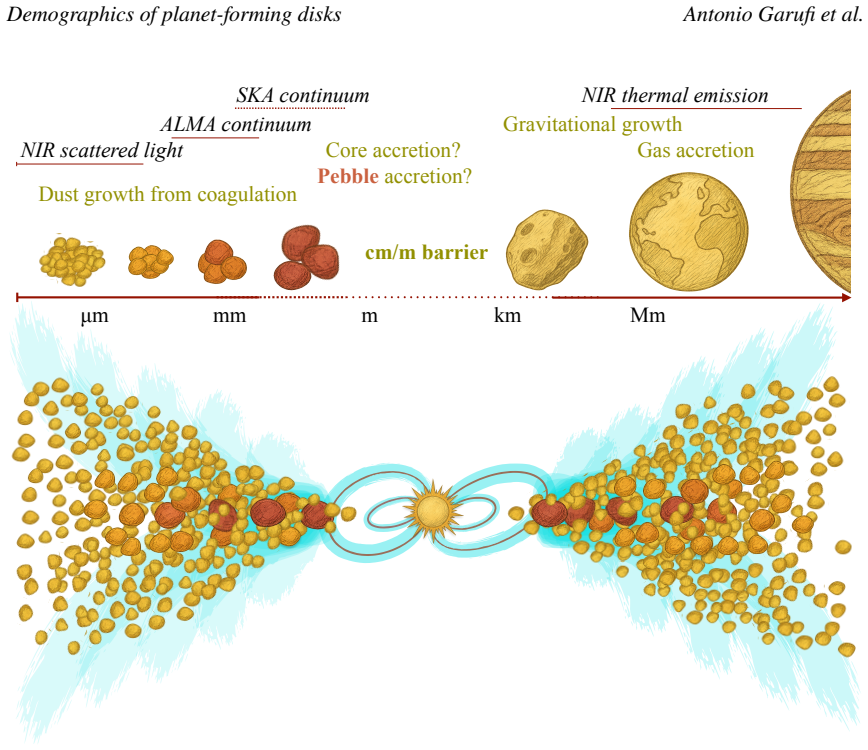
Centimeter-wavelength high-resolution imaging of protoplanetary disk emission to detect and map centimeter-sized grains.
What would settle it
A survey returning no detectable centimeter emission from a statistically large number of the targeted disks would show that the grains are either not abundant enough or do not emit as expected.
Extended reading notes
Core claim
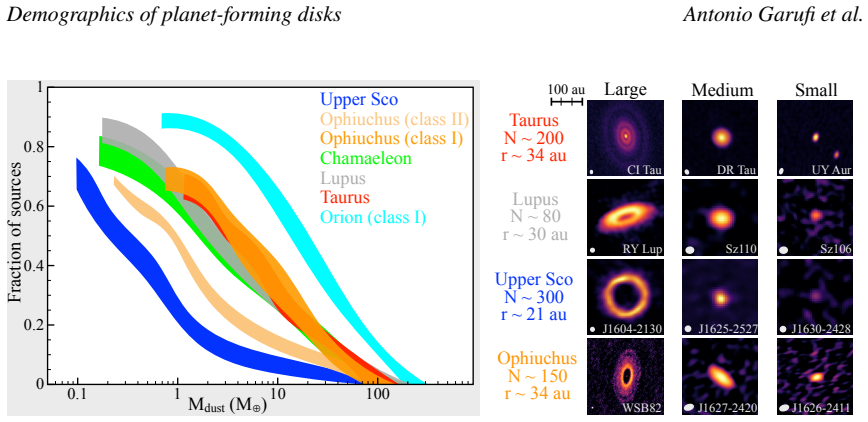
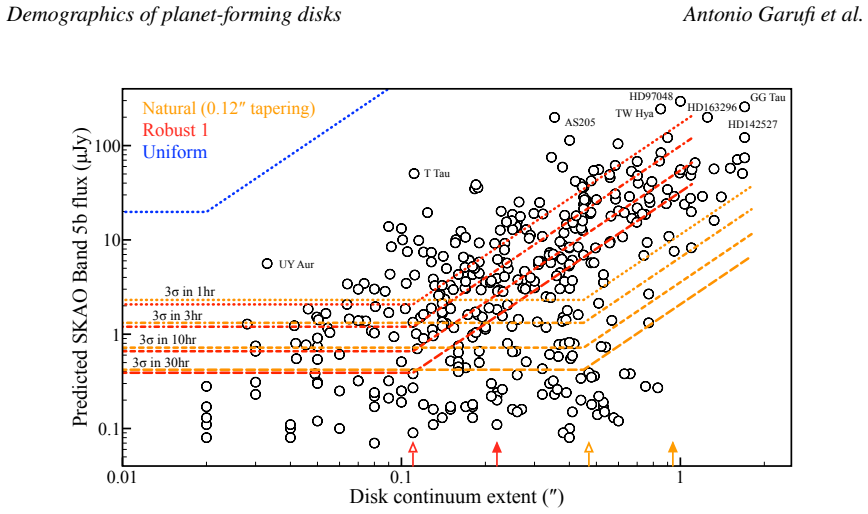
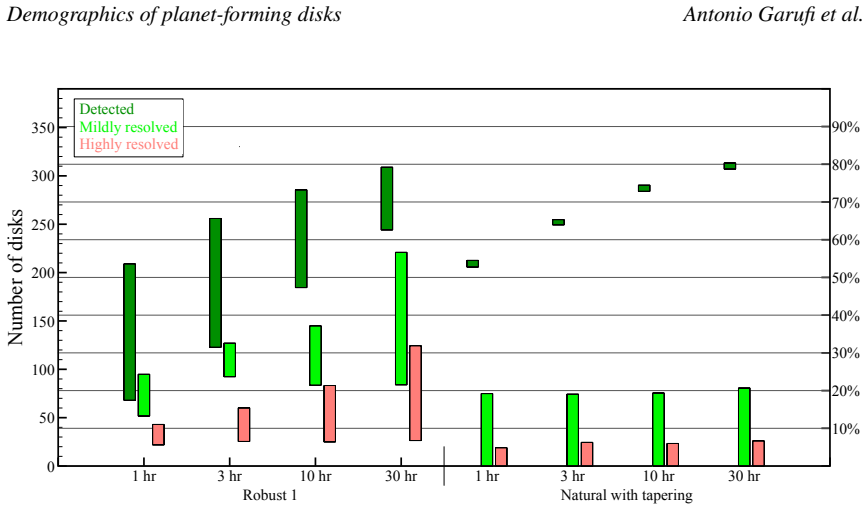
The SKAO will fill the observational gap by enabling the first large-scale, high-resolution survey of disk emission at centimeter wavelengths, allowing detection and characterization of pebbles through their spatial distribution, spectral properties, and evolutionary trends to provide essential constraints on dust growth and disk dynamics.
Load-bearing premise
Centimeter-sized grains exist in sufficient abundance and produce detectable emission at SKAO frequencies across a large sample of nearby disks.
Editorial extensions
If this is right
- Resolving pebble spatial distributions will constrain mechanisms of dust growth and radial drift in disks.
- Spectral index measurements will reveal grain size distributions and compositions.
- Comparing trends across multiple star-forming regions will map evolutionary stages of solid material.
- Improved mass estimates will reduce uncertainties in the total solid content available for planet formation.
- Detections of localized emission may identify protoplanets or their circumplanetary disks.
Reading between the lines
- Pairing SKAO centimeter data with ALMA millimeter maps could trace the full grain size spectrum from microns to centimeters in the same disks.
- Demographic statistics from the survey might identify environmental factors that accelerate or suppress pebble formation.
- If pebble emission proves common, it would support models in which these grains act as the main feedstock for core accretion.
- Target selection strategies outlined here could be adapted to other facilities for multi-wavelength follow-up.
Editorial analysis
A structured set of objections, weighed in public.
Referee Report
Summary. The manuscript outlines the scientific rationale for using the SKAO to perform the first large-scale, high-resolution surveys of planet-forming disks at centimeter wavelengths. It argues that this will enable characterization of centimeter-sized grains (pebbles), resolve their spatial distribution and spectral properties, and provide constraints on dust growth and disk dynamics in nearby star-forming regions. The text presents observational strategies, target selection criteria, predictions for detecting hundreds of disks, and potential applications to measuring actual dust masses, identifying protoplanets, and studying circumplanetary disks.
Significance. If the detectability assumptions and strategies prove robust, the work would offer timely guidance for SKAO early-science programs and help address a recognized gap in pebble evolution studies left by ALMA. It correctly identifies centimeter-wave observations as a key missing element for demographic studies of solids in disks. The absence of any quantitative sensitivity calculations or error budgets, however, limits the paper's immediate utility as a planning document.
major comments (2)
- [Abstract] Abstract and introductory sections: the central claim that SKAO 'will enable the first large-scale, high-resolution survey' and 'predictions on the detectability of hundreds of nearby disks' is asserted without any sensitivity calculations, assumed flux densities, grain-size distributions, or SKAO performance parameters. These quantities are load-bearing for the prospective conclusions yet are not derived or referenced.
- [Observational strategies] Section on observational strategies and target selection: no error budget, confusion limits, or assumed centimeter-grain opacities are provided to support the assertion that a statistically useful sample can be observed. The weakest assumption (sufficient abundance and detectable emission from cm-sized grains) is stated as motivation rather than demonstrated.
minor comments (2)
- The manuscript refers to itself as 'this chapter' in several places; clarify whether it is intended as a standalone journal article or a book chapter.
- Notation for SKAO versus SKA is used inconsistently; adopt a single acronym throughout.
Simulated Author's Rebuttal
We thank the referee for their thoughtful review and constructive comments on our manuscript. We address each major comment below and agree that incorporating quantitative elements will improve the paper's utility as a planning document for SKAO observations.
read point-by-point responses
-
Referee: [Abstract] Abstract and introductory sections: the central claim that SKAO 'will enable the first large-scale, high-resolution survey' and 'predictions on the detectability of hundreds of nearby disks' is asserted without any sensitivity calculations, assumed flux densities, grain-size distributions, or SKAO performance parameters. These quantities are load-bearing for the prospective conclusions yet are not derived or referenced.
Authors: We agree that the current version presents these claims at a high level without explicit derivations. The predictions draw on standard literature values for cm-grain opacities and SKAO sensitivity estimates, but we acknowledge the need for transparency. In revision we will add a dedicated subsection with sensitivity calculations, assumed flux densities, grain-size distributions, and direct references to SKAO performance parameters to support the detectability predictions. revision: yes
-
Referee: [Observational strategies] Section on observational strategies and target selection: no error budget, confusion limits, or assumed centimeter-grain opacities are provided to support the assertion that a statistically useful sample can be observed. The weakest assumption (sufficient abundance and detectable emission from cm-sized grains) is stated as motivation rather than demonstrated.
Authors: We accept this point. The manuscript motivates the science case but does not include the requested error budgets, confusion limits, or explicit opacity assumptions. We will revise the observational strategies section to incorporate these quantitative elements, including an error budget and demonstration of detectable cm-grain emission under realistic assumptions, to better support the claim of a statistically useful sample. revision: yes
Circularity Check
No significant circularity
full rationale
The document is an observational strategy paper outlining planned SKAO surveys of planet-forming disks at centimeter wavelengths. It presents scientific motivation, target selection criteria, and detectability estimates but contains no derivations, fitted parameters, equations, or predictions that reduce to the paper's own inputs by construction. All claims are prospective and framed as motivations for new data rather than self-referential results. No self-citations serve as load-bearing premises for any asserted theorem or uniqueness result. The central claim (SKAO enabling large-scale cm-wave disk surveys) is independent of any internal fitting or renaming of known patterns.
Assumptions & free parameters
Cite this review
Pith. "Pith review of Demographics of planet-forming disks with the SKAO." pith.science (2026). https://pith.science/paper/7QKQGEL3
@misc{pith2026260628171,
  author       = {Pith},
  title        = {Pith review of: Demographics of planet-forming disks with the SKAO},
  year         = {2026},
  howpublished = {\url{https://pith.science/paper/7QKQGEL3}},
  note         = {Machine review of arXiv:2606.28171}
}
read the original abstract
Understanding how solid material in planet-forming disks evolves from micron-sized dust to planetary cores is a central challenge in modern astrophysics. This study has advanced dramatically in the past decade, largely driven by ALMA and high-contrast imaging facilities. However, major uncertainties remain regarding the presence, evolution, and role of centimeter-sized grains (the pebbles) in planet formation. The SKAO will fill this gap by enabling the first large-scale, high-resolution survey of disk emission at centimeter wavelengths. This chapter presents the scientific rationale and observational strategies to detect and characterize pebbles in the planet-forming disks of nearby star-forming regions. By resolving their spatial distribution, spectral properties, and evolutionary trends, SKA will offer essential constraints on dust growth and disk dynamics. This work provides observational strategies, target selection, and predictions on the detectability of hundreds of nearby disks. The chapter also explores SKA's potential to uncover the actual dust mass in disks, protoplanets and their circumplanetary disks, and other aspects of the planet formation. Together, these capabilities will establish SKAO as a cornerstone facility for planet formation science in the coming decade.
Figures

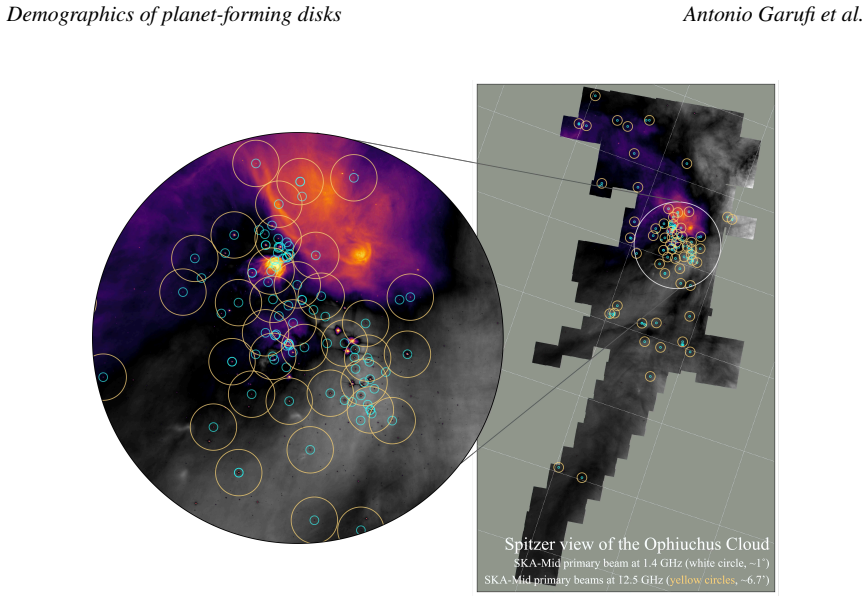
Figures from the paper (3 more)
Reference graph
Works this paper leans on
-
[1]
doi: 10.1088/0004-637X/784/1/62. A. Alaguero et al. A&A, 687:A311, July
-
[2]
doi: 10.1051/0004-6361/202449683. ALMA Partnership et al. ApJ, 808:L3, July
-
[3]
doi: 10.1088/2041-8205/808/1/L3. S. M. Andrews. ARA&A, 58:483–528, Aug
-
[4]
doi: 10.1146/annurev-astro-031220-010302. S. M. Andrews and J. P . Williams. ApJ, 631:1134–1160, Oct
work page Pith review doi:10.1146/annurev-astro-031220-010302
-
[5]
doi: 10.1086/432712. S. M. Andrews et al. ApJ, 820(2):L40, Apr
-
[6]
22 Demographics of planet-forming disks Antonio Garufi et al
doi: 10.3847/2041-8205/820/2/L40. 22 Demographics of planet-forming disks Antonio Garufi et al. S. M. Andrews et al. ApJ, 869(2):L41, Dec
-
[7]
doi: 10.3847/2041-8213/aaf741. M. Ansdell et al. ApJ, 828:46, Sept
-
[8]
doi: 10.3847/0004-637X/828/1/46. M. Ansdell et al. AJ, 153(5):240, May
Show all 142 references
-
[9]
doi: 10.3847/1538-3881/aa69c0. M. Ansdell et al. ApJ, 859:21, May
-
[10]
doi: 10.3847/1538-4357/aab890. M. Audard et al. In H. Beuther, R. S. Klessen, C. P . Dullemond, and T. Henning, editors, Protostars and Planets VI, pages 387–410, Jan
-
[11]
doi: 10.2458/azu_uapress_9780816531240-ch017. J. Bae et al. In S. Inutsuka et al., editors, Protostars and Planets VII, volume 534 of Astronomical Society of the Pacific Conference Series, page 423, July
-
[12]
doi: 10.48550/arXiv.2210.13314. S. A. Barenfeld, J. M. Carpenter, L. Ricci, and A. Isella. ApJ, 827(2):142, Aug
-
[13]
doi: 10.1086/115385. M. Benisty et al. In S. Inutsuka et al., editors, Astronomical Society of the Pacific Conference Series, volume 534 of Astronomical Society of the Pacific Conference Series, page 605, July
-
[14]
doi: 10.1038/nature11805. L. M. Bernabò et al. ApJ, 927(2):L22, Mar
-
[15]
doi: 10.3847/2041-8213/ac574e. A. Bhandare et al. A&A, 687:A158, July
-
[16]
doi: 10.1051/0004-6361/202449594. T. Birnstiel et al. ApJ, 869(2):L45, Dec
-
[17]
doi: 10.3847/2041-8213/aaf743. I. Bonnell and P . Bastien. ApJ, 401:L31, Dec
-
[18]
doi: 10.1086/186663. E. M. A. Borchert, D. J. Price, C. Pinte, and N. Cuello. MNRAS, 510(1):L37–L41, Feb. 2022a. doi: 10.1093/mnrasl/slab123. E. M. A. Borchert, D. J. Price, C. Pinte, and N. Cuello. MNRAS, 517(3):4436–4446, Dec. 2022b. doi: 10.1093/mnras/stac2872. J. M. Brown ...
-
[19]
doi: 10.1088/0004-637X/704/1/496. L. Cacciapuoti et al. ApJ, 961(1):90, Jan
-
[20]
doi: 10.3847/1538-4357/ad0f17. L. Cacciapuoti et al. A&A, 700:A188, Aug
-
[21]
doi: 10.1051/0004-6361/202554645. J. M. Carpenter et al. ApJ, 978(1):117, Jan
-
[22]
doi: 10.3847/1538-4357/ad8ebc. C. Carrasco-González et al. ApJ, 821(1):L16, Apr
-
[23]
doi: 10.3847/2041-8205/821/1/L16. C. Carrasco-González et al. ApJ, 883(1):71, Sept
-
[24]
doi: 10.3847/1538-4357/ab3d33. D. Carrera et al. arXiv e-prints , art. arXiv:2504.13246, Apr
-
[25]
doi: 10.48550/arXiv.2504. 13246. S. Casassus et al. ApJ, 754:L31, Aug
-
[26]
doi: 10.1088/2041-8205/754/2/L31. S. Casassus et al. ApJ, 812(2):126, Oct
-
[27]
doi: 10.1088/0004-637X/812/2/126. P . Cazzoletti et al. A&A, 626:A11, June
-
[28]
doi: 10.1051/0004-6361/201935273. L. A. Cieza et al. Nature, 535(7611):258–261, July
-
[29]
doi: 10.1038/nature18612. L. A. Cieza et al. MNRAS, 474(4):4347–4357, Mar
-
[30]
doi: 10.1093/mnras/stx3059. L. A. Cieza et al. MNRAS, 482(1):698–714, Jan
-
[31]
doi: 10.1093/mnras/sty2653. L. A. Cieza et al. MNRAS, 501(2):2934–2953, Feb
-
[32]
doi: 10.1093/mnras/staa3787. L. I. Cleeves, E. A. Bergin, and T. J. Harries. ApJ, 807(1):2, July
-
[33]
doi: 10.1088/0004-637X/ 807/1/2. M. S. Connelley and B. Reipurth. ApJ, 861(2):145, July
-
[34]
doi: 10.3847/1538-4357/aaba7b. C. Contreras Peña et al. arXiv e-prints , art. arXiv:2504.21237, Apr
-
[35]
2504.21237
doi: 10.48550/arXiv. 2504.21237. 23 Demographics of planet-forming disks Antonio Garufi et al. A. Coutens et al. A&A, 631:A58, Nov
-
[36]
doi: 10.1051/0004-6361/201935340. N. Cuello, F. Ménard, and D. J. Price. European Physical Journal Plus, 138(1):11, Jan
-
[37]
doi: 10.1140/epjp/s13360-022-03602-w. N. Cuello, A. Alaguero, and P . P . Poblete. Symmetry, 17(3):344, Feb
-
[38]
doi: 10.1051/0004-6361/202347042. E. Dartois et al. Nature Astronomy, 8:359–367, Mar
-
[39]
doi: 10.1038/s41550-023-02155-x. M. de Juan Ovelar et al. MNRAS, 459(1):L85–L89, June
-
[40]
doi: 10.1093/mnrasl/slw051. G. Dipierro et al. MNRAS, 453(1):L73–L77, Oct
-
[41]
doi: 10.1093/mnrasl/slv105. K. Doi and A. Kataoka. ApJ, 912(2):164, May
-
[42]
doi: 10.3847/1538-4357/abe5a6. K. Doi and A. Kataoka. ApJ, 957(1):11, Nov
-
[43]
doi: 10.3847/1538-4357/acf5df. B. T. Draine. ARA&A, 41:241–289, Jan
- [44]
-
[45]
doi: 10.1086/306387. J. Drążkowska and J. Szulágyi. ApJ, 866(2):142, Oct
-
[46]
doi: 10.3847/1538-4357/aae0fd. B. Dubrulle, G. Morfill, and M. Sterzik. Icarus, 114(2):237–246, Apr
-
[47]
1995.1058
doi: 10.1006/icar. 1995.1058. G. Duchêne, C. McCabe, A. M. Ghez, and B. A. Macintosh. ApJ, 606(2):969–982, May
1995 doi
-
[48]
doi: 10.1086/383126. C. P . Dullemond et al. ApJ, 869(2):L46, Dec
-
[49]
doi: 10.3847/2041-8213/aaf742. M. M. Dunham et al. ApJ, 710(1):470–502, Feb
-
[50]
doi: 10.1088/0004-637X/710/1/470. D. Fedele et al. A&A, 600:A72, Apr
-
[51]
doi: 10.1051/0004-6361/201629860. R. Franceschi et al. A&A, 657:A74, Jan
-
[52]
doi: 10.1051/0004-6361/202141705. L. Francis and N. van der Marel. ApJ, 892(2):111, Apr
-
[53]
doi: 10.3847/1538-4357/ab7b63. F. Fressin et al. ApJ, 766(2):81, Apr
-
[54]
doi: 10.1088/0004-637X/766/2/81. S. Fromang and R. P . Nelson. A&A, 496(3):597–608, Mar
-
[56]
doi: 10.3847/1538-3881/aa80eb. M. Galametz et al. A&A, 632:A5, Dec
-
[57]
doi: 10.1051/0004-6361/201936342. A. Garufi et al. A&A, 620:A94, Dec
-
[58]
doi: 10.1051/0004-6361/201833872. A. Garufi et al. A&A, 658:A104, Feb
-
[59]
doi: 10.1051/0004-6361/202141264. A. Garufi et al. A&A, 694:A290, Feb
-
[60]
doi: 10.1051/0004-6361/202452496. S. Giacalone et al. ApJ, 882(1):33, Sept
-
[61]
doi: 10.3847/1538-4357/ab311a. J. S. Greaves et al. Nature Astronomy, 2:662–667, June
-
[62]
doi: 10.1038/s41550-018-0495-z. O. Gressel, R. P . Nelson, N. J. Turner, and U. Ziegler. ApJ, 779(1):59, Dec
-
[63]
doi: 10.1051/0004-6361/202349046. G. Guidi et al. A&A, 664:A137, Aug
-
[64]
doi: 10.1051/0004-6361/202142303. G. Guidi et al. In Advancing Astrophysics with the SKA – II (AASKAII)
-
[65]
doi: 10.3847/1538-4357/acf853. I. Han et al. arXiv e-prints, art. arXiv:2506.16569, June
-
[66]
doi: 10.48550/arXiv.2506.16569. G. H. Herbig. ApJ, 214:747–758, Jun
-
[67]
doi: 10.1086/155304. M. Hoare et al. In Advancing Astrophysics with the Square Kilometre Array (AASKA14), page 115, 24 Demographics of planet-forming disks Antonio Garufi et al. Apr
-
[68]
doi: 10.22323/1.215.0115. J. Huang et al. ApJ, 976(1):132, Nov
-
[69]
doi: 10.3847/1538-4357/ad84df. L. A. Hühn et al. A&A, 696:A162, Apr
-
[70]
doi: 10.1051/0004-6361/202452689. A. Isella et al. Phys. Rev. Lett. , 117:251101, Dec
-
[71]
URL http://link.aps.org/doi/10.1103/PhysRevLett.117.251101
doi: 10.1103/PhysRevLett.117.251101. URL http://link.aps.org/doi/10.1103/PhysRevLett.117.251101. S. Jin et al. ApJ, 818(1):76, Feb
-
[72]
doi: 10.3847/0004-637X/818/1/76. A. Johansen, S. Ida, and R. Brasser. A&A, 622:A202, Feb
-
[74]
doi: 10.1051/0004-6361/201832957. Á. Kóspál et al. ApJS, 256(2):30, Oct
-
[75]
doi: 10.3847/1538-4365/ac0f09. M. Lambrechts and A. Johansen. A&A, 544:A32, Aug
-
[76]
doi: 10.1051/0004-6361/201219127. C.-F. Lee, Z.- Y . Li, and N. J. Turner. Nature Astronomy, page 466, Oct
-
[77]
doi: 10.3847/1538-4357/acd5c9. H. B. Liu. ApJ, 914(1):25, June
-
[78]
doi: 10.3847/1538-4357/abf8b6. H. B. Liu et al. ApJ, 972(2):163, Sept
-
[79]
doi: 10.3847/1538-4357/ad5dab. G. Lodato et al. MNRAS, 518(3):4481–4493, Jan
-
[80]
doi: 10.1093/mnras/stac3223. D. Lommen et al. A&A, 495(3):869–879, Mar
-
[81]
doi: 10.1051/0004-6361:200810999. F. Long et al. ApJ, 869(1):17, Dec
-
[82]
doi: 10.3847/1538-4357/aae8e1. F. Long et al. ApJ, 915(2):131, July
-
[83]
doi: 10.3847/1538-4357/abff53. F. Long et al. ApJ, 937(1):L1, Sept
-
[84]
doi: 10.3847/2041-8213/ac8b10. W. Lyra, A. Johansen, M. H. Cañas, and C.-C. Y ang. ApJ, 946(2):60, Apr
-
[85]
doi: 10.3847/0004-637X/829/1/1. E. Macías et al. ApJ, 865(1):37, Sept
-
[86]
doi: 10.3847/1538-4357/aad811. C. F. Manara, A. Morbidelli, and T. Guillot. A&A, 618:L3, Oct
-
[88]
doi: 10.1086/155591. A. Miotello et al. In S. Inutsuka et al., editors, Protostars and Planets VII, volume 534 of Astronom- ical Society of the Pacific Conference Series , page 501, July
-
[89]
doi: 10.48550/arXiv.2203. 09818. M. Montesinos et al. ApJ, 806:253, June
-
[90]
doi: 10.1088/0004-637X/806/2/253. D. Mouillet, A. M. Lagrange, J. C. Augereau, and F. Ménard. A&A, 372:L61–L64, June
-
[91]
doi: 10.1051/0004-6361:20010660. J. R. Najita and S. J. Kenyon. MNRAS, 445(3):3315–3329, Dec
-
[92]
doi: 10.1093/mnras/stu1994. B. J. Norfolk et al. MNRAS, 502(4):5779–5796, Apr
-
[93]
doi: 10.1093/mnras/stab313. S. S. R. Offner et al. In S. Inutsuka et al., editors, Astronomical Society of the Pacific Conference 25 Demographics of planet-forming disks Antonio Garufi et al. Series, volume 534 of Astronomical Society of the Pacific Conference Series, page 275, July
-
[94]
doi: 10.1051/0004-6361/201014903. E. Pantin, C. Waelkens, and P . O. Lagage. A&A, 361:L9–L12, Sept
-
[95]
doi: 10.3847/0004-637X/831/2/125. L. M. Pérez et al. ApJ, 813(1):41, Nov
-
[96]
doi: 10.1088/0004-637X/813/1/41. S. Perez et al. ApJ, 811(1):L5, Sept
-
[97]
doi: 10.1088/2041-8205/811/1/L5. V . Piétu, A. Dutrey, and S. Guilloteau. A&A, 467(1):163–178, May
-
[98]
doi: 10.1051/0004-6361: 20066537. J. E. Pineda et al. Nature Astronomy, 4:1158–1163, Jan
-
[99]
doi: 10.1038/s41550-020-1150-z. J. E. Pineda et al. In S. Inutsuka et al., editors, Protostars and Planets VII, volume 534 of Astronom- ical Society of the Pacific Conference Series , page 233, July
-
[100]
doi: 10.48550/arXiv.2205. 03935. P . Pinilla, T. Birnstiel, and C. Walsh. A&A, 580:A105, Aug
-
[102]
doi: 10.3847/1538-4357/aa816f. P . Pinilla et al. ApJ, 878(1):16, June
-
[103]
doi: 10.3847/1538-4357/ab1cb8. C. Pinte et al. ApJ, 816(1):25, Jan
-
[104]
doi: 10.3847/0004-637X/816/1/25. C. Pinte et al. Nature Astronomy, 3:1109–1114, Aug
-
[105]
doi: 10.1038/s41550-019-0852-6. E. Pizzati, G. P . Rosotti, and B. Tabone. MNRAS, 524(2):3184–3200, Sept
-
[106]
doi: 10.1006/icar.1996.0190. D. Powell et al. ApJ, 878(2):116, June
1996 doi
-
[107]
doi: 10.3847/1538-4357/ab20ce. B. Reipurth and C. Aspin. ApJ, 608(1):L65–L68, June
-
[108]
doi: 10.1086/422250. B. Reipurth et al. In H. Beuther, R. S. Klessen, C. P . Dullemond, and T. Henning, editors,Protostars and Planets VI, pages 267–290, Jan
-
[109]
doi: 10.2458/azu_uapress_9780816531240-ch012. Á. Ribas, C. C. Espaillat, E. Macías, and L. M. Sarro. A&A, 642:A171, Oct
-
[110]
doi: 10.1051/0004-6361/ 201015039. A. Riols and G. Lesur. A&A, 617:A117, Sept
-
[111]
doi: 10.1051/0004-6361/201833212. J. Rodmann et al. A&A, 446(1):211–221, Jan
-
[112]
doi: 10.1051/0004-6361:20054038. G. Sabatini et al. A&A, 684:L12, Apr
-
[113]
doi: 10.1051/0004-6361/202449616. G. Sabatini et al. A&A, 698:L16, June
-
[114]
doi: 10.1051/0004-6361/202554750. P . D. Sheehan et al. ApJ, 934(2):95, Aug
-
[115]
doi: 10.3847/1538-4357/ac7a3b. A. Sierra and S. Lizano. ApJ, 892(2):136, Apr
-
[116]
doi: 10.3847/1538-4357/ab7d32. S.-i. Sirono and D. Turrini. Scientific Reports , 15(1):30919, Aug
-
[117]
doi: 10.1038/ s41598-025-12643-x. M. Tazzari et al. MNRAS, 506(2):2804–2823, Sept. 2021a. doi: 10.1093/mnras/stab1808. M. Tazzari et al. MNRAS, 506(4):5117–5128, Oct. 2021b. doi: 10.1093/mnras/stab1912. 26 Demographics of planet-forming disks Antonio Garufi et al. R. Teague et...
-
[118]
doi: 10.22323/1.215.0117. L. Testi et al. A&A, 663:A98, July
-
[119]
doi: 10.1051/0004-6361/202141380. J. J. Tobin et al. ApJ, 890(2):130, Feb
-
[120]
doi: 10.3847/1538-4357/ab6f64. J. J. Tobin et al. Nature, 615(7951):227–230, Mar
-
[121]
doi: 10.1038/s41586-022-05676-z. A. Tripathi, S. M. Andrews, T. Birnstiel, and D. J. Wilner. ApJ, 845(1):44, Aug
-
[122]
doi: 10.3847/ 2041-8213/ac2b2f. D. Turrini, F. Marzari, D. Polychroni, and L. Testi. ApJ, 877(1):50, May
-
[123]
doi: 10.1051/0004-6361/202037851. C. Ubach et al. MNRAS, 425:3137–3161, Oct
-
[124]
doi: 10.1111/j.1365-2966.2012.21603.x. H. Uchimura, T. Kudoh, and Y . Tsukamoto. ApJ, 984(2):143, May
2012 doi
-
[125]
doi: 10.3847/1538-4357/ adc806. R. F. van Capelleveen et al. ApJ, 990(1):L8, Sept
-
[126]
doi: 10.3847/2041-8213/adf721. H. Vedantham et al. In Advancing Astrophysics with the SKA – II (AASKAII)
-
[127]
doi: 10.1051/0004-6361/202038087. M. Villenave et al. A&A, 653:A46, Sept
-
[128]
doi: 10.1051/0004-6361/202140496. M. Villenave et al. ApJ, 930(1):11, May
-
[129]
doi: 10.3847/1538-4357/ac5fae. M. Villenave et al. arXiv e-prints, art. arXiv:2503.05872, Mar
-
[130]
doi: 10.48550/arXiv.2503. 05872. E. I. Vorobyov and S. Basu. ApJ, 805(2):115, June
-
[131]
doi: 10.1088/0004-637X/805/2/115. E. I. Vorobyov et al. A&A, 683:A202, Mar
-
[132]
doi: 10.1051/0004-6361/202348023. P . Weber et al. ApJ, 952(1):L17, July
-
[133]
doi: 10.3847/2041-8213/ace186. S. J. Weidenschilling. MNRAS, 180:57–70, July
-
[134]
doi: 10.1093/mnras/180.1.57. D. J. Wilner, P . T. P . Ho, and L. F. Rodriguez. ApJ, 470:L117, Oct
-
[135]
doi: 10.1086/310307. D. J. Wilner, P . T. P . Ho, J. H. Kastner, and L. F. Rodríguez. ApJ, 534(1):L101–L104, May
-
[136]
doi: 10.1086/312642. D. J. Wilner et al. ApJ, 626(2):L109–L112, June
-
[137]
doi: 10.1086/431757. F. Windmark et al. A&A, 540:A73, Apr
-
[138]
doi: 10.1051/0004-6361/201118475. C. M. Wright et al. MNRAS, 453:414–438, Oct
-
[139]
doi: 10.1093/mnras/stv1619. Y . Wu et al. In Advancing Astrophysics with the SKA – II (AASKAII)
-
[140]
doi: 10.1016/j.icarus.2007.07
2007 doi
-
[141]
27 Demographics of planet-forming disks Antonio Garufi et al
doi: 10.1140/epjp/s13360-022-03616-4. 27 Demographics of planet-forming disks Antonio Garufi et al. W. Zakri et al. ApJ, 924(2):L23, Jan
-
[142]
doi: 10.3847/2041-8213/ac46ae. K. Zhang, G. A. Blake, and E. A. Bergin. ApJ, 806:L7, June
-
[143]
doi: 10.1088/2041-8205/806/ 1/L7. B. Zhao et al. Space Sci. Rev., 216(3):43, Apr
-
[144]
doi: 10.1007/s11214-020-00664-z. Z. Zhu. MNRAS, 483:4221–4241, Mar
-
[145]
doi: 10.1093/mnras/sty3358. Z. Zhu, S. M. Andrews, and A. Isella. MNRAS, 479(2):1850–1865, Sept
-
[146]
doi: 10.1051/0004-6361/202348526. 28
Reviewed June 29, 2026 · model on record in the stance chip above.
Discussion (0). Sign in to comment.